Vehicle registration records: smarter used car buying

Check a vehicle before you buy
Enter a VIN for a free instant preview — accidents, title brands, mileage, liens & open recalls.
TL;DR:
- Vehicle registration records from DMVs are official and provide critical legally binding information about a car’s history.
- Data gaps or missing history often reflect reporting delays or unreported private repairs, not necessarily problems with the vehicle.
- Combining DMV, NMVTIS, and third-party reports, along with physical inspections, offers the most reliable way to verify a used car’s background.
You pull up a vehicle history report on a used car you’re considering, and it shows a clean title, consistent ownership, and no accidents. Sounds perfect. But here’s the problem: missing history in a vehicle history report may reflect data gaps or reporting delays rather than a genuinely clean vehicle. That single misconception costs buyers thousands of dollars every year. This article breaks down what vehicle registration records really are, where they come from, how they differ from third-party reports, and what you can do right now to verify a car’s actual background before signing anything.
Table of Contents
- Why vehicle registration records matter for used car buyers
- Types of vehicle records: DMV, NMVTIS, and third-party reports
- When vehicle history and registration records don’t match: data gaps and red flags
- How to independently verify a car’s background: the step-by-step process
- What most buyers miss about vehicle registration records
- Explore your vehicle history options with VekTracer
- Frequently asked questions
Key Takeaways
| Point | Details |
|---|---|
| No single report is complete | Combining DMV, NMVTIS, and third-party records is the best way to see the full picture. |
| Gaps mean more checks | Missing information in a history report is a reason to dig deeper, not to assume all is clear. |
| Start with official records | DMV or NMVTIS documents provide the most reliable baseline for titles and branding. |
| Verify before you buy | Always confirm vehicle history yourself for peace of mind and a safer purchase. |
Why vehicle registration records matter for used car buyers
When you’re shopping for a used car, it’s easy to treat a vehicle history report as the final word on a car’s past. Most buyers pull one report and move on. But vehicle registration records are a distinct and often more authoritative source of information that deserves its own attention.
Registration records are the official legal documents maintained by your state’s Department of Motor Vehicles (DMV). They track the car’s relationship with the government and with ownership over time. Understanding why vehicle history matters goes hand in hand with knowing exactly what these official records contain and what legal weight they carry.
Here’s what a standard vehicle registration record typically includes:
- Current and past registered owners (names, sometimes addresses depending on state privacy laws)
- Title status (clean, salvage, rebuilt, junk, flood, or lemon law buyback)
- Lienholder information (whether a bank or lender still has a financial claim on the vehicle)
- Registration renewal history (periods when the car was actively registered and legally driven)
- Plate and registration number history
- State of registration changes (if the car crossed state lines)
The legal weight of DMV records is significant. When you purchase a car, the title transfer is recorded at the DMV level. If there’s a lien on the vehicle that a seller hasn’t disclosed, the DMV record will show it. If a car was ever branded as salvage in your state, that brand follows the title. These are facts that don’t disappear unless there’s a formal legal process to correct them.
“Vehicle and driver record access can vary by state, but many DMVs provide a way to request a vehicle record transcript or copy for a specific vehicle—often online or in person for a small fee.”
The important distinction here is between DMV records and third-party commercial reports. A third-party report aggregates data from multiple sources, including insurance companies, auction houses, repair shops, and rental agencies. DMV records are sourced directly from government databases. Neither is perfect alone, but together they paint a far more complete picture.
Types of vehicle records: DMV, NMVTIS, and third-party reports
Understanding the value of registration records sets the foundation. Now it’s worth seeing how different record sources compare, where each one fits into your research, and what each is best suited to reveal.
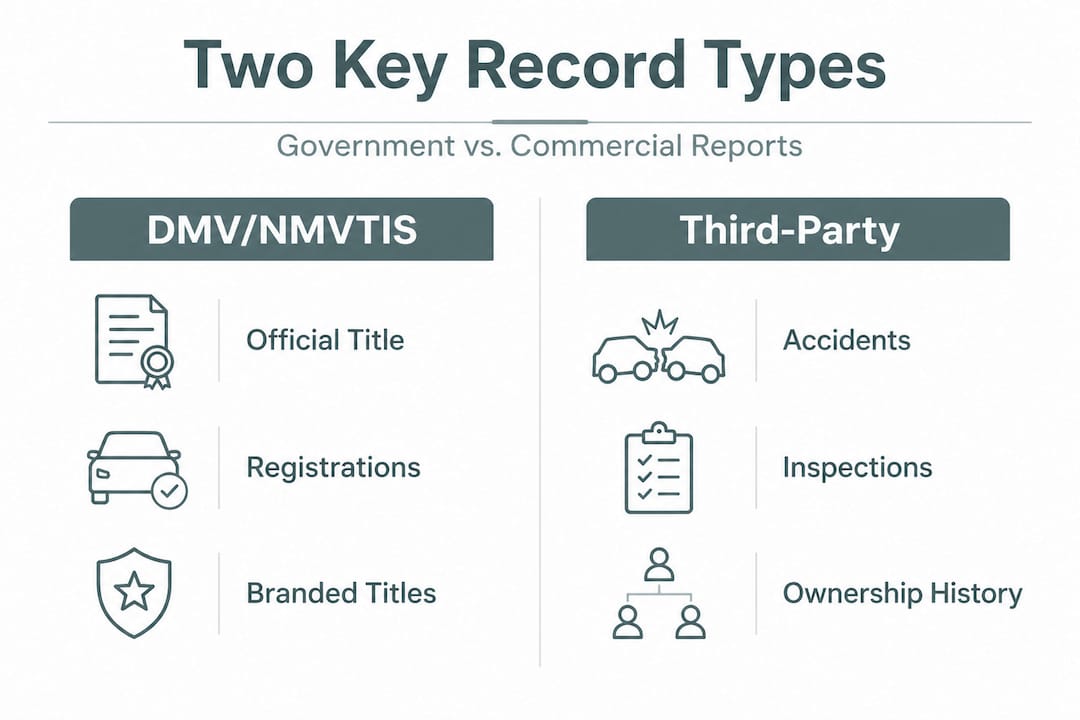
There are three main sources of vehicle history information available to you as a buyer:
1. State DMV records These are generated directly by government agencies and reflect legally recorded events. Every title transfer, lien, and registration renewal passes through the DMV. However, they are state-specific, so a car that moved from Texas to Ohio may have records split between two state systems.
2. NMVTIS (National Motor Vehicle Title Information System) NMVTIS is a federally mandated system used to consolidate state titling information across the country. It was created specifically to combat title fraud, particularly “title washing,” which is when a salvage vehicle gets re-registered in a state with looser title branding rules to make it appear clean. NMVTIS pulls data directly from state DMVs, which means it captures title brands that might not show up in commercial reports. You can learn more about how NMVTIS car history reports work and what they reveal.
3. Third-party commercial reports These are reports from companies that aggregate data from insurance claims, inspection stations, dealers, auction records, and more. They cast a wide net and often capture events that never touched a DMV database, like a minor fender bender paid out of pocket. But they also have gaps. Running a thorough vehicle history check from a reliable provider is a smart starting point.
Here’s a side-by-side comparison to help you see the differences clearly:
| Record source | Coverage | Cost | Best for |
|---|---|---|---|
| State DMV records | State-specific, legally binding | $5 to $25 per request | Title verification, lien checks |
| NMVTIS | National title data across all states | Free to low-cost via authorized providers | Title washing detection, salvage history |
| Commercial reports (e.g., Vektracer) | Wide data aggregation | $19.99 to $44.99 | Accident history, mileage, recalls |
| Free VIN checks | Limited, basic data only | Free | Quick initial screening only |
The takeaway is clear: no single source covers everything. A commercial report might show an accident that the DMV never recorded. NMVTIS might reveal a salvage brand that a commercial provider missed. Smart buyers use at least two of these sources before committing to a purchase.
When vehicle history and registration records don’t match: data gaps and red flags
Now that you know where vehicle records come from, it’s time to recognize warning signs and decode what a gap in a car’s history might really mean.

A gap in a vehicle’s history doesn’t automatically mean the car is hiding something sinister. But it does mean you should ask questions. According to research on how consumers interpret reports, missing history may reflect data gaps or reporting delays rather than a genuinely clean vehicle. The absence of evidence is not evidence of absence.
Common reasons for missing or conflicting data include:
- Private repairs: If a seller paid for body work out of pocket without filing an insurance claim, that repair never enters a database.
- State reporting delays: Some states are slower than others to submit data to national systems. A title transfer that happened three months ago might not appear yet.
- Cross-state title transfers: When a car moves between states, there’s often a lag before the new state records are fully linked to the old state’s history.
- Auction sales: Vehicles sold at wholesale auctions sometimes skip over reporting steps that retail sales would capture.
- Older vehicles: Cars more than 15 to 20 years old may have paper-based records that were never digitized.
It’s also worth noting that even reputable providers can miss events, especially repairs that were not reported to participating sources. This is not a flaw unique to one company. It’s a limitation of the entire data ecosystem.
Here’s a quick reference for evaluating record gaps:
| Gap type | Risk level | Recommended action |
|---|---|---|
| No accident history but visible body damage | High | Request independent inspection |
| Ownership gap of 1 or more years | Medium | Ask seller for explanation and service records |
| Mileage inconsistency | High | Run NMVTIS check and DMV record |
| Missing registration period | Medium | Check for out-of-state history |
| No service records at all | Low to medium | Request maintenance documentation |
Pro Tip: If a seller claims the car “has never been in an accident” but the report shows a gap right after a known high-mileage period, that’s worth investigating. Look for signs of repair like mismatched paint, uneven panel gaps, or replaced bolts near the frame.
What to do when you find a red flag:
- Note the specific gap or inconsistency you found.
- Ask the seller directly for service records, receipts, or any documentation they have.
- Cross-reference with resources on independent vehicle history reports to learn how to contextualize what you’re seeing.
- Request a DMV record for the vehicle in the state where it was last registered.
- If the car has visible damage or the seller’s story doesn’t hold up, learn how to detect accident history through physical inspection methods as well.
How to independently verify a car’s background: the step-by-step process
Once you know the risks of missing or mismatched records, here’s how you can take control and confidently uncover a car’s real history.
This process works whether you’re buying from a private seller, a small used car lot, or even a franchise dealer. The VIN (Vehicle Identification Number) is your starting point. Think of it as the car’s fingerprint: 17 characters that uniquely identify that specific vehicle and link all records back to it.
Here are the steps to follow:
-
Locate the VIN. Find it on the dashboard near the windshield on the driver’s side, inside the driver’s door jamb, or on the title and registration documents. Make sure all three locations show the same number.
-
Run a commercial VIN report. This gives you a broad picture quickly, including accident history, title status, mileage records, theft checks, and open safety recalls. Use a service that connects to NMVTIS data for maximum coverage. A step-by-step car history guide can walk you through the full process.
-
Check for open recalls. The NHTSA (National Highway Traffic Safety Administration) offers a free recall lookup by VIN on their website. An unresolved recall is not just a bargaining chip—it’s a safety concern.
-
Request a DMV record. Many states let you request a vehicle record online for a small fee. This tells you the official title history as your state government sees it. It’s especially useful if you want to verify lien status before handing over money.
-
Use NMVTIS data. Reports from NMVTIS-authorized providers will specifically flag title brands that crossed state lines. This is the strongest tool against title washing.
-
Run a check car VIN for accidents using a provider that sources from insurance and collision databases, not just DMV data.
-
Request service and maintenance records. Ask the seller for any receipts, inspection stickers, or dealer service records. A car with documented oil changes and routine maintenance tells a very different story than one with no paper trail.
-
Get an independent pre-purchase inspection. A trusted mechanic can physically check for signs of unreported structural damage, flood damage, or engine problems that no database will ever capture.
Pro Tip: Many credit unions and auto insurance companies offer free or discounted VIN check services for members. Before paying for a report, check with your bank or insurer first.
What most buyers miss about vehicle registration records
Here’s the honest truth that most articles in this space won’t tell you: no record is ever truly complete, and the smartest buyers know that.
Official records are better than nothing. NMVTIS is better than a single commercial report. A DMV record adds legal weight. But even stacking all three together still leaves room for events that were never captured anywhere. A car that sat flooded in a private garage for a month before being cleaned up and sold may never show up on any report if the owner never filed a claim and the state never issued a flood title. That’s a gap that no database can close.
What this means for you is that realistic expectations for vehicle records are part of the process. Records are evidence, not proof. They shift the burden of risk and give you leverage in a negotiation, but they don’t eliminate uncertainty entirely.
The buyers who get the best outcomes are the ones who use records as one layer of a broader assessment. They run their reports, but they also show up in person. They look at the car in daylight. They notice whether the seller is evasive about questions. They get a mechanic’s eyes on the undercarriage. They treat the history report as a starting point, not a verdict.
This mindset shift matters because overconfidence in a clean report is just as dangerous as ignoring the report altogether. The used car market rewards people who stay curious and skeptical, not people who check a box and move on.
Explore your vehicle history options with VekTracer
Armed with a real understanding of registration records and where data gaps hide, you’re in a much stronger position than most buyers walking into a used car deal.
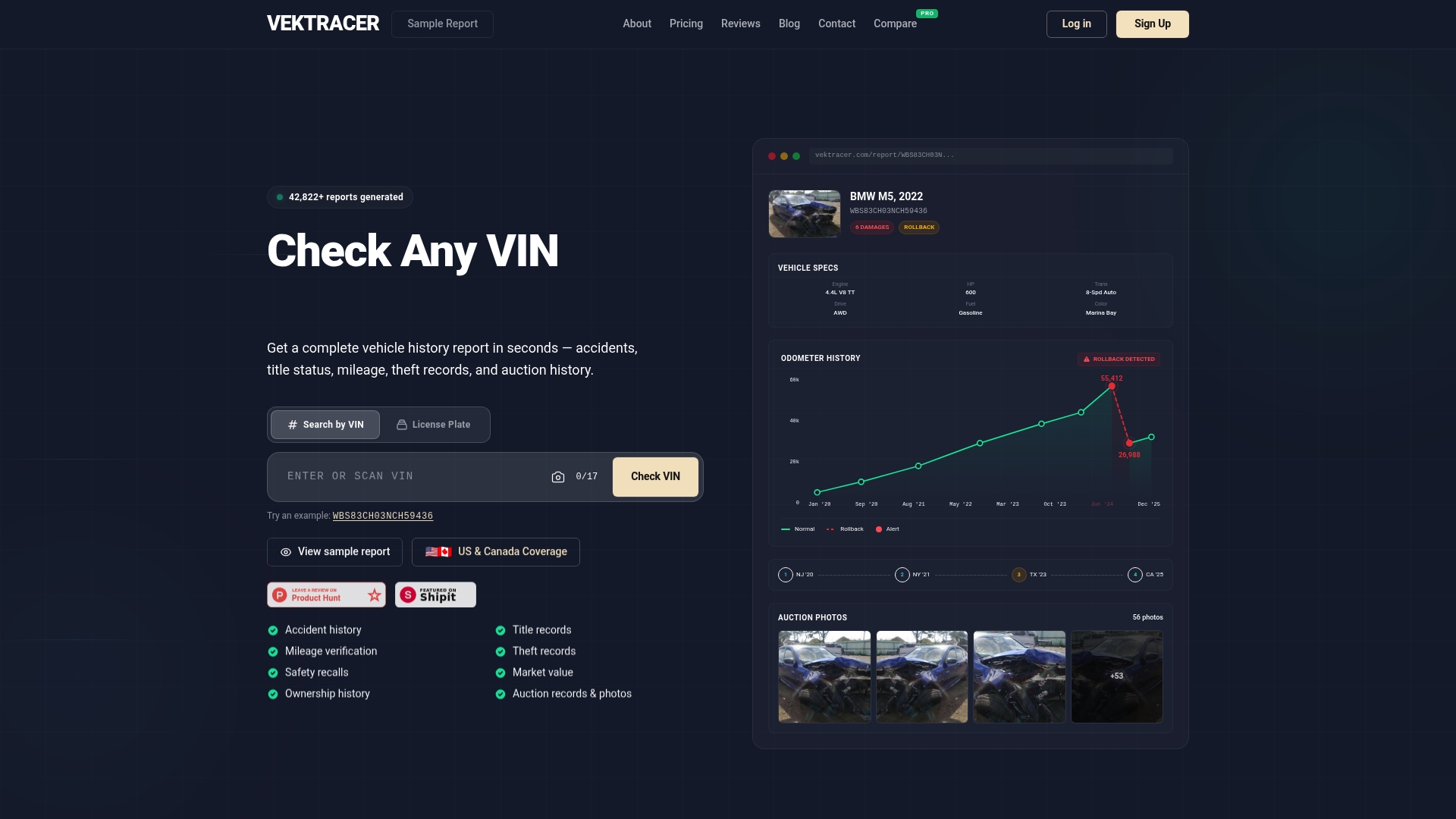
Taking action is simple. At VekTracer, you can see how VekTracer works before you commit to anything—no surprises, no guesswork. If you want to know exactly what a report looks like before you buy, check out a sample report to see the depth of data we pull together. And when you’re ready to run your own check, our pricing options start at just $19.99, well below the $44.99 you’d pay at Carfax for the same core data. We connect to NMVTIS sources, so your report reflects real title records, not just commercial aggregation. Getting started takes less than a minute.
Frequently asked questions
How do I request a vehicle registration record from the DMV?
Most DMVs let you request a vehicle record online or in person, usually for a small fee ranging from $5 to $25. Requirements, processing times, and available information vary by state.
What does NMVTIS show that a regular vehicle history report might miss?
NMVTIS consolidates state titling information from across the country and often reveals titles branded as junk, salvage, or flood that commercial aggregators can overlook, particularly when a vehicle has crossed state lines.
Why would a vehicle history report be missing information?
Reports can have gaps if events were not reported to participating databases, entered with delays, or occurred in states with slower reporting. Missing history is a signal to investigate further, not automatic confirmation of a clean vehicle.
Are DMV records always accurate and complete?
DMV records are the most legally authoritative source, but even reputable providers can miss events that were never reported through official channels, especially private repairs or undocumented sales. Cross-referencing multiple sources gives you the fullest picture.
What should I do if vehicle history records seem incomplete or raise red flags?
Use any gaps or inconsistencies as a prompt to dig deeper. Request service records from the seller, pull a DMV or NMVTIS record for that state, and consider a physical VIN plate inspection by a licensed mechanic before finalizing any purchase.
Recommended
Ready to check a vehicle?
Enter any 17-character VIN for a free instant preview — no account needed.