Why independent vehicle history reports protect used car buyers

Check a vehicle before you buy
Enter a VIN for a free instant preview — accidents, title brands, mileage, liens & open recalls.
TL;DR:
- Dealer vehicle history reports are often incomplete and should be independently verified.
- Independent reports from sources like NMVTIS and Carfax reveal broader, tamper-resistant vehicle data.
- Physical inspections and mechanic reviews are essential because reports can’t detect unreported damage or repairs.
Most used car buyers assume the vehicle history report a dealer hands them tells the whole story. It often doesn’t. Dealers often provide Carfax reports, but buyers should obtain their own independent report to verify authenticity and catch discrepancies. A dealer’s report might look thorough at first glance, but selective data, outdated records, and missing incidents can leave you with a car that hides expensive problems. This guide breaks down the limits of dealer-supplied reports, what independent reports actually reveal, and the best practices that protect your money and your safety.
Table of Contents
Checking a specific vehicle?
Run its VIN for a free preview of accidents, title brands, mileage and open recalls.
- The limits of dealer-provided vehicle history reports
- What independent vehicle history reports reveal
- What vehicle history reports can’t tell you
- Best practices: how to use vehicle history reports wisely
- The truth most buyers miss about vehicle history reports
- Get started with reliable, independent vehicle history
- Frequently asked questions
Key Takeaways
| Point | Details |
|---|---|
| Dealer reports aren’t enough | Dealers may provide incomplete vehicle history reports, so independent checks are necessary for safety. |
| Combine sources for clarity | Use NMVTIS with other reports and a mechanic’s inspection for full transparency. |
| Know what’s missing | History reports can miss unreported damage and owner maintenance, making on-site checks essential. |
| Affordable, reliable options | Independent reports give peace of mind without breaking your budget when buying used cars. |
The limits of dealer-provided vehicle history reports
To understand why independent verification matters, let’s first examine what’s missing from dealer-provided reports.
Dealers almost always want to close a sale. That’s not a criticism; it’s just the reality of how car sales work. When a dealer hands you a vehicle history report, that report may technically be accurate while still leaving out information that would make you think twice. Old data, missing incidents, and reports pulled from a single source can all create a false sense of security.
Here are the most common limitations buyers run into:
- Selective sourcing: Dealer reports often rely on one commercial provider and miss incidents recorded elsewhere.
- Outdated records: A report pulled weeks before you arrive at the lot may not include recent title changes or newly reported accidents.
- Omitted repairs: Private repairs and cash settlements after minor accidents rarely show up in any dealer-provided report.
- Dealer bias: A dealer motivated to sell may not volunteer that the report is incomplete or that you should verify it independently.
Cross-checking information is the only way to catch these gaps. If a dealer’s report says the car has a clean title but the vehicle shows signs of uneven panel gaps or fresh paint on one door, something may not add up. Learning why to seek an independent report before you negotiate is one of the most practical steps you can take.
“Dealers often provide Carfax reports, but buyers should obtain their own independent report to verify authenticity and catch discrepancies.” — Consumer Reports
This is especially important when verifying service history, since maintenance records are frequently absent from dealer-supplied reports entirely. A car that looks well-maintained on paper may have skipped every oil change in its life.
What independent vehicle history reports reveal
If dealer reports have limits, what can independent history reports actually deliver?
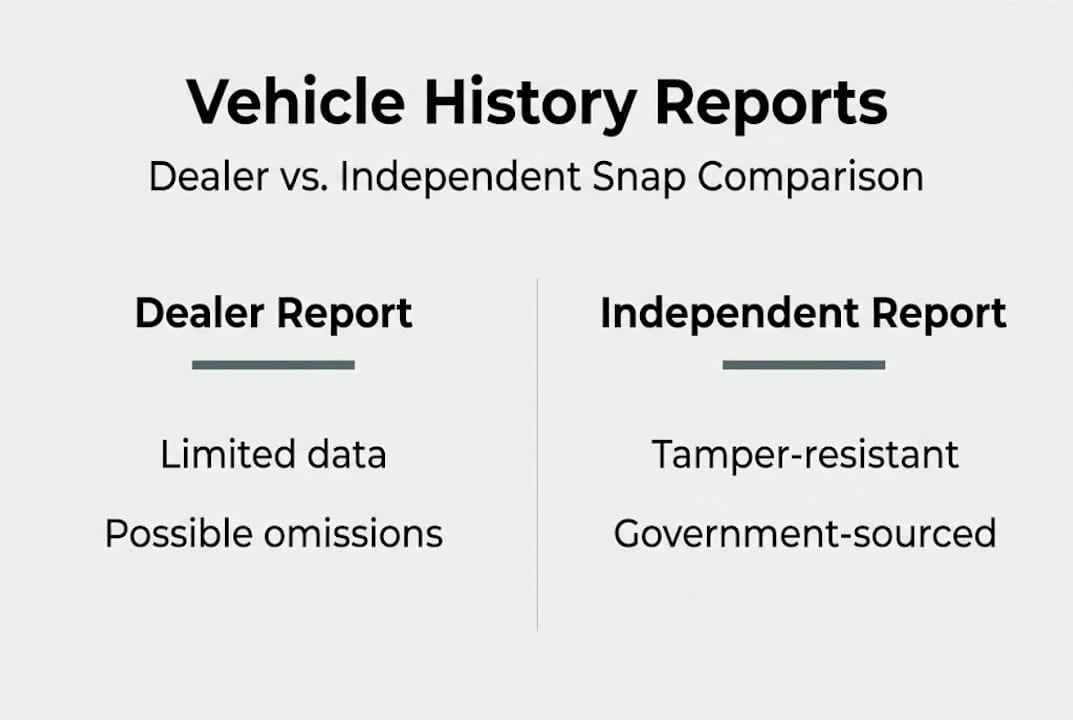
An independent vehicle history report comes from a source separate from the dealer. These include government-connected databases like the National Motor Vehicle Title Information System (NMVTIS), as well as commercial providers like Carfax and AutoCheck. NMVTIS is a federally mandated database that collects title and branding data from all 50 states, making it particularly hard to manipulate.
NMVTIS reports explained in detail, but the key point is that government-sourced data is tamper-resistant in ways that commercial reports simply cannot match. Independent NMVTIS reports empower buyers with low-cost, tamper-resistant title verification, avoiding dealer bias.
Dealer-provided vs. independent reports: a quick comparison
| Feature | Dealer-provided report | Independent report |
|---|---|---|
| Source | Single commercial provider | Multiple sources, including NMVTIS |
| Cost to buyer | Usually free (built into sale price) | $5 to $44.99 depending on provider |
| Title data | May miss out-of-state records | Pulls from all 50 states |
| Accident history | Reported incidents only | Broader incident sourcing |
| Odometer records | Limited | Cross-referenced across databases |
| Bias risk | Dealer-selected | None |
How to obtain an independent report:
- Locate the 17-character VIN on the dashboard or driver’s side door jamb.
- Visit an NMVTIS-connected provider or a trusted commercial service.
- Enter the VIN and pay for the report (costs start well under $25 at many providers).
- Review title status, odometer readings, and accident flags carefully.
- Compare what you find against the dealer’s report for any discrepancies.
Pro Tip: Start with an NMVTIS report for title and branding data, then layer a commercial report like Carfax on top if the NMVTIS check comes back clean. This two-step approach catches more problems for less money. Don’t overlook odometer fraud risks either; rolled-back odometers are more common than most buyers expect.
What vehicle history reports can’t tell you
Even the best reports can’t show you everything; let’s cover what they actually miss.
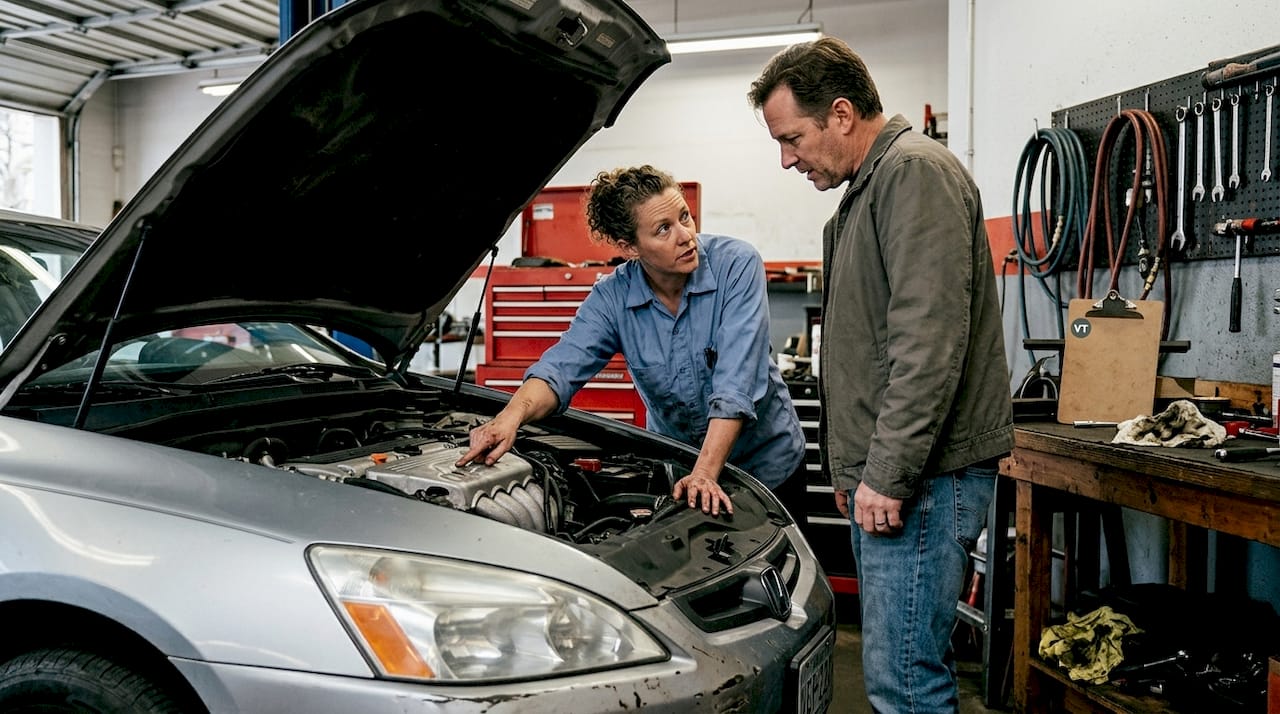
No report, no matter how thorough, has access to every event in a car’s life. Private sales, cash-settled fender benders, and repairs made without an insurance claim are invisible to every database. About 15 to 20% of minor incidents go unreported, meaning even a spotless vehicle history could be hiding real damage.
Common omissions in vehicle history reports
| What reports miss | Why it matters |
|---|---|
| Unreported accidents | Hidden structural damage can affect safety |
| Private maintenance records | No way to verify oil changes or fluid services |
| Minor cash-settled repairs | Cosmetic or mechanical fixes off the books |
| Recent title changes | Updates may lag 30 to 60 days behind |
| Pre-purchase damage | Damage that occurred after the last report pull |
Because of these gaps, there are things you should always check in person before signing anything:
- Inspect the vehicle’s body panels for uneven gaps or mismatched paint.
- Look under the hood for signs of fluid leaks or replacement parts that look newer than expected.
- Check the tires for uneven wear, which can signal alignment or suspension problems.
- Test all electronics, including windows, air conditioning, and dashboard warning lights.
- Ask to see physical maintenance receipts if the seller claims the car was well-maintained.
Pro Tip: Always pair your history report with a pre-purchase inspection (PPI) from a certified mechanic. A PPI typically costs $100 to $200 and can uncover thousands of dollars in hidden problems. No report replaces eyes under the hood.
Using a solid car history search process alongside a physical inspection is the only way to get close to a complete picture. A pre-purchase checklist can also help you stay organized during that in-person evaluation.
Best practices: how to use vehicle history reports wisely
Knowing what to look out for, let’s wrap up with practical advice for making the smartest purchase.
The best-protected buyers treat vehicle history reports as one layer of a larger due-diligence process. They don’t skip the NMVTIS check, they don’t rely solely on the dealer’s report, and they don’t skip the mechanic. Best practice is to run NMVTIS first, then Carfax or AutoCheck if it’s clean, and finish with a pre-purchase inspection.
Here’s the step-by-step sequence to follow:
- Get the VIN before you visit the lot. Ask for it in writing via email or text.
- Run an NMVTIS report first to check title status, branding (salvage, flood, lemon law), and odometer data.
- Follow up with a commercial report if the NMVTIS check is clean and you want expanded accident history.
- Compare both reports against each other and against what the dealer tells you.
- Schedule a pre-purchase inspection with a mechanic you trust, not one the dealer recommends.
- Verify the VIN physically on the dashboard, door jamb, and engine block to confirm they all match.
Signs that a vehicle history is genuinely trustworthy include:
- Consistent ownership history with no sudden gaps
- Odometer readings that progress logically across all entries
- Regular service records at the same dealership or shop
- A title that is clean with no salvage, flood, or rebuilt branding
- No pattern of short-term ownership (a red flag for problem cars being flipped)
Also review the physical title document, not just the report. Using a solid step-by-step car history guide helps you stay on track, and understanding why VIN lookup matters ensures you’re working with the right vehicle from the start.
The truth most buyers miss about vehicle history reports
After covering best practices, here’s an honest perspective few guides will tell you.
A clean vehicle history report feels like a green light. But here’s the uncomfortable truth: it’s closer to a yellow light. The report tells you what was recorded. It says nothing about what wasn’t.
We’ve seen scenarios where a buyer runs two reports, both come back spotless, and a mechanic still finds evidence of a repaired frame rail that no database ever captured. The repair was done privately, paid in cash, and never filed with insurance. The car looked fine on paper. It wasn’t.
The buyers who walk away satisfied are the ones who treat every report as a starting point, not a finish line. They dig into vehicle accident history insights, they ask hard questions, and they never skip the physical inspection. A report gives you leverage and context. A mechanic gives you certainty. Use both, every time.
Get started with reliable, independent vehicle history
Now that you know what to look for and how to protect yourself, here’s your next step.
At Vektracer, we make independent vehicle history reports accessible and affordable for every used car buyer. Our NMVTIS-connected reports start at just $19.99, covering accident history, title records, mileage verification, theft checks, safety recalls, and market value data.
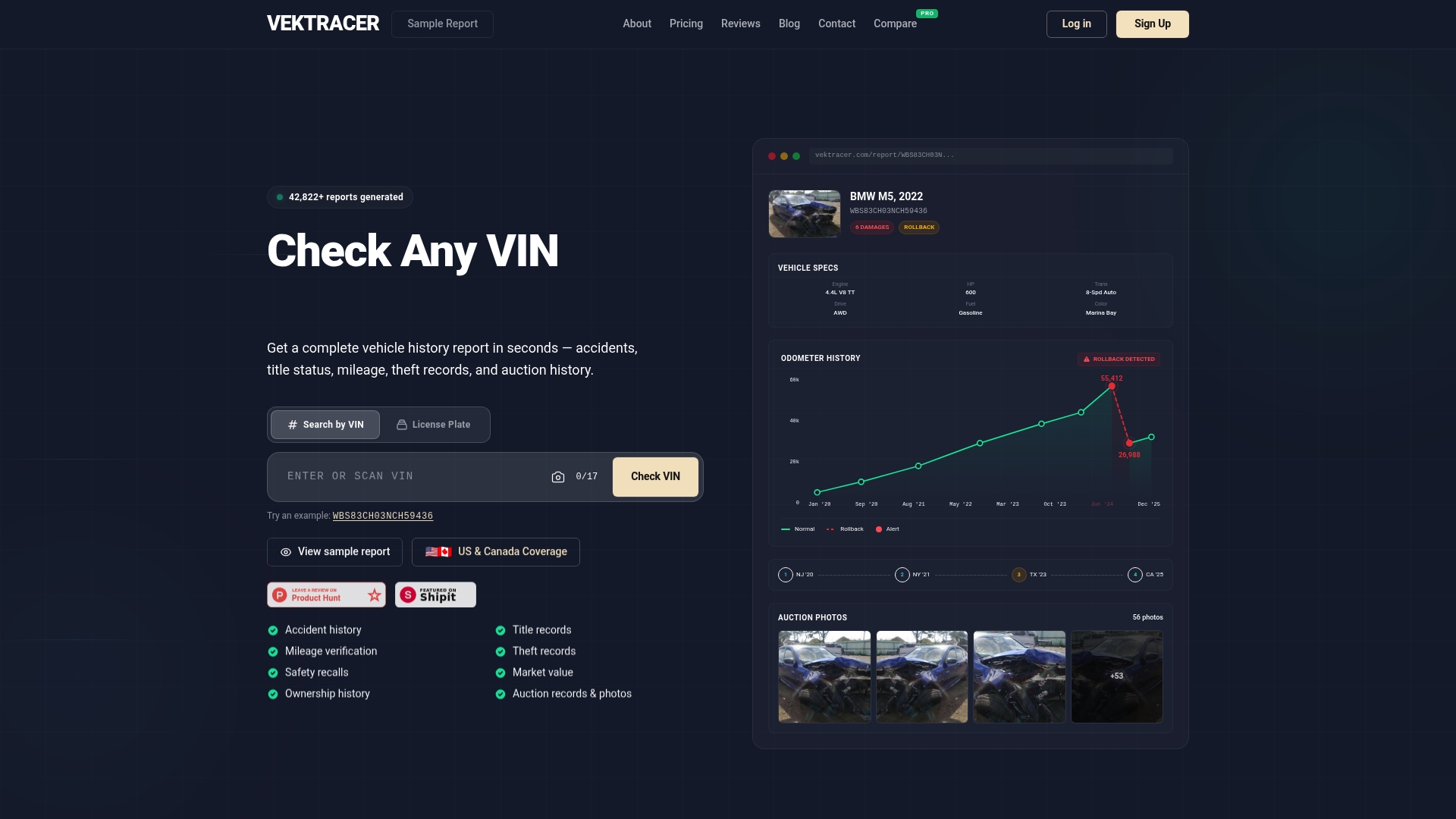
That’s a fraction of what Carfax charges ($44.99) for the same core data. You can see how Vektracer works, check out our transparent pricing, or view a sample report before you commit. Getting the full picture before you buy shouldn’t cost a fortune, and with Vektracer, it doesn’t have to.
Frequently asked questions
What is an independent vehicle history report?
An independent vehicle history report is a third-party summary of a car’s past, separate from anything the dealer provides, pulling title, odometer, and accident data from sources like NMVTIS that are tamper-resistant and unbiased.
Are dealer-provided vehicle history reports reliable?
Dealer reports can be incomplete or selectively sourced; Consumer Reports recommends verifying with your own independent report to catch discrepancies a dealer-supplied version might miss.
What does a vehicle history report typically miss?
Reports commonly miss unreported accidents, private maintenance records, and minor repairs paid out of pocket, with roughly 15 to 20% of minor incidents never making it into any database.
Which independent report should I get first?
Start with an NMVTIS report for unbiased, government-sourced title data, then consider a commercial report like Carfax or AutoCheck if the initial check is clean, per best practice.
Is one report enough to be sure a car is safe?
No single report is complete; all reports miss some incidents, so pairing multiple reports with a certified mechanic’s inspection is the only reliable way to reduce your risk.
Recommended
Ready to check a vehicle?
Enter any 17-character VIN for a free instant preview — no account needed.