What Does Branded Title Mean? A 2026 Car Buying Guide
Check a vehicle before you buy
Enter a VIN for a free instant preview — accidents, title brands, mileage, liens & open recalls.
A branded title means the car carries a permanent official mark on its title showing it went through a serious event, such as being declared a total loss, suffering flood damage, being bought back under lemon law, or having an odometer problem. That mark usually stays with the vehicle even after repairs, resale, or a move to another state.
You usually run into this question when a car looks suspiciously cheap and the listing says something like “rebuilt title” or “salvage title.” That lower price can be tempting, especially if the photos look clean and the seller says the repairs were done right. But the title is there to preserve the car's history, not to reassure you that everything is fine now.
That's the part many first-time buyers miss. A branded title doesn't just describe past damage. It changes how future buyers, insurers, and lenders view the vehicle. It can affect safety, reliability, financing, insurance eligibility, and what the car will be worth later.
If you're still getting familiar with dealership language, a plain-English glossary like Willowood Ventures car sales terminology can help decode the terms sellers use around title status, disclosures, and vehicle condition.
Your Guide to Understanding Branded Vehicle Titles
A branded vehicle title is an official state-issued label that tells you the car had a major problem in its past. That problem might be severe accident damage, flood exposure, a manufacturer buyback, odometer fraud, or another event serious enough that the state decided future buyers should be warned. As explained in this branded title overview from Wolf Pixel, the label can permanently affect a vehicle's safety, reliability, and value, and it generally stays attached to the vehicle even after repairs or resale.
That permanence is what makes branded titles different from a repair receipt or a seller's verbal explanation. A seller can say, “It was fixed.” The title says, “This car crossed a legal threshold in its history.”
Why buyers get confused
Most confusion comes from the word branded itself. It sounds broad because it is broad. “Branded title” is the umbrella term. Under it, you'll see specific brands like salvage, rebuilt, flood, lemon, and odometer-related labels.
Another common misunderstanding is assuming every branded title means the same level of risk. It doesn't. A lemon-law buyback raises a different set of concerns than a flood vehicle. A rebuilt car may be road legal after inspection, while a salvage vehicle may not be.
Practical rule: Treat the title brand as the start of your investigation, not the end of it.
What the title is really telling you
At a basic level, the state is saying this vehicle no longer belongs in the same category as a clean-title car. That doesn't automatically mean it's undrivable or worthless. It means the vehicle has a history serious enough that future owners need a durable warning.
That's why the right question isn't just “what does branded title mean?” The better question is, “What happened to this car, how was it repaired, and what problems could still follow me after I buy it?”
Common Branded Title Types and What They Signal
Different title brands tell different stories. If you lump them all together, you'll either overreact and walk away from every branded car, or underreact and miss a major risk.
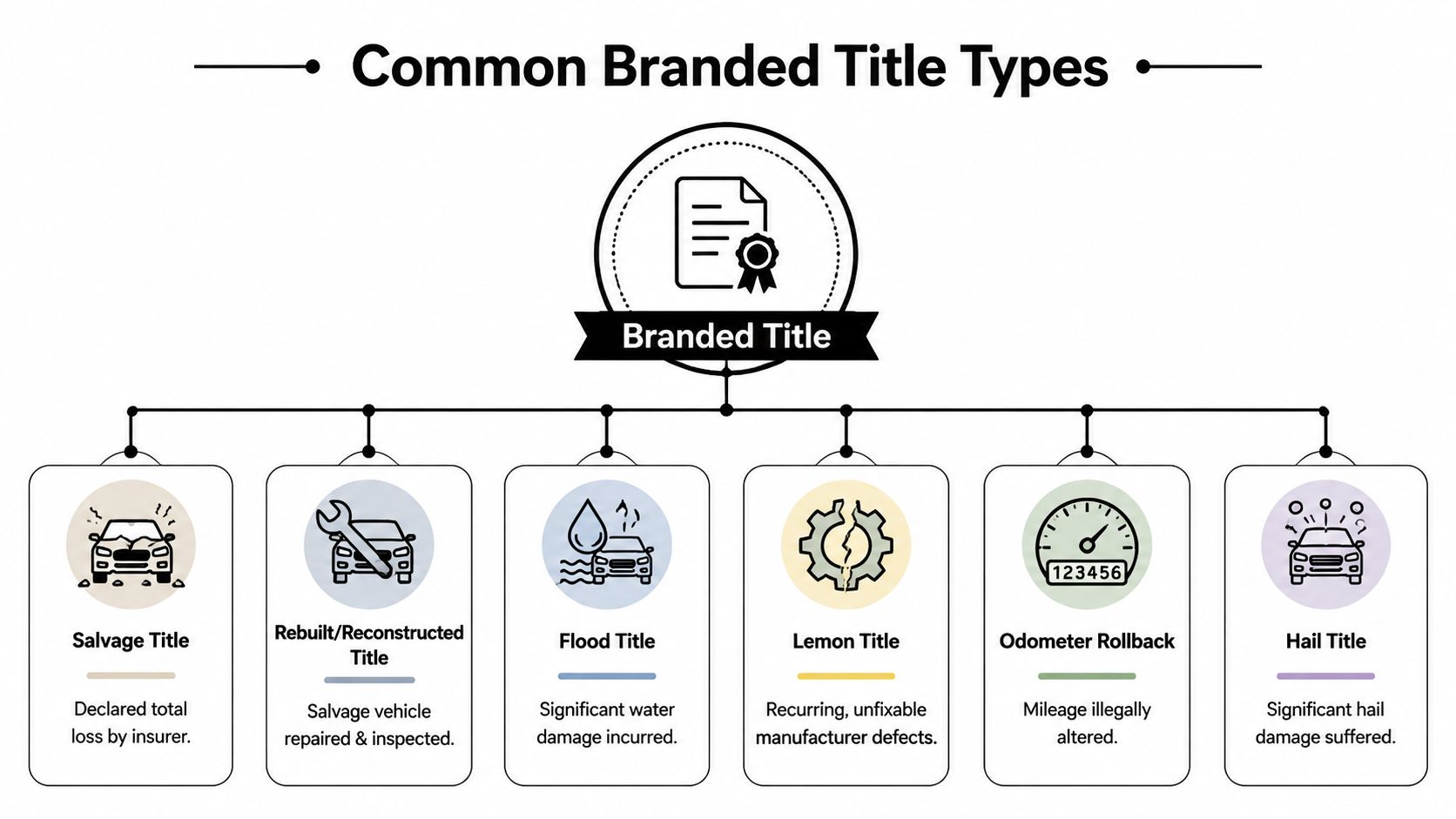
Carfax, as summarized in this CarPro explanation of branded vehicle titles, notes that titles may be branded for total loss or salvage history, rebuilt-from-salvage status, flood damage, fraudulent odometer readings, or lemon-law findings. That same source says branded-title vehicles often lose 20% to 40% of their Blue Book value.
Common Branded Title Types at a Glance
| Brand Type | What It Means | Primary Buyer Concern |
|---|---|---|
| Salvage | The vehicle was declared a total loss after major damage or another serious event | Structural integrity and whether repairs are even feasible |
| Rebuilt or Reconstructed | A salvage vehicle was repaired and passed the required state process to return to the road | Hidden damage that inspection may not fully reveal |
| Flood | The car suffered significant water exposure | Corrosion, electrical problems, and long-tail reliability issues |
| Lemon | The manufacturer bought the vehicle back after recurring defects | Repeat issues that may continue despite repair attempts |
| Odometer Rollback | The mileage history was altered or found unreliable | Unknown wear, maintenance uncertainty, and fraud risk |
| Hail | The vehicle suffered serious hail damage in a state that uses this brand | Whether damage is cosmetic only or tied to broader repair shortcuts |
Salvage and rebuilt are not the same thing
This is one of the biggest points of confusion.
A salvage title usually means the vehicle was declared a total loss after a serious event. That's a legal and insurance threshold, not just a description of visible dents or broken glass. A salvage car is the one that crossed the line.
A rebuilt title means that same vehicle was later repaired and passed the state's required process to be put back on the road. That sounds reassuring, and it matters, but it doesn't mean the car is equivalent to a clean-title vehicle.
If you want a deeper breakdown of that specific label, this guide to what a salvage title means is a useful follow-up.
Flood titles carry a different kind of risk
Flood damage worries experienced buyers for a reason. Crash damage is often visible. Water damage can spread through wiring, sensors, modules, connectors, carpeting, insulation, and metal surfaces.
The hard part is timing. A flood car may look and drive fine during a short test drive. Trouble can show up later as corrosion, intermittent electronics issues, warning lights, or failures that are difficult to trace.
Flood damage can turn a car into a troubleshooting project long after the body looks normal.
Lemon titles are about repeated defects
A lemon title or buyback brand typically points to a vehicle the manufacturer repurchased under lemon-law rules because a recurring defect couldn't be fixed properly. That defect might involve drivability, safety systems, or another persistent problem.
This brand doesn't necessarily mean crash damage. It means the car had a pattern of serious defects significant enough to trigger a legal buyback process. For some buyers, that's less alarming than collision damage. For others, it's worse, because repeat defects can be frustrating and expensive to live with.
Odometer brands signal trust problems
An odometer-related brand is more than a paperwork issue. Mileage affects price, maintenance planning, and your understanding of how much wear the engine, transmission, suspension, and interior have seen.
If the recorded mileage can't be trusted, the rest of the seller's story becomes harder to trust too. That's why odometer brands often make cautious buyers walk away, even when the vehicle otherwise looks good.
The Journey from Clean to Branded Title
A title doesn't become branded because someone felt the car looked rough. It becomes branded through a chain of events involving damage, insurance decisions, state records, and the vehicle's VIN.
Peddle's explanation of branded titles puts it clearly: a branded title is a permanent government record tied to the VIN, and the brand follows the vehicle through title transfers because it changes the vehicle's risk profile for future buyers, insurers, and lenders.
A simple real-world scenario
Say a driver gets hit hard in an intersection. The front corner is crushed, airbags deploy, and several safety systems are affected. The owner files an insurance claim.
An adjuster reviews the damage and determines the vehicle has crossed the threshold where it's treated as a total loss. At that point, the car's legal and insurance history changes. It's no longer just “a repaired used car.” It's a vehicle that has passed into branded-title territory.
What happens after the loss decision
Once that threshold event occurs, the title record is updated through the state process. The VIN becomes the anchor. That's important because the VIN is what allows the history to follow the vehicle, even when ownership changes.
Some of these vehicles are sold at auction, often to rebuilders, dealers, dismantlers, or exporters. Buyers in that market use auction history and prior condition details to understand what happened before repairs. If you want to see how auction background can fit into your research, this Copart sales history guide shows why sale records can matter.
How a salvage vehicle becomes rebuilt
If someone repairs the vehicle and meets the state's requirements, the car may be inspected and reclassified under a rebuilt or reconstructed brand. That inspection matters, but buyers should understand what it does and doesn't do.
It confirms the vehicle met the state's process for returning to the road. It does not rewrite history. It does not erase the original event. And it does not guarantee every hidden issue was found or corrected to the same standard a careful retail buyer might expect.
A rebuilt title tells you the car re-entered legal road use. It does not tell you the repair quality was equal to a clean-title car's original condition.
That's why title status should always be read together with repair documentation, independent inspection findings, and full vehicle history.
The Real-World Costs of Owning a Branded Title Car
The low asking price is what draws people in. The ownership costs are what usually change their mind.
According to Chase's guide to branded titles, the effects go beyond resale value. Branded titles also affect insurance and financing. Chase also notes that while a rebuilt brand requires a state inspection to confirm safety standards, some insurers and lenders may still refuse coverage or financing.
The discount is only one piece of the math
Buyers often focus on purchase price because it's concrete and immediate. But branded-title ownership comes with friction that clean-title buyers usually don't deal with to the same degree.
That friction shows up when you ask for full coverage, apply for a loan, trade the car in, or try to explain the title status to your next buyer. Even if the car runs well, the title keeps raising questions.
Four costs buyers underestimate
- Resale pain: Even if you buy the car cheaply, the branded title usually follows you when it's time to sell. Future buyers will ask the same questions you're asking now, and many will leave as soon as they hear “rebuilt” or “flood.”
- Insurance complications: Some insurers may limit coverage, exclude certain protections, or refuse the vehicle entirely. That can force you to shop harder and accept terms you wouldn't accept on a clean-title car.
- Financing obstacles: Some lenders won't finance branded-title cars at all. Others may look at them case by case, which slows the process and narrows your options.
- Repair uncertainty: A car can be repaired enough to look presentable and still carry unresolved structural, electrical, or corrosion issues that show up later.
Rebuilt does not mean risk-free
A rebuilt vehicle has at least cleared the state's process to return to the road. That matters. But a state inspection and a wise buying decision are not the same thing.
A state process may confirm the car meets roadworthy requirements. You still need to ask whether the repairs were thorough, whether proper parts were used, whether the alignment and restraint systems were restored correctly, and whether the car will be dependable six months from now.
That difference matters most for people buying a family car, a commuter they depend on every day, or a first vehicle for a teenager. In those cases, “cheap enough” is not a strong buying standard.
Mistakes that cost buyers later
- Assuming insurance will be simple: Buyers sometimes agree to the deal before confirming whether their insurer will write the policy they want.
- Trusting appearance over documentation: Fresh paint, polished headlights, and a clean interior don't tell you much about prior frame repair or hidden corrosion.
- Planning to resell easily: Many buyers think they'll drive it for a year or two and move on. Then they discover their buyer pool is much smaller.
- Treating all brands the same: A lemon buyback, rebuilt collision car, and flood vehicle can all carry branded titles, but the ownership risks are different.
If the deal only works because you're ignoring insurance, financing, and resale, it doesn't really work.
The strongest reason to hesitate isn't fear. It's uncertainty. Branded-title cars often require more verification, more tolerance for future hassle, and more comfort with risk than most first-time buyers have.
Your Step-by-Step Guide to Verifying a Vehicle's History
You find a car priced well below similar listings. The seller says the title issue was minor, the repairs are done, and the car drives great. That is the moment to slow down and verify every part of the story, because a branded-title purchase can look acceptable on the test drive and still create problems months later with insurance, financing, or resale.
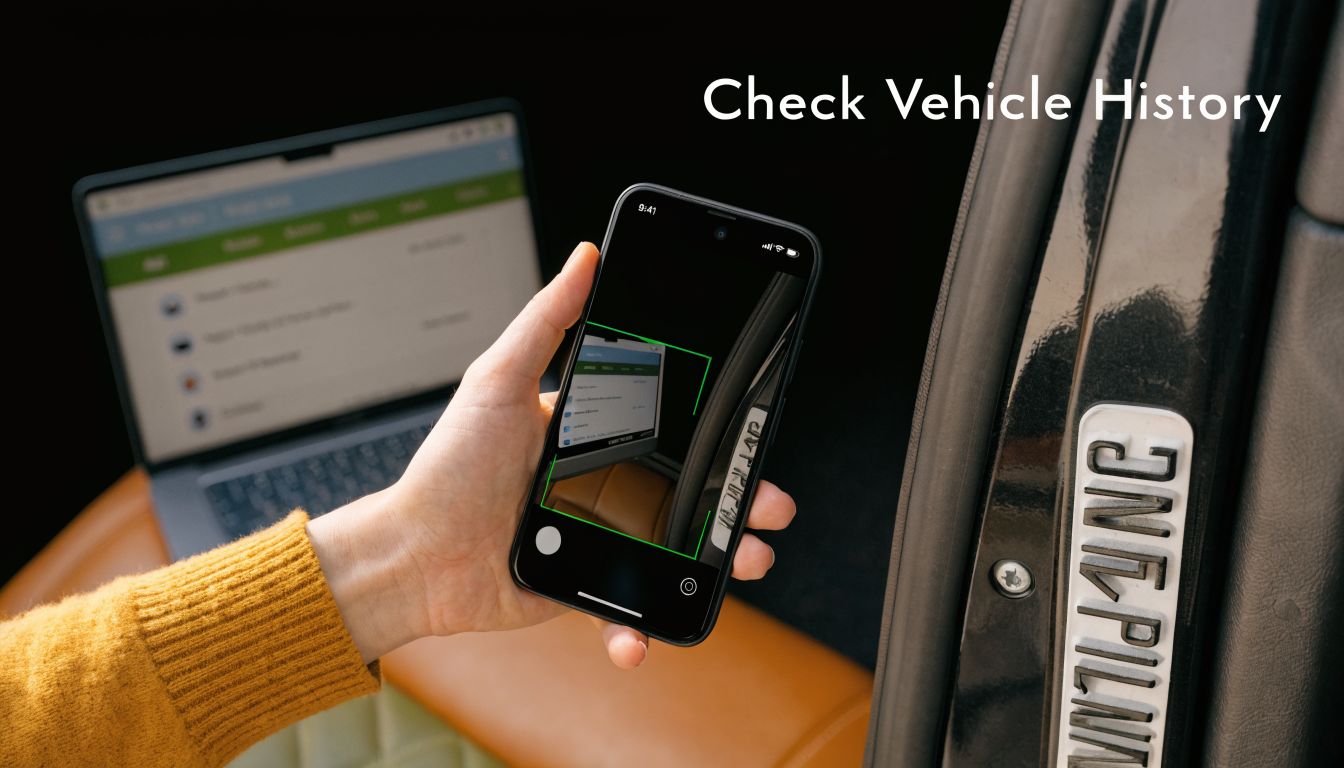
A vehicle's history works like a paper trail. If key pages are missing, you should assume you do not have the full story yet. That matters even more with title washing, where a vehicle can move between states, or between the U.S. and Canada, and pick up cleaner-looking paperwork than its past deserves.
Start with the title in front of you
Ask to see the actual title document. A listing description, text message, or verbal explanation is not enough. You want to confirm the exact brand shown on the title and whether it matches how the seller describes the car.
Pay attention to hesitation. If the seller will not show the title, says the paperwork is still coming, or asks for money before you review documents, treat that as a serious warning sign.
Follow a clear verification process
Ask direct, specific questions
Ask what brand the title carries, what happened to cause that brand, when the event occurred, and who repaired the vehicle. Specific questions make vague answers easier to spot.Match the VIN everywhere
Compare the VIN on the dashboard, driver-side door sticker, title, service records, and any inspection paperwork. One mismatch is enough to stop the deal until it is explained.Order a vehicle history report
You are looking for title events, mileage records, theft history, auction activity, lien data, and gaps between jurisdictions. If you want a framework for reviewing those details, this step-by-step guide to checking car history shows what to examine.Review repair records carefully
Receipts, parts invoices, alignment reports, inspection forms, and before-and-after photos help you test whether the seller's story holds together. A rebuilt title with no repair paperwork leaves too much to guesswork.Get an independent pre-purchase inspection
Use a mechanic or body specialist you choose. Ask them to focus on the type of damage the car reportedly had, such as flood exposure, structural repair, airbag replacement, or suspension work.
What a history report can and cannot do
A good vehicle history report helps you gather records from multiple sources into one place. It can reveal title brands, mileage inconsistencies, theft records, recall information, and other clues that are easy to miss if you only check a local DMV record.
VekTracer is one vehicle history report platform that provides VIN reports with title, mileage, theft, recall, lien, and Risk Score data. That can help you spot issues worth investigating before you spend money on an inspection or commit to a purchase.
Still, a report is a starting point, not a verdict. Missing records, delayed reporting, and cross-border transfers can leave blind spots.
Why title washing deserves extra attention
Title washing is one of the easiest ways for a risky vehicle to look safer than it is. A cleaned-up title in one state does not erase the event that caused the brand in another state or province.
This is why cautious buyers should look beyond one local record source, especially in border markets, dealer trades, auction inventory, and private-party sales involving vehicles that may have crossed between Canada and the United States. If a seller says the title is clean now, ask a better question: was it ever branded somewhere else?
A history report cannot make a branded-title car safe. It can help you confirm whether the paperwork, the seller's story, and the vehicle itself all point in the same direction.
A Decision Checklist for Buying a Branded Title Car
Some branded-title cars are bought by experienced owners who know exactly what they're getting into. Most cautious retail buyers should use a stricter standard.
If you're trying to decide whether to move forward, use this checklist. If you answer “no” to several of these, the low price probably isn't enough to justify the deal.
Buy only if you can check every box
- I know the exact title brand: I'm not relying on vague phrases like “rebuilt status” or “minor title issue.”
- I understand the event behind it: I know whether the car was a total loss, flood vehicle, lemon buyback, or had an odometer problem.
- I reviewed a full vehicle history report: I'm not basing the decision only on the seller's explanation or a local paperwork check.
- I saw supporting documents: I reviewed repair receipts, inspection paperwork, and any photos available from before the repairs.
- I got an independent pre-purchase inspection: A mechanic I trust examined the car, including areas tied to the original event.
- I confirmed insurance before purchase: I know what coverage I can get and whether any restrictions apply.
- I checked financing in advance: If I'm borrowing, I already know the lender is willing to finance this title status.
- I'm comfortable with lower resale appeal: I understand that many future buyers will hesitate or walk away.
- I'm not buying under pressure: I'm not rushing because the seller says there are “three other buyers coming tonight.”
Who should be especially careful
A branded-title car is usually a tougher fit for:
- First-time buyers: There's too much room to miss red flags.
- Parents buying for a teen driver: Safety uncertainty and repair quality matter more here than bargain pricing.
- Buyers needing easy financing: Approval can be harder, slower, or unavailable.
- People who plan to resell soon: The title issue will come back when you list the car.
When a branded-title purchase may still make sense
There are cases where a buyer knowingly accepts the tradeoffs. Maybe you have a trusted body specialist. Maybe the vehicle will stay in the family for a long time. Maybe the documentation is unusually complete and the independent inspection is strong.
That still doesn't make it a routine used-car purchase. It makes it a specialized decision that requires more proof than a clean-title car would.
Your Branded Title Questions Answered
Can a branded title ever be changed back to a clean title
In practical terms, no. A title brand is meant to preserve major history, not erase it after repairs. If someone suggests they can “clear” or “remove” the brand entirely, treat that as a major warning sign.
Are title branding rules the same in every state
No. State rules vary, and that variation is part of what makes title washing possible. A vehicle's history may not appear the same way across jurisdictions, which is why broad VIN-based history checks matter so much.
Is a rebuilt title car guaranteed to be safe if it passed inspection
No. A rebuilt title means the vehicle passed the state process required to return to the road. It does not guarantee that every hidden issue was discovered or that the repairs restored the vehicle to clean-title standards.
A passing inspection tells you the car met a threshold. It doesn't promise perfection.
Will banks finance a rebuilt title car
Some may refuse outright, while others may review it case by case. The key point is that financing is often harder with branded-title vehicles than with clean-title vehicles, so buyers should confirm loan options before negotiating the purchase.
Is a branded title always a deal-breaker
Not always. But it should always slow you down. If the seller can't produce a consistent story, complete records, and a vehicle that stands up to an independent inspection, walking away is usually the smart decision.
Is title washing only a dealer problem
No. Private sellers can do it too, and many buyers lower their guard in private-party deals because the conversation feels more casual. The risk is the same. The title history still needs verification.
What matters more, the low price or the title history
The title history matters more. A cheap price only helps if the car remains insurable, usable, and reasonably dependable for your needs. If the title status creates ongoing cost, uncertainty, or limited resale options, the discount may not be a real savings.
If you're evaluating a used car and want a clearer picture before you commit, a report from VekTracer can help you review VIN-based history in one place and compare what the seller says against documented records.
Ready to check a vehicle?
Enter any 17-character VIN for a free instant preview — no account needed.