Vin Check Up Free
Check a vehicle before you buy
Enter a VIN for a free instant preview — accidents, title brands, mileage, liens & open recalls.
You've found a used car that looks right, the price fits, and the seller says it has a clean history. Before you send a deposit, a VIN check up free search is a sensible first move. It can identify open safety recalls, some theft or salvage records, and basic VIN inconsistencies at no cost. It can't prove the vehicle has never been wrecked, flooded, title-washed, poorly maintained, or fitted with a rolled-back odometer, so treat the result as screening, not a final buying decision.
Table of Contents
- The Reality of Running a Quick Free VIN Lookup
- What Official Free Databases Show You
- The Hidden Gaps in Free Vehicle History Lookups
- Comparing Official Government Tools and Commercial Reports
- When to Upgrade to a Paid Vehicle History Report
- How to Read a VIN and Spot Red Flags Early
- Next Steps for Your Used Car Purchase
The Reality of Running a Quick Free VIN Lookup
A free lookup works best in the first few minutes of evaluating a listing. You enter the VIN from the advertisement, compare the decoded vehicle details with the seller's description, and look for an immediate reason to walk away. If the result shows an open recall or an active theft signal, you can stop before arranging an inspection or negotiating a price.
That quick filter has real value. NHTSA's recall system lets consumers search by VIN or license plate, and its recalls page says the tool can search up to 100 VINs at once. Its SaferCar app can also alert users when a recall is found for an entered VIN. NHTSA reported 997 vehicle safety recalls affecting more than 29 million vehicles in the United States in 2025, which makes a free recall search a practical first step before buying a used car (NHTSA recall data).
What the first screen can accomplish
Use the free check to answer narrow questions:
- Does the VIN identify the same make, model year, and vehicle type shown in the listing?
- Does NHTSA show an unrepaired safety recall?
- Does a theft or salvage screening service return a reported problem?
- Does the VIN appear inconsistent across the vehicle, title, registration, or insurance paperwork?
A clean answer means the car has passed a basic digital filter. It doesn't mean the seller's statement about “clean history” is complete. Free tools usually examine specific data silos, while accidents, repairs, liens, ownership transfers, and mileage events may sit in separate state, insurer, auction, or service records.
Practical rule: Use a free VIN check to decide whether a vehicle deserves more attention. Don't use it to decide whether the vehicle deserves your money.
If the basic screen looks acceptable, move to the physical inspection, title review, test drive, and a deeper history search where the vehicle's risk justifies it. A private-party car with missing records deserves more scrutiny than a well-documented vehicle from a seller who provides the VIN, title, maintenance invoices, and time for an inspection.
What Official Free Databases Show You
The value of a free VIN check depends on the source behind it. Some sites only decode the VIN and display general specifications. Official services connect the search to a defined purpose, such as safety recalls, theft records, salvage records, or title information. Their scope is narrower than a commercial report, which makes each result easier to interpret, provided you understand what it does not cover.
NHTSA for recalls and vehicle identity
NHTSA's recall lookup accepts searches by VIN, license plate, year-make-model, and equipment type. You can usually find the VIN at the base of the windshield, on the driver-side doorjamb label, registration, or insurance documents (NHTSA recall lookup guidance).
The VIN search identifies unrepaired safety recalls from the last 15 years, according to NHTSA's public lookup (NHTSA VIN recall search). An open recall gives you a specific issue to resolve. NHTSA states that dealerships repair open recalls free, so ask the seller whether the repair was completed and verify the current status before signing the bill of sale.
The same search helps confirm that the vehicle you are viewing matches the VIN supplied by the seller. That identity check has a narrow purpose. It does not search for accident damage, liens, title status, or maintenance records.
NICB for limited theft and salvage screening
NICB's free VINCheck compares the vehicle with participating insurers' theft and salvage records (NICB VINCheck). NICB says the service does not query law-enforcement records or nonparticipating insurers, so a result without a match only means that the participating records checked did not list an event.
NMVTIS and the role of official records
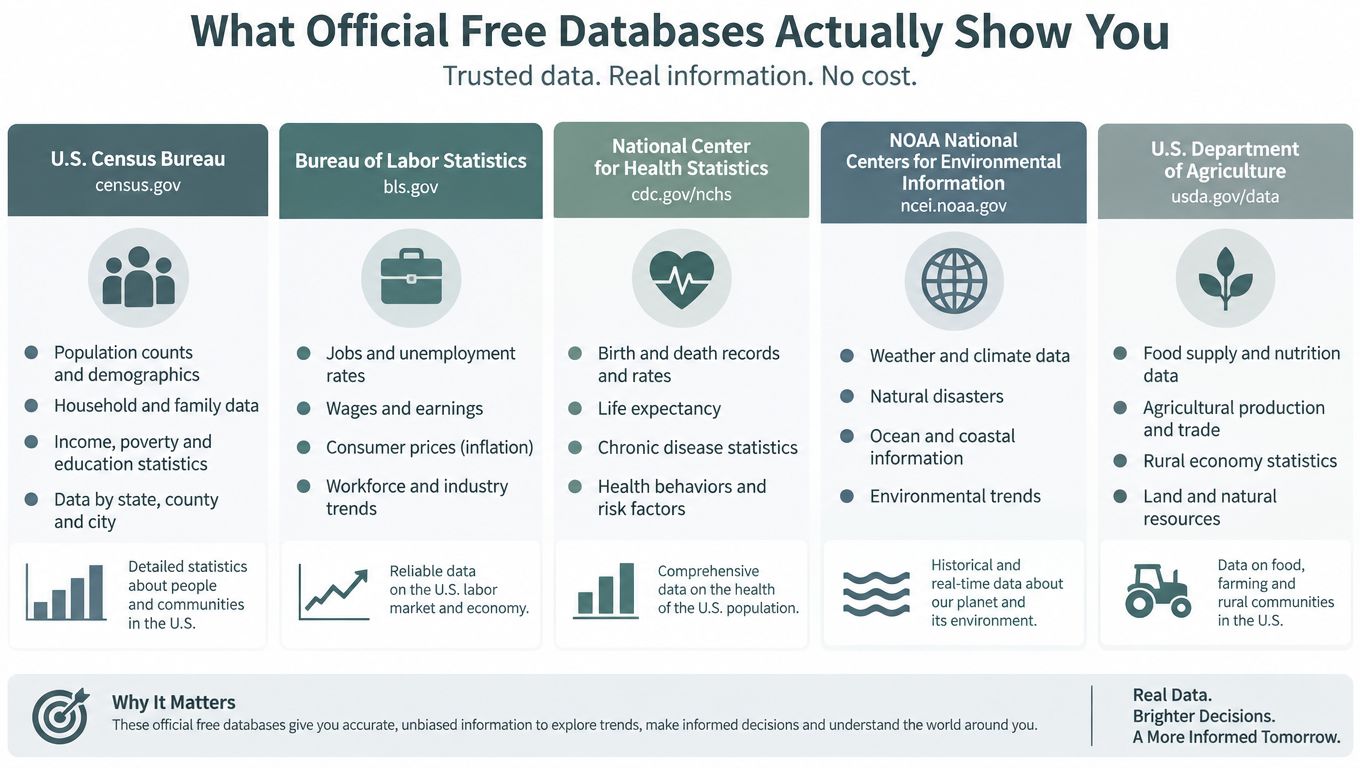
NMVTIS draws on records from state titling agencies and other reporting entities, making it different from a recall-only search. In FY2024, JSI entities reported 16.9 million records into the NMVTIS vehicle-history ecosystem, according to the FY2024 NMVTIS annual report. Those records can help identify title issues and other warning signs. For a deeper walkthrough of what NMVTIS records contain, see this guide to NMVTIS car history reports.
NMVTIS still does not guarantee a complete vehicle biography. Official consumer guidance warns that more than half of states report to the system and that a search can produce a false negative, such as no junk or salvage history when records exist elsewhere. Use the result as one defined check, then compare it with the title, seller's documents, inspection findings, and any paid report needed before purchase.
The Hidden Gaps in Free Vehicle History Lookups
A seller hands you a clean free VIN result, and the car looks freshly detailed. You sign the bill of sale, then discover unrepaired structural damage, an undisclosed lien, or a title problem that never appeared in the search. “No record found” means only that the connected records contained no matching event.
Free tools query separate data silos. A recall database can show no open safety recall while an insurer, auction, repair shop, or state title office holds important information about the vehicle's history.
As noted earlier, NICB's VINCheck covers only participating insurers. A clean result therefore says nothing about nonparticipating carriers, police records, or damage paid for directly by an owner.
The data silos that stay invisible
A vehicle can pass a theft and recall screen while still carrying serious risks:
- Unreported collision damage: Cash-paid repairs may never create an insurance record, even when the damage affected the vehicle's structure.
- Structural repairs: Fresh paint can hide poor alignment, damaged crumple zones, or weak welds that require an independent inspection to identify.
- Odometer rollback: A free lookup may not provide a dependable sequence of mileage readings from inspections, service visits, auctions, and title transfers.
- Title washing: A branded title can become less obvious when the vehicle moves through jurisdictions with different branding rules.
- Lien problems: A theft or recall result does not establish that the seller owns the vehicle free of any lender's financial interest.
- Maintenance gaps: Government safety databases do not show whether the seller changed fluids, replaced timing components, or ignored warning lights.
NMVTIS-related records can cover title, junk, salvage, theft, lien, impound, flood, fire, hail, accident, recall, defect, and odometer information. Even broader reporting depends on records being submitted and matched correctly. A missing entry is not proof that an event never happened.
Why a clean result creates overconfidence
Free tools are useful when you treat them as narrow checks. The buyer wants to know whether the car is safe, truthfully represented, fairly priced, properly titled, and likely to remain reliable. A free lookup may answer only whether a particular public safety or participating-insurer record exists.
Bridge the gaps before signing. Compare the VIN with the title, seller's documents, service records, and inspection findings. Have an independent mechanic examine repaired areas, scan the vehicle for stored faults, and check whether the mileage and condition make sense together. For ownership risk, start with this guide to a vehicle lien search by VIN, then confirm the result through the relevant state titling authority or lienholder when necessary.
A paid report can add useful history, but it still cannot replace the title review and physical inspection.
A clean free result lowers uncertainty around the records it checks. It does not remove uncertainty from the records it cannot see.
Comparing Official Government Tools and Commercial Reports
Official tools and commercial reports serve different purposes. NHTSA is the practical starting point for checking an open safety recall. NICB provides a limited screen for theft and salvage records from participating insurers. NMVTIS-related reporting supports title and brand research, while commercial reports organize available records into a timeline that can make damage, mileage, auction activity, ownership context, and cross-state history easier to review.
The practical difference is consolidation. Official tools often require separate searches for specific questions, while a commercial report can place matching records into one chronological view. NMVTIS-based reporting can include title records, junk and salvage records, theft records, lien and impound records, flood, fire, hail and accident damage, recalls and defects, and odometer rollbacks (NMVTIS reporting categories). Availability depends on the vehicle and reporting source, so treat the result as documented evidence, not a guarantee.
| Feature | Free Government Tools | Commercial Reports |
|---|---|---|
| Open safety recalls | Strong fit through NHTSA | May include available recall information |
| Basic VIN identity | Useful for decoding and validation | Usually included with broader context |
| Participating theft and salvage signals | Available through NICB's defined screen | May combine theft, title, insurance, or related records |
| Title and brand history | Available through relevant official or NMVTIS channels | Consolidated into a consumer-facing report when available |
| Accident and damage history | Not the main purpose of recall tools | May include reported accidents, damage, auction, or insurance records |
| Odometer chronology | Limited in a recall-focused search | May show mileage events from multiple sources |
| Liens and impounds | Requires the relevant state process or official record | May surface available lien or impound information |
| Ownership context | Usually narrow or jurisdiction-specific | May organize reported transfers and registration events |
| Auction photographs and listings | Not generally provided by recall tools | May appear when matching auction records exist |
| Market value context | Not the purpose of the government lookup | Some providers offer an estimate from available vehicle signals |
Match the tool to the buying situation
For a local private-party purchase, begin with NHTSA and a theft or salvage screen. Compare the VIN with the title, inspect the vehicle in person, and check whether the seller's documents support the story. Complete maintenance records and consistent condition make a broader report useful for verification, but neither lookup replaces an inspection.
An auction car, rebuilt vehicle, imported vehicle, or cross-state purchase creates more reasons to use a commercial report. Relevant records may sit with different state agencies, insurers, auctions, and service networks. A single timeline can reveal connections that separate free searches leave you to assemble yourself.
Use the paid report to organize evidence, then verify important findings against the title and the vehicle. Previous damage, a branded title, or inconsistent mileage still calls for a qualified inspection before signing the bill of sale.
When to Upgrade to a Paid Vehicle History Report
Paying for a report makes sense when the financial downside of missing a record is greater than the cost of deeper research. The decision shouldn't depend only on the seller's confidence or the vehicle's appearance. It should depend on the car's risk profile and the quality of the evidence supporting the sale.
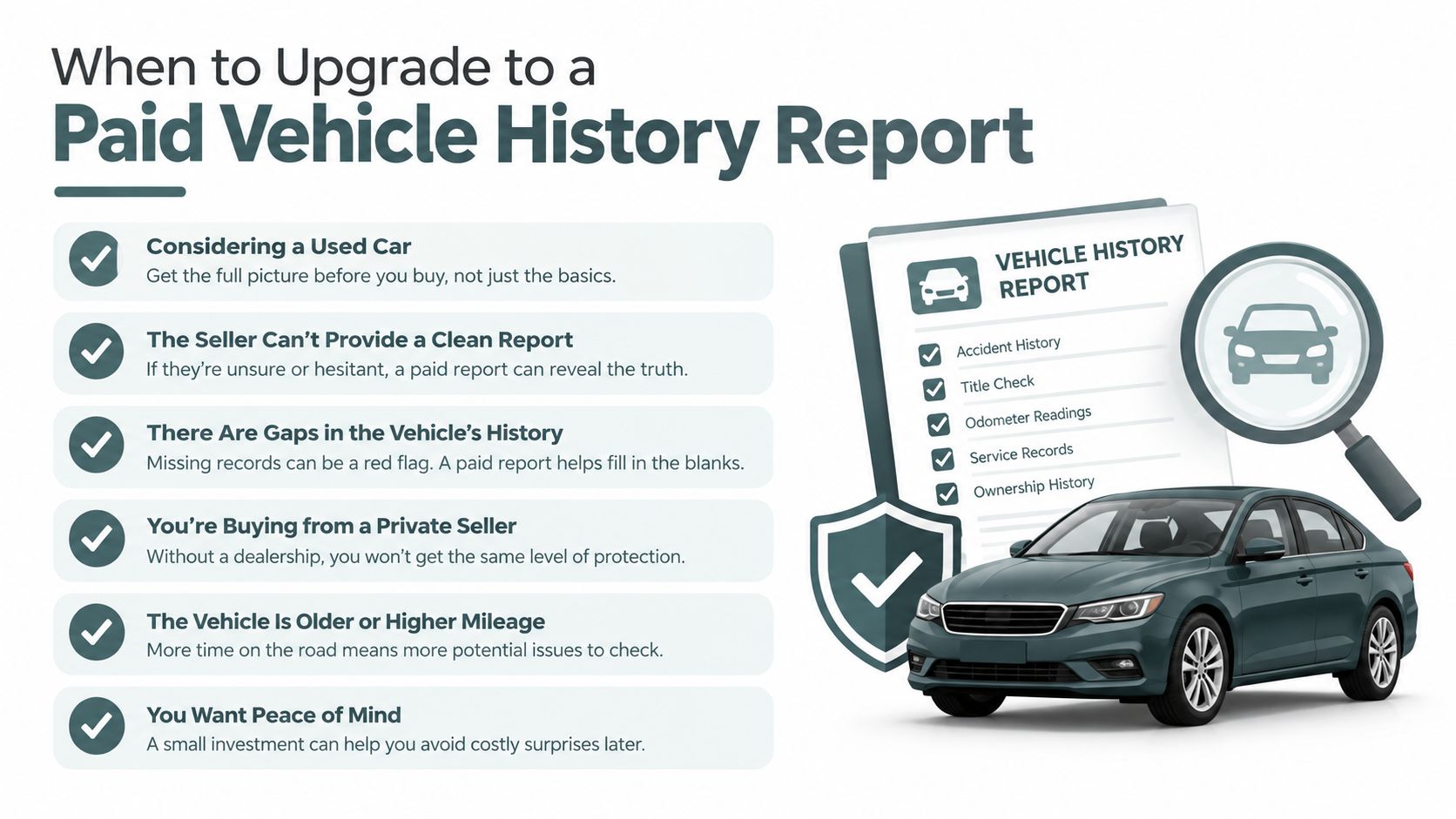
Six reasons not to stop at free data
The vehicle has a rebuilt, salvage, flood, fire, or other branded title. You need to understand how and where the brand was recorded, what damage led to it, and whether local registration rules affect future use or resale.
The car came from an auction or has auction photos. Previous images can reveal missing panels, deployed airbags, water exposure, or damage that no longer appears after cosmetic repair.
The mileage doesn't form a believable sequence. Compare the dashboard reading with title documents, inspection records, service invoices, auction listings, and report entries. A clean recall result says nothing about odometer progression.
The seller can't provide maintenance records. Missing paperwork isn't proof of neglect, but it removes evidence you could otherwise use to judge ownership and service quality.
The price seems unusually attractive. A low price may reflect damage, a title brand, a lien, a mechanical fault, or a resale problem rather than a simple seller discount.
The vehicle has crossed jurisdictions or borders. Records may be fragmented, and title branding can require careful interpretation in the jurisdiction where you plan to register the car.
AAA notes that vehicle-history reports capture reported information and can miss unreported accidents, do-it-yourself repairs, hidden flood or structural damage, delayed entries, and the vehicle's current condition (AAA-related vehicle-history guidance). That means a paid report is an escalation, not a substitute for inspection.
Use the report to direct the inspection
Don't buy a report and stop thinking. Read the timeline for gaps, conflicting mileage, title changes, damage descriptions, auction entries, and ownership patterns. Then ask a mechanic to inspect the areas suggested by the records, including frame alignment, underbody corrosion, paint thickness, airbag components, flood indicators, and fluid condition.
You can also compare available commercial services before paying. This comparison of vehicle-history report options is useful when you're weighing coverage against cost. Check whether the provider offers a preview of available records, because a report with little or no matching history may not answer the questions that caused you to order it.
How to Read a VIN and Spot Red Flags Early
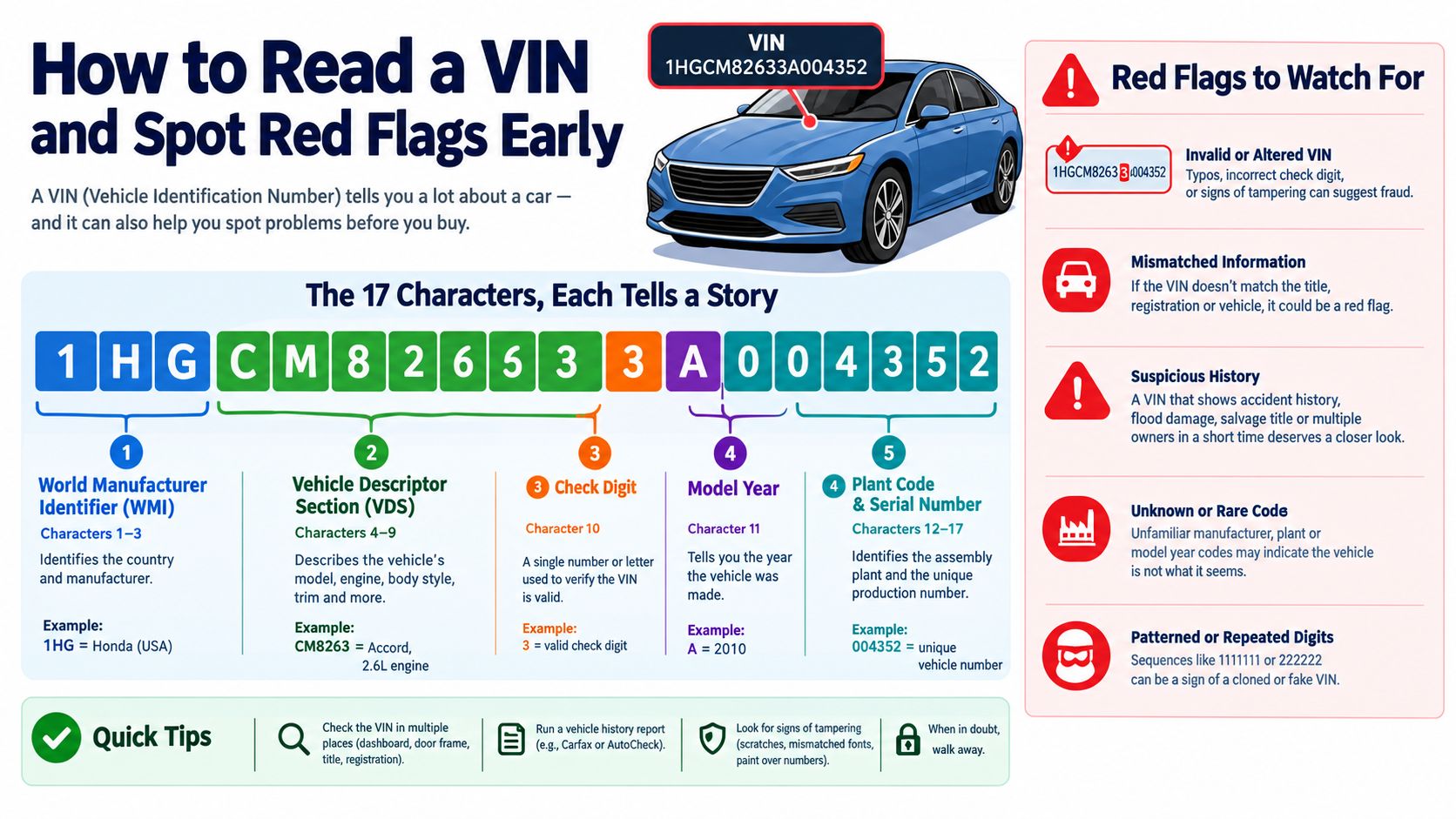
Start with the vehicle, not the website. On a modern car, locate the VIN at the base of the windshield and compare it with the label on the driver-side doorjamb. Then compare both with the registration, insurance documents, and title. The characters should match exactly, and the plates or labels shouldn't show fresh adhesive, damaged fasteners, uneven printing, scratches, or signs that someone has disturbed them.
A practical identity check
Enter the VIN only after copying it carefully. Don't rely on a seller's text message if you can inspect the physical vehicle. Check that the decoded make, model year, body type, engine information, and manufacturing details make sense for the car in front of you.
Look for contradictions that deserve an explanation:
- The listing describes a trim level the decoder doesn't identify.
- The title VIN differs from the dashboard or doorjamb VIN.
- The vehicle has a replacement body panel with a missing or damaged label.
- The seller says the car has never been modified, but the equipment doesn't match the factory description.
- The VIN appears altered, re-stamped, covered, or attached with unusual hardware.
A VIN decoder can validate identity and basic specifications. It can't confirm that every component currently fitted to the vehicle is original, or that the car hasn't been rebuilt around another body or powertrain. For owners who want an additional way to monitor vehicle condition after purchase, a connected resource such as the CARLOCK GPS tracker can provide vehicle-health context, but it doesn't replace title, theft, recall, or history-record research.
Older vehicles need more caution
NHTSA's vPIC reports about 99% decode confidence for most major brands from model year 1995 forward, but only about 60–65% for vehicles from 1980–1994, with no VIN-standard coverage before 1980 (NHTSA vPIC FAQ). Older classics and early imports therefore need stronger physical and documentary verification.
For a pre-1995 vehicle, ask for the title chain, import or registration records where relevant, period-correct identification details, and an inspection from someone familiar with that make. A decoder may not reliably identify the trim, engine, plant, or configuration that affects value and parts compatibility. Treat the digital result as a clue, not an authoritative specification sheet.
Next Steps for Your Used Car Purchase
Use a repeatable sequence instead of relying on a single clean result.
- Copy the VIN from the car itself. Compare the windshield, doorjamb, title, registration, and insurance paperwork.
- Run the official free checks. Search NHTSA for open recalls and use an appropriate theft or salvage screen. Record the results rather than relying on memory.
- Ask for the title and lien information. Confirm the seller has the right to transfer ownership and resolve any lender interest before payment.
- Review the vehicle in person. Check panel alignment, paint differences, tire wear, warning lights, underbody condition, glass dates, and signs of water or structural repair.
- Escalate when the risk warrants it. Order a commercial report for auction, salvage, rebuilt, cross-jurisdiction, unusually cheap, poorly documented, or mileage-inconsistent vehicles.
- Arrange an independent inspection. The inspector should evaluate mechanical condition and damage, not merely confirm that the engine starts.
- Put unresolved issues in writing. Don't accept a verbal promise that a recall, lien, title problem, or repair will be handled after the sale.
The right conclusion from a free VIN search is usually one of three things: walk away, continue with inspection and documentation, or pay for broader history before negotiating. That decision is more useful than a reassuring badge that says “clean.”
Vektracer lets you enter a VIN or license plate to see available vehicle-history information, including a free preview before opening a broader report. Visit Vektracer to check the specific car's available title, damage, mileage, theft, auction, ownership, and recall records before you sign the bill of sale.
Ready to check a vehicle?
Enter any 17-character VIN for a free instant preview — no account needed.