How to Buy a Used Car with a Lien in Canada Safely
Check a vehicle before you buy
Enter a VIN for a free instant preview — accidents, title brands, mileage, liens & open recalls.
If you're looking at a private-sale vehicle and the seller says, “There's still a loan on it, but it's no big deal,” stop before sending money. How to buy a used car with a lien in Canada safely comes down to three actions: verify the lien through the correct provincial registry, contact the lender directly, and make sure the lender is paid before the seller receives the balance. A lien can remain registered until the debt is paid in full, and a buyer who skips that process can face serious title and seizure problems. Federal consumer guidance on vehicle liens makes the central point clear, buyers should confirm that no lien exists before purchase and have any lien removed before registering the vehicle.
The mistake that causes most disasters isn't noticing a lien. It's paying the seller first and trusting them to settle the loan later. That reverses the safe order of payment. The lender must be dealt with before the seller walks away with the buyer's money.
Table of Contents
- Why a Used Car With a Lien Can Go Very Wrong
- Checking the Right Provincial Lien Registry
- What a Vehicle History Report Adds to a Free Lien Search
- Contacting the Lienholder and Structuring the Payout
- Cross-Provincial and Recently Imported Vehicles
- Bill of Sale, Title Transfer, and Final Documentation
- Common Questions and Your Next Step
Why a Used Car With a Lien Can Go Very Wrong
Take a typical scenario: a buyer in Mississauga agrees to purchase a used SUV from a private seller. The vehicle looks clean, the VIN matches the registration, and the seller promises to clear the remaining loan after the sale. The buyer pays a deposit, completes the purchase, and checks the registry a week later. An outstanding lien appears, while the lender has no record of the change in ownership.
The seller has already deposited the cheque. The buyer has the SUV, but the vehicle still secures someone else's debt. If the borrower stops paying, the lender may enforce its rights against the vehicle, regardless of what the buyer paid the seller. Federal guidance from Canada's official consumer information about car liens warns buyers to confirm the lien status and have the debt dealt with before completing the purchase.
A registry search is only the first protection. The payment sequence determines whether the buyer can get the lien cleared.
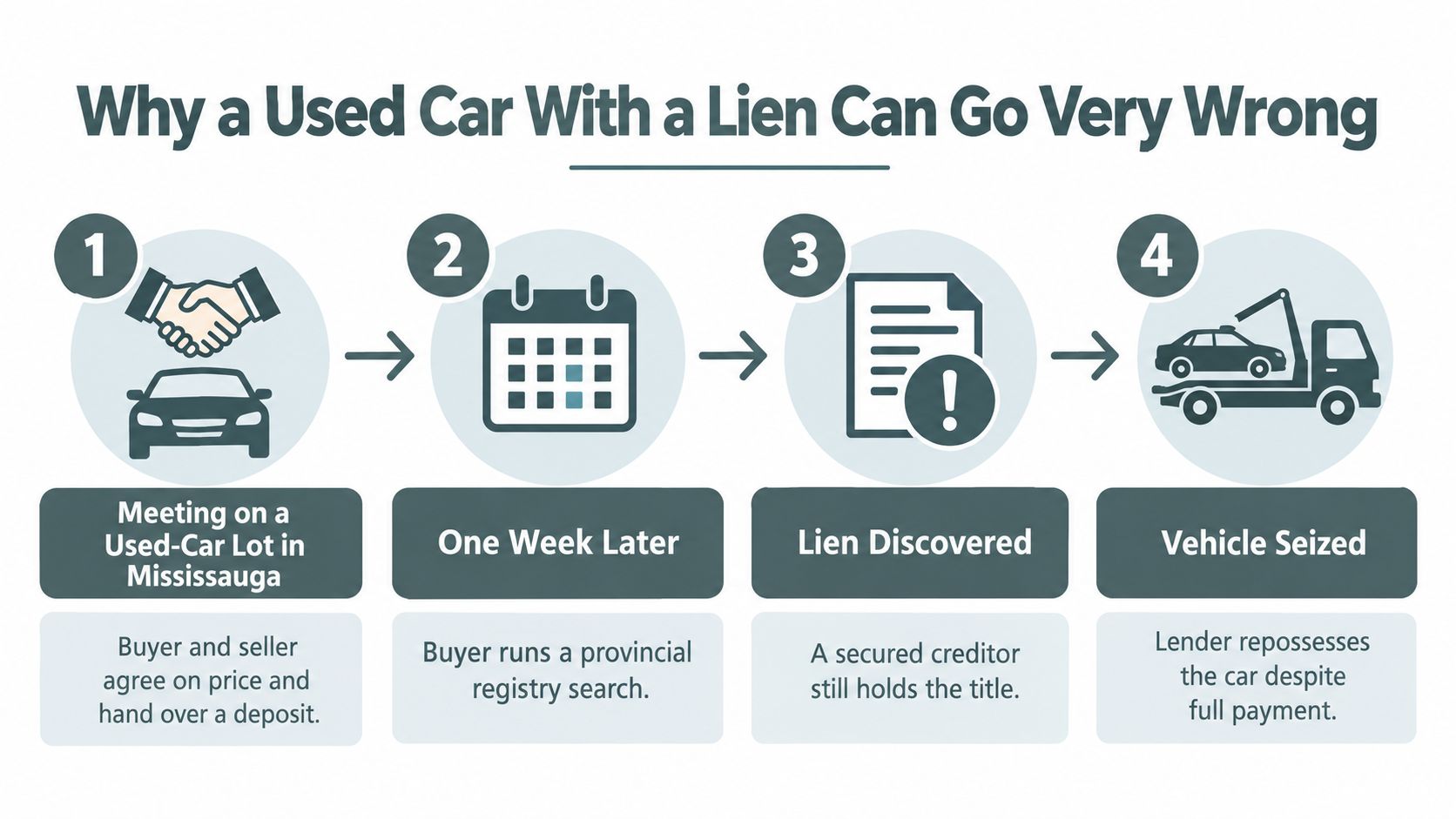
The buyer's problem is a sequencing failure. Use this order:
- Check the registry: Search the VIN in the correct provincial or territorial system before paying a deposit. In Ontario, that means the provincial Personal Property Security Registration system. In Alberta, use the Alberta Personal Property Registry. The search must match the jurisdiction connected to the vehicle and its financing history.
- Contact the lender: Ask the secured creditor to confirm the current payout amount, payment method, and documents it will issue after receiving the funds.
- Pay the lender first: Send the lender the amount required to discharge the lien. Pay the seller only the remaining balance, subject to written confirmation of the arrangement.
- Complete the transfer: Keep the lender's discharge evidence, bill of sale, payment records, and updated registry result before treating the transaction as finished.
The seller should never walk away with the buyer's money before the lender is paid.
Liens are common enough to treat as routine due diligence. CARFAX Canada reports that over 40 percent of vehicles searched in Canada have a registered lien. The registry check exposes the risk, but controlled payout prevents the seller's unpaid loan from becoming the buyer's problem.
Checking the Right Provincial Lien Registry
Canada doesn't use one universal consumer lien portal. Provincial and territorial systems control the search process, and the correct registry depends on where the vehicle is registered and where it was previously connected to a loan.
Start with the full vehicle identification number, or VIN. Confirm it against the dashboard, door label, registration document, and bill of sale. The RCMP's guidance for buying a pre-owned vehicle also recommends matching the VIN to the vehicle, checking the VIN through the manufacturer for recall or associated information, and confirming that the licence plate matches the registration form. The RCMP pre-owned vehicle checklist is a useful identity check before you investigate the lien.
Use the registry tied to the vehicle
Ontario uses the provincial Personal Property Lien system. Its motor-vehicle search requires jurisdiction and serial-numbered item details, which reflects the basic rule that the search must match the place where the vehicle was registered. You can review the process in this Ontario PPSA lien search guide.
Alberta uses the Alberta Personal Property Registry. Saskatchewan uses the Saskatchewan Personal Property Registry through ISC, and Manitoba uses its provincial Personal Property Registry. Atlantic and northern jurisdictions use the ACOL Lien Check service where available, including New Brunswick, Newfoundland and Labrador, Northwest Territories, Nova Scotia, Nunavut, Prince Edward Island, and Yukon. Quebec uses the RDPRM, the province's register of personal and movable real rights, rather than the PPSA/PPR terminology used elsewhere.
| Province or territory | Registry or portal | Key search field | Approx. cost |
|---|---|---|---|
| Ontario | Ontario Personal Property Lien system | VIN and jurisdiction details | Registry fee applies |
| Alberta | Alberta Personal Property Registry | VIN or serial-numbered vehicle details | Registry fee applies |
| Saskatchewan | Saskatchewan Personal Property Registry through ISC | VIN and debtor details where requested | Registry fee applies |
| Manitoba | Manitoba Personal Property Registry | VIN and owner or debtor details where requested | Registry fee applies |
| New Brunswick, Newfoundland and Labrador, Northwest Territories, Nova Scotia, Nunavut, Prince Edward Island, Yukon | ACOL Lien Check | VIN and relevant registration information | Service fee applies |
| Quebec | RDPRM | Vehicle and debtor information required by the search | Registry fee applies |
| British Columbia and other jurisdictions | Current provincial or territorial personal property registry | VIN and jurisdiction-specific fields | Registry fee applies |
A registry result is a snapshot, not a permanent guarantee. Save the result, record the search date, and keep it with the purchase documents. If the car recently moved provinces, search both the seller's province and the province where the vehicle is currently registered, as Ontario's guidance explains in its information about searching for registered security interests.
What a Vehicle History Report Adds to a Free Lien Search
A provincial registry search and a commercial VIN report answer different questions. The registry is the authoritative place to check whether a secured interest is registered in that jurisdiction at the time of the search. It can identify the registered creditor and registration details, but it isn't designed to reconstruct the vehicle's entire life.
A VIN-based history report adds context that a lien search usually doesn't provide. It may show registrations in other provinces, reported lien-release information, accident and insurance events, title brands, salvage or rebuilt status, odometer readings, auction records, and ownership history where those records are available. That context matters because a vehicle can have a clean result in one province while carrying a security interest connected to another jurisdiction.
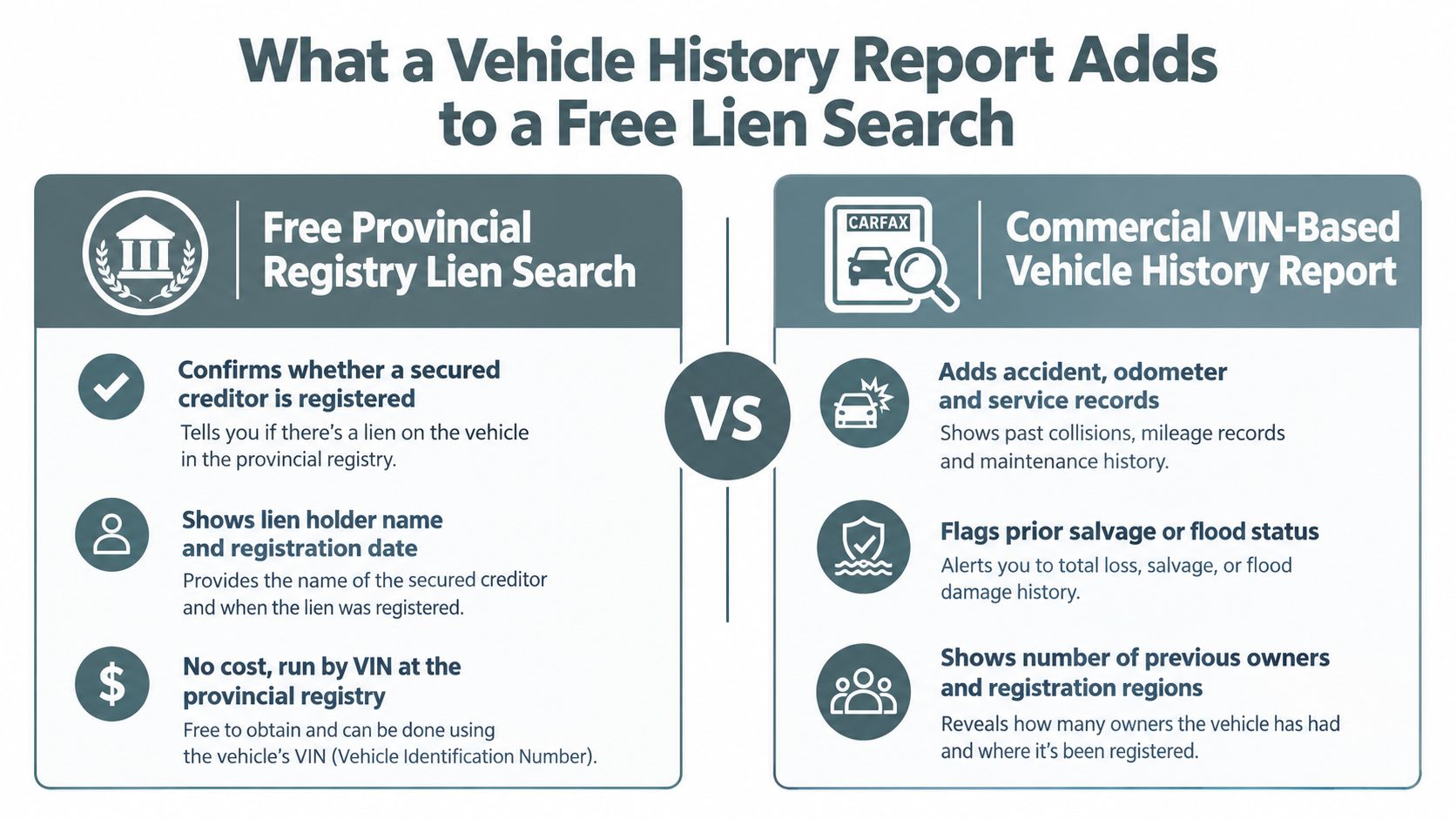
| Question | Provincial lien search | Commercial VIN-based history report |
|---|---|---|
| Is a secured creditor registered now? | Primary tool for the searched jurisdiction | May include lien information where reported |
| Which lender is listed? | Usually identifies the registered lienholder | Can provide supplemental context |
| Has the vehicle had accident or damage events? | Usually not the purpose of the search | May show reported accidents and damage |
| Has the vehicle carried a salvage or rebuilt brand? | Usually not the purpose of the search | May show title brands and registration history |
| Has the odometer history been consistent? | Usually not the purpose of the search | May show chronological mileage records |
| Could another jurisdiction contain relevant records? | Only if you search that jurisdiction | May help reveal prior registration regions |
Neither tool catches everything. A private loan that was never registered may not appear in a registry search, and a lien filed after the latest search won't appear in an old result. A commercial report also isn't a substitute for the official registry. This comparison of Canadian lien checks and vehicle history reports explains why buyers should use both tools for different parts of the decision.
Run the provincial registry search first when a current secured interest is the immediate concern. Then use the VIN history report to examine accidents, odometer records, title brands, auctions, ownership context, and possible moves between jurisdictions. Don't let a clean commercial report persuade you to skip the registry.
Contacting the Lienholder and Structuring the Payout
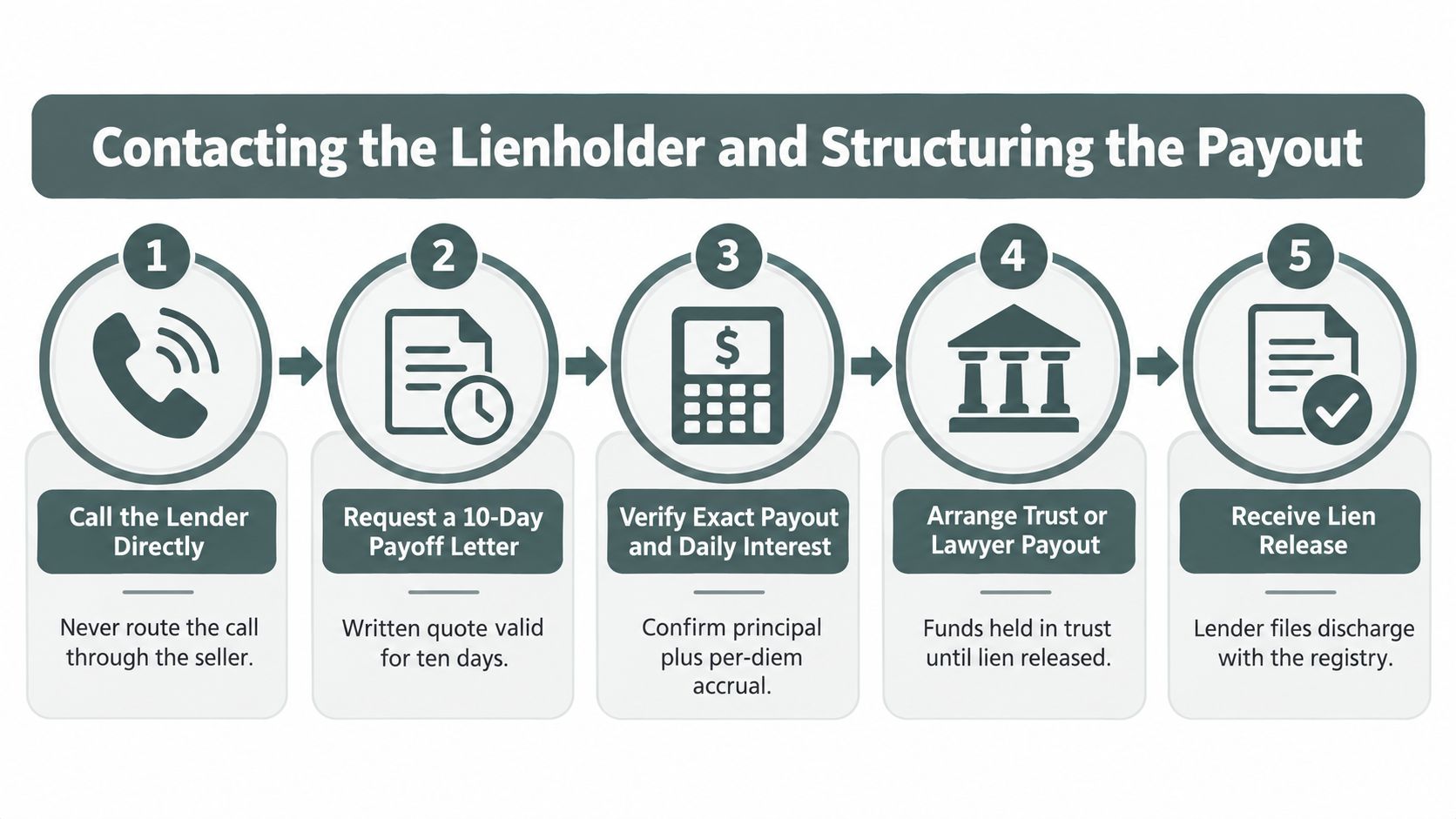
Once the registry identifies a lien, stop negotiating casually with the seller. Contact the lender using the information in the registry search, not just a phone number or email address supplied by the seller. Ask the lender to confirm the account, the vehicle, and the process required to discharge the registered security interest.
Request a written payoff statement that remains valid for the agreed payment period. It should identify the exact payout amount, explain any daily interest accrual, and provide the lender's payment instructions. Don't rely on a seller's estimate of the remaining loan balance. The amount can change, and the seller may not have access to the lender's current discharge procedure.
Put the lender ahead of the seller
Agree on the vehicle's purchase price only after you understand the lender's payout requirement. The payoff amount comes out of the purchase funds. The seller receives only the balance after the lender confirms settlement and the discharge process is underway.
For example, if the agreed price is higher than the lender's payoff, the safest structure directs the payoff portion to the lender and the remainder to the seller. If the payoff is close to or greater than the purchase price, don't assume the seller will cover the shortfall. Require the seller to do so before the transaction proceeds, or walk away.
Escrow through a lawyer or notary is the cleanest arrangement for a private sale. The buyer deposits the agreed funds into trust, the lender receives its portion, and the seller receives the net amount when the agreed release conditions are met. This protects both sides from relying on a handshake or an undated promise.
Practical rule: If the lender won't confirm the payoff and discharge process directly, don't send the seller the purchase money.
A bank draft, wire transfer, or direct lender payment is easier to document than handing the seller a cheque and hoping it gets forwarded. Confirm the lender's exact instructions independently, and keep proof of every payment. Don't alter the payment structure because the seller says the lender is inconvenient, unavailable, or asking for too much documentation.
Confirm the discharge after payment
Payment alone isn't the finish line. Follow up with the lender and request written confirmation that the loan has been settled and the discharge has been filed or will be filed with the registry. Then run a fresh registry search and compare it with the original result.
Keep all of these records:
- Original registry search: Save the report showing the lienholder and registration details.
- Written payoff statement: Retain the lender's amount, validity information, and payment instructions.
- Payment evidence: Keep bank records, receipts, trust-account documents, and correspondence.
- Discharge confirmation: Obtain the lender's written proof that the security interest has been released.
- Updated search: Confirm that the registry no longer shows the lien before finalizing the transfer.
The buyer shouldn't finalize the deal merely because the seller says the loan was paid. The registry and lender documentation must support that statement.
Cross-Provincial and Recently Imported Vehicles
One provincial search can miss a security interest connected to another province. This is the problem buyers face when a vehicle is being sold in Ontario but was previously registered or financed in Alberta, for example. The Ontario result may not reveal an Alberta registration if the buyer searches only the current jurisdiction.
The safer approach is to identify the vehicle's registration trail before purchase. Search the province where it's currently registered, the province where it was previously registered, and any province where the seller says the vehicle was financed. Alberta's lien-search guidance specifically states that its search covers Alberta registrations and that buyers must contact another jurisdiction directly for liens outside Alberta.
| Vehicle origin | Primary search | Secondary search | Extra step |
|---|---|---|---|
| Vehicle registered and financed in the same province | Current provincial PPSA or PPR portal | Search the owner details if the portal requires them | Match the VIN to all documents |
| Vehicle recently moved between provinces | Current province's registry | Previous registration or financing province | Keep both search results |
| Vehicle sold by an owner with a different provincial history | Seller's stated financing or registration province | Current registration province | Ask the lender about discharge status |
| Vehicle imported from the United States | Canadian provincial registry | US title and history records | Review import and inspection paperwork |
| Salvage, rebuilt, auction, or former lease vehicle | Current provincial registry | Prior jurisdictions and VIN history sources | Inspect title brands, mileage, photos, and ownership records |
Recently imported vehicles need a separate document review. A US or offshore security interest may not appear in a Canadian provincial registry, so ask for the prior title history and review any salvage or branded-title information. For US imports, buyers should also verify the Canadian import file, the Registrar of Imported Vehicles inspection record, and the provincial import or registration documentation before releasing funds.
A clean Canadian registry result doesn't prove that an imported vehicle has a clean foreign title. It also doesn't resolve questions about flood damage, rebuilt status, auction history, or an odometer discrepancy. Use the VIN to connect the Canadian registration to the vehicle's earlier records, then make the seller explain every gap.
For a more detailed document list, see this US-to-Canada vehicle import checklist. If the seller can't produce a coherent chain of ownership and import paperwork, the discount isn't worth the uncertainty.
Bill of Sale, Title Transfer, and Final Documentation
The bill of sale should make the lien arrangement explicit. Don't accept a vague statement that the vehicle is “clear” or “paid off.” Write down the seller's legal name, the buyer's legal name, the VIN, the make, model, model year, mileage, purchase price, payment method, deposit, and sale date.
Include a clear condition that the vehicle is being sold free of liens and security interests. If a lien exists at signing, the agreement should state that the seller will cooperate with the lender, provide the discharge, and meet a defined deadline. The contract should also say what happens if the discharge isn't provided, such as cancellation of the sale and return of funds where legally enforceable.
Sign only when the payment structure is secure
A seller's promise isn't a substitute for lender confirmation. Before signing the final transfer documents, verify that the payoff has been sent according to the lender's instructions and that the discharge documentation is available or contractually secured through trust.
Ontario's Used Vehicle Information Package and Alberta's bill of sale process can provide important transaction details, but provincial forms don't eliminate the need to verify the lien independently. A form is useful evidence. It isn't proof that a lender has released its interest.
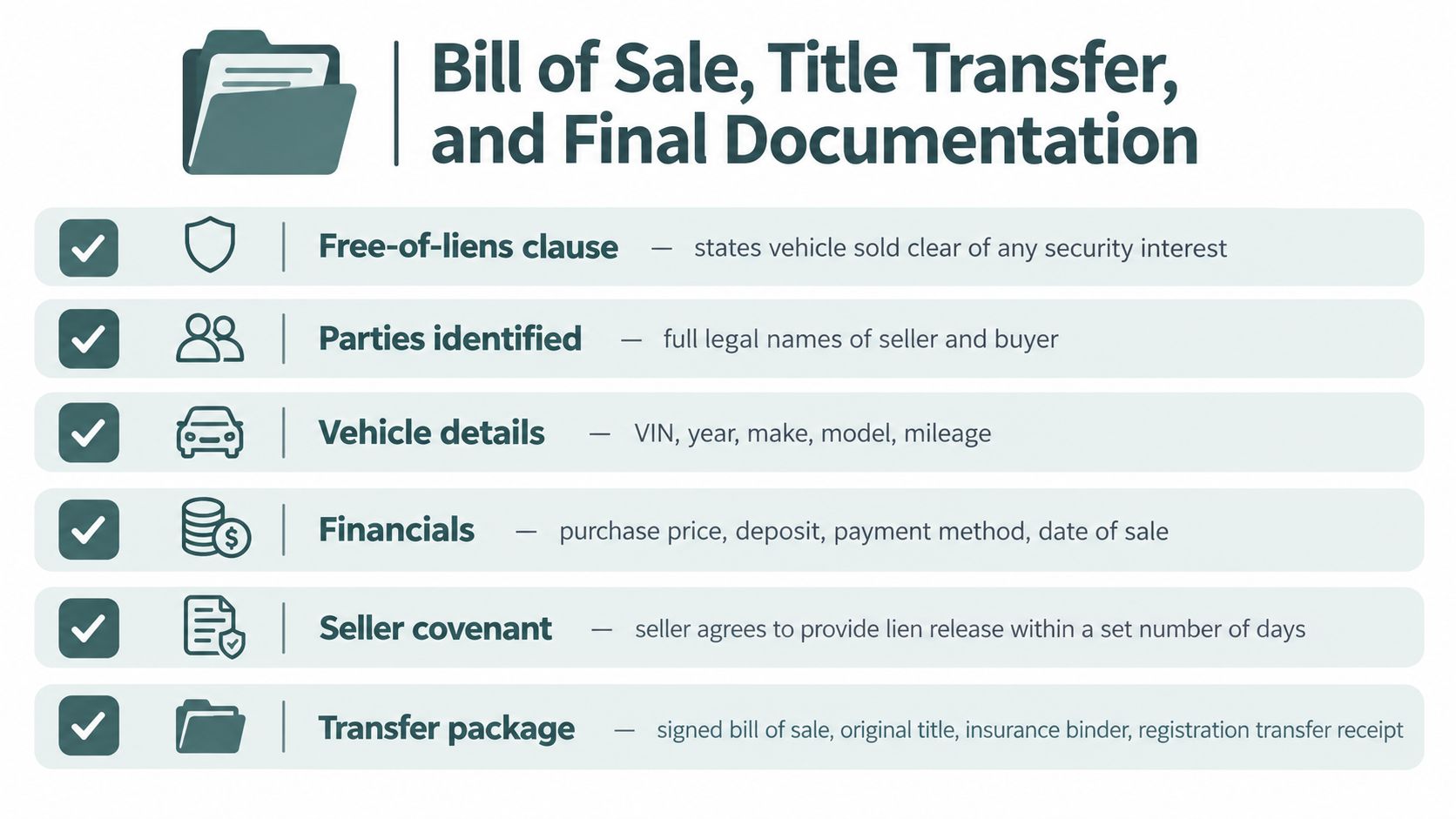
Take the transfer package to the applicable provincial licensing or registration office. Requirements vary by jurisdiction, but the buyer should expect to present the signed ownership or registration documents, the bill of sale, proof of insurance, and lien-discharge evidence where required. A safety certificate may also be required before registration, depending on the province and transaction.
Keep one folder, paper or digital, containing:
- The signed bill of sale: Include the free-of-liens clause and the lender-payment conditions.
- The original registration or ownership document: Check that the seller's name and VIN match.
- The lender's payoff confirmation: Save the written settlement evidence.
- The lien discharge: Keep the lender's release and any registry confirmation.
- The transfer receipt: Retain proof that registration was submitted or completed.
- The odometer disclosure: Preserve the mileage statement and compare it with the vehicle history.
Until those documents are in hand and the registry position is resolved, the transaction isn't fully closed. Don't spend money on upgrades, resell the vehicle, or assume you're protected because you have the keys.
Common Questions and Your Next Step
Can a seller legally sell a vehicle with an outstanding lien?
A seller may be able to negotiate a sale while a loan remains outstanding, but the buyer must not treat that as permission to ignore the lender. The lien remains a lender's registered claim until the debt is paid and the interest is discharged. Put the lender payout directly into the transaction rather than relying on the seller to handle it later.
If I pay the lender and the deal collapses, do I automatically get a refund?
No automatic refund should be assumed. Before sending money, get written terms explaining whether the lender payment is part of the purchase, how the funds are held, and what happens if the transaction fails. A lawyer or notary can structure the payment through trust and reduce the chance of a dispute.
Is a notarized bill of sale enough to clear the title?
No. A notarized bill of sale proves that the parties signed a document. It doesn't replace the lender's discharge or remove a registered security interest. The registry must be updated through the appropriate process.
How long will the discharge take to appear?
The timing depends on the lender and the provincial registry process. Don't rely on an informal estimate. Ask the lender for written confirmation, keep the discharge evidence, and verify the registry before treating the vehicle as clear.
Your immediate next step is simple: get the VIN, identify the vehicle's current and previous registration jurisdictions, and run the appropriate registry search before any money moves. Then compare the result with a VIN-based history report covering title status, accidents, odometer history, salvage records, auction history, and ownership context.
Use Vektracer to review the vehicle's available VIN and licence-plate history alongside the official provincial lien search, especially when the car has moved between jurisdictions or has auction, salvage, accident, or odometer concerns. Visit Vektracer before you pay the seller, and use the report to decide what must be verified directly with the lender.
Ready to check a vehicle?
Enter any 17-character VIN for a free instant preview — no account needed.