Importing a Car from the USA to Canada: Your Checklist
Check a vehicle before you buy
Enter a VIN for a free instant preview — accidents, title brands, mileage, liens & open recalls.
Importing a Car from the USA to Canada: Your Checklist
If you’re importing a car from the USA to Canada, these eight steps cover everything from pre-purchase to provincial plates. Complete them in order, and you won’t get turned away at the border or stuck waiting on a failed RIV inspection.
- Run a cross-border VIN history check and confirm no salvage brands, open liens, flood damage, or major undisclosed accidents appear in U.S. or Canadian records.
- Confirm admissibility on the Registrar of Imported Vehicles (RIV) Vehicle Import Compatibility (VIC) list, or verify the vehicle qualifies for the 15-year exemption.
- Gather ownership documents: original U.S. Certificate of Title in your name (or properly assigned), a detailed Bill of Sale showing the VIN and USD sale price, and a lien release if applicable.
- File the U.S. AES export entry at least 72 hours before crossing and obtain the Internal Transaction Number (ITN) from U.S. Customs and Border Protection (CBP).
- Get recall clearance from the manufacturer confirming all open safety recalls are resolved before you reach the Canadian border.
- Present Form 1 (TC Vehicle Import Form / RIV e-Form 1) to CBSA at the port of entry, pay applicable duties and taxes, and get the form stamped.
- Book and complete the RIV federal inspection within 45 days of entry and make any required modifications to meet Canadian Motor Vehicle Safety Standards (CMVSS).
- Register and insure the vehicle provincially after RIV clearance and receipt of your compliance label.
Every step above has a hard deadline or a document requirement that can stop the import cold if missed. The sections below break each one down so you know exactly what to prepare.
Key Takeaways
Importing a car from the USA to Canada requires coordinating across four agencies, meeting two hard deadlines (72-hour AES and 45-day RIV), and confirming eligibility before you pay a dollar.
| Point | Details |
|---|---|
| AES filing deadline | File the U.S. AES export entry at least 72 hours before crossing and present the ITN at the U.S. port of exit. |
| RIV inspection window | Present the vehicle for the RIV federal inspection and complete all CMVSS modifications within 45 days of entry. |
| Eligibility first | Confirm the vehicle is on the VIC list or qualifies for the 15-year exemption before purchase, not at the border. |
| Budget beyond the sticker | Factor in GST, provincial sales tax, RIV fee, possible duty, excise taxes, and modification costs — total landed cost often runs 15–25% above the USD purchase price. |
| Vektracer VIN check | Run a cross-border VIN report via Vektracer before negotiating to catch U.S. salvage, flood, and lien records that Canadian-only reports miss. |
Table of Contents
- Is this vehicle eligible to import from the USA?
- What documents do you need to import a vehicle from the USA?
- Step-by-step timeline from pre-purchase to provincial plates
- What does it cost to import a car from the USA to Canada?
- Recall clearance and the RIV federal inspection: what to expect
- Common mistakes that cause delays, refusals, or extra cost
- Should you hire a customs broker or handle the import yourself?
- Your printable checklist: pre-purchase to provincial plates
- Official resources and contact points for your import
- What the VIN check taught me before I crossed the border
- Why a VIN check belongs at the top of your import checklist
- Sources
- FAQ
Is this vehicle eligible to import from the USA?
Not every U.S. vehicle can cross the border legally, and finding out after you’ve paid is an expensive mistake. Eligibility turns on three things: whether the vehicle appears on the RIV’s compatibility list, how old it is, and whether it’s been modified or branded.
The VIC list and how it works
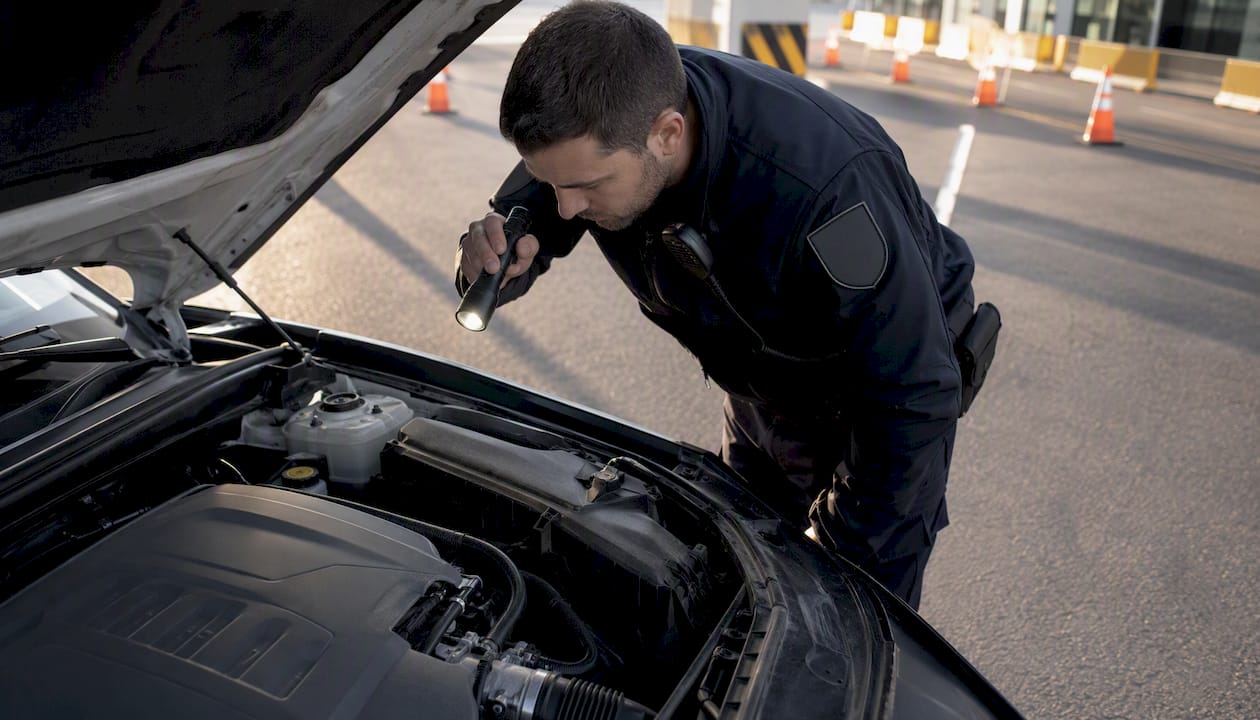
Transport Canada maintains the Vehicle Import Compatibility (VIC) list, which manufacturers voluntarily populate with models they’ve confirmed can be modified to meet CMVSS. If a vehicle isn’t on the list, it’s not automatically inadmissible, but you’ll need written confirmation from the manufacturer that it can be brought into compliance. That confirmation can take weeks to obtain, so check the list before you negotiate a price.
The 15-year exemption
Vehicles that are 15 years old or older are generally exempt from the Motor Vehicle Safety Act (MVSA) and don’t need to go through the RIV program. They still require CBSA clearance, documentation, and provincial registration, but they skip the federal inspection step. The Transport Canada and RIV FAQ confirms that vehicles less than 15 years old sold at retail in the U.S. generally must enter the RIV program.
Modified, salvage, and non-regulated vehicles
- Modified vehicles (raised roofs, van conversions, stretched frames, lift kits beyond factory spec) often lose their original manufacturer certification. RIV may reject them unless the modifier or a final-stage manufacturer can prove CMVSS compliance in writing.
- Salvage-branded vehicles can sometimes be imported under specific RIV salvage program conditions, but flood-damaged vehicles face much stricter limits. Confirm current salvage eligibility with RIV before purchasing.
- Non-regulated vehicles (certain off-road or specialty units) fall outside the standard RIV program. Presenting one at the border without prior research can result in immediate refusal.
Pro Tip: Contact the manufacturer’s import compliance department directly, not just the dealer, and ask for a written statement confirming VIC compatibility and any known modifications required. Get the VIC list annotation in writing before you wire any money.
What documents do you need to import a vehicle from the USA?
Getting turned away at the border almost always comes down to a missing or improperly prepared document. CBSA Memorandum D19-12-1 spells out the proof-of-ownership requirements in detail. Here’s what you need and where to get each item.
Ownership and title documents
- Original U.S. Certificate of Title in the buyer’s name, or properly assigned by the seller with a wet-ink signature in the assignment section. A photocopy or a title in the seller’s name with no assignment will not clear CBSA. For new vehicles, a Manufacturer’s Statement of Origin (MSO) substitutes for the title.
- Bill of Sale listing the full VIN, sale price in USD, buyer and seller full legal names and addresses, and the transaction date. An incomplete bill of sale invites delays and can trigger a valuation dispute that holds up duty calculations.
- Lien release if the vehicle was financed. Verify the U.S. title is lien-free before purchase using a vehicle title check and confirm with the lienholder that the release has been recorded with the state DMV.
Export and recall documents
- Internal Transaction Number (ITN) from the U.S. AES export filing. U.S. CBP requires this at the port of exit; without it, the vehicle will not be allowed to leave the U.S.
- Recall clearance letter from the manufacturer confirming all open safety recalls are resolved. You can request this directly from the manufacturer’s customer service line or through the RIV’s recall check process. Some manufacturers provide electronic confirmation; print it and carry it.
Border and insurance documents
- Form 1 (TC Vehicle Import Form / RIV e-Form 1): Download and print from the RIV or Transport Canada website before you arrive at the border. CBSA completes and stamps it at the port of entry.
- Proof of temporary insurance valid in Canada for the drive from the border to your destination.
- Government-issued ID for the importer (Canadian passport, PR card, or equivalent).
Pro Tip: Organize originals in a labeled folder with a separate set of photocopies. CBSA will retain or stamp certain originals, so know in advance which documents you’ll get back and which stay with the officer. The stamped Form 1 is your proof of legal entry — guard it.
Step-by-step timeline from pre-purchase to provincial plates
The Canada car importing process involves four agencies across two countries, and the sequence matters as much as the documents. Miss a step or reverse the order and you’ll restart from scratch.
Step 1: Pre-purchase checks
- Run a cross-border VIN history check. A vehicle history report that pulls from both U.S. NMVTIS records and Canadian provincial feeds can reveal salvage brands, flood history, and liens that a Canadian-only report misses entirely.
- Verify VIC list admissibility for the specific year, make, and model. Note any annotations about required modifications.
- Order an independent mechanical inspection from a licensed mechanic before finalizing the deal. Vehicle Sales Authorities recommend pairing a history report with a physical inspection because reports can’t detect active mechanical issues or hidden wear.
- Estimate modification costs for any CMVSS changes the vehicle will need (daytime running lamps, immobilizers, bilingual/metric labeling).
- Request the title and recall status from the seller before transferring any funds.
Step 2: Before crossing the border
- File the U.S. AES export entry at least 72 hours before your planned crossing. The seller, buyer, or a licensed freight forwarder can file through the Automated Export System. The resulting ITN must be in hand before the vehicle reaches the U.S. port of exit.
- Arrange temporary Canadian insurance that covers the vehicle from the moment it crosses.
- Collect and organize all original documents (title, bill of sale, ITN, recall clearance, Form 1 printout, ID, insurance).
Step 3: At the U.S. port of exit
- Present the original title and ITN to U.S. CBP. Be prepared for export checks; failure to present the ITN at the U.S. port of exit generally results in denial of export and forces a restart of the entire sequence.
Step 4: At the Canadian port of entry
- Present all documents to CBSA, declare the import, and pay applicable duties and taxes.
- CBSA completes and stamps Form 1. If this is a commercial import, report at the commercial office per CBSA rules.
- CBSA will provide instructions for registering with the RIV program.
Step 5: After entry (within 45 days)
- Pay the RIV user fee and register the vehicle with the RIV program.
- Present the vehicle for the RIV federal inspection. Complete any required CMVSS modifications (daytime running lamps, immobilizers, bilingual/metric labeling).
- Receive Form 2 (the RIV inspection certificate) and the Canadian compliance label.
- Complete provincial registration, provincial safety inspection, and emissions testing where required by your province or territory.
Transportation and logistics options
- Drive it across yourself: Simplest and cheapest if the vehicle is roadworthy and you have temporary insurance. Works well for short distances.
- Roll-on/roll-off (RoRo) shipping: Cost-effective for longer distances or when you’re buying remotely. The vehicle is driven onto a ship or rail car. Requires coordinating AES filing timing with the carrier’s schedule.
- Enclosed carrier: Best for high-value or classic vehicles. More expensive but protects the vehicle from road and weather damage during transport.
A typical import with clean paperwork takes several weeks from AES filing to provincial plates. Delays usually come from outstanding recalls, title issues, or modification backlogs at inspection shops.
What does it cost to import a car from the USA to Canada?
Budgeting for a USA to Canada vehicle import means accounting for several layers of charges beyond the purchase price. The exact amounts vary by vehicle origin, province, and year, so treat the breakdown below as a framework rather than a fixed quote.
Duty and federal taxes
- Customs duty: Vehicles with North American origin under CUSMA (formerly NAFTA) typically enter duty-free. Non-North American origin vehicles may be subject to a general duty rate; independent customs guides cite a rate around 6.1% for non-NA origin vehicles, applied to the vehicle’s declared value.
- GST (5%): Applied to the vehicle’s value plus any applicable duty. Collected by CBSA at the border.
- PST/HST: Varies by province and is typically collected at provincial registration, not at the border. Ontario charges HST; British Columbia charges PST; Quebec charges QST. Confirm your province’s rate before budgeting.
RIV and other fees
- RIV user fee: Paid when you register with the RIV program after entry. This fee funds the federal inspection process and compliance tracking. Confirm the current amount directly with RIV, as it is subject to change.
- Excise tax on air conditioning: A flat federal excise tax applies to vehicles equipped with air conditioning.
- Green Levy: Applies to fuel-inefficient vehicles above a certain fuel-consumption threshold. The levy amount scales with fuel consumption rating.
- Customs broker fees: If you hire a broker, expect a service fee on top of the above. Fees vary by broker and complexity of the import.
- Transport/shipping costs: Depend on distance and method (drive, RoRo, enclosed carrier).
- Inspection and modification costs: CMVSS modifications can range from minor label changes to significant electrical work, depending on the vehicle.
Budgeting example: A USD $20,000 vehicle from a U.S. seller with North American origin enters duty-free. At the border, you’d pay 5% GST on the CAD equivalent of $20,000 (converted at the day’s exchange rate). After entry, add the RIV fee, any excise taxes, provincial sales tax at registration, and modification/inspection costs. Total landed cost in CAD can easily run 15–25% above the USD sticker price once taxes, fees, and modifications are included.
Always verify current duty rates, tax treatment, and RIV fees with CBSA, RIV, and your provincial authority before committing to a purchase. Fees and tax treatment shift with exchange rates, vehicle origin rules, and provincial policy.
Recall clearance and the RIV federal inspection: what to expect
The RIV inspection is the step most importers underestimate. It’s not a simple safety check; it’s a federal compliance verification against CMVSS, and it has a hard deadline.
Getting recall clearance
Before the RIV will issue a compliance label, you must prove that all manufacturer safety recalls on the vehicle are resolved. Here’s how to get that proof:
- Contact the manufacturer’s customer service or recall department with the VIN. Ask for a written or electronic recall clearance letter confirming zero open recalls.
- Alternatively, use the RIV’s recall check tool to identify outstanding recalls and then contact the manufacturer to have them resolved at a U.S. or Canadian dealership.
- Keep a printed copy of the clearance letter. RIV requires evidence of clearance, not just your word.
You can also use a vehicle recall checklist to cross-reference known recalls before purchase, which saves time at the RIV stage.
What the RIV federal inspection covers
The inspection checks CMVSS compliance items that U.S.-spec vehicles often lack or have in different configurations:
- Daytime running lamps (DRLs)
- Immobilizer systems
- Bilingual (English/French) labeling on controls and safety equipment
- Metric speedometer markings
- Specific lighting configurations required under Canadian standards
Modifications required to pass are the importer’s responsibility and must be completed within the 45-day window.
The 45-day rule
Importers must present the vehicle for the RIV federal inspection and complete all required modifications within 45 days of the date of importation. Failure to meet this deadline can result in the vehicle being required to leave Canada or, in extreme cases, destruction of the vehicle.
If the vehicle fails inspection, there’s a correction window: fix the deficiencies and request a re-inspection. If it becomes clear the vehicle cannot be brought into compliance, you must notify RIV immediately. Costs for re-inspection and modifications are entirely on the importer.
Pro Tip: Book your RIV inspection appointment the same week you cross the border. Inspection slots at authorized facilities fill up, and waiting until day 40 to schedule leaves no buffer for failed inspections or parts delays.
Common mistakes that cause delays, refusals, or extra cost
Most import problems are predictable. Here are the failure points that show up repeatedly, and what to do about each one.
Title and ownership problems
- Improperly assigned title: The seller didn’t sign the assignment section correctly, or the title is still in a previous owner’s name. Verify the full title chain before paying. A vehicle title check can surface prior ownership gaps.
- Undisclosed lien: The vehicle has an outstanding loan the seller didn’t mention. Always request a lien release and verify it’s been recorded with the state DMV before the title transfers to you.
Export and recall failures
- No AES/ITN at the U.S. port of exit: This is the single most operationally disruptive mistake. The vehicle will not be allowed to leave the U.S., and you’ll need to restart the 72-hour AES clock. File early.
- Open safety recalls: RIV will not clear a vehicle with unresolved recalls. Sellers sometimes don’t know about open recalls, which is why you check before purchase, not after.
History and modification issues
- Hidden salvage or flood history: Canadian-only reports frequently miss U.S.-sourced title brands. A cross-border VIN check that pulls from NMVTIS and Canadian provincial records is the only reliable way to catch these before purchase.
- Modified vehicles without compliance documentation: A vehicle with a lift kit, roof conversion, or frame modification needs written proof from the modifier that CMVSS compliance was maintained. Without it, RIV will reject the vehicle.
Registration sequencing errors
- Attempting provincial registration before RIV clearance: Most provinces require federal RIV clearance before they’ll issue long-term registration. Skipping or rushing the RIV step doesn’t save time; it creates a dead end.
Pro Tip: Pair your VIN history check with an independent mechanical inspection before you finalize any deal. History reports expose title brands and unit-level events; inspections find mechanical and structural issues that reports cannot. Both are necessary.
Should you hire a customs broker or handle the import yourself?
For a straightforward private purchase with a clean title, many Canadians handle the import themselves. For anything more complex, a licensed customs broker can save you from costly mistakes.
What a customs broker handles
A broker can coordinate or manage: AES filing (if arranged with a U.S. counterpart), CBSA entry paperwork, duty and tax calculations, carrier coordination, and sometimes RIV follow-up. They know which CBSA offices handle vehicle imports and how to flag issues before they become border refusals.
When DIY makes sense
- The vehicle has a clean, properly assigned title with no liens.
- No significant modifications from factory spec.
- You’re comfortable reading CBSA and RIV guidance and meeting deadlines independently.
- You have time to coordinate the AES filing, transport, and inspection scheduling yourself.
When to hire a broker
- Commercial imports or multiple vehicles in a single transaction.
- Salvage-consigned vehicles or complex title situations.
- Vehicles with outstanding liens or title chain gaps.
- You’re short on time or unfamiliar with the multi-agency process.
- The vehicle requires significant CMVSS modifications and you need help coordinating the inspection.
Questions to ask a broker before hiring
- What is your all-in fee estimate, and what does it include?
- Do you coordinate the U.S. AES filing, or is that my responsibility?
- Can you provide references from recent vehicle import clients?
- How do you handle a failed RIV inspection?
- Are you licensed with CBSA as a customs broker?
Broker vs. DIY at a glance
| Factor | DIY | Customs Broker |
|---|---|---|
| Cost | Lower (no broker fee) | Higher (service fee added) |
| Time investment | High (you manage everything) | Lower (broker handles paperwork) |
| Best for | Simple, clean-title private purchases | Complex, commercial, or salvage imports |
| Risk if error | Delays, re-export, extra fees | Broker absorbs coordination errors |
Your printable checklist: pre-purchase to provincial plates
Print this page or save it to your phone. Check off each item as you complete it.
Pre-purchase
- [ ] Run a cross-border VIN history check (U.S. NMVTIS + Canadian provincial records)
- [ ] Confirm vehicle is on the RIV/VIC list or qualifies for the 15-year exemption
- [ ] Order an independent mechanical inspection
- [ ] Verify title is in seller’s name with no liens; request lien release if financed
- [ ] Check for open safety recalls via manufacturer and RIV recall tool
- [ ] Estimate CMVSS modification costs before agreeing on a price
Before crossing (72-hour AES deadline)
- Complete U.S. AES export filing at least 72 hours before the planned crossing.
- Obtain the ITN from the AES filing.
- Arrange temporary Canadian insurance.
- Print Form 1 (RIV e-Form 1) from the Transport Canada or RIV website.
- Organize originals: title, bill of sale, ITN, recall clearance, Form 1, ID, insurance.
- Confirm payment method for duties and taxes at the border.
At the border
- [ ] Present all documents to CBSA officer
- [ ] Declare the import and vehicle value
- [ ] Pay applicable duties and taxes (GST, customs duty if applicable)
- [ ] Obtain stamped Form 1 from CBSA
- [ ] Receive CBSA instructions for RIV registration
Post-entry (45-day RIV inspection deadline)
- Pay RIV user fee and register with the RIV program.
- Book RIV federal inspection appointment immediately.
- Complete required CMVSS modifications before inspection date.
- Pass RIV inspection and receive Form 2 and compliance label.
- Complete provincial registration, safety inspection, and emissions test.
- Obtain provincial insurance and plates.
Pro Tip: Keep every stamped form, receipt, and correspondence in a single folder. Provincial registries sometimes ask for the stamped Form 1 and RIV compliance label months after the import, especially if you move provinces.
Official resources and contact points for your import
Go directly to the source. These agencies publish the forms, fee schedules, and eligibility rules that govern every step of the import.
Canadian federal agencies
- Registrar of Imported Vehicles (RIV): Vehicle compatibility check, e-Form 1 download, RIV inspection location finder, recall check tool, and the 45-day inspection program details.
- Transport Canada: Import eligibility guidance, Motor Vehicle Safety Act and CMVSS explanations, and the official VIC list.
- Canada Border Services Agency (CBSA): Form 1 processing at the port of entry, duty and tax details, Memorandum D19-12-1 (proof-of-ownership requirements), and commercial import reporting rules.
U.S. agencies
- U.S. Customs and Border Protection (CBP) — Motor Vehicle Export Guidance: AES filing instructions, ITN requirements, and what to present at the U.S. port of exit.
Provincial registration
- Each province and territory maintains its own vehicle registration authority. Search “[your province] vehicle registration” to find the relevant ministry or registry. Provincial safety and emissions inspection requirements vary significantly; confirm them before scheduling your RIV inspection so you can sequence both efficiently.
What the VIN check taught me before I crossed the border
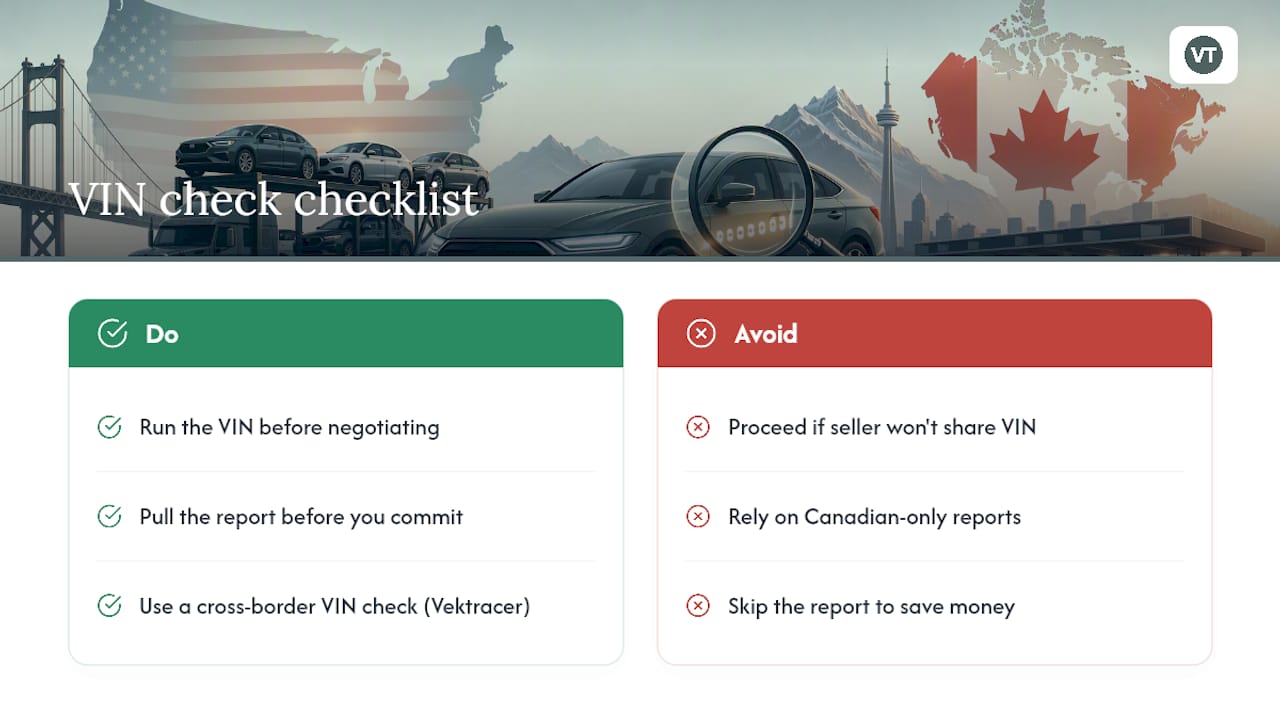
The single decision that consistently saves cross-border buyers time and money is running the VIN check before negotiating, not after. U.S. sellers don’t always know their vehicle carries a salvage or flood brand in another state’s records, and Canadian-only reports routinely miss those entries because they don’t pull from NMVTIS. Walking away from a vehicle with a hidden flood brand before you’ve paid is infinitely easier than trying to reverse an import after the fact.
On the AES timing: coordinate your filing with your transport or shipping schedule, not the other way around. If you’re using a carrier, get their estimated pickup date first, then file AES so the 72-hour window lands before the vehicle actually moves. Filing too early isn’t a problem; filing after the vehicle is already at the port of exit is.
Why a VIN check belongs at the top of your import checklist
The most expensive surprises in a cross-border import aren’t the taxes or the RIV fee. They’re the ones you didn’t see coming: a flood-branded title that only shows up in U.S. records, a lien the seller forgot to mention, or a salvage history that makes the vehicle inadmissible before you’ve even filed the AES.
Vektracer pulls from NMVTIS-connected U.S. sources and Canadian provincial records in a single VIN lookup, surfacing the cross-border title brands, accident history, theft records, and open recalls that a Canadian-only report can miss. Reports start at $19.99, which is a fraction of what a single border refusal or failed RIV inspection costs in time and rebooking fees.
Run the VIN before you negotiate the price. If the seller doesn’t share the VIN for a pre-purchase check, that’s your answer. See how Vektracer works and pull the report before you commit to anything.
Sources
- Importing a vehicle from the United States and Mexico
- Memorandum D19-12-1: Importing Vehicles into Canada
- Motor vehicle export guidance — U.S. Customs and Border Protection
- Frequently Asked Questions - Importing vehicles purchased in the United States into Canada
- Vehicle history reports and inspections — Vehicle Sales Authorities (VSABC)
- Import A Car From The USA To Canada: 2026 Guide | Ambassador
This article is general information, not a substitute for advice from a qualified lawyer. Consult a qualified legal professional about your own circumstances before acting on anything here.
FAQ
What documents are needed to import a car from the USA to Canada?
You need the original U.S. Certificate of Title (properly assigned to you), a Bill of Sale with the VIN and USD price, the AES Internal Transaction Number (ITN), a recall clearance letter from the manufacturer, proof of temporary Canadian insurance, government-issued ID, and a completed Form 1 (RIV e-Form 1) to present at CBSA. CBSA Memorandum D19-12-1 details the full proof-of-ownership requirements.
How much does it cost to import a car from the USA to Canada?
Beyond the purchase price, expect to pay 5% GST on the vehicle’s value at the border, provincial sales tax or HST at registration (rate varies by province), the RIV user fee, a possible federal excise tax on air conditioning, and modification and inspection costs. Vehicles without North American origin may also face a customs duty.
Can I import a car from the USA that is older than 15 years?
Yes. Vehicles 15 years old or older are generally exempt from the Motor Vehicle Safety Act and the RIV program, meaning they skip the federal inspection step. They still require CBSA clearance, full documentation (title, bill of sale, ID), and provincial registration. Transport Canada’s FAQ confirms this exemption applies to vehicles not sold at retail in the U.S. within the last 15 years.
Can a customs broker help me import a car from the U.S. to Canada?
A licensed customs broker can handle CBSA entry paperwork, duty and tax calculations, carrier coordination, and sometimes RIV follow-up, which is particularly useful for commercial imports, salvage vehicles, or complex title situations. For a straightforward private purchase with a clean title, many importers handle the process themselves using official Transport Canada and CBSA guidance.
Recommended
Ready to check a vehicle?
Enter any 17-character VIN for a free instant preview — no account needed.