Title Washing Explained and How to Avoid It
Check a vehicle before you buy
Enter a VIN for a free instant preview — accidents, title brands, mileage, liens & open recalls.
Title washing is the fraudulent removal of a salvage or junk brand by retitling a vehicle in another state. The immediate protection is to correlate title history across states with NMVTIS and a VIN history report before purchase.
You may be looking at a clean-looking used car right now, with a seller insisting that the title is clear and the price is fair. The vehicle may even look freshly repaired. The problem appears later, when an earlier record reveals that the car was declared salvage, sold through an auction, or moved between jurisdictions before its current title was issued.
Title washing is a vehicle-fraud practice that makes serious prior history harder to see. It can affect private-party buyers, dealers, auction shoppers, owners checking liens, and anyone relying on a license-plate or VIN lookup. This guide explains how the fraud works, why a clean current title isn't conclusive, and how to read a vehicle's timeline for missing links.
A government lookup and a commercial report serve different purposes. NMVTIS was created to centralize title-brand information, while state DMV tools generally provide a state-specific status or transaction check. A commercial VIN report can add auction, insurance, odometer, ownership, and cross-jurisdiction context, but no report guarantees that every record will be found. Missing or inconsistent reporting can leave gaps.
For a plain-language explanation of related title categories, see what a branded title means. Understanding that distinction helps you decide whether a vehicle deserves an inspection, a price adjustment, or no purchase at all.
Table of Contents
- Introduction What Title Washing Means for Used Car Buyers
- How Title Washing Works and Why Brands Disappear
- Common Methods Behind Washed Titles and Legal Context
- Official Checks Versus Commercial History Reports
- Red Flags and Detection Techniques That Reveal a Washed Title
- Step by Step VIN and History Checks Before You Buy
- Next Steps for Buyers Sellers and Dealers to Stay Protected
Introduction What Title Washing Means for Used Car Buyers
A seller sends photos of a polished sedan. The dashboard VIN matches the listing, the current title says “clean,” and the seller reports no serious problems. Then an earlier record shows the car was registered in another state and received a different title status after moving. That change does not prove fraud by itself, but it creates a question the current title cannot answer.
Title washing happens when a junk or salvage brand is lost or fraudulently removed after a vehicle is retitled in another state. A title brand should follow the vehicle like a warning label attached to its history. If that warning disappears during an interstate transfer, the document may look cleaner than the vehicle's complete provenance.
The U.S. Department of Justice says a 2009 NMVTIS pilot study estimated that the system could prevent title washing involving approximately 60,000 brands per year and reduce insurance payoffs on stolen vehicles by more than $200 million annually (U.S. Department of Justice NMVTIS consumer fact sheet). These figures describe the estimated scale of the problem and the purpose of centralized title data. They do not guarantee that every washed vehicle will be identified.
What buyers should understand first
A washed title may not involve an obviously forged document. The more useful clue is a broken provenance trail. The vehicle's reported history stops connecting cleanly across states, insurers, auctions, mileage records, or ownership transfers.
Read the timeline as carefully as the current title. A missing period, a sudden state change, a brand that vanishes, or an auction record that conflicts with the seller's story can show where the trail needs closer review.
Before paying, ask:
- Does the title brand match the vehicle's earlier history?
- Do the VIN, seller identity, and physical vehicle agree with the paperwork?
- Does the timeline explain each major change in location, ownership, and mileage?
- Do auction or insurance records conflict with the current title?
For a plain-language explanation of related title categories, see what a branded title means. A careful buyer treats a clean field as one clue, then compares documents and independent records, preserves the paperwork, and investigates unexplained gaps before money changes hands.
How Title Washing Works and Why Brands Disappear
A title brand should follow a vehicle like a warning label attached to its history. Salvage, junk, rebuilt, and flood designations signal a serious event or a legal classification. Because states use different definitions and procedures, the same vehicle can receive labels that do not match neatly after it crosses a state line.
Title washing occurs when that warning becomes incomplete or disappears during retitling. The U.S. Department of Justice explains that junk or salvage brands can be lost or fraudulently removed after a vehicle is titled in another state, as described in the NMVTIS title-washing explanation.
The basic sequence
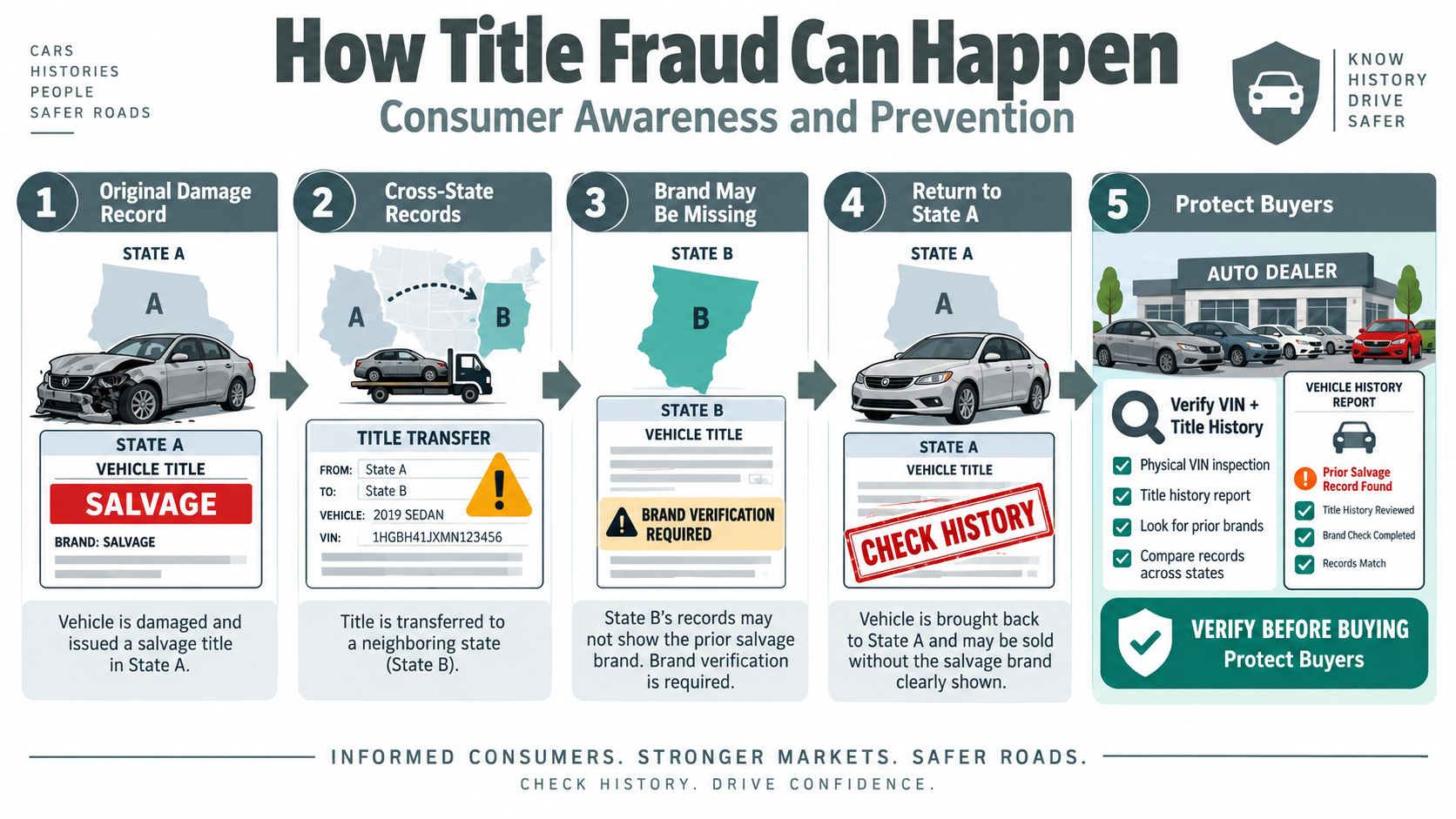
The pattern is easier to understand as a broken provenance trail:
- A vehicle receives a serious-damage or junk designation. An insurer, auction, or state authority records that the car suffered a major loss.
- The vehicle moves to another jurisdiction. That state reviews the available documents under its own titling and branding rules.
- The earlier warning becomes incomplete or disappears. The brand may be recorded differently, left out, or deliberately concealed.
- A new title is issued. The document may look clean even though older records still show the damage.
- The vehicle returns to the market. A seller may present the latest title as though it covers the entire story.
Congressional testimony described vehicles being titled and retitled across states so severe-damage brands would disappear. It also described brands being physically obscured before retitling, damaging the paper trail itself. See the Congressional testimony on title washing.
Practical rule: A title is one document in the vehicle's history, not the entire history.
Follow the vehicle's timeline rather than stopping at its current title. Compare prior-state records with insurance total-loss events, salvage-auction entries, ownership changes, and mileage history. A gap in time, a sudden change of state, a vanished brand, or an auction record that conflicts with the seller's account can mark the point where verification is needed. Records from another jurisdiction or an auction archive may preserve the missing chapter.
Common Methods Behind Washed Titles and Legal Context
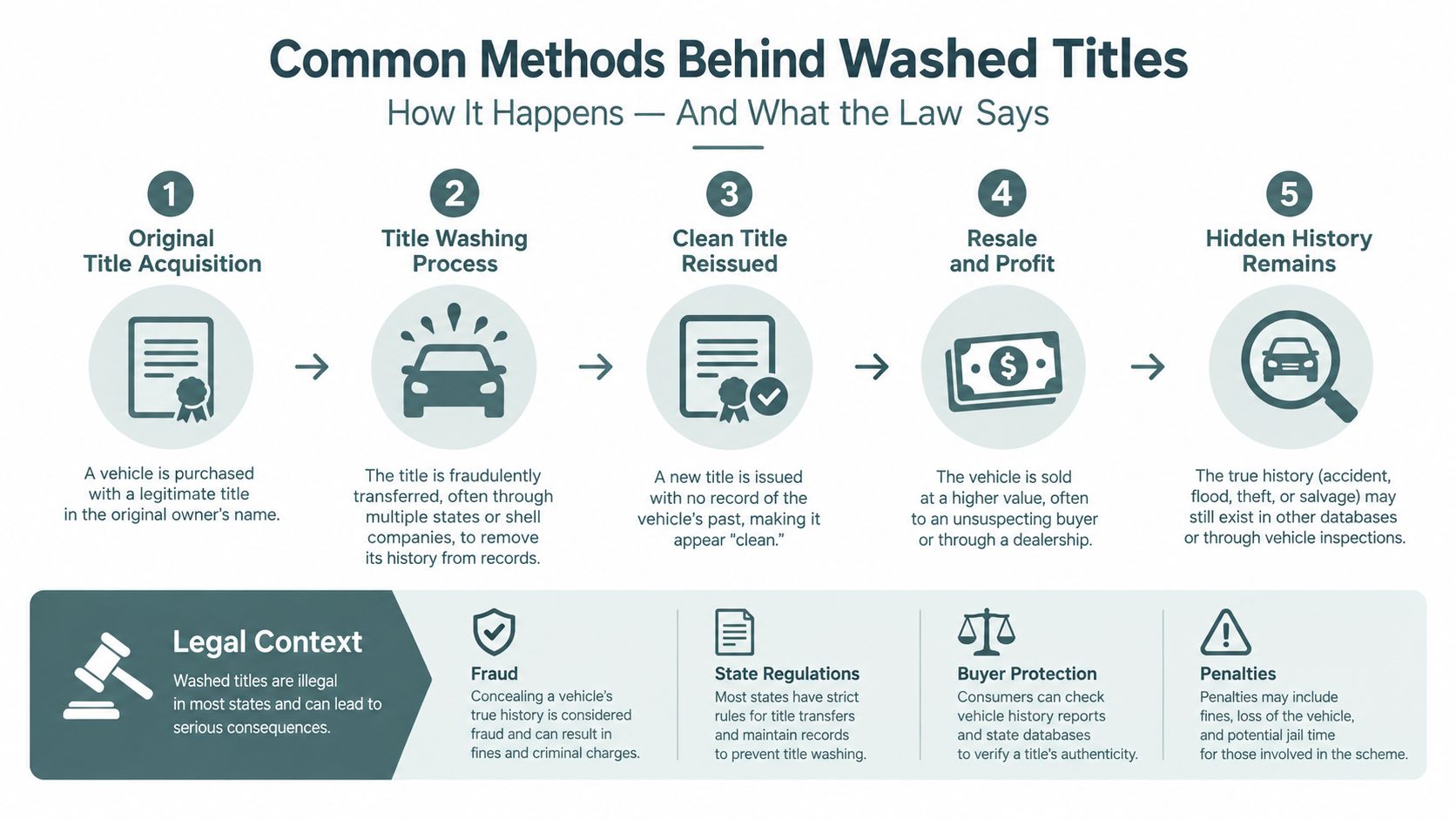
Interstate retitling is the central issue because title systems aren't identical. States can use different definitions, thresholds, procedures, and database connections for salvage, junk, rebuilt, flood, and other brands. A vehicle that moves through several jurisdictions can accumulate records that don't line up neatly, even without intentional fraud. Deliberate manipulation takes advantage of that fragmentation.
Repeated transfers create more opportunities for a record to become incomplete. A severe-damage event may appear in an insurer's file, then the vehicle may enter a salvage auction, move through a state with different branding treatment, and later receive another title. If the later document is reviewed without the earlier records, a buyer sees only the final chapter.
Cross-border movement adds another layer. Vehicles can move between the United States and Canada, and records may be distributed between different agencies, insurers, auction systems, and import documentation. A missing record isn't proof that a vehicle was washed, but it should reduce confidence in a clean-title conclusion.
Why NMVTIS exists
The federal government created the National Motor Vehicle Title Information System, or NMVTIS, to centralize title-brand information and reduce cross-state loopholes. The system is designed to help state titling agencies, consumers, insurers, and other authorized users identify title brands and related vehicle history.
NMVTIS still depends on the quality and completeness of reporting. If an underlying state, insurer, auction, or other source doesn't report consistently, aggregation can't restore information that was never supplied. That limitation is especially important when a vehicle has traveled across states or across the U.S. and Canadian border.
Title washing can also involve more than salvage or flood history. A broader review may reveal signals related to stolen vehicles, liens, commercial use, ownership context, or odometer concerns. The intended NMVTIS function includes helping prevent stolen vehicles from entering commerce, while title and lien records may be maintained through separate state processes.
The legal and ownership risk
No state officially authorizes title washing. The legal problem is the fraudulent concealment or alteration of material vehicle history, not the fact that a car was transported to another state. Buyers should avoid trying to resolve legal questions by relying on a seller's explanation alone.
A clean title doesn't prove low risk when the registration sequence is suspicious, the vehicle has repeated interstate transfers, or the physical condition conflicts with the records. The right response is verification through the relevant DMV, NMVTIS-supported information, the seller's documents, and a qualified inspection.
Official Checks Versus Commercial History Reports
Official checks and commercial reports shouldn't be treated as interchangeable. A state DMV may let you check a title or lien status for a vehicle registered in that state, while NMVTIS helps centralize title-brand information across participating jurisdictions. A commercial report can organize additional records into a timeline, but it remains dependent on available source data.
New York DMV provides a direct title-or-lien status check by VIN and notes that VINs used for that transaction can vary from 11 to 17 characters (New York title and lien lookup information). California DMV also offers a license-plate-or-VIN lookup for lien-sale excess fees. These examples show why official tools are valuable, but also why they aren't universal vehicle-history reports.
| Capability | Official State or NMVTIS Check | Commercial VIN History Report |
|---|---|---|
| Current state title or lien status | Useful when the vehicle is within that state's system and the lookup supports the requested transaction | May summarize title or lien signals, but critical findings should be confirmed with the relevant agency |
| National title-brand context | NMVTIS is designed to centralize title-brand information across participating jurisdictions | Can present brand history in a more readable vehicle timeline |
| Accident and insurance events | Usually limited by the agency and purpose of the lookup | May include reported accidents, insurance total-loss events, and damage records |
| Auction activity | Generally not the purpose of a DMV lookup | May include auction records, sale details, and historical photos where available |
| Odometer chronology | May show information held by the issuing agency | Can place reported readings into a timeline to identify inconsistencies |
| Ownership and registration context | Often limited to the state or transaction | May organize transfers across jurisdictions when records are available |
| Recalls and theft signals | Depends on the agency or specific tool | May combine recall and theft data, but the source and coverage should be reviewed |
A commercial report doesn't replace the physical title or a state agency. It adds context that can help you identify where the official questions should be asked.
For a closer explanation of what NMVTIS reports can and can't establish, review what buyers must know about NMVTIS vehicle history reports. Cross-checking at least two independent sources is a sensible practice when the vehicle has a complex interstate or cross-border timeline.
Red Flags and Detection Techniques That Reveal a Washed Title
A used car can look ordinary until its history is read as a connected trail. The useful question is not whether the latest title looks clean. It is whether the vehicle's locations, dates, mileage, brands, ownership changes, and physical condition form a believable story.
Start with the title's issue history. A new title after a state-to-state move deserves closer review, especially when the earlier jurisdiction is absent from the available record. The move may be legitimate. Ask why the title changed, whether the prior state records support the current brand, and whether the gap leaves an important event unexplained.
Build a timeline before judging the car
Create a simple chronology:
- Record the earliest known location: Note the first state or province associated with the VIN.
- Mark title transfers: Look for rapid or repeated movement between jurisdictions.
- Compare mileage readings: Flag jumps, reversals, or long periods without supporting entries.
- Locate insurance events: Check whether a total-loss or major-damage event came before a clean title.
- Review auction activity: A salvage-auction appearance may explain repairs that the current title does not mention.
- Compare the vehicle itself: Look for mismatched paint, uneven panel gaps, repaired welds, water-related corrosion, or interior damage that conflicts with the paperwork.
Cross-state title fraud has been discussed as a broken provenance trail, where the evidence becomes fragmented as a vehicle moves between jurisdictions (federal testimony on cross-state title fraud). A record limited to the current title state can miss information held in earlier state systems, insurance files, or auction archives. That is why a disappearing brand matters: it may mark a break in the trail rather than prove that the vehicle was never damaged.
When records and the vehicle disagree, pause the transaction. An inspection can explain a repair, but it cannot turn an unexplained title gap into a clean history.
Transaction patterns and location can add context. Discussion of NMVTIS and titling fraud points to the value of examining where rebuilt titles are issued, rather than treating every vehicle or seller the same (IACP discussion of NMVTIS). A state or seller is not automatically fraudulent. A concentrated or unusual transfer pattern calls for stronger verification and direct questions before purchase.
Step by Step VIN and History Checks Before You Buy
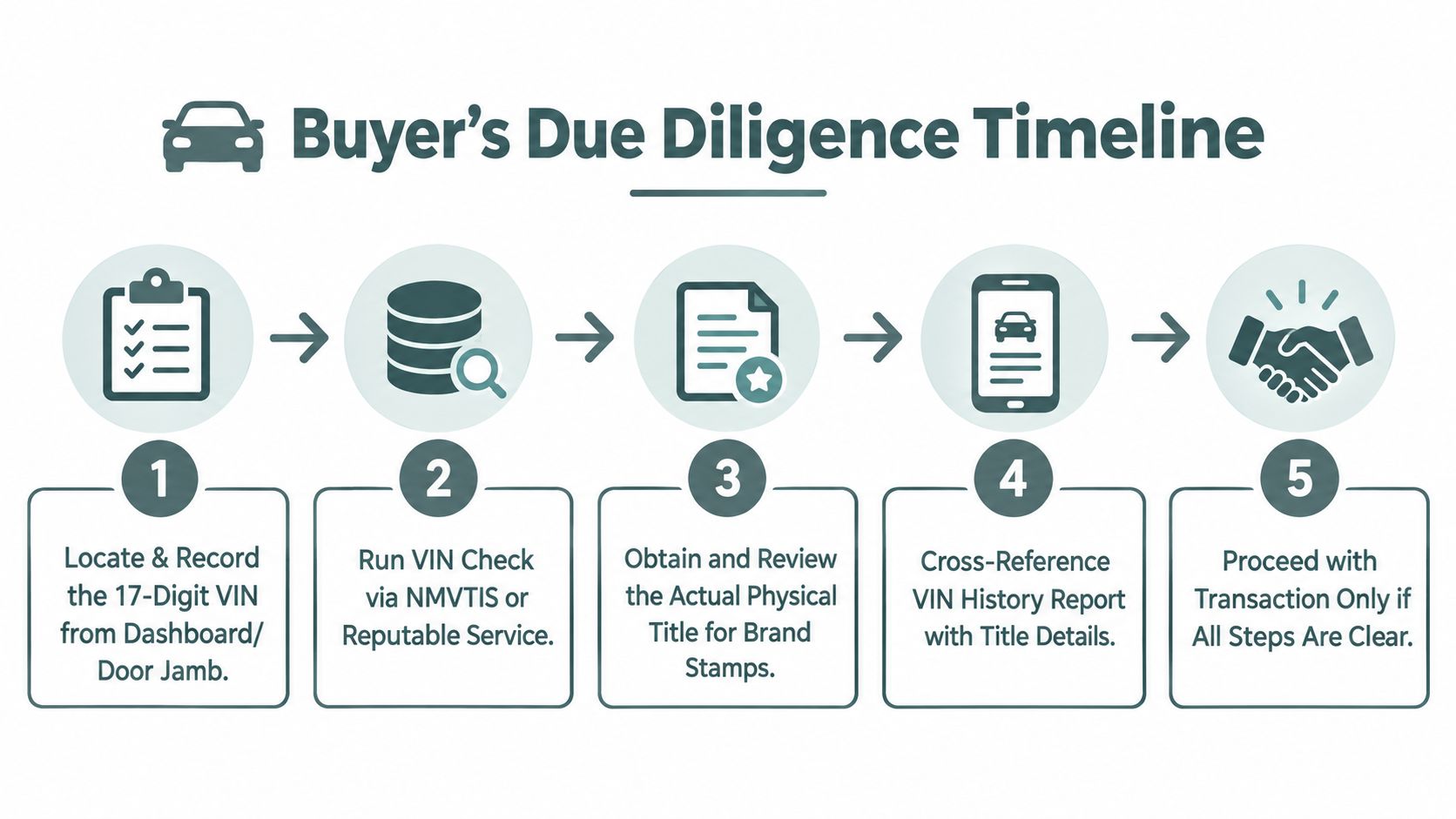
Begin with the vehicle, not the seller's screenshot. Locate the VIN at the dashboard and door jamb, then compare it with the title, registration, insurance paperwork, and listing. A standard modern VIN is commonly presented as 17 characters, but official transaction requirements can differ, so use the exact identifier requested by the relevant agency.
Follow the evidence in order
- Confirm the identifier. Check every visible VIN location for matching characters. Don't rely on a plate alone if the VIN is available.
- Run an initial lookup. Use an official state or NMVTIS-supported check to see whether title, brand, lien, or theft information is available. A free preview from a commercial provider can help confirm that the vehicle has usable coverage before you purchase a full report.
- Order a detailed history report when the vehicle remains viable. Review title brands, insurance losses, accident entries, auction records, historical photos where available, odometer readings, theft information, recalls, ownership transfers, and service records.
- Compare the timeline with the physical title. Check the title number, issuing jurisdiction, brand fields, VIN, seller identity, and apparent alterations. A clean field on the latest document doesn't erase an earlier conflicting record.
- Inspect before committing. Have an independent mechanic examine structural repairs, flood indicators, welds, paint transitions, safety systems, and underbody condition. Ask the seller to explain every major gap in writing.
Vektracer is one commercial option that compiles VIN-based records from government registries, insurance networks, auctions, theft databases, and service networks across the United States and Canada. Its reports can organize title brands, chronological odometer readings, accident and damage records, auction photos where available, ownership transfers, theft checks, recalls, and market-value context into one timeline. Coverage, fees, processing time, and available records vary by vehicle and source, so verify important findings with the relevant DMV, NHTSA, NMVTIS, insurer, or auction.
For readers checking vehicles outside this system, car check Ireland ShamAuto offers a separate guide to Irish vehicle checks. The agency and database structure differs by country, so don't assume a U.S. title procedure applies to an imported vehicle.
A practical walkthrough of the general research sequence is available in this step-by-step car history check guide. The central rule remains the same: use the VIN to connect documents, databases, physical condition, and the seller's explanation.
Next Steps for Buyers Sellers and Dealers to Stay Protected
A buyer should treat an unresolved timeline gap as a decision point, not a minor paperwork issue. Ask for the prior title, repair invoices, insurance documentation, auction information, and an independent inspection. If the seller can't explain why a salvage-related record is followed by a clean title, walking away is safer than assuming the missing information is harmless.
A private seller can reduce suspicion by disclosing known damage, retaining supporting documents, and giving a prospective buyer permission to verify the VIN independently. A recent history report isn't a substitute for honest disclosure, but it gives both parties a shared record to discuss.
Dealers and brokers need a repeatable process for auction inventory. Record the VIN at intake, preserve title and auction documents, compare U.S. and Canadian records when imports are involved, and keep report PDFs with the vehicle file. If a vehicle has an unusual registration sequence, don't market the clean current title as proof that the car has no material history.
The same caution applies to the transaction itself. Verify the seller's identity, confirm lien release requirements with the relevant authority, and research the business before sending funds. This guide on how to check a business before paying can help with the seller-side part of that review.
A clean title can describe the latest document without describing the whole vehicle.
When the database conflicts with the car, stop and document the conflict. Ask the DMV or title agency what it can verify, ask the seller for records, and use an independent inspection before deciding whether the price reflects the uncertainty.
Vektracer lets you enter a VIN or license plate to review available title brands, accident and damage records, odometer chronology, auction history, theft signals, recalls, and ownership context. Visit Vektracer to check the vehicle's available history before you buy, sell, or accept a title at face value.
Ready to check a vehicle?
Enter any 17-character VIN for a free instant preview — no account needed.