Missing Catalytic Converter: Your 2026 Buyer's Guide
Check a vehicle before you buy
Enter a VIN for a free instant preview — accidents, title brands, mileage, liens & open recalls.
You're looking at a used car that seems cheap for the year and mileage, then you start it and the exhaust note is way too loud. That's not a small cosmetic issue. A missing catalytic converter can turn a “good deal” into a car with legal problems, repair bills, registration trouble, and a vehicle history trail that suggests theft, undisclosed damage, or a sloppy prior repair.
For a buyer, the key question isn't just “Is the converter gone?” It's why it's gone, whether the seller can document it, and what that missing part says about the car's true risk.
What a Missing Catalytic Converter Really Means
A catalytic converter is part of the exhaust system. Its job is simple in buyer terms. It cleans up exhaust before it leaves the tailpipe.
When it's missing, the car usually gets louder right away. But noise is only the obvious symptom. The bigger problem is that the vehicle has lost a required emissions component, and that creates mechanical, legal, and financial risk all at once.
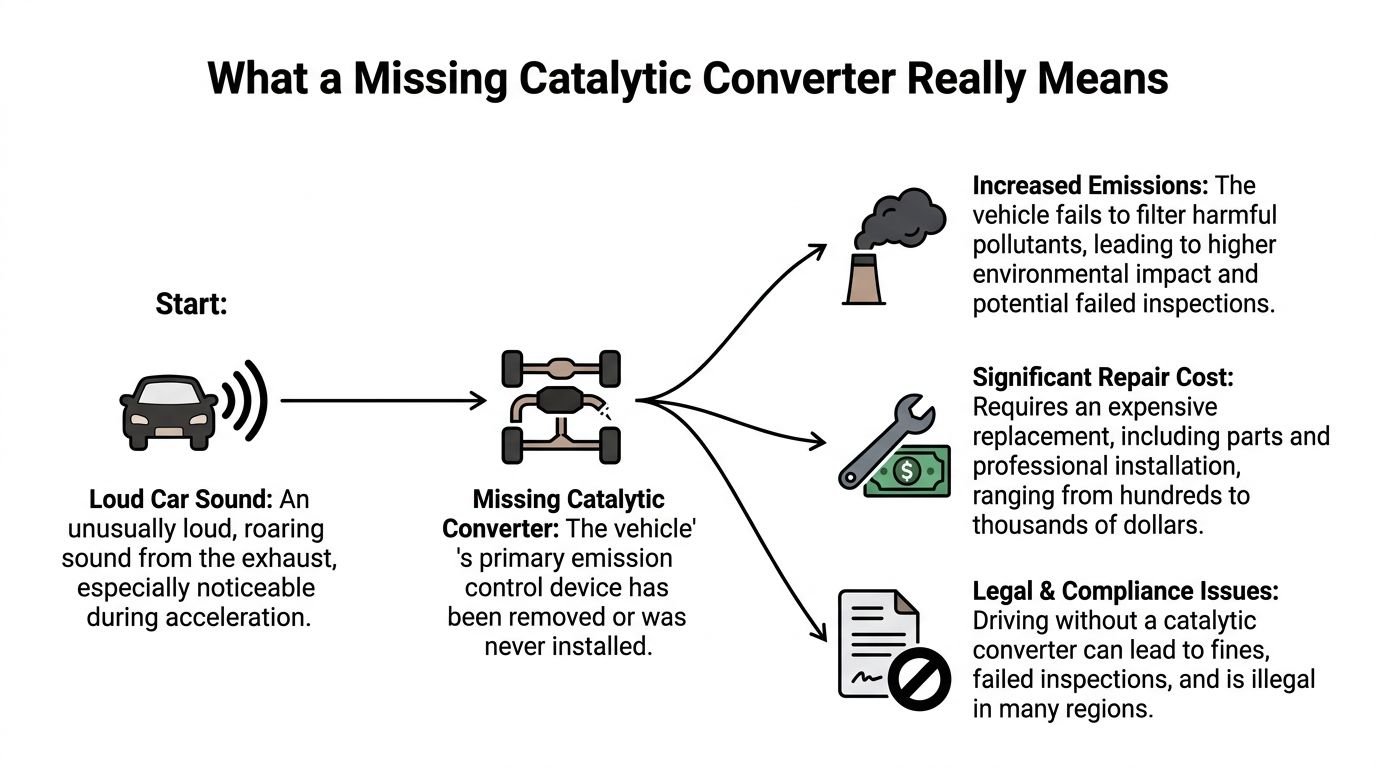
What happens when the converter is gone
On most modern vehicles, the engine computer notices fast. A P0420 fault code gets triggered because the rear oxygen sensor signal no longer behaves the way it should. With the converter missing, the rear O2 sensor reads raw exhaust gas instead of converted exhaust, and the mismatch can push long-term fuel trim beyond a 5% deviation, which affects fuel calibration, drivability, and can contribute to engine problems over time, as shown in this diagnostic explanation of the P0420 pattern.
That matters to a buyer because a seller may frame the problem as “just an exhaust part.” It isn't. Once the converter is removed, the car can idle rougher, smell stronger from the exhaust, and keep the check engine light on even if the seller has cleared codes recently.
Practical rule: If the seller says the car “just needs a muffler,” but the underbody shows a gap where the converter should sit, assume the problem is bigger until proven otherwise.
Why buyers should treat it as a red flag
Three issues come up immediately:
- Legality: The car isn't emissions compliant with the converter missing.
- Repair exposure: You're not buying one part. You may be buying a repair chain that includes sensors, cut exhaust sections, clamps, or welded pipe correction.
- History risk: A missing converter can point to theft, but it can also point to an undisclosed accident or a prior owner unloading the car after a loss event.
A clean-looking body doesn't erase that risk. I've seen buyers focus on paint, tires, and panel gaps while missing the fact that the car sounds like an open pipe and has fresh cuts under the center floor.
The transaction issue most buyers miss
The missing converter changes the entire deal. It affects what the car is worth, whether it can pass inspection, and whether the seller's story makes sense.
If the car is being sold privately, ask one direct question: Was the converter stolen, removed during a repair, or intentionally cut out? If the answer is vague, defensive, or unsupported by receipts, slow down.
Your Physical Inspection Checklist for a Missing Converter
You don't need to be a technician to catch this. You need a flashlight, a few minutes, and the discipline to look under the car before you talk price.

What to look for under the car
Start near the exhaust path between the engine and the muffler. On many vehicles, the converter sits in the middle section, though location varies by model.
Use this quick checklist:
- An obvious empty space: If you see two exhaust pipe ends with a gap between them, that's the first big sign.
- Fresh cuts or saw marks: Theft usually leaves rough cuts. They often look bright, recent, and uneven.
- New pipe in one section only: A shiny replacement section next to older exhaust parts can mean someone bypassed the converter instead of repairing the system correctly.
- Messy welds: Poor weld beads or quick patch work often show that someone did the cheapest possible fix.
- Loose or missing hangers: If the system was cut quickly, the exhaust may hang differently than it should.
If you want a broader walkaround routine before purchase, use this used car inspection checklist for buyers and dealers alongside the converter check.
What to listen for
Start the engine cold if you can. A missing converter often gives the car a harsh, roaring exhaust note, especially on startup and when you blip the throttle lightly.
Don't let the seller drown that out with conversation, music, or a warm engine that's already running when you arrive. Ask for a true cold start.
If the car sounds much louder than other stock examples of the same model, stop assuming and get underneath it.
What sellers do to hide it
Not every missing converter is obvious from standing height. Some sellers try to control the inspection.
Common tactics include:
- Parking over gravel, grass, or a curb so you can't get a clear line of sight.
- Warming the engine before you arrive so startup noise is less noticeable.
- Clearing codes before the showing.
- Calling it a “straight pipe upgrade” on a daily driver that clearly wasn't built as a legal modified car.
A straight answer comes with documentation. A risky sale comes with excuses.
Using a Vehicle History Report to Uncover the Truth
Physical inspection tells you what's missing. A vehicle history report helps you understand why.
That distinction matters. A converter can disappear because it was stolen in a parking lot. It can also be missing because the car was damaged underneath, repaired cheaply, or moved through a title history where corners were cut. For a buyer, those are very different risk profiles.

What to look for in the report
The report doesn't just confirm theft. It can reveal the surrounding story.
Check for these patterns:
| Report clue | What it may mean for a missing converter |
|---|---|
| Theft or damage entry | The converter may have been cut off in a documented theft event |
| Prior accident or undercarriage damage | The exhaust may have been damaged and never properly restored |
| Salvage, rebuilt, or inconsistent title trail | The car may have been put back on the road with incomplete repairs |
| Mileage irregularities | The seller may already be hiding one problem, and the missing converter is another signal |
Vehicle history reports from providers like CARFAX and AutoCheck can flag a missing catalytic converter under damage or theft categories, and that flag can reduce market value by 15% to 25%, according to this overview of vehicle history report cost and risk-score usage. That's one reason buyers should read the report as a negotiation and fraud-screening tool, not just a title check.
Theft versus hidden damage
A straightforward theft case usually looks cleaner on paper. You may see a theft-related insurance record, a repair invoice, and a timeline that makes sense. The seller can often show when it happened and what was replaced.
A more troubling case looks messy. The car may have underbody damage history, a rebuilt title path, odd service gaps, or a seller who says, “It's been like that since I bought it.”
That's where buyers need context, not just data dumps. If you're comparing report options and trying to decide whether legacy reports are enough, it helps to review how a report is supposed to work in the first place. This guide on what a vehicle history report includes is useful before you run one. If you're also weighing providers, a side-by-side look at CARFAX comparisons can help. For cross-border shoppers, the right starting point may be a VIN check Canada search or a VIN check USA search, depending on where the vehicle has been registered.
A cheap car with a missing converter and a fuzzy title story is rarely a bargain. It's usually a cleanup project someone else wants you to finance.
The buying decision
If the report shows a documented theft and complete repair records, you may still have a workable deal if the converter is now properly installed. If the car still has the converter missing and the report shows broader history concerns, treat the missing part as a symptom, not the full problem.
If you're serious about the car, run the VIN before you hand over a deposit. That small step is often the difference between buying a repairable theft victim and buying a title headache with an exhaust issue attached.
The True Cost to Repair and Replace
A missing converter changes the deal math fast. The asking price may look attractive, but the actual number is the purchase price plus exhaust repair, compliance parts, inspection risk, tow costs if the car is too loud or unsafe to drive, and the chance that the damage under the car is worse than the listing shows.
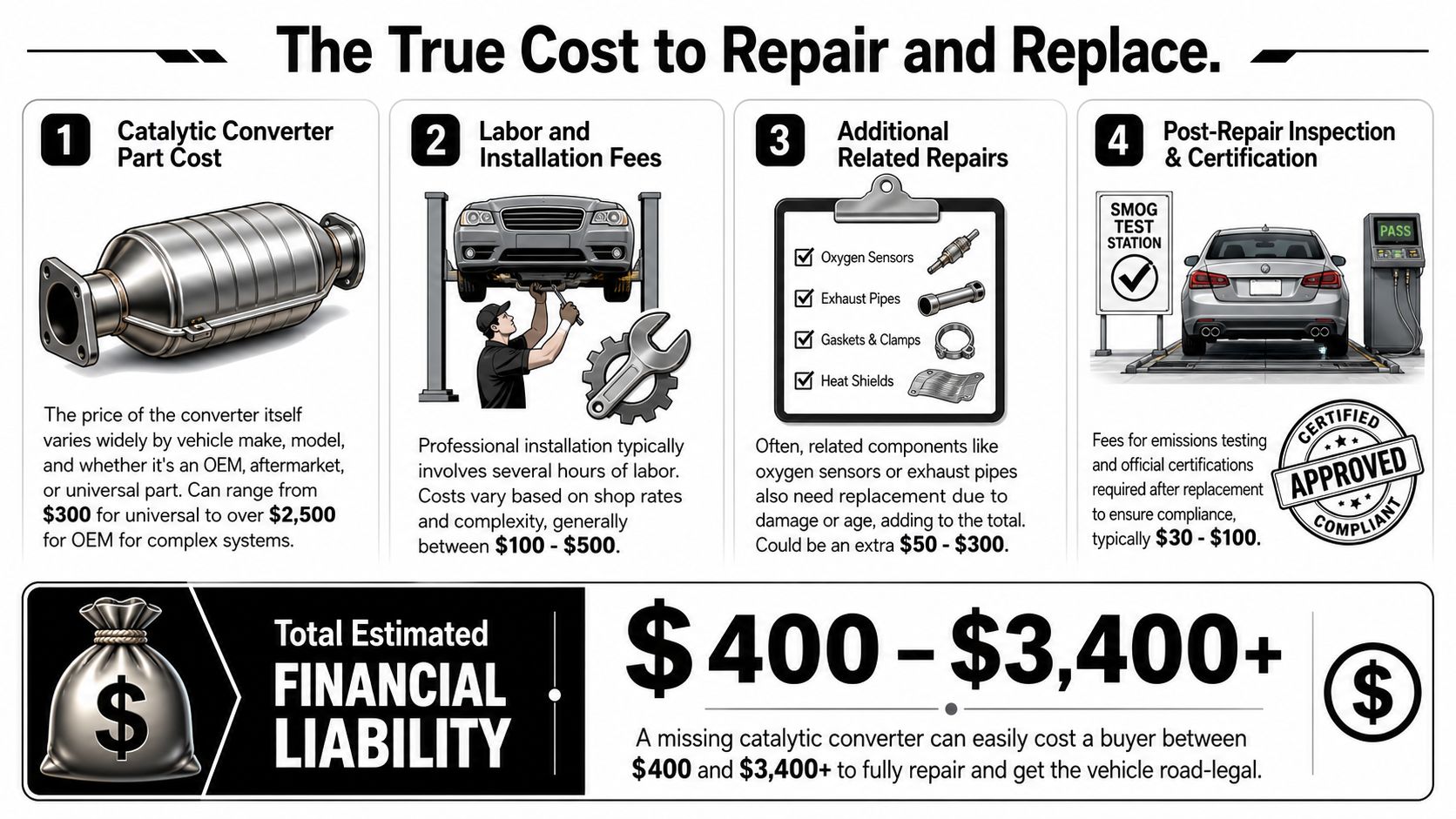
What the repair bill usually includes
AAA notes that catalytic converter replacement can run from hundreds of dollars into the thousands, depending on the vehicle and what was damaged with it, in its guide to catalytic converter theft and replacement costs. That range is broad for a reason. Shops price the whole repair, not just the metal canister that went missing.
A proper estimate usually includes:
- The converter assembly: OEM, direct-fit aftermarket, or a compliant unit approved for that vehicle and state.
- Pipe and flange repair: Thieves often cut more pipe than necessary, which leaves the shop fixing missing sections before the new converter even goes in.
- Oxygen sensors and wiring: If sensors were cut, cracked, or contaminated, the check engine light problem does not end with the converter.
- Labor and diagnostics: The shop still has to confirm there are no exhaust leaks, sensor faults, or catalyst efficiency codes after installation.
I tell buyers to expect variance, not a clean average.
Why one “cheap fix” turns expensive
The seller's favorite line is, “It just needs a converter.” Sometimes that is true. Often it is incomplete.
A targeted truck, hybrid, or late-model SUV can require a more expensive assembly, and some states are stricter about which replacement parts are legal to install. A cheap universal unit may lower the noise and still leave you with a car that fails inspection, triggers codes, or cannot be registered without more work. If you buy for business use, road-legal status matters beyond passenger-car convenience, and Premier Fleet Repair LLC's 2026 guide is a useful reference point for how inspection standards affect operating vehicles.
The transaction risk matters just as much as the repair line items. If a seller is pricing the car as though the problem is minor, but the underbody shows rough cuts, missing shields, or patched exhaust work, assume the discount is not enough until a shop has seen it.
Shop-floor reality: the first quote is often the best-case number. Cut wiring, damaged flanges, and failed sensors push the final invoice higher.
Buyer takeaway
Treat a missing converter as a value adjustment, not a simple parts order. Price the car as if you may need exhaust work, diagnostics, compliance-approved parts, and a second inspection after the repair.
Also look at the insurance angle before you close. A car with theft history, prior claims, or salvage-related issues can cost more to insure or cover poorly, and this guide on how vehicle history affects insurance costs for used car buyers helps frame that risk. If the seller cannot support the story with paperwork and the numbers only work under a best-case repair scenario, walk away or negotiate from the assumption that the converter is only one part of the problem.
Avoiding Legal and Insurance Nightmares
A lot of buyers assume the hard part is paying for the repair. Often, the harder part is dealing with registration, coverage, and paperwork after the sale.
A missing catalytic converter isn't just a mechanical defect. It can turn into an insurance dispute or a registration problem fast.
Mistakes buyers make
The first mistake is assuming insurance will automatically cover the theft. Many full-coverage policies may exclude theft of parts if the theft wasn't reported within 24 to 48 hours or if the vehicle was parked in a place the insurer considers unsecured, based on this consumer guide to stolen catalytic converter signs and insurance nuances.
The second mistake is assuming you can just drive the car home and sort it out later. A missing converter can stop the vehicle from clearing emissions-related requirements, which affects registration and resale. For commercial buyers, fleet managers, and dealer operators, inspection compliance matters across the whole vehicle, not just the exhaust. That's why practical references like Premier Fleet Repair LLC's 2026 guide are worth keeping on hand when you're evaluating road-legal status and documentation standards.
What works and what doesn't
Here's the plain version.
- What works: Getting the seller to provide theft documentation, claim records, repair invoices, and proof the car is currently compliant.
- What doesn't: Taking the seller's word that “insurance was going to handle it” or “the shop said it's fine to drive.”
If you're buying from a private party, verify whether the issue was ever reported. If you're buying from a dealer, ask for the repair order and emissions-related paperwork. If those documents don't exist, you're carrying the risk.
A useful companion read is this breakdown of how vehicle history affects insurance costs for buyers, because the missing converter may be only one factor pushing a vehicle into a more expensive or harder-to-insure category.
Paperwork closes risk. Stories don't.
The legal side buyers underestimate
The legal trouble usually doesn't arrive at the seller's driveway. It shows up later, when you try to register the car, pass inspection, or explain a visible exhaust modification that shouldn't be there.
That's why a missing converter belongs in the “fix before purchase or walk away” category for most retail buyers.
How to Negotiate or When to Walk Away
If the converter is missing, negotiate from the position that the car is not retail-ready. It has an emissions defect, a likely diagnostic issue, and a history question attached.
For buyers, there are two reasonable paths.
First, negotiate only if the seller is transparent and the documentation is clean. That means a clear story, receipts, and enough price room to cover the repair burden and the hassle. Use the repair exposure and the market-value hit tied to a theft or damage flag as a bargaining tool. Don't negotiate off the seller's opinion. Negotiate off what it will take to make the car compliant and saleable again.
Second, walk away if the facts don't line up. Walk if the seller won't allow an inspection. Walk if the VIN history is inconsistent. Walk if the underbody shows cut pipes and the seller claims ignorance. Walk if the asking price is “cheap” but not cheap enough to absorb both the repair and the hidden-risk premium.
For private sellers, the smart move is simple. Repair it correctly before listing, or disclose it clearly with a written estimate and any theft or insurance paperwork.
For dealers, this is even more direct. Selling a vehicle with a missing converter is a reputation risk and a comeback problem waiting to happen. A dealer should either repair it to compliance or wholesale it transparently rather than present it like a normal front-line used car.
If you still like the vehicle, make the sale contingent on a professional inspection and a verified vehicle history report. If the seller resists either one, you already have your answer.
Frequently Asked Questions
Which vehicles get targeted most often
Hybrid models and high-volume trucks and SUVs show up repeatedly in theft claims because their converters contain valuable metals and are often easy to reach from underneath. The usual suspects include the Toyota Prius, Honda Accord, Honda CR-V, Ford F-150, and Ford Explorer, which aligns with theft trend reporting from the National Insurance Crime Bureau.
For a buyer, that matters for two reasons. First, a target model deserves a closer underbody inspection. Second, a missing converter on one of these vehicles is easier for a seller to explain away as “common theft,” even when the actual cause may involve prior damage, an unfinished repair, or a car pushed back into the market too quickly.
How common is catalytic converter theft really
It became a nationwide theft pattern, not a rare one-off problem. Marketplace's reporting, citing insurer and industry data, showed theft claims climbed sharply over a short period, and the scale was large enough to affect repair costs, insurance claims, and parts availability across the market, according to Marketplace's reporting on NICB and insurer data.
Buyers should treat that context carefully. High theft volume makes a missing converter plausible, but it does not make the seller's story automatically credible.
Will an anti-theft cage or shield stop it
It helps, but it does not guarantee protection.
In the shop, these devices are best viewed as delay tools. They make cutting the converter out slower, louder, and more frustrating. That often pushes a thief toward an easier vehicle, but a determined thief with time and tools can still get through.
Can a missing converter mean more than theft
Yes. I would never treat a missing converter as a theft case by default.
It can point to prior collision damage, a sloppy or incomplete exhaust repair, salvage or rebuilt history, or a seller unloading a car with known problems before the next inspection cycle. In a transaction, that is the bigger risk. The missing part hurts value, but the hidden story behind it can hurt far more if the VIN record, title trail, and repair history do not line up.
Is a loud exhaust enough to confirm it
No. A loud exhaust only tells you something is wrong in the system.
A cracked flex pipe, broken flange, rusted-out section, or muffler failure can sound severe. The car still needs an underbody inspection to confirm whether the converter is gone, partially cut, or replaced with the wrong part.
Is it ever worth buying a car with a missing catalytic converter
Sometimes. The deal has to make sense on paper and under the car.
That means the seller can document what happened, the title and VIN history are clean, and the discount covers the actual repair, the time off the road, and the resale penalty that follows a car with theft or damage baggage. If any part of that picture is shaky, the cheapest price on the listing often turns into the most expensive car to own.
If you want to verify whether a missing catalytic converter is a simple theft case or part of a bigger title, damage, or mileage problem, run the VIN through VekTracer. It's a practical way to check accident history, theft records, mileage flags, title data, recalls, and a vehicle risk score before you commit to the wrong car.
Ready to check a vehicle?
Enter any 17-character VIN for a free instant preview — no account needed.