How to Remove a Lien from a Car Title in Ontario
Check a vehicle before you buy
Enter a VIN for a free instant preview — accidents, title brands, mileage, liens & open recalls.
A lien stays with the vehicle until it's formally discharged. To remove a lien from a car title in Ontario, the secured debt must be paid, the lender must provide written proof of release, and the discharge must be recorded in Ontario's registry.
You may be dealing with this right now because a buyer found an encumbrance during a private sale, a lender says the loan was paid but the vehicle record still isn't clear, or a used-car listing looks clean while the paperwork tells a different story. The important distinction is simple: payment clears the debt, but only a recorded discharge clears the lien from the vehicle record.
Ontario buyers and sellers should treat lien removal as a compliance process with two milestones. First, the owner satisfies the secured debt and obtains a lien-release or discharge document. Second, that document is used to update the provincial record so the vehicle shows clear status. A sale, ownership transfer, clean-looking advertisement, or verbal promise doesn't complete either step.
Table of Contents
- What Removing a Lien Really Means in Ontario
- How to Verify a Lien Before You Try to Remove It
- Paying Off the Debt and Getting the Discharge Recorded
- How to Confirm the Title Is Actually Clear
- Common Problems That Keep a Lien on the Record and How to Fix Them
- Your Next Step to a Lien Free Title in Ontario
What Removing a Lien Really Means in Ontario
A private seller may tell a buyer, “The loan is paid off.” That sounds reassuring, but it doesn't prove the vehicle is free of the lender's claim. In Ontario, a lien remains attached to the vehicle when the car is sold or ownership changes, and it stays there until the lienholder formally discharges it. The Financial Consumer Agency of Canada explains the risk of buying a vehicle with a lien, including why buyers should require written confirmation before completing the purchase.
The same issue appears from the seller's side. A seller may have made the final loan payment months ago, yet the record can still show an active security interest if the lender hasn't issued or recorded the discharge. A buyer, lender, dealer, or registration office may then stop the transaction until the paperwork catches up.
Practical rule: A paid loan and a clear vehicle record are related, but they aren't the same thing.
The two milestones that matter
The first milestone is financial. The secured party, usually a bank, finance company, repair business, or other creditor, must receive the amount required to satisfy the debt. After payoff, request a written lien release or discharge document that identifies the vehicle and confirms the secured claim has been released.
The second milestone is administrative. The discharge must be recorded through Ontario's personal property security system so the registry no longer shows the lien. Ontario's official registration and lien-search service remains part of the provincial vehicle-record process, with ServiceOntario contact channels listed for security-interest searches and updates, including Toronto 416-325-8847 and toll-free 1-800-267-8847.
That means the practical journey is:
- Verify the lien and identify the secured party.
- Contact the lender for the official payoff instructions.
- Pay the secured debt in full.
- Obtain written discharge evidence.
- Record or confirm the discharge in the Ontario registry.
- Recheck the vehicle record before calling the title clear.
Why a sale doesn't solve the problem
Ontario registers the security interest against the vehicle, not merely against the individual who borrowed the money. If the seller transfers the car while the lien remains active, the buyer can inherit a serious practical problem connected to the unpaid secured debt. That's why a buyer shouldn't rely on a seller's statement that the lender has been paid.
A seller should clear the lien before listing whenever possible. If the sale must happen while financing remains outstanding, both parties should agree in writing on how the lender will be paid, who will obtain the discharge, and what documents must be delivered before the buyer treats the vehicle as clear.
How to Verify a Lien Before You Try to Remove It
Start with verification, not a phone call to a lender chosen from memory. You need to know whether a lien exists, which secured party registered it, and which record details will later be required for the discharge.
Use Ontario's official documents and registry
For a private purchase, ask for the Used Vehicle Information Package, commonly called the UVIP, and review the vehicle information carefully. Ontario also directs buyers toward lien-search tools because the security interest is registered against the vehicle. The provincial Personal Property Security Registration help guidance explains the discharge process and the identifying information used in the registry.
Keep the following details together before contacting the lender:
- VIN: Match the vehicle identification number on the car, the seller's documents, and every search result.
- Make and model year: Use these to catch obvious record inconsistencies.
- File number: Preserve the registration file number shown in the security-interest record.
- Debtor name: Record the name exactly as it appears, including spelling and formatting.
- Secured party name: Capture the lender or creditor's exact registered name.
- Record status: Note whether the entry appears active, amended, partially discharged, or otherwise changed.
The file number and names matter because Ontario's discharge workflow depends on matching the registry record. A correct VIN alone may not resolve a mismatch in the debtor or secured-party information.
Add a VIN history check for context
An official registry search is the controlling check for the registered security interest, but it doesn't replace broader vehicle research. A VIN-based history report can add context about title brands, accident or damage records, ownership transfers, odometer history, theft records, and auction activity where available. That context is useful for buyers examining salvage or auction vehicles, cross-border inventory, private-party listings, and Carfax-alternative options.
Use the official search to answer, “Does the provincial record show a security interest?” Use the history report to ask, “Does the vehicle's broader timeline make sense?” Neither source guarantees that every lien, accident, owner, or record will appear.
For a focused explanation of the provincial process, use this Ontario PPSA lien-search guide alongside the official registry result. Don't treat a commercial report as government proof, and don't treat a clean commercial result as permission to skip the official search.
Paying Off the Debt and Getting the Discharge Recorded
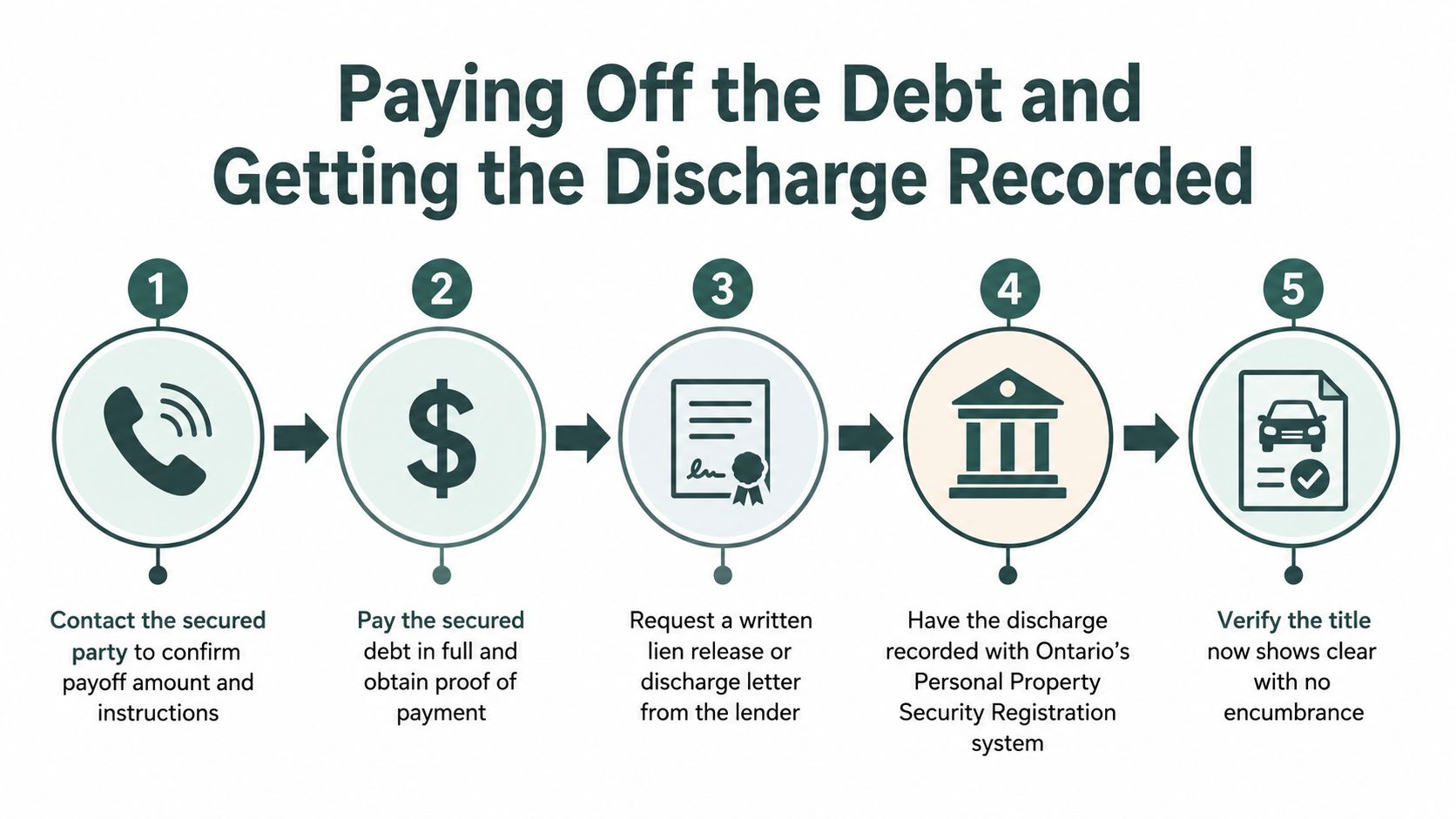
Once the lien is confirmed, control the sequence. The most common mistake is stopping after the payment clears. In Ontario, the discharge is the step that changes the registry record, so the lender's instructions and the registry details must line up.
Contact the secured party first
Call the secured party using a verified contact channel, not only a number supplied in an informal message. Ask the representative to confirm:
- The lien is still registered against the vehicle.
- The exact payoff amount and payment instructions.
- The date through which that payoff amount is valid, if applicable.
- The documents the lender will issue after receiving payment.
- Whether the lender files the discharge directly or expects the owner to submit or confirm it.
- The file number and registered names that will appear on the discharge.
If you're buying the vehicle, ask the seller to authorize direct confirmation with the lender. For a private transaction, payment should be structured so the secured party receives the required payoff, rather than sending the entire purchase price to the seller and hoping the debt is handled later.
Pay the debt and preserve proof
Pay the secured debt according to the lender's instructions. Keep the payment confirmation, receipt, correspondence, and any account statement showing that the balance was satisfied. Payment evidence helps, but it isn't a substitute for the lender's written release.
Request a document that clearly identifies the lien release or discharge. It should connect the release to the vehicle and the registered creditor. If the lender sends a generic account-paid notice without discharge information, ask whether a separate lien-release letter or registry discharge confirmation is required.
A seller should give the buyer copies only after checking that the documents are complete and legible. A buyer should compare the VIN and names against the official search before accepting the paperwork.
Record the discharge accurately
Ontario's PPSA process removes a lien through a discharge or partial discharge filed on the personal property registry. The registry guidance states that a discharge requires the original file number, the debtor name, and the secured-party name. The filing must be designated as a discharge and include the required section 13 information.
The practical filing sequence is:
- Obtain the lender's release: Don't begin with an unsupported verbal claim.
- Match the identifiers: Compare the file number, debtor name, and secured-party name with the registry entry.
- Submit or confirm the discharge: Follow the registry or lender instructions for recording the release.
- Keep the confirmation: Save the discharge record with the lender's letter and payoff proof.
- Search again: Confirm the active encumbrance no longer appears.
Ontario lien guidance indicates that amending, partially discharging, or fully discharging an Ontario lien is no charge through the relevant registration process, as described in UCDA's Ontario lien-registration guidance. The cost isn't the main obstacle. Accuracy and completion are.
Buyer and seller payment choices
A seller can pay off the debt before advertising the vehicle, which produces the cleanest sale process. If the seller can't fund the payoff independently, the buyer and seller can coordinate payment directly to the lender, with the remaining purchase funds handled separately. The lender's written instructions should govern the transaction.
Don't hand over the full purchase price because the seller promises to pay later. Don't accept a photograph of a supposed release without matching it to the registry entry. If the buyer must take possession before the record is updated, the parties should document the arrangement, retain the discharge evidence, and understand that possession doesn't equal a clear lien record.
The workable sequence is payment, written release, recorded discharge, and a fresh search. Skipping the third step leaves the control point unfinished.
For document wording and practical questions to ask the lender, see this guide to a car lien release letter. Keep the original documents, not just screenshots, because a later buyer or registry representative may need clear evidence.
How to Confirm the Title Is Actually Clear
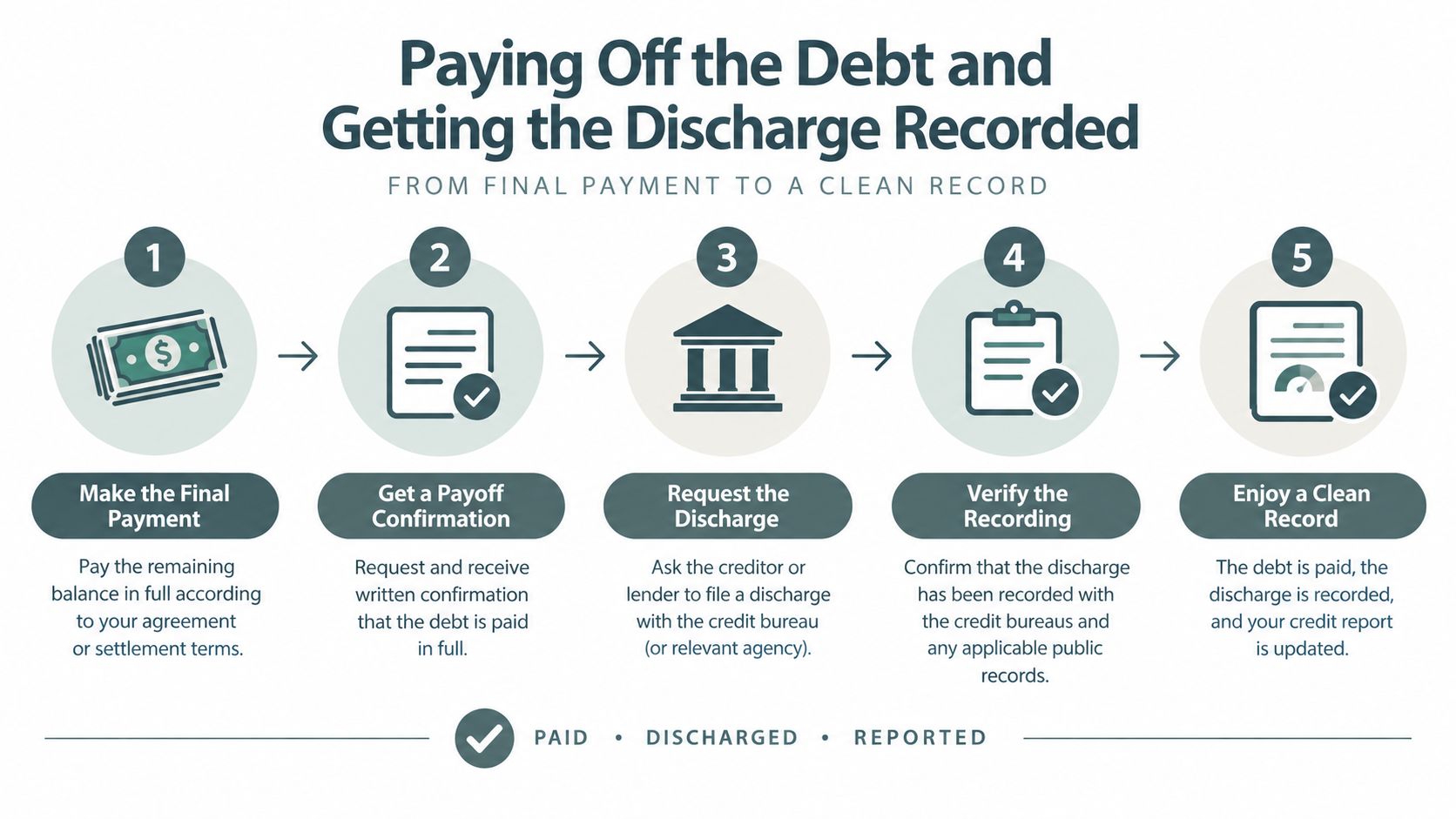
A lender's email saying “paid” is encouraging, but it doesn't complete verification. After the discharge is submitted or recorded, run the provincial search again and compare the result with the original entry. You want to see that the registered security interest has been discharged, not merely that the loan account shows a zero balance.
A current UVIP or other official vehicle-record result can support the ownership and registration review. Keep the discharge letter, registry confirmation, and updated vehicle documentation together. If you're selling, that package gives the buyer something concrete to review instead of asking for trust.
A commercial VIN report answers a different set of questions. It may show title brands such as salvage or rebuilt, accident and damage events, odometer history, ownership transfers, theft information, auction records, and timeline context where those records are available. Vektracer is one commercial option that compiles VIN-based vehicle-history records, including lien and loan information with lienholder and release-status details in its full report, but it isn't a government agency and its report shouldn't replace the official Ontario security-interest search.
| Check Type | What It Proves | Best Use | Limitation |
|---|---|---|---|
| Official Ontario registry search | Whether the provincial security-interest record shows an active lien or recorded discharge | Confirming the legal registry status before purchase or sale | It doesn't provide a complete accident, auction, odometer, or ownership timeline |
| UVIP and vehicle registration records | Vehicle and registration information supplied through Ontario's official process | Reviewing the vehicle's provincial record and supporting a private sale | It isn't a substitute for every security-interest or historical record check |
| VIN history report | Broader reported history, such as title brands, damage, odometer, ownership, and auction context | Screening a vehicle and finding inconsistencies across jurisdictions | Coverage varies, and a clean report isn't proof that no lien exists |
| Lender release document | The secured party's written confirmation that the debt and lien have been released | Proving payoff and supporting the registry update | It doesn't prove the registry has already been updated |
Before closing a deal, follow this lien-release verification checklist. The strongest file contains all three layers: lender proof, an updated official record, and a current VIN history review.
Common Problems That Keep a Lien on the Record and How to Fix Them
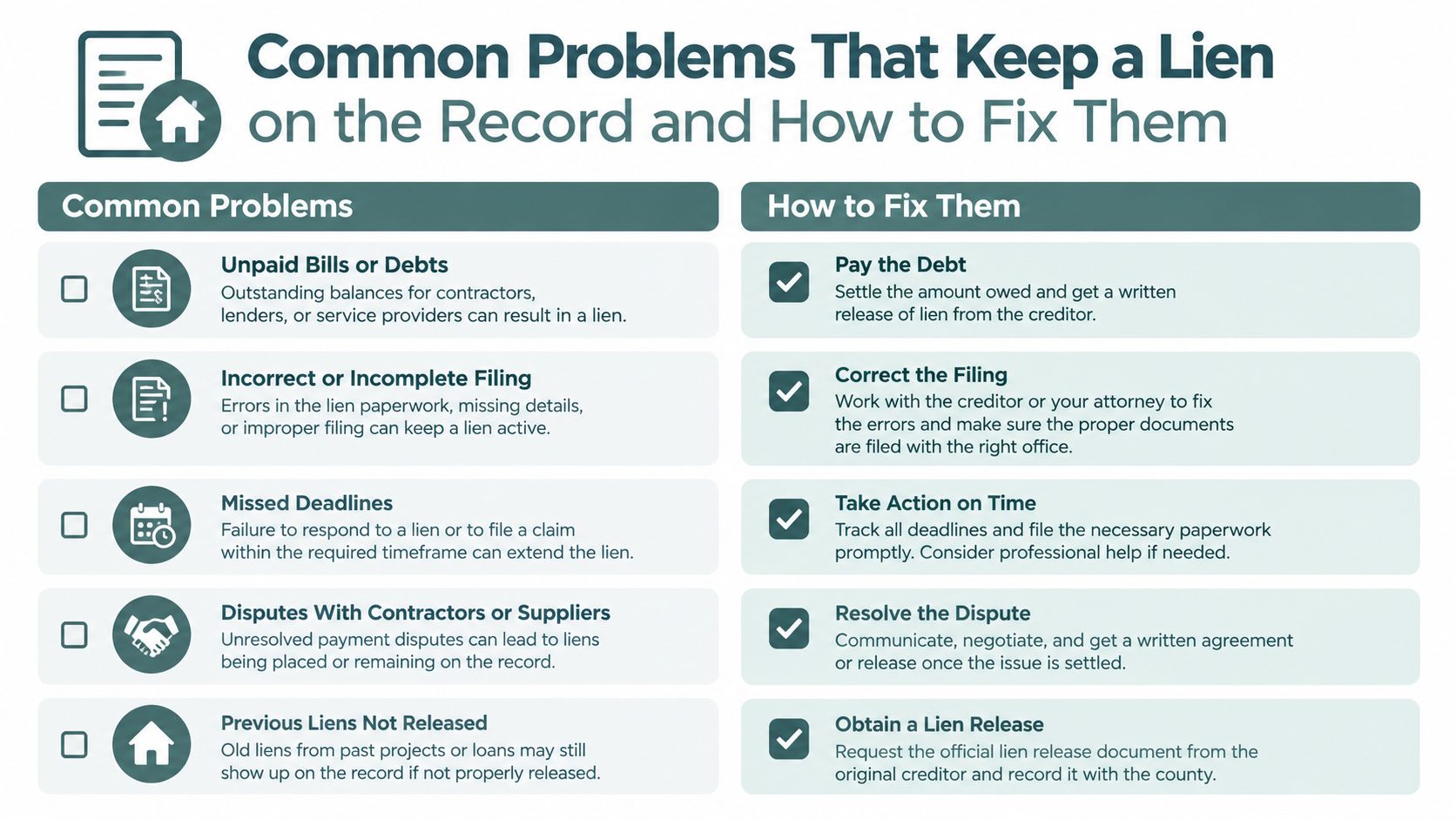
The frustrating scenario is familiar. The owner has paid the lender, but a fresh search still shows the lien. Usually, the problem is not solved by making another payment. It requires identifying which part of the discharge chain failed.
Match the record before resubmitting anything
Ontario's registry guidance makes the matching requirements important. A wrong file number, an abbreviated debtor name, an incorrect secured-party name, or missing section 13 information can prevent the discharge from being recorded correctly. Compare every field against the original registration rather than copying details from memory.
Use a short lender message such as:
Please confirm that the lien for VIN [VIN] has been fully discharged. Please provide the discharge confirmation, original file number, debtor name, secured-party name, and the date the discharge was recorded or submitted.
If the lender issued a release but didn't file the discharge, ask who is responsible for the registry submission and request written confirmation once it's completed.
Diagnose the common failure points
- Lender hasn't issued the release: Send the payoff confirmation and request the specific lien-release or discharge document. Ask for escalation if the first representative only confirms the loan balance.
- Details don't match: Point out the exact difference in the file number or names and ask the secured party to correct the discharge filing.
- Registry record hasn't caught up: Contact ServiceOntario through the official channels and ask what confirmation or corrected filing is required. Ontario's security-interest service lists Toronto 416-325-8847 and toll-free 1-800-267-8847 for related assistance, as noted in the provincial registration guidance.
- Lender closed or was acquired: Locate the successor institution, provide the vehicle and registration details, and ask the registry about the required evidence if no successor can confirm the file.
- Seller can't produce proof: Pause the purchase. A buyer shouldn't complete the transaction on verbal assurances when the official record remains encumbered.
- Vehicle changed hands with an undisclosed lien: Preserve the advertisement, bill of sale, search result, messages, and payment records. Contact the seller and secured party promptly, then obtain guidance from the appropriate Ontario registry or legal professional.
Don't confuse a registry delay with proof that the lien is invalid. Keep the lender's release and the latest search result, then ask the responsible party to correct the missing step. If the creditor disputes the payoff or the vehicle has changed hands through multiple private transactions, get legal advice rather than improvising a transfer.
Your Next Step to a Lien Free Title in Ontario
The reliable answer to how to remove a lien from a car title in Ontario is a two-milestone workflow: pay the secured debt and record the discharge. Start with the VIN-based verification, review the UVIP and official Ontario security-interest result, capture the file number and exact names, then contact the secured party for payoff instructions and written release documentation.
Use this final checklist before buying or selling:
- Verify first: Confirm the lienholder and registration details.
- Pay correctly: Follow the secured party's payoff instructions.
- Keep proof: Save payment records and the written release.
- Record the discharge: Ensure the Ontario registry reflects the release.
- Search again: Don't call the title clear until the current result supports it.
- Share the file: Give the buyer the discharge letter and relevant updated records.
A commercial VIN report can add useful context about accidents, title brands, odometer history, ownership, theft, and auction records, but it can't replace the official Ontario registry check. If the record still shows a lien, stop the sale or registration process until the lender and registry resolve the discrepancy.
Use Vektracer to run a VIN or licence-plate history check for available lien, title, accident, odometer, ownership, and auction context before you buy or list the vehicle. Pair that report with Ontario's official lien search and the lender's written discharge so your clear-title decision rests on documented evidence, not a promise.
Ready to check a vehicle?
Enter any 17-character VIN for a free instant preview — no account needed.