How to Negotiate a Used Car Price With Accident History
Check a vehicle before you buy
Enter a VIN for a free instant preview — accidents, title brands, mileage, liens & open recalls.
How to Negotiate a Used Car Price With Accident History
When a VIN check shows an accident, that history is your negotiating leverage, not a reason to walk away. The core move is simple: translate documented evidence (a vehicle history report, a pre-purchase inspection, and written repair estimates) into a specific dollar deduction off the out-the-door price. Dealers typically concede a moderate discount on cars with condition issues; private sellers often offer slightly higher flexibility when defects are documented by paperwork..
Here’s the short plan:
- Research comps. Pull market value from KBB, Edmunds, CarGurus, and Carfax Market Value before you contact the seller.
- Run the VIN and order a vehicle history report (VHR). Use Carfax, AutoCheck, or Vektracer to confirm accident entries, title status, and mileage.
- Get a pre-purchase inspection (PPI). An independent mechanic documents frame damage, airbag status, alignment, and leaks.
- Cost out repairs. Collect written estimates for every defect the PPI finds.
- Make a justified offer. Subtract documented repair costs from your market target, then open 5–8% below that number.
- Negotiate the out-the-door price only. Never let the conversation shift to monthly payments.
Key Takeaways
Checking a specific vehicle?
Run its VIN for a free preview of accidents, title brands, mileage and open recalls.
Documented evidence — a vehicle history report, a PPI, and written repair estimates — is what turns accident history into a defensible dollar deduction off the out-the-door price.
| Point | Details |
|---|---|
| Research comps first | Triangulate KBB, Edmunds TMV, and local listings; asking prices run 5–12% above transaction prices. |
| Verify the VIN across all documents | Confirm the VIN matches on the dashboard, door jamb, title, and VHR before trusting any report entry. |
| PPI converts defects into dollars | A moderate-fee inspection produces itemized repair costs that are far harder for sellers to dismiss than verbal complaints. |
| Use the offer formula | Market target minus documented repair costs minus buyer margin equals your opening offer; never exceed your walk-away line. |
| Negotiate OTD price only | Monthly payment negotiation lets sellers hide costs; one out-the-door number keeps the deal transparent. |
| Vektracer for affordable VHR | Vektracer reports start at $19.99 and cover accident history, title records, mileage, and market value from NMVTIS-connected sources. |
Table of Contents
- How to research market value before you negotiate a used car price
- What should you check on a vehicle history report?
- How a pre-purchase inspection turns photos into negotiation leverage
- How to convert accident history into a dollar adjustment and calculate your offer
- What negotiation tactics actually work when buying a car with accident history
- How negotiating with a dealer differs from a private seller
- Sample negotiation scripts and phrases that actually help
- Pre-negotiation checklist: what to bring before you sit down
- Which vehicle history report tools should you use?
- What I’ve learned from buying cars with accident history
- Vektracer gives you the accident history data you need before you negotiate
- Sources
- FAQ
How to research market value before you negotiate a used car price
Your offer is only as strong as the market data behind it. Triangulate value using Carfax Market Value, Kelley Blue Book’s Fair Purchase Price, Edmunds’ True Market Value (TMV), and nearby listing comps — asking prices typically run somewhat above what cars actually sell for, so using a single source almost always anchors you too high.
How to build a solid set of comparables:
- Find 5–7 listings for the same year, trim level, and drivetrain, with mileage within roughly 20% of the car you’re considering.
- Filter by your region. Regional price variance can swing 15–20%, so a national average is a rough guide at best.
- Note days on market for each listing. A car sitting for 60+ days signals a motivated seller and a price that hasn’t found a buyer.
- Record the asking price separately from the likely transaction price. KBB and Edmunds both show what buyers are actually paying, not just what sellers are asking.
Pro Tip: Dealers buy cars at wholesale (auction) prices and retail them at a markup. Published auction data can give you a rough sense of what a dealer paid. If the retail ask is close to the wholesale estimate, the dealer’s margin is thin and their flexibility is limited — useful context before you open.
Once you have your range, write down a single target price — the most you’d pay for this car in clean condition. Every adjustment from accident history and defects comes off that number.
What should you check on a vehicle history report?
A vehicle history report (VHR) is the first filter, not the final answer. Absence of a reported accident does not prove the car was never damaged — private repairs, delayed insurance filings, and unreported incidents all fall through the cracks. Use the report to screen and to generate questions, then verify with a PPI.
The three main report providers:
- Carfax is the most widely recognized and pulls from a large network of insurance companies, repair shops, and state DMVs. Strong on title flags and service records.
- AutoCheck (from Experian) scores vehicles on a proprietary scale and tends to capture more auction-history data, which matters if the car passed through dealer auctions.
- Vektracer uses NMVTIS-connected sources and covers accident history, title records, mileage verification, theft checks, safety recalls, and market value data. At $19.99, it costs significantly less than Carfax ($44.99) or AutoCheck ($24.99) and delivers the same core data. A vehicle history report from any NMVTIS-connected provider is a credible starting point.
VIN verification steps — do this before trusting any report:
VINs appear in multiple locations: the dashboard (visible through the windshield), the driver-side door jamb, and the title. Confirm the number matches across all three, and that it matches the listing and the VHR. A mismatch is an immediate red flag.
What to look for on the report itself:
- Accident entries: number of incidents, severity (minor vs. airbag deployment), and whether structural damage is noted
- Salvage or total-loss flags on the title
- Number of previous owners and ownership duration
- Mileage progression — gaps or reversals suggest odometer fraud
- Service records and their regularity
- Missing records for long stretches, which may indicate unreported private repairs
When you find accident entries, note the date, the reported damage type, and whether the record shows a repair. That detail becomes the basis for your PPI checklist.
How a pre-purchase inspection turns photos into negotiation leverage
A PPI is the single best investment you can make before buying a car with accident history. An independent mechanic charges a moderate fee for a thorough inspection, and the written report converts vague concerns into specific, costed line items — which are much harder for sellers to dismiss than subjective complaints.
Photo checklist for listing images and the in-person walk-around:
- Panel gaps: uneven spacing between doors, fenders, and hood suggests replacement or realignment after a collision
- Paint texture: orange-peel finish, overspray on trim, or color mismatch between panels indicates repaint work
- Headlight lens condition and seal integrity
- Tire wear pattern — uneven wear across the tread points to alignment problems
- Undercarriage and wheel wells for rust, fresh undercoating (which can hide damage), or bent metal
- Interior: airbag covers for signs of replacement, seat belt pretensioner condition, and any water staining
What a mechanic checks during a PPI:
- Frame and structural integrity (a frame-straightening machine leaves measurable traces)
- Airbag deployment history and whether replacement bags are OEM or aftermarket
- Alignment angles, which reveal whether the car pulls or has hidden suspension damage
- Fluid leaks at the engine, transmission, and differential
- Brake pad thickness and rotor condition
- Suspension bushings and ball joints
If a dealer or private seller refuses to allow a PPI, treat that refusal as a serious warning. Sellers with nothing to hide have no reason to block an inspection. Detecting accident history often comes down to what a trained eye catches in person that a report cannot.
After the PPI, ask the mechanic to itemize every finding with an estimated repair cost. That written list is your negotiation document.

How to convert accident history into a dollar adjustment and calculate your offer
The formula is straightforward:
Market target price − documented repair costs − buyer margin = opening offer
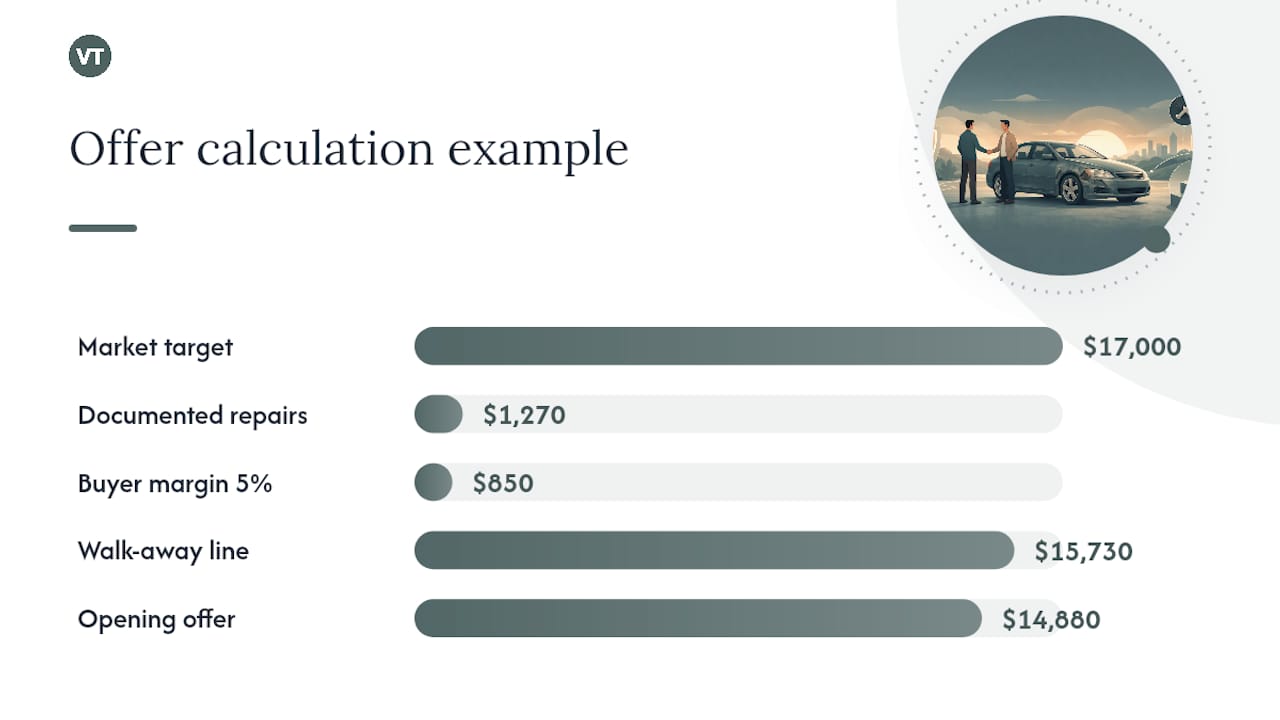
Your walk-away line is the market target price minus repair costs, with no additional margin. You should never pay more than that for a car with documented defects.
Common repair cost ranges to use as reference:
Worked example:
A 2019 sedan is listed at $18,500. Your comp research puts the clean-condition market value at $17,000. The PPI finds a repainted front bumper (estimated $800 to redo properly), a misaligned front axle ($120), and worn front brake pads and rotors ($350). Total documented repairs: $1,270.
- Market target: $17,000
- Minus repairs: $1,270
- Minus buyer margin (5%): $850
- Opening offer: $14,880 (round to $14,900)
- Walk-away line: $15,730
You open at $14,900, backed by the PPI report and written estimates. If the seller counters at $17,000, you don’t argue — you show the paperwork and let the numbers speak. Converting PPI findings into written discount requests is what separates a justified offer from a vague complaint.
What negotiation tactics actually work when buying a car with accident history
The most important rule: negotiate the out-the-door price only. Monthly payment negotiation lets sellers hide costs by extending loan terms or marking up financing. Get one number — the total price including all fees and taxes — and work from there.
Step-by-step negotiation sequence:
- Ask for the out-the-door number first. At a dealership, say: “Before we talk about anything else, what’s the out-the-door price on this car?” Write it down.
- Present your evidence. Hand over the VHR, PPI report, and repair estimates. Say: “Based on the accident entry and these repair costs, I’m at $[opening offer].”
- Go quiet. State your number, then stop talking. Silence is pressure. Many sellers fill it by conceding.
- Counter in small increments. If they push back, move up in $200–$300 steps, not $1,000 jumps. Each increment should come with a reason (“I can go to $15,200, but I’m still absorbing the alignment cost”).
- Use timing. End-of-month visits work in your favor at dealerships — salespeople are closing quotas and managers approve deals they’d reject mid-month.
- Reveal preapproval late. Having financing already arranged gives you leverage, but don’t show it until you’ve agreed on the OTD price. Dealers profit on financing; showing it early shifts the conversation.
Walk-away criteria:
- Seller refuses a PPI
- VIN mismatch across documents
- Salvage or rebuilt title not disclosed upfront
- OTD price stays above your walk-away line after two counter rounds
- Seller becomes aggressive or withholds repair records
How negotiating with a dealer differs from a private seller
The channel you’re buying from changes the rules significantly.
| Dimension | Dealer | Private Seller |
|---|---|---|
| Realistic discount (with documented defects) | 5–8% | 8–15% |
| Evidence received | Formal PPI report, written estimates | Same, but personal rapport matters more |
| Who typically pays for PPI | Buyer | Buyer |
| How to present your adjustment | Written line items tied to repair estimates | Verbal walkthrough of PPI findings, then written offer |
| Post-sale protection | Limited warranty possible; CPO cars have more | As-is; no recourse after signing |
| Financing markup risk | High — dealers profit on rate spread | None — private sales are cash or buyer-arranged |
Dealer-specific tactics:
- Always separate the trade-in negotiation from the purchase price. Dealers blend the two to obscure true margins.
- Ask for the out-the-door price in writing before discussing financing.
- Request that any agreed repair credits appear as a line item on the buyer’s order, not as a verbal promise.
Private-seller tactics:
- Bring the PPI report in person and walk through it item by item. Private sellers respond better to a calm, factual conversation than to a formal written counter.
- Get any agreed price reduction confirmed in a bill of sale before handing over payment.
- Verify the title is clean and in the seller’s name. A third-party name on the title creates complications.
Sample negotiation scripts and phrases that actually help
Opening with a private seller:
Opening at a dealership:
Responding to pushback:
Closing with a repair-credit ask:
Phrases that hurt your position:
- “What monthly payment can you get me?” (shifts control to the seller)
- “I love this car.” (signals you’ll overpay)
- “This is my absolute maximum.” (reveals your ceiling)
- “I need to decide today.” (removes your walk-away power)
Practice your opening script out loud before you go. Saying the numbers confidently, without hesitation, signals that your offer is grounded — not emotional.
Pre-negotiation checklist: what to bring before you sit down
Arriving prepared is half the battle. Run through this list before any negotiation:
- VIN confirmed across dashboard, door jamb, and title
- VHR printout (Carfax, AutoCheck, or Vektracer) with accident entries highlighted
- PPI report with mechanic’s name, shop address, and itemized findings
- Written repair estimates for each defect (at least two quotes for major items)
- 5–7 comparable listings printed or saved, showing asking prices and days on market
- Your target price, opening offer, and walk-away number written down privately
- Preapproval letter or cashier’s check (keep this in your pocket until OTD price is agreed)
- Photo documentation of any visible defects from the listing and your in-person inspection
Questions to ask the seller before any payment:
- “Has the car had any repairs not reflected in the VHR?”
- “Do you have receipts for the accident repairs?”
- “Why are you selling?”
- “Has the car ever had a salvage or rebuilt title?”
Keep your three numbers (opening offer, target, walk-away) private. Writing them down for yourself is fine; sharing them with the seller hands over control.
Which vehicle history report tools should you use?
Three providers cover the core data most buyers need when buying a car with accident history.
- Carfax ($44.99 per report) is the most recognized name and pulls from a broad network of insurers and repair shops. Best for title-flag verification and service record depth.
- AutoCheck ($24.99 per report) scores cars on a proprietary scale and captures more auction-history data — useful if the car has passed through multiple dealer lots.
- Vektracer (starting at $19.99) uses NMVTIS-connected sources and delivers accident history, title records, mileage verification, theft checks, safety recalls, and market value data. For buyers who want the same core data at a lower cost, it’s a practical first step. You can see how it works before ordering.
When to order each report:
- Before the PPI: run a VHR to screen for salvage titles or major accident entries. No point paying for an inspection on a car with a rebuilt title you’d reject anyway.
- After the test drive: validate what the seller told you against what the report shows.
- Immediately before closing: a final check catches any title changes or new entries since your first report.
Buying two reports from different providers is worth considering on any car with a known accident entry. Each provider has different data sources, and a discrepancy between them is itself a signal.
Dr. Vin offers a condition-report tool that generates photo-based damage estimates — useful for translating visible defects into dollar figures before you have a full PPI in hand.
Pro Tip: An NMVTIS-connected report is the minimum standard for any used car purchase. NMVTIS (National Motor Vehicle Title Information System) aggregates title data from all 50 states, so a salvage or total-loss flag from any state shows up — not just the state where the car is currently registered.
What I’ve learned from buying cars with accident history
The most useful thing I’ve done in any negotiation involving a prior accident is show up with a printed PPI report and say nothing after naming your offer. Presenting mechanic’s written findings with specific line items tends to change the conversation and pressures the seller to engage with the evidence or demonstrate unwillingness to negotiate honestly — which is its own answer.
The second lesson: always ask for the out-the-door price before discussing anything else. Dealers are skilled at keeping the conversation on monthly payments, trade-in value, and financing terms. Each of those conversations is a separate negotiation where they hold the advantage. The OTD number is the only one that matters.
And if the seller won’t allow a PPI, or the VIN doesn’t match across documents, walk away. A car that someone is hiding is never worth the price of finding out why.
Vektracer gives you the accident history data you need before you negotiate
Before you sit across from any seller, you need to know exactly what the VIN shows. Vektracer’s reports cover accident history, title records, mileage verification, theft checks, safety recalls, and market value data — all from NMVTIS-connected sources — starting at $19.99. That’s less than half the cost of a Carfax report ($44.99) for the same core data.
Run the VIN before you schedule a PPI. If the report shows a salvage title or multiple accident entries, you’ll know whether to proceed, renegotiate your expectations, or move on entirely. Check the sample report to see exactly what you’ll get, then run a VIN check before your next negotiation.
Sources
- Negotiate a Used Car Price: Scripts & Tactics | Dr. Vin
- How to Negotiate Car Prices
- Accident Check by VIN - Reported Damage Limits
- Using VIN numbers to check car accident history | J.D. Power
Order your VIN check before scheduling the PPI. Keep printed copies of every report — the VHR, PPI findings, and repair estimates — with you at the negotiation.
FAQ
How much can you realistically negotiate off a used car with accident history?
The exact amount depends on the severity of the accident, the cost of outstanding repairs, and how long the car has been listed.
Is it a good idea to buy a car with accident history?
It can be, as long as the damage was minor, properly repaired, and fully documented. A car with a single fender-bender and clean repair records is very different from one with frame damage or a salvage title — always get a PPI to know which you’re dealing with.
What is the $3,000 rule for cars?
The $3,000 rule is an informal buyer guideline suggesting you should not pay more than $3,000 above a car’s documented market value without a clear justification. It’s a rough ceiling on how much you should let seller pressure or emotional attachment push your offer above what the data supports.
What should you never say during a car negotiation?
Avoid “What monthly payment can you get me?” (shifts control to the seller), “I love this car” (signals you’ll overpay), and “This is my maximum” (reveals your ceiling). Stick to the out-the-door price and let your documented evidence do the talking.
What should you do if a VIN check shows an accident?
Order a PPI from an independent mechanic, collect written repair estimates for any defects found, and use those costs to calculate a justified offer below the clean-market price. A VIN check showing an accident is the starting point for negotiation, not a reason to walk away automatically.
Recommended
Ready to check a vehicle?
Enter any 17-character VIN for a free instant preview — no account needed.