Alberta Personal Property Registry Vehicle Lien Search: Tips
Check a vehicle before you buy
Enter a VIN for a free instant preview — accidents, title brands, mileage, liens & open recalls.
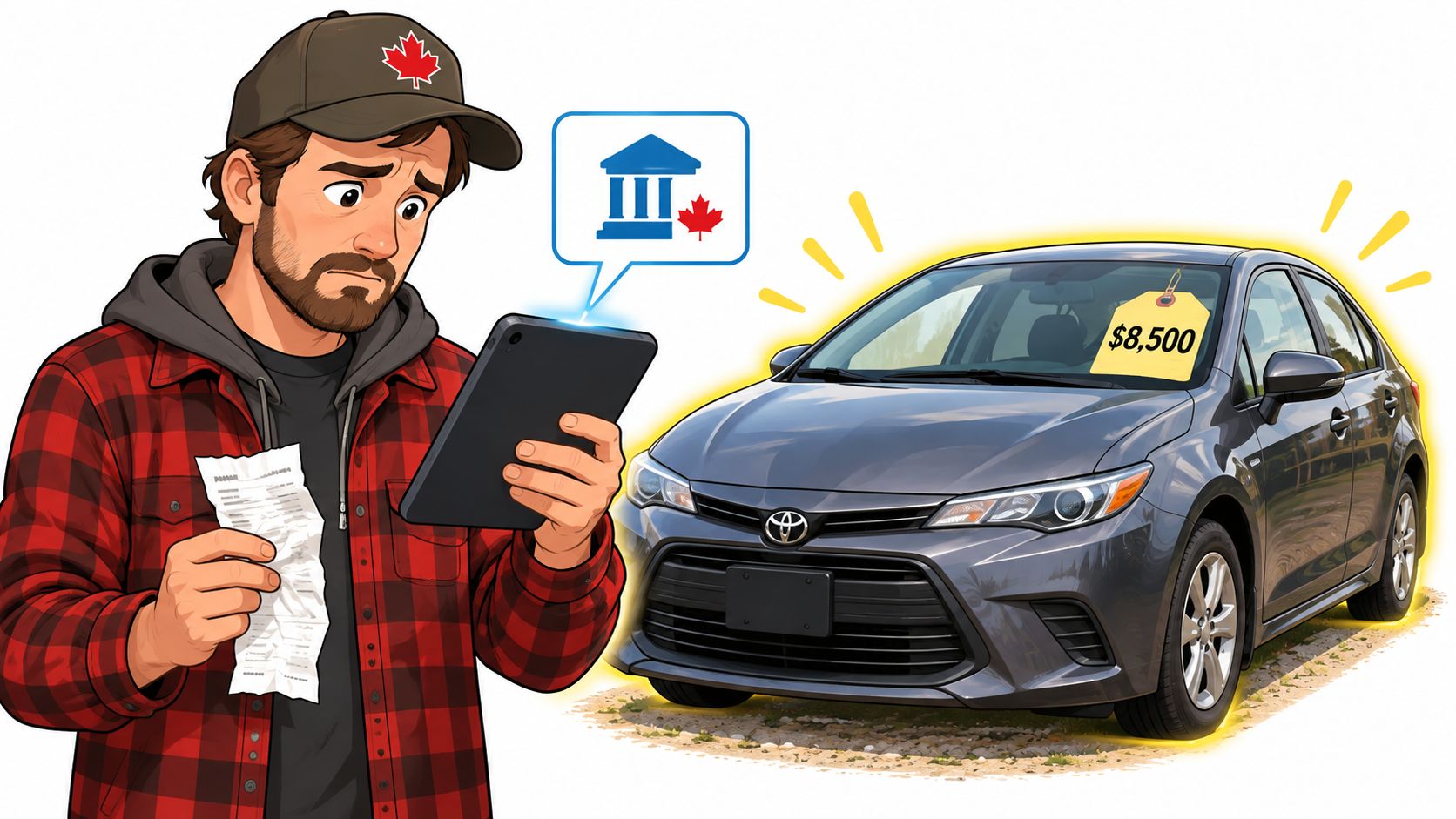
A private seller offers you an Alberta vehicle at a price that looks unusually attractive, and you're about to hand over the money. Before you do, run an Alberta personal property registry vehicle lien search using the vehicle identification number, or VIN. The search can identify liens registered in Alberta, but it doesn't prove the vehicle has a clean title, hasn't been stolen, or has no accident, odometer, salvage, or out-of-province financing history. Treat it as one important layer of due diligence, not the entire vehicle investigation.
Table of Contents
- What an Alberta Vehicle Lien Search Actually Checks
- How to Perform the Official PPR Lien Search
- Critical Limits of Searching Alberta Records Only
- VIN-Based Searches Versus Commercial Vehicle Reports
- What to Do After the Search Results Come Back
- Practical Checklist for Alberta Vehicle Buyers
What an Alberta Vehicle Lien Search Actually Checks
The Alberta Personal Property Registry, operating within the province's Personal Property Security Act system, records security interests in personal property. For a vehicle buyer, the practical question is narrow: does Alberta have a registered lien or encumbrance associated with this vehicle?
That scope matters. A clear search result can reduce one transaction risk, but it doesn't establish the vehicle's full ownership history or condition. It doesn't verify theft status, accident damage, odometer accuracy, or obligations recorded outside Alberta. The Alberta government states that lien searches cover Alberta-registered liens only, a limitation also reflected in AMA's vehicle lien-search guidance.
What the search can tell you
An Alberta search may show that a lender or other secured party registered an interest against the vehicle. That can affect whether the seller has the right to transfer it free of that interest. An exact match deserves direct follow-up, especially before you sign a bill of sale or release funds.
The province's process supports serial-number searches for several property types, including motor vehicles, trailers, mobile homes, aircraft, boats, outboard motors, and farm vehicles. For a car or truck, the VIN is the central identifier, so compare it with the vehicle, registration documents, and the seller's paperwork before submitting the search.
Practical rule: A “no match” result means no matching Alberta registration was returned. It doesn't mean “clean title” in every jurisdiction.
The distinction is easy to miss because buyers often use “lien check” and “title check” as if they were interchangeable. They aren't. A lien search addresses registered security interests, while a broader history review may address title brands, accidents, odometer readings, auction records, theft information, and ownership context. For a plain-language explanation of the difference, see what a lien on a vehicle means.
How to Perform the Official PPR Lien Search
Start by obtaining the full VIN directly from the vehicle. Check the VIN plate or label against the registration document and the seller's paperwork. Don't rely only on a license plate, a text message, or an online listing, because the VIN is the identifier used for the vehicle-specific search.
Alberta's official process uses a completed search request submitted through a registry agent. The provincial guidance says the request can be made after downloading and completing the relevant form, and the search can be submitted through an Alberta registry agent office. The process is regulated, so availability follows registry service procedures rather than operating like an always-open consumer database. Alberta lists registry office hours as 8:15 a.m. to 4:30 p.m., Monday to Friday, closed on statutory holidays. Those hours are provided in Alberta's personal property registration guidance.
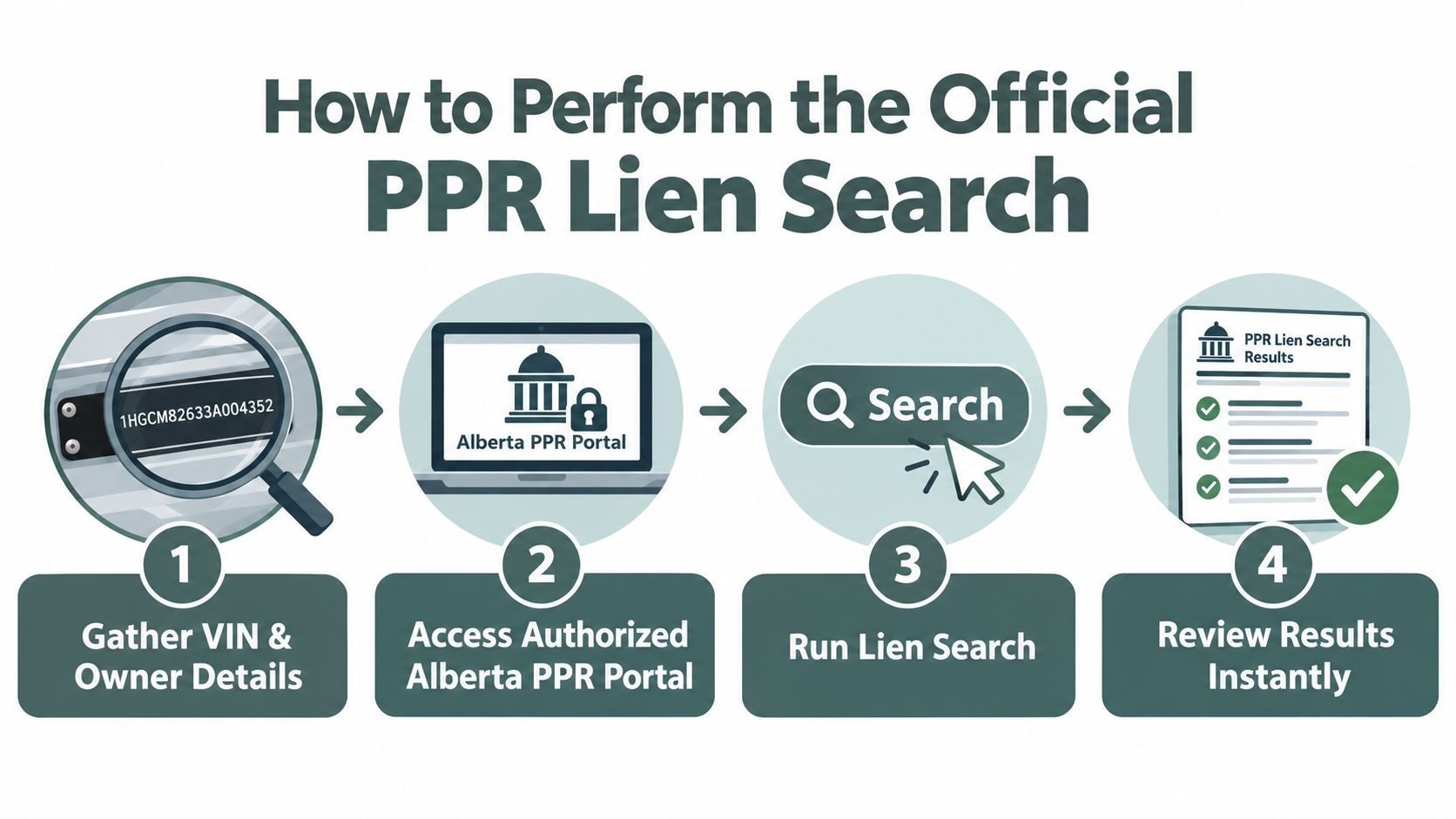
Use the result category correctly
The official result can return one of four categories:
- Exact match: The search found a registration matching the submitted vehicle details. Treat this as a matter requiring investigation, not an automatic reason to walk away or proceed.
- Inexact match: The system found a registration that may relate to the vehicle but doesn't align perfectly with the search information. Confirm the details with the registry agent and investigate before treating the result as clear.
- No match: No matching Alberta registration was returned. This is useful, but it only addresses the Alberta records covered by the search.
- Both exact and inexact matches: The system returned registrations in both categories. Ask for clarification and resolve each potentially relevant entry before paying.
An inexact match doesn't automatically prove an active lien. It signals that the registration needs follow-up, which is why small input errors and inconsistent documentation matter. Recheck every VIN character and compare the result with the seller's identification and ownership documents.
What the official route doesn't provide
The PPR isn't a mechanical inspection, title-history report, theft check, or accident database. It won't tell you whether the vehicle has been branded salvage elsewhere, whether the odometer readings form a consistent timeline, or whether an earlier lender outside Alberta released its interest.
Use the official search for the specific question it was designed to answer. Then add separate checks for the risks that question doesn't cover.
Critical Limits of Searching Alberta Records Only
The most important limitation is geographic. Alberta's guidance states that lien searches are limited to liens registered in Alberta, so the result doesn't confirm liens registered outside the province. A vehicle may have moved into Alberta after being financed elsewhere, and an Alberta-only result won't automatically reconstruct that earlier financing history.
That boundary also applies to theft status. The Alberta guidance says the lien search doesn't verify whether a vehicle has been stolen. A buyer who treats “no lien found” as a complete clearance is answering questions the registry was never designed to answer.
Situations that require extra caution
Consider a vehicle that previously lived in another Canadian province or in the United States. An Alberta PPR search may be clean because the relevant registration sits outside Alberta, even though the vehicle's earlier history still affects the transaction. The same concern applies to vehicles bought through an auction, imported privately, or advertised with incomplete ownership paperwork.
The risk isn't that the provincial registry is defective. The risk comes from using a precise local tool as though it were a nationwide title and history system.
| Alberta-only result | What it supports | What it doesn't establish |
|---|---|---|
| No match | No matching Alberta-registered lien was returned | No out-of-province lien, theft issue, accident, salvage brand, or odometer problem |
| Exact match | A potentially matching Alberta registration exists | That the debt is unpaid, current, or impossible to discharge |
| Inexact match | A registration requires identification and follow-up | That the vehicle definitely has an active lien |
Build a layered decision
For an Alberta-used vehicle, combine the PPR result with the VIN on the vehicle, registration and ownership documents, seller identity, inspection findings, and broader history records. A commercial report can add context from other jurisdictions, but it also shouldn't be treated as an absolute guarantee that every event has been reported.
Ask the seller where the vehicle was previously registered and whether it was financed, imported, rebuilt, or sold through an auction. If the answers don't align with the documents or the VIN history, pause the transaction rather than relying on a clean local result.
VIN-Based Searches Versus Commercial Vehicle Reports
A VIN-based Alberta search and a commercial vehicle-history report serve different purposes. The AMA vehicle-history service says its lien search scans Alberta's Personal Property Registry Information System for liens or encumbrances registered against the vehicle in Alberta only. That makes it targeted and relevant when the immediate question is whether an Alberta-recorded security interest appears.
A commercial report starts with the same core identifier, but its value comes from assembling records across multiple sources and jurisdictions. Vektracer describes its reports as compiling VIN-based information from government registries, insurance networks, auctions, police theft databases, and service shops across the United States and Canada. Depending on what has been reported and made available, that broader view can help identify accident events, title brands, salvage history, odometer inconsistencies, ownership context, and auction records.
Neither route replaces the other. The official search has direct relevance to Alberta-registered liens, while a commercial report can help reveal why a vehicle's past may extend beyond Alberta. A buyer evaluating an imported vehicle, auction purchase, or unusually cheap private-party listing should consider both.
| Search Method | What It Covers | Key Limitations | Best Use Case |
|---|---|---|---|
| Alberta PPR search through a registry agent | Security interests registered against the vehicle in Alberta | Alberta-only scope, no theft verification, and no complete vehicle history | Confirming whether an Alberta-recorded lien appears before purchase |
| AMA VIN-based lien search | A VIN search of Alberta's Personal Property Registry Information System for Alberta liens or encumbrances | Still limited to Alberta records and lien-related information | Convenient, targeted Alberta lien screening |
| Commercial VIN-history report | Potentially broader records across Canadian and U.S. jurisdictions, including reported damage, brands, mileage, ownership, theft, and auction context | Coverage depends on the records available and reported; it isn't a government title determination | Screening cross-border, imported, auction, salvage, or uncertain vehicles |
For a focused explanation of the VIN process, review this guide to vehicle lien searches by VIN. The practical choice is often sequential: verify the Alberta lien position, then use a broader report and document review to investigate risks outside that registry's scope.
What to Do After the Search Results Come Back
A result is useful only when it changes what you do next. Keep the search result with the vehicle documents, and don't let a seller's urgency push you into paying before you understand any match or inconsistency.
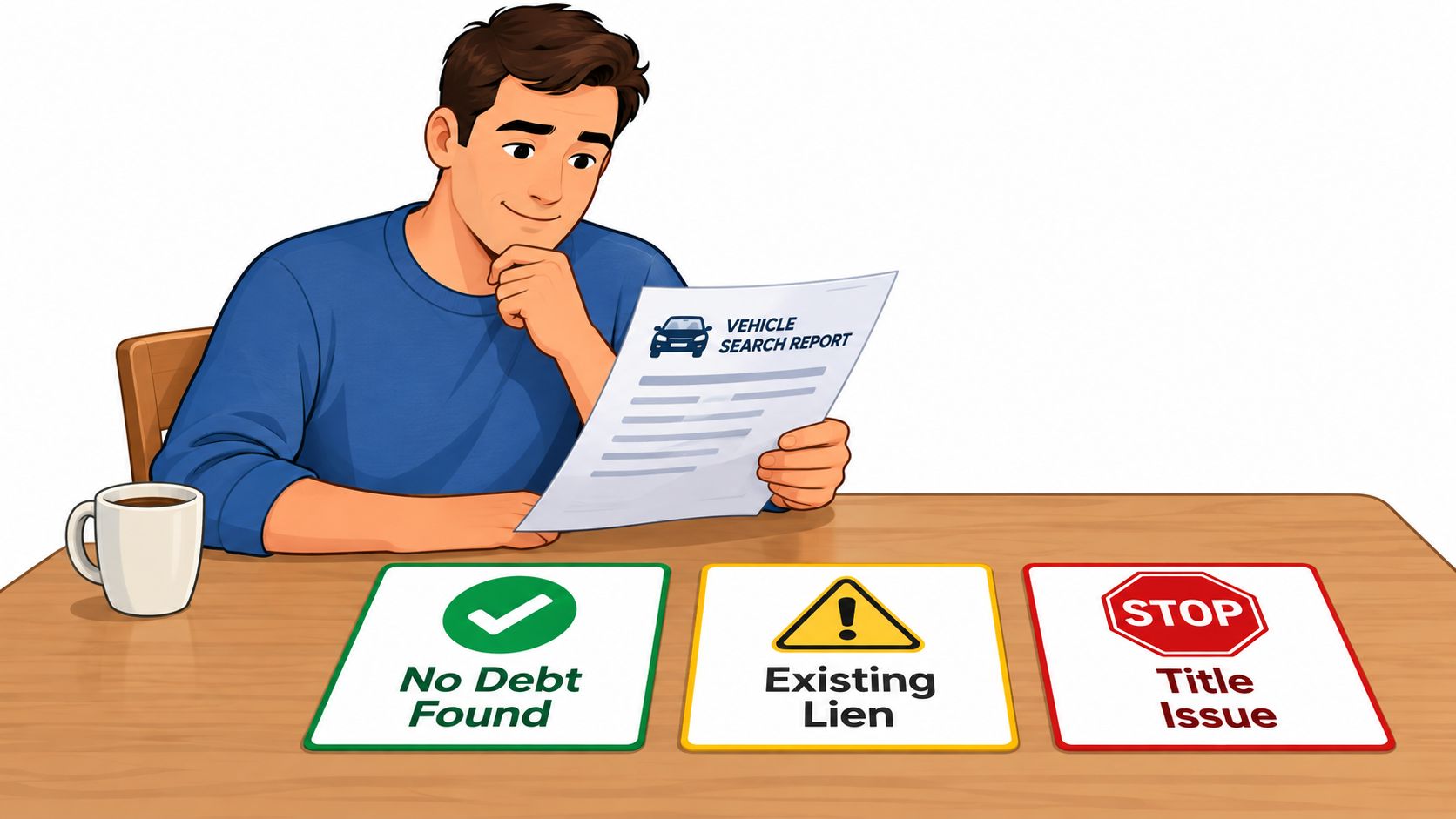
If the result is no match
A no-match result supports the conclusion that the search found no matching Alberta registration. Keep the conclusion narrow. Review the seller's identity and ownership documents, compare every VIN location, ask about previous provinces or countries of registration, and consider a broader history report before completing the deal.
A no-match result also doesn't remove the need for a physical inspection or an independent assessment of the vehicle's condition. If you're buying for work or managing drivers rather than purchasing a personal vehicle, a separate driver abstract screening service for employers addresses the driver's record, not the vehicle's lien or title history.
If the result is an exact match
An exact match means you need to identify the secured party and understand whether the obligation remains outstanding. Ask the seller for lender contact details and written confirmation of the payoff or discharge process. Don't assume that a seller's verbal assurance removes the registration.
The lender, not the seller, controls the release of its security interest. Coordinate payment and discharge documentation before treating the vehicle as transferable without that encumbrance. If the transaction can't be structured so the lien is addressed, postpone it.
If the result is inexact or mixed
An inexact result, or a result containing both exact and inexact matches, needs clarification from the registry agent and careful comparison with the vehicle documents. Correct any VIN-entry error, ask what information produced the match, and request professional assistance when the record remains unclear.
Use this guide to checking whether a lien was released as a practical reference, but confirm the status through the relevant registry or lender. The safest decision is to wait until the uncertainty is resolved, rather than accepting a discounted price in exchange for an unresolved ownership risk.
Practical Checklist for Alberta Vehicle Buyers
The Alberta personal property registry vehicle lien search belongs near the beginning of your buying process, before money changes hands. It gives you a focused answer about Alberta-registered security interests, while the rest of your checks address the vehicle's identity, condition, and history.
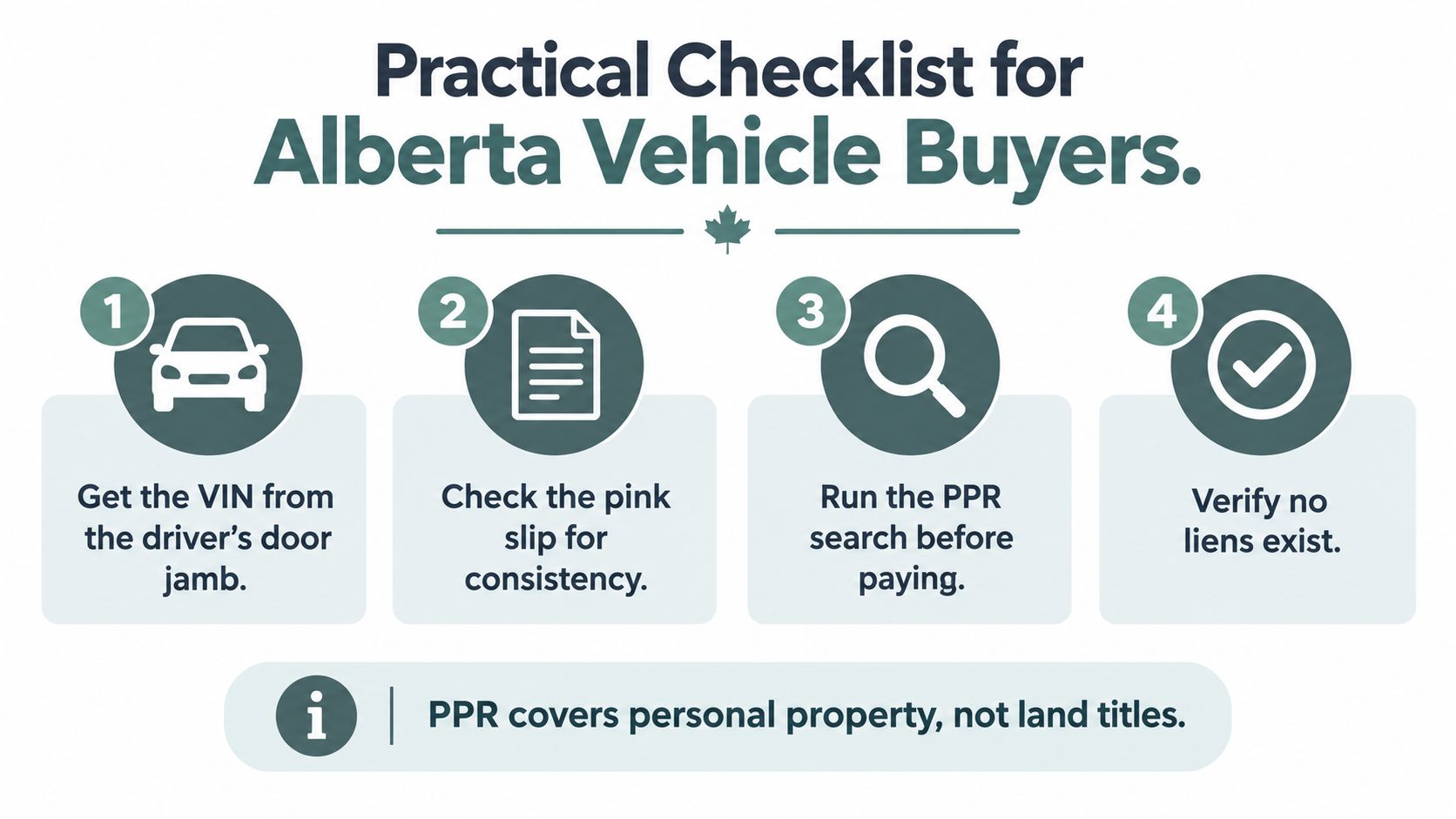
Use this checklist for a private sale, dealer purchase, auction vehicle, or cross-border import:
- Get the VIN: Read it from the vehicle and compare it with the registration, ownership documents, and listing.
- Confirm the seller: Check that the person offering the vehicle matches the ownership documentation and can explain any differences.
- Run the Alberta PPR search: Submit the vehicle-specific search through the official Alberta process or an authorized registry agent.
- Read the category carefully: An exact, inexact, no-match, or mixed result each requires a different response.
- Investigate a match: Contact the registry agent or secured lender when the result identifies a potentially relevant registration.
- Add broader history context: Consider accident, salvage, title-brand, odometer, theft, ownership, and auction records, particularly when the vehicle has crossed jurisdictions.
- Keep the documents: Save the result, seller disclosures, lender correspondence, bill of sale, and any release documentation.
A clear Alberta result is helpful, but it isn't a universal clean-title certificate. The strongest buying decision comes from matching the VIN, validating the seller's documents, resolving liens, and checking the vehicle's wider history before payment.
Vektracer compiles VIN-based vehicle-history records across the United States and Canada, including available accident, title-brand, odometer, theft, ownership, and auction information. Enter the vehicle's VIN or license plate at Vektracer to review the available history before you commit your money.
Ready to check a vehicle?
Enter any 17-character VIN for a free instant preview — no account needed.