What Is a Lien on a Vehicle: Protect Your Purchase
Check a vehicle before you buy
Enter a VIN for a free instant preview — accidents, title brands, mileage, liens & open recalls.
A lien on a vehicle is a legal claim a lender or service provider has on the car as security for an unpaid debt. That means the lienholder can legally repossess the vehicle if the debt isn’t paid, even after the car has been sold to someone new.
If you’re looking at a used car and the price seems unusually good, this is one of the first things to check. Many first-time buyers focus on mileage, accident history, and how the car drives. Those matter, but a lien can create a very different kind of problem. The car may look perfect and still come with a financial claim attached to it.
That’s why understanding what is a lien on a vehicle matters before you hand over money. A lien isn’t just paperwork sitting in a file. It affects ownership, title transfer, and in some cases your right to keep the car.
What Is a Vehicle Lien and Why Does It Matter
You find a used SUV that looks like a bargain. The seller has the keys, the test drive goes well, and the paperwork seems ordinary. Then a problem surfaces after the sale. A lender or repair shop still has a legal claim tied to that vehicle.
That claim is the lien.
A vehicle lien gives a creditor the right to the car until a debt connected to it is paid and formally cleared. In plain terms, ownership and full control are not always the same thing. A buyer can take possession of the vehicle while another party still has a recorded financial interest in it.
A car loan is the clearest example. The bank provides the money, and the lien stays on the vehicle record until the loan is satisfied and released. Other claims can appear too, including liens tied to unpaid repair bills. Provincial registration systems and title records are what matter here, because that is where the claim follows the vehicle, not just the person who owes the money.
Why does this matter so much? Because a lien changes the risk of the deal.
A clean interior, a fair price, and a polite seller do not confirm clear title. A lien is closer to a hidden claim on the car's value. It works like buying a house with an unpaid mortgage attached. The asset may be in front of you, but someone else may still have rights that can interfere with transfer, financing, or your ability to keep it without dispute.
For first-time buyers, the common mistake is treating a lien check like extra paperwork. It is better to treat it as risk management. Sometimes a lien is a serious warning sign, especially if the seller is vague about payoff details or wants to rush payment. In other cases, it is a manageable situation if the seller can prove the balance, arrange payout, and provide a proper release. That distinction matters. Smart buyers do not reject every car with a lien automatically. They decide based on whether the risk is clear, documented, and solvable.
Practical rule: Before you pay a deposit or sign anything, confirm whether the vehicle can be transferred with clear title and what steps are needed to remove any existing claim.
Many buyers also assume the sale itself wipes out old debt. It does not. The lien usually remains on record until the creditor files the release. That is why checking title history and ownership records together gives you a much better picture of the deal. For a broader explanation, see why vehicle history matters when you want to buy smarter and avoid risks.
If you plan to finance your purchase, understanding loan structure helps too. Comparing flexible vehicle finance options can make it easier to see how lenders protect their interest and what paperwork you should expect before ownership is fully clear.
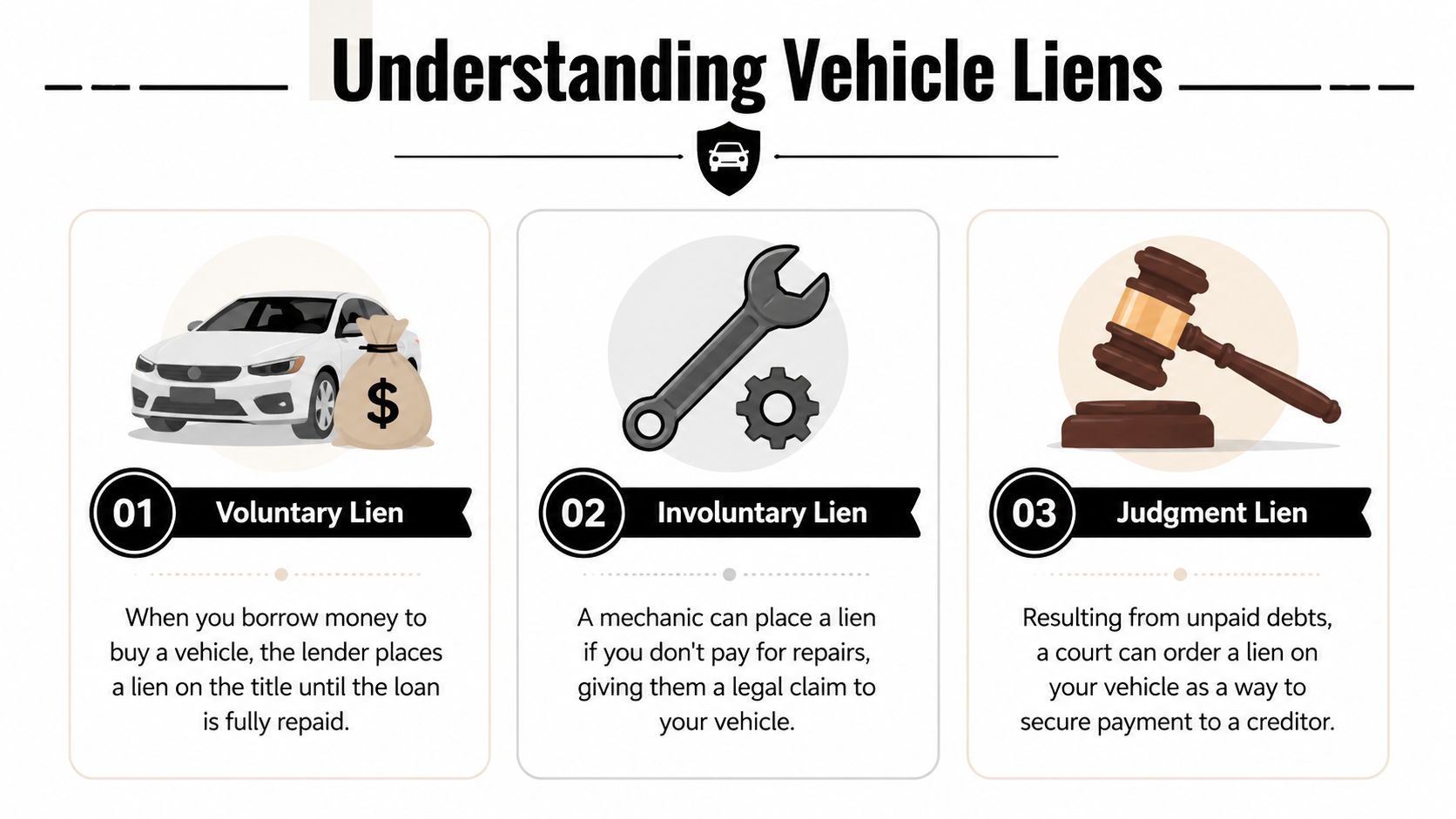
The Three Main Types of Vehicle Liens Explained
A vehicle lien works like a legal hold on the car’s title. The reason behind that hold matters because it changes the buyer’s risk and the best way to handle the deal.
Some liens are part of an ordinary financing arrangement. Others point to unpaid bills or a court dispute. For a first-time buyer, that difference is practical, not academic. One type may be routine and easy to clear at closing. Another may signal missing paperwork, payment conflict, or a seller who cannot deliver clean ownership without extra steps.
Voluntary liens
A voluntary lien is the standard car-loan lien. The owner agrees to it when financing the vehicle, and the lender records its interest against the title.
By itself, this is usually the least surprising type. It often means the seller still has an active auto loan. The main question is whether there is a clear payoff process and a confirmed lien release. If those pieces are in place, this can be a manageable transaction rather than an automatic deal-breaker.
A voluntary lien is often the kind a careful buyer can work with. You just need documentation, exact payoff instructions, and proof that the title will be released after the debt is paid.
Involuntary liens
An involuntary lien is placed without the owner choosing it as part of a normal financing deal. It usually appears after a debt tied to the vehicle goes unpaid.
The example many buyers run into is a mechanic’s lien, sometimes called a garageman’s lien. A repair shop may file one if it performed work and did not get paid. Capital One’s explanation of mechanic’s liens outlines how these claims can arise and why they complicate ownership until they are resolved.
This type deserves closer attention. An unpaid repair bill may sound small compared with an auto loan, but it can still block a clean transfer. It can also point to a dispute over repairs, storage fees, or prior possession of the vehicle.
A car can run perfectly and still carry a legal problem on paper.
Judgment liens
A judgment lien usually starts outside the car deal itself. A creditor wins a court judgment over an unpaid debt, then uses that judgment to claim an interest in the debtor’s property, which may include a vehicle.
For buyers, judgment liens often create the most confusion because they do not fit the normal financed-car pattern. The seller may even say, truthfully, that the car loan is paid off while the title is still burdened by a separate legal claim.
That makes judgment liens harder to treat as routine. They often require extra verification, and they may raise broader questions about whether the seller can transfer clear title without court-related paperwork or additional creditor action.
Vehicle Lien Type Comparison
| Lien Type | How It's Created | Who Places It | Common Example |
|---|---|---|---|
| Voluntary lien | Borrower finances the vehicle and agrees to the lender’s security interest | Bank, credit union, finance company | Auto loan on a recently purchased car |
| Involuntary lien | Debt tied to the vehicle goes unpaid | Repair shop or other qualifying claimant | Unpaid repair bill leading to a mechanic’s lien |
| Judgment lien | Court action gives a creditor a legal claim | Creditor through legal process | Vehicle tied to an unpaid debt after judgment |
Why the type matters
The lien type helps you decide whether you are looking at a routine payoff, a solvable paperwork problem, or a transaction with legal complexity that may not be worth the effort.
That is the risk-management lens buyers should use. A voluntary lien with a verified payoff may be a calculated opportunity if the seller is organized and transparent. An involuntary or judgment lien usually calls for more skepticism, more documentation, and a firmer line on what must be resolved before money changes hands.
How a Lien Impacts Car Buyers and Sellers
You agree on a price, hand over the money, and expect to drive home with a car that is fully yours. Then the paperwork stalls because someone else still has a legal claim on the vehicle.
That is what changes when a lien is involved. A lien does not always kill a deal, but it does change the level of risk, the paperwork, and the way money should move.
For buyers, the main question is ownership control. A car can look fine in the driveway and still come with a title problem attached to it. A lien works like a padlock on the title. Until that claim is released, your ability to register, sell, or fully control the vehicle may be limited.

What buyers stand to lose
The risks are practical, not abstract:
- Registration delays: You may have trouble completing title transfer or registration if the lien is still active.
- Unclear payoff handling: The seller may promise to pay off the debt after the sale, but a promise is not proof.
- Weakened position: Once you have paid, you have fewer ways to force the seller to finish the payoff and release process.
- Possible creditor action: If the debt remains unresolved, the lienholder may still have rights tied to the car.
This is why a lien check is really a risk-management step. You are not just asking whether a lien exists. You are asking whether the lien can be cleared in a controlled, documented way before the deal is finished. If you need help confirming whether the record is clean, start with a vehicle title status check before treating the sale like a routine private-party transaction.
Why sellers struggle with liened vehicles
For sellers, an open lien adds friction at every stage.
Some buyers will leave as soon as they hear the title is not clear. Others may still be interested, but they usually want proof of the payoff amount, direct contact with the lienholder, and a payment process that sends money where it needs to go instead of relying on trust alone.
That changes the sale in two ways. First, it slows everything down. Second, it often weakens the seller’s position in negotiations because the buyer is taking on paperwork risk, timing risk, and the chance that the release does not happen as promised.
A lien can be a red flag or a calculated opportunity
A lien is not automatically a deal breaker.
A routine lender lien with a verified payoff can be manageable if the seller is organized, the lienholder confirms the amount due, and the release process is clear. In that case, the buyer may be able to negotiate a better price because the transaction takes more work.
A murkier lien is different. If the seller cannot explain who holds the claim, cannot produce payoff information, or wants you to pay first and trust them later, the car stops being a bargain and starts becoming a problem.
Buyer mindset: Ask two questions. Who has the legal claim, and what exact steps clear that claim before ownership transfers to me?
Here is the practical distinction. A seller who says, "My bank still has a lien, here is the payoff letter, and we can complete payment with the lender involved," is presenting a solvable transaction. A seller who says, "Just pay me and I will sort it out afterward," is asking you to take on risk that should stay with them.
Your Step-by-Step Guide to Checking for a Vehicle Lien
You find a used car that looks clean, drives well, and is priced a little below similar listings. Then one question changes the whole deal. Can the seller transfer clear ownership to you today?
That is why lien checks matter. You are not just verifying a fact. You are measuring transaction risk. A clean answer lets you keep moving. A messy answer tells you whether this is still a workable purchase, or a car that will cost you time, paperwork, and control.
Step 1 Ask the seller direct, specific questions
Start with plain language. Ask whether there is an active auto loan, whether a repair shop or storage yard has an unpaid claim, and whether any loan was recently paid off but not yet removed from the title.
The goal is not to catch the seller in a mistake. The goal is to see whether their story is clear, consistent, and supported by documents.
Ask for:
- The lienholder’s name: Bank, credit union, finance company, repair shop, or other claimant.
- Proof of payoff if the seller says the lien is cleared: A lien release, payoff confirmation, or updated title record.
- A reason for any delay: If they say the debt is paid, ask why the title still has not been updated.
A seller who answers quickly and produces paperwork is giving you something useful. A seller who stays vague is also giving you useful information.
Step 2 Review the title and ownership papers carefully
Next, inspect the title itself, or the ownership document used in that state or province. You are checking for any sign that another party still has a legal claim tied to the car.
This part works like checking a house deed before closing. The car may be parked in the seller’s driveway, but the paperwork tells you who still has rights attached to it.
Watch for mismatched names, missing releases, recent title transfers, or paperwork from another state that does not line up cleanly with the current record. If the vehicle has crossed state lines, a single paper document may be incomplete or out of date. Buyers in the UK who are sorting out ownership documents after a purchase may also find this guide to the streamlined V5C application process helpful.
Step 3 Verify the record through official title systems
Seller answers and printed documents are only the first layer. You also want an independent record check.
In the United States, title and lien information is often checked through state motor vehicle agencies and services that draw from official title data. That matters because paperwork can lag behind a payoff, and a seller may not realize a record still shows an open claim. In other cases, the opposite is true. The seller may say everything is fine, but the record shows a lien that still needs to be cleared.
Step 4 Run a VIN-based title and history check
A VIN check helps you compare the seller’s story with the vehicle’s paper trail. That is where a lien search becomes more than a yes or no exercise. You are checking whether the title history is clean, whether ownership records make sense, and whether the risk matches the discount, if there is one.
If you want a stronger grasp of how title records fit into the buying process, read this guide on how to check vehicle title status.
Check the car in person. Check the paperwork with the same care.
Step 5 Decide what the result means for your deal
The result should guide your next move.
- No lien appears: Continue with the inspection, history review, and normal purchase steps.
- A lien appears, but the payoff path is clear: Confirm the payoff amount, confirm who gets paid, and decide whether the price makes the extra work worthwhile.
- A lien appears, and the seller cannot explain it well: Stop until the record is clarified.
- Records conflict: Treat the car like a file with missing pages. You may still be able to buy it, but only after the missing pieces are filled in.
That framework helps first-time buyers avoid two common mistakes. One is walking away from every lien, even the routine ones that can be handled properly. The other is treating every lien as harmless paperwork. A smart buyer separates manageable friction from ownership risk.
Using VekTracer to Uncover Lien and Title Issues
When buyers read title records or history reports for the first time, the problem usually isn’t effort. It’s interpretation. The data may be there, but it isn’t always obvious what should worry you and what’s routine.
That’s where a tool that organizes risk can help.

Why context matters more than a single flag
A lien entry on its own doesn’t answer the buyer’s real question. You still need to know what else is going on with the vehicle.
That’s why it helps to review lien status alongside title records, accident history, mileage verification, theft checks, recalls, and ownership details. Buyers make better decisions when they see the whole pattern rather than one isolated note.
VekTracer is designed around that kind of decision-making. Instead of forcing buyers to piece everything together manually, it combines core report data with a Risk Score that gives an at-a-glance sense of overall vehicle risk. For shoppers comparing multiple options, the Compare Tool can also help separate a manageable title issue from a deal that’s becoming too messy to justify.
Useful when you’re comparing paperwork, not just cars
A big part of used-car buying is document quality. One seller has a lender payoff letter. Another says the title is “in the mail.” Another says everything is fine but can’t explain a discrepancy.
That’s similar to what buyers run into with registration paperwork in other markets. If you’ve ever looked into UK ownership documents, a guide to the streamlined V5C application process shows how missing paperwork can slow down a simple purchase.
Clean decisions come from clean records. If the records are messy, the car has to be priced and handled accordingly.
For buyers who want one place to review title-related risk before committing, a VIN report can make the next step clearer. It won’t replace common sense, but it can shorten the gap between “I like this car” and “I know what I’m buying.”
Resolving a Lien Before You Buy or Sell
You are standing in a bank lobby with the seller, ready to buy the car. The seller says, “I still owe a little on it, but I’ll pay that off as soon as you hand me the money.” That is the point where a routine deal can stay controlled or turn into a paperwork problem you did not bargain for.
A lien payoff is not just an administrative detail. It is a transfer-of-risk moment. If you handle it carefully, a car with a lien can still be a reasonable purchase. If the payoff process is vague, rushed, or based on trust alone, the same car can become expensive to straighten out later.
A controlled way to handle the payoff
Use a process that keeps money, documents, and title status tied together:
- Confirm who holds the lien. The lender or claimant listed in the records should match the seller’s story and paperwork.
- Ask for an official payoff statement. You need the exact amount due and the date through which that amount is valid.
- Send payoff funds to the right party. In many private-party sales, the safer method is paying the lienholder directly for the payoff amount, then paying the seller any remaining balance.
- Get written release confirmation. A verbal promise is not enough. Ask what document, notice, or electronic update will show the lien has been released.
- Confirm how the title will update. Some states and lenders process releases electronically. Others still involve mailed paperwork and a waiting period.
That sequence works like closing out one claim before starting a new ownership record. The goal is simple: no gap between “the loan is paid” and “the lien is still attached to the vehicle on paper.”
What buyers and sellers should watch closely
For buyers, the safest deals are the ones where the seller is comfortable putting the lienholder in the middle of the process. A cooperative seller will usually provide the account details, lender contact information, payoff letter, and a clear plan for title transfer.
For sellers, preparation matters just as much. If you know there is still a lien, contact the lender before listing the car. Ask for the payoff process, the release method, and the expected timing. Buyers are much more likely to move forward when you can explain the steps clearly instead of saying the title is “being handled.”
Some lien situations are annoying but manageable. Others signal a deeper ownership problem. If the records are inconsistent, the lienholder cannot be verified, or the title chain is broken, you may need to understand remedies used in harder title cases, such as a vehicle title bond for disputed or incomplete ownership records.
Mistakes that cause the most trouble
- Handing the full purchase price to the seller before the lien is addressed. If the payoff never reaches the lender, the lien can remain attached to the car.
- Treating a bill of sale as proof that the lien is gone. It documents the sale, not the release of a financial claim.
- Skipping direct contact with the lienholder. You need confirmation from the party that holds the legal claim.
- Ignoring timing. A paid lien is not always an immediately cleared title.
- Assuming every liened vehicle is a bad deal. Some are fine purchases if the paperwork path is clear and the price reflects the extra effort.
A practical decision rule
Proceed only when the transaction can be documented from start to finish. That means a verified lienholder, a current payoff amount, a payment plan that does not rely on blind trust, and a clear release path.
If the seller resists direct verification, cannot explain the payoff process, or pressures you to “just work it out later,” treat that as a pricing and risk signal. In many cases, the better move is to pass. In others, a disciplined buyer may still proceed, but only if the discount is real and the lien-release steps are fully controlled.
Frequently Asked Questions About Vehicle Liens
Does a vehicle lien disappear when the car is sold?
Not automatically. A sale between private parties doesn’t by itself remove the lien. The debt has to be satisfied and the lien has to be properly released in the relevant system.
Is a lien the same as a salvage or rebuilt title?
No. A lien is a financial claim against the vehicle. A salvage or rebuilt title is a title brand tied to the vehicle’s damage or legal history. They affect a car in different ways.
Can I buy a car that has a lien on it?
Yes, but only if the process is controlled carefully. The important question isn’t just whether a lien exists. It’s whether the lien can be verified, paid off safely, and formally released.
What should I ask for after a lien is paid?
Ask for written proof that the lien has been released and confirm that the title record has updated or is in the process of updating.
Are mechanic’s liens different from lender liens?
Yes. A lender lien usually comes from financing the car. A mechanic’s lien comes from unpaid repair or service charges. Both can affect your ownership if unresolved.
If you’re checking a used car and want a clearer picture before you commit, VekTracer can help you review VIN-based title, lien, accident, mileage, theft, and recall records in one place. It’s a practical next step for comparing vehicles, spotting red flags early, and making a more confident buying decision.
Ready to check a vehicle?
Enter any 17-character VIN for a free instant preview — no account needed.