Why Reporting Vehicle Theft Protects You and Your Car
Check a vehicle before you buy
Enter a VIN for a free instant preview — accidents, title brands, mileage, liens & open recalls.
TL;DR:
- Promptly reporting a stolen vehicle increases recovery chances by up to 34 percent.
- Timely reports create critical database alerts that help law enforcement recover vehicles faster.
- Reporting also safeguards owners legally and financially by ensuring proper registry flags and insurance claims.
Most car owners assume reporting a stolen vehicle is a formality that rarely leads to anything useful. That assumption is costly. Reporting theft immediately raises recovery odds by up to 34%, with roughly 20% of vehicles recovered within the first 24 hours. Vehicle theft is far more common than people expect, affecting over a million U.S. owners annually, and it is climbing in key Canadian provinces. This guide walks you through exactly why, when, and how to report vehicle theft, so you protect your car, your finances, and your legal standing.
Table of Contents
- Why immediate reporting matters: Recovery rates and statistics
- Insurance requirements and financial protection
- Legal safeguards and government registries: Why agencies must know
- Public safety, organized crime, and the bigger picture
- Why most car owners underestimate the value of reporting theft
- How VekTracer helps you stay secure and informed
- Frequently asked questions
Key Takeaways
| Point | Details |
|---|---|
| Prompt reporting increases recovery | Vehicles reported stolen quickly are much more likely to be recovered by police. |
| Insurance requires a police report | You must file a police report to get your insurance claim processed for vehicle theft. |
| Agency records protect you legally | Reporting your theft to government registries prevents criminals from misusing your car and shields you from legal trouble. |
| Reporting disrupts organized crime | When you report vehicle theft, you help break the cycle of crime and reduce costs for everyone. |
Why immediate reporting matters: Recovery rates and statistics
When your car disappears, every hour counts. The moment you contact police and file a report, your vehicle’s identifying information, including its VIN (Vehicle Identification Number, the unique 17-character code that acts as a fingerprint for your car), gets entered into national recovery databases. In the United States, that is the National Crime Information Center, known as NCIC. In Canada, it is the Canadian Police Information Centre, known as CPIC. These systems alert law enforcement across the country in real time, giving officers at traffic stops, border crossings, and checkpoints the ability to flag your vehicle and stop it from moving further.
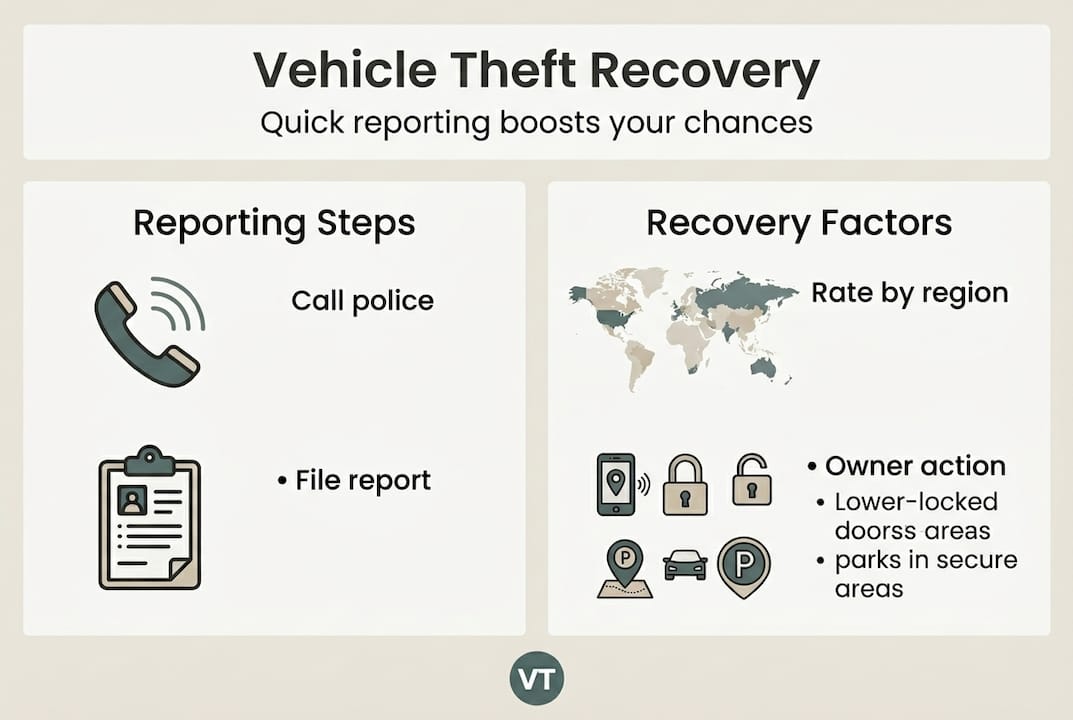
The data makes a compelling case for speed. Recovery rates in the US exceed 85% when owners report promptly, while Canadian recovery rates vary more sharply by region, ranging from 48% to 71% depending on where the theft occurs. Canada’s auto theft landscape cost insurers and owners a combined $900 million in claims in 2025, with provinces like Ontario and Quebec posting lower recovery rates due to organized export and re-VINing schemes (re-VINing is when criminals replace a vehicle’s legitimate VIN with a false one to disguise its stolen status).
Recovery rates by region
| Region | Annual thefts (approx.) | Recovery rate |
|---|---|---|
| United States (2023) | 1,000,000+ | 85%+ |
| Canada (national avg.) | High volume | 48–71% |
| Ontario / Quebec | Elevated hotspots | Below national avg. |
Why the gap? In Ontario and Quebec, sophisticated theft networks move vehicles to ports within hours of the crime. By the time an owner realizes the car is gone, it may already be in a shipping container. That is not speculation. It reflects the documented activity of organized rings that exploit every delay in reporting.
Here is what delays actually cost you:
- Vehicles moved across borders before police databases are updated
- VINs altered or cloned, making recovery and identification difficult
- Parts stripped at chop shops, meaning the car may never be recovered as a whole unit
- Criminal networks alerted to begin the re-VINing or export process
You can also protect yourself before a theft happens. Understanding theft checks in auto reports when buying a used car ensures you are not unknowingly purchasing a vehicle that was previously stolen and reintroduced to the market.
Statistic callout: Vehicles reported stolen within the first hour are significantly more likely to be recovered intact. Every 60 minutes of delay gives criminal networks more runway to move, strip, or disguise your car.
Speed is not just about sentiment. It is about math. The faster you act, the better the numbers work in your favor.

Insurance requirements and financial protection
Getting your car back is only one piece of the puzzle. Even if the vehicle is never found, your ability to recover financially depends entirely on one document: the police report. Without it, your insurance claim goes nowhere.
This is not a technicality buried in fine print. Theft claims require a police report, and filing without one results in an automatic denial. Delayed reporting also raises a red flag with insurance investigators, who may interpret the gap as a sign of fraud. Insurance companies have dedicated special investigation units (SIUs) that scrutinize theft claims carefully, and anything unusual in your timeline gives them grounds to reject your claim or launch a formal fraud investigation.
Here is the typical process that follows once you report the theft and contact your insurer:
- File the police report as soon as you confirm the vehicle is stolen, not misplaced or towed.
- Call your insurance company within 24 hours and provide the police report number.
- Submit supporting documents, including your registration, proof of ownership, and any relevant receipts for add-ons or modifications.
- Enter the waiting period. Most insurers require roughly 30 days before they finalize a total loss payout, giving police time to locate the vehicle.
- Receive the settlement, which is typically based on the actual cash value (ACV) of your vehicle at the time of theft, not what you originally paid for it.
One thing many owners do not realize is that if the vehicle is recovered after the insurance company has already paid out, the insurer legally owns the car. You cannot simply keep both the money and the recovered vehicle. That is standard practice across the U.S. and Canada.
“Failing to report quickly does not just slow your payout. It can disqualify you entirely and flag your name for future claims.”
Pro Tip: Screenshot your police report confirmation or write down the report number immediately. Your insurance company will ask for it repeatedly throughout the claims process, and having it accessible speeds everything up considerably.
A few additional financial realities to keep in mind:
- Rental car coverage during the investigation period is only available if your policy includes it and you have a police report on file.
- Gap insurance (which covers the difference between your car’s value and what you still owe on a loan) only applies when a valid theft claim is open.
- Loan or lease obligations continue even while your car is missing. Reporting quickly helps initiate the insurance process faster so you are not making payments on a car someone else is driving.
The police report is not just a bureaucratic step. It is the key that unlocks your entire financial protection system.
Legal safeguards and government registries: Why agencies must know
Beyond insurance, reporting theft to the right government agencies creates a legal shield around your name and your record. Once a theft report is filed, the relevant agency, either your state DMV (Department of Motor Vehicles) in the U.S. or your provincial licensing authority in Canada, flags the VIN in official records. That single action has far-reaching consequences for anyone who tries to use, sell, or register your vehicle.
Reporting to your DMV or provincial authority immediately marks the VIN as stolen in government records, which blocks any attempt to transfer the title or register the vehicle under a new name. Without that flag, a thief could theoretically sell your car to an unsuspecting buyer through a fraudulent private sale, and that buyer might drive it for months before discovering the truth.
This matters for you in two specific ways:
- You are protected from fraudulent sale liability. If your car is sold and involved in a dispute, the theft record shows the transaction was not authorized by you.
- You are protected from criminal liability. If your stolen vehicle is used to run a red light, cause an accident, or commit a crime, parking tickets, traffic violations, and civil claims could otherwise land at your door. A theft report on file is your documented proof that you were not behind the wheel.
Reporting steps by jurisdiction
| Step | United States | Canada |
|---|---|---|
| Police report | Local or county police, then NCIC | Local police, then CPIC |
| Registry notification | State DMV or equivalent | Provincial transport authority |
| Insurance notification | Within 24 hours of report | Within 24 hours of report |
| Additional step | Some states require written DMV notice | Some provinces have online portals |
For Canadian owners, the process varies meaningfully by province. If you are in Ontario, you can review Ontario vehicle registry checks to understand how VIN flags appear in official records. Alberta owners have a separate process through the Alberta vehicle registry. Understanding your provincial system matters because a flag in one province does not automatically appear in another without proper database coordination.
Pro Tip: Before you buy any used vehicle, run VIN checks before buying to ensure the VIN has not been flagged as stolen in any jurisdiction. Criminals count on buyers skipping this step.
The legal protection piece is one that far too many car owners never think about until it is too late. Reporting is not just about recovering your property. It is about making sure someone else’s actions cannot be legally tied back to your name.
Public safety, organized crime, and the bigger picture
Your decision to report a theft is not just personal. It feeds into a much larger system designed to disrupt organized criminal networks that treat stolen vehicles as a business.
Auto theft in North America is not primarily driven by joyriders. The industry that profits most from stolen vehicles is organized crime. Vehicles are stolen on order, stripped for parts at chop shops, re-VINed for resale, or exported in shipping containers to overseas markets where demand is high and enforcement is limited. Unreported thefts fuel criminal operations that generate funding for drug trafficking and other serious crimes, with Canadian auto theft alone generating over $900 million in annual claims.
“Vehicle theft is not a victimless crime or a statistical footnote. It is a primary revenue stream for criminal organizations operating across North America.”
When you report a theft promptly, you contribute to a chain of accountability:
- Your report creates a timestamped record that law enforcement uses to track theft patterns in your area.
- Database entries alert border agencies, helping stop vehicles from leaving the country.
- Pattern data from multiple reports helps police identify chop shop locations and criminal ring activity.
- Insurance data from reported claims informs industry-wide efforts to reduce premiums over time by addressing root causes.
The collective cost of auto theft does not just affect victims directly. It drives up insurance premiums for every driver in high-theft regions. It diverts police resources. It floods used car markets with vehicles carrying fraudulent histories, which puts buyers at risk of unknowingly purchasing a stolen car. Every unreported theft makes each of these problems worse.
Your report, even if it never leads to the recovery of your specific vehicle, adds to a body of evidence that investigators, insurers, and policymakers use to fight organized vehicle crime. That matters for your neighbors, your community, and ultimately your own wallet through the insurance rates you pay.
Why most car owners underestimate the value of reporting theft
Stepping back from the statistics, here is something we see consistently: people delay reporting because they are holding onto hope. They think maybe they parked on the wrong block. Maybe a family member borrowed it. They wait an hour, then two, then a full day passes before they call police.
That hesitation is understandable. But the data is unambiguous. The fastest reports are the ones that intercept vehicles before they vanish into criminal supply chains. By the time you feel certain enough to call, the window for the best outcome may have already narrowed.
There is also a common belief that reporting is pointless because police cannot do much. That belief does not account for what a database entry actually does. It is not just a report sitting in a file. It actively alerts every officer who runs that plate, every border agent who scans that VIN, and every registry system that processes a title transfer.
The owners who fare best, financially and legally, are the ones who treat reporting like a first-response action, not an afterthought. Running theft history checks on any vehicle you are considering buying is the equivalent mindset applied before ownership. Acting early, on both ends of a theft event, is always the right call.
How VekTracer helps you stay secure and informed
If you want practical support around vehicle security, VekTracer is built for exactly that. Whether you are trying to verify a vehicle’s history before buying or checking if a VIN has ever been flagged as stolen, how VekTracer works makes that process fast, clear, and affordable.
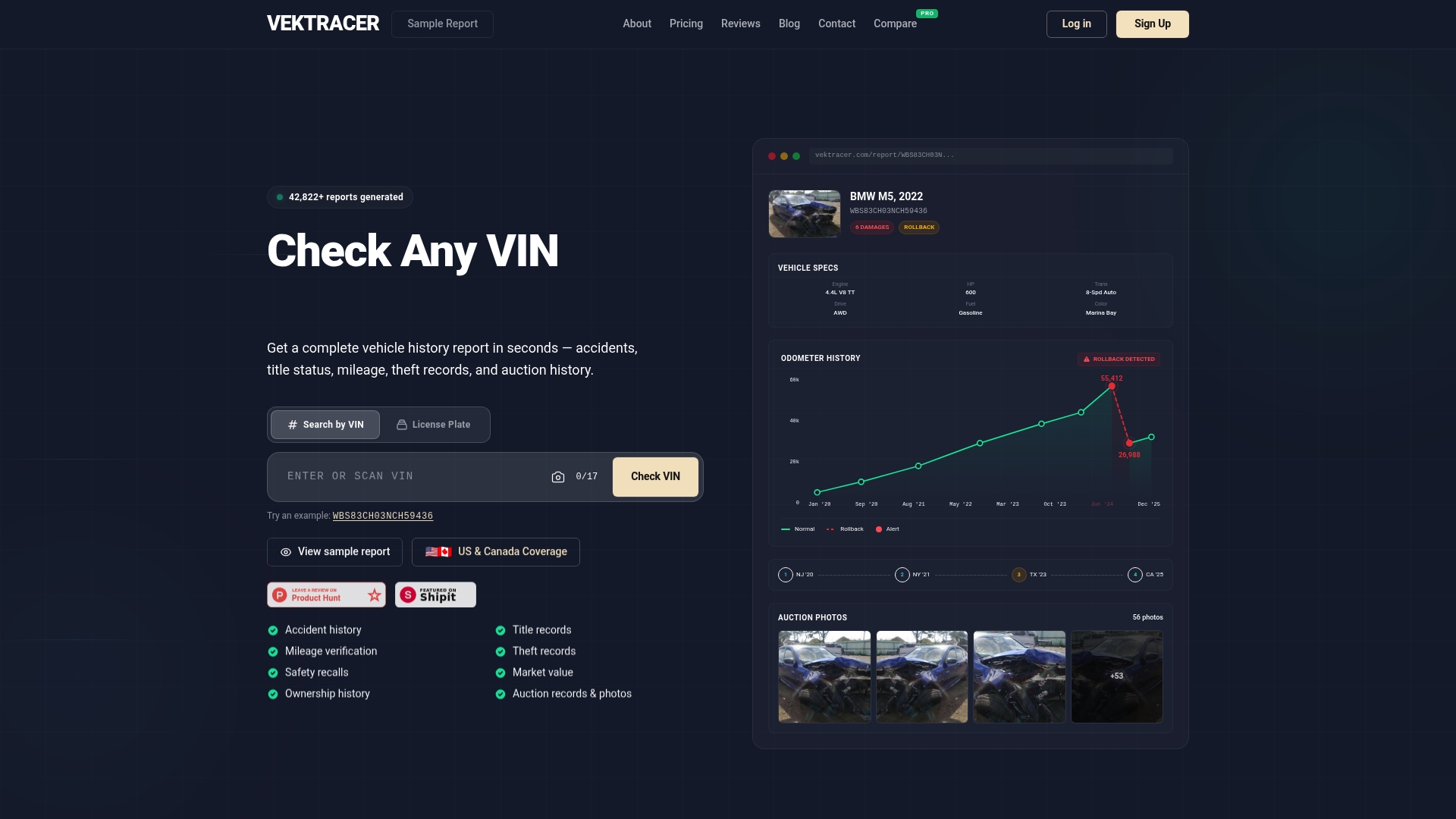
VekTracer’s VIN-based reports pull from NMVTIS-connected sources to show you theft records, title history, accident data, mileage verification, and safety recalls, all in one place. Our pricing options start at just $19.99, which is significantly less than Carfax at $44.99. For anyone who wants ongoing awareness and peace of mind around vehicle theft monitoring, VekTracer gives you the tools to stay informed at every stage of ownership.
Frequently asked questions
How soon should I report a stolen vehicle?
You should report a stolen vehicle to police immediately to maximize recovery chances and protect your insurance claim. Prompt reporting raises recovery odds by up to 34%, with 20% of vehicles found within the first 24 hours.
Can I file an insurance claim if I don’t report the theft to police?
No. Most insurance providers require a police report to process a theft claim, and filing without one results in an automatic denial that may also trigger a fraud review.
Will reporting a stolen car affect my insurance rate?
Reporting theft itself does not increase your rates, but making a claim may affect your premiums depending on your policy and insurer. Delayed reporting, however, can complicate or void a claim entirely.
What happens if a stolen vehicle is used for illegal activities?
If you report the theft promptly, government registry flags protect you from liability for tickets, accidents, or crimes committed by the thief. Without a report on file, that legal protection does not exist.
How do authorities track and recover stolen vehicles?
Police enter stolen vehicle data into national databases like NCIC in the U.S. or CPIC in Canada, which alert law enforcement at traffic stops, border crossings, and title transfer points across both countries.
Recommended
Ready to check a vehicle?
Enter any 17-character VIN for a free instant preview — no account needed.