Unlock Jaguar History with Our Vin Decoder Jaguar

Check a vehicle before you buy
Enter a VIN for a free instant preview — accidents, title brands, mileage, liens & open recalls.
A Jaguar VIN decoder translates the vehicle's 17-character identification number into the car's factory specs, model year, assembly details, and history clues that matter before you buy. But a spec check alone isn't enough. The smart move is to decode the VIN manually first, then verify authenticity and hidden risk through a full vehicle history report.
You're probably here because you found a used Jaguar that looks right on paper. Clean photos, plausible mileage, good options, maybe even a seller who sounds organized. The problem is that luxury cars can look convincing while hiding title problems, mileage issues, or VIN inconsistencies that won't show up in a basic lookup.
That's where the gap is. A basic VIN decoder tells you what the car was built to be. A proper history check helps confirm whether the car in front of you still matches that identity. If you're also comparing tools for a broader VIN check USA, VIN check Canada, or deciding whether a full vehicle history report is worth the cost, this is the practical way to approach a Jaguar without guessing.
Your Guide to Decoding a Jaguar VIN
You find a used Jaguar that looks right. The photos are clean, the trim matches the ad, and the seller has a believable story. Before you book transport or start negotiating, check whether the car's identity holds up under scrutiny.
A Jaguar VIN decoder is the first filter, not the final answer. It helps confirm what the car was built to be. It does not confirm that the car still carries its original identity, mileage, or title status. That gap matters more on a used luxury car than many buyers realize.
Start with a quick Jaguar VIN decoder tool to verify the visible factory data. Use it to compare the seller's description against the VIN. If the listing says supercharged V8, one model year, or a specific body style and the decode points elsewhere, stop and resolve that before spending money on an inspection.
A basic decode is useful for three jobs:
- Confirming manufacturer and model identity: You want to know the VIN belongs to a Jaguar and aligns with the vehicle being advertised.
- Checking factory configuration: The VIN can help verify model year, engine family, body type, and production details.
- Catching early mismatches: A disagreement between the VIN and the ad often signals either a careless seller or a car that needs much closer review.
That said, buyers get into trouble when they treat a decoded VIN like proof of legitimacy.
It isn't.
Manual decoding and basic lookup tools only tell you that the number follows the expected format and points to a certain build. They do not tell you whether the VIN plate was moved, whether the odometer reading makes sense, or whether the car has salvage, theft, export, or title-brand history. On Jaguars, that difference can mean the gap between a sound purchase and an expensive mistake.
My rule is simple. Decode first to confirm specs. Then verify authenticity and risk with records that show what happened to that specific car over time.
If you inspect a Jaguar in person and run into missing keys or access problems while trying to verify ownership details, support from a legitimate local specialist can help. In that situation, car key programming in Christiansburg may be useful during a lawful ownership verification process.
Breaking Down the Jaguar 17-Digit VIN Code
A Jaguar VIN does more than label the car. It gives you a factory identity to compare against the metal, the paperwork, and the seller's story. That comparison matters, because a clean spec decode can still sit on top of a cloned VIN, a swapped engine, or a car with paperwork problems.
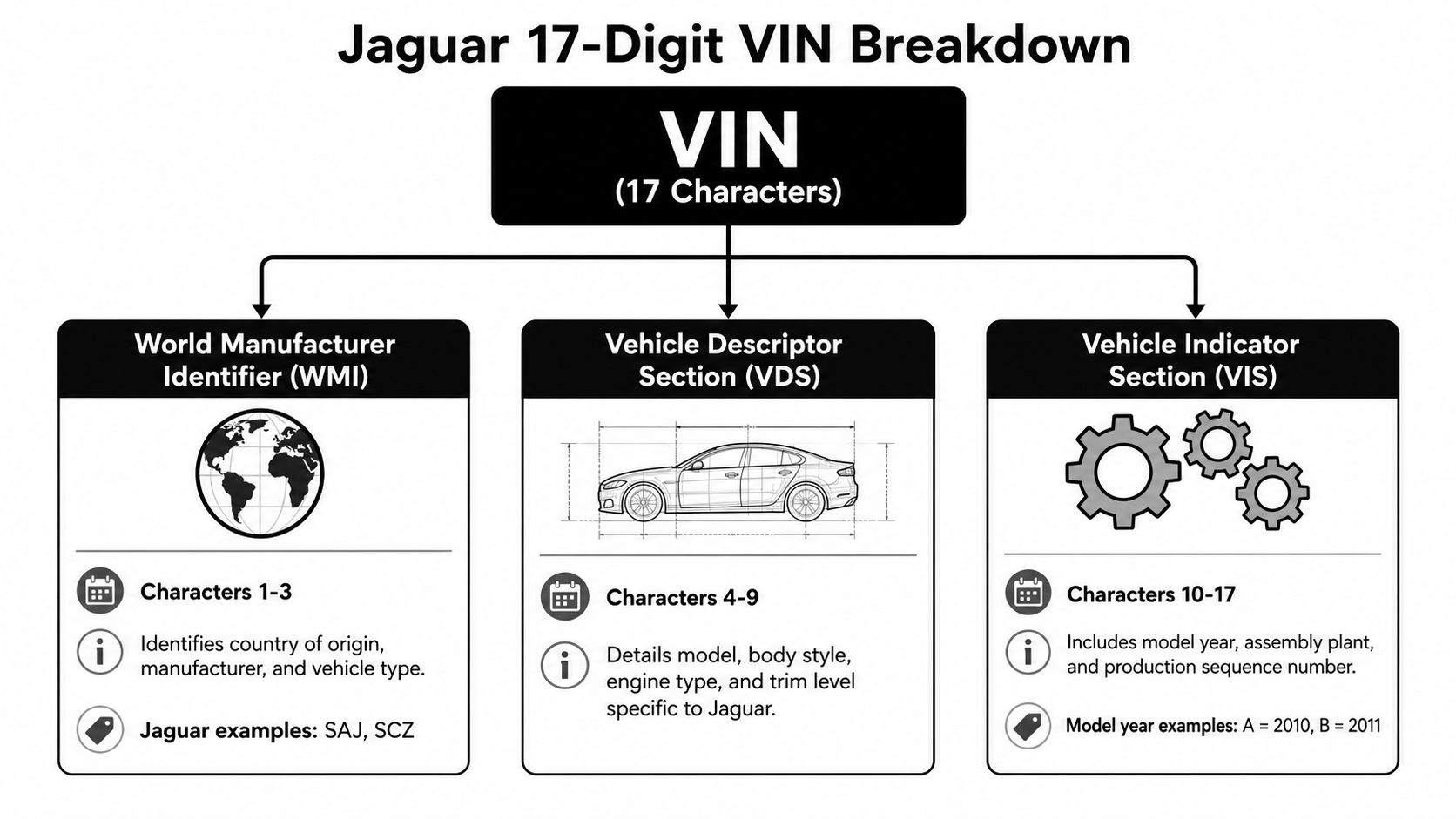
WMI tells you the manufacturer
The first three characters are the World Manufacturer Identifier, or WMI. On Jaguars, you will usually see SAJ. That confirms you are starting with a Jaguar-coded VIN, not just a listing that claims to be one.
For a buyer, this is a fast filter. If the first three characters do not fit Jaguar's coding, stop treating it like a routine typo. Either the ad is wrong, the paperwork is wrong, or the car in front of you is not what the seller says it is.
VDS tells you the build details buyers usually overrate
Characters 4 through 8 describe the vehicle's configuration. Depending on the model and year, this section can point to body style, restraint system, engine variant, and other factory attributes. The 9th character is the VIN checksum, which helps validate that the number itself is structurally plausible.
That middle block is useful, but buyers often ask it to do too much. A decoder may confirm that the VIN fits an XF sedan with a certain engine family. It does not prove the current engine is original, the trim was not rebadged, or the car was not rebuilt after a major loss.
Use this section for comparison, not proof.
| VIN area | What it helps confirm | Why it matters |
|---|---|---|
| 1 to 3 | Manufacturer identity | Confirms the VIN starts as a Jaguar-coded number |
| 4 to 8 | Model and factory equipment clues | Lets you compare the car, ad, and paperwork against the original build |
| 9 | Checksum | Screens out invalid VIN entries and some transcription errors |
VIS identifies the individual car
Positions 10 through 17 make up the Vehicle Identifier Section, or VIS. In this section, you read the model year, assembly plant, and the car's serial sequence.
This section matters more than many buyers realize. Two used Jaguars can look identical on a lot and still have very different histories. The VIS is what separates one car from another when you start matching the VIN against title records, service history, auction photos, and physical stampings.
On Jaguars, the 8th digit is often important because it can help identify the factory-installed engine variant. If that decoded engine information does not line up with what is found in the car, treat it as an inspection issue. It may be innocent, such as a legitimate engine replacement. It may also point to a poorly disclosed repair, a parts swap, or a car built from multiple vehicles.
A correct decode is only step one. The next step is checking whether this exact Jaguar, with this exact serial identity, matches the body, engine, labels, title, and history records attached to it.
Where to Physically Locate the VIN on Your Jaguar
A seller hands over a clean title, the ad photos look right, and the dashboard VIN matches the paperwork at first glance. Buyers get burned when they stop there.
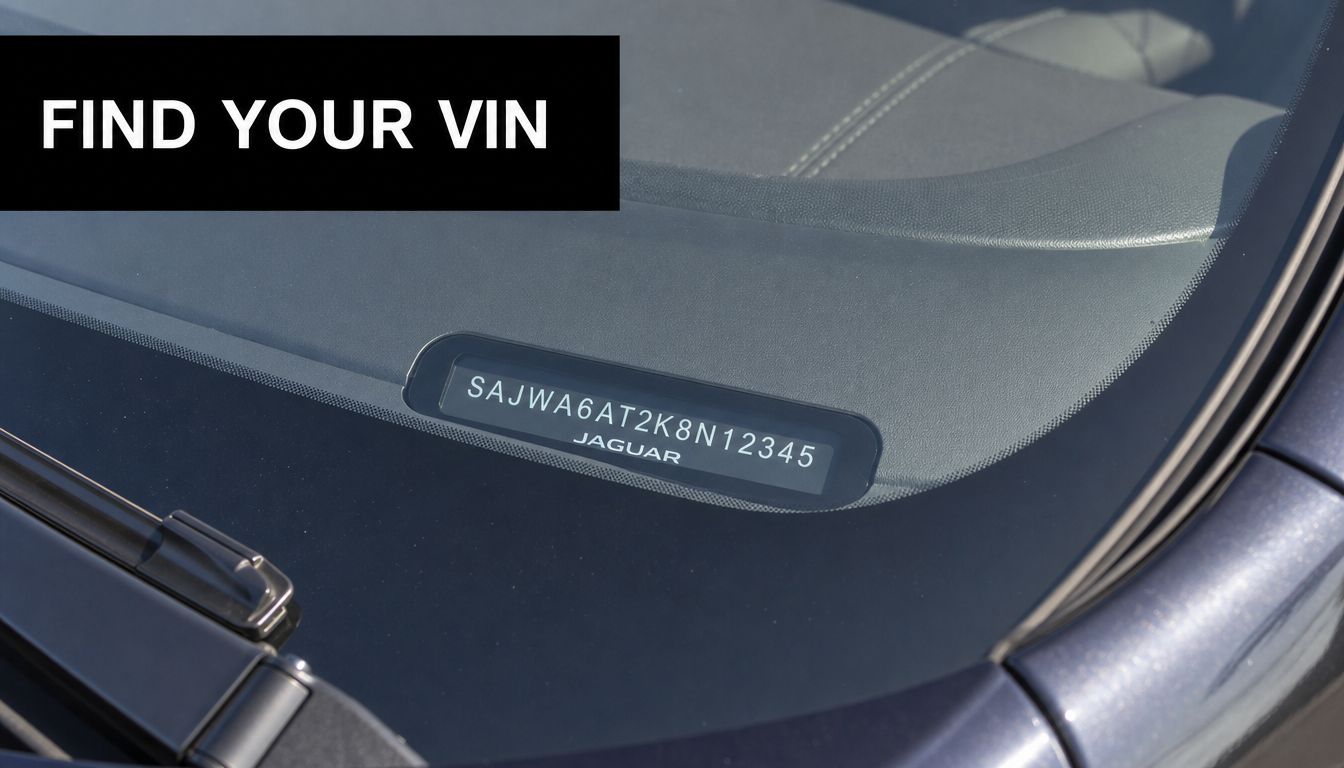
On a used Jaguar, the VIN needs to be checked in more than one physical location. The visible VIN at the base of the windshield is the quick access point. You should also inspect the driver's door jamb label or plate, then verify at least one harder-to-alter stamped location on the car. On some Jaguars, that can include an engine or body stamping, depending on model and year.
The three places to check first
When I inspect a used Jaguar, I want agreement across the car, not just a readable number in one spot.
- Windshield VIN plate: Use this for the first comparison against the title, registration, and listing.
- Driver's door jamb label or plate: Check for matching characters, but also look at the label itself. Peeling edges, incorrect rivets, uneven spacing, or fresh paint around the area can point to replacement work or tampering.
- Stamped VIN or identifying number on a fixed component: This is the harder check, and it matters most when the car has salvage history, inconsistent paperwork, or signs of major repair.
What matters during a physical VIN check
A matching dashboard VIN tells you very little by itself. It confirms the seller put a VIN where you expected to see one.
The stronger test is consistency. The same 17 characters should appear exactly the same across the paperwork, the visible VIN, and the other factory identifiers. One wrong digit can be a simple clerical error. A different label, a missing plate, or signs that the mounting area has been disturbed changes the risk profile of the car.
That does not always mean theft or cloning. It can also mean accident repair, a replaced door, an engine swap, or poor recordkeeping. The point is practical. Once the physical VIN trail stops being clean, a basic decoder stops helping much.
Use this order:
- Check the title and registration
- Match the windshield VIN exactly
- Inspect the door jamb label closely
- Verify a stamped identifier on the vehicle
- Pause the deal if anything does not line up
If a Jaguar shows VIN agreement in only the easiest place to look, you do not have verification yet. You have a starting point.
Common Mistakes When Using a Basic VIN Decoder
You find a Jaguar that looks right, the VIN decodes to the right model, and the seller sounds prepared. Buyers get into trouble at that point. A basic decoder confirms the VIN is structured like a Jaguar VIN. It does not confirm the car in front of you is legitimate, properly titled, or low-risk to buy.
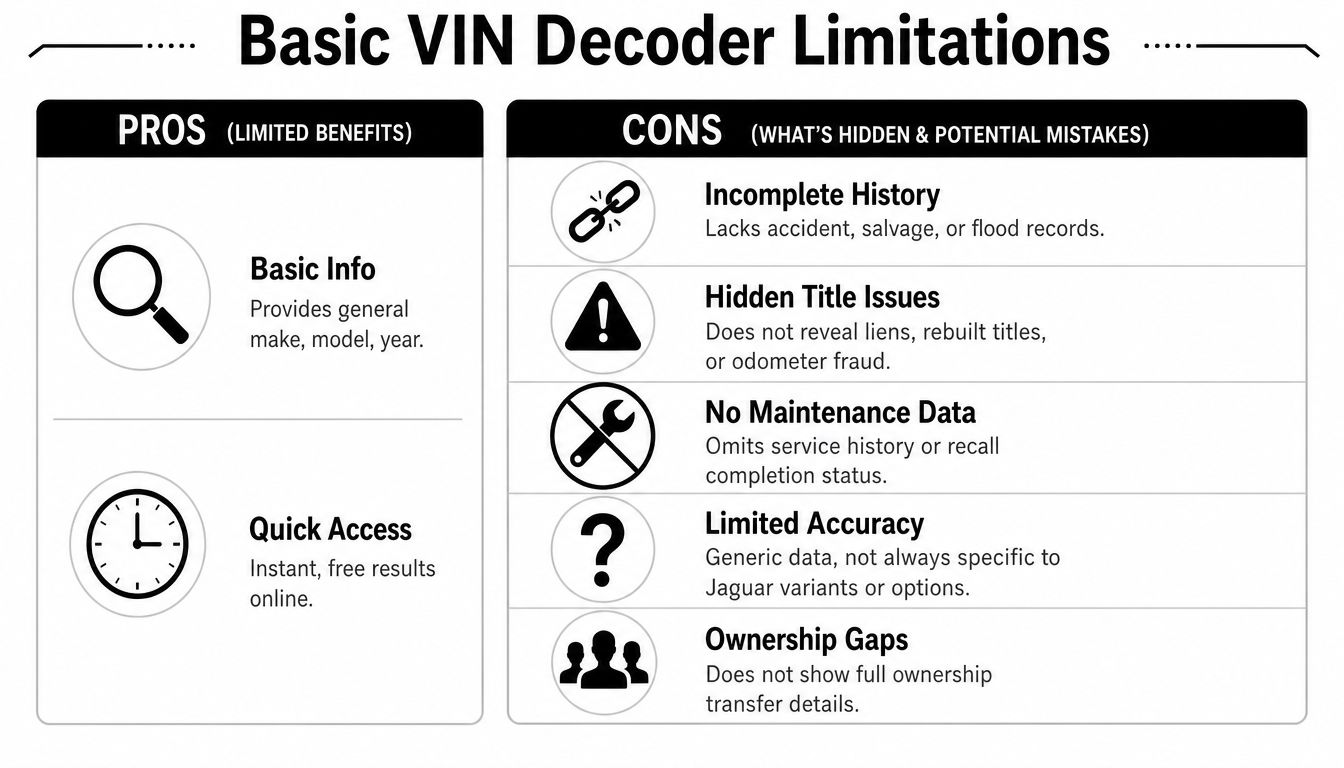
That gap matters more on a used Jaguar than many buyers expect. These cars often move through auctions, specialist dealers, rebuilders, and private sales. A free decoder can tell you engine family, model year, and body type. It cannot tell you whether the identity is clean, whether the mileage history makes sense, or whether the seller's story holds up under record checks.
Mistake one: treating a spec match as identity verification
If the decoder returns Jaguar XF and the car is wearing XF badges, that only tells you the visible story is consistent. Cloned cars pass that test all the time. So do cars rebuilt from major collision damage.
The question is not "does this VIN decode correctly?" It is "does this VIN belong to this exact car, with this ownership and title history?" Those are different checks, and buyers who treat them as the same thing miss the highest-risk problems.
Mistake two: skipping the checksum and format check
The 9th character exists to validate the VIN. If the checksum fails, stop treating it like a minor typo. Start treating it like a file that needs explanation before money changes hands.
In practice, an invalid VIN creates bigger problems than a decoder error. Insurance quoting can fail. Registry searches can come back incomplete. Title and history records can break off because one character is wrong, or because the number was altered. Either way, the result is the same. You cannot verify the car cleanly.
Mistake three: assuming every decoder answers the same question
Some tools are built for catalog data. They identify trim, engine, plant, restraint system, and year. That is useful during an initial screen.
It is weak for fraud detection.
A buyer trying to assess risk needs more than build data. Title brands, theft records, mileage consistency, auction activity, total-loss events, and lien signals matter more than whether the car left the factory with one wheel option or another. If you need a clearer breakdown of what those reports cover, read this guide to a vehicle history report and what it shows.
Mistake four: missing the trade-off between speed and certainty
A basic decoder is fast, and that is its value. I use one early to rule out obvious mismatches before spending time on a car. The mistake is letting that first pass carry too much weight.
Used properly, decoding is a filter. It helps you catch easy inconsistencies. It does not replace title verification, record review, or a proper inspection. On a Jaguar with incomplete paperwork, salvage history, or suspiciously low miles, manual decoding is only the first step. Actual work starts when you verify that the VIN has a believable paper trail and that the car's history supports the asking price.
Verifying Authenticity with a Vehicle History Report
You decode the VIN on a used Jaguar and the specs line up. The seller sounds credible. The photos look clean. That is still not enough to confirm the car is genuine, properly documented, or priced for its real risk.
A basic decoder tells you what the car was built to be. A vehicle history report helps you verify whether the car in front of you has a believable paper trail. That gap matters more on a Jaguar than many buyers expect, because these cars can carry expensive repair history, title complications, theft exposure, or mileage questions that do not show up in a simple spec check.
What I look for is consistency. The VIN should match the paperwork, the ownership timeline should make sense, mileage should rise in a believable pattern, and any accident or insurance event should fit the condition of the car. If those pieces do not agree, the problem is no longer academic. It affects value, insurability, and whether you should stay in the deal at all.
A solid report usually helps you confirm:
- accident and damage history
- title brands such as salvage, rebuilt, or flood
- odometer readings over time
- theft records and recovery history
- registration, lien, or export signals that need follow-up
If you want a plain-English overview before comparing providers, read this guide to what a vehicle history report shows.
The practical trade-off is simple. A decoder is fast and cheap. A full report costs more, but it can save you from buying a Jaguar with a cloned identity, an insurance total-loss past, or a mileage story that falls apart the moment service records are checked.
Theft history deserves special attention. A recovered theft car is not automatically a write-off, but it needs closer scrutiny for key replacement, module coding, forced entry damage, and future insurance friction. Buyers who have never dealt with that process should review managing vehicle theft insurance so they understand what happens after a theft claim and why that history can follow the vehicle.
Here is the buying rule I use. If the Jaguar is expensive enough to finance, insure, or repair, it is expensive enough to justify a proper history report before money changes hands.
How to Interpret Red Flags on a Jaguar Report
You run a report on a used Jaguar and it looks decent at first glance. Then one line shows a mileage jump that makes no sense, or a theft recovery entry appears with no supporting paperwork. That is the point where a basic spec check stops being useful and real risk assessment starts.
I separate report problems into two buckets. Authenticity problems question whether the car is really the car being advertised. Condition and ownership problems mean the identity may be legitimate, but the financial and repair risk can still be high.
Identity red flags
A Jaguar report can look clean and still miss a cloned or altered vehicle if nobody checks the car itself. The VIN on the report must match the VIN on the car, and the stamped and labeled locations need to agree with each other. If one location differs, treat the car as suspect until the seller proves otherwise.
The report deserves extra scrutiny when you see:
- VIN inconsistency across physical locations: Stop the deal until you verify why the numbers differ.
- Title paperwork that does not cleanly match the seller: This can turn into a registration or ownership problem after purchase.
- Imported or export history with gaps: Sometimes harmless, often sloppy, occasionally a sign that the paper trail was broken for a reason.
One practical point from inspection work: identity risk outranks cosmetic condition every time. A scratched, honest Jaguar is easier to price than a clean-looking car with a questionable identity.
History red flags
It's common for buyers to get lazy. They see the right color, the right wheels, the right engine code, and they treat the report like a formality. On a used Jaguar, the expensive mistakes usually hide in the history, not the brochure specs.
Use the report findings this way:
| Report finding | What it usually means | Best next step |
|---|---|---|
| Minor damage history | May be acceptable if repairs were documented and finished properly | Check panel fit, paintwork, and invoices |
| Mileage inconsistency | Possible rollback, clerical error, or cluster replacement | Verify service dates, inspection records, and the full mileage sequence |
| Salvage or rebuilt branding | Lower market value and higher insurance and resale friction | Buy only if the price reflects the risk and an expert inspection supports it |
| Theft history or recovery record | Potential for missing keys, replaced modules, poor repairs, or future insurance issues | Confirm recovery paperwork, repair documentation, and insurer treatment before proceeding |
Mileage issues need more than a quick glance at the odometer. A believable Jaguar should show a consistent pattern across inspections, service visits, registration events, and sale listings. If the sequence is broken, use this guide on checking a vehicle for odometer rollback to verify what happened before you discuss price.
Theft history also gets misunderstood. A recovered theft car is not automatically bad stock, but it needs a harder inspection than a standard used car. I want to know whether keys were replaced properly, whether modules were recoded, whether there was forced entry damage, and whether the insurer branded or restricted the car in a way that will affect the next owner. Buyers who have never dealt with that side of ownership should read managing vehicle theft insurance before treating a theft recovery as a bargain.
What to do after a red flag appears
Do not bargain first. Verify first.
Ask for the document that resolves the issue, then check whether it does. A seller who cannot explain a title brand, mileage gap, or theft recovery entry with records is asking you to absorb the risk blindly. On a Jaguar, that can mean electrical repairs, insurance complications, financing trouble, or a car that is hard to resell even if it drives well today.
One rule is simple. An honest report with documented repairs is often a workable deal. A clean-looking Jaguar with unresolved identity, mileage, or theft questions usually is not.
If you're also comparing providers and wondering about reporting style, side-by-side tools, or whether another report format is easier to read, check the Carfax comparison page.
Frequently Asked Questions About Jaguar VINs
Can I decode a classic Jaguar built before 1981
Only with older Jaguar-specific records, not with the same standardized method used on modern cars. Pre-1981 cars often rely on chassis numbers, body plates, factory build records, and club or marque archives instead of a modern 17-digit lookup.
For a classic Jaguar, the job is identity verification first, specification second. Check that the stamped numbers, tags, paperwork, and model details all agree. If they do not, treat it as an authenticity problem, not a decoding problem.
What's the difference between a VIN and a chassis number on a Jaguar
On newer Jaguars, buyers often use the two terms interchangeably because the VIN is the main legal identifier for registration, insurance, and history checks.
On older Jaguars, the chassis number may be the number that matters most in period documents and restoration records. That distinction matters if you are buying a classic, an import, or a car with heritage paperwork. A seller who mixes the terms casually may just be imprecise. A seller whose documents show conflicting identifiers needs harder scrutiny.
If a Jaguar was imported from the UK to the US, what should I check
Start with identity continuity. The VIN on the car, the title, customs paperwork, auction records, service records, and any import documents should line up cleanly.
Then check the parts that get missed. Speedometer unit changes, delayed state registration, salvage branding in a prior market, and gaps between export and first US title can all hide real risk. Imported Jaguars can be solid cars, but they need a cleaner paper trail than domestic cars because there are more places for the history to break.
Can I rely on the engine code in the VIN
Use it to confirm what the car was built with, not what sits in the engine bay today. The VIN can point you toward the original engine type, which is useful when you are checking whether the car matches its factory configuration.
That matters most on performance trims and higher-value examples. If the decoded engine type, emissions label, and physical engine do not match, stop treating it as a minor detail. It could be an honest engine replacement, or it could mean the car is being represented inaccurately.
Is a basic decoder enough for a used Jaguar purchase
A basic decoder only answers the easy questions. It can confirm model, year, engine family, and where the car was built. It does not confirm that the VIN belongs to the shell in front of you, that the mileage history makes sense, or that the title record is clean.
That is the gap buyers miss. Spec decoding helps you identify the car. Fraud screening helps you decide whether the car is safe to buy.
Where should I start if I'm still comparing options
Start at the car itself.
Match the VIN in every physical location you can access. Then decode it to confirm the factory identity. After that, review the history report and read it like a risk document, not a brochure. If the Jaguar passes those three steps, it has earned the right to get a proper inspection.
If you want a faster way to vet a used Jaguar before you commit, VekTracer gives you the practical next step: a full vehicle history report with mileage verification, title and lien status, theft records, recall alerts, and a clear Risk Score so you can decide whether the car deserves an inspection, a lower offer, or a hard pass.
Ready to check a vehicle?
Enter any 17-character VIN for a free instant preview — no account needed.