How to Check for Odometer Rollback: A 2026 Guide
Check a vehicle before you buy
Enter a VIN for a free instant preview — accidents, title brands, mileage, liens & open recalls.
Used car buyers lose money on odometer fraud every day, and the mistake usually starts the same way: they trust the number on the dash as if it were proof. It is only one claim. To verify mileage, build a case from three directions.
Use a triangulation method. Check the digital history, inspect the car’s real-world wear, and read the paper records side by side. A clean vehicle history report means less if the driver’s seat is collapsed and the brake pedal is worn smooth. A low-mileage interior means less if service invoices show oil changes far too often for the miles displayed. Conflicts like that are what expose rollback.
The point is not to hunt for one smoking gun. It is to see whether the same story shows up in all three places. The Federal Trade Commission outlines common used-car fraud risks at https://consumer.ftc.gov/articles/buying-used-car. Mileage fraud fits that pattern because one false number can distort value, maintenance expectations, and the risk you are about to take on.
When the digital record, physical condition, and paperwork line up, confidence goes up. When even one of them is out of step, stop treating the odometer as fact and start treating it as a claim that needs proof.
The Reality of Odometer Fraud and Your First Line of Defense
An odometer rollback changes more than the number on the dash. It changes how you price the car in your head, how you judge remaining life, and how much risk you're about to accept. A car that looks like a low-mileage bargain can be a tired vehicle with hidden wear, deferred maintenance, and safety-related issues that arrive sooner than you expected.
Federal law treats odometer tampering seriously, and for good reason. Once mileage is falsified, the buyer loses the most important shortcut for estimating age and use. The fix isn't paranoia. It's a process.
Use the three-way check, every time
When buyers ask me how to check for odometer rollback, I tell them to stop thinking in single checks and start thinking in layers:
- Digital evidence: pull a vehicle history report and read the mileage timeline, not just the title status.
- Physical evidence: inspect the cabin, tires, lights, and general wear to see whether the car's condition matches the claimed miles.
- Paper evidence: review service invoices, oil stickers, inspection records, and title wording.
Practical rule: If the odometer says one thing, but the records or wear say another, believe the conflict, not the seller's explanation.
A lot of bad purchases happen because buyers rely on one clean-looking signal. Clean interior. Smooth seller. Nice photos. Fresh detail. None of that proves mileage.
What first-time buyers usually miss
Most rollback scams aren't exposed by one dramatic clue. They're exposed by inconsistency. The car claims low miles, but the driver's seat is flattened. The history report shows a gap. The oil-change sticker under the hood shows a higher number than the dash.
That's the whole game. You're not trying to be a forensic genius. You're trying to catch contradictions before you hand over money.
Digital Forensics Using Vehicle History Reports
A vehicle history report is the first filter because it lets you look at mileage as a timeline instead of a single snapshot. That's the right mindset. Odometer fraud isn't just about a low number. It's about whether the number makes chronological sense.
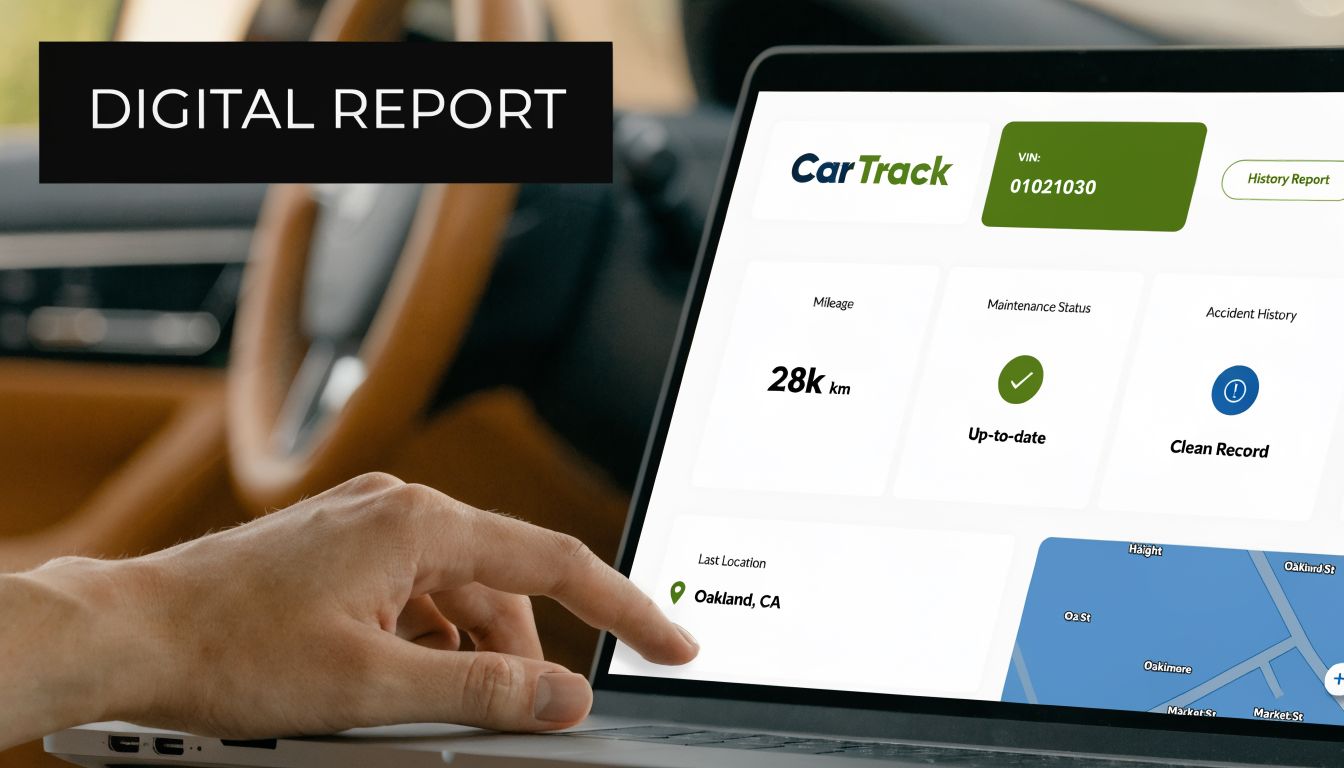
Vehicle history reports are central to rollback detection because they show mileage from inspections, services, and registrations, and they can expose drops, gaps, TMU branding, or warnings such as possible rollback, as described by VinCheckUp's odometer history overview.
Read the mileage line by line
Don't skim the report for accidents and stop there. Go straight to the mileage entries and read them in date order.
What you want is a believable progression. Mileage should rise over time, with normal variation in how often it's reported. What should bother you:
- Backward movement: a later record showing fewer miles than an earlier one
- Long flat stretches: repeated records with no real mileage increase over an extended period
- Missing chronology: big gaps where you'd expect service, registration, or inspection entries
- Mileage brands: wording such as TMU or Not Actual Mileage
- Explicit report alerts: language indicating the mileage may be inaccurate
A simple scenario that catches people off guard
Say a car is advertised as low mileage. The dashboard looks attractive. The seller says it was a weekend car. Then the report shows an older service entry with a higher reading than the current dash, followed by a later title event with lower mileage. That isn't a quirky paperwork issue until proven otherwise. That's a serious fraud signal.
I've seen buyers talk themselves out of obvious warning signs because the seller sounded calm and had a plausible story. Calm sellers still sell bad cars.
A good mileage timeline should feel boring. The moment it gets confusing, you need a second layer of proof.
What works and what doesn't
What works is comparing dated mileage records to each other and asking whether the sequence holds up. What doesn't is treating a report as a pass-fail badge. A report can be useful even when it's incomplete, and it can look clean until you study the actual entries.
If you're shopping across multiple vehicles, use a report tool that makes mileage anomalies easy to spot. Some buyers compare entries manually. Others use platforms that flag suspicious patterns. If you're still narrowing options, a used car history check guide helps frame what belongs in a report before you visit the seller, and a VIN check USA lookup can help you start from the VIN rather than the listing. VekTracer is one example of a report platform that includes a mileage timeline, rollback alerts, and a Risk Score so you can quickly see whether a car deserves closer inspection.
For digital checks, the trade-off is simple. Reports are fast and often revealing, but they aren't the whole case. A clever fraudster may leave you with partial records, delayed reporting, or conflicting entries that still need confirmation on the car itself.
The Physical Inspection When Wear Tells the Real Story
A rollback usually breaks down in one place first. The mileage claim stops matching the wear pattern on the car.
That is why I treat the walk-around as a triangulation step, not a cosmetic check. The odometer gives one story. The cabin, exterior, and tires give another. Your job is to see whether those stories agree.
Start with the surfaces the driver uses every trip
Begin in the driver's seat and work outward. This area collects the most honest wear because sellers can clean it, condition it, or cover it, but they rarely make years of use line up neatly with a low-mile claim.
Check the brake and accelerator pedals first. On a low-mileage car, the rubber pattern usually still has definition. On a higher-use car, the edges round off, the texture gets slick, and the contact areas look polished. Then move to the steering wheel and shift knob. A shiny wheel, peeling coating, faded shift markings, or a loose-feeling selector can fit an older, higher-mile car. They do not fit a car that supposedly spent most of its life barely driven.
The driver's seat bolster matters for the same reason. Repeated entry and exit crush the outer edge. If that bolster is flattened, split, heavily creased, or sagging, count it as one more point against the number on the dash.
Use wear as a consistency test, not a mileage calculator
| Component | Low Mileage (<30,000 miles) | Medium Mileage (50,000-80,000 miles) | High Mileage (100,000+ miles) |
|---|---|---|---|
| Pedals | Sharp texture, limited smoothing | Noticeable smoothing on contact areas | Heavily polished, worn edges, reduced texture |
| Steering wheel | Matte finish, minimal hand shine | Mild gloss on common grip points | Strong shine, worn coating, possible peeling |
| Driver seat bolster | Firm shape, light creasing | Moderate creasing, some softening | Flattened support, deeper wrinkles, visible wear |
| Carpet and floor mat | Light compression | Moderate heel wear in driver's footwell | Heavy mat wear, thinning, deep heel marks |
| Shift knob or selector | Markings clear, finish intact | Light wear on top surfaces | Faded markings, polished or loose-feeling trim |
Use that chart carefully. No single item proves fraud. A replaced steering wheel, fresh floor mat, or seat cover can throw off one clue. Three or four mismatches in the same car deserve much more scrutiny.
I also check the small stuff buyers miss. Window switches with worn icons, a start button with the lettering rubbed off, a door handle shiny from constant use, or a seatbelt webbing edge that feels fuzzy can all support the same conclusion.
"Highway miles" is not a free pass. Long trips still wear the wheel, seat, pedals, and switchgear.
Read the exterior like a second witness
Now step outside and ask a simpler question. Does the body look like it has lived a low-mile life?
Focus on the nose, windshield area, lamps, and driver's door. Heavy stone chipping across the front bumper and hood points to a lot of road time. Cloudy headlights can come from age and sun exposure, but they still need to make sense with the claimed mileage and model year. Loose trim, tired weather stripping, and a driver's door that feels used far more than the passenger doors often tell a harder story than the odometer does.
Look underneath if you can do it safely. Road grime packed into suspension corners, rust flecks on hardware, and underbody wear can support a higher-use history. If you want a better framework for checking title-related inconsistencies alongside what you see on the car, this used car title record checklist pairs well with a physical inspection.
Tires are one of the quickest tie-breakers
Tires force specific questions. Are they original, replaced as a set, or mixed brands with different date codes? A low-mileage car may still need tires because of age, but the seller should be able to explain that clearly. Vague answers are a problem.
A car showing very low miles with badly worn tires, a tired driver's seat, and polished pedals is the kind of mismatch that should stop the deal until you verify more. On the other hand, fresh tires alone do not clear the car. Sellers replace tires all the time. Check the DOT date codes, tread wear pattern, and whether the rest of the car supports the same story.
What physical inspection adds to your case
Digital records show reported events. Paper records show documented events. Physical wear shows lived use.
That combination is how buyers avoid fooling themselves. If the history report looks mostly clean but the cabin feels used up, keep digging. If the interior looks right for the mileage but the service timeline later shows a conflict, keep digging. Confidence comes from agreement across all three layers, not from any one clue in isolation.
Auditing the Paper Trail of Service Records and Titles
Paper records are low-tech, which is exactly why they matter. Fraudsters often focus on the odometer display and the sales pitch. They don't always clean up every invoice, sticker, inspection note, and title notation that follows the car around.
A major blind spot in most buyer advice is how to analyze partial service records in a structured way. In private sales, where digital history can be incomplete, service documents often become the strongest evidence trail, as noted in this discussion of service-record analysis gaps.
What to ask the seller for
Ask for the records plainly. Don't apologize for it.
Use questions like these:
- "Do you have oil-change receipts or service invoices?"
- "Can I see the current title, not a copy?"
- "Do you have inspection paperwork or maintenance booklets?"
- "Are there any records from the previous owner?"
A legitimate seller may not have everything, but they usually won't get defensive about the request.
How to audit the paperwork
Look for mileage entries on every document you can find. Service invoices, emissions paperwork, inspection sheets, and even stickers under the hood can all carry mileage.
What matters is pattern. Put the documents in date order and compare the numbers. If one repair invoice shows mileage higher than the current odometer, that's not a minor concern. That's a direct contradiction.
Pay close attention to title language too. Terms like Total Mileage Unknown or Not Actual Mileage change the risk profile of the whole deal. If you need help reading title wording and spotting title-related warning signs, this title record checklist for used cars is a useful companion.
Service records are powerful because they were usually created for maintenance, not resale. That makes them harder to stage convincingly after the fact.
What works better than people expect
Under-hood oil stickers are easy to overlook and often revealing. So are glovebox receipts, old tire invoices, and inspection reminders tucked into maintenance folders. Buyers love polished listings. Fraud investigations love neglected paperwork.
The trade-off is that paper trails can be messy. Shops record mileage differently. Owners lose documents. Some records are handwritten. That's fine. You're not looking for perfection. You're looking for conflicts that shouldn't exist.
Advanced Detection Methods and Professional Inspections
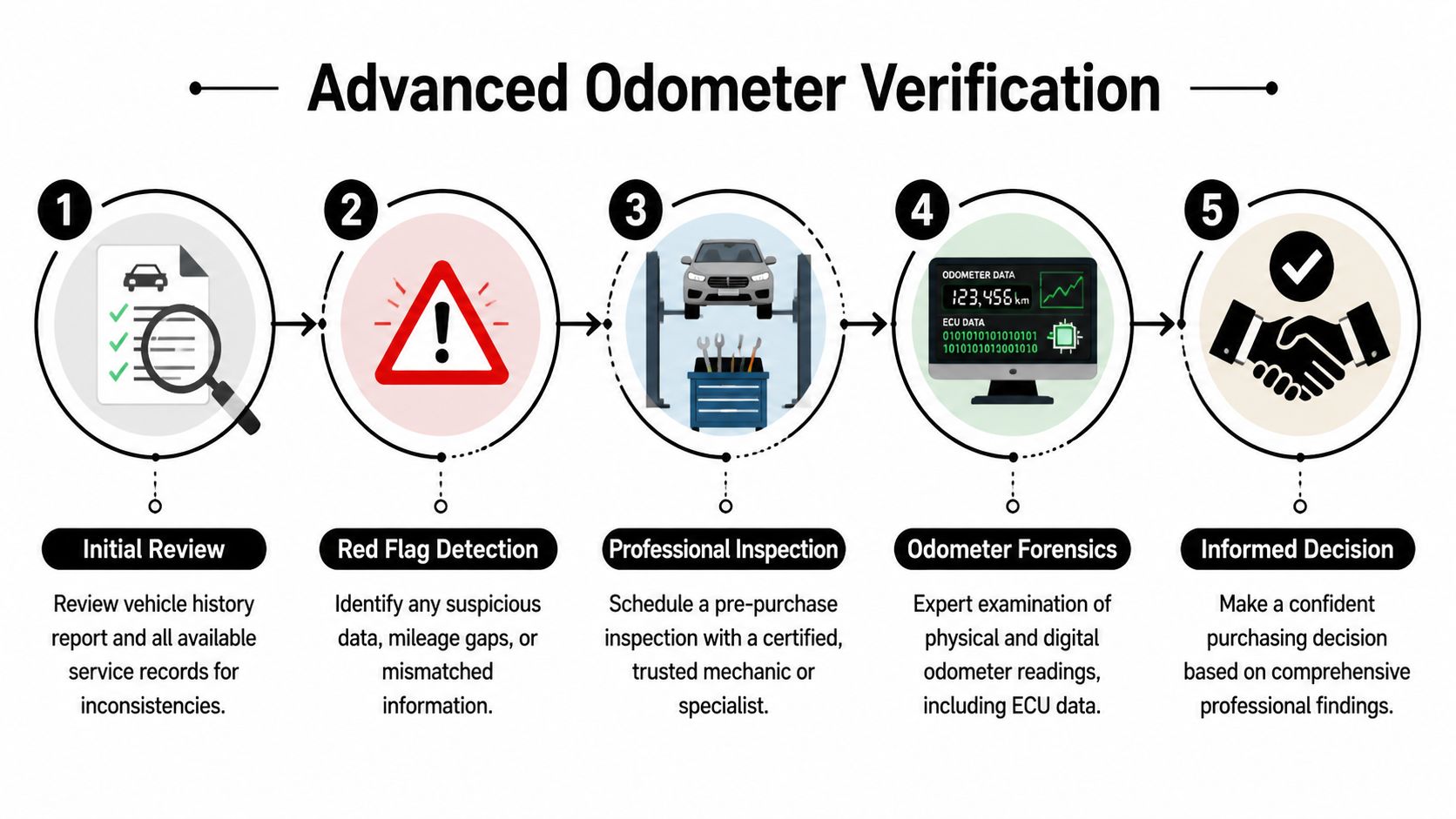
When your first three checks raise questions, stop guessing and bring in a professional. A pre-purchase inspection is where suspicion becomes evidence.
The most useful technical check isn't reading the dash again. It's checking mileage stored elsewhere in the vehicle. Professional rollback detection relies on reading mileage data from multiple control units, including the Engine Control Module, Transmission Control Module, and Instrument Cluster, because mismatches between those stored values can reveal tampering, as explained in OBDeleven's overview of multi-module mileage verification.
What a good mechanic can actually do
A proper shop can connect factory-grade or equivalent diagnostic equipment and compare mileage values across modules. If the dashboard display was changed but the other modules still hold older mileage data, the mismatch is a major fraud indicator.
That matters most on later-model vehicles with distributed electronics. It gives you a way to test whether the visible odometer agrees with the rest of the vehicle's memory.
But don't treat scan data like gospel
Buyers can easily become overconfident. Multi-module scanning is powerful, but it isn't magic.
One technical source puts it plainly: there isn't any bulletproof methods to find out for sure that your car has been rolled back, because even ECU-related data can sometimes be falsified too, as discussed in this technical rollback video.
That doesn't make scanning useless. It means you shouldn't let one green-looking diagnostic result erase a bad history report or suspicious wear.
When to order a pre-purchase inspection
Get a professional inspection when:
- The mileage timeline looks odd: drops, long flat periods, or unclear title branding
- The car's wear doesn't fit the story: seat, pedal, or tire condition looks too advanced
- The seller gets slippery: reluctance to provide records or allow independent inspection
- The vehicle is expensive enough that a mistake hurts: especially if you're buying for long-term use
If you're already at the stage of hiring a mechanic, a vehicle inspection report guide can help you understand what should appear in a useful pre-purchase inspection and what a vague once-over misses.
The strongest rollback case is built when the scan tool, the mileage history, and the wear pattern all point in the same direction.
What works versus what doesn't
What works is escalation. Start with records, inspect the car, then use professional scanning when something doesn't fit. What doesn't work is jumping straight to one specialized tool and assuming it settles the matter.
A seasoned buyer doesn't ask, "Which single test proves the mileage?" The better question is, "How many independent checks agree?"
What to Do if You Suspect Odometer Rollback
If you suspect rollback before purchase, walk away unless the seller can produce convincing proof that resolves the conflict. There are too many used cars on the market to gamble on one with a mileage story that doesn't hold together.
Expert buyers use a three-layer process that combines digital records, physical wear inspection, and paper trail review, and any discrepancy across those layers should trigger more investigation or a professional scan before purchase, according to iSeeCars' guidance on spotting and acting on odometer rollback.
If you haven't bought it yet
Do this in order:
- Pause the deal: don't leave a deposit because the seller says the issue is "just paperwork."
- Save evidence: take photos of the odometer, tires, seat wear, oil stickers, and any report entries that conflict.
- Ask direct questions: "Why does this record show higher mileage than the dash?" Then listen for specifics, not stories.
- Request an independent inspection: if the seller refuses, that tells you plenty.
If you already bought it
Start documenting everything. Keep the ad, bill of sale, text messages, title copy, report, service paperwork, and photos of the odometer. Then contact your state motor vehicle agency or consumer protection office and ask how to report suspected odometer fraud. NHTSA also notes that victims should document inconsistencies and consult professionals in its earlier-cited odometer fraud guidance.
Don't keep driving around hoping the issue will somehow become less serious. It won't.
FAQ Answering Your Odometer Fraud Questions
Is a small mileage discrepancy always fraud
No. Sometimes a mismatch comes from a clerical entry, delayed reporting, or a data entry mistake. What matters is whether the discrepancy fits a believable explanation and whether the rest of the evidence supports it. One odd entry may be an error. A pattern of conflicts is different.
Can digital odometers really be rolled back
Yes. Digital doesn't mean tamper-proof. That's why checking the dashboard alone is a weak method. Modern rollback detection works better when you compare digital history, physical wear, paperwork, and if needed, module data from a professional scan.
What's the difference between rollback and TMU
Rollback means someone intentionally reduced or altered the displayed mileage. TMU means the actual mileage can't be verified with confidence. They aren't identical, but both create risk because you can no longer rely on the mileage as accurate. For most first-time buyers, either one should trigger much closer scrutiny.
If you're comparing used cars and want one place to review mileage timelines, title data, and risk signals before you commit, VekTracer is a practical starting point. Use it early, then verify what you find with an in-person inspection and the paper trail.
Ready to check a vehicle?
Enter any 17-character VIN for a free instant preview — no account needed.