Unlock Your Audi's Secrets with vin decoder audi

Check a vehicle before you buy
Enter a VIN for a free instant preview — accidents, title brands, mileage, liens & open recalls.
You can decode an Audi VIN by breaking the 17-digit code into three parts: the WMI, VDS, and VIS, which reveal where the car came from, how it was configured, and the unique production details tied to that exact vehicle. This same VIN is also essential for verifying whether the Audi in front of you matches its paperwork before you spend real money on it.
That matters most when the car looks right, sounds right, and still feels a little too good to be true. A used Audi can present beautifully and still carry the wrong identity, hidden damage history, or a parts mismatch that turns ownership into a string of expensive surprises. If you're using a vin decoder audi search because you're about to buy, sell, or inspect one, the VIN is where the useful truth starts.
Your Audi's VIN is More Than Just a Serial Number
A lot of buyers treat the VIN like an admin detail. It isn't. On an Audi, it's the fastest way to move from seller claims to verifiable facts.

Audi VINs follow the standardized format set by ISO 3779, and since 1981 that format has been used to identify vehicles across major markets. The code is split into three sections: the World Manufacturer Identifier in positions 1 to 3, the Vehicle Description Section in positions 4 to 9, and the Vehicle Identifier Section in positions 10 to 17. That structure is what lets you decode factory information instead of guessing from trim badges, seller descriptions, or online listings (VinFreeCheck Audi VIN decoder).
Why this matters before you buy
Used Audi shopping often comes down to trust. The seller says it's the right engine, the right year, the right trim, and that nothing major is hiding. The VIN gives you a way to test those claims.
Since the standardization of VINs in the 1980s, Audi VIN checks have become central to accessing history data. In the U.S. and Canada, that data is tied to NMVTIS, while European checks can include theft records from national registries. VIN checks are also important for catching odometer issues, especially because odometer fraud appears in 15 to 20% of used luxury imports according to Vindecoder.eu's Audi page.
Practical rule: If you're looking at a used Audi and haven't checked the VIN yet, you don't know the car. You only know the listing.
What the three sections tell you
Each section answers a different buying question:
- WMI: Who built it, and where did it originate?
- VDS: What model, engine, and core configuration did Audi assign at the factory?
- VIS: What year, plant, and unique serial details belong to this exact car?
If you want a deeper breakdown of how VINs work before focusing on Audi specifics, this guide on VIN numbers explained and how to verify vehicle history is a useful companion.
The big takeaway is simple. A VIN doesn't just label the car. It gives you a framework for deciding whether the story you're being sold matches the car you're standing next to.
First Steps Finding and Validating the VIN
The first mistake buyers make is assuming one visible VIN is enough. It isn't. A clean dashboard plate can still be attached to a car with a different identity elsewhere.

A stronger routine is to check multiple locations before you decode anything. A dealer-oriented method for fraud detection uses the dashboard VIN, door frame, under-trunk or other stamped locations, the MMI menu, and the logbook or registration. That approach detects fraud in 92% of cases, while mismatches can point to cloning in up to 8% of the used Audi market, with victims facing repairs costing over $5,000 according to Nerdbot's Audi VIN guide.
Where to look on an Audi
Start with the places that are easiest to access and hardest to excuse away.
Dashboard plate through the windshield
This is the one most buyers see first. It's quick to inspect and should be clean, legible, and consistent with paperwork.Driver-side door jamb sticker
Open the door and compare every character carefully. A single mismatch matters.Registration, title, or logbook
Paperwork errors do happen, but don't assume that's all it is.MMI menu on newer models
Many post-2005 Audis show VIN information inside the infotainment system.Stamped locations such as trunk or under-seat areas
These are useful when you want another physical reference point beyond the obvious labels.
What you're actually checking for
This isn't just a scavenger hunt. You're looking for consistency.
- Matching digits across locations: The VIN on the car and on the paperwork should be identical.
- Signs of tampering: Rivets, scratches, glue residue, uneven fonts, or labels that look newer than surrounding trim deserve more scrutiny.
- Seller behavior: Hesitation, rushing, or excuses about why one VIN area is unreadable should slow the deal down.
Check at least two physical locations and the paperwork before you trust any decoder result. A decoder only processes the number you enter. It can't tell you whether you typed a cloned VIN from a swapped plate.
If you want to run a model-specific lookup after that physical inspection, an Audi VIN check page can help organize the next step.
A short buyer checklist
Use this before you discuss price:
- Photograph the dashboard VIN
- Compare it to the door jamb label
- Match both to the registration or title
- Check the MMI if the car has it
- Pause the deal if any character differs
A buyer who validates first avoids the worst kind of mistake. That's paying premium-Audi money for a car with a hidden identity problem.
Decoding the Audi VIN A Character by Character Breakdown
A clean-looking Audi can still hide a bad story. The VIN helps separate a well-presented car from the exact car Audi built, and that difference matters when you're deciding whether to buy, negotiate harder, or walk away.
Once the VIN has been physically verified, the next job is reading what each character says about identity, build, and plausibility. Audi uses the standard 17-character VIN structure split into WMI, VDS, and VIS. The 9th character is a check digit used to validate whether the VIN is mathematically consistent under the North American VIN standard, as explained by the National Highway Traffic Safety Administration VIN guidance.
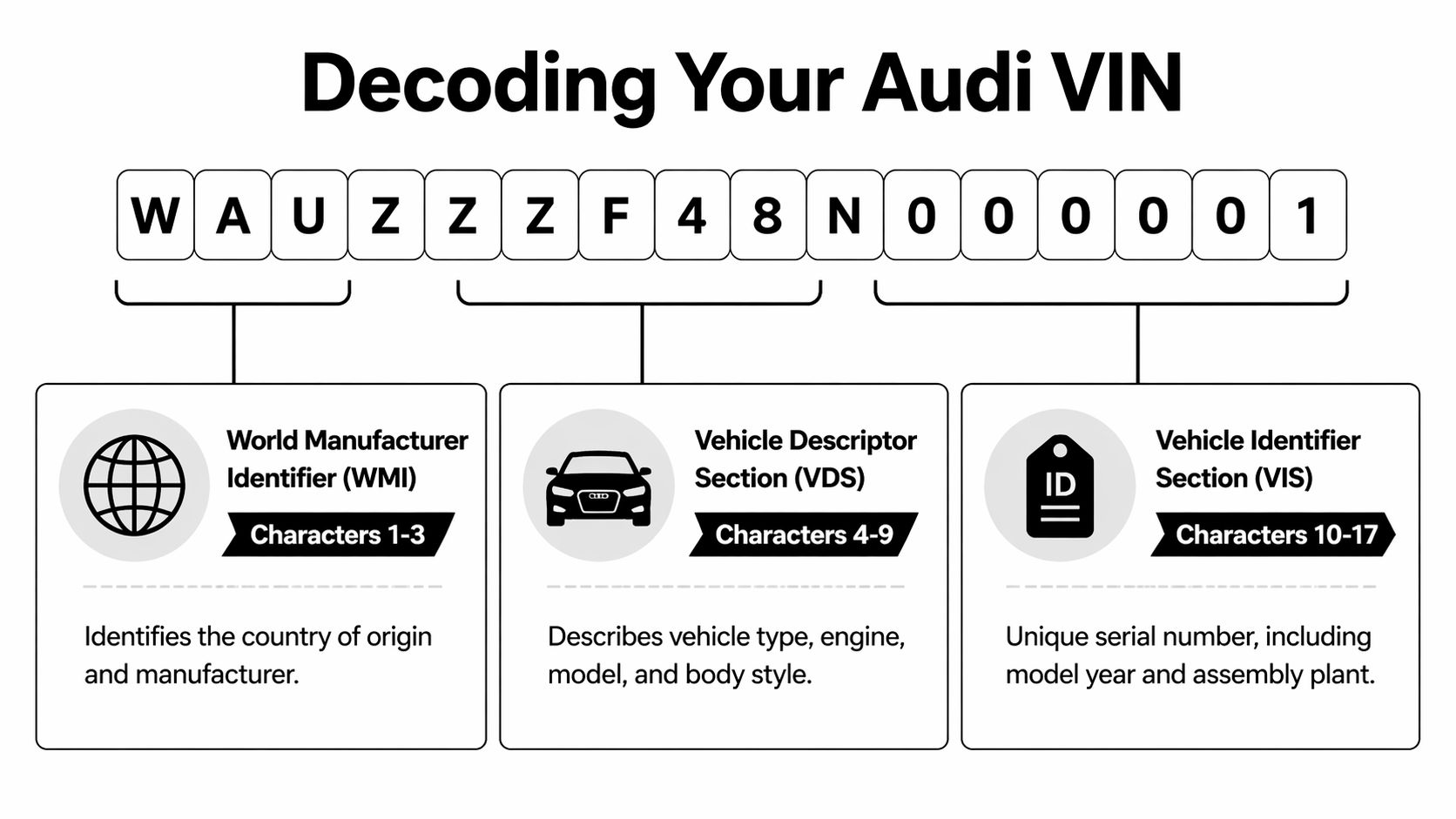
Audi VIN position breakdown
| Position(s) | Section | What It Decodes |
|---|---|---|
| 1-3 | WMI | Country or region, manufacturer, vehicle type |
| 4-9 | VDS | Model series, engine or restraint-related identifiers, model details, check digit |
| 10-17 | VIS | Model year, assembly plant, production sequence |
WMI means origin and manufacturer
The first three characters are your first filter.
A common Audi WMI is WAU, which is widely associated with Audi passenger vehicles. That does not prove the car is honest on its own, but it gives you a quick way to test whether the VIN starts in the right place. If the badge says Audi and the WMI points somewhere unexpected, stop there and verify before you spend time decoding the rest.
This is also where cloned or altered identities can start to show. A seller may focus on trim, mileage, or options. The WMI is much simpler. It tells you whether the manufacturer and vehicle type make sense at all.
VDS tells you what Audi actually built
Positions 4 through 9 narrow the car down from a brand name to a factory configuration. Depending on market and model, this part of the VIN can reflect details tied to:
- Model or series
- Engine family
- Restraint or safety system coding
- Body or configuration identifiers
- Check digit at position 9
For buyers, this matters more than the trunk badge. Audis get rebadged, ads get copied, and trim descriptions get sloppy. The VDS gives you a better starting point for checking whether a claimed engine or model family is even plausible.
I treat this section as a credibility check. If a seller claims a higher-output engine, rarer variant, or unusual configuration, the middle of the VIN should support that claim before I trust anything in the listing.
The 9th character check digit matters more than buyers expect
The 9th position is the check digit. It exists to catch errors and suspicious VINs before you build assumptions on top of them.
A bad check digit does not automatically mean fraud. It can mean someone typed the VIN wrong, copied an S as a 5, or read a photo badly. It can also mean the number on one label does not belong to the rest of the car. That is why this character matters. It helps you catch trouble early, before you order records, compare options, or discuss price.
If you want a broader framework before decoding an Audi specifically, this guide on what VIN decoding means for smarter car buying lays out the logic clearly.
VIS identifies the exact vehicle
Positions 10 through 17 turn the VIN into one specific car.
This section includes:
- 10th character: model year code
- 11th character: assembly plant
- 12th to 17th: production sequence number
The year code is especially useful when an ad is vague or optimistic. On used Audis, sellers sometimes mix up production year, model year, and registration year. The VIN helps you sort that out. The plant code can help too, especially if you are checking whether the car's origin lines up with factory records, import paperwork, or market-specific equipment.
A quick example of how buyers use this
Take an Audi VIN that begins with WAU.
- WAU points to an Audi passenger vehicle
- Characters 4 to 8 narrow down the model family and build details
- Character 9 tells you whether the VIN passes the check-digit formula
- Character 10 gives the model year code
- Character 11 identifies the plant
- Characters 12 to 17 distinguish that exact production unit
That sequence gives you more than a spec sheet. It helps answer important buying questions. Does the year match the advert? Does the claimed engine make sense? Does the car identify as the kind of Audi the seller says it is?
There is a trade-off, though. A VIN can confirm identity and factory coding, but it will not tell you everything about keys, modules, or later changes made outside the factory. If you're trying to connect VIN research with lock, immobilizer, or replacement key work, this guide to automotive key codes gives useful context.
Use the VIN to verify the car first. Then decide whether the story around it still holds up.
Beyond the Basics Audi-Specific Codes and Common Pitfalls
Decoding the VIN correctly is only half the job. The harder part is understanding what can still go wrong even when the VIN looks valid.
Audi buyers run into this with engines, trim assumptions, and parts ordering. A listing may say "2.0T," "3.0 V6," "S line," or "Prestige," but the useful answer comes from the full VIN and the way that exact car was configured at the factory. Decoder references note that Audi VINs can help confirm specs such as 2.0L turbo or 3.0L V6, along with model families like A3, A4, Q5, and Q7 on the cited Audi page.
The real-world problem with VIN splits
A common issue on Audis is the VIN split during a mid-cycle change. That's when two vehicles from the same broad model year can require different parts because Audi changed components during production.
According to GoodCar's Audi VIN decoder guide, VIN splits in 2017-2018 Audis can affect up to 25% of parts lookups, which is exactly why ordering by "year, make, model" alone is risky.
Here's the kind of situation that causes trouble:
- A buyer owns a B9 A4 and orders a sensor or trim part based on the listing year
- The seller lists compatibility by model year only
- The part arrives and doesn't fit because the car falls on the other side of a production split
- Time and money get wasted, and the buyer starts chasing the wrong fault
This is especially common with online marketplaces where broad compatibility claims are used to move inventory faster than the buyer can verify.
If you're buying Audi parts, the full VIN beats the model year every time.
Check digit failures and altered identities
The same GoodCar source notes that an invalid check digit can flag tampering in 15 to 20% of fraud cases involving altered VINs. That's not a small detail. It's one of the few built-in safeguards that lets you question the number itself before you build a whole buying decision around it.
That becomes more important on premium used cars because cosmetic fixes can hide a lot. A clean repaint and fresh detailing don't validate identity. The VIN does some of that work, but only if you check it.
Audi details that matter in ownership
Audi-specific interpretation gets useful in a few places:
- Plant code awareness: Assembly plant can matter for recall or service context.
- Engine confirmation: Similar-looking cars can carry different engines and supporting parts.
- Model family clues: A, S, RS, and Q naming may sound obvious, but trim badges alone don't prove factory spec.
- Key and lock planning: If you've verified the VIN and need supporting ownership details for keys or immobilizer-related work, this guide to automotive key codes gives practical context on how coded vehicle identification ties into replacement and security work.
A careful buyer uses the VIN for three jobs at once. Confirm identity, confirm configuration, and avoid compatibility mistakes later.
When a VIN Decoder Is Not Enough The Full Story
A decoder tells you what Audi built. It doesn't tell you what happened after delivery.

That's the limit many buyers miss. You can decode the WMI, confirm the year code, validate the check digit, and still know nothing about salvage branding, mileage issues, title problems, or whether the VIN itself has been used to hide the wrong vehicle history.
According to the NHTSA vPIC decoder reference page, free decoders confirm specs but often miss legitimacy checks, and 15% of used luxury cars have VIN discrepancies linked to fraud. The same source notes that these tools generally don't cross-check against manufacturer databases or real-time systems, and 70% of private sale buyers skip verification altogether.
Decoder versus vehicle history report
This is the practical difference:
| Tool | What it helps you answer |
|---|---|
| VIN decoder | What was this Audi built as? |
| Vehicle history report | What has this Audi been through? |
A decoder is great for verifying the factory starting point. A history report is what helps with purchase risk.
If you're comparing report providers before spending money, this Carfax comparison page is a useful place to weigh the trade-offs. If you're shopping across borders, it also helps to understand how a VIN check in Canada can differ from a VIN check in the USA, because title, lien, and theft data can be gathered differently depending on the market. For a broader perspective on first-time purchase due diligence, this article on buying a used car is also worth a read.
What works and what doesn't
What works:
- Use the decoder first to verify the Audi's identity and factory spec
- Use a full vehicle history report next to check the car's life after it left the factory
- Compare the report to the physical car so damage signs, mileage, and paperwork all make sense together
What doesn't:
- Relying on one free decoder
- Assuming a clean listing means a clean history
- Treating the VIN as a parts lookup only
A decoder is a filter. It is not the final decision tool.
Answering Your Top Audi VIN Decoder Questions
Can a VIN decoder tell me if an Audi was in an accident
Not by itself. A decoder is mainly about factory identity and configuration. It can tell you what the car was built as, but not whether it later picked up accident damage, title branding, theft records, or mileage issues. That's where a vehicle history report matters more than the raw decode.
Can an Audi VIN be faked or altered
Yes, which is why physical verification matters before digital decoding. Cloned or altered VINs can be made to look convincing at a glance. That's why matching the dashboard plate, door jamb label, paperwork, and other vehicle locations is a better buying habit than trusting one visible tag.
A valid-looking VIN is not the same thing as a trustworthy car. Verify the number on the vehicle before you analyze the number online.
Why doesn't the model year always match the build date exactly
The VIN's 10th character identifies the model year, not necessarily the exact day or month the car was assembled. In practice, an Audi can be built before or during the start of the stated model year cycle. That's why buyers and parts counters sometimes see confusion when a door sticker date and VIN year code don't line up exactly.
For ownership decisions, the better rule is simple. Use the full VIN first, then confirm with the production label if the job is sensitive to build timing.
Can the VIN help with recalls and service issues
Yes, but there are limits. Standard decoders and many basic checks usually surface recalls more reliably than they surface brand-specific service campaigns or technical bulletins.
That matters on newer Audi models. A major gap in the market is Audi-specific TSB decoding beyond standard NHTSA recalls, and VinAudit's Audi decoder page notes that Audi issued 12 new TSBs in Q1 2026 for MHEV systems in A6/A7 models that standard decoders miss. If you're buying a newer hybrid or electric-leaning Audi, unresolved software and service campaign issues can matter just as much as headline recall data.
What should I do before making an offer on a used Audi
Use a short decision sequence:
- Find the VIN on the car
- Match it across multiple locations
- Decode it to confirm the factory identity
- Pull a vehicle history report
- Compare the report to the seller's claims and the physical condition
If those five pieces line up, you're negotiating from a much stronger position. If they don't, you just saved yourself from buying the wrong Audi.
If you've decoded the VIN and want the car's history, not just its factory spec, get a report from VekTracer. It's built for buyers who want accident history, mileage verification, theft and title checks, open recalls, and a simple Risk Score before making an offer.
Ready to check a vehicle?
Enter any 17-character VIN for a free instant preview — no account needed.