VIN numbers explained: verify vehicle history in 2026
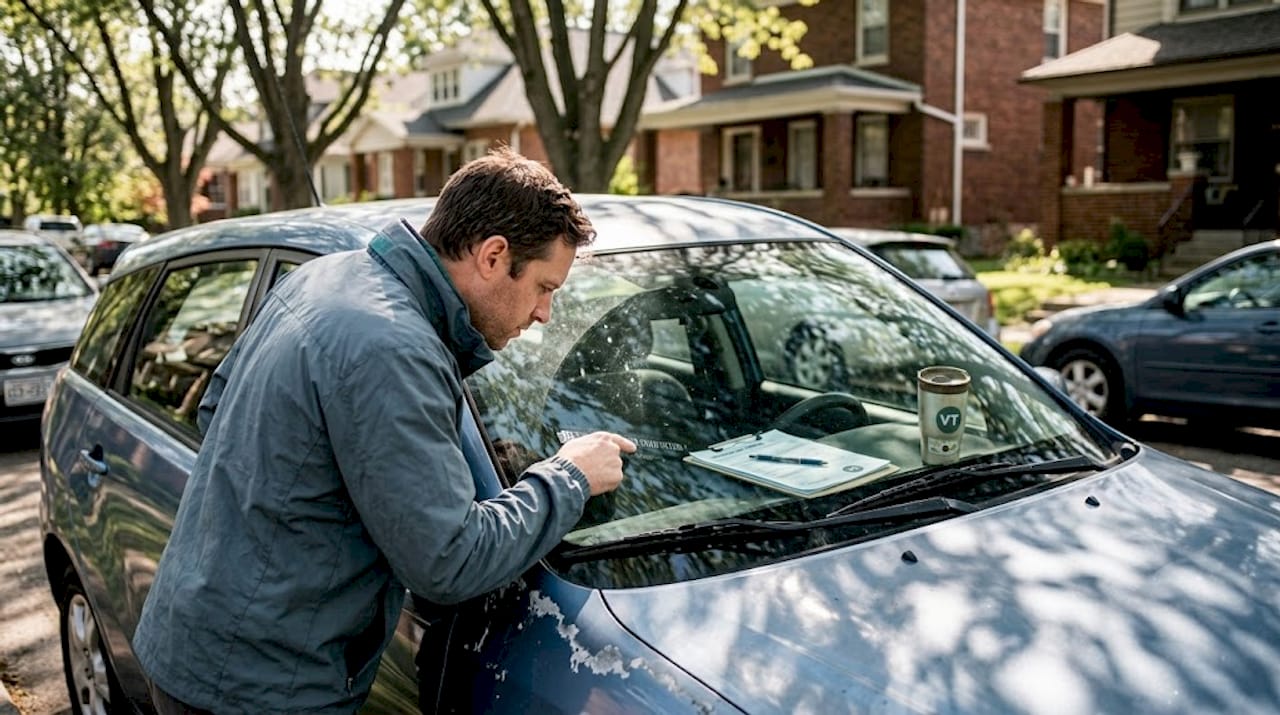
Check a vehicle before you buy
Enter a VIN for a free instant preview — accidents, title brands, mileage, liens & open recalls.
TL;DR:
- A VIN is a unique 17-character code that reveals a vehicle’s history, origin, and details.
- Verifying all VIN locations on the vehicle and documents helps detect tampering or fraud.
- Manual VIN checks and understanding the structure prevent costly mistakes during used car purchases.
Most people glance at a VIN, shrug, and move on. It looks like a random string of letters and numbers stamped on a dashboard. But that 17-character code is actually the closest thing a vehicle has to a fingerprint. It holds the full story of where a car was built, what happened to it, and whether the seller is being honest with you. If you’re buying a used car in the U.S. or Canada, understanding the VIN isn’t optional. It’s your single most powerful tool for avoiding fraud, hidden damage, and costly surprises.
Table of Contents
- What is a VIN number and why does it matter?
- How is a VIN structured? Numbers, letters, and what they reveal
- Where to find and verify the VIN: On the car and on paper
- Red flags, exceptions, and making the most of the VIN
- The overlooked power of the VIN: What most buyers miss
- Take the next step: Verify VINs with confidence
- Frequently asked questions
Key Takeaways
| Point | Details |
|---|---|
| VIN is your security tool | A VIN is the best way to verify any used car’s real history and protect your investment. |
| Every digit matters | Each character in a VIN reveals crucial information about the car’s make, model, and background. |
| Always check for matches | Match VINs across the car, title, and records to spot fraud or mistakes quickly. |
| Look for warning signs | Irregular or mismatched VINs signal risk—know the exceptions and act before you buy. |
What is a VIN number and why does it matter?
VIN stands for Vehicle Identification Number. It’s a unique 17-character code assigned to every car, truck, and motorcycle manufactured after 1981. No two vehicles share the same VIN, ever. Think of it as a social security number for your car.
Automakers use the VIN from the moment a vehicle rolls off the assembly line. It gets attached to every major event in that vehicle’s life: warranty claims, factory recalls, insurance reports, title transfers, and accident records. When you run a VIN check, you’re pulling from all of those sources at once.
Here’s why that matters for you as a buyer. A used car might look spotless on the outside. Fresh paint, clean interior, low mileage on the odometer. But why VIN lookup matters becomes clear the moment a report reveals a prior flood title, a rolled-back odometer, or a theft record the seller never mentioned.
Some common misconceptions worth clearing up:
- “It’s just a serial number.” It’s much more. The VIN is a structured code that encodes real data about the vehicle’s origin, specs, and history.
- “I can trust the seller’s word.” Even honest sellers may not know their car’s full history. The VIN tells you what they can’t.
- “It doesn’t matter if the car looks fine.” Cosmetic repairs can hide serious structural damage. The VIN reveals what’s underneath.
- “All VIN checks are the same.” They’re not. The depth of data varies significantly by provider.
VIN fraud is also a real and growing problem. Criminals sometimes “clone” a VIN by copying the number from a clean vehicle and applying it to a stolen or salvaged one. Knowing how to read your VIN and verify it manually is your first line of defense.
Bottom line: The VIN is not a formality. It’s the most reliable piece of information attached to any used vehicle, and ignoring it puts your money and safety at risk.
Now that you’ve seen why understanding the VIN is key, let’s break down exactly what these characters mean.
How is a VIN structured? Numbers, letters, and what they reveal
The VIN structure breaks into three sections: the World Manufacturer Identifier (WMI), the Vehicle Descriptor Section (VDS), and the Vehicle Identifier Section (VIS). Each section carries specific, standardized information.
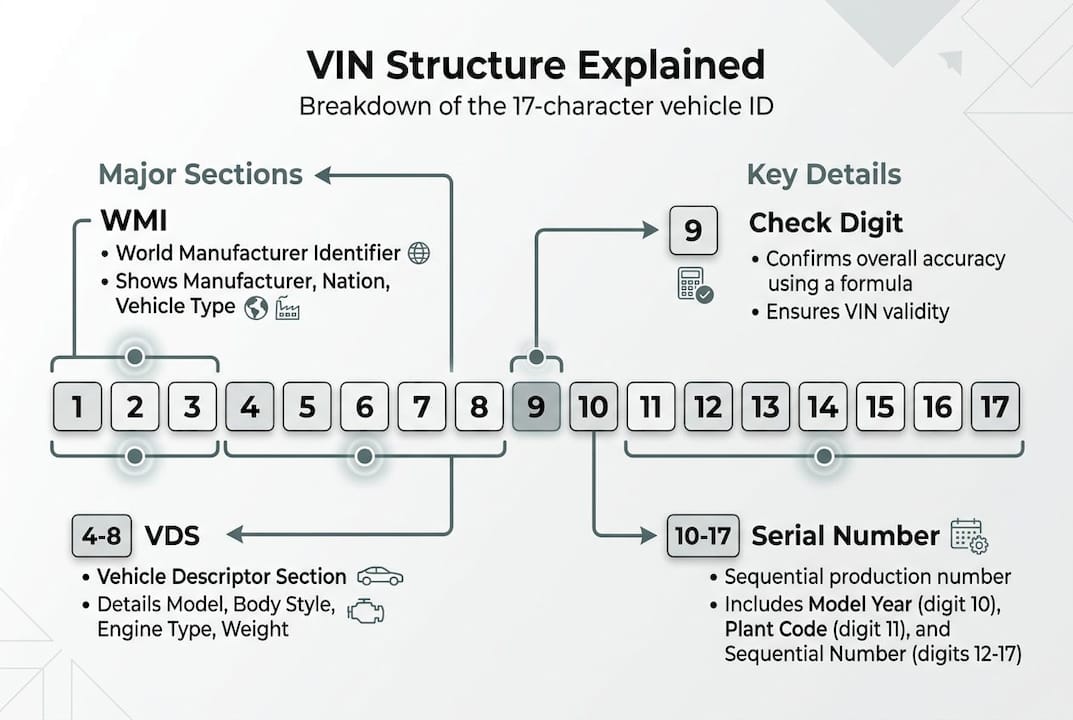
Here’s a breakdown of all 17 positions:
| Position | Section | What it tells you |
|---|---|---|
| 1 | WMI | Country of manufacture |
| 2 | WMI | Manufacturer |
| 3 | WMI | Vehicle type |
| 4-8 | VDS | Model, body style, engine type |
| 9 | VDS | Check digit (fraud detection) |
| 10 | VIS | Model year |
| 11 | VIS | Assembly plant |
| 12-17 | VIS | Sequential serial number |
A few things stand out here. First, the check digit at position 9 is calculated mathematically from the other characters. If it doesn’t match, something is wrong with the VIN. Second, the letters I, O, and Q are never used in a VIN because they look too much like 1, 0, and 0. If you see those letters in a VIN, it’s a red flag.
Model years repeat on a 30-year cycle, so a VIN with “A” in position 10 could mean 1980 or 2010. Context from the rest of the VIN helps clarify this.
How to read a VIN step by step:
- Write down the full 17-character VIN.
- Identify positions 1-3 to find where and by whom the car was built.
- Check positions 4-8 for model and engine details.
- Verify the check digit at position 9 using a VIN decoding guide.
- Confirm the model year at position 10 against the seller’s claim.
- Use 17 digits explained to cross-reference the full sequence.
Pro Tip: If the serial number section (positions 12-17) contains letters where only numbers are expected, or the sequence looks irregular, that’s a signal the VIN may have been altered. Always verify with a trusted lookup tool.
Once you understand the structure, it’s crucial to know where you can actually find the VIN on a vehicle and documents.
Where to find and verify the VIN: On the car and on paper
Knowing what a VIN means is only useful if you know where to look for it. VIN locations include the dashboard, driver door jamb, engine block, and vehicle title. Each location serves a purpose, and checking all of them is non-negotiable.
The most common physical locations:
- Dashboard (driver’s side): Visible through the windshield at the base of the glass. This is the easiest spot to check.
- Driver-side door jamb: Look at the sticker on the inside edge of the door frame. It lists the VIN along with tire pressure and weight ratings.
- Engine block: Stamped directly into the metal. Harder to access but very difficult to alter without obvious signs.
- Trunk or frame: On some trucks and older vehicles, the VIN also appears on the frame near the front axle.
On paper, you’ll find the VIN on the title, registration, and insurance documents. Every single one should match the VINs on the car itself.

Here’s a quick comparison of VIN location reliability by vehicle type:
| Vehicle type | Most reliable location | Secondary check |
|---|---|---|
| Passenger car | Dashboard (windshield) | Door jamb sticker |
| Pickup truck | Door jamb sticker | Frame near front axle |
| SUV/Crossover | Dashboard (windshield) | Engine block stamp |
| Motorcycle | Steering head (neck) | Engine case |
Pro Tip: Always check that all VINs match. A mismatch between the dashboard VIN and the door jamb sticker, or between the car and the title, is a serious warning sign. It could mean the vehicle is stolen, rebuilt from parts, or has a spot a fake VIN situation you need to investigate further.
Use VIN lookup tips to make sure you’re cross-checking every source before handing over any money.
To ensure the VIN you find is authentic, you need to know about edge cases, warning signs, and common issues.
Red flags, exceptions, and making the most of the VIN
Not every VIN follows the standard 17-character format. VINs can be tampered with, and exceptions include pre-1981 vehicles and off-road models. Knowing the exceptions helps you avoid being caught off guard.
Edge cases to be aware of:
- Pre-1981 vehicles used shorter, non-standardized VINs. The format varied by manufacturer, so there’s no universal decoding method.
- Low-volume manufacturers (small custom builders, kit cars) may use different numbering systems approved by their local authority.
- Off-road and specialty vehicles like ATVs and snowmobiles sometimes follow different standards depending on the country of origin.
Warning: A VIN that looks “almost right” is more dangerous than one that’s obviously wrong. Fraudsters study VIN formats carefully. A single transposed character or a failed check digit is your cue to walk away.
Red flags that should stop you cold:
- Scratched, re-stamped, or missing VIN plates
- VIN on the dashboard doesn’t match the door jamb or title
- Characters include I, O, or Q
- The check digit doesn’t validate correctly
- Seller refuses to let you photograph or write down the VIN
If you spot any of these, here’s what to do:
- Do not complete the purchase until everything is explained and verified.
- Run a free odometer check to see if mileage records are consistent.
- Use a service to check VIN for accidents and title history.
- Contact your local DMV or law enforcement if you suspect the vehicle is stolen.
- Walk away if the seller pressures you to skip the verification step.
The VIN is your foundation. Every other piece of due diligence you do on a used car should start here.
The overlooked power of the VIN: What most buyers miss
Here’s something most buyers get wrong. They run one online report, see a clean result, and assume they’re covered. But online reports only capture what’s been officially recorded. Manual VIN verification catches what databases miss.
We’ve seen cases where 17 VIN digits matter in ways that no report could flag. A cloned VIN, for example, will often pass a basic history check because the clean vehicle’s record looks fine. The only way to catch it is by comparing the physical VIN stamps across multiple locations on the car itself.
One character out of place can cost you thousands. A transposed digit in the serial section, a check digit that doesn’t add up, a model year that contradicts the seller’s claim. These aren’t technical details. They’re money.
The buyers who get burned are almost always the ones who skipped the in-person check. They trusted the listing photos, took the seller’s word, or assumed a report covered everything. Ethical sellers don’t just tolerate close VIN scrutiny. They welcome it. If a seller gets defensive when you pull out a flashlight and check the door jamb, that tells you everything you need to know.
Verification takes ten minutes. A mistake can take months and thousands of dollars to undo.
Take the next step: Verify VINs with confidence
You now know how to read a VIN, where to find it, and what warning signs to watch for. The next step is putting that knowledge to work before you sign anything.
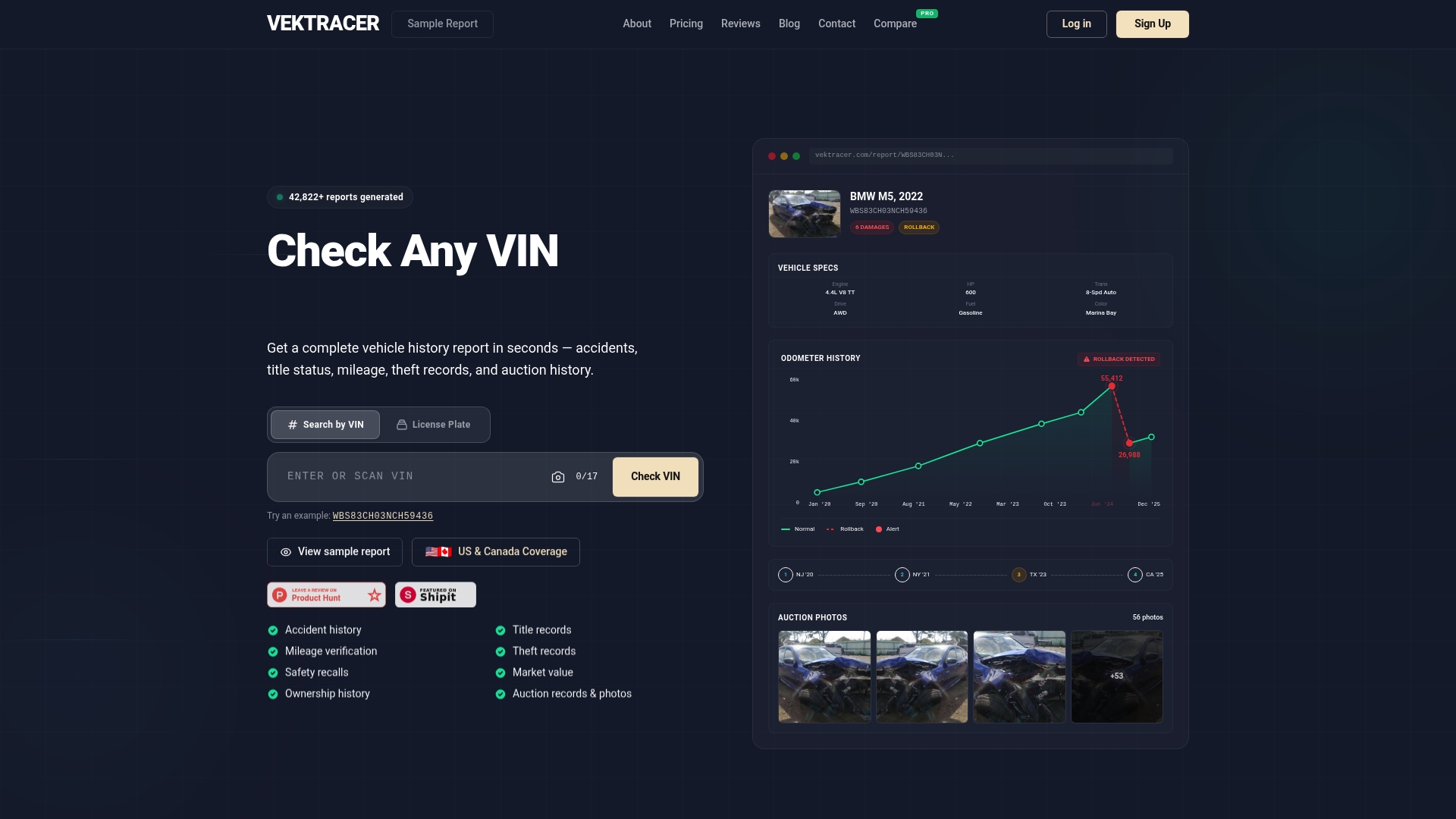
Vektracer makes it fast and straightforward. Our VIN history reports pull from NMVTIS-connected sources to give you accident history, title records, mileage verification, theft checks, safety recalls, and market value data. You can see exactly how VIN checks work before you commit. Check VIN check pricing starting at $19.99, which is less than half what Carfax charges for the same core data. Review a sample VIN report so you know exactly what you’re getting. Your next used car purchase deserves a solid foundation.
Frequently asked questions
Where can I find a vehicle’s VIN number?
The VIN appears on the dashboard, door jamb, and title. Always check all locations and confirm they match before buying.
What do the 17 characters of a VIN mean?
Each position encodes specific data: the WMI covers origin and maker, the VDS covers model and engine, and the VIS includes the model year, plant, and serial number.
Can a VIN ever be shorter or different?
Yes. Pre-1981 vehicles used shorter, non-standardized VINs, and low-volume or specialty manufacturers may use different approved formats.
How can I tell if a VIN has been tampered with?
Look for mismatched VINs, scratched plates, forbidden characters like I, O, or Q, and a check digit that fails mathematical validation during a lookup.
Recommended
Ready to check a vehicle?
Enter any 17-character VIN for a free instant preview — no account needed.