What is VIN decoding? A complete guide for smarter car buying

Check a vehicle before you buy
Enter a VIN for a free instant preview — accidents, title brands, mileage, liens & open recalls.
TL;DR:
- VIN decoding reveals vehicle origin, specifications, and history crucial for safe buying.
- Accurate decoding depends on reliable tools like NHTSA’s free decoder and physical VIN verification.
- Combining VIN analysis with vehicle history reports reduces risks and helps confirm vehicle authenticity.
A single misread digit in a Vehicle Identification Number (VIN) can unravel an entire used car deal. Yet most buyers glance at the VIN sticker, confirm it matches the paperwork, and move on. That’s not decoding. True VIN decoding means reading what every character actually tells you about the vehicle’s origin, specs, and identity. VIN decoding can reveal manufacturing and history details that protect you from costly mistakes. In this guide, we’ll walk through what VIN decoding is, how each digit works, which tools to trust, and how to apply this knowledge before you sign anything.
Table of Contents
- What VIN decoding means and why it matters
- Decoding the VIN: What each digit reveals
- Official VIN decoding tools: Sources, accuracy, and pitfalls
- Using VIN decoding for safer purchases: History, recalls, and risk reduction
- What most guides miss about VIN decoding
- Decode with confidence: Take the next step
- Frequently asked questions
Key Takeaways
| Point | Details |
|---|---|
| VIN decoding essentials | Decoding a VIN reveals crucial info about a vehicle’s origin, features, and authenticity before you buy. |
| Check digit importance | The 9th digit helps catch most mistakes or fraud, protecting buyers and dealers from costly errors. |
| Use official sources | NHTSA’s free decoder provides the most accurate, up-to-date decoding for U.S. vehicles. |
| Smart buying steps | VIN decoding should precede recall and accident checks for a safer, smarter used car transaction. |
What VIN decoding means and why it matters
The 17-character VIN became a global standard in 1981 when the National Highway Traffic Safety Administration (NHTSA) required all vehicles sold in the U.S. to carry one. Before that, manufacturers used their own numbering systems, which made cross-referencing nearly impossible. The standardized format changed everything for buyers, dealers, insurers, and regulators alike.
VIN decoding is the process of interpreting the 17-character code to reveal details such as manufacturer, country of origin, model year, engine type, assembly plant, and unique serial number. Think of it as the vehicle’s fingerprint. No two VINs are identical, and each character is there for a specific reason.
For used car buyers and independent dealers, decoding is the first line of defense. It lets you verify that the car in front of you is actually what the seller claims it is. It helps you spot tampered VINs, confirm the right parts are installed, and check whether the vehicle is subject to open safety recalls. Understanding how VIN protects used car buyers goes well beyond just matching numbers on a sticker.
Here’s what a properly decoded VIN can tell you:
- Country and manufacturer where the vehicle was built
- Make, model, and body style to confirm what you’re actually buying
- Engine type and drivetrain to verify specs match the listing
- Model year to catch misrepresented vehicles
- Assembly plant for tracing production details
- Unique serial number to distinguish this specific vehicle from all others
“The VIN is the single most important identifier in any vehicle transaction. Skipping the decode step is like buying a house without checking the address.”
Exploring the benefits of VIN lookup before any purchase puts you in a much stronger position at the negotiating table.
Decoding the VIN: What each digit reveals
With a sense of the big-picture importance, it’s time to dig into what the 17 characters actually mean and how to read them like a pro.
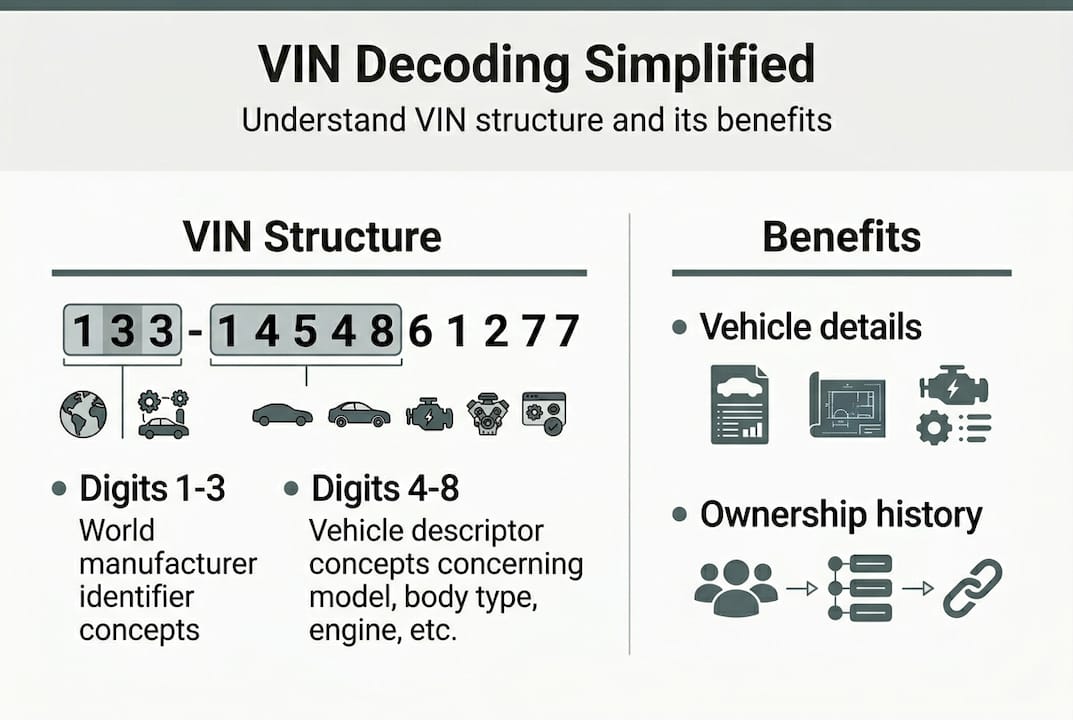
Every VIN follows a defined structure. Positions 1 to 3 form the World Manufacturer Identifier (WMI), which tells you the country of origin and the manufacturer. Positions 4 through 8 make up the Vehicle Descriptor Section (VDS), covering the model, body style, restraint systems, and engine. Position 9 is the check digit. Positions 10 through 17 form the Vehicle Identifier Section (VIS), which includes the model year, plant, and serial number.

| Position | Name | What it encodes |
|---|---|---|
| 1 | Country code | Where the vehicle was manufactured |
| 2 | Manufacturer | The specific automaker |
| 3 | Vehicle type | Division or vehicle type |
| 4 to 8 | VDS | Model, body style, engine, restraints |
| 9 | Check digit | Mathematical integrity check |
| 10 | Model year | Year of manufacture |
| 11 | Assembly plant | Where it was built |
| 12 to 17 | Serial number | Unique production sequence |
The 9th digit deserves special attention. It’s calculated using a specific formula applied to the other 16 characters. If the math doesn’t check out, the VIN is either mistyped or tampered with. This single character catches the vast majority of input errors and fraudulent VINs before you waste time or money.
Here’s how to read a VIN step by step:
- Locate the VIN on the dashboard (driver’s side, visible through the windshield), the driver’s door jamb sticker, and the title document.
- Write it down exactly as it appears. Note that VINs never include the letters I, O, or Q to avoid confusion with 1 and 0.
- Run the check digit calculation or use the NHTSA tool to confirm validity.
- Decode positions 1 to 3 to confirm manufacturer and origin.
- Decode position 10 to confirm the model year matches the listing.
- Cross-reference positions 4 to 8 against the seller’s stated specs.
Pro Tip: Always compare the VIN in at least three locations: the dashboard, the door jamb sticker, and the title. A mismatch in any location is a serious red flag that warrants immediate investigation before you go any further.
For a deeper look at what a full reading a VIN report looks like in practice, it helps to see a real example side by side with the raw VIN.
Official VIN decoding tools: Sources, accuracy, and pitfalls
Understanding the numbers is one thing. Using the right decoding tool is another. Let’s compare the best options and what to watch out for.
The gold standard is the NHTSA VIN Decoder. NHTSA’s free decoder pulls from 565 manufacturer submittals and is routinely updated, meaning it has the broadest and most accurate coverage available. Commercial decoders may have less pattern coverage and lower accuracy, especially for less common makes or specialty vehicles.
| Tool | Accuracy | Recall support | Batch search | Cost |
|---|---|---|---|---|
| NHTSA VPIC | Very high | Yes | Yes (API) | Free |
| Commercial decoders | Moderate to high | Varies | Often yes | Paid or freemium |
| Dealer software tools | High for common makes | Limited | Yes | Subscription |
Here’s what to watch for when using any decoding tool:
- Non-standard vehicles such as off-road equipment or RVs may not decode cleanly in any system
- Partial VIN searches can return multiple matches, leading to incorrect spec assumptions
- Check digit mismatches should stop you in your tracks, not just trigger a warning you click past
- Outdated commercial tools may miss recent manufacturer pattern updates
- Batch import errors in dealer software can silently assign wrong specs to inventory
A useful statistic: roughly 95% of VIN input errors are caught by the check digit alone. That means if your tool flags a check digit failure, the problem is almost certainly a typo or a tampered plate, not a software glitch.
Always start with the NHTSA tool for baseline accuracy, then supplement with a full vehicle history check to get the complete picture beyond just specs.
Using VIN decoding for safer purchases: History, recalls, and risk reduction
Armed with a decoded VIN, buyers and dealers can now apply this in a smart buying process.
Decoding alone tells you what the car should be. A history report tells you what actually happened to it. Together, they give you a much clearer picture of risk. Here’s a practical workflow:
- Locate and record the VIN from the dash, door jamb, and title. Confirm all three match.
- Run the NHTSA check digit validation to confirm the VIN is structurally sound.
- Decode the full VIN to verify make, model, year, and engine against the listing.
- Check for open safety recalls using the decoded VIN at NHTSA’s recall database.
- Pull a full vehicle history report to check for accidents, title issues, and odometer discrepancies.
- Schedule an in-person inspection with a trusted mechanic before finalizing the deal.
This sequence follows best practice: decode, recall check, history report, then in-person inspection, with check digit failures catching most input errors and fraud attempts before they cost you anything.
Here’s what VIN decoding can tell you:
- Manufacturer, origin, and production specs
- Model year and assembly plant
- Whether the VIN structure is valid
And what it cannot tell you on its own:
- Past accidents or collision damage
- Title washing or salvage history
- Rolled-back odometers
- Theft records
That’s why decoding is the starting point, not the finish line. Use your decoded VIN to cross-reference the vehicle recall checklist for used car purchases and then run a report to check car VIN for accidents before committing.
Pro Tip: Before paying for any history report, confirm the VIN passes the NHTSA check digit test. Paying for a report on a fraudulent or mistyped VIN wastes money and gives you false confidence. Also review a warranty coverage guide to understand what post-purchase protections may apply.
What most guides miss about VIN decoding
Most VIN decoding guides are written for the easy cases. A mainstream sedan from a major manufacturer, clean title, single owner. Those situations decode cleanly every time. But real-world buyers and dealers face fuzzier situations that most guides never address.
Here’s one that trips up even experienced dealers: model year codes repeat in 30-year cycles, and commercial tools may have ambiguity or miss non-standard models entirely. The letter “A” in position 10 could mean 1980, 2010, or 2040. If you’re looking at an older vehicle and your decoder confidently tells you it’s a 2010 model, that confidence may be misplaced.
Then there are multi-stage builds, RVs, and off-road vehicles. These often have VINs assigned by a secondary manufacturer after the base chassis is modified. No decoder handles these cleanly. The VIN might validate structurally but return incomplete or misleading spec data.
The uncomfortable truth is that digital decoders are only as good as the data behind them. Even NHTSA’s tool won’t catch every edge case. The only real protection is physical verification. Check the VIN plate on the dash. Check the door jamb. Check the engine block stamp. If those don’t all agree, no online tool can save you.
Before trusting any report, review red flags on VIN reports to understand what warning signs actually look like in practice. Skepticism, combined with the right tools, is your strongest asset.
Decode with confidence: Take the next step
You now know how VIN decoding works, which tools to trust, and where the gaps are. The logical next step is putting that knowledge to work with a platform built for exactly this purpose.
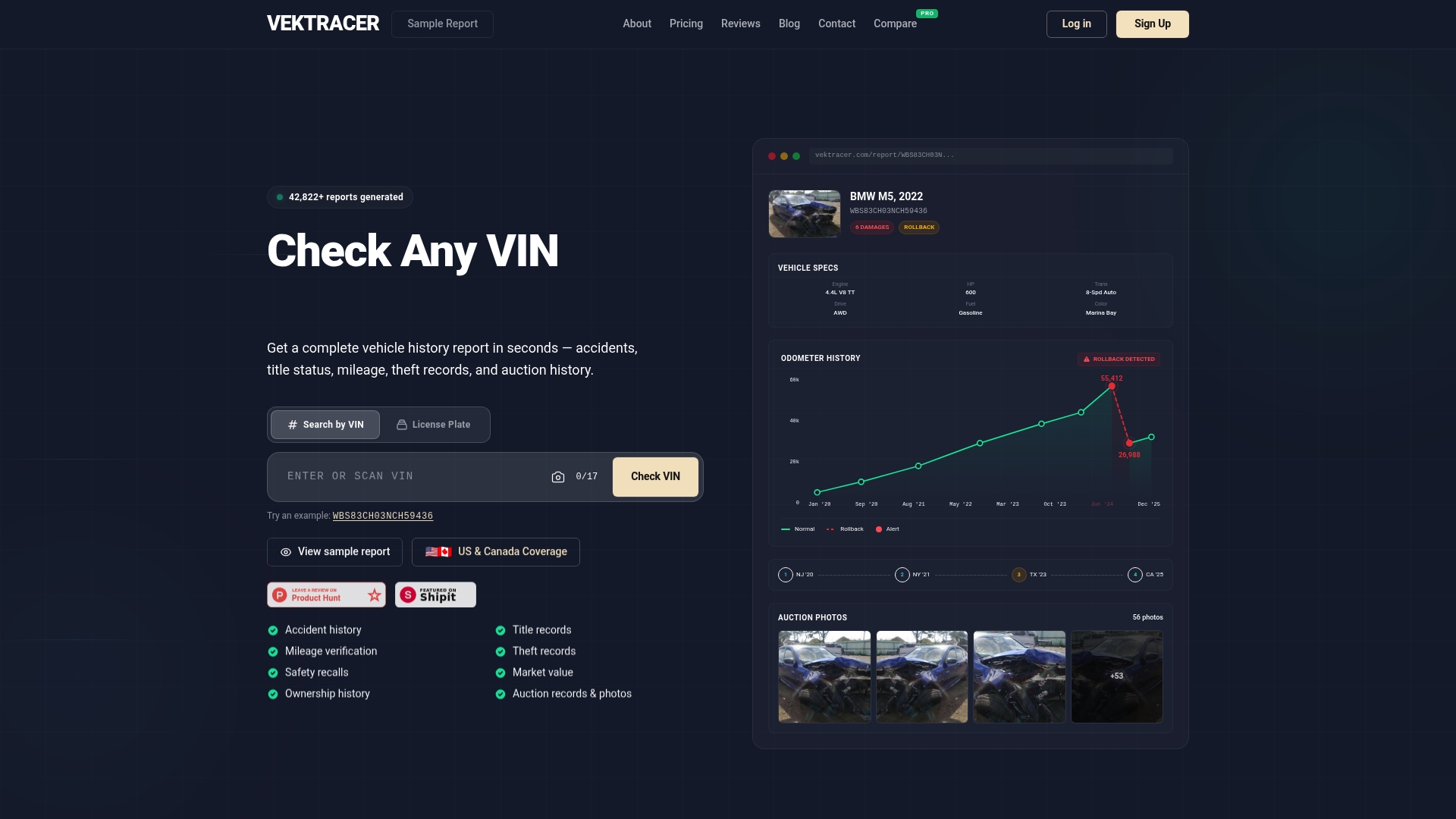
At Vektracer, how VekTracer works is straightforward: you enter a VIN, and we return a full history report covering accidents, title records, mileage verification, theft checks, safety recalls, and market value. Our reports start at $19.99, compared to $44.99 for Carfax and $24.99 for AutoCheck, and pull from NMVTIS-connected sources for the same core data. Check our pricing to see how far your budget goes, or review a sample VIN report to see exactly what you get before you buy.
Frequently asked questions
What information does VIN decoding reveal?
VIN codes detail manufacturer, year, and more, including the vehicle’s assembly plant, engine type, body style, and unique serial number that distinguishes it from every other vehicle ever built.
Is the NHTSA VIN decoder more reliable than commercial VIN decoders?
Yes. The NHTSA is the accuracy benchmark because its data comes directly from manufacturer submittals, giving it broader and more authoritative coverage than third-party tools.
What should I do if the check digit (9th position) does not match or fails?
A failed check digit means the VIN was mistyped, tampered with, or is invalid. Check digit catches ~95% of input errors, so recheck all physical VIN locations before taking any further steps.
Are there vehicles whose VINs cannot be fully decoded?
Yes. Edge cases include RVs, off-road vehicles, and repeated model year codes that cycle every 30 years, which can cause ambiguity even in reliable decoding tools.
At what point should I check the VIN in a used car purchase?
Check the VIN first, before reviewing history reports or paying any deposits. Buyers and dealers should always verify VIN integrity before purchasing to catch errors and fraud at the earliest possible stage.
Recommended
Ready to check a vehicle?
Enter any 17-character VIN for a free instant preview — no account needed.