Vehicle Inspection Report: A Complete 2026 Guide
Check a vehicle before you buy
Enter a VIN for a free instant preview — accidents, title brands, mileage, liens & open recalls.
A vehicle inspection report is a hands-on snapshot of a car’s condition right now, and it’s different from a VIN history report, which shows the car’s recorded past. That distinction matters because a mechanic can tell you what’s worn, leaking, bent, or unsafe today, while a history report tells you what happened before you ever showed up to look at the car.
If you’re standing next to a used car that looks clean, drives okay, and has a seller saying “nothing’s wrong with it,” you’re in the exact spot where this report matters most. A shiny hood doesn’t tell you if the brake pads are nearly gone. A smooth test drive doesn’t tell you if the frame was repaired badly after an accident. And a friendly seller can’t always explain wear that only shows up when the car is on a lift.
For a first-time buyer, that’s where confidence usually breaks down. You know you should “get it checked,” but the paperwork can look technical fast. My job here is to make that simple. By the end, you’ll know what a vehicle inspection report covers, how to read the findings, and how to use it alongside a VIN-based vehicle history report so you don’t miss the risks one tool can’t see on its own.
What Is a Vehicle Inspection Report
A vehicle inspection report is the written record a mechanic creates after checking a car’s important systems. Think of it as the car’s current health report. It tells you what the mechanic saw, tested, measured, and flagged on the day of inspection.
If you’ve ever bought a used car from a private seller, you know the feeling. The paint looks good. The seats are clean. The engine starts without drama. But underneath that first impression, you still have questions. Is the suspension worn out? Are the tires safe? Is there rust where you can’t see it? A proper inspection report answers those questions with observations, not guesses.
A good report usually covers the parts that affect safety, drivability, and repair costs. That includes brakes, tires, steering, suspension, fluids, leaks, battery condition, lights, and visible signs of damage or poor previous repairs. Some shops also include photos, measurements, and a short road test summary.
Practical rule: A vehicle inspection report tells you what the car is like today. It does not tell you everything that happened to the car before today.
That’s one reason this isn’t a small niche service. The global vehicle inspection services market reached approximately USD 26.4 billion in 2024 and is projected to grow to over USD 85 billion by 2030, driven by safety rules and the increasing complexity of modern vehicles, according to DataIntelo’s vehicle inspection services market analysis.
Why buyers rely on it
A first-time buyer usually wants one thing. To avoid a bad decision.
A vehicle inspection report helps in three ways:
- Safety: It can catch worn brakes, unsafe tires, steering problems, and other defects that matter the moment you drive away.
- Negotiation: If the report shows needed repairs, you can ask the seller to fix them, lower the price, or walk away.
- Clarity: It separates cosmetic flaws from serious mechanical issues, which keeps you from overreacting to the wrong things.
What it doesn’t do
Even the best mechanic can only inspect what’s physically present and observable. A report won’t automatically reveal title branding, prior theft records, lien issues, or mileage history inconsistencies. That gap is where many buyers get tripped up, and we’ll get to that later.
Anatomy of a Standard Inspection Report
When you first open a vehicle inspection report, it can feel like a stack of boxes, notes, and checkmarks. Don’t let that throw you. Most reports follow the same basic logic. The mechanic moves from outside the car to inside, then underneath, then through the major systems that make it move and stop.
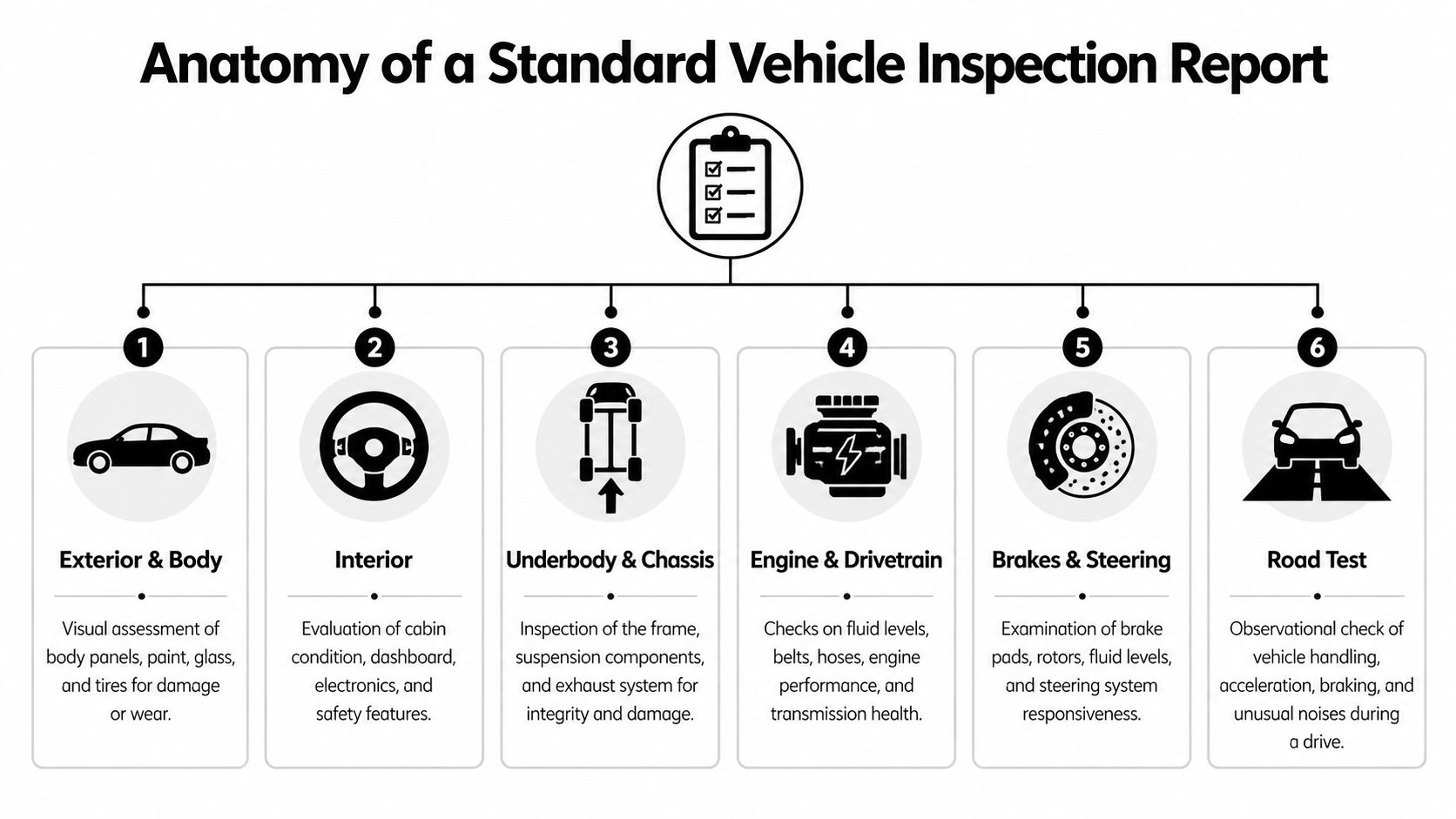
If you want to see how a modern digital report is organized, a sample vehicle inspection report helps make the format easier to understand before you’re staring at one from a shop.
Exterior and body
Start with the shell of the car. Think of this as skin and bones.
The mechanic looks for dents, mismatched paint, rust, cracked glass, damaged lights, uneven panel gaps, and signs of previous body repair. Uneven gaps around doors, hood, or trunk can suggest prior collision work. Mismatched paint texture can suggest a respray. Rust near rocker panels, wheel arches, and underbody seams can be more than cosmetic if it has spread into structural areas.
If you want a better sense of how professionals measure car paint accurately, paint thickness gauges are useful because they help spot repainted sections that your eye might miss.
Interior and electronics
Inside the cabin, the mechanic isn’t just checking whether the seats look tidy. They’re checking whether the car’s controls and safety-related features work as they should.
That usually includes:
- Dashboard warnings: Any active warning lights can point to engine, ABS, airbag, or charging system problems.
- Basic controls: Windows, locks, mirrors, seat adjustments, and climate controls should respond normally.
- Safety items: Seat belts, horn, wipers, and interior warning indicators matter more than many buyers realize.
A dead radio is annoying. An airbag light is a different conversation.
Underbody and chassis
Often, many expensive surprises are concealed. Most buyers never crawl under a car, and many sellers hope you won’t.
The mechanic checks the frame, suspension mounting points, exhaust system, visible leaks, rust, and signs of impact damage underneath. On a used car, underbody condition often tells a truer story than the shiny exterior. Fresh undercoating can sometimes hide corrosion, so the shop should note anything that looks suspicious or hard to evaluate.
Underbody damage often answers questions the seller can’t, or won’t, answer clearly.
Engine and drivetrain
The engine is the heart. The transmission is what turns that power into motion. Both need more than a quick glance.
A decent inspection report will note fluid condition, visible leaks, belt and hose condition, battery connections, idle quality, and how the vehicle behaves during operation. On the drivetrain side, the mechanic may check for rough shifting, delayed engagement, abnormal noises, vibration, or axle and CV boot issues.
Some findings are simple. A seep at a valve cover gasket might be manageable. A major fluid leak paired with rough shifting is a much bigger risk.
Brakes, steering, and tires
This is the section I tell buyers to read twice. These items affect whether the car stops straight, tracks properly, and stays planted on the road.
In professional inspections, service brakes, steering mechanism, and tires are mandatory checks, and a steer tire with tread depth below 4/32-inch is an automatic failure because of hydroplaning risk on wet roads, as explained in this guide to reading and acting on inspection reports.
Here’s what that means in plain language:
- Tires: Low tread, uneven wear, bulges, or mismatched tires can point to safety issues or alignment and suspension problems.
- Brakes: Pad wear, rotor condition, pedal feel, and pulling under braking tell you whether the stopping system is healthy.
- Steering: Looseness, vibration, wandering, or clunking can point to worn joints or steering components.
Road test notes
A road test ties the whole report together. Some problems only show up while moving.
The mechanic may note pulling, vibration, brake pulsation, poor acceleration, transmission hesitation, unusual engine noise, or suspension knocks over bumps. This is where a report becomes more than a static checklist. It turns into a real-world assessment of how the car behaves.
Physical Inspection Versus a VIN History Report
Many buyers often get mixed up. They think a vehicle inspection report and a vehicle history report are basically the same thing. They aren’t.
A physical inspection report shows the car’s current condition. A VIN history report shows the car’s recorded background. You want both because each one catches things the other can miss.
If a mechanic says the front tires are wearing unevenly, that’s current condition. If the VIN report shows a prior accident, that’s recorded history. Put those together, and the story gets clearer.
The difference at a glance
| Attribute | Physical Inspection Report | VIN History Report |
|---|---|---|
| Main purpose | Shows present mechanical and safety condition | Shows recorded past events tied to the VIN |
| Done by | Mechanic or inspection technician | Data platform using vehicle records |
| Best at finding | Wear, leaks, rust, noise, brake and tire condition, visible damage | Title history, mileage records, accident entries, theft records, liens, recalls |
| Time focus | What the car is like now | What has been reported over time |
| Can verify a warning light or bad suspension part | Yes | No |
| Can reveal branded title or lien issues | No | Yes |
| Can detect hidden wear that matches rollback suspicion | Yes, indirectly | Yes, through mileage history if records exist |
| Most useful for | Purchase decisions, safety, repair planning, negotiation | Fraud screening, ownership risk, background verification |
What a mechanic can see that records can’t
A VIN report can’t tell you if the brake pedal feels soft today. It can’t hear a wheel bearing growl. It can’t spot a fresh fluid leak unless someone recorded that issue somewhere else.
A mechanic can also catch clues that records don’t spell out. For example:
- Uneven tire wear can hint at bad alignment or bent suspension parts.
- Fresh overspray can suggest recent bodywork.
- Excessive engine movement can point to worn mounts.
- Burnt transmission fluid smell can reveal trouble not obvious on a short drive.
What records can reveal that a physical inspection can’t
A mechanic can inspect the car in front of them, but they can’t pull title records out of thin air. That matters because hidden paperwork problems can follow the car even if it feels fine on the road.
A VIN history report can help uncover things like:
- Mileage inconsistencies
- Title branding
- Reported accidents
- Theft records
- Open recalls
- Lien-related concerns where available
If you’re comparing history providers, the CARFAX comparison page is one place to look at feature differences. If you’re shopping broadly, running a VIN check in the USA or a VIN check in Canada can help you screen the car before you spend time setting up an in-person inspection.
A clean-looking car can still have a messy paper trail. A clean paper trail can still hide present mechanical problems. That’s why smart buyers verify both.
The smart order of operations
For most buyers, the best sequence is simple.
First, run the VIN and see if the car has any obvious history concerns. Then, if it still looks promising, pay for the hands-on inspection. That way you don’t waste time scheduling a mechanic for a car that already shows major record-related red flags.
How to Read the Findings and Take Action
A vehicle inspection report only helps if you know what to do with it. Most reports become easier to use when you sort findings into three buckets: minor, serious, and dangerous.
That keeps you from making two common mistakes. First, walking away from a good car over small wear items. Second, buying a risky car because the body looked nice and the seller seemed honest.
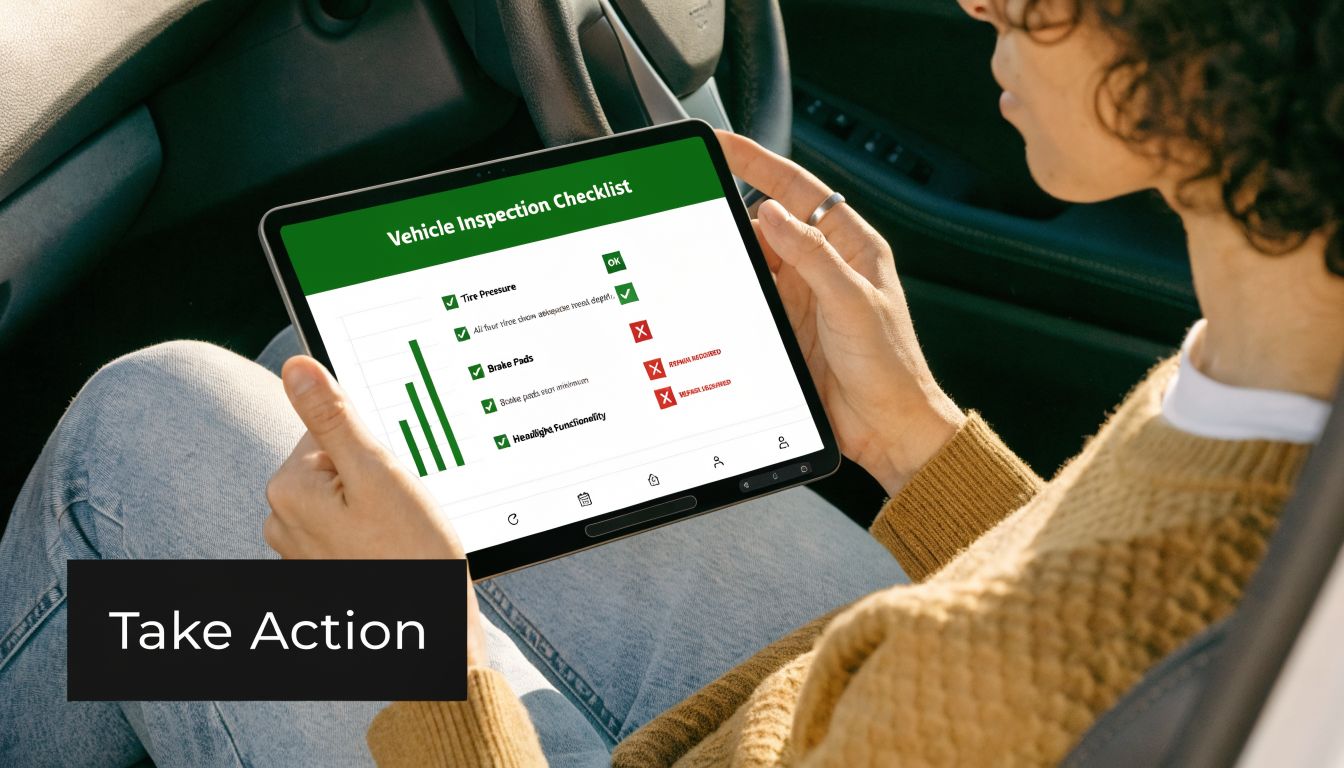
Professional inspections often use these kinds of severity levels. According to Eurowag’s guide to vehicle technical inspections, defects are commonly categorized as minor, serious, or dangerous, and dangerous defects such as brake fade from worn pads below 1.5mm or excessive steering play over 30mm account for 28% of vehicles ordered off the road.
Minor findings
Minor items are the things you expect on a used car. They matter, but they usually don’t make the vehicle unsafe right now.
Examples include:
- Cosmetic wear: Small paint chips, light scratches, worn trim, stained seats
- Routine service needs: Aging wiper blades, old cabin filter, weak battery starting to show age
- Manageable seepage: Light sweating around a gasket with no active dripping
These are useful for budgeting, but they usually aren’t deal-breakers. If the rest of the car is strong, you note them and move on.
Serious findings
Serious items don’t always mean “run,” but they do mean “slow down.”
These are the findings that should trigger a deeper conversation with the seller and often a price adjustment. They might include uneven tire wear that suggests alignment or suspension work, fluid leaks that need repair, worn brake components that still function but are nearing replacement, or suspension parts with noticeable play.
Use serious findings for decisions like:
- Ask the seller to repair the issue before sale
- Negotiate the price to reflect the needed work
- Get a second opinion if the finding could point to something larger
If the seller gets defensive or refuses a reasonable conversation after a documented inspection, that tells you something too.
Dangerous findings
Dangerous findings are where buyers get hurt financially or physically if they ignore the report.
If the report shows a defect that makes the car unsafe to drive, treat that as a stop sign. Worn brake pads below safe limits, major steering looseness, severe tire issues, or structural damage in critical areas can change the whole deal.
Shop-floor advice: If the car needs immediate safety work before it should be driven normally, don’t let your excitement outrun the report.
A simple action plan
When you get the report, don’t just skim for the word “pass” or “fail.” Read it in order and make notes.
Circle safety-related items first
Brakes, tires, steering, suspension, lights, and structural concerns come before cosmetic flaws.Separate maintenance from risk
Old wiper blades are maintenance. A bad tire or steering issue is risk.Ask for plain-English clarification
If the report says “play in front suspension,” ask which part, how severe it is, and whether it affects safe driving.Use the findings in negotiation
A report isn’t just information. It provides an advantage when the problems are documented clearly.Be willing to walk away
A used car is never the last used car on earth.
For a deeper pre-purchase checklist, this used car inspection checklist for buyers and dealers is a good companion when you’re reviewing a report line by line.
A real-world example
Say the report shows these findings:
- Front tires worn unevenly
- Rear brake pads low
- Small valve cover leak
- Cracked windshield
- Steering feels loose over bumps
That’s not “just used car stuff.” It’s a mix. The valve cover leak may be manageable. The tire wear and loose steering could point to a front-end issue. Low rear pads need attention. The cracked windshield may be a repair or replacement question depending on location and severity.
A first-time buyer often sees five problems and thinks all five are equal. They aren’t. The skill is ranking them correctly.
When You Absolutely Need an Inspection
Some purchases give you a little room for error. A used car isn’t one of them.
If you’re buying from a private seller, buying for a teenager, or stocking inventory as an independent dealer, a pre-purchase inspection should be treated as part of the buying process, not an optional extra. The reason is simple. A lot of unsafe vehicles still look normal at first glance.

States with vehicle safety inspection programs experience 10.4% fewer fatal crashes per 100 million miles traveled than states without them, and in Virginia, 8,209,716 vehicles were inspected in one year with 1,634,740 vehicles, or about 19.9%, failing due to critical safety defects, according to The Case for Vehicle Safety Inspections.
Private-party buyer checklist
Private sales can be perfectly legitimate, but they also come with less protection. That means the inspection does more work for you.
- Verify the basics: Make sure the VIN on the car matches the paperwork before anything else.
- Insist on a lift inspection: Leaks, rust, frame damage, and suspension wear are easier to spot underneath.
- Watch seller behavior: If the seller refuses an inspection, resists a test drive route, or pushes urgency, slow down.
A private seller may honestly not know what’s wrong. That doesn’t reduce your risk.
Parent buying for a teen
For a teen driver, safety matters more than style, horsepower, or fancy trim.
Look closely at the report sections covering tires, brakes, steering, suspension, lights, and visibility items like wipers and glass. You want the car to be predictable and forgiving, not just affordable.
A teen’s first car doesn’t need to be perfect. It does need to stop straight, steer correctly, and stay stable in bad weather.
Independent dealer or reseller
If you’re a dealer, every missed defect can turn into a comeback, a dispute, or inventory that sits too long.
The inspection should help you answer three questions fast:
- Is this unit safe to retail as-is?
- What reconditioning work is unavoidable?
- Is there evidence of prior poor repair that raises liability concerns?
For shops and fleet-minded operators, practical maintenance habits matter too. Resources like T1A Auto's vehicle care strategies can help frame what a disciplined inspection and upkeep process looks like over time.
Situations where skipping is a bad bet
There are a few moments when I’d say the inspection is essential:
| Situation | Why it matters |
|---|---|
| Buying sight unseen | Photos hide a lot |
| Car has high wear for its age | Wear patterns may point to hard use or poor care |
| Seller says “it just needs a small fix” | Small fixes often aren’t small |
| Vehicle was recently detailed heavily | Clean surfaces can distract from mechanical issues |
| You’re buying under time pressure | Rushed buyers miss expensive problems |
If any of those apply, don’t rely on instinct. Get the report.
Building a Complete Risk Profile with VIN Data
A mechanic tells you what the car is doing now. VIN data helps tell you whether the car’s history supports what you’re seeing.
That combination matters because a physical inspection alone can miss paperwork and identity risks that don’t show up on a lift. According to Omnitracs’ guide to the driver vehicle inspection report, a physical inspection alone can miss up to 70% of title-related problems, and odometer rollback affects an estimated 1 in 13 used cars in the US.
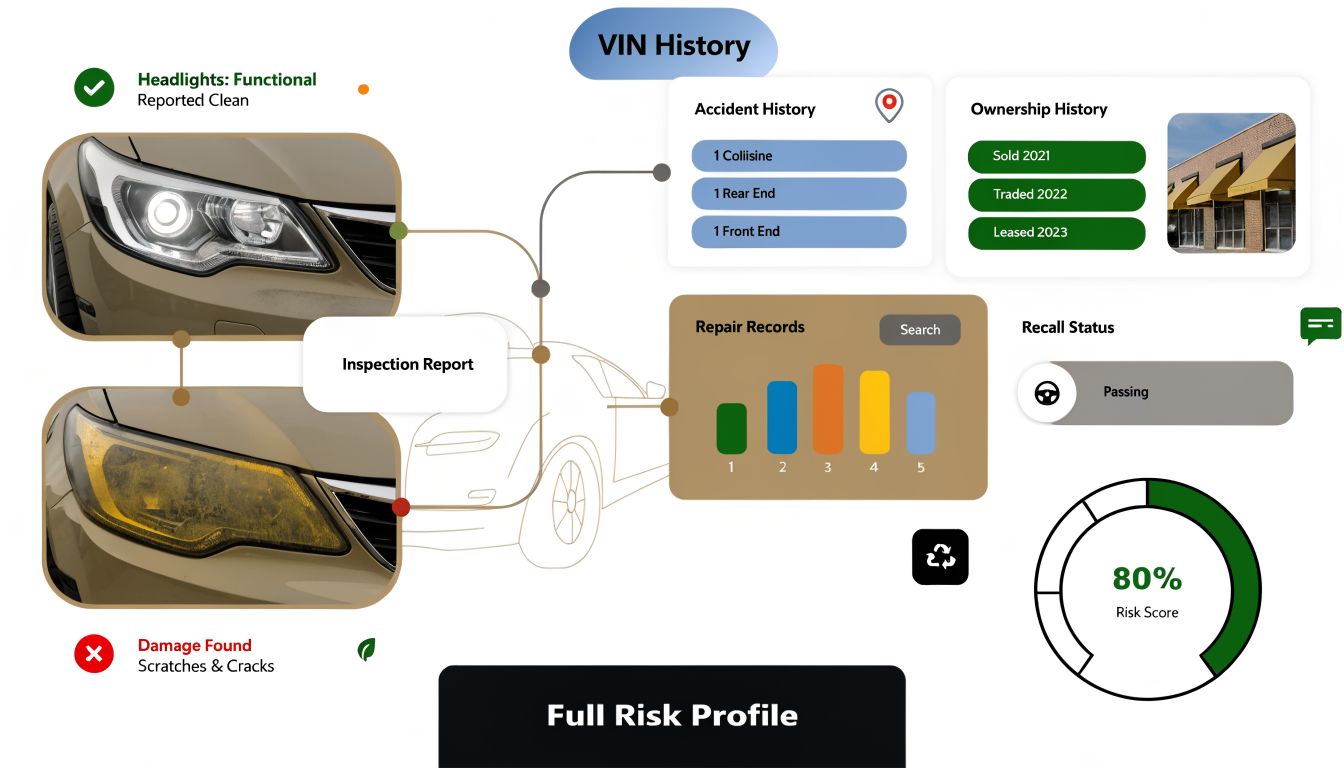
How the two reports work together
Here’s the simplest way to think about it.
The inspection report checks the body and systems. The VIN report checks the paper trail and recorded events attached to that specific vehicle identity. One confirms condition. The other confirms context.
For example:
- The mechanic notes unusual wear on pedals, seat bolsters, and steering wheel.
- The VIN history shows mileage progression that doesn’t make sense.
- Taken together, that can strengthen suspicion of odometer fraud.
Or:
- The mechanic sees signs of repaired front-end damage.
- The VIN report shows a prior accident or title issue.
- Now you have a fuller explanation of what you’re looking at.
Risks a VIN report helps uncover
A first-time buyer often assumes a clean inspection means a clean buy. Not always.
A VIN-based vehicle history report can help flag risks such as:
- Mileage inconsistencies
- Branded or salvage title concerns
- Reported theft records
- Lien status concerns where available
- Recall information
- Recorded accident and damage history
If you’re not familiar with title branding, this guide on salvage car titles is a useful primer because many buyers don’t realize how much a title label can affect value, insurability, and resale.
A practical sequence for buyers
This is the order I recommend:
Run the VIN report first
If the paper trail already raises major concerns, you may save yourself the trouble of booking an inspection.Review the report for history clues
Focus on title status, mileage records, accident entries, theft records, and recalls.Bring those clues to the mechanic
If you suspect prior front-end damage, ask the shop to pay extra attention to structural alignment, suspension mounting points, and repair quality.Compare the present with the past
Insight comes from matching what the mechanic sees to what the records suggest.
For buyers who want a better sense of what a history report includes, this VIN lookup report guide is a useful reference before you start comparing vehicles.
The safest used-car decision usually comes from asking two separate questions. What happened to this car before? What condition is it in now?
Frequently Asked Questions
Is a vehicle inspection report worth it for a used car?
Yes, especially if you’re buying from a private seller or considering an older vehicle. A vehicle inspection report gives you an independent look at the car’s current condition. That helps you spot safety issues, estimate upcoming repairs, and negotiate from facts instead of hunches.
Even when the seller seems straightforward, the inspection can uncover worn brakes, tires near replacement, hidden leaks, or poor prior repairs that aren’t obvious on a normal test drive.
Is a vehicle inspection report the same as a vehicle history report?
No. They work together, but they are not the same thing.
A vehicle inspection report is a physical, present-day evaluation done by a mechanic. A vehicle history report is a VIN-based record search that can show title events, mileage history, recalls, theft records, and other documented background information. If you only use one, you’re buying with partial information.
What should I do if the mechanic finds problems?
First, don’t panic. Used cars almost always have some findings.
Instead, sort the issues by severity. Cosmetic flaws and routine maintenance needs are one thing. Safety-related defects and major mechanical concerns are another. Ask the mechanic which findings need immediate action, which can wait, and which ones suggest larger hidden problems. Then decide whether to negotiate, request repairs, get a second opinion, or walk away.
Can a clean inspection still mean a risky car?
Yes. A clean physical inspection doesn’t guarantee a clean title history or accurate odometer record.
That’s why buyers should pair the inspection with a VIN check. A car can drive well today and still carry history concerns that affect value, financing, resale, or your long-term risk.
Are state inspections the same as a pre-purchase inspection?
Usually, no.
A state safety or emissions inspection is meant to check compliance with local requirements. A pre-purchase inspection is a buyer-focused review meant to help you decide whether the specific car is worth buying. The scope, depth, and purpose are different.
How do I find a good mechanic for a pre-purchase inspection?
Look for a shop that works on the brand you’re considering or has strong experience with used-car inspections. Call ahead and ask whether they do pre-purchase inspections, whether they put the vehicle on a lift, whether they road test it, and whether they provide written findings with photos.
If a shop sounds rushed or vague, keep calling. You want a mechanic who can explain the findings in plain language, not someone who just checks boxes.
Your Next Steps to a Confident Purchase
A good used-car decision usually comes down to two kinds of proof. You need proof of the car’s condition now, and proof of its recorded history before now.
That’s why a vehicle inspection report matters so much. It shows what a mechanic can see, hear, test, and measure. It helps you separate harmless wear from expensive trouble. It gives you solid ground for negotiation. And sometimes it gives you the clearest answer of all, which is to keep shopping.
But don’t stop there. A hands-on inspection and a VIN history report solve different problems. One checks the machine in front of you. The other checks the record attached to it. When you combine both, you reduce the chances of missing the issue that costs you later.
If you’re shopping right now, keep the process simple:
- Screen the vehicle’s recorded history first
- Book a pre-purchase inspection for the cars that still look promising
- Read the findings by severity, not emotion
- Walk away when the evidence says walk away
Buying a used car doesn’t have to feel like gambling. It feels risky when you rely on appearance, seller confidence, or a short test drive. It feels much better when you inspect, verify, and make the decision with your eyes open.
Before you book a mechanic, it helps to rule out the vehicles that already show history concerns. You can start with a VekTracer VIN report to review accident records, mileage verification, title and lien status, theft checks, recalls, and a simple Risk Score before deciding which car is worth an in-person inspection.
Ready to check a vehicle?
Enter any 17-character VIN for a free instant preview — no account needed.