Used Car History Check: Spot Red Flags & Buy Smart
Check a vehicle before you buy
Enter a VIN for a free instant preview — accidents, title brands, mileage, liens & open recalls.
A used car history check is the essential first step in due diligence, because it can reveal accidents, title status, mileage history, theft records, and ownership changes before you hand over money. A clean report gives real peace of mind, and a flagged one can save you from a costly mistake.
Most buyers see the ad first. Clean photos, shiny paint, low miles, maybe a seller who sounds honest on the phone. What matters is what happened before that listing went live. The car’s past affects safety, resale value, insurance, and whether you’re about to buy someone else’s headache.
The good news is that a solid report can uncover a lot. The better news is that once you know how to read one properly, you stop treating it like a yes-or-no pass and start using it the way experienced buyers do: as a risk map.
Finding the VIN and Choosing Your Report
A used car history check starts with one thing. The VIN.
Since 1981, the 17-character VIN has made vehicle tracking far more reliable across the U.S., Canada, and Europe, which is why modern report providers can pull ownership, title, and other history data from large record networks (CARFAX on VIN standardization and vehicle history reports). If you're looking at an older vehicle built before that standard, your paper trail may be thinner from the start.

Where to find the VIN
On most vehicles, you can check these spots:
- Dashboard at the windshield: Look from outside the car on the driver’s side.
- Driver’s door jamb: Open the door and check the sticker or plate.
- Title and registration paperwork: The number on the car should match the number on the documents.
- Insurance card or service records: Useful as a second match point if the seller has them.
If the VIN on the dashboard, door jamb, and paperwork don’t match, stop right there. That can point to paperwork errors, sloppy title handling, or something worse like VIN tampering.
Practical rule: Never run a report from a photo in the ad alone. Put eyes on the actual VIN plate and compare it to the title before you trust anything else.
What you’re checking before you buy the report
Don’t just copy the number and move on. Take a minute and inspect the area around it.
Look for:
- Fasteners that look disturbed: Missing, mismatched, or freshly tooled screws near the VIN plate.
- Sticker damage: A torn or oddly placed door-jamb label.
- Signs of repainting around the plate: Fresh paint or sanding marks can be a warning.
- Paperwork inconsistencies: Different trim, year, or body style than what’s in front of you.
A report is only as good as the VIN entered. Start with the wrong identity, and every result after that is useless.
If you want a broader walkthrough before you start, this VIN lookup guide for safer used car buying is a good companion to keep open while you're shopping.
Which report should you pull
Most buyers end up comparing CARFAX, AutoCheck, and newer VIN-based tools.
Here’s the practical difference:
| Tool | What buyers often use it for | What to keep in mind |
|---|---|---|
| CARFAX | Ownership history, title events, mileage entries, service-related visibility on many vehicles | Strong brand recognition, but you still need to inspect the car |
| AutoCheck | Auction-oriented history and score-style screening | Useful when a car may have moved through wholesale channels |
| NMVTIS-based checks | Title, salvage, insurance loss, and junk records | Good baseline for title verification, not a complete damage picture |
| VekTracer | VIN reports with accident history, mileage verification, theft records, title and lien status, recalls, and a Risk Score from 1-100 | Helpful if you want one report that summarizes risk at a glance |
That last point matters more than people think. A raw report can feel like a stack of disconnected events. A risk score won’t replace your judgment, but it can help you sort candidates quickly when you’re comparing several cars.
A simple buying habit that works
If you’re serious about a car, ask the seller for the VIN before you drive across town. Honest sellers usually provide it without drama. If someone stalls, gives excuses, or says you can get it when you arrive, treat that as part of the risk profile too.
The smartest way to begin is boring. Verify the VIN. Match it to the title. Then run the report.
Decoding Accident and Damage History
Accident history is where many buyers either overreact or miss the underlying problem.
A single report entry noting “damage reported” does not instantly mean a vehicle is salvage. Conversely, a flawless exterior and a spotless history record provide no assurance that the underlying frame is sound. Success lies in understanding which types of damage should end a negotiation and which types merely adjust the market value.
Vehicle history reports detect 85-95% of severe accidents and branded titles, but they can still miss 30-50% of private or unreported repairs, which is why a clean report is helpful but never final (Consumer Reports on limits of used car history reports).
What matters more than the word accident
The word itself is too broad. What matters is the likely severity and what systems may have been affected.
A parking-lot scrape and a front-end collision can both land in a report. Only one raises questions about cooling components, airbags, alignment, crash structure, and long-term tire wear.
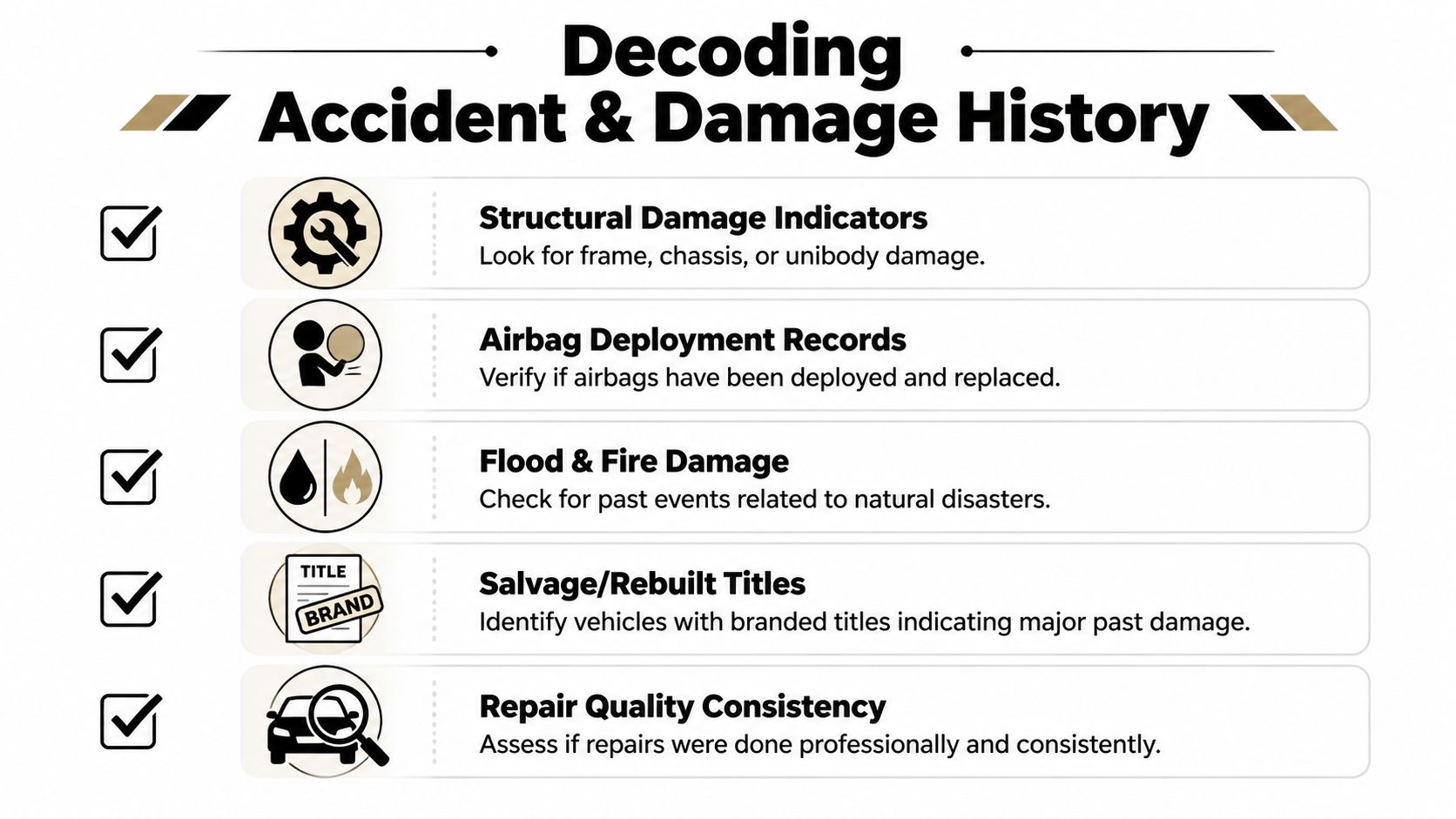
When you read the damage section, focus on these signals:
- Structural or frame damage: This is the one that changes everything. Poor structural repair can affect safety and how the vehicle tracks down the road.
- Airbag deployment: Once airbags have gone off, repair quality matters a lot. The parts are expensive, and corner-cutting happens.
- Flood or fire history: Electrical problems can linger long after cosmetic repairs.
- Repeated damage entries: Multiple incidents often tell you more than one isolated event.
- Auction or insurance language: Terms tied to loss events deserve a closer look.
If the report gives vague language and no detail, don’t fill in the blanks with optimism. Assume there’s more to verify.
How to read between the lines
A report rarely tells the full repair story. It tells you that an event was recorded. Your job is to connect that event to the car sitting in front of you.
Here’s a practical way to interpret common patterns:
| Report pattern | What it often means in real life | What to do next |
|---|---|---|
| Single minor damage entry | Could be cosmetic, but verify panel fit and paint match | Inspect body lines and get repair invoices if available |
| Front-end accident | Could involve radiator support, sensors, airbags, headlights | Check alignment, warning lights, cooling system, and hood gaps |
| Side damage | Could be doors only, or could involve pillars and structural sections | Inspect welds, seal lines, and how doors open and shut |
| Rear damage | Sometimes simpler, sometimes affects trunk floor or unibody alignment | Check spare-tire well, trunk seams, and rear tire wear |
| No accident listed, but paint looks uneven | Repair may not have been reported | Treat visual evidence as stronger than the report’s silence |
A lot of buyers make one big mistake here. They ask, “Was it in an accident?” The better question is, “What parts of the vehicle were likely affected, and how well were they repaired?”
That’s a much more useful question because repair quality is what follows you after purchase.
For a more hands-on checklist, see this guide on how to detect accident damage before buying a used car.
A clean report means no known major event was captured by the data sources in that report. It does not mean the sheet metal, welds, paint, or suspension have never been touched.
A real-world way to judge damage risk
Say you’re comparing two similar cars.
Car A has one documented minor incident from years ago, straight panel gaps, matching paint texture, no warning lights, and a clean drive. Car B shows no accident entry, but the hood sits high on one side, the front bumper shade doesn’t match the fenders, and there’s overspray on trim.
Car A may be the safer buy.
That sounds backward until you remember this: documented and properly repaired damage is often less risky than undocumented damage you’re discovering yourself.
Damage that should slow you down immediately
Not every red flag means walk away on the spot. Some mean “stop and verify before you get emotionally attached.”
These deserve that response:
- Structural damage wording
- Airbag deployment with no paperwork
- Flood branding
- Rebuilt or salvage history tied to collision loss
- Multiple accidents in a short ownership period
If you still want the car after seeing one of those, the next move isn’t negotiation. It’s inspection by an independent mechanic or body specialist.
Verifying Title Status Mileage and Liens
The title and mileage log tell the story sellers often leave out. In such situations, a car can look clean, drive fine, and still be the wrong buy.
The easiest way to think about it is this: accident history tells you what happened to the car. Title status, mileage records, and liens tell you what happened on paper, which can be just as expensive.
According to Kelley Blue Book’s vehicle history guidance, odometer fraud affects nearly 2 million vehicles annually in the U.S., and a rollback of 50,000 miles can artificially inflate price by 20-30% (Kelley Blue Book on odometer fraud and vehicle history reports). That’s why mileage verification is never a minor detail.
Read the title like a warning label
A “clean title” is what most buyers want, but you still need to read the full report because title language can get messy fast.
Watch for brands such as:
- Salvage: The vehicle was declared a total loss.
- Rebuilt or reconstructed: It was previously salvage and later returned to the road.
- Flood: Water damage can create long-term electrical and corrosion problems.
- Lemon: Manufacturer buyback issues can follow the vehicle into resale.
- Junk or non-repairable: Usually not something a retail buyer should touch.
These labels affect more than resale. They can create insurance trouble, financing trouble, and parts-quality questions if the car was repaired cheaply.
Here’s the practical side of it:
| Title status | What it usually means for a buyer | Typical stance |
|---|---|---|
| Clean | No major title brand shown | Proceed, but keep checking the rest of the history |
| Salvage | Major prior loss event | Usually walk away |
| Rebuilt | Repaired after salvage | Consider only with strong proof and a deep inspection |
| Flood | Water exposure history | Usually walk away |
| Lemon | Prior major defect case | Investigate carefully before considering |
A seller may say, “It was just cosmetic.” The title brand matters more than the sales pitch.
Mileage should tell a smooth story
When I read a mileage timeline, I don’t look at the latest odometer first. I look for rhythm.
A believable mileage history usually climbs in a steady way across registrations, service visits, inspections, and ownership changes. A suspicious one has drops, long blanks, or totals that don’t fit the age and use of the vehicle.
Here’s how to judge it:
Start with the oldest visible reading.
This gives you a baseline for how the car was used early on.Follow the dates in order.
You’re not just checking miles. You’re checking whether the sequence makes sense.Look for sudden decreases or odd stalls.
If the reading goes backward, that’s obvious. More subtle cases show unrealistically low mileage over long periods.Compare mileage to wear.
Pedals, steering wheel, seats, switchgear, and driver’s door wear can tell on a “low-mileage” car.Match mileage to ownership changes.
Frequent transfers with incomplete mileage reporting deserve a harder look.
Shop-floor rule: A suspicious odometer timeline doesn’t become less suspicious because the car drives well. Fraud and mechanical condition are separate issues.
Liens can turn a simple purchase into a legal mess
Buyers focus on accidents and miss one of the most practical problems: liens.
A lien means a lender or other party may still have a legal claim tied to the vehicle. If the seller doesn’t own it free and clear, your “good deal” can become paperwork trouble fast. This matters even more in private-party sales, where buyers often assume the title in hand settles everything.
A strong report can help flag lien status, but don’t stop there. Ask to see the title, verify the seller’s name, and if there’s any payoff involved, make sure the release process is clear before money changes hands.
If you want a more focused walkthrough on title red flags, this vehicle title check guide for used car buyers covers what to confirm before you commit.
A detective example that changes the decision
Say a car shows:
- a clean-looking exterior,
- one owner for a long stretch,
- then a short ownership change,
- then a rebuilt title,
- then low current mileage for its age.
That combination tells a story. The long first ownership may have ended in a major loss event. The short transfer after that may have been part of repair or resale. The low mileage may be real, or it may not reflect the car’s full life accurately enough to trust resale value.
That doesn’t automatically prove fraud. But it does tell you the burden of proof has shifted. The seller now needs records, not reassurance.
What the History Report Does Not Tell You
In the process of buying a used car, a lot of first-time buyers get burned. This happens when they get a clean report and assume the car is clean.
It doesn’t work that way. A vehicle history report is a strong filter, not a full biography.
The biggest blind spots show up in private sales and cross-border transactions. NMVTIS is strong for title-related data, but it may not include all accident or repair history, and a salvage vehicle from one state can sometimes be re-registered with a cleaner-looking title in another (AAMVA on NMVTIS consumer limits and data gaps).
Missing data is still a clue
If a report has very little information, don’t read that as proof of a spotless past.
Sometimes it means:
- Repairs were paid out of pocket
- The shop didn’t report data into the networks used by your report provider
- The vehicle moved between regions or jurisdictions
- The seller is in a private sale chain with thin documentation
- The car has gaps in reporting history
That last one matters. Silence in the file can be normal. But silence combined with fresh paint, worn interior parts, or a vague seller story is not normal enough to ignore.
The report can’t judge repair quality
This is the limitation buyers overlook most.
A history report may tell you an accident was recorded. It won’t tell you whether the repair shop used proper procedures, whether weld points are clean, whether hidden corrosion was left behind, or whether cheap replacement parts were fitted where OEM-quality parts should have gone.
That’s why two cars with the same type of prior damage can carry very different real-world risk.
If the report shows damage, inspect the repair. If the report shows nothing, inspect the car anyway.
Cross-border and private-sale risk
Cars move. Titles move. Data quality doesn’t always move with them.
A vehicle that spent time in different states or provinces may have a history trail that’s harder to read. That doesn’t make it bad by itself, but it does raise the value of seller records, service paperwork, and an independent inspection. Private sellers also tend to have less standardized documentation than franchised dealers, so you have to build the missing context yourself.
Here’s a practical checklist for blind spots a report won’t fully solve:
- Ask for maintenance records: They can fill service gaps a report doesn’t show.
- Ask how damage was handled: Insurance claim, body shop invoice, or cash repair all matter.
- Check where the vehicle lived: Coastal, flood-prone, and cross-border history can change your inspection priorities.
- Inspect the underside: Surface rust, corrosion, and poor repairs often tell a different story than the listing.
- Get a pre-purchase inspection: This is the step that tests reality against paperwork.
A clean report and a bad car can exist together
That’s not a flaw in the concept of reporting. It’s just the limit of databases.
Reports are strongest when an event touched insurance, police, DMV, auction, or participating service records. They’re weaker when damage stayed off the books. If a seller says, “You don’t need an inspection, the report is clean,” that’s backward. A clean report is exactly when buyers get too comfortable.
Your Action Plan From Report to Decision
At this point, the report should help you sort the car into one of three buckets. Don’t overcomplicate it.
Green light
Move forward when the report and the vehicle agree with each other.
That usually looks like this:
- VIN matches everywhere
- Title looks clean
- Mileage timeline makes sense
- No major damage indicators jump out
- The car’s condition matches the paper trail
This is the car you take to a pre-purchase inspection with cautious optimism. You’re not done, but you have a reason to keep going.
Yellow light
Most decent used cars meet these criteria. Not perfect. Not automatic rejects either.
Common yellow-light examples:
- One older damage entry with no obvious repair problems
- Thin history file but a credible seller with records
- Multi-owner history that still reads consistently
- Minor title or registration complexity that has a clear explanation
In these cases, use the report as a negotiation tool. Ask for invoices. Ask direct questions. Price the risk realistically. If anything stays fuzzy, let the mechanic settle the argument.
Decision shortcut: If the seller can explain the issue clearly and back it up with paperwork, keep evaluating. If the explanation changes, stop.
Red light
Some combinations aren’t worth chasing unless you know exactly why you’re taking the risk.
Walk away, or be prepared to justify the gamble, when you see:
- Salvage or flood history
- Structural damage concerns
- Mileage inconsistencies
- Title problems that the seller can’t cleanly document
- A seller who avoids sharing the VIN or paperwork
That last one deserves more weight than people give it. Good cars can still have complicated histories. Honest sellers don’t usually hide basic identifying information.
What works and what doesn’t
What works:
- Running the report before the test drive
- Comparing the report against the actual car
- Using title, accident, and mileage history together instead of in isolation
- Treating missing information as something to investigate
- Paying for an independent PPI before money changes hands
What doesn’t:
- Trusting the seller’s summary of the report
- Assuming “clean” means “never damaged”
- Ignoring lien questions
- Negotiating first and verifying later
- Falling in love with the car before the paperwork checks out
If you’re comparing multiple options, it helps to line the reports up side by side instead of judging each one in a vacuum. That’s where a report comparison tool can save time, especially if you’re sorting through several candidates. If you also want to compare provider differences, this CARFAX comparison page is a practical next step, and you can also browse the site’s VIN check pages or related used-car buying blog posts.
Frequently Asked Questions About Car History Checks
Can a car have a clean report and still have been in an accident
Yes. Some accidents and repairs never make it into the databases used by vehicle history services, especially in private-pay repair situations. That’s why a clean report lowers risk but doesn’t remove it.
Is a used car history check enough on its own
No. It’s the first filter, not the final decision. You still need a pre-purchase inspection by an independent mechanic, especially if the car has any accident, title, mileage, or ownership oddities.
Which is better, CARFAX or AutoCheck
Neither one is automatically better for every car. CARFAX is often the report buyers recognize first. AutoCheck can be useful when auction-related history matters. The right move is to use a report you can interpret properly and back it up with inspection.
What if the seller won’t give me the VIN
Treat that as a warning. A legitimate seller should understand why you want the VIN for a used car history check. If they refuse, stall, or keep changing the subject, move on unless they provide a solid reason and paperwork you can verify in person.
Should I buy a car with an accident on the report
Sometimes yes. The key question is what kind of accident, what parts were affected, and how well it was repaired. A documented minor incident with quality repairs can be less risky than an undocumented repair on a supposedly clean-history car.
Do I need a vehicle history report in Canada and the U.S.
Yes. The basic logic is the same in both markets. You want to verify title status, mileage history, damage records, theft records, and ownership changes before you buy. If you’re shopping across borders, be even more careful about data gaps and paperwork consistency.
If you’re narrowing down a few cars and want the paperwork side handled quickly, VekTracer lets you run a VIN-based vehicle history report with accident history, mileage verification, title and lien status, theft records, recalls, and a Risk Score. It’s a practical way to screen a vehicle before you spend time on calls, test drives, and an inspection.
Ready to check a vehicle?
Enter any 17-character VIN for a free instant preview — no account needed.