Tire Tread Wear: A Buyer's Guide to Safety and Risk
Check a vehicle before you buy
Enter a VIN for a free instant preview — accidents, title brands, mileage, liens & open recalls.
You're standing next to a used car, crouched by the front wheel, trying to decide if the seller's story holds up. The tires can answer that faster than most sales pitches. Tire tread wear isn't just rubber wearing down. It's one of the clearest physical records of how a vehicle was driven, maintained, aligned, and sometimes misrepresented.
A clean body and shiny interior can hide a lot. Tires usually can't. If you know what to look for, tread depth and wear pattern can tell you whether the car is safe today, whether it's been neglected, and whether the odometer reading deserves a second look.
What Tire Tread Wear Reveals About a Car
Tire tread wear is the gradual loss of the rubber that contacts the road. For a driver, that sounds like routine maintenance. For a used car buyer, it's evidence.
Start with the basic safety line. In the U.S., the federal legal minimum tread depth for passenger vehicle tires is 2/32 inch (1.6 mm), and that standard has been in force since August 1, 1968. At that point, the tire is considered legally bald and needs replacement immediately, according to the U.S. Tire Manufacturers Association tire care and safety guide.
That legal limit matters, but it doesn't tell the full story of a used car. A tire can still be legal and still be a warning sign. Uneven shoulder wear can point to chronic underinflation. One-sided wear often hints at alignment trouble. Cupping can suggest worn suspension parts or a wheel balance problem. Four matching tires with even wear usually tell a very different story than one cheap replacement paired with three aging, unevenly worn tires.
What tires tell you at a glance
A quick walkaround can reveal several things:
- Safety condition: Whether the car is close to needing tires now, not later.
- Maintenance habits: Even wear usually means the owner kept up with pressure checks and rotations.
- Mechanical condition: Strange patterns often point to alignment or suspension faults.
- Ownership style: Mixed brands, mismatched sizes, or neglected tread often show corner-cutting elsewhere too.
Practical rule: If the seller says the car was “meticulously maintained” but the tires show obvious neglect, trust the tires first.
The reason this matters for pricing is simple. Tires change the actual cost of the deal. If the car already needs a set of tires and an alignment, the asking price isn't the actual price. That's one reason it helps to pair a physical inspection with a broader used car value estimate before you commit.
Measuring Tread Depth The Right Way
Most buyers either don't measure tread at all or they do one quick check on one tire and call it done. That misses half the point. You're not just checking if the tire passes. You're checking if the wear is consistent across the tire and across the whole car.
Wet-road safety drops before the legal limit. Tires need at least 4/32 inch (3.2 mm) of tread to maintain safe braking performance in rain, and hydroplaning risk rises sharply below 3/32 inch (2.4 mm), according to this tread depth safety guide.
Use the penny test for the bare legal minimum
The penny test is crude, but it's useful when you're in a driveway or parking lot with nothing else.
- Insert a penny into the tread groove with Lincoln's head facing down.
- If the top of Lincoln's head is fully visible, the tire is around the legal end of life.
- Repeat that check in multiple grooves and on multiple tires.
This test only tells you whether the tire is flirting with the absolute minimum. It doesn't tell you if the tire is a good bet in rain, and it won't expose uneven wear unless you check several points.
Use the quarter test for the smarter threshold
The quarter test is the better quick screen for a buyer because it aligns more closely with real-world wet traction concerns.
- Check multiple spots: Don't test one groove and move on.
- Compare inside, center, and outside: That's how you catch inflation and alignment clues.
- Inspect both front tires and both rear tires: Front and rear often wear differently.
If the tread looks acceptable in the center but weak on one edge, don't let one “passing” spot reassure you.
A tire that passes a casual parking-lot test can still be telling you the car needs alignment work.
Use a tread depth gauge if you want the truth
A tread depth gauge is cheap, small, and much more precise than coin tests. This is the tool inspectors rely on because it gives you a repeatable reading.
Here's the method that works:
| Check point | What to do | What it helps reveal |
|---|---|---|
| Inner tread | Measure near the inside shoulder | Camber wear, neglected alignment |
| Center tread | Measure in the middle rib | Overinflation clues |
| Outer tread | Measure near the outside shoulder | Underinflation, edge wear |
| Around circumference | Check more than one point around the tire | Cupping, patch wear, irregular wear |
Use that process on every tire, including the spare if it's accessible. A proper used car inspection checklist for buyers and dealers should always include tread depth in multiple locations, not one quick glance.
Common measuring mistakes
- Only checking one tire: The problem is often isolated to one corner.
- Checking only the center groove: That misses edge wear.
- Ignoring the rear tires: Buyers often focus on the fronts and miss serious issues in back.
- Measuring dirty tires: Stones and packed debris can fool your eye and your gauge.
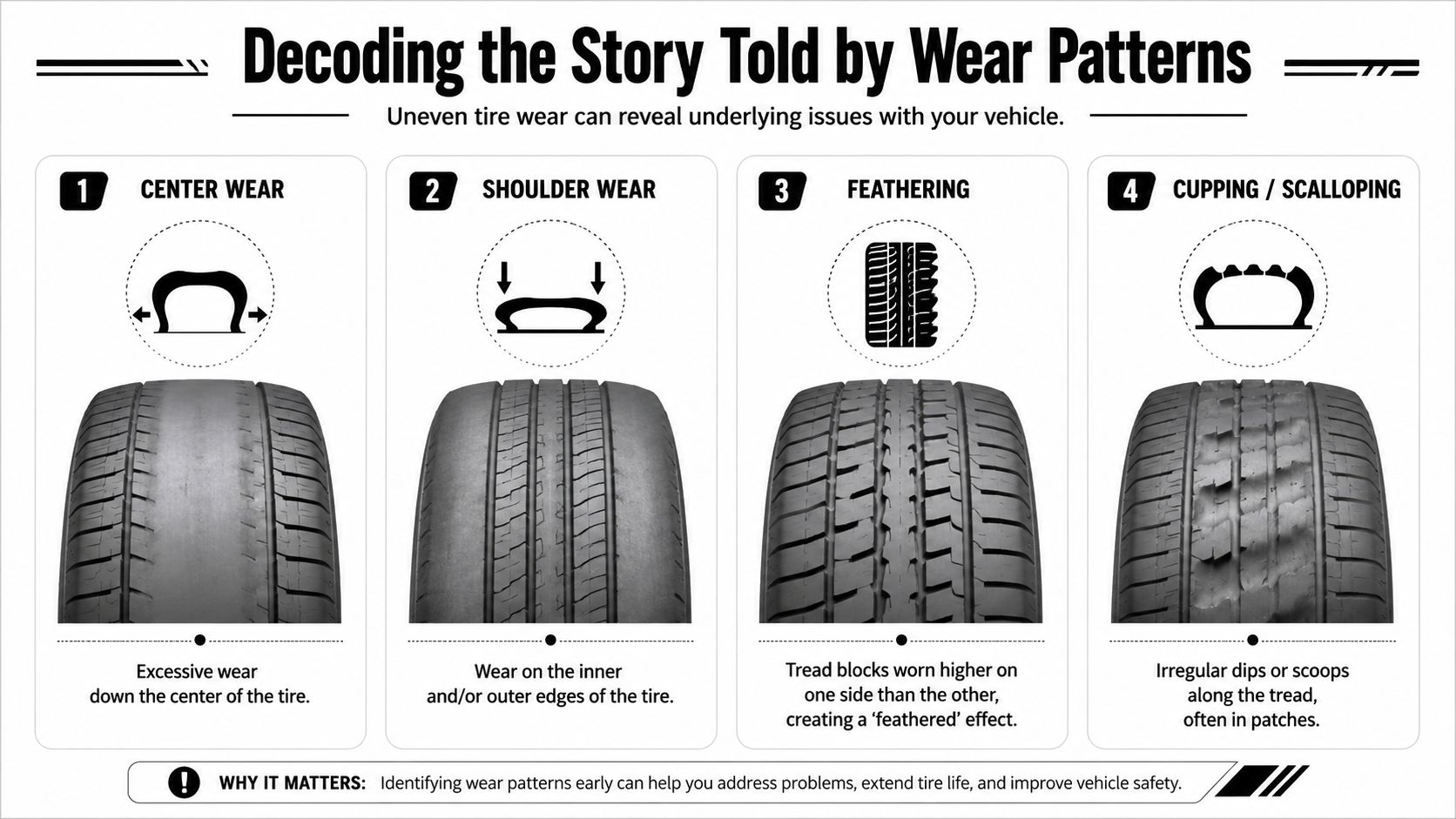
Decoding the Story Told by Wear Patterns
Depth tells you how much tire life is left. Pattern tells you what the car has been doing to the tire. That's the part most buyers miss.
Center wear
Center wear looks exactly like it sounds. The middle rib of the tread is more worn than both shoulders.
That usually means the tire spent too much time overinflated. The center of the tread carried too much of the load, so it scrubbed down faster than the edges. On a used car, center wear often tells you the owner cared more about avoiding a low-pressure warning than maintaining the correct pressure.
Shoulder wear
Shoulder wear shows up on the outer edges of the tire, sometimes on both sides, sometimes more heavily on one.
When both shoulders are worn and the center looks deeper, underinflation is high on the suspect list. When one shoulder is noticeably worse than the other, you're often looking at an alignment-related issue instead of simple pressure neglect.
One-sided wear
This is one of the most revealing patterns for a buyer. One side of the tread, either inner or outer, is worn much more heavily than the other across the same tire.
That often signals a geometry problem in how the wheel sits on the road. If it's severe, I treat it as more than a tire issue. It can point to a car that has gone too long without proper correction, or one that may have had impact damage, curb strikes, or worn components that were never addressed.
If one tire is worn heavily on the inside edge and the seller says, “It just needs air,” keep digging.
Feathering
Feathering is easy to miss unless you run your hand across the tread blocks. One direction feels smooth. The other feels sharp or saw-toothed.
This pattern usually means the tire has been dragged slightly sideways as it rolls. Buyers often overlook it because the tire can still show decent remaining depth. The pattern matters because it tells you the car may not be tracking straight, even if the steering wheel feels mostly normal on a short test drive.
Cupping or scalloping
Cupping looks like a series of scooped dips around the tread. Instead of smooth, even wear, the tire surface rises and falls in patches.
This is the pattern that often sends me past the tire and straight to the suspension and wheel-end components. It can also show up with balancing problems. If you hear a rhythmic hum on the road and see cupping on the tread, that's not cosmetic.
For a full used-car evaluation, tire evidence should sit alongside a pre-purchase car inspection, not replace it. Tires tell you where to look harder.
Tracing Wear Patterns to Their Mechanical Roots
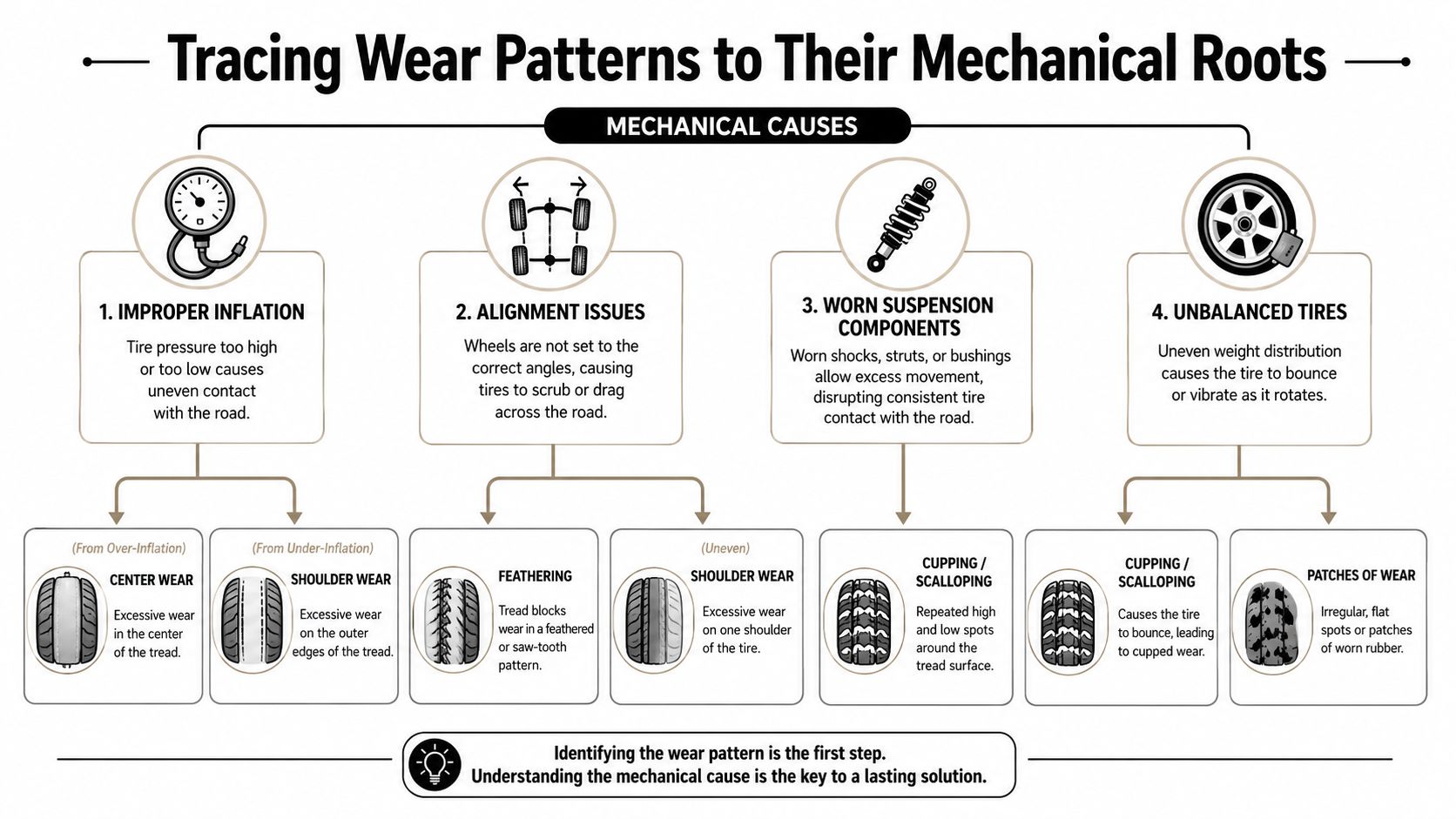
Spotting a pattern is useful. Knowing what likely caused it is what helps you make a buying decision.
Inflation problems
Improper inflation leaves a very readable signature. Too much air usually wears the center faster. Too little air wears the shoulders faster because the outer edges carry more of the contact load.
Tire pressure habits tell you a lot about ownership quality. Someone who rarely checks pressure often skips other basic maintenance too. I don't treat inflation wear as proof of a bad car, but I do treat it as a clue about how carefully the car was kept.
Alignment faults
Alignment problems are more serious because they can eat through a decent tire while also pointing to underlying causes.
A useful way to think about alignment is this. A properly aligned wheel rolls straight and flat. A misaligned wheel scrubs. Sometimes it leans too much on one edge. Sometimes it points slightly inward or outward and drags the tread across the road. That's how you get one-sided wear or feathering.
Here's a simple comparison:
| Wear pattern | Likely root issue | Why it matters to a buyer |
|---|---|---|
| One-sided inner or outer wear | Alignment geometry problem | Tire replacement may not solve it alone |
| Feathering across tread blocks | Toe-related alignment issue | Car may wander or feel vague |
| Repeated uneven wear after replacement | Unresolved chassis issue | Expect continuing tire expense |
A fresh set of tires can temporarily hide this. That's why I always ask when the tires were installed and whether alignment paperwork exists.
Suspension wear
Suspension problems don't always announce themselves with clunks on a short drive. Tires often show the evidence first.
Cupping or scalloping can point toward worn shocks, struts, joints, or other components that let the tire bounce instead of staying planted. The tire doesn't maintain steady contact, so it wears in patches. If the road test also brings vibration, droning, or a loose front end feel, I assume the tire is only one part of the repair bill.
Shop-floor habit: When I see cupping, I stop talking about tires and start asking about shocks, struts, and balance history.
Balance and rotation issues
Some wear patterns come from neglect rather than outright failure. Tires that weren't rotated on schedule often show front-to-rear differences that are bigger than they should be. A wheel that isn't balanced properly can leave irregular wear patches and cause steering shake at speed.
Buyers often make a common mistake. They see “newer tires” and assume the issue is solved. It may not be. If the old tires wore badly because of unresolved balance or suspension trouble, the current set may be heading down the same path.
What works and what doesn't
A few practical truths help here:
- Replacing tires alone works when the wear came from age and otherwise even use.
- Replacing tires alone doesn't work when the root cause is alignment, suspension, or balance.
- An alignment helps only if worn parts aren't preventing the settings from holding.
- A smooth test drive doesn't clear the car if the tread tells a different story.
That's why tread inspection is so valuable. It turns a vague concern into a targeted question. Instead of asking the seller, “Is anything wrong with it?” you can ask, “Why is the inside edge of the right front worn more than the rest of the tire?”
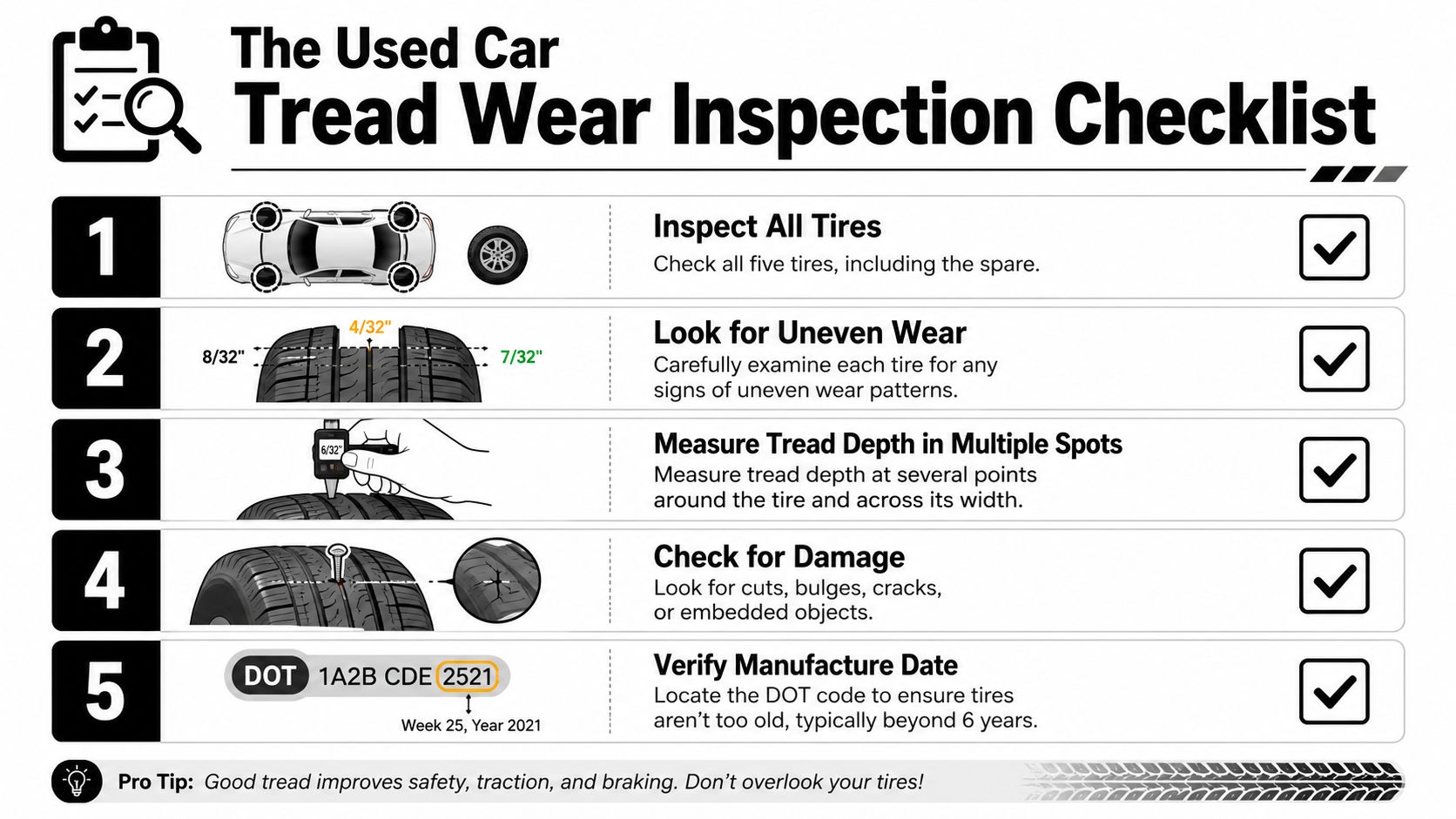
The Used Car Tread Wear Inspection Checklist
This is the inspection routine I'd use standing next to a used car before I trust the mileage, the maintenance story, or the asking price.
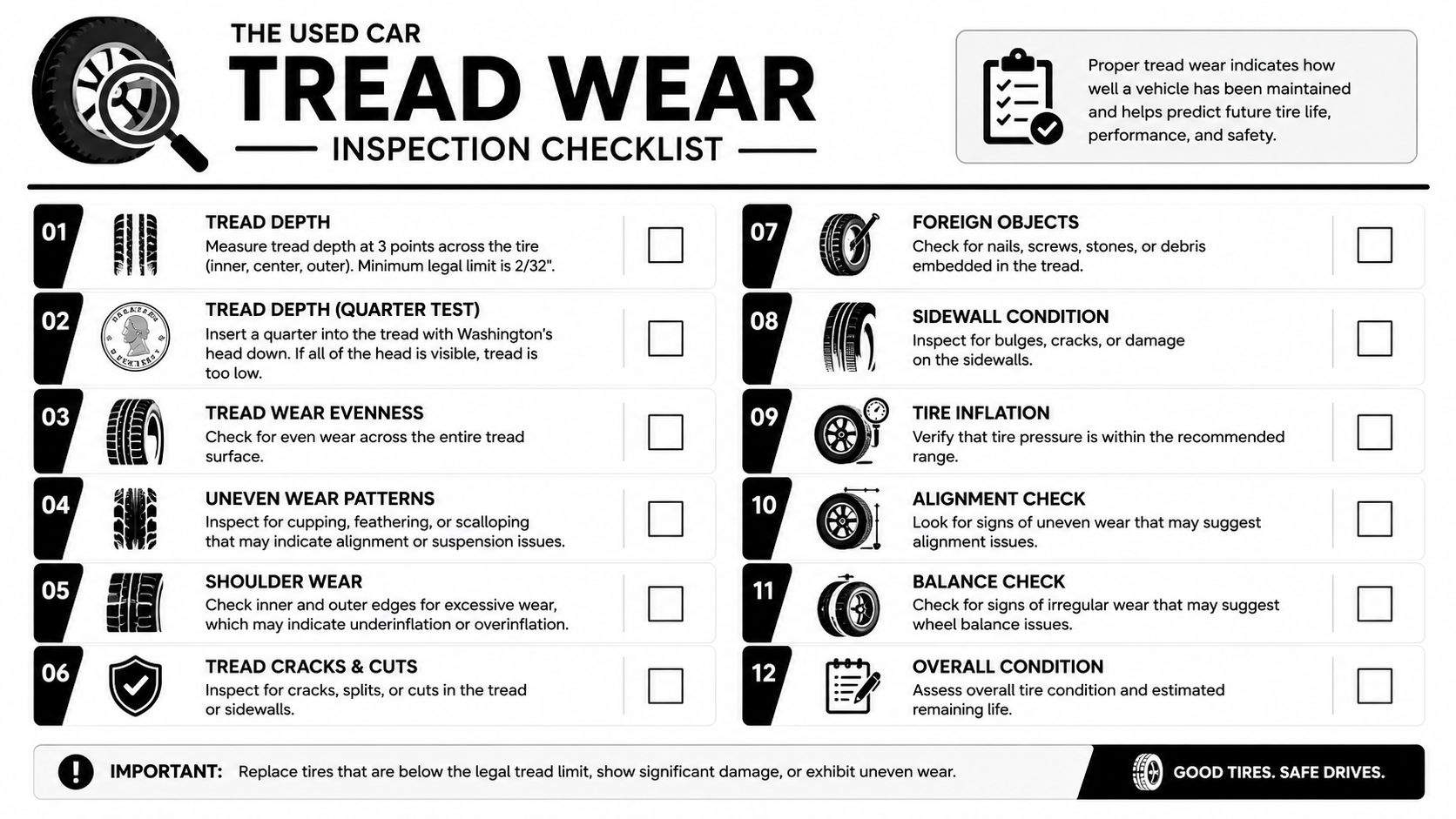
Start with consistency
Look at all four mounted tires first, then the spare if the seller will let you inspect it.
- Match the brand and type: Four matching tires usually suggest planned maintenance. A random mix can suggest piecemeal repairs.
- Check the size markings: Mismatched sizes raise questions about prior replacement choices.
- Scan for one tire that looks much newer: That can point to a recent failure, impact, or isolated problem corner.
A single replaced tire isn't automatically bad. But it does create a follow-up question. Why was that one replaced, and what fixed the cause?
Read the date and the tread
DOT date codes matter because age and wear don't always move together. A tire can show usable tread and still be old enough to raise concern. AAA notes that tires older than six years should be replaced regardless of tread depth due to age-related degradation, as explained in this AAA tire replacement guide.
Then inspect the tread itself:
- Measure depth in more than one groove.
- Compare inner, center, and outer areas.
- Feel for feathering with your hand.
- Look for cupping, cracks, bulges, plugs, or exposed damage.
Compare the tires to the odometer story
Tire tread wear serves as a forensic tool, not just a maintenance check. Comparing tire wear against odometer readings and DOT date codes can plausibly validate or flag inflated mileage claims, according to this used-car tire inspection guide from Bumper.
The point isn't that tread gives you a perfect mileage calculation. It doesn't. The point is that the physical evidence should broadly fit the story.
A practical buyer's checklist:
- Low-mileage claim with heavily worn tires: Ask whether the tires are original and when they were installed.
- Recent tires on a supposedly lightly used car: Ask for receipts. New rubber may be fine, or it may be covering a wear history you can no longer inspect.
- Old tires with very low odometer reading: Check whether the car sat unused for long periods.
- Wear pattern that conflicts with “highway miles only”: Highway use alone doesn't explain every pattern.
The broader wear-rate context can help frame your thinking. In the U.S., tire tread deteriorates at about 0.2/32 of an inch per 1,000 miles driven, and a vehicle driven the national average of 10,000 miles annually loses about 2/32 inch of tread depth per year, based on this transportation research report. That isn't a courtroom-grade odometer test. It is a useful reality check.
Tires don't prove rollback by themselves. They do tell you when the mileage claim deserves verification.
Red flags worth slowing down for
- The seller talks a lot but won't let you inspect closely
- The front tires look very different from the rear with no explanation
- One edge is bald while the rest of the tire looks decent
- The DOT dates suggest old tires on a “barely driven” car
- The tread story and the maintenance records don't line up
If those signs stack up, stop relying on the seller's memory. Verify the vehicle's past with the VIN, compare mileage history across records, and check for other inconsistency markers through VIN check pages, a detailed vehicle history report, and useful related blog posts. If you're comparing providers before you buy, this Carfax comparison page is a sensible place to weigh what matters to you.
Answering Your Top Tire Tread Questions
What do UTQG treadwear ratings actually mean
They're a comparison tool, not a mileage promise. Under the UTQG system, a tire with a 400 treadwear rating is expected to last twice as long as one rated 200 only when both are driven under identical conditions, and actual mileage varies significantly, as explained in this UTQG treadwear rating guide.
That means you shouldn't shop by the treadwear number alone. A higher number may indicate longer expected life, but it can come with trade-offs in feel, grip, or how the tire suits your vehicle.
How often should I rotate my tires
Follow the vehicle manufacturer's maintenance schedule and don't guess. Rotation matters because tires don't all do the same work. On many vehicles, the front tires handle more steering and braking load, so they wear differently from the rear.
If you're already seeing mild uneven wear, rotation may slow further imbalance, but it won't correct an existing alignment or suspension fault. Rotation is maintenance, not diagnosis.
Can a tire with good tread still be too old
Yes. Good-looking tread can fool buyers into thinking the tire is safe because there's still visible rubber left. Age changes that equation.
Rubber hardens, dries, and loses resilience over time. If you're evaluating an older used car, check the DOT date code rather than judging by tread alone. This matters even more for vehicles that sat for long periods.
Is tire service worth getting locally before a long trip
If you've already found an issue, yes. A local specialist can quickly confirm whether you're looking at simple wear, a puncture problem, or something rooted in alignment or suspension. For readers in the UK, a practical example is this tyre callout in suffolk, which is the kind of service that helps when a tread concern turns into an immediate roadworthiness problem.
Tires are often the most honest part of a used car. They don't care about the ad copy, the polished paint, or the seller's confidence. They show what the car has been through.
Before you trust a used car's mileage or condition, verify the paper trail against what the tires are telling you. VekTracer helps buyers check accident history, title issues, recalls, and mileage records through VIN-based reports, with tools built to make risk easier to spot before you buy.
Ready to check a vehicle?
Enter any 17-character VIN for a free instant preview — no account needed.