Most Reliable Audi: A 2026 Buyer's Guide
Check a vehicle before you buy
Enter a VIN for a free instant preview — accidents, title brands, mileage, liens & open recalls.
The surprising answer is that the most reliable Audi usually isn't the biggest, newest, or most expensive one. The strongest evidence points to the Audi A4, especially the B9 generation from 2016 to 2020 and later B8 models from 2013 to 2016, with the Q5 and Q3 close behind for buyers who want an SUV.
That matters because Audi's reputation is often painted with a broad brush. In practice, reliability is far more model-specific and year-specific than the badge alone suggests. A smart used buyer shouldn't ask, "Are Audis reliable?" The better question is, "Which Audi, from which years, with which history?"
The Verdict on Audi Reliability in 2026
Audi reliability in 2026 is best understood as a risk spectrum, not a brand verdict. Buyers who treat every Audi as equally dependable miss the pattern that matters most: the safest used buys cluster around specific model lines, engine combinations, and production years.
Three models sit at the low-risk end of that spectrum: A4, Q5, and Q3. They appear repeatedly in owner feedback, used-market recommendations, and independent reliability roundups for one simple reason. They pair Audi's more familiar four-cylinder hardware with platforms that have had time to mature in the field.
The A4 remains the clearest starting point. Across multiple owner discussions and reliability summaries, later B8 cars and the B9 generation show up more often than any other Audi when the question is long-term durability rather than badge appeal or feature count. That does not make every A4 a safe purchase. It does suggest that, if your goal is to reduce downside, the A4 gives you the strongest odds.
For SUV shoppers, the logic is similar. The Q5 is the stronger family choice because it balances space, parts availability, and a drivetrain configuration that independent shops know well. The Q3 makes sense for buyers who want a smaller crossover and fewer complexity traps than larger, more option-heavy Audis often bring.
Why these models keep surfacing
This is less about prestige and more about failure exposure. Audi's better bets usually share the same advantages:
- Established powertrains: The 2.0-liter turbo four-cylinder has a longer real-world track record than many of Audi's more complicated setups.
- Manageable complexity: Fewer high-end systems usually means fewer expensive age-related faults.
- Better service familiarity: Common models are easier to diagnose, easier to source parts for, and less likely to become shop-time black holes.
That last point is often underestimated.
A used luxury car does not become reliable because it survived the warranty period. It becomes a rational buy when the common failure points are known, repair paths are predictable, and independent mechanics have seen the platform enough times to spot trouble early.
A better decision framework
Mileage, trim level, and cosmetic condition matter, but they should not lead the analysis. Generation history matters more. A low-mileage Audi from a problem-prone run can be a worse bet than a higher-mileage A4 or Q5 from a proven stretch of production with documented maintenance.
Use the shortlist this way:
| Buyer priority | Lowest-risk Audi choice | Why |
|---|---|---|
| Sedan reliability first | A4 B9 or later B8 | Strong owner reputation, broad parts support, familiar drivetrain |
| SUV with family use | Q5 | Balanced packaging, known service history, lower complexity than larger models |
| Smaller city SUV | Q3 | Simpler ownership case and strong reputation within Audi's crossover range |
| Newer electrified Audi curiosity | Q4 e-tron | Early signs look encouraging, but individual vehicle history matters more than model hype |
The key takeaway is simple. Choose the right year first, the right configuration second, and the individual car third. Skip that order, and it becomes easy to overpay for a bad Audi that only looks like a smart buy on paper.
How We Measure Real-World Audi Reliability
Reliable Audis are found by narrowing risk, not by trusting the badge. A car can score well in broad dependability studies and still carry one expensive failure point in a specific engine or model year. That is why our method uses three layers of evidence: industry data, model-year failure patterns, and the history of the individual vehicle.

What brand-level data indicates
A useful starting point is J.D. Power's Vehicle Dependability Study. In the 2025 study, Audi scored slightly above the industry average of 190 problems per 100 vehicles, ahead of Mercedes-Benz at 215 PP100 and Land Rover at 245 PP100, but behind BMW at 178, Lexus at 162, and Toyota at 148, according to this Audi reliability analysis citing the 2025 VDS.
That places Audi in the middle of the premium market. The brand is no longer carrying the same reliability stigma it had in earlier eras, but the brand-wide result also does not justify shopping every Audi with equal confidence.
How to read PP100 without overrating it
Problems per 100 vehicles is useful because it measures owner-reported issues across a large sample. Lower scores usually mean fewer complaints, but PP100 mixes together very different types of trouble. A failed water pump and a glitchy infotainment screen both count as problems, even though the cost, inconvenience, and long-term risk are nowhere near the same.
So use PP100 for direction, not certainty.
It answers a few practical questions:
- Is Audi trending toward average or better brand dependability? Yes, recent data suggests improvement.
- Is Audi still riskier than the strongest Japanese luxury and mainstream brands? Yes.
- Can brand-level data identify the safest used Audi to buy? No. That requires model-year analysis and vehicle history.
Use brand reliability data to select a manufacturer, then use model-year analysis to select a specific vehicle.
Why model-year evidence matters more for used Audis
Used-car risk lives at the platform level. Audi has produced excellent cars and expensive mistakes under the same brand umbrella, sometimes only a few years apart. That is why this guide gives more weight to generation history, engine-transmission combinations, and recurring owner complaints than to brand averages alone.
This is also where the primary sweet spots appear. A mature production run often has the bugs worked out, the common repairs documented, and the independent-shop knowledge base in place. A red-flag year usually shows the opposite pattern. Repeated complaints cluster around the same systems, repair costs rise, and buyers end up paying for complexity that never got fully sorted.
For Audi, the distinction between mechanical failures and nuisance faults matters. Luxury brands often lose points in dependability surveys because they fit more software, sensors, and convenience features. Buyers should still care about those problems, but a used-car decision should rank a timing issue, oil-consumption pattern, or transmission fault far above a temperamental screen or intermittent sensor warning.
The three-layer framework we use
| Reliability layer | What it answers | Why it matters |
|---|---|---|
| Brand-level dependability | Is Audi broadly improving or slipping? | Sets market context and helps compare Audi with rival brands |
| Model, generation, and year record | Which versions have the best odds of low-drama ownership? | Identifies sweet spots and exposes red-flag years |
| Vehicle-specific history | Has this exact car been maintained and repaired properly? | Decides whether the individual car is worth buying |
The last layer decides the purchase. Service records, recall completion, inspection findings, and a clean VIN history can turn a good model-year into a safe buy. Missing maintenance, accident history, or signs of repeated unresolved repairs can ruin even a well-regarded Audi.
That is the core of our method. We are not trying to crown one perfect Audi. We are trying to reduce the chance that a used luxury car turns into a five-figure mistake.
Ranking The Most Reliable Audi Models and Years
Audi reliability is concentrated, not evenly distributed. If you want the lowest-risk used Audi, the winning move is rarely "buy the newest one you can afford." It is to target the model-year pockets where Audi's engineering had settled, major weak points were already known, and repair exposure stayed closer to predictable than open-ended.
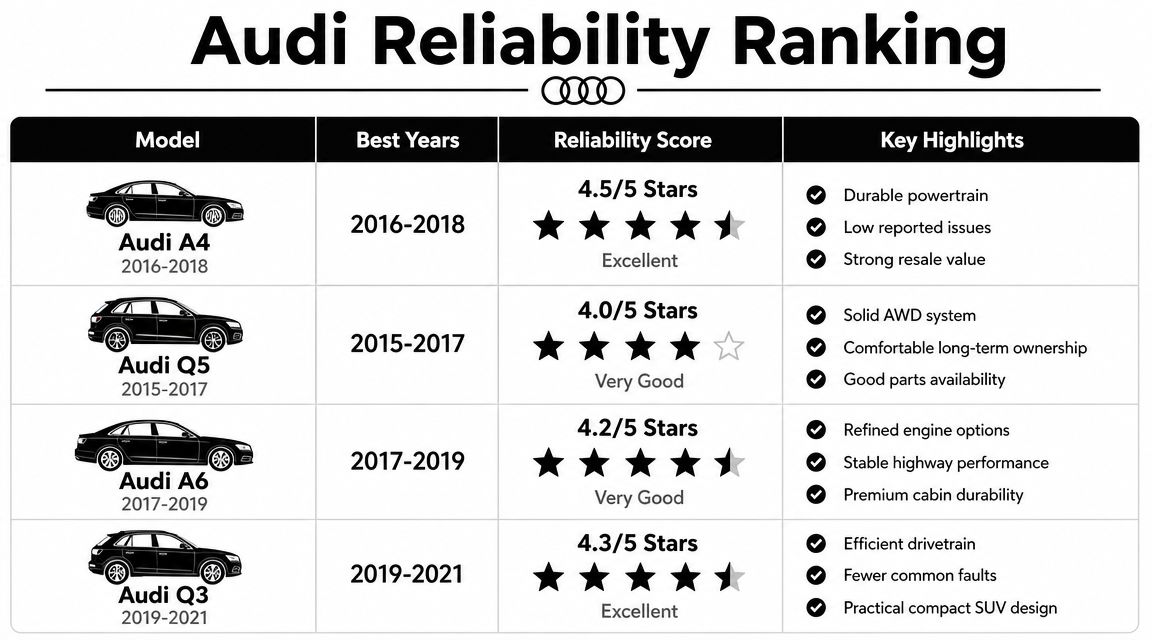
Reliability ranking at a glance
| Rank | Model | Best years to target | Why it ranks here | Watch-outs |
|---|---|---|---|---|
| 1 | Audi A4 | 2013 to 2016 later B8, 2017 to 2020 B9 | Best balance of durability, parts availability, and manageable complexity | Confirm oil-service history, cooling-system condition, and transmission behavior |
| 2 | Audi Q5 | 2015 to 2017, plus carefully maintained newer examples | Strong family-use case without the cost exposure of larger SUVs | Suspension wear, overdue fluid services, and neglected AWD maintenance |
| 3 | Audi Q3 | Recent model years, especially lower-owner examples | Simpler mission and fewer expensive systems than bigger Audi SUVs | Interior wear, deferred maintenance, and accident-repaired urban cars |
| 4 | Audi A3 | Well-kept later examples with full records | Lower entry price and shared-group components can reduce ownership friction | Hard-driven cars, patchy service history, and modified examples |
| 5 | Audi A6 and larger models | Select years only | Comfortable and appealing, but risk rises with feature count and drivetrain complexity | Air suspension, electronics, cooling systems, and expensive convenience tech |
This ranking is a risk map, not a trophy list. A well-kept Q5 can be a safer buy than a neglected A4, and a clean-history A3 often makes more financial sense than a cheap A6 loaded with deferred repairs.
1. Audi A4. The safest all-around bet
The A4 earns the top spot because its strongest years combine three things buyers rarely get at once in a used luxury car: mature engineering, broad independent-shop familiarity, and a large owner base that has already exposed the recurring faults.
The sweet spot is specific. Later B8 cars from 2013 to 2016 and early to mid B9 cars from 2017 to 2020 are usually the years cautious buyers should start with. Earlier examples in a generation often carry more unresolved teething issues. Later examples benefit from updated components, revised software, and years of field fixes.
The A4 also avoids one of the biggest used-Audi traps. It delivers the premium badge and daily comfort buyers want without piling on the same level of system complexity found in larger six-cylinder sedans and SUVs.
Reliability profile
A good A4 usually ages in a predictable way. You still need to budget for normal premium-car maintenance, but the ownership pattern is more likely to involve scheduled service, wear items, and isolated repairs than a chain reaction of expensive faults.
That distinction matters. Predictable cars are easier to own even when they are not cheap.
Buyers should still verify oil-change intervals, cooling-system health, carbon buildup on direct-injection engines where relevant, and transmission operation during a cold start and full warm-up drive.
2. Audi Q5. The practical choice with the best margin for error
The Q5 ranks second because it offers a safer path into an Audi SUV than the larger, more complicated alternatives. It gives buyers the format many need, family space, ride height, and all-weather usability, without pushing them as quickly into big-ticket complexity.
Its best years tend to be the more mature versions within a generation rather than the earliest redesign years. That pattern shows up often with Audi. Once the platform, engine calibration, and electronics package have had time in the field, ownership risk usually drops.
Reliability profile
The Q5's appeal is pragmatic. It does a lot of jobs well, and that matters because buyers who keep a car for years need usefulness as much as reliability.
Its weak point is buyer complacency. The Q5 often presents well on a test drive, even when maintenance has been deferred. A polished interior and quiet ride can hide overdue driveline service, worn suspension components, or cooling-system neglect. That is why a used car history check before buying an Audi is more than a formality. It helps confirm whether the car's condition matches its appearance.
3. Audi Q3. The lower-risk small SUV
The Q3 deserves more attention than it usually gets in Audi reliability discussions. It lacks the prestige of larger models, but that is partly the point. Buyers chasing reliability should care less about hierarchy inside the brand and more about how much complexity they are taking on.
In that context, the Q3 makes sense. It is smaller, lighter in mission, and generally less exposed than larger Audi SUVs packed with expensive convenience features.
Reliability profile
The Q3 suits buyers who want an Audi badge without signing up for the full maintenance and repair profile of the upper lineup. It is often the rational choice for city use, first-time luxury ownership, or households that want all-wheel drive and a premium cabin without oversized running costs.
Shop carefully, though. Many Q3s spend their lives in dense urban use, where cosmetic damage, short-trip wear, and parking-lot repairs are common. A clean title alone is not enough. You want evidence of consistent servicing and bodywork done to a proper standard.
4. Audi A3. Good value, but only with records
The A3 sits just behind the top three because it can be a smart buy for disciplined shoppers, yet the used market around it is less forgiving. Lower transaction prices attract buyers who are more likely to postpone maintenance, and smaller premium cars often pass through more owners by the time they become affordable.
That does not make the A3 unreliable by default. It means condition spreads are wider.
Reliability profile
A carefully maintained A3 can deliver much of what makes an Audi appealing while avoiding the operating costs of the brand's larger vehicles. Shared Volkswagen Group hardware can also make parts sourcing and independent repair less painful than on more specialized models.
The filter needs to be stricter. Service records, stock mechanical condition, and signs of careful ownership matter more here than trim level or option count.
5. A6, A7, Q7, and other larger Audis. Buy only if the price reflects the risk
These models rank lower for one reason. Complexity rises faster than purchase price falls.
That is why they can look like bargains. On the used market, a heavily depreciated executive Audi often offers more leather, tech, and horsepower for the money than an A4 or Q5. The lower asking price is frequently a warning about future repair exposure, not a market mistake.
Reliability profile
Larger Audis can still work for informed buyers who shop narrowly, inspect aggressively, and keep a repair reserve. They just should not be the default answer for anyone searching for the most reliable Audi.
More systems create more failure paths. Air suspension, advanced driver-assistance hardware, higher-output engines, and densely packaged electronics all add cost when the car ages out of warranty.
How to use this ranking
Use the list in two stages.
First, choose from the top of the ranking unless you have a strong reason not to. That alone cuts out a large share of avoidable risk. Second, narrow your search to the model-year sweet spots, then judge the individual car on maintenance history, ownership pattern, accident record, and inspection results.
That is how reliable used-car buying works. The right Audi model helps. The right year helps more. The right individual car decides whether the purchase is smart.
High-Risk Models and Common Problems to Avoid
The costliest used Audis usually do not fail in one dramatic moment. They drain budgets through repeated, expensive faults across engines, transmissions, suspension, and electronics. That is the pattern to avoid.
For buyers focused on reliability, the primary question is exposure. Some Audis are manageable if they have strong records and the right model year. Others stay risky even when the odometer looks attractive, because the expensive parts are the parts that age badly.
Where buyers get into trouble
Mileage is only one input. A lower-mile executive Audi with skipped services, multiple owners, and aging high-cost hardware can be a worse purchase than a higher-mile A4 or Q5 that has been serviced on time.
Complexity is the dividing line. As noted earlier, Audi's stronger bets tend to sit in the simpler, mainstream part of the range. Once you move into older cars with air suspension, more powerful drivetrains, or dense option lists, the margin for error shrinks fast. The risk assessment should change with it. A "good deal" on paper can become an expensive car to make right.
That is why model-year selection matters more than badge prestige. In the used Audi market, the safest buy is often the car with fewer headline features and a cleaner maintenance file.
Common high-cost Audi failures
The table below is a screening tool, not a prediction. It highlights the problem areas that most often turn a tempting used Audi into a poor value.
| Problem Area | Affected Models/Years | Estimated Repair Cost |
|---|---|---|
| Oil consumption concerns | Earlier 2.0T cars, especially older used examples | Can be expensive, varies by cause |
| Timing chain related issues | Older V6 and V8 Audi models | Often high-cost because labor is intensive |
| S-Tronic or mechatronic problems | Earlier dual-clutch-equipped vehicles | Can be very expensive |
| Air suspension failures | Larger SUVs and high-spec luxury models | Typically high-cost compared with standard suspension |
| Infotainment and electronic faults | Tech-heavy models across multiple years | Cost varies from nuisance fixes to major module replacement |
A few of these are manageable in isolation. The problem is stacking. An older Audi with minor oil consumption, intermittent transmission behavior, and one inoperative suspension or infotainment feature can quickly erase any purchase-price advantage.
Paperwork matters here as much as the road test. Before you spend time arranging inspections, review the car's background with a used car history check guide so you can filter out the obvious risk early.
A cheap used Audi is often pre-discounted for repairs the next owner will have to fund.
Red-flag buying scenarios
Some patterns deserve immediate caution:
- Luxury bargain syndrome: A larger Audi is priced far below comparable examples. That often reflects expected repair exposure, hidden history, or both.
- Patchy service history: Audi powertrains and gearboxes tolerate neglect poorly. Missed fluid services and vague invoices matter.
- High-spec aging cars: More comfort and driver-assistance features mean more modules, sensors, motors, and control units that can fail.
- Cosmetic freshness without records: Fresh paint correction and clean leather do not offset missing receipts, inconsistent mileage history, or unclear ownership.
- Recent resale after major work: A seller who just replaced one expensive component may be exiting before the next one fails.
What to avoid in practice
Avoid shopping by monthly payment or feature count alone. That approach pushes buyers toward the exact cars with the highest downside. Older A6, A7, A8, Q7, and performance variants can make sense only when the price, records, and inspection findings leave room for known risk.
A better framework is simple. Start with the model-year sweet spots identified earlier. Treat known trouble areas as price-adjustment items, not surprises. Then judge the individual car on service history, ownership pattern, failure-prone equipment, and whether the asking price still makes sense if one major repair shows up in year one.
That is how you separate an affordable Audi from an expensive mistake.
How to Verify Any Used Audi with a VIN Check
General reliability research tells you where to shop. A VIN check tells you whether the specific car is worth pursuing. That's the gap many buyers miss.
A model can be strong on paper and still be a terrible purchase if it has accident damage, title branding, odometer inconsistencies, theft history, or unresolved recalls. That's why any serious Audi search should include a vehicle history report before money changes hands.

What a VIN check should confirm
At minimum, verify these areas before you commit to a used Audi:
Title status
Salvage, rebuilt, flood, or lien-related issues can change the value and risk profile immediately.Accident and damage history
Damage history isn't always a deal-breaker, but undisclosed structural repair should change your decision or your price.Mileage consistency
Odometer rollback turns a "low-mileage bargain" into a false premise.Theft records
This matters more than buyers think, especially with private-party transactions.Open recalls
Recalls don't automatically make a car bad, but they can reveal unresolved manufacturer-level problems.
A practical verification workflow
Use a simple sequence so you don't waste time emotionally committing to the wrong car.
| Step | What to do | What you're looking for |
|---|---|---|
| 1 | Get the VIN from the listing or seller | Immediate willingness to share it |
| 2 | Run a vehicle history report | Title, accident, mileage, theft, recall clarity |
| 3 | Compare the report against seller claims | Any mismatch is a warning |
| 4 | Match history to model risk | A stronger model with bad history is still a bad buy |
| 5 | Schedule a pre-purchase inspection | Final mechanical reality check |
Why Audi buyers should be extra disciplined
Audi is exactly the kind of brand where a history report has outsized value. The cars hold appeal, often look excellent even when aging, and can hide ownership risk behind a premium presentation.
A buyer considering multiple cars should also compare them side by side. That's especially helpful when you're choosing between, say, an A4 with higher mileage but stronger service records and a lower-mile Q5 with an unclear accident entry. A tool that lets you compare histories directly can shorten that decision.
If you're decoding trim, engine, and build details before ordering a report, Audi shoppers can use an Audi VIN decoder guide to understand what the VIN reveals.
Buyer's filter: Don't ask whether the car looks clean. Ask whether the paperwork agrees with the story being sold.
The mistake buyers make with good models
The strongest Audi models create false confidence. A buyer hears that an A4 or Q5 is one of the safest choices and starts skipping verification steps because the model itself feels reassuring. That's backwards.
The better the model's reputation, the more selective you should be about the individual vehicle. Good models attract more buyers, and that means sellers can sometimes lean on the badge and the reputation instead of proving condition. The disciplined move is to require both.
A reliable Audi becomes a smart purchase only when model choice and vehicle history line up.
The Essential Pre-Purchase Inspection Checklist
A VIN report tells you where the car has been. A walkaround and test drive tell you how it behaves now. Both matter.
You don't need to be a master technician to catch red flags. You just need a repeatable checklist and the discipline to slow down. If you want a broader explanation of what professionals look for during an essential car health check, that overview is a useful companion before you inspect any used Audi.
Walkaround checks that reveal neglect
Start before the engine is running.
- Panel alignment: Uneven gaps can hint at prior body repair.
- Tire wear: Uneven wear can point to suspension, alignment, or accident issues.
- Lights and lenses: Moisture, cracks, or mismatched units deserve questions.
- Glass and trim condition: Cheap replacement pieces can suggest corner-cutting after damage.
Then look underneath if possible.
- Fluid traces: Active leaks matter more than a freshly cleaned engine bay.
- Exhaust appearance: Excess soot, odd smell, or visible corrosion should be noted.
- Suspension stance: If the car doesn't sit evenly, don't ignore it.
Cabin and startup checks
This part exposes the difference between a cared-for car and a car that was merely detailed.
| Checkpoint | What to notice | Why it matters |
|---|---|---|
| Cold start | Rattles, rough idle, warning lights | Startup often reveals hidden issues |
| Screen and controls | Lag, dead buttons, glitchy menus | Electronics can be expensive to sort out |
| Climate system | Weak output or strange smells | HVAC repairs can escalate quickly |
| Seat and steering controls | Full function without hesitation | Confirms basic electrical health |
Test drive checklist
Drive the car long enough to expose behavior, not just enough to confirm it moves.
- Transmission response: It should shift smoothly in normal driving.
- Brake feel: Pulsing, pulling, or noise deserves attention.
- Steering tracking: The car should hold its line without constant correction.
- Noise over bumps: Clunks and knocks usually don't fix themselves.
- All electronics on: Test cameras, parking sensors, Bluetooth, windows, and driver-assist features.
If you want a deeper step-by-step process before hiring a shop, this pre-purchase car inspection checklist is a practical reference.
If the seller discourages a cold start, rushes the test drive, or resists an independent inspection, the car may be telling you everything you need to know.
When to stop the deal
Walk away if several smaller warning signs appear together. One weak battery isn't the same as warning lights, uneven tires, missing records, and a vague seller. Patterns matter more than any single flaw.
The best used Audi purchases rarely feel dramatic. They feel boring, documented, and consistent. That's exactly what you want.
Frequently Asked Questions About Audi Reliability
Which Audi is the most reliable overall
For most used buyers, the safest answer is still the Audi A4. Its strongest years have the deepest owner history, the widest parts support, and fewer pattern-failure risks than many larger or more complex Audis. The Q5 is the better fit if you need more space, while the Q3 makes sense for buyers who want a smaller SUV and are willing to accept a shorter track record in some trims.
The key point is not just model choice. It is choosing the right generation and year within that model. A well-documented A4 from a proven year is usually a lower-risk purchase than a newer, higher-spec Audi with a weaker reliability record.
Has Audi's reliability improved?
Yes. Audi's recent reliability picture is better than the brand's older reputation suggests, especially once you separate stronger model-year combinations from the problem years that still distort buyer perception.
That improvement seems to come from a simpler formula than marketing would suggest. Audi tends to do better when it sticks with established engines, avoids major first-year complexity, and benefits from later production fixes within a generation. For shoppers, that means the smartest move is rarely "buy the newest Audi you can afford." It is "buy the Audi built after the early bugs were worked out, but before aging electronics and deferred maintenance start to dominate."
Are Audi EVs becoming the most reliable models in the lineup?
They may become some of the lowest-maintenance Audis, but it is too early to treat them as the default recommendation.
Electric Audis remove several traditional failure points, including oil leaks, carbon buildup, and many transmission-related issues. That can make the ownership experience simpler. The unknowns are different: software stability, charging hardware, and long-term battery and module costs once these vehicles age out of early ownership. For now, EVs look promising, but the evidence base is still much thinner than it is for proven gasoline A4 and Q5 sweet spots.
Is Audi more reliable than Mercedes?
In many mainstream used-car comparisons, Audi can be the lower-risk buy, but only if you stay disciplined about model and year selection.
Buyers can be misled by brand-level rankings. A reliable A4 or Q5 from a known good year is a very different ownership proposition from a high-spec performance Audi loaded with expensive systems. The same applies to Mercedes. Compare like for like. In the middle of the lineup, Audi often makes a stronger case on reliability than its older reputation would suggest.
Should I buy an Audi without an independent inspection?
No.
Service records and a history report help, but they do not confirm current mechanical condition. If you are buying at a distance, considering a car with limited records, or comparing several candidates quickly, outside independent vehicle inspection services can reduce the chance of inheriting hidden suspension, cooling-system, or electronic faults.
What's the biggest mistake buyers make with used Audis?
They buy the most impressive Audi in budget instead of the Audi with the lowest verified risk.
That mistake usually shows up as a buyer stretching for more power, more features, or a lower asking price while ignoring service history, prior accident quality, and known failure patterns for that model year. The better framework is simple: start with a proven year, verify the VIN history, confirm maintenance, then let trim and options come last.
A used Audi is rarely a good deal because it looks like one. It becomes a good deal when the records, inspection findings, and model-year history all point in the same direction.
If you're down to a few used Audis and want to separate the safe bet from the expensive mistake, get a VekTracer vehicle history report. It gives you accident, title, mileage, theft, lien, and recall data in one place, and the Compare Tool can help you line up multiple candidates before you buy.
Ready to check a vehicle?
Enter any 17-character VIN for a free instant preview — no account needed.