Mercedes Benz VIN Check: A Buyer's How-To Guide (2026)
Check a vehicle before you buy
Enter a VIN for a free instant preview — accidents, title brands, mileage, liens & open recalls.
You’re probably looking at a used Mercedes right now, maybe a C-Class, E-Class, GLE, or an S-Class that seems priced just well enough to be tempting. A proper mercedes benz vin check helps you confirm what the car was built as, but the smart purchase decision comes from reading the full history behind that VIN, not just decoding the badge, engine, and trim.
That’s the difference most first-time luxury buyers miss. A decoder can tell you the factory story. A vehicle history report tells you whether that same car later picked up accident damage, mileage problems, title issues, liens, or open recalls.
Where to Find Your Mercedes-Benz VIN
Before you check anything, you need the right VIN. On modern Mercedes-Benz models, that means a 17-character VIN. If you pull the wrong number from the wrong document, every report after that becomes useless.
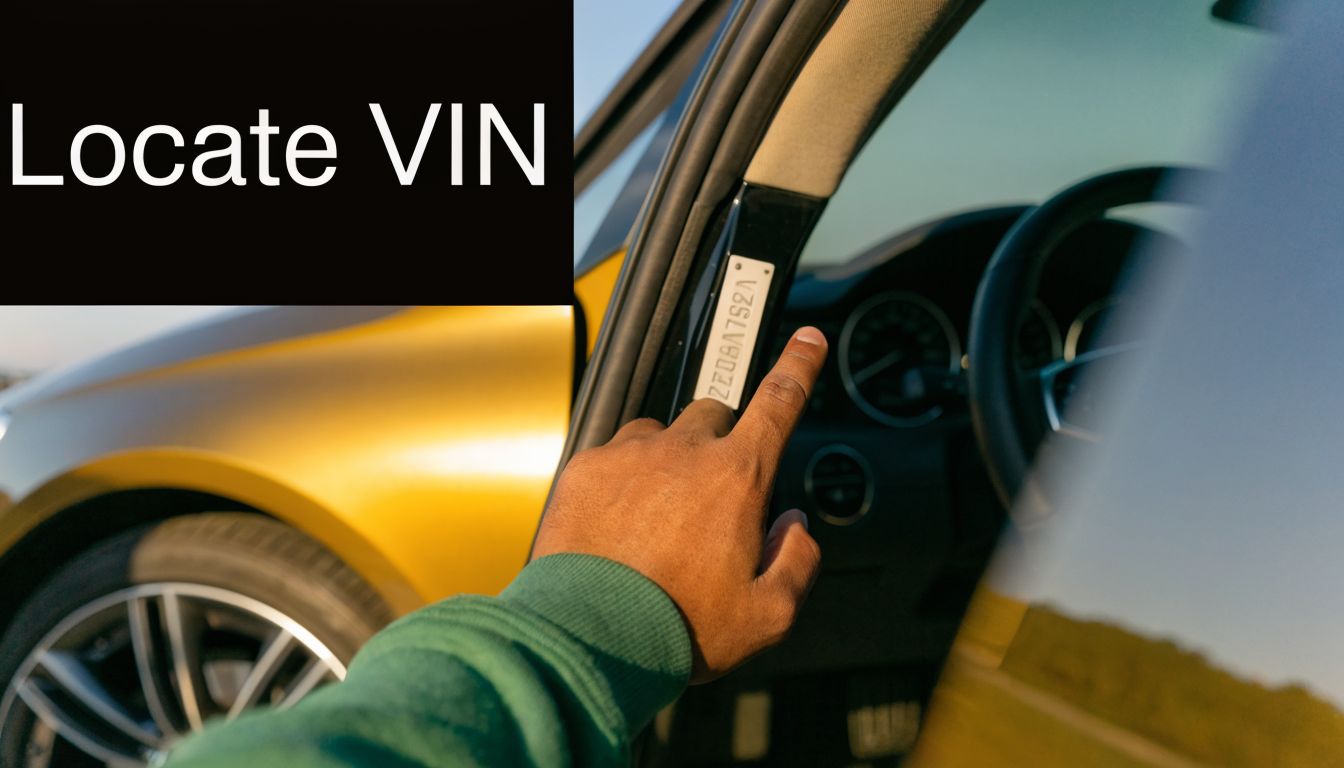
The first place to look is the driver’s side dashboard, visible through the windshield from outside the car. This is usually the fastest place to confirm the VIN during a walkaround. If the seller is rushing you, this is still one of the easiest checks you can do before you even open the door.
A second key location is the driver’s side door jamb sticker. Open the driver’s door and look for the manufacturer label. That sticker should match the dashboard VIN exactly, character for character.
The places that matter most
Check these locations before you order any report:
- Dashboard VIN plate: Best for a quick first look through the windshield.
- Door jamb label: Good for confirming the car still carries matching identification.
- Registration and title documents: These tell you whether the paperwork follows the actual vehicle.
- Engine bay or frame stamp: Some models also have stamped VIN locations under the hood or on structural sections.
Mercedes VIN decoding guidance notes that buyers should confirm the VIN across the dashboard, door jamb, registration, and frame locations because mismatches can reveal tampering, and forensic audits found mismatches in up to 15% of high-mileage used imports according to Adsit’s Mercedes VIN guide.
Practical rule: If the VIN on the glass, door sticker, and paperwork doesn’t match exactly, stop the deal until you know why.
What a mismatch can mean
Not every mismatch means a stolen car, but none of them are harmless. In the field, the most common explanations are sloppy paperwork, replaced body panels with the wrong labels, major repair history, VIN cloning, or theft-related fraud.
Use a basic sequence:
- Read the VIN from the dashboard
- Match it to the door jamb
- Match both to the title or registration
- Only then order the report
If you want a good primer on what should appear in a report once you have the VIN, this guide on how to check vehicle history is a useful next step.
A quick buyer scenario
A first-time buyer often checks the listing, copies the VIN from a photo, and orders a report before seeing the car. That works only if the listing is accurate. I’d rather verify the car in person first, because researching the wrong VIN gives you confidence in the wrong vehicle.
That single habit saves a lot of wasted time. It also keeps you from negotiating over a car whose identity you haven’t confirmed.
How to Decode a Mercedes-Benz VIN Manually
A Mercedes VIN isn’t random. It follows a fixed structure, and once you know how to read it, you can verify whether the car in front of you matches the seller’s description.
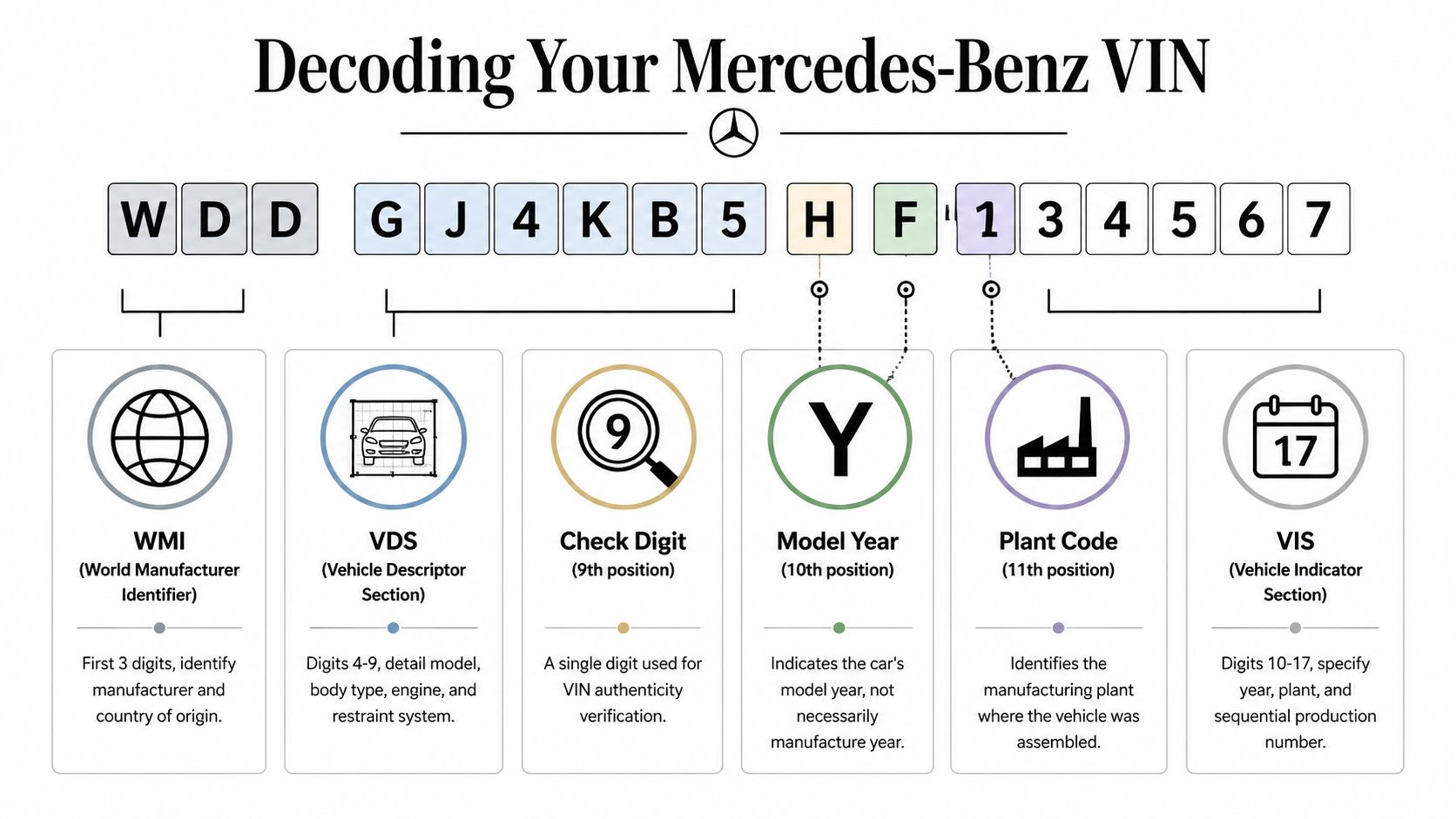
Mercedes-Benz VIN structure has been standardized since 1983. The first three characters are the World Manufacturer Identifier, where WDB denotes passenger cars from Germany, WDC is used for SUVs like the GLE and GLS, and 4JG identifies US-built models. Positions 4-8 make up the Vehicle Descriptor Section, which covers details such as body style and engine. Those details matter because the C-Class and E-Class together account for 35% of all Mercedes VIN checks, according to VINFound’s Mercedes-Benz VIN reference.
Start with the first three characters
The WMI tells you the manufacturer and build region. For a buyer, regional-spec claims then begin to be tested.
A few examples matter more than the rest:
- WDB: German-built Mercedes passenger cars
- WDC: Mercedes SUVs such as GLE or GLS
- 4JG: US-built Mercedes models
If a seller says the vehicle is a German-market car but the VIN starts with a US build code, you need to ask more questions. That doesn’t automatically make the car bad, but it does mean the story needs checking.
Read the middle of the VIN carefully
Characters 4 through 8 form the VDS. Here, Mercedes identifies model line, body style, restraint system, and engine-related specification.
This is the section buyers skip too often. They see AMG wheels, AMG floor mats, maybe even an AMG trunk badge, and assume the car is what the badge says it is. The VIN is where you verify whether that claim started at the factory.
Don’t let cosmetic upgrades rewrite the car’s identity. The VIN usually settles that argument quickly.
For common models, this matters a lot:
| VIN section | What it helps confirm | Why it matters |
|---|---|---|
| Positions 1-3 | Manufacturer and region | Verifies origin and market spec |
| Positions 4-8 | Model, body, engine-related details | Helps separate trims and identify rebadged cars |
| Position 9 | Check digit | Helps test VIN validity |
| Position 10 | Model year | Confirms the coded model year |
| Position 11 | Assembly plant | Useful for build verification and some recall checks |
| Positions 12-17 | Serial sequence | Identifies the individual vehicle |
The check digit and model year
The 9th character is the check digit. This is a mathematical control character used to validate whether the VIN itself is structurally believable. It’s not something you inspect by eye with full confidence, but if a decoder or report flags an invalid check digit, take it seriously.
The 10th character shows the model year. This is useful when a seller blurs the line between production year, registration year, and model year. Those aren’t always the same thing, and on luxury cars that difference can affect price.
The 11th character points to the assembly plant, and the final six characters identify that exact vehicle in sequence.
A real-world badge check
Say you’re looking at an E-Class advertised as an AMG variant. The trunk badge says one thing, but the VIN’s descriptor section points to a non-AMG engine and standard trim.
That doesn’t always mean fraud in a criminal sense. Sometimes an owner liked the look and added badges, wheels, and bumper parts. But from a buying standpoint, it still matters because you don’t want to pay AMG money for a cosmetic tribute car.
When buyers ask what manual decoding is good for, that’s the answer. It lets you challenge the sales pitch before you get emotionally attached.
If you want a broader look at how decoding fits into a smarter buying process, this explainer on what VIN decoding means in practice is worth reading.
Why a Full Vehicle History Report is Non-Negotiable
VIN decoding confirms factory identity. It does not tell you what happened after the car left the factory.
That gap is where expensive mistakes happen. A Mercedes can decode perfectly and still have prior collision damage, mileage inconsistencies, lien exposure, theft history, or open recall work that was never completed.
What decoding can’t tell you
A decoder answers questions like these:
- What model was this car built as?
- Where was it assembled?
- Which trim or engine family does the VIN point to?
A vehicle history report answers different questions:
- Was it written off or rebuilt?
- Did the odometer readings stay consistent?
- Is there a lien attached?
- Has it moved across borders with gaps in the record?
- Are there open recalls that still need attention?
Advanced Mercedes VIN checks rely on aggregated sources such as NMVTIS, lien data, and recall screening. That matters because the official Mercedes portal flags open recalls on up to 25% of 2015-2020 models, while 22% of cross-border sales show mileage discrepancies and 12% of Canadian private sales can hide liens without a PPSA search, according to this Mercedes VIN research summary from the MercedesClub forum reference.
Why buyers get tripped up
The mistake usually starts with a false sense of security. The car decodes correctly, the title looks clean, and the seller seems informed. That feels like progress, but it isn’t enough to support a purchase decision on its own.
A factory spec sheet tells you what the car started life as. A history report tells you what you’re actually buying.
For a first-time luxury buyer, caution is most critical. Mercedes parts, electronics, suspension systems, and body repairs can get expensive quickly. Saving a small amount by skipping the report can expose you to repair bills or legal issues that cost far more later.
If you want the broader buyer logic behind this step, read why vehicle history matters when you want to buy smarter and avoid risks.
Reading the Report Interpreting Key Red Flags
A vehicle history report only helps if you know what deserves attention. Most buyers scan for “no accidents” and stop there. That’s too shallow for a Mercedes, especially one that’s old enough to have changed hands several times.
Accident and damage history
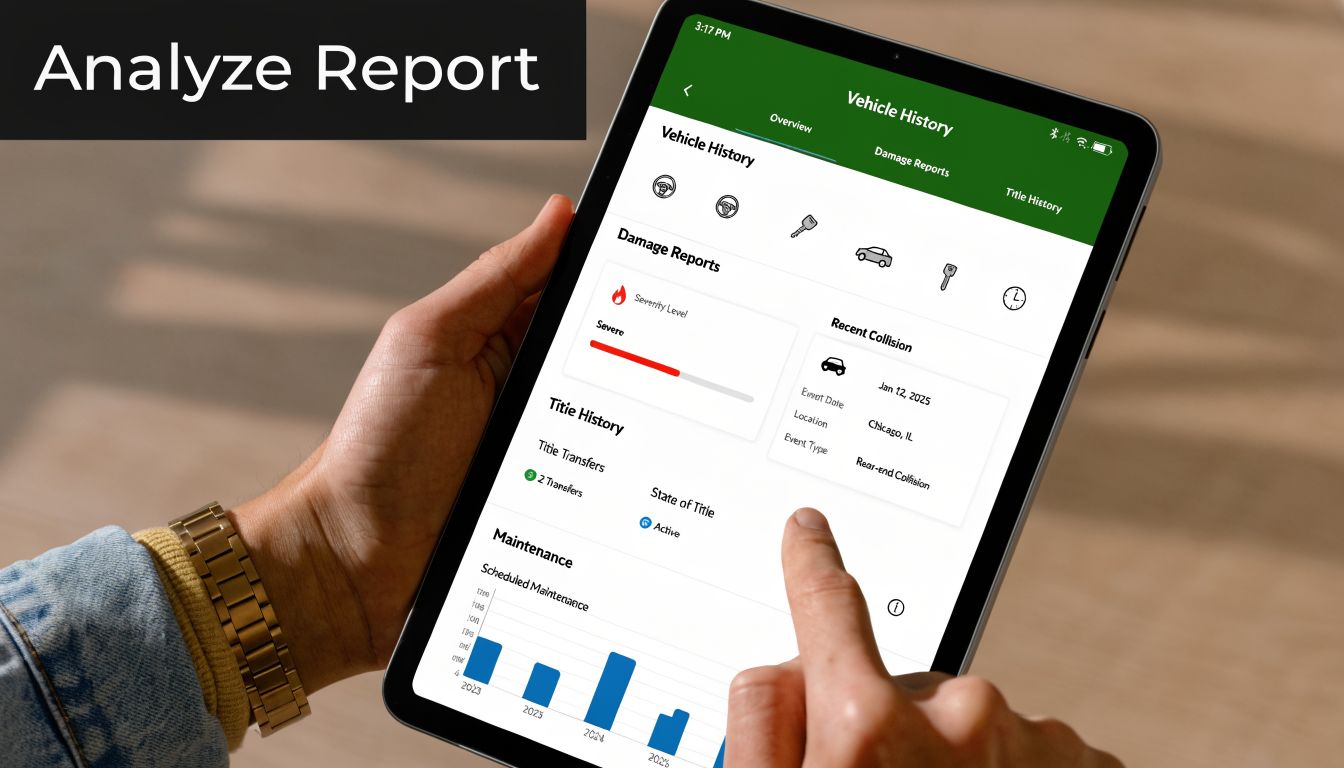
Not all damage entries carry the same weight. A minor cosmetic claim is different from structural damage, airbag deployment, flood exposure, or repeated collision records.
Read for patterns, not just labels. One isolated repair record with clean service afterward can be manageable. Multiple damage events, especially if they cluster tightly in time or involve front-end and suspension-related areas, deserve a closer inspection.
Look for these signals:
- Structural language: Terms like structural damage, frame damage, or severe impact need independent inspection before you go further.
- Repeated claims: Multiple entries can point to a hard-used vehicle or one that spent time in heavy traffic use.
- Airbag-related records: These raise the stakes because safety systems may have been deployed, replaced, or improperly repaired.
- Gaps after major damage: If the report shows a significant event and then little to no trace of follow-up servicing, ask for invoices.
A history report doesn’t replace a pre-purchase inspection. It tells you where the inspection needs to focus.
Odometer and mileage verification
This is the area free decoders miss most often. They’re good at factory options and weak at life-story problems.
A critical gap in most free Mercedes VIN decoders is mileage fraud detection. NMVTIS data from 2023 shows odometer fraud affects 2-8% of used vehicles, luxury brands face higher risk, and a 2024 CarFax analysis found 15% of sampled Mercedes C-Class vehicles had mileage discrepancies over 10,000 miles, according to MBTools’ summary of Mercedes VIN check blind spots.
What mileage fraud looks like on a report
You’re not just looking for the word “rollback.” Many reports flag softer warning signs first.
Use this checklist:
- Mileage drops between entries: If one record shows higher mileage and a later one shows less, treat it as a major red flag.
- Long ownership periods with little mileage movement: Sometimes that’s normal. Often it needs explanation.
- Service records that don’t align with the odometer trend: A report might show maintenance timing that feels inconsistent with the claimed use.
- Auction records that conflict with retail records: These can expose hidden jumps or missing periods.
If the miles don’t rise in a believable line over time, the burden shifts to the seller to prove the odometer is right.
On Mercedes models, inflated resale values create more incentive for mileage manipulation than on ordinary commuter cars. That’s one reason buyers should read every dated entry in sequence instead of trusting the summary line.
Title brands and lien status
A clean title is helpful, not conclusive. It means the title itself doesn’t carry a major recorded brand in that jurisdiction. It doesn’t guarantee an accident-free or trouble-free car.
The title section matters most when you see words like these:
| Title term | What it means for a buyer | Typical response |
|---|---|---|
| Salvage | Insurer or authority considered the vehicle a major loss | Usually walk away unless you understand the rebuild completely |
| Rebuilt | Salvage vehicle returned to the road after repairs | Inspect aggressively and price it accordingly |
| Flood | Water exposure risk | Usually avoid due to electrical and corrosion issues |
| Theft recovery | Vehicle was reported stolen and later recovered | Verify damage, missing parts, and title treatment |
| Lien record | A lender may still have a legal claim | Confirm release before any payment changes hands |
Liens create a different kind of risk. Even if the car drives perfectly, unresolved financial claims can become your problem if ownership transfer isn’t handled properly.
For buyers comparing report providers, clarity matters as much as data depth. Some reports bury title and lien warnings deep in the file. Others surface them immediately. If you’re evaluating options, this Carfax comparison page helps frame what to look for in report presentation and decision support.
Recalls and service history
Open recalls aren’t cosmetic admin issues. They can involve airbags, software, fuel systems, braking, or other safety-relevant systems. If the report shows an open recall, the next question is whether a Mercedes dealer can confirm the remedy is still outstanding and available.
Service history is useful for a different reason. It helps you judge whether the car was cared for consistently or only patched up before sale.
A practical reading order works well here:
- Check for open recalls first
- Scan service intervals for consistency
- Compare the service timeline to the mileage timeline
- Look for abrupt gaps near ownership changes or auction events
The best reports make this easier by grouping risk areas instead of forcing you to hunt line by line. That’s especially helpful when you’re comparing several similar cars and trying to decide which one deserves an inspection deposit.
Making a Purchase Decision with Advanced Tools
At some point, you stop researching and start choosing. That’s where many buyers get stuck. Two Mercedes listings can both look clean enough on the surface, yet one is plainly the safer buy once you line up the risk factors side by side.
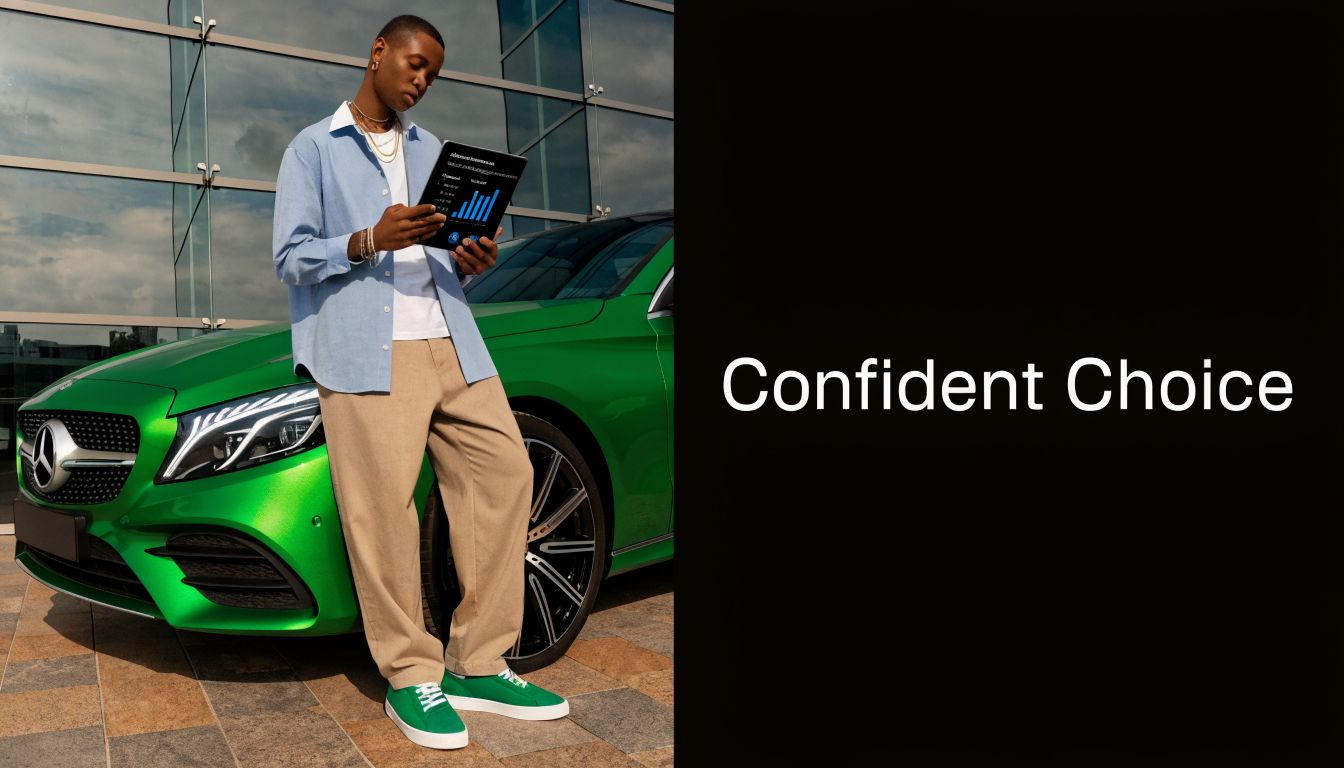
Turn raw data into a decision
A good report gives detail. A better buying tool also gives interpretation.
That’s where a Risk Score helps. Instead of forcing you to weigh every title note, mileage issue, accident entry, and recall item from scratch, a score gives you an at-a-glance way to sort cars into lower-risk and higher-risk choices. It doesn’t replace judgment, but it improves triage.
This matters even more for international and cross-border inventory. Recall and service campaign data remain an underserved area for Mercedes buyers, especially outside recent US models. NHTSA logged 1.2 million Mercedes recalls between late 2024 and early 2026, and EU RAPEX added 18 Mercedes safety alerts in 2025. Canadian buyers also face 25% higher recall non-compliance in cross-border sales, according to Mercedes-Benz vehicle information referenced through MBUSA.
A side-by-side comparison works better than memory
If you’re deciding between two E-Class sedans, don’t compare them from notes in your phone. Put them side by side and force the differences into view.
One may have:
- cleaner mileage progression
- fewer ownership changes
- no title complications
- better recall clarity
- stronger service continuity
The other may still be attractive, but the safer car usually becomes obvious once those details sit next to each other.
What advanced comparison is actually good for
A comparison tool helps most when the cars are close in age, trim, and asking price. That’s the point where buyers get distracted by paint color, wheel design, or one extra option package and miss the fact that one vehicle carries materially more risk.
For dealers, this same process helps with presentation. Teams that want to improve how they explain inventory online can also borrow ideas from broader automotive digital marketing strategies that focus on clearer buyer communication and trust-building. The useful takeaway isn’t marketing hype. It’s that buyers respond better when complex vehicle information is made easier to compare.
If you’re down to two or three candidates, use a report platform that supports direct comparison and plain-language risk signals. It saves time, sharpens negotiation, and makes it easier to walk away from the wrong car.
Common Mercedes VIN Check Mistakes to Avoid
The expensive mistakes aren’t usually dramatic. They’re small shortcuts that feel harmless at the time.
Mistake one: trusting a decoder as if it were a history report
A decoder confirms factory identity. It doesn’t uncover the car’s life after delivery. Buyers who stop at trim and equipment data often miss the parts that matter most in a used purchase.
The better move is simple. Decode first, then verify the history separately.
Mistake two: treating minor damage as no big deal
“Minor” on a report can still lead to expensive follow-up problems. Paintwork, panel replacement, suspension alignment issues, water intrusion, and sensor calibration problems don’t always announce themselves clearly in a listing.
Ask what was repaired, where it was repaired, and whether invoices exist. If the answers stay vague, let the inspection do the talking.
Mistake three: assuming a clean title means a clean car
A clean title is not a full character reference. Cars can carry poor repairs, unreported accidents, and neglected maintenance while still showing a clean title.
A clean title lowers one category of risk. It doesn’t erase the others.
Mistake four: failing to match the VIN on the car to the paperwork
This is the most avoidable error. Buyers get excited, run the report from the ad, and then never check whether the actual vehicle matches that number.
Use the dashboard, door jamb, and documents every time. If one digit is off, pause everything.
Mistake five: ignoring open recalls
Some buyers think recalls are just dealer admin work. They aren’t. Open recalls can involve serious safety issues, and they also tell you whether the current owner kept up with manufacturer service actions.
A short final checklist helps:
- Match the physical VIN first
- Decode the VIN to confirm model identity
- Pull a full history report
- Read mileage entries in sequence
- Check title, lien, theft, and recall sections
- Use a pre-purchase inspection before money changes hands
That process isn’t overkill. It’s how you avoid buying the wrong Mercedes for the right-looking price.
Frequently Asked Questions About Mercedes VIN Checks
How do I run a VIN check on a classic Mercedes from before 1981
Pre-1981 Mercedes models don’t always follow the modern standardized 17-character format, so you may not get the same clean decoding experience you’d expect on later cars. That means you’ll often rely more on chassis numbers, model-specific records, specialist forums, marque experts, and factory documentation rather than modern consumer VIN tools.
For Mercedes produced after the standard era began, VINs can also reveal useful production context. Examples cited in decoder records include the 1995 E420 (WDBEA34E7SC172732) associated with the shift to OBD-I diagnostics and the 2003 E220 CDI (WDB2110061A369854) associated with early BlueTEC-related development, as noted by LastVIN’s Mercedes VIN examples. For older classics, expect more manual verification and less plug-and-play reporting.
Are there differences when checking a Mercedes imported from Canada or the USA
Yes. Cross-border cars often create record gaps, unit differences, and branding confusion. You may see odometer history in different measurement systems, auction or registration gaps, or recall compliance issues that don’t show up cleanly in a single domestic database.
If you’re shopping across borders, use a report provider with coverage for both markets and check the relevant lookup path for your jurisdiction. These pages on VIN check Canada and VIN check USA are the right starting points.
One practical clue also helps. In the US market, which accounts for about 300,000 units annually, Mercedes VINs starting with 4JG identify Tuscaloosa-built vehicles. That can help you verify assembly claims on certain US-market SUVs, as covered in the earlier production examples.
Can a dealer or private seller refuse to provide the VIN
They can, but you shouldn’t continue. A seller who won’t share the VIN before serious negotiation is asking you to accept risk blindly.
There are legitimate reasons a seller might hide part of a VIN in a public ad photo. There is no good reason to refuse the full VIN once you’re a real buyer. If they won’t provide it, move on to another car.
A Mercedes is rarely hard to find. A transparent seller can be.
If you want to move from basic decoding to a purchase decision with less guesswork, VekTracer gives you detailed vehicle history reports, mileage verification, title and lien checks, recall alerts, and a clear Risk Score that helps you judge whether a Mercedes is worth pursuing. It’s a practical next step when you’re comparing listings and want more than a factory spec sheet.
Ready to check a vehicle?
Enter any 17-character VIN for a free instant preview — no account needed.