License Plate Lookup Texas: What Works in 2026
Check a vehicle before you buy
Enter a VIN for a free instant preview — accidents, title brands, mileage, liens & open recalls.
You're standing on a Houston used-car lot with only a Texas license plate in front of you. The seller's paperwork is missing, the VIN isn't visible, and you want to know whether the vehicle is worth pursuing. A license plate lookup in Texas can help narrow the vehicle to a record, but it won't legally hand you the registered owner's name or address. Treat the plate as a triage tool, then move to the VIN for title brands, odometer history, accidents, theft records, liens, and auction history.
Table of Contents
- Starting With Just a Texas Plate
- How Big the Texas Plate Problem Actually Is
- What the Texas DMV Will and Will Not Release
- Why a Plate Search Cannot Identify the Owner
- Free Lookups Versus Paid History Reports
- From Plate to VIN and a Real History Check
- Picking the Right Lookup Path for Your Situation
Starting With Just a Texas Plate
Start by recording the plate exactly as it appears. Check every letter and number, note that Texas is the issuing state, and compare the plate with the vehicle in front of you. A wrong character or missing state can produce no match or connect you to the wrong vehicle.
That first search can answer a limited but useful question: does the plate correspond to a Texas-registered vehicle record, and does the returned vehicle information fit what you're inspecting? It may help confirm the make, model, model year, body style, and registration status, depending on the channel and source. It cannot confirm that the person standing beside the car is the registered owner.
Practical rule: A plate can point you toward the vehicle record. It isn't a legal shortcut to someone's private information.
Texas protects personally identifying motor-vehicle information under the federal Driver's Privacy Protection Act and state disclosure rules. The Texas DMV privacy and license-plate lookup rules matter because many commercial pages imply that a plate alone reveals an owner. That promise doesn't match the disclosure framework.
Your next move depends on your purpose:
- Shopping for a used vehicle: Use the plate to help locate the VIN, then run a VIN-based history report.
- Checking a title or lien: Use the official TxDMV request process when you have a qualifying reason or formal transaction.
- Investigating a crash or abandoned vehicle: Contact law enforcement, your insurer, or TxDMV rather than relying on a consumer search page.
- Checking a salvage or auction vehicle: Prioritize title brands, odometer readings, damage records, and auction documentation tied to the VIN.
The plate gets you started. The VIN is what supports a serious buying decision.
How Big the Texas Plate Problem Actually Is
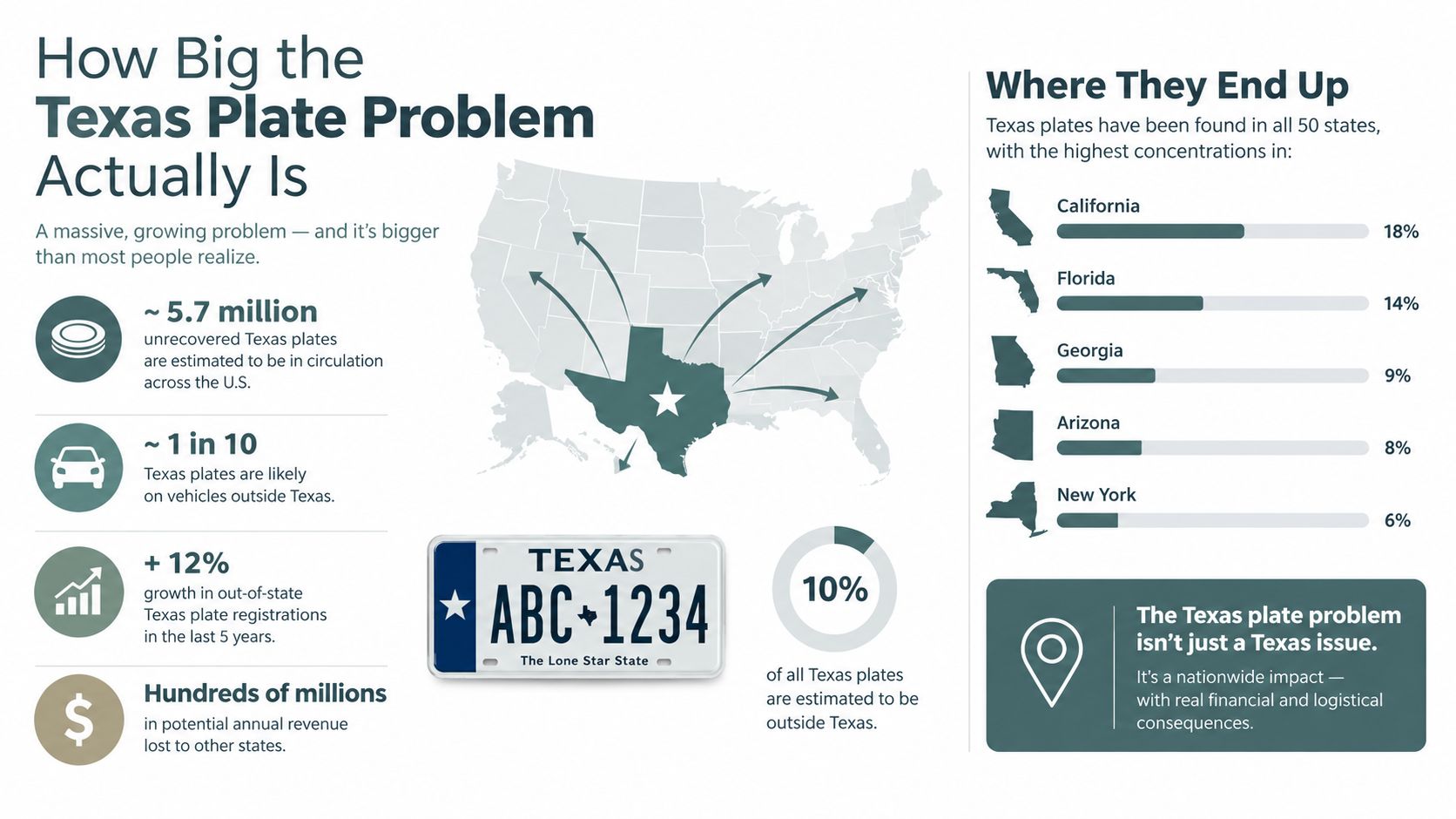
A Texas plate search reaches into a registry measured in tens of millions of vehicles. The Texas Department of Motor Vehicles reported 25,904,676 registered vehicles in FY 2023, compared with 25,640,919 as of August 31, 2022, and 26.9 million as of August 31, 2025, according to its vehicle-registration fact sheet. That scale makes a plate string weak evidence without state context. The same sequence may exist elsewhere, appear on a specialty plate, or remain tied to a vehicle after registration details change.
The registry also runs through constant administrative activity. In FY 2023, TxDMV mailed 23,949,846 registration renewal notices, registered 6,038,291 vehicles online across 254 counties, and reported an average 2-day turnaround time for updating vehicle-registration record files. These figures, documented in the same FY 2023 fact sheet, describe a high-volume system, not a small public directory built for casual owner searches.
Texas manufactured 11,384,088 license plates in FY 2023, including 1,161,344 special plates and 283,362 personalized plates registered that year, according to the official fact sheet. Plate matching therefore requires attention to plate type, registration timing, and the issuing state. A plate alone is a triage tool. It helps narrow the vehicle record, but it does not identify the owner or establish a vehicle's history.
Treat an instant owner name from a supposedly free page as a warning sign. Texas uses controlled records access, while third-party databases can be incomplete, outdated, or built from recycled information. Use a free result only as a lead. Verify the vehicle, obtain the VIN, and base any serious history decision on VIN-linked records.
What the Texas DMV Will and Will Not Release
Texas offers formal routes for requesting vehicle information, but none functions like an unrestricted public owner search. The available paths include contacting TxDMV, visiting a Regional Service Center, or submitting Request for Texas Motor Vehicle Information, Form VTR-275. The right route depends on whether you need basic vehicle confirmation or records connected to a lawful, documented purpose.
A phone call or in-person inquiry may help confirm whether a plate is associated with a Texas vehicle record and may provide vehicle-level details such as make, model, year, body style, and registration information. It doesn't turn the plate into a public identity key. Form VTR-275 is the formal option for eligible requests involving records such as title or lien information, subject to the request's purpose, supporting material, and applicable access rules.
The privacy boundary is the part buyers most often misunderstand. A casual requester generally won't receive the registered owner's name, home address, phone number, email address, or driver license number. The Texas license-plate records overview explains why consumer-style searches shouldn't be treated as a lawful method for identifying a private individual.
| Channel | Plate Confirmed | Make/Model/Year | Registration Status | Owner Name | Owner Address |
|---|---|---|---|---|---|
| TxDMV phone inquiry | Potentially, subject to agency process | Vehicle-level details may be available | Limited, depending on request | Not released to casual requesters | Not released to casual requesters |
| Regional Service Center | Potentially, subject to agency process | Vehicle-level details may be available | Limited, depending on request | Not released to casual requesters | Not released to casual requesters |
| Form VTR-275 | Yes, when the request qualifies and records match | Vehicle and title information may be available | Title or lien information may be available for eligible requests | Restricted unless a permissible use applies | Restricted unless a permissible use applies |
Before submitting a request, gather the exact plate, issuing state, vehicle information, your reason for requesting records, and any documents that support that purpose. Don't assume that paying a fee guarantees a complete file, and don't assume an official request replaces a VIN history check. TxDMV records and commercial reports serve different purposes.
Why a Plate Search Cannot Identify the Owner
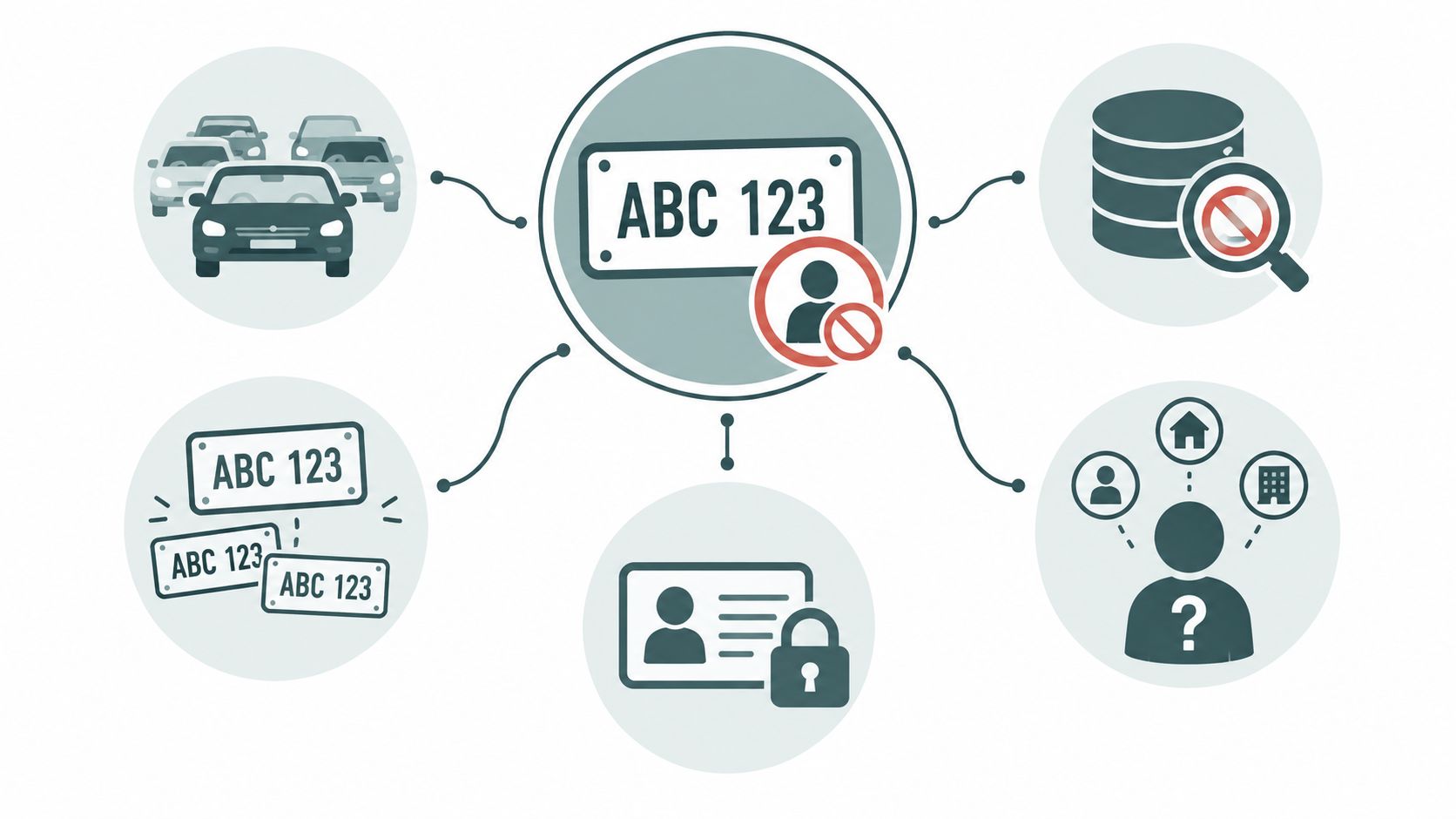
A license plate is attached to a vehicle record, not a person's public identity. Seeing a plate on a truck tells you what's displayed on the vehicle. It doesn't authorize you to obtain the owner's private DMV information.
The Driver's Privacy Protection Act limits disclosure of personal information from motor-vehicle records to defined permissible uses. Texas Transportation Code Chapter 730 applies the same basic principle to state motor-vehicle information. Law enforcement work, insurance claims, licensed private-investigator activity, and court-related requests can create legitimate pathways, but a buyer's curiosity or a seller's marketing dispute generally doesn't qualify by itself.
That distinction matters after a hit-and-run, when someone finds an abandoned vehicle, or when a private-party seller seems suspicious. A consumer search page that claims to reveal a name may be displaying data from another source, outdated information, or an unsupported result. It doesn't override the DPPA or compel TxDMV to disclose protected data.
What you can reasonably expect
For a normal used-car investigation, focus on vehicle-level questions:
- Does the plate match the vehicle in front of you?
- Is Texas the issuing state?
- Does the returned make, model, and year fit the seller's description?
- Can the seller provide the VIN and title documents?
- Does the VIN produce consistent title, mileage, damage, and theft information?
Owner identity is a separate legal issue. If you have a qualifying insurance, legal, or law-enforcement purpose, document it and use the appropriate official channel. Otherwise, stop trying to turn the plate into an owner search and move to the VIN.
A plate narrows the vehicle. The VIN supports the history.
Free Lookups Versus Paid History Reports
Free plate pages and paid VIN reports answer different questions. A free or informal plate lookup can provide a quick sanity check, but it may rely on incomplete databases, recycled plate information, or a sales funnel that withholds useful details until payment. It isn't a substitute for a title search or vehicle-history report.
Paid consumer reports from services such as Carfax or AutoCheck generally work best from the VIN. They may expose title events, odometer entries, accident information, and registration history when those records are available. They still won't guarantee every incident, lien, owner, or repair appears, because reporting depends on the source and the event being recorded.
Dealer-grade and NMVTIS-oriented sources can add another layer, particularly for salvage buyers and independent dealers comparing vehicles across states. Look for title-brand information, theft records, auction history, photographs, and a clear explanation of the source coverage. NMVTIS consumer guidance says records can include junk, salvage, and flood brands, insurer or self-insurer total-loss determinations, and transfers to recyclers, junk yards, or salvage yards in the official NMVTIS consumer information.
| Source Type | Shows Owner Name | Title Brands | Accident Records | Auction Photos | Typical Cost |
|---|---|---|---|---|---|
| Free plate lookup page | No reliable consumer access | Usually limited or unclear | Usually limited or unclear | Rarely available | Free or unclear |
| Paid consumer VIN report | No | Often available when reported | May be available when reported | Provider-dependent | Paid, amount varies |
| Dealer-grade or NMVTIS-oriented source | No casual owner disclosure | Central feature when reported | Broader source coverage may be available | May be available | Paid, amount varies |
For Texas purchase decisions, use free tools to check whether the vehicle description makes sense. Then ask the seller for the VIN and compare the report with the title, dashboard VIN, door-jamb label, and vehicle condition. A free Texas VIN check can be a useful starting point before you decide whether a broader paid report is justified.
From Plate to VIN and a Real History Check
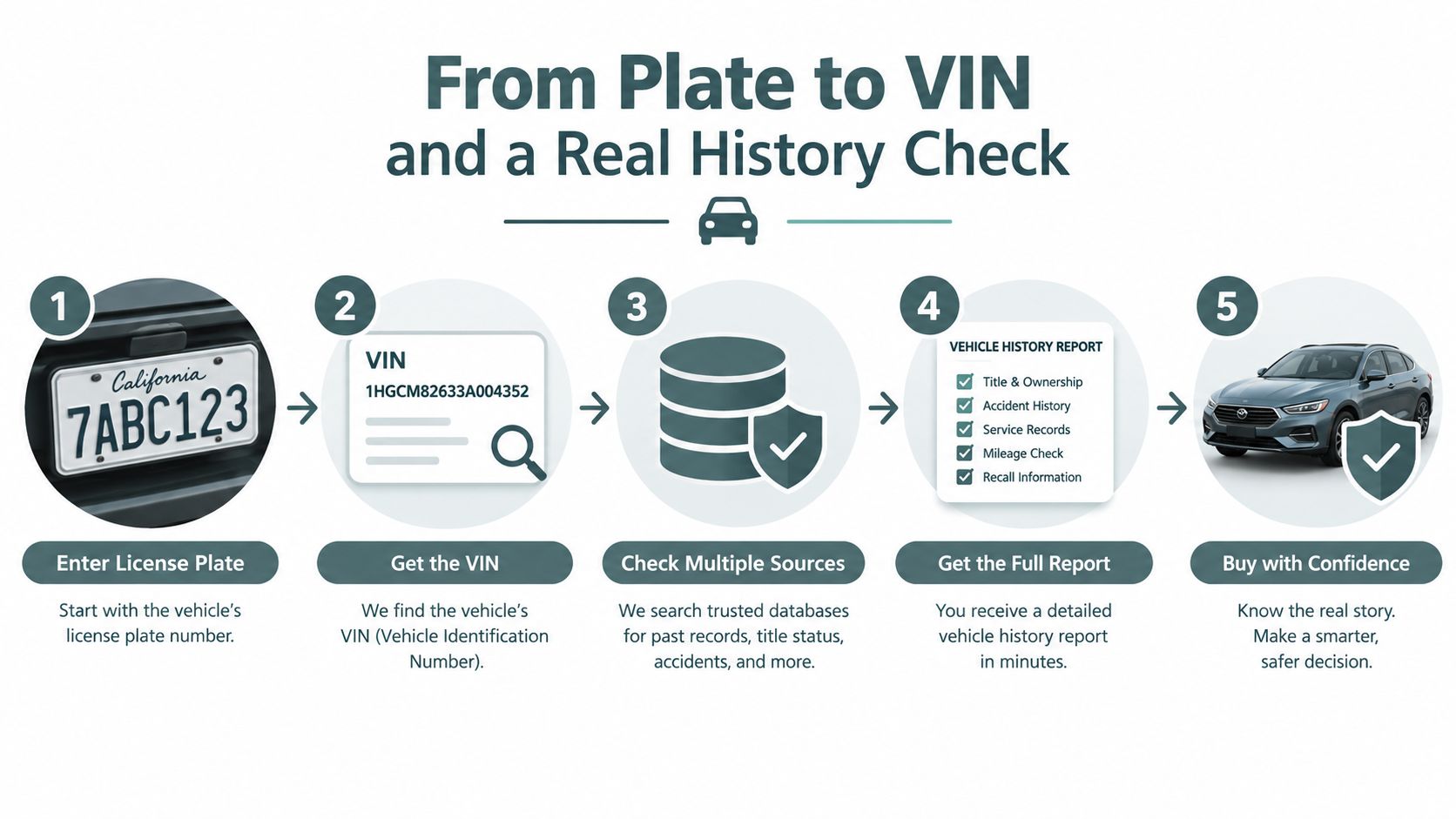
The plate-to-VIN handoff is where a weak lead becomes useful due diligence. Texas plate-to-VIN systems work best when you provide the exact plate and identify Texas as the issuing state. Without the state, a matching string can point to the wrong jurisdiction or fail to produce a result.
Follow the vehicle, not the marketing claim
Capture the plate carefully. Read it from the vehicle, record every character, and note any specialty or personalized design. Don't rely on a blurry photograph or a seller's typed message.
Find the VIN on the vehicle. Check the dashboard at the driver-side corner, the driver-side door-jamb label, insurance paperwork, and title documents. Compare the physical VIN with every document before paying a deposit.
Decode the 17-character VIN. A free NHTSA VIN decoder can help confirm factory attributes such as model year, make, model, engine, and manufacturing plant. A mismatch can indicate a paperwork error, a swapped component, a cloned identity, or a vehicle description that doesn't match the factory record.
Run a VIN-based history check. Compare title brands, odometer readings, ownership transfers, accident entries, theft records, and auction history where available. For salvage and auction vehicles, pay particular attention to salvage, rebuilt, flood, junk, and other branded-title events.
Use an official request when the transaction requires it. TxDMV's Form VTR-275 process may be appropriate for eligible title or lien-record requests. Follow the agency's requirements instead of treating a commercial report as an official title certificate.
The key point is that a VIN report can reveal history that a plate alone can't establish. A plate may connect you to a current vehicle profile, while the VIN lets multiple records be reconciled across jurisdictions and reporting systems.
Read brands as permanent warning signals
NMVTIS treats title brands as records that follow the vehicle through future titles. A later clean-looking title doesn't erase an earlier salvage, junk, or flood brand. The NMVTIS title-brand best-practice document explains the permanence of those brands.
Use the plate-to-VIN lookup workflow as a practical sequence, not as permission to skip verification. If the VIN is missing, altered, unreadable, or inconsistent across the car and paperwork, pause the transaction and resolve that problem first.
Picking the Right Lookup Path for Your Situation
Choose the lookup method based on the decision you're making, not just the information you currently have. A plate-only page is reasonable for initial triage. It's the wrong tool for proving ownership, clearing a lien, or evaluating a rebuilt vehicle.
| Scenario | Best Path | What You Get | What You Do Not Get |
|---|---|---|---|
| You're considering a private-party purchase | Obtain the VIN and run a history report | Vehicle history, title events, mileage, and reported damage | A guarantee that every event appears |
| You own the Texas-titled vehicle and need title or lien information | Follow the TxDMV formal request process, including Form VTR-275 when appropriate | Official records available to an eligible requester | Automatic access to protected personal information |
| You suspect salvage, flood, or junk history | Use a VIN report with NMVTIS-related title data | Brand and disposition records when reported | Proof that unreported repairs never occurred |
| You're checking a plate after a crash or suspected crime | Contact your insurer or law enforcement | A lawful investigation pathway | Instant public owner identification |
| You're an independent dealer screening inventory | Use VIN-based history tools and retain the supporting documents | Repeatable vehicle-risk triage across records | Complete certainty on every vehicle |
For a title or lien question, keep the request tied to the actual vehicle and transaction. For a purchase decision, ask the seller for the VIN before negotiating seriously, inspect the title and labels, and compare the report against the car. For auction and salvage inventory, review branded-title events and disposition records before estimating repair costs or resale value.
Vektracer accepts a Texas plate or VIN and can compile available accident, title-brand, mileage, theft, ownership, recall, service, and auction information into a structured vehicle-history report. It's a commercial research option, not a TxDMV replacement, so use the official process when you need an authoritative state record.
Keep copies of the seller's listing, title images, VIN photographs, plate notes, and reports. If the seller disputes a history entry, you'll have a clear record of what you checked and when.
Enter the Texas plate or VIN at Vektracer to see whether the available vehicle history supports the seller's story. If the result shows a title brand, mileage inconsistency, accident record, theft flag, or auction history, pause the purchase and verify the issue before paying.
Ready to check a vehicle?
Enter any 17-character VIN for a free instant preview — no account needed.