License Plate Lookup Privacy Laws Guide
Check a vehicle before you buy
Enter a VIN for a free instant preview — accidents, title brands, mileage, liens & open recalls.
You're looking at a used car in an online auction, or you've spotted one parked nearby, and the license plate seems like the easiest way to learn who owns it. Under license plate lookup privacy laws, that assumption is wrong. In the United States, a plate can help identify vehicle-related information, but a casual search generally can't lawfully reveal the registered owner's name, address, phone number, or similar personal details. Lawful due diligence focuses on the vehicle's title, brands, damage, mileage, theft status, recalls, and available history, not on exposing the person behind the plate.
Table of Contents
- The Legal Reality Behind Plate Searches
- Federal Baseline and the Driver's Privacy Protection Act
- State-Level Variations and Automated Reader Limits
- How Compliant Vehicle History Reports Are Built
- The Shift Toward Data Broker Regulation and Retention
- Protecting Your Privacy and Verifying Vehicle History
- Common Misconceptions About Plate Lookups
The Legal Reality Behind Plate Searches
A private-party buyer may see a promising car, copy its plate, and search online hoping to confirm the seller's story. An independent dealer might receive a trade-in and want to connect the plate to a previous owner. In both situations, the plate feels like a public identifier, but the legal treatment changes once the search attempts to connect that identifier to a person.
The practical distinction is straightforward:
- Vehicle facts: Make, model, model year, VIN-related history, title brands, salvage information, auction records, reported mileage, theft records, and certain recall information may be available through lawful vehicle-history sources.
- Personal identity data: The registered owner's name, home address, phone number, and comparable DMV-held details are protected information unless a recognized legal exception applies.
A plate can function as an index to a vehicle's history without becoming a lawful shortcut to the owner's identity. That boundary protects both consumers and businesses from turning an ordinary vehicle search into unwanted surveillance or personal-data exposure.
Why the plate-to-person link matters
The number printed on a plate isn't usually the central privacy problem. The risk arises when someone uses it to retrieve or infer a person's identity and location. A service that advertises a secret owner database, promises a home address, or offers a name from a plate should be treated cautiously. It may be inaccurate, unlawful, or both.
For legitimate vehicle research, a VIN is usually the stronger identifier because it follows the vehicle through title, insurance, auction, service, and other records without requiring disclosure of the current owner's identity. A plate lookup can still help locate the right vehicle record, but the useful output should remain focused on the vehicle.
Businesses handling plate data should also document why they're accessing it, what information they return, and how long they retain it. Resources such as BatchData vehicle data access can help technical teams think through plate-based workflows, but access design doesn't override privacy law.
Practical rule: If the requested result is a person's name or address, stop treating the task as a vehicle-history search and evaluate whether a specific legal purpose exists.
For buyers, the lawful alternative is to ask the seller for the VIN, compare the VIN on the vehicle with the title and listing, and order a history report that focuses on the car's condition and legal status. For owners, the safest assumption is that a plate may be visible in public, but DMV-held personal information still isn't open for casual retrieval.
Federal Baseline and the Driver's Privacy Protection Act
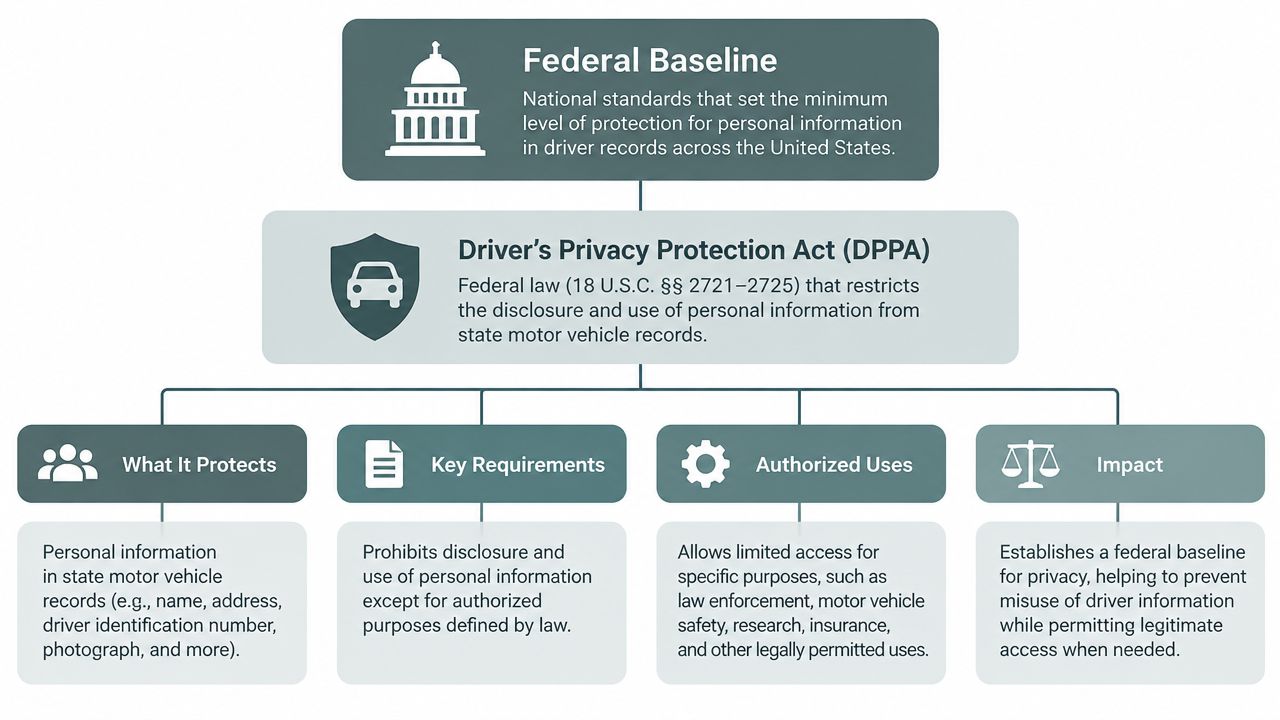
A buyer may have a legitimate reason to check a plate, yet that purpose does not create a right to the registered owner's identity. The federal starting point is the Driver's Privacy Protection Act, or DPPA. Enacted in 1994, it established a nationwide baseline for personal information held in state motor-vehicle records. Those records can connect a plate or VIN with a registered owner, so the law restricts disclosure except for defined purposes. Legal Clarity's DPPA summary outlines the general restriction, permitted exceptions, and civil consequences for improper access.
The DPPA does not block every vehicle-related fact. It distinguishes vehicle information suitable for lawful reporting from protected identity data. A compliant report may show a title brand, salvage status, auction history, mileage entries, or other available vehicle history, while withholding the owner's name, address, phone number, and comparable identifiers. That separation is the practical boundary between a vehicle-history product and a secret owner-search service.
The permissible-use framework
The DPPA recognizes 14 permitted exceptions to its general disclosure ban. They include defined uses connected with law enforcement, insurance claims, litigation, motor-vehicle safety, fraud prevention, and other legally recognized purposes.
An online form cannot turn a convenient explanation into a qualifying purpose. A business needs a genuine legal basis, suitable authorization, and controls that prevent staff or customers from using protected data for unrelated searches. A dealer reviewing a vehicle's title condition is not automatically entitled to the registered owner's personal record. An insurer handling a claim may have a different basis, but the access must remain tied to that claim and its authorized purpose.
Penalties change the business calculation
Improper access can trigger a civil penalty of at least $2,500 per violation. That risk affects independent dealers, lead providers, data aggregators, and software teams considering a plate-to-owner feature. A privacy notice alone does not make that workflow lawful.
A workable control framework should include:
- Purpose validation, documenting why protected data is requested.
- Authorization checks, particularly for insurance, legal, or government users.
- Role-based access, keeping ordinary shoppers away from DMV-derived identity data.
- Search logging, recording the user, purpose, and records accessed.
- Data separation, keeping vehicle facts apart from protected identity records.
- Retention controls, deleting data after the authorized purpose ends.
For buyers, the DPPA explains why lawful vehicle-history platforms can provide useful research without identifying an owner. VIN-based title and vehicle records can support a purchase decision while preserving the boundary around personal identity. Buyers who need context on official title data can review what buyers should know about NMVTIS car history reports.
State-Level Variations and Automated Reader Limits
The federal DPPA sets the baseline for personal data, while state law often governs what happens after a plate is captured by an automated license plate reader, or ALPR. An ALPR can record a plate as a vehicle passes a camera, then store, search, share, or combine that observation with other information. That creates a different privacy issue from a buyer checking a vehicle for a lawful transaction.
State rules increasingly address retention limits, purpose restrictions, and sharing controls. The requirements differ, so a dealer, vendor, or vehicle-history provider operating across state lines needs source-specific controls rather than one uniform process.
| State | Retention Limit | Key Privacy Restriction |
|---|---|---|
| California | 60 days for California Highway Patrol ALPR data unless used as felony evidence, under the 2011 rule | In 2015, California defined ALPR-collected information as personal information and restricted public-agency sale or sharing except to another public agency |
| Florida | The verified material doesn't specify a general day limit | A 2014 law made ALPR images and data confidential, with disclosure allowed to criminal-justice agencies and, in some cases, the registered owner |
| Maine | 21 days | A 2009 rule limited ALPR data storage to 21 days |
These state milestones appear in the National Conference of State Legislatures overview of ALPR statutes. Retention deserves the same review as initial collection. A system may collect a plate for a defined purpose, then create a separate compliance problem by keeping the record indefinitely or sharing it beyond the permitted group.
Manual lookups versus scaled surveillance
A one-time buyer search and a continuously searchable ALPR database involve different privacy risks. A buyer typically seeks vehicle facts relevant to a transaction. A searchable ALPR system can create a historical record of where a vehicle appeared, depending on what the cameras capture and how the agency or vendor controls access.
Operators should document five questions:
- Storage: How long are raw plate observations retained?
- Searchability: Can users review only a known incident, or browse historical movements?
- Sharing: Can another agency, vendor, or commercial partner access the records?
- Purpose: Is use limited to the original public-safety reason?
- Auditability: Are searches recorded and reviewed?
California's rules illustrate the move toward treating ALPR information as privacy-sensitive rather than ordinary public data. Florida uses confidentiality restrictions, while Maine uses a shorter retention standard. Each approach limits casual access and later reuse through a different legal mechanism.
A dealer or vehicle-history provider should map where each data source was collected, where it is stored, and which users can retrieve it. The customer's location does not erase obligations tied to the collection site or storage location. For lawful vehicle research, the safer design separates public vehicle facts from protected owner identity and avoids turning a plate search into a searchable movement history.
How Compliant Vehicle History Reports Are Built
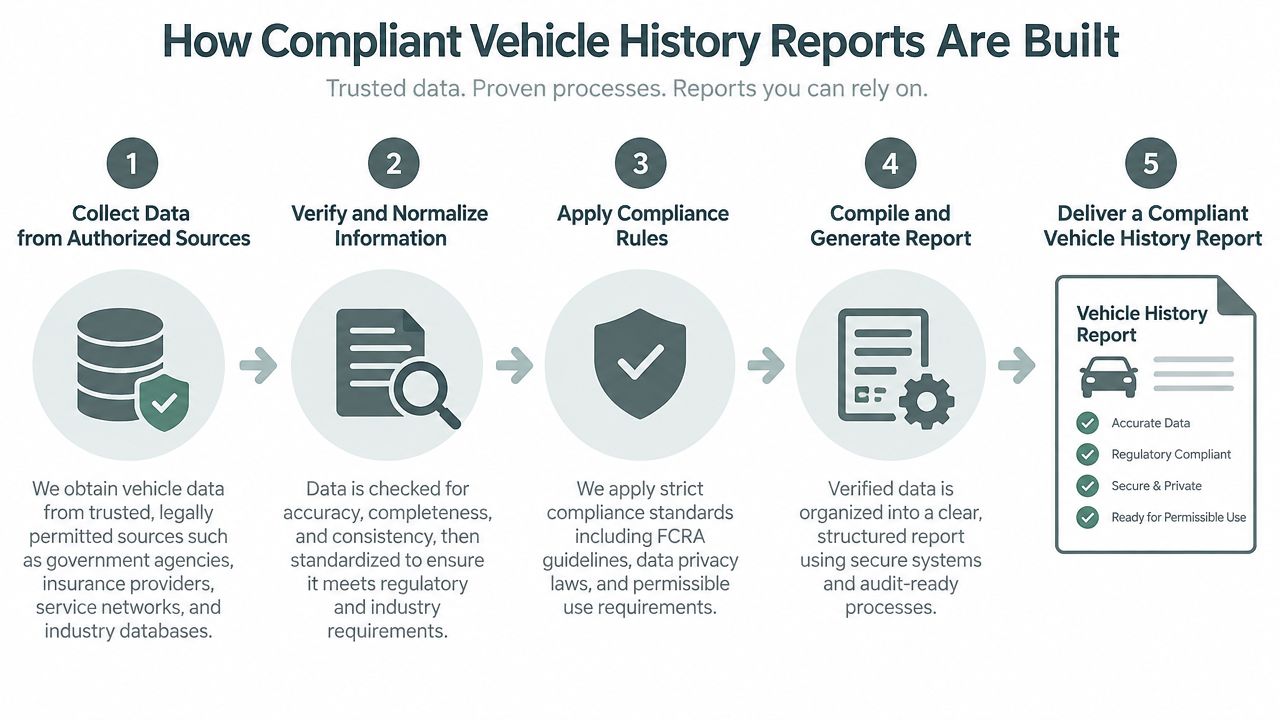
A lawful vehicle-history platform starts with a different question from an owner-search service. It asks, what can be reported about this vehicle without disclosing protected personal identity data? That design choice shapes the data sources, the report fields, the access rules, and the audit trail.
The VIN is normally the central key. A plate may help locate the vehicle, but the report should resolve to vehicle history rather than expose a DMV owner record. Relevant non-personal information can include title brands, salvage or rebuilt designations, flood indicators, reported accidents, auction records, historical images, odometer readings, theft records, service entries, and available recall information.
The separation that protects the buyer
A sound report architecture keeps vehicle identity and person identity in separate lanes:
- Input resolution: The system accepts a VIN or plate and identifies the relevant vehicle record.
- Source matching: It checks authorized title, insurance, auction, theft, service, and other vehicle-related sources.
- Record normalization: It organizes inconsistent entries into a readable timeline.
- Personal-data filtering: It excludes protected names, addresses, phone numbers, and comparable DMV details unless a verified permissible use applies.
- Report delivery: It presents vehicle facts, caveats, and source limitations without turning the report into a people-search product.
That separation is important because an official title system and a commercial report serve different purposes. NMVTIS is an official national title system used to help states and law enforcement deter title fraud and related crimes. The DOJ/NMVTIS program also explains that the operator can't modify title information such as junk, salvage, insurer designations, lien, or theft data. Those records remain with the state DMV that issued the title. The official NMVTIS contact page provides that program context.
What a report can't prove
A clean-looking report isn't a guarantee that the vehicle has never been damaged, owned by a particular person, or subject to a lien that hasn't entered the available data. Reporting depends on source participation, timing, jurisdiction, and the quality of the underlying record.
Use the report as a screening and verification tool. Compare it with the physical VIN, title document, seller disclosures, an independent inspection, and the issuing state's official process. A report can reveal a serious warning before purchase, but it can't replace a state title search or a mechanic's assessment.
The Shift Toward Data Broker Regulation and Retention
The privacy question now extends beyond whether someone can access a plate record. Compliance also depends on who stores the record, how long it remains available, what other data is attached to it, and whether the business reuses or monetizes it for a different purpose.
The regulatory situation remains uneven. Some states impose specific requirements on automated license plate readers, while others provide less direction on retention, secondary use, or sharing across jurisdictions. That inconsistency creates practical risk for national platforms and independent dealers that obtain vehicle data from multiple states. A company may follow one state's retention rule and still violate another jurisdiction's requirements.
Data-broker rules add another layer. California, Vermont, Oregon, and Texas were identified in 2026 commentary as requiring data brokers to register. Registration does not authorize a prohibited search. The DPPA still turns on its 14 permissible uses for personal information obtained from DMV records. A lookup can become unlawful if a company keeps plate-linked information after the original purpose ends, combines it with unrelated identity data, or gives a customer a way to search for a person.
Retention is now a control, not an afterthought
Businesses handling plate-linked records should maintain an inventory that answers operational questions:
- Collection: Does the system capture plate text, an image, VIN, location, timestamp, or owner data?
- Purpose: Why was each field collected, and is that purpose documented?
- Retention: When does the business delete or anonymize each record?
- Access: Which employees, vendors, agencies, or customers may search it?
- Reuse: Could the information support marketing, profiling, debt collection, or another secondary activity?
- Audit: Can the company show that each search matched the stated purpose?
Recent 2025–2026 disputes included proposals for tighter warrant standards and shorter retention periods, including 21 days in Washington and 14 days in a proposed Michigan bill, as described by the data-broker privacy analysis from Venable. The proposals point toward documented necessity, limited storage, and searchable access logs.
California's ALPR framework can create statutory damages of $2,500 per violation for missing privacy-policy requirements. A 2026 appellate decision also treated failure to maintain and publish an ALPR privacy policy as actionable harm. Startups developing data products should review the HB 1799 analysis for startups and obtain jurisdiction-specific advice before launching a plate-data workflow.
A public privacy notice matters only if the systems follow it. Retention schedules, vendor contracts, employee permissions, deletion procedures, and incident response should match the promises published in the Vektracer privacy policy. The policy can explain handling practices, but it cannot authorize an unlawful purpose or cure improper access.
Protecting Your Privacy and Verifying Vehicle History
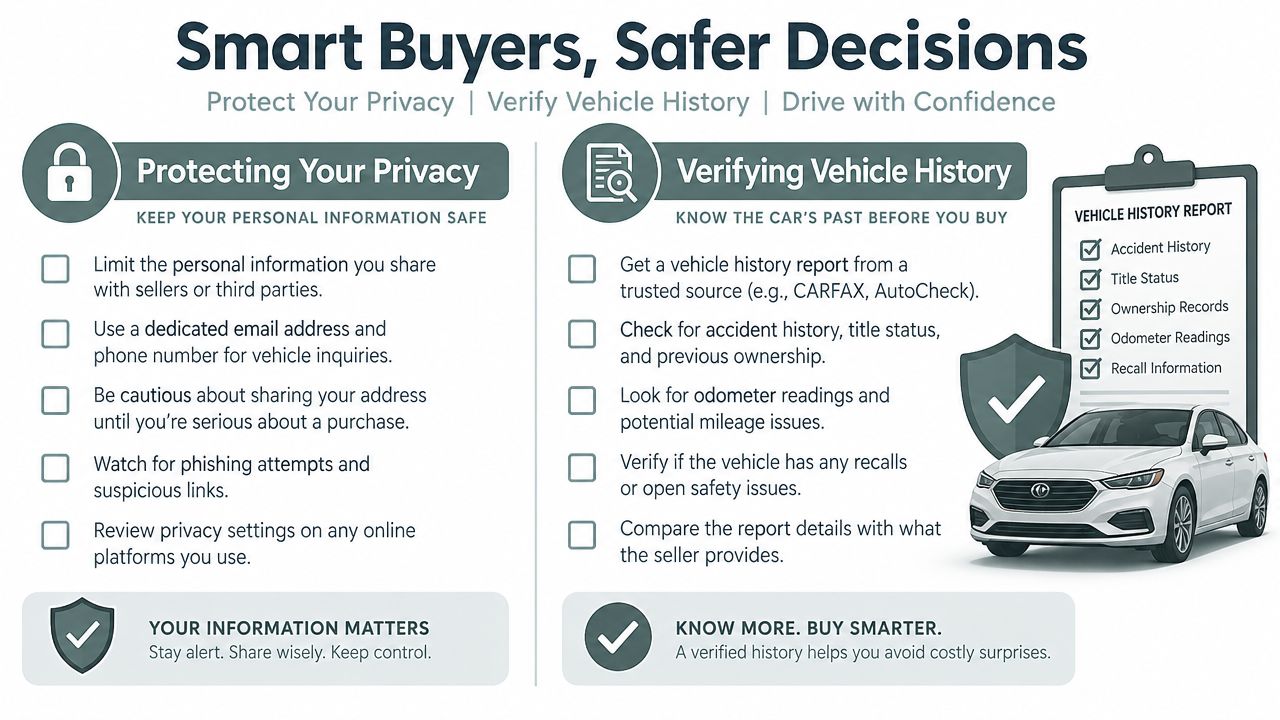
Vehicle owners and vehicle buyers need different safeguards. Owners should reduce unnecessary exposure and understand what their state offers. Buyers should avoid owner searches and build a documented vehicle-history process that confirms the car, the seller, and the records all match.
Steps for vehicle owners
Start with the DMV in the state where the vehicle is registered. Look for information about privacy restrictions, address confidentiality, protected-record requests, or safety-related exemptions. Eligibility and procedures differ, so don't assume a program exists or applies without checking the official agency's current requirements.
Also review where you publish vehicle images. Photos posted in listings, social media, or public forums can expose a plate even when the owner's DMV record remains protected. Blurring the plate in public photos can reduce casual collection, though it doesn't erase records already captured by cameras or copied by others.
Keep registration documents, insurance records, and title paperwork out of public images. If a buyer needs verification, provide the VIN through a controlled transaction channel and redact personal information from documents that aren't necessary for the sale.
A lawful buyer workflow
- Get the VIN directly. Ask the seller to provide the VIN and photograph the vehicle identification label, title, and odometer.
- Match the identifiers. Confirm that the VIN on the car, title, listing, and report is identical.
- Check official sources. Use the relevant DMV, NHTSA, or other government lookup for the information that agency provides, such as available title or recall data.
- Order a broader report. A commercial report can consolidate accident and damage records, title brands, salvage history, auction records, odometer entries, theft information, ownership context, and service data when reported.
- Investigate warning signs. Ask for documents supporting a rebuilt title, repair invoices, mileage changes, lien release, or auction damage photographs.
- Inspect before payment. Hire an independent mechanic and confirm the title transfer process with the issuing jurisdiction.
The report should help you decide what to verify next, not persuade you to skip verification. It also won't guarantee that every accident, lien, owner, or record appears, because coverage depends on the underlying source.
A VIN or plate input should be used only for the vehicle transaction or research purpose you selected. Don't submit someone else's plate to a service that claims it can reveal protected personal details, and don't retain downloaded reports longer than your business or transaction requires.
Common Misconceptions About Plate Lookups
Myth one: paying a fee makes an owner search legal. It doesn't. A commercial website can't create a DPPA exception merely by charging for access, and a promise to reveal a private owner's name or address should raise an immediate warning.
Myth two: every government vehicle record is open to the public. New York's Department of Motor Vehicles specifically states that the DPPA restricts using a vehicle plate number or VIN to search for the name of a vehicle owner. The New York DMV's DPPA guidance makes the practical rule clear for consumers: a normal plate or VIN search isn't a lawful path to protected owner identity information.
Myth three: a vehicle-history report is the same as an official title record. It isn't. NMVTIS is an official national title system, and its operator says it can't modify title data such as junk, salvage, insurer designations, lien, or theft information. Those records remain with the state DMV that issued the title. A commercial report may organize available records from multiple sources, but the issuing DMV remains important when you need authoritative title correction, lien release, or transfer action.
Myth four: a clean report proves the vehicle has no problems. It doesn't. A report can miss events that were never reported, haven't propagated through the available sources, or occurred in a jurisdiction with limited participation. Treat a clean result as one favorable signal, then compare it with the vehicle inspection, title, seller explanation, and service documentation.
Myth five: ALPR privacy is just a police issue. ALPR systems show why retention and secondary use matter, but the same design principles apply to commercial platforms. Businesses should limit collection, enforce purpose-based access, document sharing, and delete records when the authorized need ends.
The safest approach to license plate lookup privacy laws is also the most useful for a buyer. Use the plate to help identify the vehicle when appropriate, use the VIN to investigate its history, and keep the owner's personal identity outside the transaction unless a lawful, documented exception applies.
Vektracer compiles available VIN and license-plate vehicle history, including title brands, accident and damage records, mileage history, theft checks, recalls, auction records, and ownership context without presenting protected owner identity details. Visit Vektracer to enter a VIN or license plate and review the vehicle's available history before you buy, sell, or take a trade-in.
Ready to check a vehicle?
Enter any 17-character VIN for a free instant preview — no account needed.