How to Detect Title Washing on Any Used Car
Check a vehicle before you buy
Enter a VIN for a free instant preview — accidents, title brands, mileage, liens & open recalls.
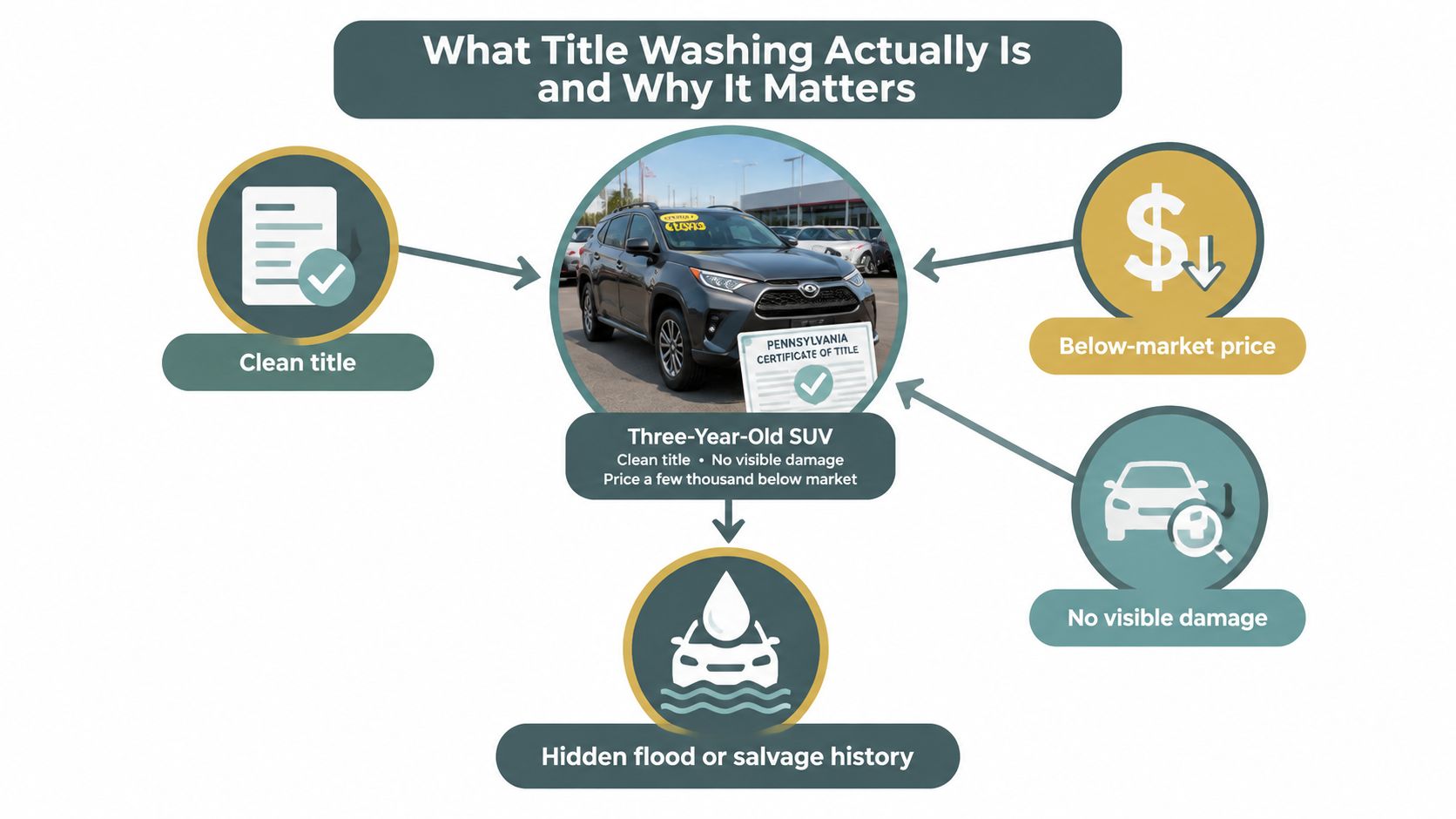
You're standing on a dealer's lot looking at a three-year-old SUV with a clean Pennsylvania title, no obvious damage, and a price a few thousand below comparable vehicles. The seller says it has never had a serious problem. How to detect title washing in that situation starts with one rule: don't trust the current title as the vehicle's complete history. Compare prior-state brand records with the current title, then verify the VIN, auction history, insurance losses, liens, and physical condition before you pay.
Table of Contents
- What Title Washing Actually Is and Why It Matters
- Start With the Paperwork the Seller Can Show You
- Compare Prior-State Brand Records Against the Current Title
- Cross-Check VINs, Auction Photos, and Insurance Loss Records
- Red Flags That Point to a Washed Title
- Verify the Findings Before You Pay
- Your Detection Checklist and Next Step
What Title Washing Actually Is and Why It Matters
Title washing is the practice of concealing a vehicle's title brand when the vehicle is retitled in another state. The brand may identify salvage, rebuilt, flood, hail, lemon, theft recovery, or another condition that can materially affect safety, insurability, resale value, and registration. The U.S. Office of Justice Programs explains that NMVTIS was created to reduce this risk by centralizing vehicle-brand information across states. The NMVTIS fact sheet describes title washing as the removal or concealment of a vehicle's brand during interstate retitling.
This isn't a harmless paperwork change. A vehicle with undisclosed structural damage may have poor crash protection, while flood exposure can leave corrosion and electrical faults that appear long after the sale. An insurer may also evaluate the vehicle differently after a claim if its prior total-loss history comes to light, and a later buyer may discover that the car's resale value is far below what a clean title suggests.
Why the current document can mislead you
A state-issued title generally reflects the issuing state's current record. If that state doesn't check the originating state, or doesn't check every prior titling state, an earlier brand may fail to carry forward. NMVTIS consumer guidance explains that this gap can allow brand washing when a vehicle moves between jurisdictions.
The practical consequence is simple:
A clean current title proves what the latest state recorded. It doesn't prove that the vehicle has always had a clean history.
The national risk is material enough to justify screening every used car. A widely cited estimate places title washing at about 1 in every 325 used cars, or roughly 0.31% of the market, according to Cars.com's analysis of washed-title vehicles. The key detection principle is to compare prior-state brand records against the current title's status. That comparison reveals what a single clean document can hide.
Start With the Paperwork the Seller Can Show You
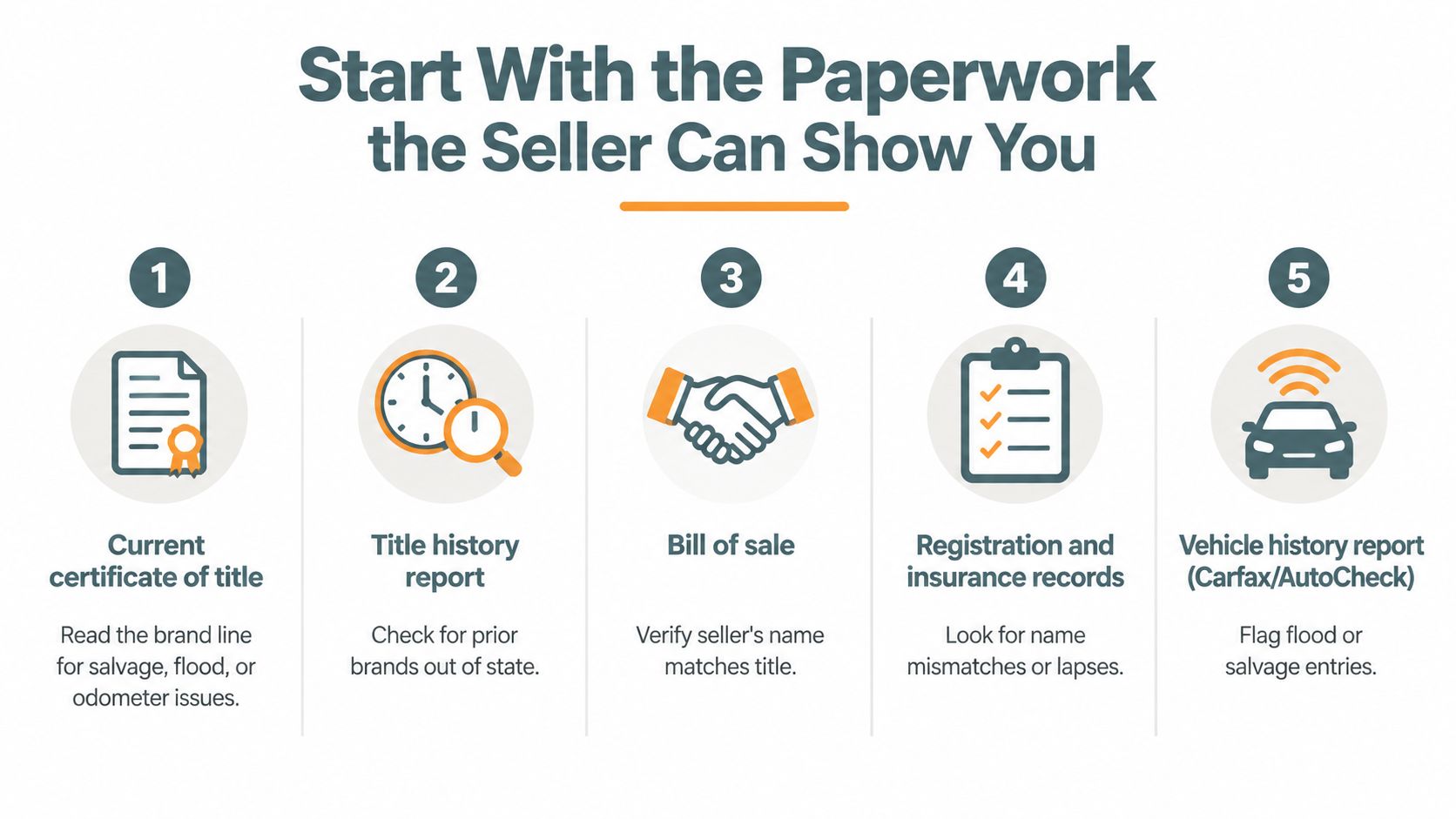
Begin with the original certificate of title, not a photograph sent through a marketplace chat. Read the brand line, issuing state, transfer date, odometer entry, owner name, lien notation, and any reassignment section. Look for erasures, white-out, inconsistent typefaces, restamped VIN information, damaged security paper, or a clean brand line that doesn't make sense alongside an out-of-state ownership history.
Write down the VIN exactly as it appears on the title. Don't rely on a plate number alone, because license plates can change when a vehicle changes owners or states. A plate lookup can help locate a vehicle record, but the VIN is the identifier you'll use to reconcile title, registration, auction, insurance, and ownership data.
Match the VIN before ordering records
Inspect the VIN at the dashboard, driver-side door jamb, engine bay or frame location where applicable, and the federal safety label. Each identifier should match character-for-character. Pay attention to altered rivets, uneven lettering, fresh paint around a plate, a sticker printed on noticeably different material, rewelded metal, or an overpainted dashboard.
A mismatch may indicate more than title washing. It can point to a cloned vehicle, swapped identity, or altered identification plate. Don't continue negotiating until the discrepancy is explained by an official correction record.
Use state records as a baseline
Ask for the current registration card, bill of sale, lien release, insurance documentation, and any available prior title copies. The seller's name should align with the title and bill of sale, or the seller should explain the legal relationship, such as dealership authority or power of attorney.
Then check the issuing state's official title and lien service. State services can confirm whether a title or lien is currently recorded, but they're limited to that state's records. For example, New York DMV's title and lien status service allows users to check recorded title and lien information, while Virginia DMV requires title handling through a customer service center when a lien is removed from DMV records.
Use the current title as a starting point, not a conclusion. For a visual reference, compare the document with this guide to what a car title looks like, but remember that appearance alone can't authenticate a title or establish a complete interstate history.
Compare Prior-State Brand Records Against the Current Title
The defining test is cross-state title-brand reconciliation. You're looking for a brand that appears in an earlier jurisdiction, then disappears after the vehicle receives a later title in another state. The VIN stays constant, but the paper trail changes. That disappearing brand is the technical signature that separates title washing from an ordinary title transfer.
NMVTIS is the federal backbone for this check. Pull an NMVTIS consumer disclosure from an approved provider and review every state listed in the title history. Look for salvage, rebuilt, flood, hail, junk, total-loss, or other brand entries, then compare those entries with the state shown on the seller's current title. Official NMVTIS consumer information explains why checking previous titling states matters.
Read the history as a sequence
Don't scan only for the word “salvage.” Build a timeline:
- Identify the earliest state associated with the VIN.
- Note every title brand and the date or sequence in which it appears.
- Compare the last branded state with the state that issued the current title.
- Look for an abrupt relocation, a missing transfer interval, or a clean title issued after a branded record.
- Verify the same sequence through the current issuing state's title-history service.
Commercial reports such as Carfax and AutoCheck can add accident, mileage, registration, and auction context, but treat them as supplements. They don't replace NMVTIS or the issuing state's official record, and no report promises to contain every event.
| Prior-State Brand | Current Title Brand | What It Means |
|---|---|---|
| Salvage, flood, rebuilt, or junk | Clean | High-risk mismatch. Investigate the retitling state and demand independent corroboration. |
| Branded title | Same or equivalent brand | The brand appears to have followed the vehicle. Continue checking repairs and inspection status. |
| No prior brand found | Clean | Lower documentary concern, but still verify VINs, physical condition, auction history, and loss records. |
| Prior total-loss record | No matching brand shown | Treat as unresolved until the title and insurance history explain the difference. |
State variation matters. Cars.com reported about 1 in 44.6 used cars with a washed title in Mississippi, compared with about 1 in 324.9 nationally and about 1 in 87 in New Jersey. The same analysis reported about 1 in 2,127 in Ohio, illustrating why a national average can obscure local risk. The Cars.com state comparison supports using the vehicle's entire registration path rather than judging risk from the current state alone.
For a focused explanation of brand categories and what they can signal, review this title brands reference for VIN checks. The current title tells you what the latest jurisdiction accepted. The prior-state record tells you what the vehicle may have survived.
Cross-Check VINs, Auction Photos, and Insurance Loss Records
Paperwork can be altered, incomplete, or delayed. The next layer is VIN concordance, meaning every physical and electronic record points to the same vehicle.
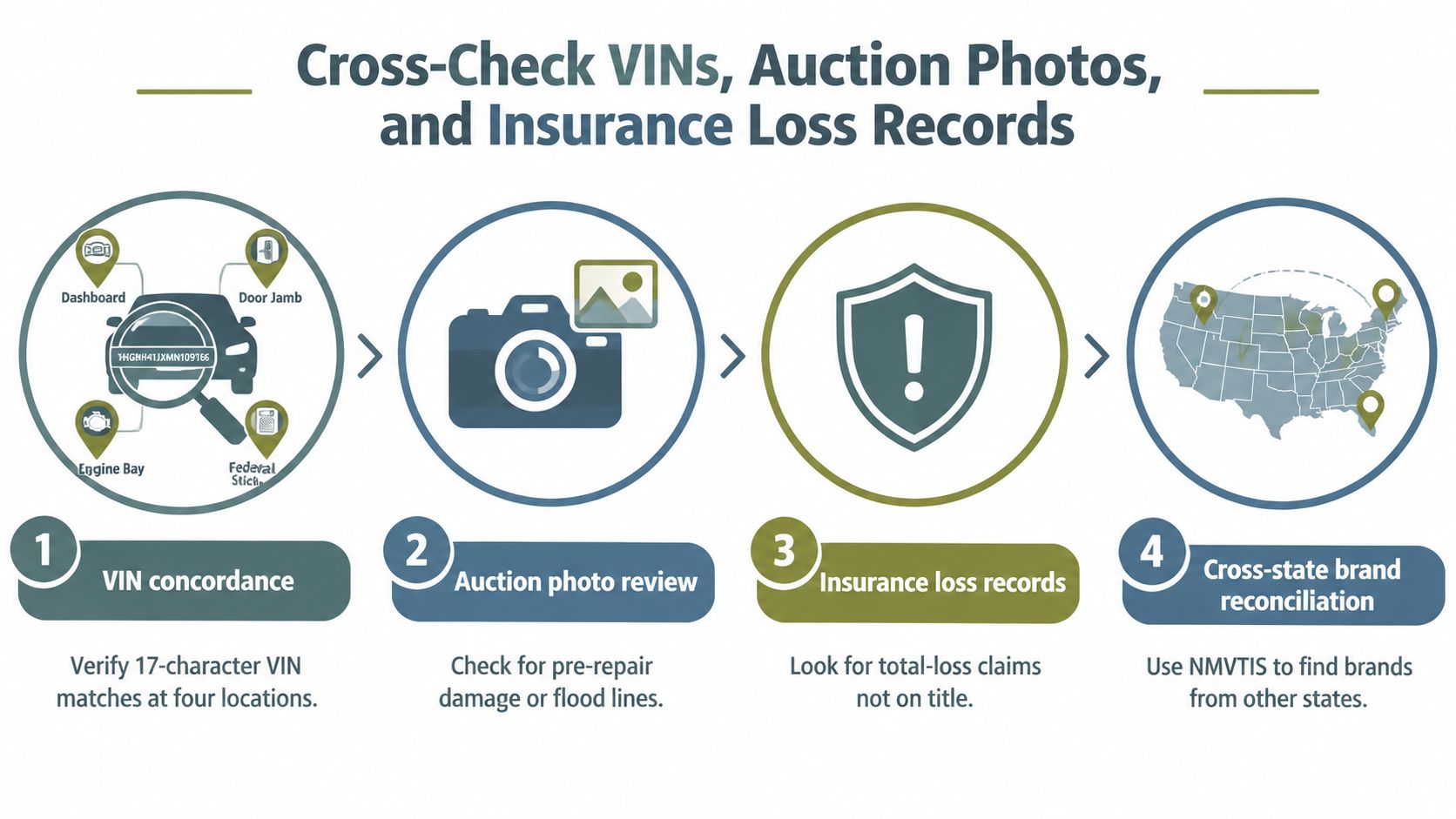
Start at the dashboard VIN plate and driver-side door jamb. Continue to the engine bay stamp, frame location, and federal safety label where those identifiers are present. Compare all characters, spacing, rivets, plate mounting, and surrounding finish. A correct VIN should appear consistently, not as one clean plate surrounded by disturbed metal or mismatched paint.
Use images to inspect the vehicle before repair
Search the VIN through auction records associated with Copart or IAA when those records are available. Review every archived image, not just the final listing. Look for deployed airbags, crushed suspension, front-end impact, flood lines, mud or silt, mismatched wheels, broken glass, salvage-lot markings, and damage hidden by later cosmetic repairs.
Auction photos can be more revealing than a seller's current walk-around video because they may show the vehicle before cleaning and reconstruction. They're still not definitive on their own. A missing auction record doesn't prove the vehicle never went through an auction, and an image can be misclassified or unavailable.
Corroborate loss information
Request an NMVTIS disclosure and review insurance total-loss information, including JCARE entries where they're available in the records you obtain. Federal rules require reporting entities such as insurers, salvage auctions, rental fleets, tow operators, and others to report within 30 days of acquiring or handling a salvage vehicle, according to the federal NMVTIS reporting document. That timing rule helps explain why a recent event may not appear immediately.
A useful plate-to-VIN workflow begins with the registration or listing plate, then moves to the VIN before you order a detailed history report. This license plate lookup guide explains the identification step without treating a plate result as a substitute for title verification.
Strong confirmation comes from a cluster: a tampered VIN plate, auction photos showing severe damage, and a prior insurance total-loss record together carry far more weight than any single warning.
For buyers who want one structured view of records from multiple sources, a guide to NMVTIS vehicle-history reports can help distinguish the federal title layer from commercial history data.
Red Flags That Point to a Washed Title
The most useful red flags are inconsistencies between documents, geography, timing, and the vehicle itself. A low price can start the investigation, but it can't prove fraud. A missing brand becomes much more serious when it follows a rapid state transfer and the vehicle shows repair evidence.
Documentary and registration warning signs
Watch for an issuing state that doesn't match the seller's residence, a registration renewal soon after a prior-state title issue, or a clean current title after an earlier state record carried a brand. Compare the seller's name across the title, registration, bill of sale, and lien paperwork. Inconsistent fonts, altered stamps, poor-quality scans, and non-standard security paper deserve independent verification rather than visual acceptance.
Registration geography can add context. A vehicle registered in a hurricane or flood-prone area, including Florida, Texas, Louisiana, North Carolina, or New Jersey, and then retitled elsewhere after an abrupt transfer deserves closer flood inspection. Geography alone isn't evidence of washing, because legitimate owners move and vehicles travel.
Physical and digital warning signs
Fresh undercoating over frame rails can hide welds or corrosion. New airbags paired with an unusually clean steering wheel may indicate a major collision repair. Salt staining, damp odors, corrosion under seats, residue in wiring connectors, or suspiciously clean body panels on a rebuilt vehicle should trigger a professional inspection.
Document authenticity is also a current concern. An Allied Solutions industry article says AI image editing can create highly realistic false title documents, which means a clean-looking scan shouldn't be treated as proof. Verify the document through the issuing DMV, compare it with independent records, and inspect the vehicle's chain of custody.
| Category | Specific Red Flag | Why It Matters |
|---|---|---|
| Title document | Brand missing from the current title but present in a prior-state record | The vehicle's paper history may have changed during retitling. |
| Registration path | Abrupt move between states followed by a clean title | The transfer may warrant a full cross-state reconciliation. |
| VIN identity | Different character, disturbed rivets, or altered surrounding metal | The vehicle may be cloned or identity-altered. |
| Repairs | Fresh undercoating, weld marks, new airbags, or flood residue | Cosmetic work may conceal structural or water damage. |
| Digital paperwork | Edited scans, cloned DMV pages, or inconsistent formatting | The document may not be independently authentic. |
Verify the Findings Before You Pay
Treat each warning as a lead, then apply a second-source rule. A suspicious title should be checked against a state record, NMVTIS disclosure, auction image, insurer record, or physical inspection. One unexplained discrepancy may be a clerical error. Several independent discrepancies form a decision problem you shouldn't ignore.
Book a pre-purchase inspection with a shop that can examine more than paint and engine noise. Ask specifically for:
- Paint-depth testing: Look for repaired panels and inconsistent refinishing.
- Frame measurement: Check for structural pulls, distortion, and uneven alignment.
- Borescope inspection: Examine cylinder walls when water intrusion or severe engine damage is suspected.
- Airbag-module review: Confirm that restraint components and crash data don't contradict the seller's account.
- Flood inspection: Check wiring, connectors, carpeting, seat mounts, and hidden residue.
- Structural inspection: Look for weld marks, replacement rails, overspray, and repair seams.
Don't let a seller choose a shop with a financial interest in completing the sale. Meet at the issuing DMV when practical, especially if the seller resists independent verification or insists on an immediate deposit.
What to do when the evidence confirms washing
Stop the transaction and preserve the evidence. Save title photographs, screenshots of history records, auction images, messages, the bill of sale, payment records, and the inspection report. Contact the seller's state DMV fraud unit and report the suspected issue through the appropriate NMVTIS or federal consumer channel. Ask the seller for a refund or vehicle replacement only in writing, and avoid altering or reselling the vehicle while the dispute is unresolved.
If the records remain inconclusive, don't close because the seller says the title is clean. Require a coherent title chain verified through NMVTIS and the relevant state records. Sellers who are legitimate should be able to explain the timeline, lien status, ownership changes, and repair history without pressuring you to skip inspection.
For owners or dealers preparing a vehicle for resale, accurate documentation matters as much as presentation. Anyone researching how to sell cars on eBay Motors should keep title, repair, auction, and disclosure records aligned so the next buyer can verify the vehicle's identity and history.
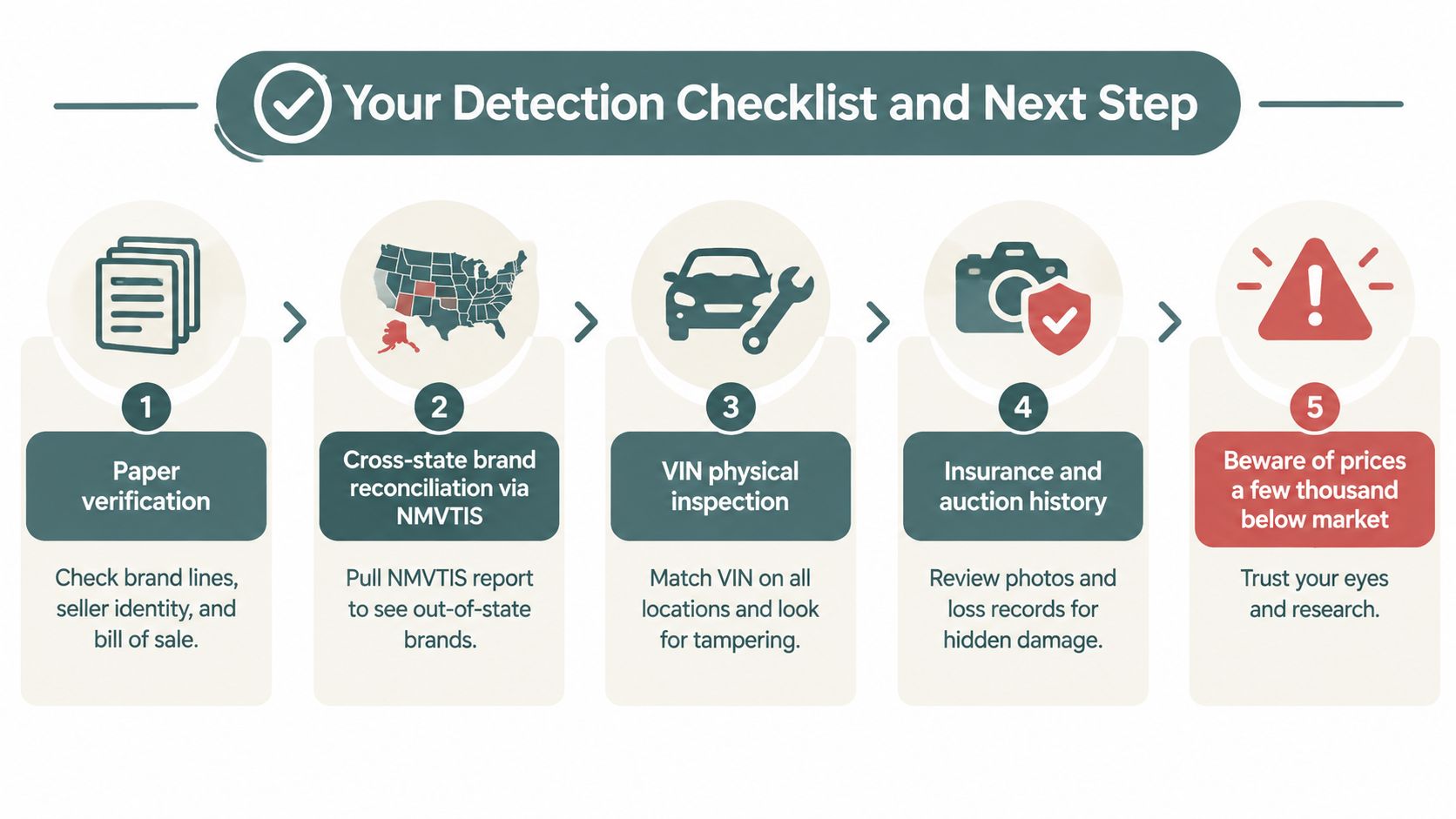
Your Detection Checklist and Next Step
Run this checklist in order, and keep copies of everything you review.
- Paper verification: Read the current title's brand line, VIN, odometer entry, issuing state, lien notation, seller name, and transfer history. Compare the title with registration and the bill of sale.
- Cross-state reconciliation: Pull an NMVTIS report and list every prior state. Compare earlier salvage, flood, rebuilt, junk, hail, total-loss, or other brand entries with the current title.
- VIN concordance: Photograph the dashboard, door jamb, engine bay or frame stamp, and federal safety label. Confirm that every character matches.
- Auction and insurance review: Search available Copart and IAA records, inspect pre-repair images, and review total-loss or JCARE information where reported.
- Red-flag review: Investigate abrupt state changes, unexplained timeline gaps, storm or flood geography, altered paperwork, unusual repairs, and mismatched ownership names.
- Independent inspection: Hire a qualified shop to examine frame structure, welds, airbags, paint depth, wiring, flood residue, and mechanical condition.
A commercial report can consolidate title brands, ownership context, odometer history, auction records, accident information, and other available records, but it won't replace an official DMV check or physical inspection. Vektracer is one option for entering a VIN or license plate and reviewing available vehicle-history records in a structured report before deciding whether a deeper inspection is justified.
Start with the VIN or license plate lookup, then use the result to guide the official title, lien, NMVTIS, and inspection checks. The objective isn't to reject every out-of-state vehicle. It's to confirm that the paper trail, physical VINs, loss history, and current condition all describe the same car.
If you're screening a specific used vehicle, visit Vektracer to enter its VIN or license plate and review available title, brand, accident, mileage, ownership, auction, and theft-history records. Use that report as the first documentary layer, then verify any concern through official state records and an independent inspection before paying.
Ready to check a vehicle?
Enter any 17-character VIN for a free instant preview — no account needed.