How to Report Odometer Rollback in 2026: A Practical Guide
Check a vehicle before you buy
Enter a VIN for a free instant preview — accidents, title brands, mileage, liens & open recalls.
You've bought a three-year-old crossover advertised with 24,000 miles, but the brake rotors, weatherstripping, and steering wheel look much older. Then a VIN-based history report shows emissions and service entries at 89,000 miles. Reporting odometer rollback means filing with your state DMV, and suspected large-scale fraud should also be reported to the NHTSA Vehicle Safety Hotline at 888-327-4236. Don't confront the seller first and give them time to replace records or resell the vehicle. Build a dated evidence file, send the complaint to the right agency, and preserve every document.
Table of Contents
- Why Odometer Rollback Is Worth Reporting Right Now
- How Common Rollback Fraud Is
- Build Your Evidence File Before You File the Report
- Where to Send the Report in the United States
- Writing the Complaint So It Gets Action
- What Happens After You File
- Your Next Step to Confirm and Report
Why Odometer Rollback Is Worth Reporting Right Now
A mileage discrepancy isn't a cosmetic problem. An altered odometer can reduce the vehicle's market value, distort the next buyer's financing decision, and help the same seller profit from another transaction. If the vehicle is resold before investigators see the records, proving the sequence becomes harder.
Reporting also protects your position as a buyer. State disclosure laws may provide routes to rescind a sale, recover money, or pursue civil remedies, but those options depend heavily on documentation. A formal complaint creates a record that the mileage was challenged and gives enforcement officials a chance to correct title or transfer information before the fraud compounds.
Practical rule: Don't file with a single suspicious number. File with a contradiction that another person can verify.
Start by documenting the dashboard reading, VIN, title, listing, and seller communications. Then compare the current reading with dated records from service shops, inspections, registrations, auctions, and title transfers. A concise explanation of what odometer rollback means can help buyers distinguish an actual mileage conflict from normal wear or a legitimate instrument-cluster replacement.
The U.S. process is the main reference point for North American buyers, but Canadian owners should use their provincial motor vehicle branch, provincial consumer-protection office, and the Canadian Anti-Fraud Centre where appropriate. In the United States, NHTSA says large-scale fraud schemes should go to its Vehicle Safety Hotline, while individual odometer fraud cases should be reported to the relevant state enforcement agency. NHTSA also identifies its Office of Odometer Fraud Investigation at 1200 New Jersey Avenue SE, Washington, DC 20590. That gives consumers and investigators both a direct federal channel and a clear federal destination for serious patterns. (NHTSA odometer fraud reporting guidance)
How Common Rollback Fraud Is
The scale justifies reporting. NHTSA's Preliminary Report: The Incidence Rate of Odometer Fraud estimated the lifetime incidence of odometer fraud at 3.47% of vehicles and linked the problem to approximately $1.06 billion in annual consumer losses. These figures are a policy benchmark, not proof that every suspicious vehicle was altered. They do show why state and federal reporting systems accept odometer complaints. (NHTSA incidence analysis)
A clean dashboard does not establish accurate mileage. Rollback evidence can appear through conflicting title entries, a replaced instrument cluster, edited electronic records, or paperwork that disagrees with the vehicle's service history. Digital tampering may leave fewer obvious signs, so investigators need dated records that can be compared across sources.
Odometer Fraud Scope at a Glance
| Metric | Value |
|---|---|
| Estimated lifetime incidence of odometer fraud | 3.47% of vehicles |
| Estimated annual consumer losses | About $1.06 billion |
Older vehicles, salvage and auction vehicles, private-party transactions, and cross-state sales warrant closer review because their mileage records may sit in separate systems. None of those categories proves fraud, and a missing entry proves nothing by itself. Compare every available mileage record and identify the first point where the sequence becomes inconsistent.
A commercial history report can help locate that break, but it is supporting evidence rather than a government finding. Buyers can browse service history before filing and organize reported service entries for comparison. A persuasive complaint connects multiple dated sources, explains the contradiction plainly, and gives investigators records they can verify. That evidence triangulation matters more than a single suspicious dashboard reading.
Build Your Evidence File Before You File the Report
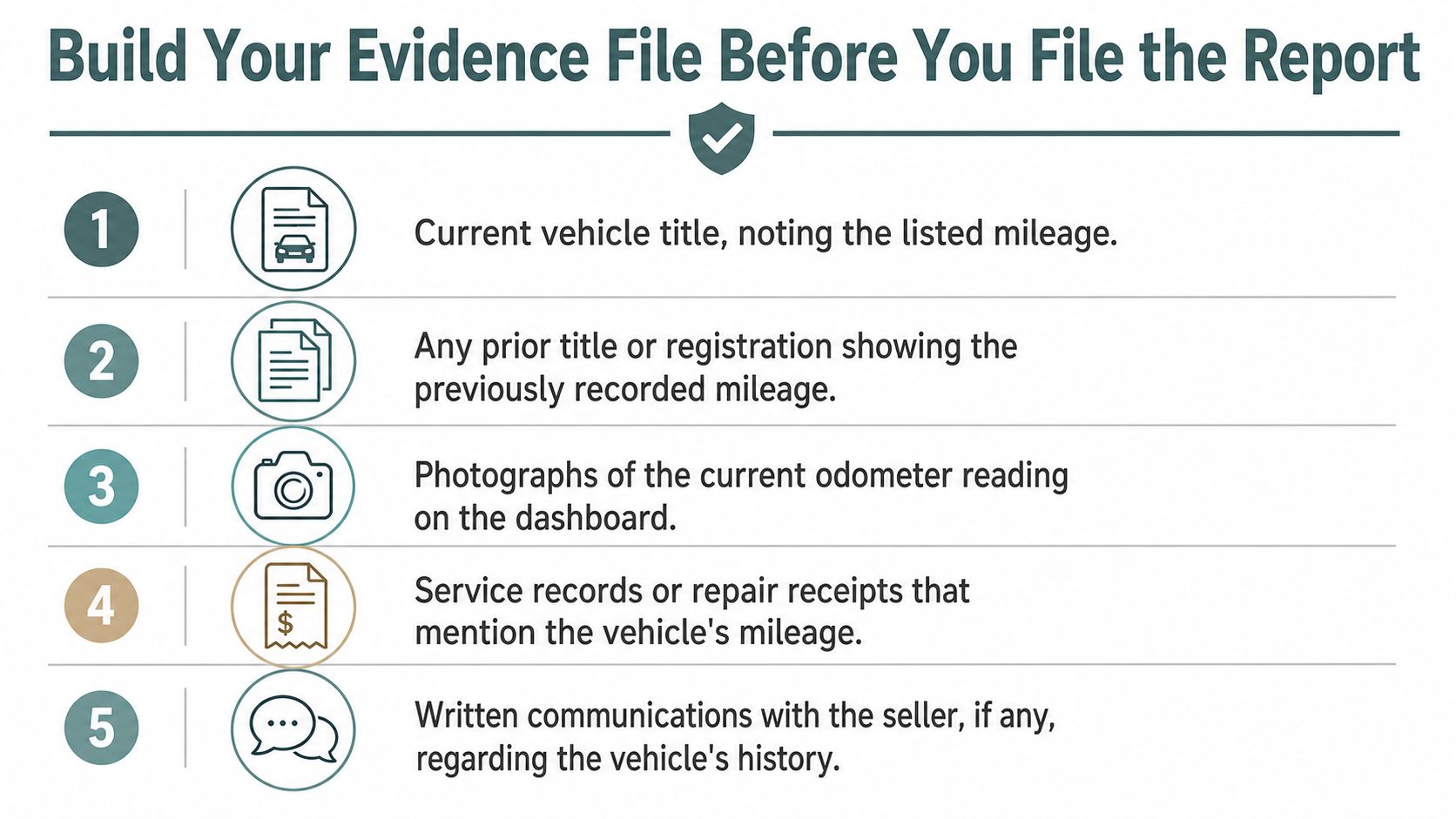
Investigators need a traceable timeline. Start with the current title, recording the mileage shown and the vehicle description. Add any prior title, registration, or transfer document that records mileage. Don't discard paperwork because it appears to show the seller's version. A document that conflicts with another record can be the most useful item in the file.
Next, collect records that were created during ordinary ownership:
- Maintenance records: Request dealer printouts, repair orders, oil-change stickers, tire-replacement receipts, and inspection documents that include dates and mileage.
- Government records: Pull the available NMVTIS title record through your state DMV portal and save the result with the retrieval date.
- Commercial history reports: A VIN-based report from Vektracer, Carfax, or AutoCheck can highlight mileage entries that contradict the dashboard. It can also provide context from title, auction, ownership, or service records when those records are available.
- Vehicle photographs: Photograph the odometer at startup, the under-dash VIN plate, the door-jamb label, and any visible signs of instrument-cluster work.
- Transaction evidence: Save the online listing, bill of sale, warranty documents, seller texts, emails, and messages about mileage, condition, or prior use.
Compare records instead of collecting them passively
Create a simple chronology with the date, source, recorded mileage, and document name. Mark entries that move backward, remain implausibly unchanged, or jump sharply without an explanation such as a documented cluster replacement. You can also review guidance on reading VIN mileage history, but keep the original records that support every entry in your comparison.
Physical wear can support the timeline, but it rarely proves the offense by itself. A worn steering wheel or replaced pedal cover may justify further investigation, while a dated service invoice showing a higher mileage is much more persuasive.
Use a VIN odometer rollback check as one part of the comparison, not as a substitute for official records. Before contacting an agency, confirm that your file contains a documented mileage gap of more than 500 miles across dated sources. Then label each attachment, keep a copy of the submission, and avoid editing the original files.
Where to Send the Report in the United States
Send the complaint to the agency with authority over the conduct. A state DMV or motor vehicle enforcement unit should receive reports about title-transfer discrepancies, false odometer disclosure forms, and inspection-station failures. Use the state's official complaint process, then confirm its mileage-disclosure requirements before filing.
Federal reporting makes more sense when the evidence points to a broader pattern. Contact NHTSA's Vehicle Safety Hotline at 888-327-4236 for a cross-state seller, repeated complaints involving several vehicles, or a dealer moving inventory between jurisdictions. NHTSA separates large-scale fraud reporting from individual cases, so send a single-vehicle dispute to the relevant state enforcement agency through its NHTSA reporting channels.
Choose the National Insurance Crime Bureau when the rollback appears connected to salvage titles, VIN cloning, theft, or insurance fraud. Provide the VIN and police report number when available. A state attorney general's consumer-protection division can address deceptive dealership conduct or broader private-seller activity under state law. Local police can document suspected criminal tampering and give you a case number, which can strengthen later submissions to the DMV, NICB, or attorney general.
Canada follows a different process. Contact the provincial motor vehicle branch, such as ServiceOntario or SAAQ, and involve the Canadian Anti-Fraud Centre and the appropriate provincial consumer-protection office when the transaction crosses provincial lines. A U.S. agency cannot replace the relevant Canadian provincial authority.
Where to Report Odometer Rollback Agency Matching Guide
| Agency / Channel | Trigger | How to File | What They Do |
|---|---|---|---|
| State DMV or motor vehicle enforcement | Title, transfer, disclosure, or inspection discrepancy | Use the state's official complaint process and attach the evidence file | Reviews mileage and title compliance, with possible enforcement referral |
| NHTSA Vehicle Safety Hotline | Large-scale, interstate, or repeated fraud pattern | Call 888-327-4236 | Receives federal odometer-fraud reports and identifies patterns |
| NICB | Salvage, theft, VIN cloning, or insurance-fraud connection | Submit an online tip with the VIN and police report number when available | Reviews possible insurance and vehicle-crime links |
| State attorney general | Deceptive dealer or seller conduct | File with the consumer-protection division | May pursue consumer-fraud enforcement |
| Local police | Suspected criminal tampering or forged transaction evidence | Make a report and retain the case number | Documents the complaint and may investigate criminal conduct |
| Provincial Canadian authorities | Canadian registration, title, or cross-province dispute | Contact the provincial motor vehicle and consumer offices | Applies the relevant provincial process |
Your evidence file should determine the order. Start with the state enforcement agency, add police documentation when criminal conduct appears likely, and use federal or specialized channels when the records show connections beyond one transaction. Expect agencies to review records before contacting the seller, so preserve originals and retain every confirmation number.
Writing the Complaint So It Gets Action
An investigator should be able to identify the vehicle, seller, transaction, contradiction, and requested remedy without calling you to reconstruct the story. Put the facts in date order and use the same mileage figures shown on the source documents.
Include the identifying facts
Your complaint should contain:
- Vehicle identity: The full 17-digit VIN, make, model year, license plate if relevant, and current odometer reading.
- Mileage proof: A photograph of the current dashboard reading, plus prior readings from titles, registrations, service records, inspections, and VIN-based reports.
- Seller information: The seller's legal name, business name, address, telephone number, email address, and dealer license number if applicable.
- Transaction details: Purchase date, sale price, advertised mileage, actual observed mileage, and the location of the sale.
- Legal basis: Identify the applicable state odometer law or federal rule, such as 49 USC 32705, without claiming that an agency has already found a violation.
- Attachments: Current and prior titles, bill of sale, warranty documents, service records, report pages, photographs, and screenshots of the original listing.
A strong opening can be direct: “I am reporting a suspected odometer disclosure violation involving VIN [VIN]. The vehicle was advertised at [mileage], while a dated service record from [date] records [higher mileage]. Attached documents show the sequence.”
End with a specific request. Ask the agency to review the disclosure, correct the title if appropriate, assess civil penalties, refer the matter for criminal investigation, or explain the available process for rescission or refund. Sign and date the complaint. Keep opinions out of the factual chronology. “The seller is a criminal” adds little; “the listing stated this mileage, while the attached invoice states that mileage on an earlier date” gives investigators something they can test.
What Happens After You File
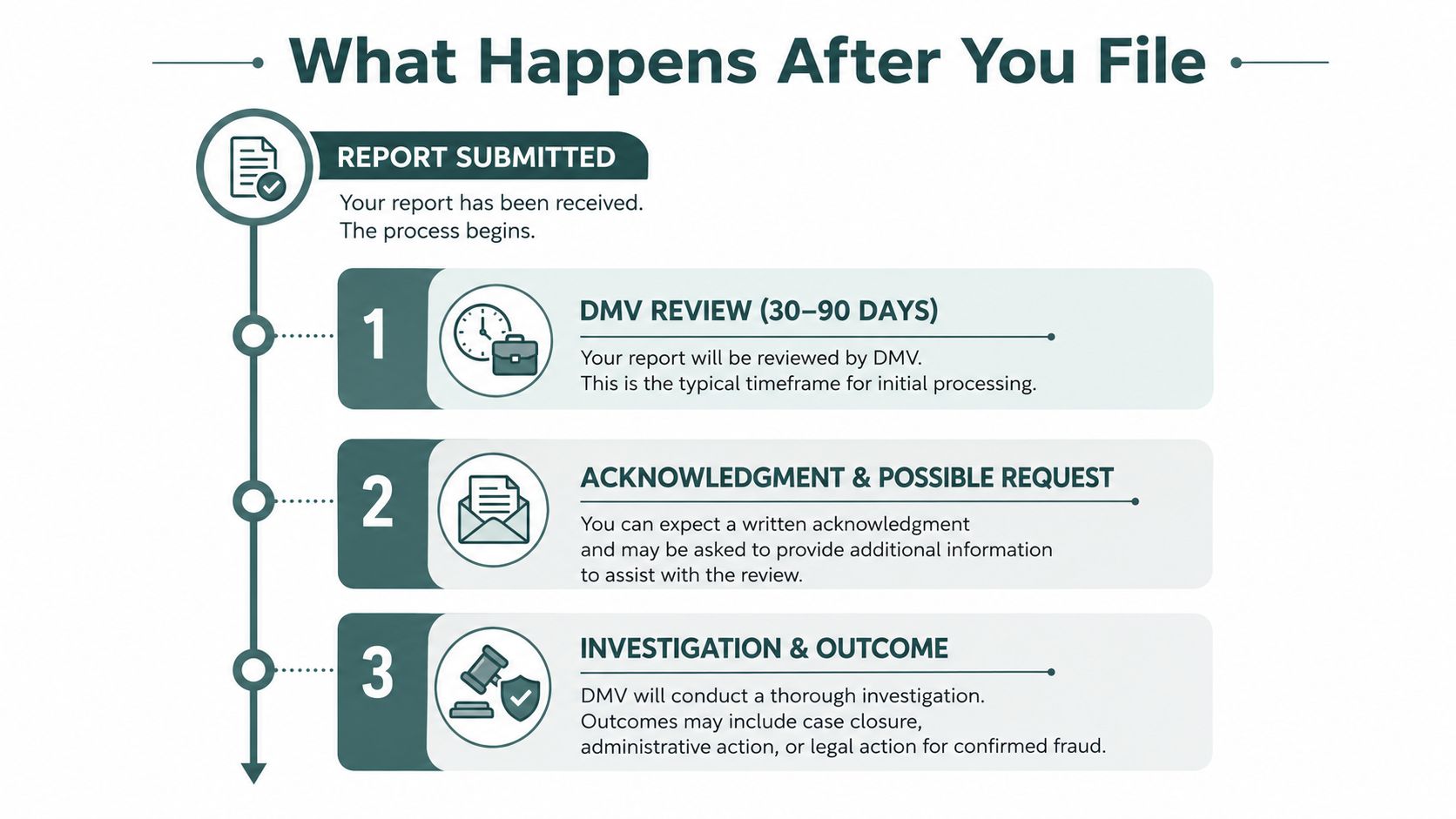
A complaint can move slowly even when the evidence is clear. State DMV reviews may take 30 to 90 days. The agency may acknowledge the filing, request the seller's response, or refer the matter to a motor vehicle enforcement unit or attorney general's office. None of those steps guarantees a violation finding, refund, or criminal prosecution.
Federal reports and state complaints serve different purposes. NHTSA hotline reports enter a federal database, while federal enforcement generally concentrates on patterns involving multiple vehicles or interstate sellers. Individual filers usually receive confirmation that the report arrived. NICB reviews may take 14 to 30 days, and NICB may contact you if the VIN matches an open investigation. Review the NHTSA federal odometer-fraud information to understand the federal reporting role.
Possible outcomes and parallel remedies
An agency may correct the title, impose civil penalties, suspend a dealer's license, or seek restitution when authorized. It may also close the case because the evidence is insufficient, the conduct falls outside its jurisdiction, or another agency must act first. A clear record sequence matters more than a single report. Match the dashboard reading against dated titles, service invoices, inspection records, listings, and VIN-based reports so investigators can test the contradiction.
Do not wait for an agency response before reviewing private remedies. Depending on state law, you may be able to revoke the sale under an odometer-fraud statute, report a deceptive online listing to the FTC, or file in small claims court within the applicable limit. A lawyer can assess rescission, damages, and deadlines, especially if the seller denies knowing about the discrepancy.
Keep every acknowledgment, call log, document request, and response. If you move, sell, repair, or retitle the vehicle, preserve the original evidence and disclose the suspected discrepancy to prevent the problem from reaching another buyer.
Your Next Step to Confirm and Report
Pull a VIN-based report from a service such as Carfax, AutoCheck, Vektracer, or NMVTIS through the appropriate state DMV portal. Compare the dashboard reading with every dated mileage entry, then save a side-by-side file showing the source, date, reading, and contradiction. Government records and commercial reports serve different purposes, so label them separately instead of presenting a commercial report as an official finding.
Check your state's mileage-disclosure window before sending the complaint. Some jurisdictions may impose a defined filing period, while federal odometer exposure can remain relevant beyond a single transaction, so don't assume that waiting is harmless. File with the state DMV before the seller transfers the title again when possible, because a post-sale rollback case is harder to trace after additional transfers.
Use a short action window
Within the next 48 hours, complete these tasks:
- Photograph the vehicle: Capture the odometer at startup, VIN plate, title, and any visible instrument-cluster issue.
- Freeze the records: Download the listing, export messages, scan the bill of sale, and save original report files.
- Build the chronology: Put each mileage reading in date order and identify the first documented contradiction.
- Check the deadline: Confirm the state's disclosure and complaint requirements through its official DMV or motor vehicle agency.
- Submit copies: Send the evidence package to the correct channel and keep certified copies, delivery confirmation, and the complete complaint.
A free odometer check by VIN can help you decide whether the dashboard reading warrants a deeper file. It won't replace a state title record, inspection document, or investigator's determination, but it can help surface the mileage timeline you need to compare before you file.
Vektracer compiles available VIN-based records into a structured vehicle-history report, including mileage history and related title, accident, auction, ownership, and service context when reported. Visit Vektracer to check the vehicle's available history, document a suspected discrepancy, and prepare a clearer report for the appropriate agency.
Ready to check a vehicle?
Enter any 17-character VIN for a free instant preview — no account needed.