Ford Mustang VIN Code Decoder: Your Complete Guide

Check a vehicle before you buy
Enter a VIN for a free instant preview — accidents, title brands, mileage, liens & open recalls.
You're standing next to a Mustang, the seller is talking fast, and the badge on the fender is doing a lot of the selling. That's when the VIN matters. A ford mustang vin code decoder helps you read the car's factory identity so you can check whether the story matches the metal.
For a first-time buyer, VIN decoding can feel like reading a foreign language. It isn't. It's more like automotive archaeology. Each letter and number is a layer of the car's original build, and once you know how to read those layers, you stop shopping on hope and start buying on evidence. If you want a broader foundation before focusing on Mustangs, this guide on what VIN decoding means for smarter car buying is a useful starting point.
Introduction Decoding Your Mustang's DNA
A Mustang VIN is the car's factory fingerprint. It tells you what the car was when Ford built it, not what someone painted, badged, or advertised later.
That distinction matters most when emotion enters the deal. A classic fastback can be presented as something rarer than it is. A newer Mustang can be listed with options that sound right but don't line up with the original build. The VIN gives you a neutral starting point.
Reading a Mustang's VIN is like checking the tag sewn into a vintage leather jacket. The outside tells you the style, but the inside label reveals what it is.
Practical rule: Decode the VIN before you fall in love with the car. It's much easier to walk away from a mismatch early than to untangle one after money changes hands.
Mustang buyers usually run into two different VIN “languages.” Classic cars use a shorter Ford-specific format. Later cars use the standardized format shared across the modern auto industry. If you don't know which language you're looking at, even a correct VIN can seem confusing.
The good news is that Mustang VINs are logical once you break them into pieces. Year. Plant. Body. Engine. Serial. Those details aren't trivia. They're the backbone of authenticity, especially when you're deciding whether a car is original, altered, or misunderstood.
The Tale of Two VINs Classic vs Modern Mustangs
The first thing to know is simple. Not all Mustang VINs follow the same rules.
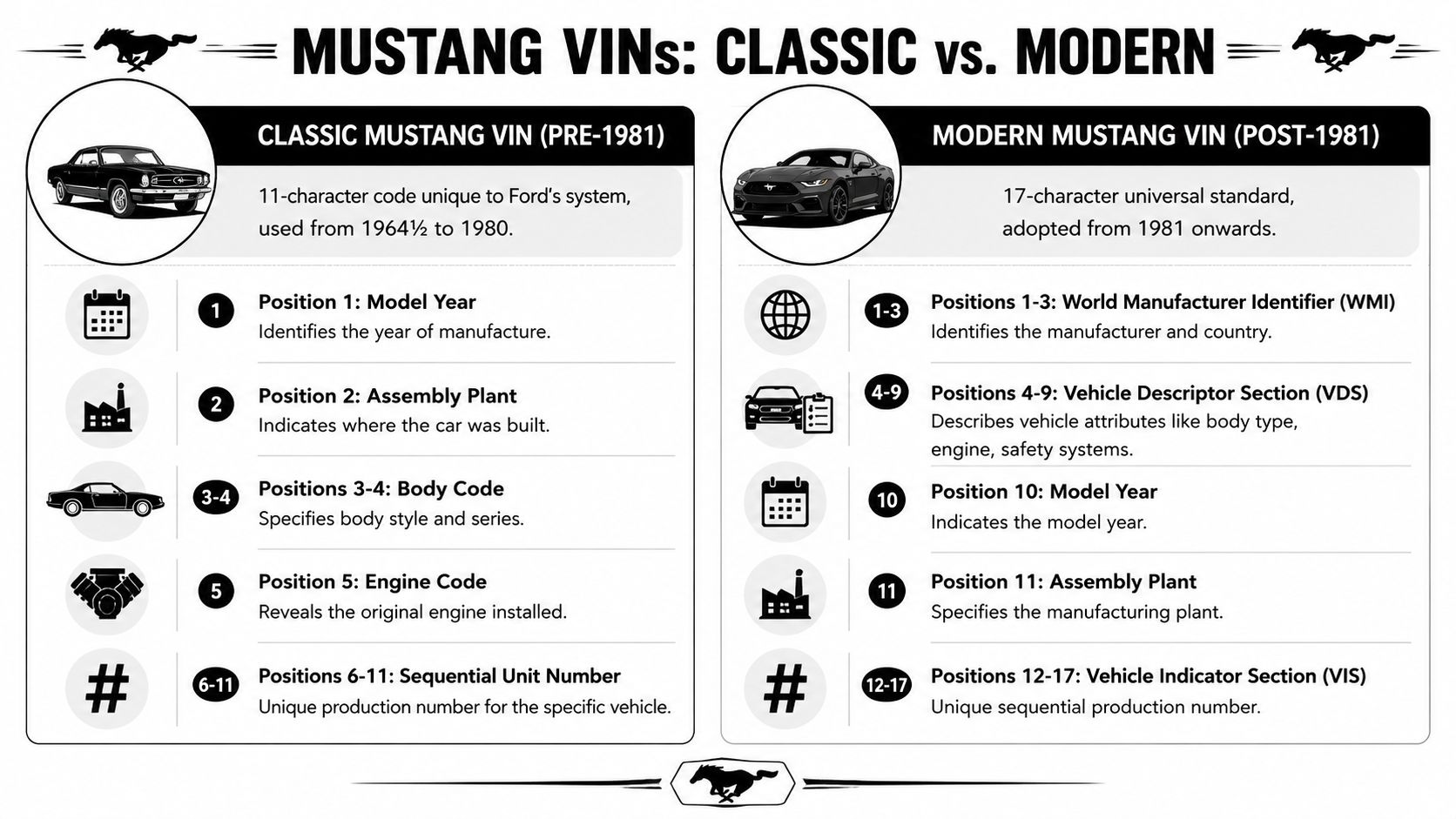
Ford used a shorter format on early Mustangs. Then the industry changed. According to this classic Mustang VIN reference, Ford Mustang VIN decoding changed with industry-wide VIN standardization in 1981. For 1965-1973 first-generation Mustangs, the VIN used a shorter structure where the first character identified the model-year ending digit, the second the assembly plant, characters 3-4 the body style, character 5 the engine code, and the remaining characters the consecutive unit number. Modern VINs use a 17-character structure in which the first 3 characters are the WMI, characters 4-8 describe vehicle attributes, the 9th is a check digit, the 11th identifies the assembly plant, and characters 12-17 are the serial number.
Why the split matters
If you try to decode a classic Mustang with a modern VIN tool, you can end up with partial or misleading results. The reverse is also true. A modern Mustang VIN has more structure and more verification built into it.
Classic VINs are compact. They're closer to a shorthand note from the factory. Modern VINs are more like a standardized record that many systems can read consistently.
That's why buyers get tripped up. They expect every VIN to reveal the same level of detail in the same positions. Mustangs don't work that way across eras.
Classic and modern side by side
| Feature | Classic VIN (Pre-1981) | Modern VIN (Post-1981) |
|---|---|---|
| Length | Shorter Ford-specific format | 17-character standard |
| Core purpose | Basic build identity | Global identification and validation |
| Model year location | First character | Later position within the modern structure |
| Assembly plant | Second character | Eleventh character |
| Body style | Characters 3-4 | Encoded in the descriptor section |
| Engine information | Character 5 | Encoded in the descriptor section |
| VIN validation | Simpler format | Includes a check digit |
| Best use | Authenticating originality on older cars | Confirming factory specs and supporting history checks |
Think of it as two dialects
A 1965 Mustang VIN and a modern Mustang VIN are related because they both identify a car. But they aren't interchangeable. One is compact and brand-specific. The other is standardized and built for broader use across manufacturers and markets.
That's why a ford mustang vin code decoder has to start with one question first: Is this a classic Ford-format VIN or a modern 17-character VIN?
Once you answer that, the rest gets much easier.
Read the VIN like you'd read a map from the right era. A paper road atlas and a GPS app both help you travel, but they don't organize information the same way.
Decoding the Classic Mustang VIN 1964½ to 1973
Classic Mustang VINs are satisfying because they're direct. Every position has a job, and once you know those jobs, the car starts talking.
For 1965-1973 first-generation Mustangs, the VIN is an 11-character code where character 1 is the model year's last digit, character 2 is the assembly plant, characters 3-4 define body style, character 5 identifies engine type or size, and characters 6-11 are the consecutive unit number, as explained in JEGS' first-gen Mustang VIN decoder reference. That same reference notes why this matters in practice. It lets buyers verify whether a car was built as a hardtop, convertible, or fastback, and whether the reported engine matches original production specs. One example is the “K” engine code for a 1965 optional 289 CID V8 High Performance engine.

Position by position
Here's the easiest way to read a classic Mustang VIN. Don't try to memorize every code at once. Start with the role of each character.
First character
This is the model year's last digit. On an early Mustang, that immediately narrows the car's place in the first-generation timeline.Second character
This identifies the assembly plant. For buyers, plant codes matter because they're part of confirming whether the car's paperwork and physical identity are consistent.Third and fourth characters These define the body style. A buyer can use this information to start separating a true factory body configuration from a dressed-up imitation.
Fifth character
This is the engine code, and it often gets the most attention. If a seller claims the car is something special, this character deserves a slow, careful look.Last six characters
These are the consecutive unit number. Think of them as the car's individual production identity within that factory run.
Why collectors care so much about body and engine codes
A badge can be replaced in an afternoon. The VIN is much harder to fake convincingly across the whole car.
If the VIN says hardtop and the car is being sold as something rarer, you've found a problem. If the VIN's engine code doesn't support the seller's claim about the original powertrain, you may be looking at a clone, a tribute build, or an honest car with an inaccurate description.
That doesn't automatically make the car bad. It just changes what the car is.
A tribute car can still be enjoyable. Trouble starts when a tribute is priced like an original.
A simple decode example
Take the sample VIN 5F07K423456 from the verified reference above. It decodes as:
- 5 = 1965 model year
- F = Dearborn assembly plant
- 07 = hardtop body
- K = 289 CID High Performance V8
- 423456 = consecutive unit number
That one string tells a buyer a lot. Not just that it's a 1965 Mustang, but that it was built as a hardtop and that its VIN supports a high-performance engine claim.
Common beginner mistakes with classic VINs
- Assuming every fastback is factory special: Body style alone doesn't prove trim package or performance pedigree.
- Confusing current engine with original engine: A car can have a replacement engine and still wear its original VIN.
- Ignoring the unit number: It won't tell you option packages by itself, but it helps identify the specific vehicle.
- Treating the door tag as the whole story: On older cars, you want cross-checks, not a single source.
Classic Mustang decoding works best when you approach it like a restorer, not just a shopper. Ask what the car started life as. Then compare that answer with what's sitting in front of you.
Cracking the Code of Modern 17-Digit Mustang VINs
Modern Mustang VINs are more systematic. Once you know the layout, they're easier to decode consistently because the format follows a shared standard.
For modern Ford Mustangs, Bumper's Mustang VIN decoder reference states that the VIN follows the 17-character global standard. The first 3 characters are the World Manufacturer Identifier (WMI), and the Vehicle Descriptor Section, typically characters 4-8, can encode engine type, transmission, model or trim, body style, and gross vehicle weight range. That reference also cites Mustang WMIs such as 1FA, used on Mustang models in the 1981-2004 and 2015-2024 ranges, indicating Ford Motor Company production in Dearborn, Michigan. Practically, a correct decode can confirm factory specs before a purchase and support recall or history checks.

The three main sections
Modern VINs are easiest to understand in blocks.
WMI
The first three characters identify the manufacturer. This is your first checkpoint that the VIN belongs to the kind of vehicle you think you're examining.
A known Mustang example is 1FA. If the opening characters don't make sense for the car in front of you, stop and verify before going further.
Descriptor section
Characters in the middle of the VIN describe the vehicle itself. Modern decoding becomes useful for everyday shopping in these positions because they can encode details such as engine type, transmission, body style, and trim-related information.
For a buyer, this section is where claims meet documentation. If a listing describes one drivetrain or body configuration and the VIN points another way, you've got a question worth asking before inspection day.
Check digit and identifier section
The 9th position is the check digit. It's there to help validate the VIN structure.
Later characters identify things like model year, plant, and serial sequence. That gives modern VINs a stronger mix of specification data and identification control than older systems.
Why this matters in the real world
A modern Mustang can be advertised with factory-sounding language that's technically wrong. Sellers may be careless, optimistic, or relying on prior listings. A proper decode gives you something firmer than memory or marketing copy.
That also matters if you're sorting out post-purchase issues. If a key problem, lockout, or replacement-key situation comes up, region-specific service info can save time. For buyers and owners in the UK, this guide to automotive locksmith options for West Wales drivers is a practical reference.
A quick buyer checklist for modern Mustangs
- Start with the full 17 characters: Missing or altered characters are a warning sign.
- Check the WMI first: It confirms the manufacturer identity.
- Compare VIN details to the listing: Engine, transmission, body style, and trim claims should line up.
- Use the VIN for deeper verification: A decoded VIN is the doorway to broader ownership and history research.
If you're actively shopping, a dedicated Ford Mustang VIN check tool can help connect the decoded build identity to the car's broader record.
When a modern VIN and a seller's description disagree, trust the VIN first and investigate the rest.
Practical Decoding Examples and Real-World Scenarios
Knowledge sticks when you use it. So let's apply the decoding logic the way a buyer would, standing by the car or reviewing a listing.
Scenario one, the classic with a performance claim
A seller has an early Mustang and says it's a genuine K-code car. That sounds exciting, but the right response isn't excitement. It's patience.
You look at the VIN and focus on the fifth character. On a first-generation Mustang, that character is the engine code. If it's K on a 1965 example, that supports the claim that the car was born with the 289 CID High Performance V8. At that point, the conversation changes. You're no longer asking whether the claim is possible. You're asking whether the rest of the car still supports that original identity.
That means checking whether the body style in the VIN matches the body in front of you and whether the physical tags and stampings appear consistent.
Scenario two, the Fox Body project car
A later Mustang from the modern VIN era often gets modified. Exhaust, wheels, suspension, intake parts, and cosmetic changes can blur what was factory and what was added later.
In that case, the VIN helps you separate original build facts from owner-installed changes. The WMI confirms manufacturer identity, and the descriptor section helps verify core build details like body style and drivetrain-related attributes. That's useful when a seller mixes factory terminology with aftermarket upgrades.
A project car isn't automatically a bad buy. But you want to know whether you're buying an original configuration with changes, or a car whose advertised identity depends mostly on add-on parts.
Scenario three, a recent special-edition Mustang
With a newer performance Mustang, the VIN becomes a reality check against the window-sticker style language in the listing. Modern buyers often assume the badge, wheels, and trim pieces tell the whole story.
They don't. The VIN can confirm whether the car started life as the trim level and configuration being advertised. That's especially helpful when comparing multiple cars that look similar in photos but may differ in factory equipment.
What these examples teach you
Across all three cases, the pattern is the same:
- Decode first: Establish what the car was built as.
- Compare second: Match that against the seller's description and the physical vehicle.
- Investigate third: If details don't line up, ask why.
The VIN doesn't tell you whether you should love a Mustang. It tells you whether the Mustang you love is being represented honestly.
That's where the ford mustang vin code decoder becomes more than a reference chart. It becomes a buying filter.
Beyond the Digits Spotting Fakes and VIN Tampering
A VIN can be decoded perfectly and still mislead you if the physical VIN itself has been altered, swapped, or attached to the wrong car. That's the part many first-time buyers miss.
Authenticity starts with the number, but it doesn't end there. You also have to inspect where that number appears and how it appears.
What to look for on the car itself
A legitimate VIN presentation usually looks consistent with the age and condition of the vehicle. Trouble often shows up in the details.
- Mismatched wear: A pristine VIN plate on a heavily aged car deserves attention.
- Odd fasteners or rivets: Hardware that looks out of place can suggest prior removal.
- Disturbed paint or metal: Scratches, fresh paint edges, or tool marks around the VIN area can point to tampering.
- Uneven character appearance: Characters that don't align or look inconsistent can be a warning sign.
These signs don't prove fraud by themselves. They tell you to slow down.
Cross-checking matters more than trusting one plate
Older Mustangs are especially vulnerable to identity games because a valuable trim or engine story can dramatically affect buyer interest. That's why experienced shoppers don't rely on one visible tag.
They compare the VIN plate, door information, title paperwork, and other vehicle identifiers wherever available. The goal is consistency. If one source tells a different story, that mismatch needs explaining before the sale moves forward.
A fraud-spotting mindset
The safest buyers think like investigators, not fans.
Ask simple questions:
- Does the VIN format match the car's era?
- Does the body style encoded in the VIN match the actual body?
- Does the engine code support the seller's originality claim?
- Do the visible identifiers appear untouched and consistent?
If the answer to any of those is no, the burden shifts to the seller to document why.
A believable story is not evidence. Matching identifiers are evidence.
That mindset protects you from the classic trap of buying a “special” Mustang that's a standard car wearing better clothes.
From VIN to Full Story Getting a Complete Vehicle History
VIN decoding tells you how a Mustang was born. It doesn't tell you what happened after it left the factory.
That gap matters. A decoded VIN can confirm factory specs, but it can't tell you whether the car later picked up accident damage, title issues, theft history, recall concerns, or mileage inconsistencies. That's where a broader VIN lookup report guide becomes useful.
Think of the decoder as the birth certificate and the history report as the biography. You need both if you're making a serious buying decision.
For modern shopping, especially when you're comparing several cars online, a vehicle history platform can help. VekTracer is one example. It uses the VIN to pull a report that can include accident and damage history, mileage verification, title and lien status, theft records, open recall alerts, and Canadian market value estimates. It also offers a Risk Score and a Compare Tool for evaluating multiple vehicles side by side.
That doesn't replace a physical inspection. It sharpens it.
If the VIN says the Mustang started life as the right trim and engine, the history report helps answer the next set of questions. Has it been damaged? Has its ownership record stayed clean? Does the mileage story hold together? That combination is what gives you a more complete picture of the car you're about to buy.
Frequently Asked Questions About Mustang VINs
Can a VIN prove a Mustang is original?
It can prove a lot about the car's original factory identity, especially body style and engine coding on classic cars and build-related attributes on modern ones. But a VIN alone can't prove every component on the car is original today.
Is the VIN enough to buy a Mustang confidently?
No. It's the first filter, not the final answer. You still want a physical inspection, documentation review, and a vehicle history check.
Why do classic Mustang VINs seem easier but also riskier?
They're easier because the format is shorter and more direct. They're riskier because older cars have had more time to be repaired, modified, rebodied, or misrepresented.
What if the seller's description doesn't match the VIN decode?
Treat that as a pause point. Sometimes it's an honest mistake. Sometimes it's a sign that the car is being presented as something it isn't.
Are VIN decoders and vehicle history reports the same thing?
No. A decoder explains what the VIN means structurally. A history report uses the VIN to search for records tied to the car's life after production.
What's the biggest mistake first-time Mustang buyers make?
They decode the VIN but don't verify the car around it. A correct-looking number is only useful if it belongs to the actual vehicle being sold.
If you want to move from decoding to decision-making, VekTracer can help you check a Mustang's broader record before you buy. Use it after the VIN decode, not instead of it, so you can compare factory identity with the car's real-world history.
Ready to check a vehicle?
Enter any 17-character VIN for a free instant preview — no account needed.