Extended Warranty Options: A Buyer's Decision Guide 2026
Check a vehicle before you buy
Enter a VIN for a free instant preview — accidents, title brands, mileage, liens & open recalls.
Extended warranty options usually fall into three categories: manufacturer-backed, dealership-sold, and third-party contracts. The right choice depends less on the brochure and more on your car's actual condition, age, and risk profile from a vehicle history report, especially when plans can cost about $90 per month, often $70 to $100, and a major failure can average $4,200 to repair.
You're probably in one of two spots right now. Either you're in the finance office getting the “protect your investment” pitch, or you're shopping after the sale and trying to figure out whether any coverage is worth the money. Good. That's the right moment to slow down.
Most buyers make the same mistake. They compare warranty brochures before they evaluate the vehicle itself. That's backward. If the car's history is clean and the risk looks low, you may not need expensive coverage at all. If the history is messy, the wrong warranty can still leave you paying out of pocket.
Is an Extended Warranty a Smart Move or a Costly Gamble
The finance manager slides the contract over, tells you modern cars are full of expensive electronics, and gives you one last decision before the keys hit your hand. That's when people overpay.
An extended warranty can be a smart hedge. It can also be a dressed-up profit center. The difference comes down to two things: the vehicle's risk and who's backing the contract.
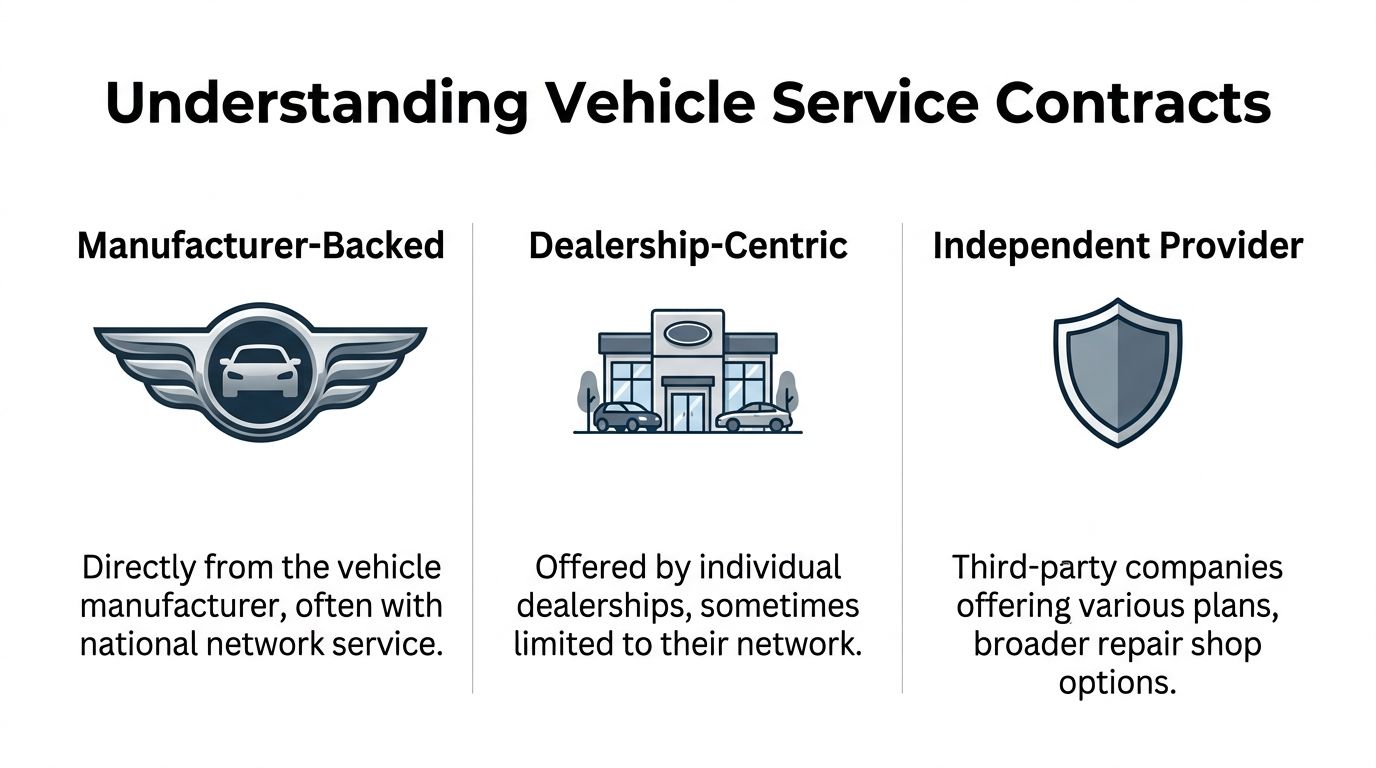
The three buckets buyers actually face
Most extended warranty options fit into these lanes:
- Manufacturer-backed plans that stay closest to the original factory warranty experience
- Dealership-sold contracts that may be tied to one dealer group or a limited service network
- Third-party contracts sold by independent providers with broader variation in quality
The pitch makes them sound similar. They're not.
If you're buying a used vehicle with a strong reputation for dependability, start with the vehicle class before you even look at service contracts. Lists of best used cars for reliability can help you avoid buying a car that practically requires extra coverage just to sleep at night.
Practical rule: Don't buy a warranty first and then justify the car. Buy the car first, based on its history and reliability, then decide whether the risk still needs to be insured.
When it's smart
A warranty makes more sense when the vehicle is older, more complex, or expensive to fix, and when you don't want to absorb a sudden repair bill yourself. It also makes sense when the car's history raises concern. Prior accident damage, repeated ownership turnover, title issues, or mileage inconsistencies all increase uncertainty.
When it's a costly gamble
It's a bad buy when you're paying for broad coverage on a vehicle with a low-risk history and enough personal cash reserve to handle repairs. It's also a bad buy when you haven't checked the contract administrator, the exclusions, or the claim process.
A lot of “peace of mind” products sell anxiety relief, not value. If the vehicle doesn't justify the premium, skip it. If the contract isn't clear, skip it faster.
Decoding the Main Types of Vehicle Service Contracts
Think of these contracts like health coverage models. Some are tight-network, predictable, and easier to trust. Others offer more flexibility but require more scrutiny.
Manufacturer-backed plans
These are the closest thing to factory warranty continuity. If you're buying a newer vehicle from Toyota, Ford, Honda, or another major brand, this option usually gives you the cleanest ownership experience.
You're typically dealing with the automaker's authorized repair network, standardized claims handling, and fewer surprises about where work can be done. That's the upside.
The downside is flexibility. You may pay more, and you usually won't get the same freedom to shop outside the brand's network.
Dealership-centric contracts
These live in the gray zone. Some are solid. Some are overpriced store products wrapped in urgency.
A dealership contract can work if the terms are clear, the administrator is reputable, and the dealer's service department is strong. But some of these plans subtly tie you to a narrow repair path, or they make cancellation, reimbursement, or claim approval harder than expected.
Here's the key question: If your transmission fails, who authorizes the repair and who pays the shop? If the salesperson can't answer that cleanly, walk.
Independent third-party contracts
These are the widest category and the hardest to judge. Some offer broad repair-shop choice and useful coverage. Others are all marketing.
The flexibility is attractive. A good third-party contract may let you use more repair facilities and choose a plan that fits an older or higher-mileage car better than a factory plan would. But your experience depends heavily on the administrator and the fine print.
The broader the promise, the more carefully you need to read exclusions, labor rules, prior authorization requirements, and claim procedures.
Coverage type matters as much as provider type
The provider category tells you who's behind the contract. The coverage structure tells you what kind of protection you're buying.
According to CarShield's explanation of what extended warranties cover, bumper-to-bumper extended warranties cover nearly all vehicle systems, whereas powertrain warranties offer longer coverage durations, up to 10 years or more, for critical parts like the engine, transmission, drive shafts, transfer case, differential, and axles. Those plans also exclude routine maintenance like oil changes, tire rotations, and wiper replacements.
Here's the practical comparison:
| Contract type | Best for | Main advantage | Main risk |
|---|---|---|---|
| Manufacturer-backed | Newer vehicles | Cleaner claims process | Less flexibility |
| Dealership-centric | Buyers who trust one dealer group | Can bundle convenience | Markup and narrow service path |
| Independent provider | Older cars, broader shop choice | More plan variety | Quality varies sharply |
What Do Extended Warranties Actually Cover and Cost
Most buyers ask the wrong first question. They ask, “What's your best warranty?” The right question is, “What am I paying, what's covered, and what repair risk am I shifting off my back?”

What coverage usually looks like
One market breakdown states that extended warranty plans typically cover 127 major vehicle components on average, with three common tiers: Basic, Plus, and Best, and monthly prices ranging from $65 to $125 depending on vehicle type and plan level, with a 30-day money-back guarantee included in those plans in the example discussed on this vehicle service contract overview.
That tier structure is simple enough:
- Basic usually centers on the core drivetrain and major mechanical systems
- Plus adds systems that fail less often but still hurt when they do
- Best moves toward near-total coverage, closer to exclusionary protection
The more useful way to think about it is financial exposure. If your concern is catastrophic failure, a powertrain-style plan may be enough. If you're buying a feature-heavy truck or SUV loaded with electronics, climate components, and suspension complexity, broader coverage may be justified.
What it costs in the real market
Insurify reports that in 2026, the average cost of an extended auto warranty is approximately $90 per month, with typical market rates between $70 and $100 per month, while major component failures can average $4,200 to repair in its breakdown of extended auto warranty cost.
That's the key tradeoff. If you're paying years of premiums for a car that's unlikely to generate a claim, the math gets ugly. If one serious failure would wreck your budget, the premium may be worth it.
Real quotes matter more than brochure language
These examples show how wildly pricing can move:
- For a 2026 Toyota Tundra Platinum, one buyer reported a dealer quote for a 6-year/125,000-mile extended warranty at $4,000, while another quote for a 10-year/100,000-mile Toyota Platinum plan came in around $1,550 through volume-based dealership promotions, based on this Toyota Tundra owner discussion.
- For Ford's 8-year/100,000-mile extended warranty in 2026, pricing was reported in a range from $2,500 to $4,499, and one dealership example listed a 7-year/100,000-mile plan at $2,500, according to this Ford warranty pricing discussion.
That spread tells you something important. Shopping the contract matters almost as much as shopping the car.
A warranty quote without comparison shopping is like accepting the first repair estimate. Convenient, yes. Smart, no.
If you're used to evaluating protection products in other industries, the same logic applies here. A useful comparison mindset also shows up in products like insurance plans for contractor's specialized equipment, where value depends on matching coverage to asset risk instead of buying the broadest option by default.
How Vehicle History Determines Your Warranty Needs
Most advice on extended warranty options often falls apart. It treats every car as if it starts from the same baseline. It doesn't.
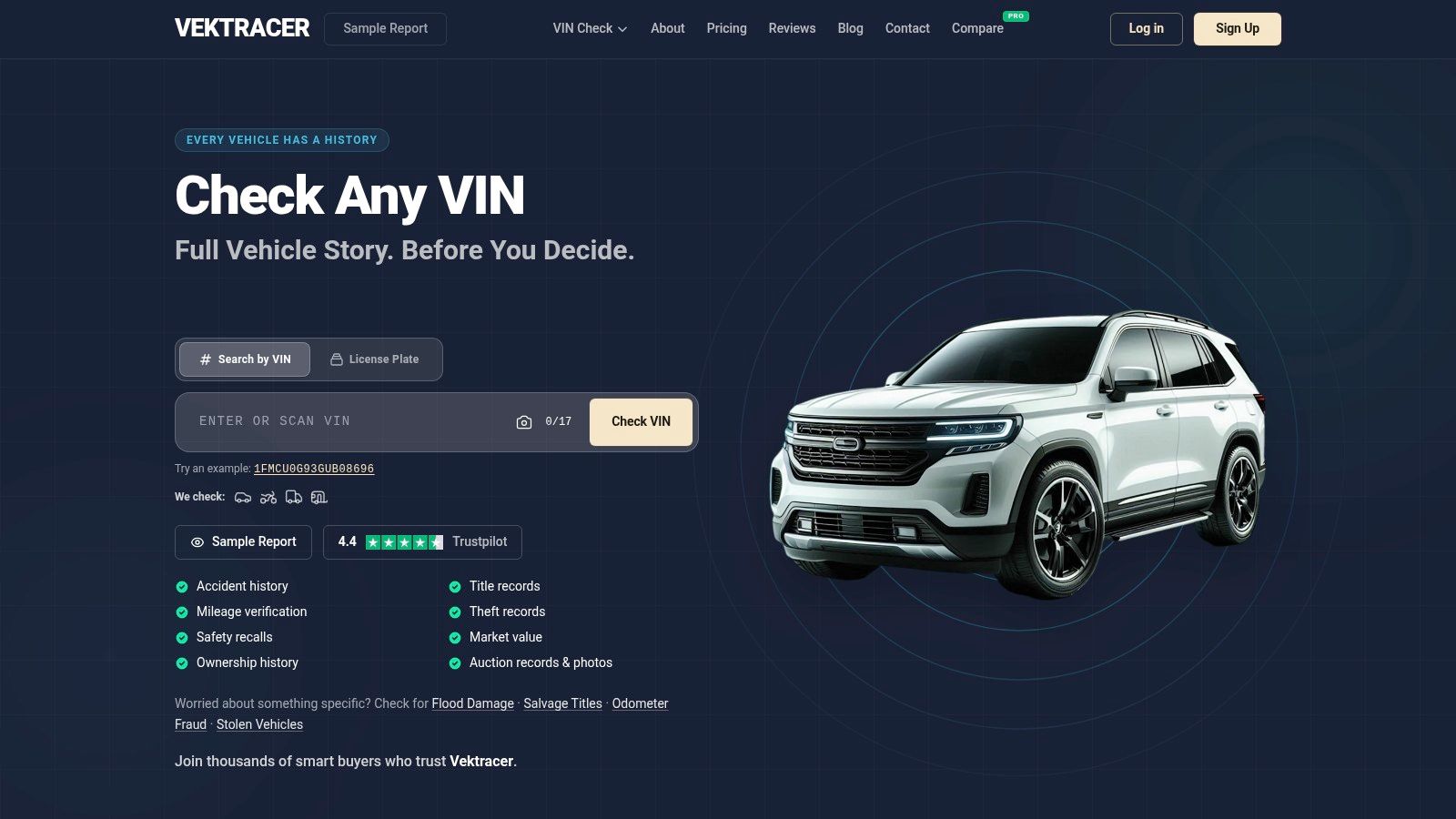
A warranty decision should begin with the vehicle history report. Not with the finance office script. Not with a sales page full of “platinum” branding. With the VIN.
What a clean history usually means
A later-model vehicle with one owner, no accident history, consistent mileage records, and no title issues is a very different risk than a vehicle that's been through multiple hands and body shops.
That's why a vehicle history report matters before you compare contracts. It changes the question from “Which warranty is best?” to “Does this specific car justify buying one at all?”
If the history is clean and the model is known for reliability, you may be better off skipping extensive coverage and keeping your money liquid for future repairs. Broad coverage on a low-risk car often turns into prepaid anxiety relief.
What a messy history usually means
Now flip it. A used vehicle with prior collision damage, repeated resale, title inconsistencies, open recalls, or signs of hard commercial use deserves a more defensive approach.
That doesn't automatically mean “buy the most expensive plan.” It means your warranty choice should follow the actual risk pattern:
- Higher structural or repair complexity risk points toward stronger coverage
- Higher documentation risk means you should read exclusions with extra care
- Higher ownership uncertainty makes a reputable administrator more important than a flashy plan name
Buy warranty coverage the way you buy insurance on any asset. Base it on the documented chance of loss, not the salesperson's fear script.
Use the report to choose the type, not just yes or no
A cleaner car may only justify a narrower powertrain contract, or none at all. A riskier car may justify a bumper-to-bumper style plan if the administrator is solid and the exclusions aren't loaded against you.
That's also where compare tools become useful. If you're choosing between two similar vehicles, small differences in accident history, title status, and mileage consistency can change whether the warranty is smart on one car and wasteful on the other.
If you haven't run a VIN check yet, do that before you spend another minute comparing warranty brochures.
Red Flags and Warranty Scams to Watch Out For
The most dangerous warranty mistake isn't buying too little coverage. It's buying a contract from the wrong company and finding that out only after the breakdown.
Stop focusing only on the seller
The seller may be a dealer, a call center, or an online brand. That's not the part that matters most. The administrator matters. The administrator is the company that decides whether your claim gets approved and how payment happens.
The Federal Trade Commission's consumer guidance on extended warranties and service contracts highlights a critical problem: 30% of extended warranty complaints stem from denied claims or slow reimbursement, and 40% of buyers skip checking the administrator's track record. The same guidance-based data says buyers should prioritize administrators with 20+ years of history and an A BBB rating, because they have a significantly higher claim-payout rate.
That's the filter. Not the logo on the brochure. Not the salesperson's confidence level.
Common warning signs
Watch for these patterns:
- Urgency pressure: “Today only” pricing is usually there to stop you from reading.
- Robocall language: If you're hearing about your “expiring factory warranty” from a random caller, assume nonsense until proven otherwise.
- Vague exclusions: If the contract doesn't spell out what isn't covered in plain language, expect friction later.
- Reimbursement traps: Some plans force you to pay first and fight for repayment after.
- Repair authorization games: If the shop has to wait on a slow third party, your car can sit while the claim stalls.
The history report still helps here
A contract dispute gets worse when the car itself has a questionable paper trail. Odometer issues, undisclosed prior damage, or title irregularities can create room for finger-pointing when a claim appears.
That's why checking for mileage anomalies matters before you ever buy coverage. A guide on how to check for odometer rollback is worth reviewing if the numbers on the dash and the paper trail don't line up cleanly.
If the administrator is hard to identify, hard to research, or hard to question before purchase, they'll be even harder to deal with after a breakdown.
Your Final Decision Checklist Before Signing
Consumers don't need more warranty marketing. They need a short list of questions that cuts through it.
Questions to ask the provider
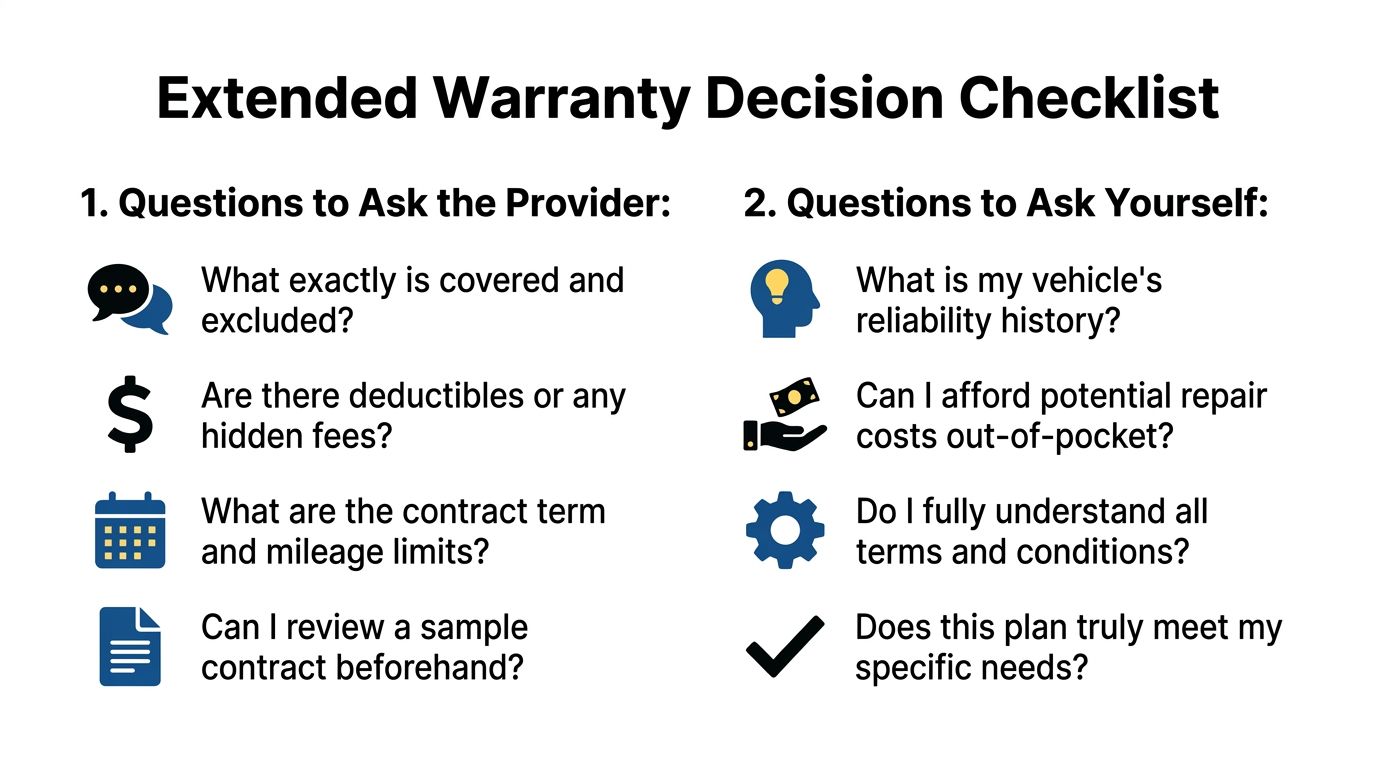
Don't ask, “Is this a good warranty?” Ask questions that force specifics.
- Who is the administrator: Get the exact company name in writing, not just the brand that sold you the contract.
- What is excluded: Ask for the exclusion list before you ask about monthly payment.
- How are claims paid: Direct payment to the shop is cleaner than reimbursement after the fact.
- Where can repairs be done: National flexibility matters if you travel or move.
- Can I read the sample contract first: If they won't show it before payment, that's enough reason to leave.
Questions to ask yourself
This part matters more than the pitch.
- What does the vehicle history tell me: If you haven't reviewed title, accident, mileage, and ownership records, you're guessing.
- Could I handle a large repair bill without stress: If the answer is no, a strong contract may buy real budget stability.
- Am I keeping this vehicle long enough: Short ownership changes the math.
- Does the car's reputation support self-insuring instead: Some vehicles justify a repair fund more than a contract.
For a broader pre-purchase review, this checklist on what to check when buying a car helps frame the warranty decision inside the bigger buying decision.
Don't ignore transferability math
Most buyers hear “transferable” and assume that's automatically a plus. It isn't.
NEAMB's consumer guidance on questions to ask before buying an extended vehicle warranty makes the better point: if the warranty's remaining cost and transfer fee exceed 15% of the car's current value, transferring it is rarely cost-effective for short-term owners.
That's the kind of calculation buyers skip. They focus on whether transfer is allowed, not whether transfer makes financial sense.
One more practical filter
Sometimes the best decision comes from talking through edge cases with someone who deals in risk products every day, especially if you're comparing several protection options at once. The logic behind finding the right insurance for Floridians applies here too. A real conversation often reveals exclusions and tradeoffs that online checkout flows hide.
Frequently Asked Questions About Extended Warranties
Can you buy an extended warranty after you already bought the car
Yes, often you can. But waiting usually reduces your best options. Coverage availability and pricing tend to depend on the vehicle's age, mileage, and condition. If you wait until the car is older or starts showing problems, you may face fewer plan choices, stricter exclusions, or higher prices. If you're considering post-purchase coverage, get quotes before the car crosses major age or mileage thresholds.
Do extended warranties cover oil changes, tires, and routine maintenance
Usually no. Routine maintenance is generally excluded. That includes common items like oil changes, tire rotations, and similar wear-and-tear services. Some plans may offer separate maintenance add-ons, but don't assume a service contract works like a prepaid maintenance package. Read the exclusions first.
Is a warranty worth it on a high-mileage vehicle
Sometimes, but only if the contract is still priced rationally and the administrator is credible. A high-mileage car with questionable history can justify protection if you're trying to cap downside risk. But that same car can also be the easiest place to overpay for narrow coverage loaded with exclusions. On older vehicles, the exact contract language matters more than the sales pitch.
Which is better, bumper-to-bumper or powertrain
Neither is “better” in the abstract. They solve different problems. If your biggest fear is catastrophic engine or transmission failure, powertrain coverage may be enough. If you're buying a feature-heavy vehicle with expensive electrical, steering, suspension, or climate-control systems, broader protection may fit better. The smarter choice depends on the car's actual risk profile, not the most impressive plan name.
Is Carfax worth it when deciding on a warranty
A vehicle history report is worth it if it helps you avoid buying the wrong car or the wrong coverage. Buyers searching for Carfax worth it, vehicle history report, VIN check USA, VIN check Canada, or Carfax pricing 2026 are usually asking the same underlying question: “How much uncertainty am I removing before I commit money?” That's the right question. The warranty decision gets easier once the vehicle's documented risk is clear.
If you want to decide on a warranty based on the car's actual paper trail instead of sales pressure, start with VekTracer. A VIN report, risk score, and side-by-side comparison can tell you whether you're looking at a low-risk car that doesn't need extra coverage or a higher-risk one where a carefully chosen contract makes sense.
Ready to check a vehicle?
Enter any 17-character VIN for a free instant preview — no account needed.