What to Check When Buying a Car: A 10-Point Checklist
Check a vehicle before you buy
Enter a VIN for a free instant preview — accidents, title brands, mileage, liens & open recalls.
You're probably doing what most used-car buyers do right now. Opening listings, comparing prices, zooming in on glossy photos, and wondering whether the “clean” car in front of you is clean once the paperwork and mechanical reality catch up. That's exactly where people get burned. The car looks right, the price feels close enough, and they only start checking the hard stuff after they've already fallen for it.
If you want the short answer to what to check when buying a car, start with the VIN-based facts before the test drive, then confirm the car's real condition in person. Check history, title, odometer, theft status, recalls, financing exposure, and seller paperwork first. Then inspect the body, tires, fluids, electronics, brakes, and how it drives. That order matters because it saves time and keeps you from spending an afternoon inspecting a car you should've rejected in five minutes.
That approach matters even more in a market this big. In the U.S., there were over 16,500 franchised dealerships selling 17.22 million vehicles in 2018, and total new-vehicle sales topped $1 trillion, which is a good reminder that buyers are operating in a huge, fast-moving market where paperwork problems and hidden issues can get missed if you rush (CBT News dealership statistics). Kelley Blue Book also says over 80% of car shoppers don't know exactly which new or used car they want next, which means many people are comparing multiple cars without full background information on any of them. That's how bad deals stay alive.
A solid process fixes that. Use this 10-point checklist to screen a car before you get emotionally invested, then use the hands-on inspection to decide whether it's worth your money, your insurance premium, and your future repair bills.
1. Vehicle History and Accident Report Review
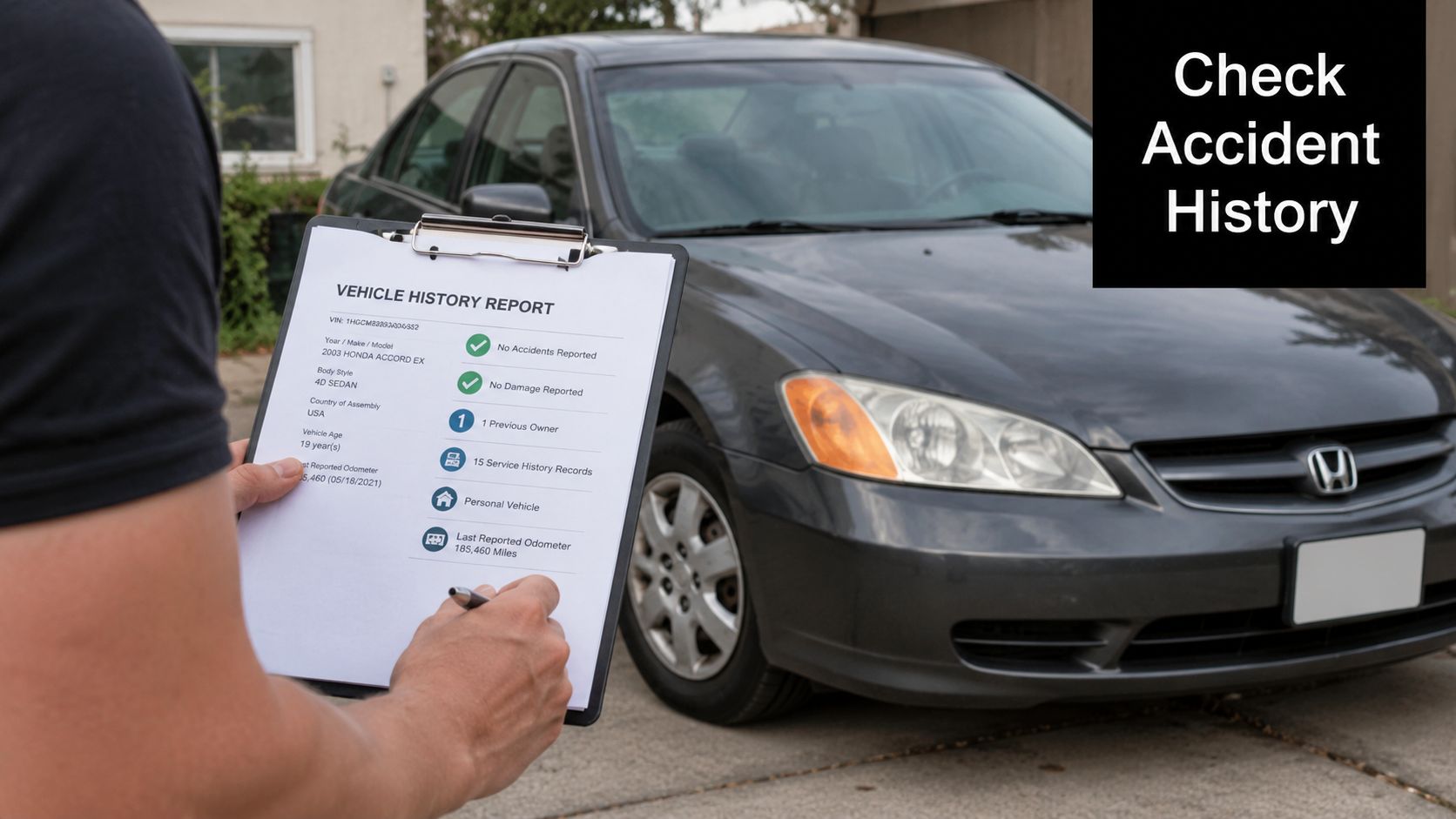
You find a clean-looking used car, the photos look right, and the price is close enough to keep your attention. That is the point where buyers waste time. Screen the VIN first, then decide whether the car deserves an in-person inspection.
A used car's story often shows up in the records before you can spot it on a walkaround. If I'm helping someone shop, I pull the history before we talk ourselves into the car. Accident history is not just about whether something happened. It is about what happened, how serious it was, whether the repair trail makes sense, and whether the asking price still fits the risk.
What the report should tell you
A proper vehicle history report should show prior accidents, damage entries, title problems, liens, theft records, and mileage-related flags before you ever set up a meeting. VekTracer's Risk Score is useful at this stage because it helps sort obvious rejects from cars that deserve a closer look. That saves time, especially when you are comparing several listings that all sound clean in the ad.
Do not stop at the word "accident." Check where the car was hit, whether airbags deployed, whether the damage was listed as structural, and whether there is any sign of flood exposure or salvage-related activity. A light rear bumper claim is a different conversation from front-end damage followed by inconsistent title history.
One simple test works well. Compare the seller's description to the report. If the listing says "never damaged" and the VIN file shows a collision entry, you have already learned something important about the seller and the car.
Practical rule: If a seller minimizes recorded damage, inspect the repair quality with extra skepticism.
For a closer look at what accident entries can reveal, read this guide on reviewing accident history by VIN before buying.
How to read the red flags correctly
Some history problems are manageable. Some are expensive. Older cosmetic damage with clear repair records can still make sense if the car drives right, the bodywork is straight, and the price reflects the history.
The combinations are what matter. Structural damage plus vague paperwork is a bad sign. Repeated collision entries over a short period can point to hard use or poor repairs. A long gap between a damage event and later title activity deserves a closer look too, especially if the seller has no paperwork to explain it.
I have seen cars that felt fine on a short test drive but showed obvious clues of previous repair once we looked closer at welds, headlight alignment, overspray, and uneven panel gaps. The report does not replace a hands-on inspection. It tells you where to focus and which cars are not worth the trip at all.
2. Odometer Reading and Mileage Verification
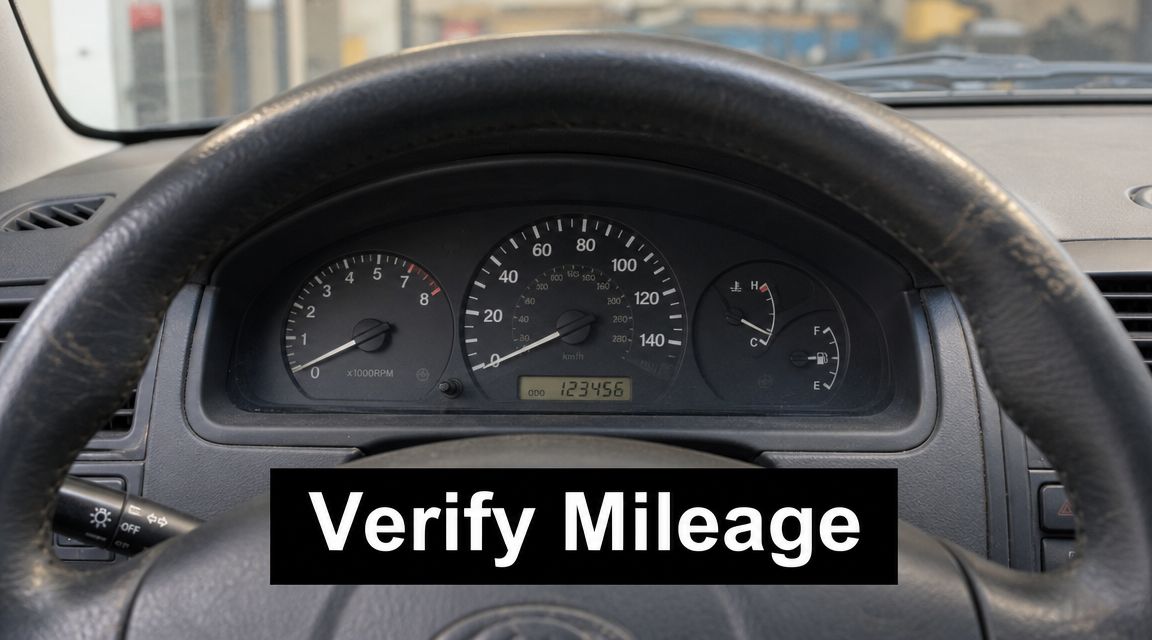
Mileage matters, but only if it's believable. An odometer reading by itself doesn't tell you much. What you need is a mileage story that makes sense across service visits, registration records, inspection records, and the car's physical wear.
This is one of the easiest places for buyers to get fooled because a lower number feels safer. It isn't, unless the supporting records line up.
How to sanity-check the mileage
Start simple. Compare the odometer reading to the condition of the driver's seat, steering wheel, pedals, shift knob, and door handles. If the car claims light use but those touch points are badly worn, something deserves a closer look.
Then compare the reading against whatever service paperwork exists. Oil-change stickers, maintenance receipts, and shop invoices often tell a more honest story than the dashboard does. If the miles jump oddly, freeze for a while, or seem to move backward between records, that's a major red flag.
Use a VIN tool that specifically checks for mileage inconsistencies and rollback patterns. This walkthrough on how to check for odometer rollback is worth reading before you inspect a car.
A car can have low displayed mileage and still be a high-wear vehicle. The seat, pedals, and service trail usually give it away.
Real-world red flags
A common scenario is a car that looks presentable in photos, has an attractive mileage claim, and even drives okay on a short route. Then you notice the driver's bolster is flattened, the brake pedal rubber is heavily worn, and the service receipt in the glovebox shows a much higher mileage from years earlier. At that point, the burden shifts to the seller to explain it.
What works is combining records with your own eyes. What doesn't work is trusting one dashboard number or one listing description. Mileage fraud changes value, maintenance timing, and the likelihood of expensive repairs. If the odometer story doesn't hold together, move on.
3. Title Status and Ownership Verification
A car can be mechanically decent and still be a bad purchase if the title isn't clean or the seller doesn't have the legal right to sell it. Buyers often leave this until late in the process because title questions feel administrative. They're not. They're ownership, registration, and resale problems waiting to happen.
Before money changes hands, the seller's name should match the title or the dealership paperwork should clearly show legal authority to sell the vehicle. If it doesn't, stop and sort that out before doing anything else.
The title problems that matter most
You're checking for branded title status, salvage or rebuilt history, and any active lien. A lien means a lender may still have a legal claim on the vehicle. A branded title tells you something significant happened in the car's past, often involving major damage or an insurance total loss process.
Use a VIN check to verify title status before the test drive, not after. This guide on how to check vehicle title status covers the basics.
A title issue doesn't always mean fraud, but it always means more work. Sometimes the seller really is waiting on paperwork. Sometimes they financed the car and haven't cleared the lien. Sometimes the listing leaves out a branded-title history because they know many buyers won't ask soon enough.
Trade-offs buyers should understand
A rebuilt-title car may be cheaper. That's the appeal. The trade-off is that the discount often follows you for the entire time you own it. Insurance, financing, resale, and buyer confidence can all get harder.
If you're considering one anyway, be stricter, not looser. You need better documentation, stronger repair records, and a more careful mechanical inspection than you'd demand on a clean-title car.
- Match names carefully: The seller's ID, title, and bill of sale should line up.
- Ask about liens directly: Don't accept vague answers like “that should be cleared soon.”
- Read title branding exactly: If the title carries a designation, don't let the listing language soften it.
4. Theft Records and Recovery Status Check
A stolen vehicle problem can wipe out an otherwise good deal fast. Most buyers don't think about this because they assume theft status is something only dealers worry about. It isn't. If a vehicle has been reported stolen, recovered, or tangled up in questionable paperwork, you can end up with legal trouble, registration trouble, or both.
This is one of those checks that feels unnecessary right up until it saves you.
Why this check matters early
Theft screening belongs near the start of your process, along with title and accident review. If a car is flagged in theft records, or if the VIN history raises questions about recovery status, you don't want to waste time arranging inspections and financing.
The seller's behavior often gives you clues. A private seller who won't meet at their home, wants cash only, rushes the sale, or prices the car suspiciously low may be disorganized. Or they may be someone you shouldn't be doing business with.
If the seller is hard to verify, the car is hard to trust.
What to look for beyond the database check
A theft-record search is the first layer. The second layer is consistency. Does the VIN match all documents? Does the seller have registration paperwork that makes sense? Do their answers about ownership line up with the record trail?
Recovered-theft vehicles deserve extra caution even when they're legally back in circulation. Some come back with interior damage, wiring problems, missing modules, or rough repairs after parts were stripped or locks were forced. That kind of damage may not show up in a quick walkaround.
What works is combining theft status, title verification, and seller identity checks into one decision. What doesn't work is saying, “It's probably fine because it's being sold publicly.” Public listings aren't proof of legitimacy. They're just ads.
5. Open Recall and Safety Issue Investigation
A car can look excellent and still have an unresolved safety defect. That's why recall checking should happen before the test drive, not as an afterthought after you've already negotiated the price.
This point gets overlooked because many buying guides focus heavily on visible condition. Tires, paint, leaks, and electronics matter, but they don't tell you whether the vehicle has an open safety campaign tied to its VIN.
Check recalls separately from inspection
Mainstream inspection checklists often underplay this step, even though VIN-level recall checking and vehicle history reports are important pre-purchase tools for surfacing safety defects, title problems, prior accidents, service points, and ownership history (Habberstad BMW buying guide). That's the practical gap many buyers miss. They inspect what they can see and forget to verify what the manufacturer already identified as a problem.
Use the VIN to check recall status directly. Then ask the seller for proof that recall repairs were completed if they say the issue was handled. If they can't show it, assume it still needs attention until you verify otherwise.
What to do if a recall is open
An open recall doesn't automatically kill the deal. The right response depends on the defect, the vehicle, and whether the repair is straightforward. Some recalls are relatively simple to complete. Others involve parts delays, drivability concerns, or safety issues serious enough that I wouldn't hand over money until the work is done.
Use the open recall as a decision point:
- If it affects safety systems: Wait for repair confirmation before buying.
- If the seller says it's fixed: Ask for service documentation, not verbal reassurance.
- If parts aren't available yet: Decide whether you're comfortable owning the problem while you wait.
This is also where a VIN-first workflow helps. You can screen out risk before spending your Saturday on a car that should never have made your shortlist.
6. Vehicle Inspection and Mechanical Condition Assessment
History tells you what happened. Inspection tells you what the car is today. You need both.
I've seen clean-history cars with neglected maintenance, dry-rotted tires, leaking shocks, and transmissions that clearly weren't happy. I've also seen vehicles with older damage history that were repaired well and maintained properly. That's why the physical inspection still carries serious weight.
What to inspect yourself before paying a mechanic
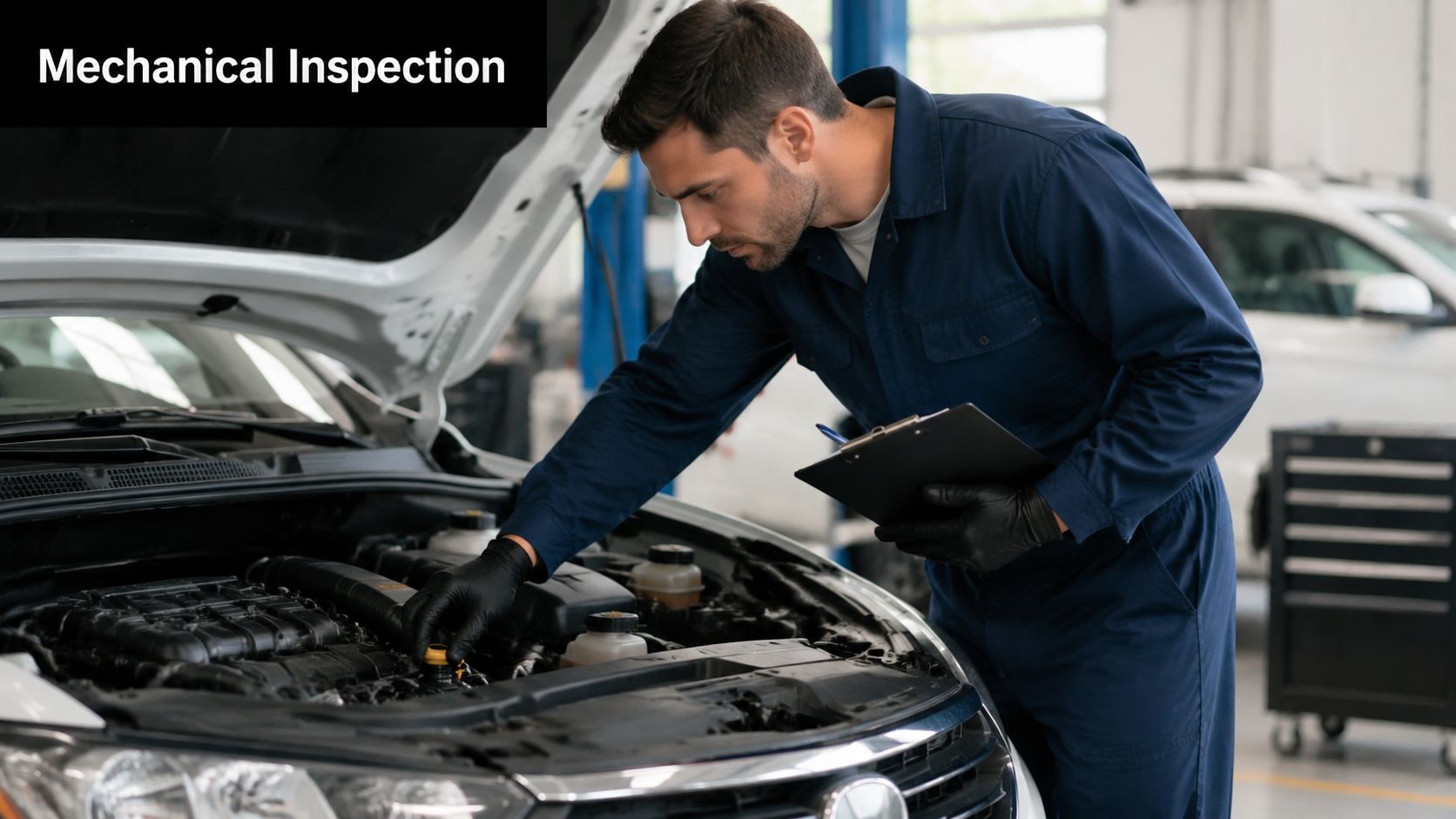
Before you book a pre-purchase inspection, do your own first pass. Walk around the car in daylight and check body-panel gaps, paint match, rust, and tire condition. Open the hood and look for leaks, cracked hoses, low fluids, and anything that looks recently cleaned in a suspiciously selective way.
Then drive it long enough to expose behavior. Don't just circle the block. Test low-speed turns, braking, acceleration, highway speed, and a rough patch of road if possible.
A useful background read is this article on why a car won't start and related issues, because starting, battery, and electrical symptoms often show up during a used-car inspection in ways buyers dismiss too quickly.
When a professional inspection is non-negotiable
If the car has accident history, unusual noises, warning lights, fluid leaks, rough shifting, or seller explanations that don't quite add up, get an independent mechanic to inspect it. Not the seller's friend. Not the shop next door to the lot unless you trust them. Someone who works for you.
Ask for a written list of findings and estimated repairs. That gives you an advantage. What's more, it tells you whether the “good deal” only works because the next owner is about to inherit brakes, tires, suspension work, or a cooling-system problem.
Shop-floor view: A smooth test drive can hide a lot. A lift, a flashlight, and a mechanic with no stake in the sale usually can't.
Tools like VekTracer's Risk Score can help you decide which cars deserve an inspection first. That's useful when you're comparing several candidates and don't want to pay for a full inspection on every single one.
7. Market Value and Price Comparison Analysis
A used-car price only means something in context. Buyers get in trouble when they anchor too hard to one listing, one “fair price” badge, or one seller's story about how much interest the car is getting.
The better approach is to benchmark the car against the current market, then compare several listings with the same year, trim, mileage range, and condition. You're not trying to find the cheapest car online. You're trying to find out whether this specific car is priced like a clean, well-kept example or like one with hidden baggage.
Use live market signals, not gut feel
Market pricing moves. CarGurus says its Pricing Index tracks millions of used-car prices and reported a month-over-month increase of 1.5% in its latest snapshot, while CarEdge's 2025 trend guide says retail and wholesale used-car prices are falling and cites an average used-car listing price of $25,512 in October 2025 (CarGurus used-car price trends). The exact takeaway for a buyer is simple. Don't trust stale pricing assumptions. Check a live index, then compare the vehicle against several current listings.
That comparison tells you more than a seller's phrase like “priced to move.” If one vehicle is noticeably cheaper than similar examples, there's usually a reason. It may be harmless, like cosmetic wear or a private-sale discount. It may also be title trouble, poor repairs, missing service history, or looming mechanical work.
How to compare without fooling yourself
Try to compare like with like:
- Match trim and drivetrain: A base model and a higher trim aren't equal just because the year matches.
- Adjust for condition: Tires, interior wear, accident history, and maintenance records all affect value.
- Price the total deal: Include taxes, fees, financing terms, and immediate repairs.
If you're evaluating trade-in or replacement value at the same time, this overview on how to recover true car value with SnapClaim can help frame the discussion.
What works is using pricing data to support negotiation. What doesn't work is chasing the lowest asking price and assuming you won. A cheap car with bad paperwork or deferred maintenance often becomes the expensive one.
8. Insurance History and Claim Records Verification
Insurance history adds context that buyers often skip. A claim record can reveal how often the car has had trouble, what kind of trouble it was, and whether the pattern fits the seller's version of the vehicle's past.
This is especially useful when the listing sounds unusually clean for the age and condition. If the report suggests multiple damage events or a total-loss path in the past, that changes how I read the rest of the file.
What claim history can tell you
Claim records can support or challenge what you already found in the accident and title sections. A car with one older, well-documented incident may still be a reasonable buy. A car with repeated claims, vague repair history, and cosmetic freshening right before sale deserves more skepticism.
I pay close attention to patterns. Several claims clustered in a short period can suggest a rough ownership chapter, repeat damage, or persistent problems that the seller may not explain clearly.
Don't separate insurance risk from buying risk
This isn't just historical curiosity. It can affect what you pay after the purchase. Before you commit, get an insurance quote on the exact vehicle you're considering. If the car's history or branding changes the premium or coverage options, you want to know now.
A practical conversation with the seller sounds like this: What happened, who repaired it, and what paperwork do you have? If they become evasive on basic claim questions, that usually tells you enough.
What works is using claim history as a context check. What doesn't work is assuming “it looks fixed” means the financial and risk side of the vehicle is behind it. Sometimes it is. Sometimes it isn't.
9. Service Records and Maintenance History Review
A thick folder of service records doesn't guarantee a great car. But a complete absence of maintenance paperwork should make you cautious, especially if the seller is claiming careful ownership.
Maintenance history helps answer a simple question. Did someone stay ahead of problems, or did they just keep the car alive long enough to sell it?
The pattern matters more than one receipt
You're looking for consistency. Regular oil changes, routine wear-item replacements, and documented repairs done as needed are all good signs. Long gaps followed by a burst of recent work can mean the seller is trying to make the car presentable after a period of neglect.
Cross-check service records with the VIN report and odometer reading. If the paperwork supports the mileage and the repair story, confidence goes up. If records are missing or conflict with the reported use, confidence drops fast.
Service records don't need to be perfect. They do need to make sense.
What to ask the seller directly
Ask for receipts, not summaries. “I just serviced it” isn't useful unless you can see what was done. If a seller says major work was completed recently, ask where it was done and whether there's documentation.
Watch for these situations:
- Recent major repairs right before sale: Sometimes good, sometimes a sign the owner wants out before the next issue.
- Repeated work on the same system: Could indicate an unresolved problem.
- No records but strong claims: Treat that as unverified.
A well-maintained high-mileage car can be a better buy than a lower-mileage car with no maintenance trail. That's one of the most useful truths in used-car shopping, and buyers who understand it usually avoid a lot of expensive mistakes.
10. Vehicle Identification Number and Authenticity Verification
The VIN ties the whole deal together. If the VIN is wrong, mismatched, altered, or inconsistent across documents and the vehicle itself, nothing else matters until that's resolved.
This is one of the last checks many buyers do because it seems obvious. The problem is that obvious things are often skipped when a deal starts moving fast.
Match the VIN everywhere
Check the VIN on the dashboard, door jamb, title, registration, insurance paperwork, and any report you ran. They should all match exactly. Then make sure the VIN decode aligns with the actual vehicle. Year, make, model, engine, and key features should make sense together.
This step matters for buyers searching across regions too. Whether you're comparing VIN check USA options, need a VIN check Canada, or want to compare providers against Carfax alternatives and comparisons, the principle is the same. The VIN has to match the car in front of you and the records attached to it.
Signs of tampering
Most VIN plates look boring, and that's good. You should get suspicious if the VIN plate appears disturbed, the rivets look unusual, labels seem replaced, or one document shows a character that doesn't match the others.
A common real-world problem is the simple mismatch. The seller sends one VIN in messages, but the windshield plate on the car differs by a character. Sometimes it's a typo. Sometimes it isn't. Slow down and resolve it before discussing deposits, financing, or transport.
A VIN check is quick. Untangling a bad VIN situation isn't. This is one of the highest-value low-effort checks in the whole process.
10-Point Car Buying Checklist Comparison
| Check | 🔄 Implementation complexity | ⚡ Resource requirements | ⭐ Expected outcomes | 📊 Ideal use cases | 💡 Key advantages / Tips |
|---|---|---|---|---|---|
| Vehicle History and Accident Report Review | Moderate, aggregate multi-source records | Database access, paid report services | Reveals reported accidents, damage severity and repair history | Pre-purchase screening and negotiation | Cross-reference sources; follow up with inspection if incidents found |
| Odometer Reading and Mileage Verification | Moderate, pattern analysis & rollback detection | DMV/service records, historical mileage data | Detects odometer tampering and inconsistent mileage | Any vehicle with unusual mileage or incomplete records | Compare wear patterns to mileage; verify multi-state titles |
| Title Status and Ownership Verification | Low–Moderate, legal/title checks | DMV/NMVTIS access, title documents | Identifies liens, salvage/rebuilt brands, and ownership issues | Any used purchase before transfer of ownership | Always inspect the actual title; verify seller name and lien status |
| Theft Records and Recovery Status Check | Low, VIN cross-checks vs theft databases | National theft registries, VIN lookup tools | Flags stolen/recovered vehicles and associated risks | Low-priced deals or sellers with limited provenance | Run checks on every VIN; verify seller identity and documentation |
| Open Recall and Safety Issue Investigation | Low, recall database matching | NHTSA/manufacturer recall databases | Identifies outstanding safety recalls and repair needs | Safety-conscious buyers and older model years | Confirm recall repairs completed; negotiate or delay purchase if open |
| Vehicle Inspection and Mechanical Condition Assessment | High, hands-on mechanical evaluation | Qualified mechanic, time, inspection fee | Detects current mechanical faults and wear not in records | High-mileage, older vehicles, or those with history flags | Use independent mechanic; obtain detailed written report and repair estimates |
| Market Value and Price Comparison Analysis | Moderate, market and comparable analysis | Listing data, valuation tools (KBB/NADA), time | Establishes fair market price and regional variances | Price negotiation and cross-region purchases | Compare multiple platforms and factor in condition/mileage |
| Insurance History and Claim Records Verification | Moderate, claim frequency/severity review | Insurance claim databases, report services | Reveals patterns of prior claims and potential risk | Vehicles with multiple incidents or unknown history | Look for recurring issues; request repair documentation |
| Service Records and Maintenance History Review | Low–Moderate, document collection & analysis | Dealer/independent shop records, receipts | Shows maintenance consistency and major repairs performed | Assessing prior care and remaining component life | Cross-check records with mileage; be wary of large gaps |
| VIN Verification and Authenticity | Low, format + physical checks | VIN lookup tools, physical inspection of VIN locations | Confirms VIN authenticity and detects cloning/tampering | Every used vehicle transaction | Inspect VIN at multiple locations and match all documents |
From Checklist to Confident Purchase
A good used-car purchase usually comes down to discipline, not luck. The buyers who avoid bad deals aren't always the ones who know the most about engines or bodywork. They're the ones who follow a repeatable process and don't let excitement push them past the red flags.
That process starts before the test drive. Screen the car by VIN first. Check accident history, title status, liens, theft records, mileage consistency, and open recalls. That early filter saves time and keeps you from investing energy in vehicles that already have too many questions attached to them. It also helps you compare cars more accurately when several listings look similar on the surface.
Then confirm the present-day condition with your own inspection and, when needed, a professional pre-purchase inspection. These inspections help buyers separate cosmetic shine from real condition. Paint correction, a clean interior, and fresh detailing can make almost anything look cared for. What matters more is whether the suspension is tight, the transmission shifts cleanly, the brakes are healthy, the tires wear evenly, the cooling system is stable, and the car shows no signs of hidden structural or electrical trouble.
Financing deserves the same practical mindset. Industry reporting says improving inventory and lower OEM costs are bringing back financing incentives, but 0% APR offers remain rare for used cars and are more common on newer models and high-credit buyers, while longer loan terms and deferred-payment options are becoming more common (used car market trends for buyers). That's why I always tell buyers not to judge affordability by the monthly payment alone. Use pre-approval and payment calculators, and price the whole deal, not just the sticker.
If you're deciding between several candidates, put them side by side and compare the risk, not just the color and asking price. One car may be slightly cheaper but carry weaker service records, prior damage, open recalls, or title concerns. Another may cost a bit more up front but be cleaner where it counts. In practice, the second car is often the cheaper one to own. A lot of expensive regret starts with trying to save money in the wrong place.
This is also where a modern data-first workflow helps more than the old “go see it and trust your gut” method. Gut instinct can tell you whether a seller feels evasive. It can't tell you about a lien, a mileage inconsistency, or a prior branded title. Good buyers use both. Start with the record trail. Then use your eyes, ears, and a mechanic to confirm what the data suggests.
If you want one simple rule to keep in mind, it's this: never let the test drive be the first real investigation. By the time you're in the seat, you should already know whether the vehicle is worth serious attention. That keeps you focused, helps you negotiate from facts, and makes it easier to walk away when the story doesn't add up.
A tool like VekTracer can fit naturally into that process because it gives you VIN-based checks, a Risk Score, and a way to compare multiple vehicles before you commit. That doesn't replace an inspection. It helps you decide which cars deserve one. Use the report to narrow the field, inspect the finalists carefully, and make your final choice based on the full picture instead of a listing headline.
If you're narrowing down a few used cars, run the VINs through VekTracer before you schedule test drives. It's a practical way to check accident history, title and lien status, odometer consistency, theft records, recalls, and compare candidates so you spend time on the right car.
Ready to check a vehicle?
Enter any 17-character VIN for a free instant preview — no account needed.