Check Engine Light Kia Soul: What It Means and What to Do
Check a vehicle before you buy
Enter a VIN for a free instant preview — accidents, title brands, mileage, liens & open recalls.
You're in the driveway, the Kia Soul starts up fine, and then that check engine light stays on. If it's steady and the car drives normally, you've got time to diagnose it the smart way. If it's flashing, treat it as urgent and stop pushing the car until you know what's wrong.
A check engine light Kia Soul warning is not a verdict, it's a signal from the car's onboard diagnostics that something in the engine or emissions system needs attention. The first question is always simple, steady or flashing, because that tells you whether you're dealing with a low-risk nuisance or a misfire that can cook the catalytic converter.
What the Check Engine Light Really Tells You in a Kia Soul
A Kia Soul does not use a model-only warning system for this light. It runs on the standard OBD-II setup used across gas vehicles, so the lamp is a broad engine and emissions alert, not a message that points to one failed part. That is why the same dashboard light can mean something cheap, like a loose gas cap, or something much pricier deeper in the ignition or exhaust system.
The 30-second triage
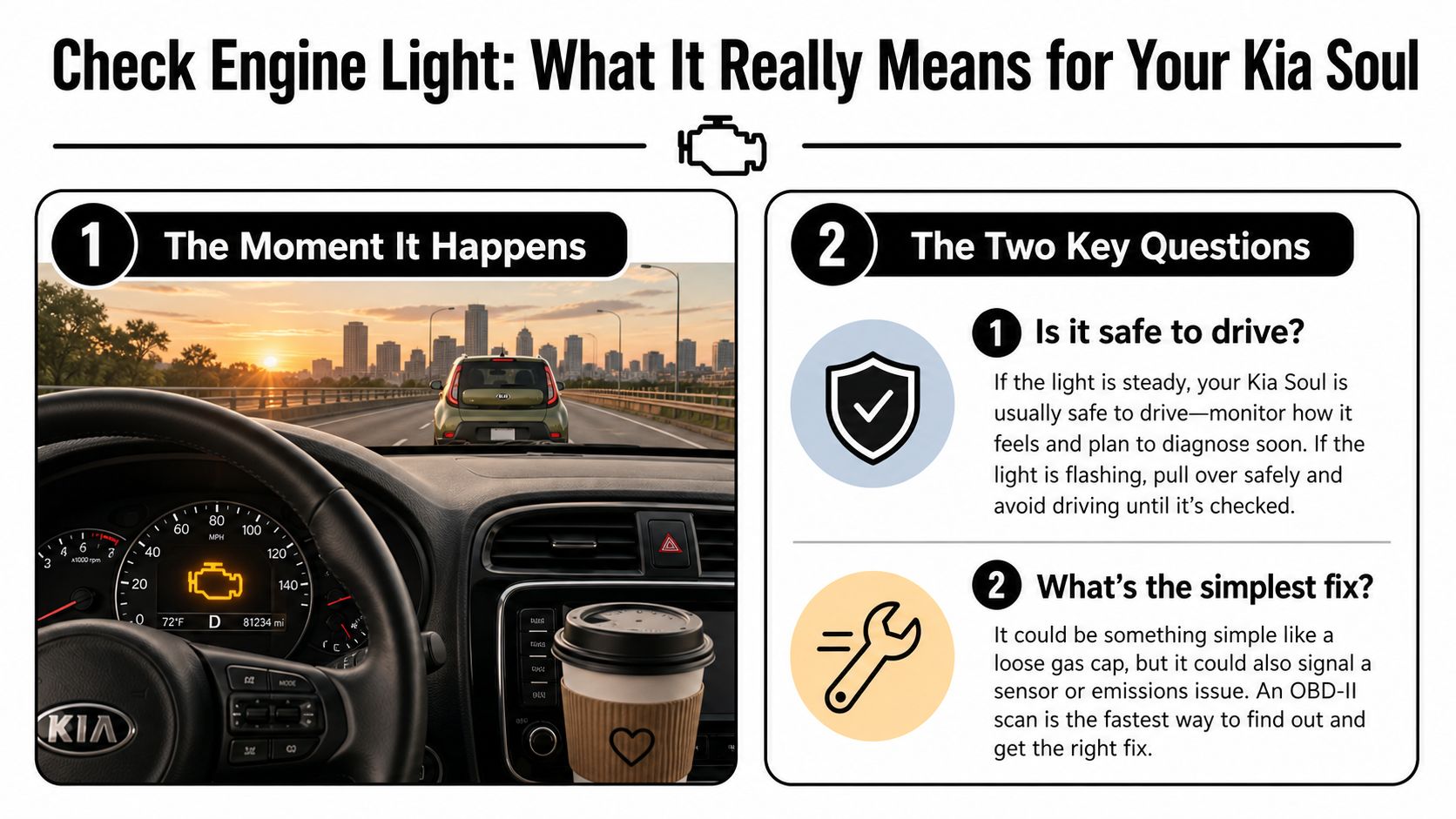
Start with two questions. Is the light steady or flashing? Is the car driving normally? If it is steady and the Soul feels normal, you usually have a short window to check it without panicking. If it is flashing, the car is pointing to a misfire-style problem that needs immediate attention, because unburned fuel can overheat the catalytic converter.
Practical rule: do not guess at the cause before you know the code. A lit lamp is a symptom, not a diagnosis.
A steady light can still hide a real repair, so “steady” does not automatically mean “minor.” The code read is what separates a cheap fix from a larger one, and for a used-car buyer that light should change the deal discussion, not end it on sight. For broader context on dashboard warning lights, see our guide to car service lights.
A useful habit is to avoid clearing the code first. If you wipe it out before you read it, you throw away the evidence that shows what the engine was doing when the fault set.
How to Read the Code Yourself in Under Ten Minutes
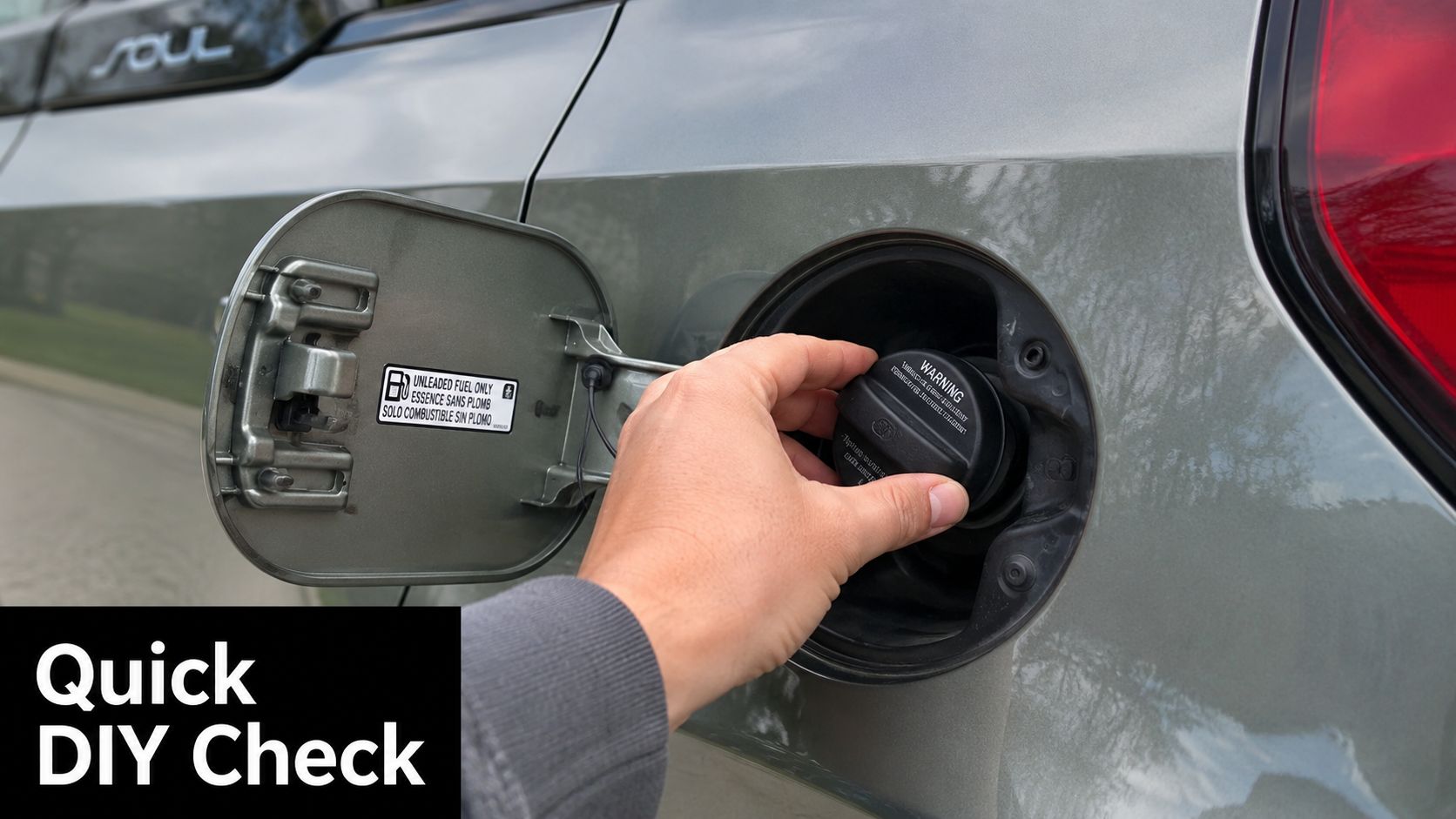
A Soul owner can usually get a useful answer without spending much. Start at the fuel door, because a loose or damaged gas cap is one of the most common triggers, and it's the cheapest thing to rule out first. Reseat it firmly until it clicks, then look under the steering column for the OBD-II port and plug in a basic scanner, or have a parts store scan it for you.
What the scanner is actually reading
The code is the car's stored fault label. A generic P0 code points to a common OBD-II fault that applies broadly, while a manufacturer-specific P1 code can narrow the problem further. The freeze-frame data matters too, because it shows the engine conditions at the moment the code set, and that snapshot often tells a technician more than the light itself.
A basic Bluetooth dongle and phone app can be enough for home triage, especially if you only need the code and want to see whether the issue returns after a repair. A free in-store scan is enough when you're trying to confirm whether the problem is just a gas-cap style evaporative leak or something more urgent.
Write the code down before you erase anything. Once the freeze-frame is gone, you've made the diagnosis harder for yourself.
The order matters. Inspect the cap, scan the code, note the freeze-frame, then decide whether you're fixing, clearing, or both. That sequence keeps you from paying for the same scan twice.
The Kia Soul Codes Owners See Most and What Each One Costs
The codes Soul owners run into most tend to fall into four families. Evaporative-emissions faults usually start with the fuel system and cap area. Ignition and misfire faults are more urgent, because they can turn into rough running or catalytic-converter damage if ignored. Oxygen sensor and catalyst codes point to exhaust monitoring problems, and fuel-and-air metering faults usually mean the engine isn't measuring incoming air or fuel correctly.
| Code family | Common triggers | Typical repair | Cost range | Drive now? |
|---|---|---|---|---|
| Evaporative emissions | Loose or damaged gas cap, minor vapor leak | Reseat or replace the cap | $10–25 for a replacement cap | Usually yes, if steady |
| Ignition and misfire | Spark plugs, coil issues, misfire-related faults | Diagnose ignition parts and repair the failed component | Depends on fault | No if flashing |
| Oxygen sensor and catalyst | Sensor drift, catalyst efficiency problems | Replace the failed sensor or repair the root cause | Depends on fault | Usually only briefly |
| Fuel and air metering | Airflow, fuel delivery, sensor faults | Test the related sensor or fuel/air component | Depends on fault | Maybe, but don't ignore it |
The broad cost reality is simple. A loose cap is often the cheapest fix, while sensor and catalyst work gets expensive fast. Independent automotive sources estimate loose gas caps account for 10–15% of all check-engine-light cases across vehicles, while oxygen sensor failures account for 20–30%. That's why a cap check comes first, but it's also why you don't stop there if the code points elsewhere. Common check-engine causes and repair context
The Soul-specific risk that changes the conversation
Older Souls deserve extra caution if you're looking at a 2014–2016 Soul 2.0L. Those vehicles have been linked with P1326 and engine-knock-related warnings, and owners should verify whether campaigns like PI2002B or FL701 were completed before they keep driving long distance. A flashing lamp with reduced power or limp mode is not the same thing as a loose cap, and it should be treated as a mechanical inspection priority.
If you're seeing that kind of warning, don't think in terms of convenience fixes. Think in terms of whether the car should be driven at all until someone has checked the actual fault.
Why You Should Never Clear the Light Before Fixing the Fault
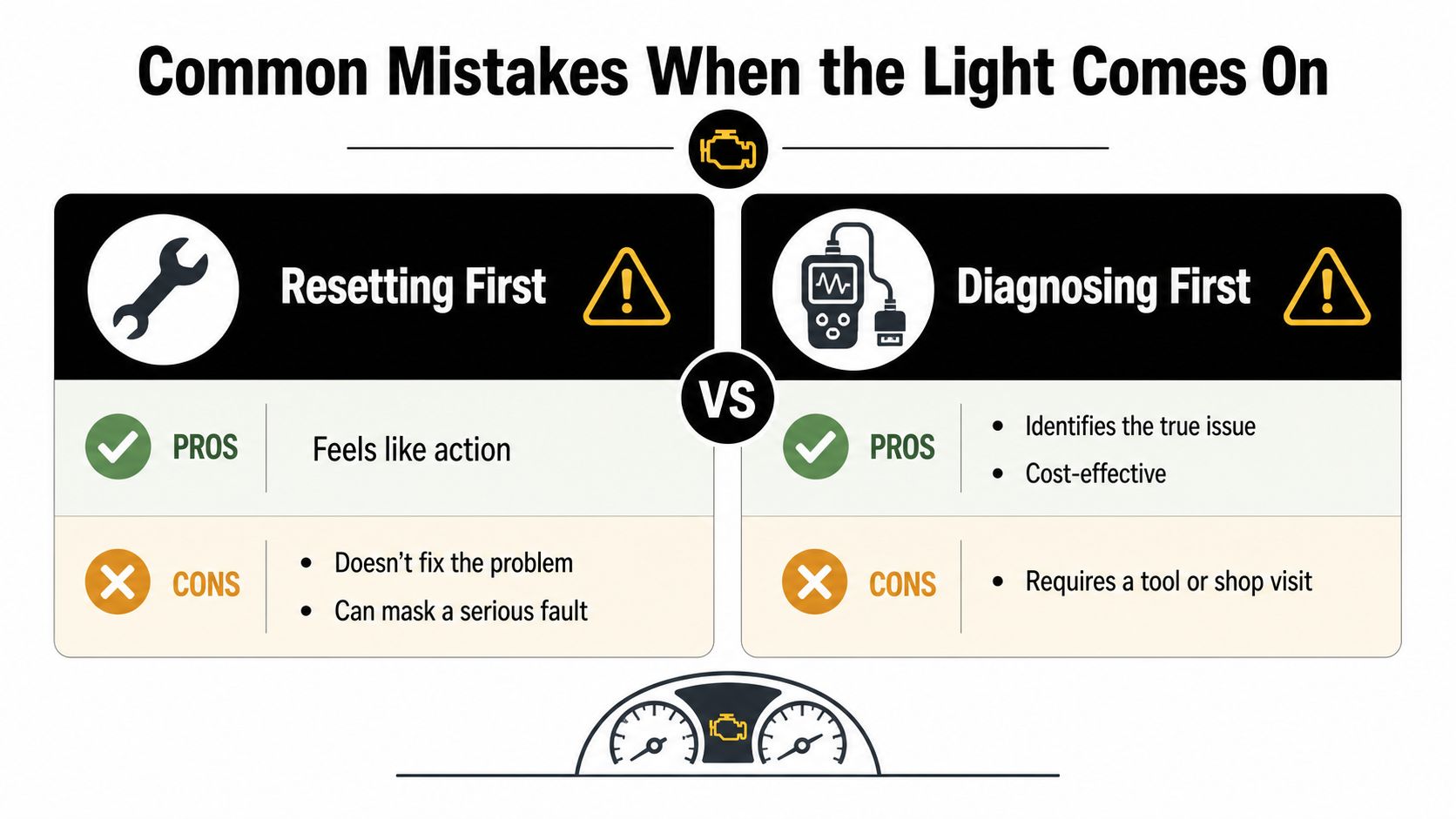
Clearing the light first feels productive, but it can hide the exact clue you needed. Disconnecting the battery for a reset, or hitting clear on a scanner before any repair, can wipe the freeze-frame data that shows what the engine was doing when the fault set. Once that's gone, the next technician has less to work with.
What reset-first thinking gets wrong
The problem is not just wasted time. If the actual fault is a misfire, a lean condition, or a catalyst-efficiency issue, the car keeps operating with the underlying problem still active. The lamp might disappear for a while, but the damage doesn't care that the dash is quiet.
A flashing light with limp-mode behavior is the clearest example. If the Soul won't go over normal road speeds and the light is flashing, the car is already limiting itself to prevent damage. Clearing codes won't change that behavior if the fault is still there.
Diagnose first. Repair first. Clear last.
There's a big difference between hiding a warning and solving a fault. A scanner's clear-code function has its place, but only after the cause is fixed and the car has a chance to prove the repair on a normal drive. If you need a quick reset check after repair, the better test is whether the light stays off through actual drive cycles, not whether it vanished for five minutes in the driveway.
Buying a Used Kia Soul With the Light Already On
A used Soul with the lamp on can still be a reasonable buy, but only if you treat the warning as part of the price, not a shrug-worthy detail. Say you're looking at a 2018 Soul, the test drive feels fine, and the seller says it only needs a gas cap. The first move is to ask for the code, because that one number tells you whether you're looking at a cheap evaporative fault or a repair that changes the deal.
Once you have the code, classify it by family. If it's a cap or vapor-leak issue, the repair is usually small. If it points to misfire, catalyst, or metering problems, you've got a negotiation point, or a reason to walk.
The VIN check is the other half of the decision
A vehicle history report fills in what the dash can't tell you. A VIN check can reveal open recalls, mileage inconsistencies, title problems, theft records, and branded or salvage history that helps explain why the warning keeps coming back. For used Souls, that matters even more if you're near the 2014–2016 2.0L campaign range, because a code alone won't tell you whether the car already had the relevant service completed.
If you want the VIN side of the decision in one place, the Soul-specific lookup is here, VIN check for Kia Soul. For shoppers comparing broader history-report options, this Carfax pricing comparison is the right place to see how the choices stack up. If you're using VekTracer as part of your shopping process, its VIN workflow is a practical way to line up the warning light with the vehicle's history instead of relying on the seller's story.
Before you leave a deposit, verify these four things:
- The actual trouble code: don't buy on a verbal description alone.
- The driveability status: flashing light or limp mode changes the risk level.
- The VIN history: check recalls, title status, and mileage consistency.
- The repair estimate: make sure the number still makes sense after the code is known.
Repair Paths, Final Checks, and Quick Answers
A check engine light on a Kia Soul does not point to one fix. A loose gas cap or a simple evaporative leak is something a careful DIY owner can handle with a scanner and a little patience. Sensor faults, ignition problems, and intermittent misfires are usually where the cheap fix ends and real diagnostics begin. If the code points to campaign work, deeper manufacturer testing, or anything tied to warranty questions, a Kia dealer is the safer place to start.
| Repair path | Best for | Strength | Trade-off |
|---|---|---|---|
| DIY scan and fix | Simple codes like gas cap or clear low-level faults | Lowest direct cost, fast | Easy to miss a deeper issue |
| Independent mechanic | Common repairs and better all-around diagnostics | Good balance of cost and experience | Shop quality varies |
| Kia dealership | Complex faults, recalls, campaign checks | Best access to Kia-specific info | Usually the highest service cost |
If you want a second set of eyes on the repair plan, FixyFlow for auto repair gives owners a practical way to compare what a shop says it found with what should be checked next. For buyers who also want the paper trail behind the car, the vehicle inspection report guide helps connect the warning light with the rest of the vehicle's condition.
Final checks before you call it solved
A repair is only real when the light stays off through normal driving. Clear the code after the underlying fault is fixed, then drive the car the way you normally would and see whether the warning returns. If it does, the diagnosis is still open.
On a used Soul, a history report should also show a clean title, consistent odometer data, and no open recall that explains the warning. If the same light comes back soon after a reset, treat that as an unfinished repair, not bad luck.
If the same light comes back soon after a reset, treat that as unfinished diagnosis, not bad luck.
FAQ
Is it safe to drive a Kia Soul with the check engine light on?
If the light is steady and the car drives normally, you usually have time to scan it and make a plan. If it is flashing, stop driving as soon as it is safe to do so.
How long does the light take to reset after a repair?
The light typically turns off after several normal drive cycles once the underlying cause is resolved. If the fault is still there, it comes back.
Does a Kia Soul have model-specific recall or campaign issues tied to the light?
Some 2014–2016 Soul 2.0L vehicles are tied to campaign checks around PI2002B and FL701, especially when P1326 or knock-related warnings are involved.
What should I do if the light comes back after clearing it?
Return to diagnosis and stop treating it like a reset problem. Read the code again, check whether the fault family changed, and inspect the repair you thought fixed it.
If you are deciding whether a Kia Soul is worth buying, or you are staring at a light that will not stay off, VekTracer can help you line up the VIN history with the warning on the dash before you commit. Use the car's history, compare it against another vehicle, and make the next move with real data instead of guesswork.
Ready to check a vehicle?
Enter any 17-character VIN for a free instant preview — no account needed.