Car Service Light on? What It Means and What to Do Next
Check a vehicle before you buy
Enter a VIN for a free instant preview — accidents, title brands, mileage, liens & open recalls.
If your car service light just came on, it usually means routine maintenance is due, not that the car is about to fail. It often appears as a wrench or spanner icon or a message like “service due now,” and that's very different from a red or flashing warning light, which calls for immediate attention.
That distinction matters a lot when you're standing in a driveway, sitting in a parking lot, or test-driving a used car and suddenly notice a light on the dash. Most drivers see any warning light and assume the worst. In many cases, the service light is the car's maintenance reminder doing its job.
The catch is that the phrase “service light” gets used loosely. Sometimes it really is just a scheduled reminder. Other times, especially on newer vehicles or cars with body-control electronics, the light can point to something beyond an oil change. If you're buying used, that matters even more, because a recently reset light doesn't prove the work was actually done.
What the Car Service Light Really Means
A service light is usually the car's way of saying, “You're due for maintenance.” It's commonly shown as a spanner/wrench icon or a message like “service due now,” and it typically points to annual service timing rather than an active breakdown, as explained in this guide to dashboard warning lights and service reminders.
That's why this light feels scary but often isn't urgent. It functions as a calendar reminder. It's there to keep you on schedule with oil changes, inspections, brake checks, and other routine work before neglected maintenance turns into a real repair.
Read the color before you react
On most dashboards, amber or yellow means caution, while red means stop and investigate immediately. That color system gives you your first clue about whether you're dealing with a maintenance issue or something more serious.
If your light is amber and the car is driving normally, you usually have time to book service. If it's red, or if the vehicle is acting strangely, don't treat it like a routine reminder.
Practical rule: A wrench light in amber usually means “schedule service.” A red warning light means “change plans and check the car now.”
Why this matters for everyday drivers
A lot of confusion comes from the fact that manufacturers don't all use the same symbol language. One brand may use a wrench icon for maintenance. Another may pair a service message with menu-based maintenance codes. If you want a make-neutral overview of interpreting wrench light warnings, that resource is useful because it shows how the icon can vary by vehicle.
If your car says “maintenance required” instead of showing a wrench, this breakdown of what maintenance required means helps clarify the difference between a reminder and a fault light.
Service Light vs Check Engine Light A Critical Distinction
Drivers mix these up all the time, and it leads to bad decisions. One light usually tells you the car is due for maintenance. The other points to a detected problem that needs diagnosis.
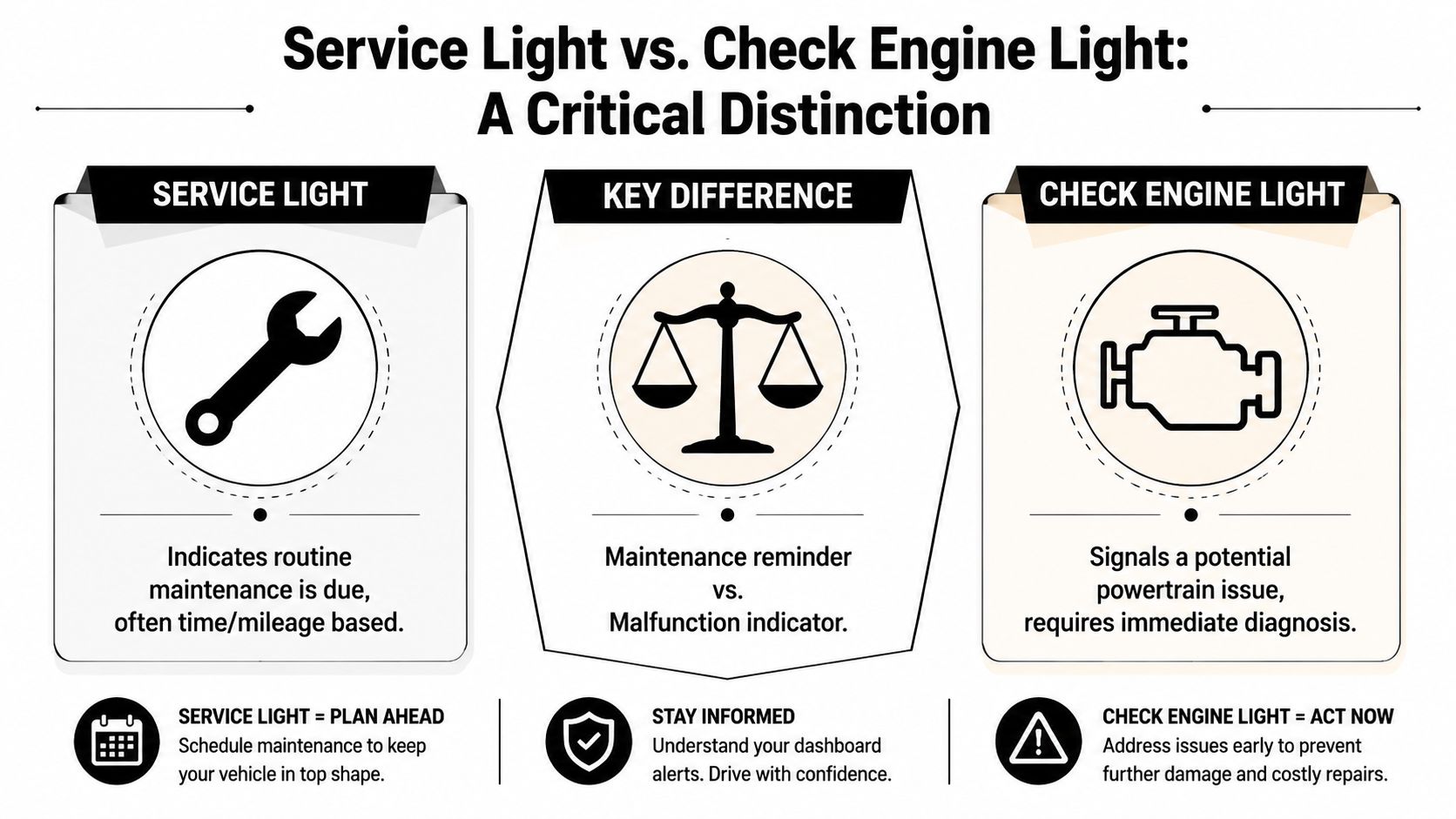
Side by side comparison
| Light | What it usually looks like | What it usually means | What to do |
|---|---|---|---|
| Service light | Wrench, spanner, or service message | Scheduled maintenance is due, or a service-related reminder has been triggered | Check service interval status, review recent maintenance, book service |
| Check engine light | Engine-shaped icon | Engine, emissions, or powertrain-related issue needs diagnosis | Scan for fault codes and diagnose the cause promptly |
That sounds simple, but in practice, the confusion is more complex. Many people search for “car service light” as if it were one universal warning. In practice, the same phrase can refer to very different systems, including routine maintenance reminders and stability-control-related alerts, which is why this explanation of illuminated service or ESC warnings is so important.
What drivers get wrong
A few common mistakes show up again and again:
- Assuming every service light is harmless: Sometimes it is. Sometimes it's tied to a body or stability system issue that needs diagnosis.
- Calling every dashboard light a check engine light: That sends you down the wrong path immediately.
- Describing the wrong symbol to the shop: Saying “my engine light is on” when it's really a wrench icon can waste time.
If you're calling a mechanic, tell them the icon shape, the color, and whether the car feels normal. That's more useful than saying “a light came on.”
A used-car example
Say you're test-driving a used SUV. The dash is clean at startup. Ten minutes later, a wrench light appears. That doesn't automatically mean the engine is bad. It may mean the maintenance interval wasn't reset properly, or it may mean the seller cleared it recently and the reminder came back.
That's why identifying the exact light matters before you negotiate, approve repairs, or walk away.
Common Triggers for the Service Light
Most service lights come on because the car has reached a preset maintenance interval. Many vehicles use a maintenance timer or the body control module to trigger the light after a set mileage interval, while some can also use it for non-engine issues detected by vehicle electronics, according to this overview of dashboard indicators and service-light behavior.
The most common causes
Start with the boring explanation first. Most of the time, that's the right one.
- Routine oil service due: The light may be tied to elapsed driving interval or calendar-based maintenance.
- Inspection items coming due: Some cars use the same reminder system for filters, fluid checks, brakes, or broader scheduled service.
- Maintenance wasn't reset after service: The work may have been done, but the indicator was left active.
- Electronic or body-related issue: On some vehicles, the same service-style warning can be triggered by non-engine systems.
What to check before assuming the worst
Use a simple checklist:
- Review your records: If you can't remember the last oil change or inspection, the light may be accurate.
- Look at the message text: “Service due now” points you in a different direction than a traction or stability warning.
- Notice how the car drives: If it runs normally, that leans toward a reminder. If there are drivability issues, don't guess.
- Check the inspection paperwork: A recent vehicle inspection report can help you match the dashboard warning with any noted maintenance items.
When the trigger isn't just maintenance
Owners and buyers often get tripped up. A wrench or service message isn't always just about oil. On some vehicles, electronics in the body control system can set a service-related warning for issues that have nothing to do with engine lubrication.
That's why “I'll just get an oil change” doesn't always solve it. If the light remains after proper service and reset, the next step is diagnosis, not guesswork.
Resetting the Light The Right Way and the Wrong Way
A reset should come after the service, not instead of it. That sounds obvious, but plenty of bad advice online tells drivers to clear the light first and worry about the maintenance later.
Some cars let you reset the service light through the steering-wheel controls or dash menu. Others need a model-specific procedure. Some newer vehicles may require a scan tool. This matters because reset steps vary by make and model, and a reset does not fix the underlying issue or prove the service was completed, as noted in this guide on maintenance-light reset procedures and their limits.

The right way
If the light came on in your own car, follow this order:
Confirm what the light is
Identify the symbol and message, not just the fact that something illuminated.Check whether service is due
Look at your maintenance records, sticker, app, or service booklet.Complete the maintenance
That may be an oil service, inspection, brake check, or whatever your car is due for.Reset the reminder using the correct procedure
Use the owner's manual or a shop that knows the model-specific steps.
The wrong way
These are the shortcuts that create bigger problems later:
- Clearing the light before selling the car
- Resetting it because the car “seems fine”
- Assuming a YouTube reset applies to every trim and model year
- Treating a persistent service light as a software glitch without scanning for faults
A cleared dash is not service history. It's just a cleared dash.
Why used-car buyers should care
This is one of the easiest ways sellers make a car look tidier than it is. A recently reset service light can hide overdue maintenance, and on some cars it can distract from a deeper issue that still needs diagnosis.
If you're shopping, compare the dashboard condition with the paperwork. If records are thin, a VIN-based history check can add context. VekTracer is one option for that. It provides VIN reports with service-history-related context such as title, mileage verification, recall alerts, and inspection-related clues that can help you judge whether a clean dash lines up with the car's documented past.
If the seller says, “The light was just reset after service,” ask for the invoice. If they can't produce it, treat the reset as unverified.
Service Costs and When to See a Mechanic
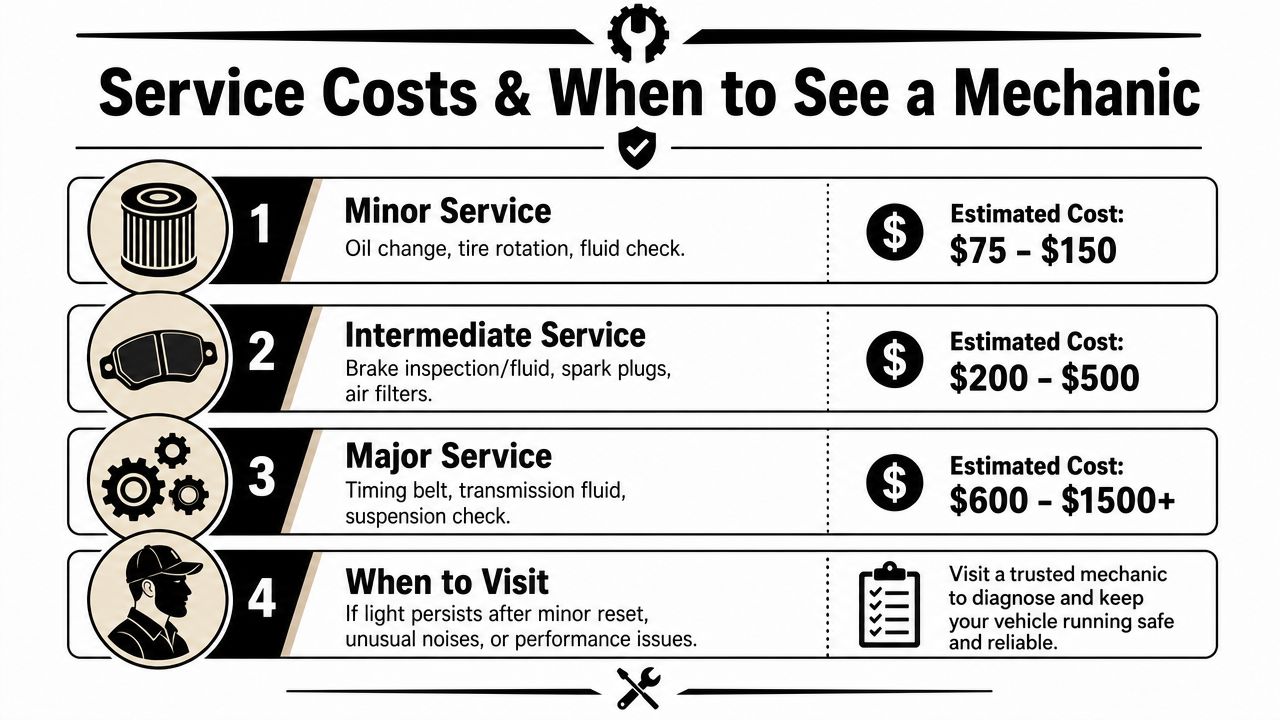
You'll see a lot of online content attach exact service prices to a warning light. The problem is that the light itself doesn't tell you what the final bill will be. A basic maintenance visit and a diagnostic visit can look the same from the driver's seat until the car is inspected.
What usually affects the cost
A service-light visit can land in very different buckets:
- Basic maintenance: Oil service, routine inspection, fluid top-off, filter checks.
- Scheduled service package: Broader maintenance based on the manufacturer schedule.
- Diagnostic work: Needed when the light persists, the symbol is ambiguous, or the issue may involve electronics.
- Repair work found during inspection: Brakes, charging issues, sensor faults, or other maintenance-related findings.
The right budget question isn't “How much does a service light cost?” It's “Is this a routine reminder, or is the car asking for diagnosis?”
When you can wait briefly and when you shouldn't
Warning-light color is one of the clearest severity clues. On many dashboards, green or blue means information, yellow or amber means caution, and red means stop and assess immediately. If a warning light is red or flashing, it can point to a high-severity fault such as a charging-system problem, which is why this dashboard-light severity guide is worth paying attention to.
Use that rule in practice:
- Amber service light, car drives normally: Book service soon.
- Light stays on after service: Get it diagnosed.
- Red or flashing warning, or obvious symptoms: Stop treating it as routine and get help.
Don't judge urgency by how inconvenient the timing is. Judge it by the light color and how the car behaves.
A practical decision checklist
You should see a mechanic sooner rather than later if any of these apply:
- The light is red or flashing
- The car is stalling, overheating, struggling to start, or losing electrical power
- You just bought the vehicle and have no records
- The service light came back right after a reset
- You're hearing noises or feeling braking, steering, or charging problems
If you're buying used, bring the dashboard warning into the broader pre-purchase process. This used-car inspection checklist for buyers and dealers is a good companion because it helps you connect what the dash says with what the car shows on inspection. For owners who manage multiple vehicles, these fleet vehicle performance tips are also useful because they reinforce the same habit: reminders matter most when they're backed by real maintenance records.
Frequently Asked Questions About the Car Service Light
Can I keep driving with the car service light on
Usually, yes, if it's a standard amber maintenance reminder and the car is otherwise driving normally. That said, don't turn “safe for now” into “ignore it for months.” The light is there to keep routine wear from turning into expensive repairs.
Will an oil change always turn the service light off
Not always. If the service was due and the maintenance system is reset properly, that often resolves it. But if the light was triggered by another service item or a body/electrical issue, an oil change alone may not clear it.
Why did the light come back after it was reset
That usually points to one of three things: the service wasn't completed, the reset procedure wasn't done correctly, or the warning is tied to another issue. A repeated light deserves a proper look, especially on newer cars with more complex maintenance menus and electronic modules.
Is a recently reset service light a red flag on a used car
It can be. A reset only tells you the reminder was cleared. It doesn't prove the oil was changed, the inspection happened, or overdue work was handled. Ask for invoices, service-book stamps, or digital records.
Does the service light affect how the car runs
A routine maintenance reminder usually doesn't change vehicle performance by itself. If the car is running poorly, the issue may go beyond a simple reminder and should be diagnosed rather than dismissed as “just a service light.”
Is the service light the same on every car
No. The general idea is similar, but the icon, wording, trigger logic, and reset method vary by make and model. That's why owner's manual guidance matters so much here.
Should I reset the light before taking the car to a shop
No. Leave it on if you haven't completed the required service. The active reminder helps the shop understand what the vehicle is asking for, and it avoids hiding the timing of overdue maintenance.
If you're checking out a used car and the dashboard story doesn't match the paperwork, run a VekTracer report before you commit. It's a simple way to compare the car's warning-light situation with its VIN history, mileage records, title details, recalls, and other risk signals so you can buy with clearer eyes.
Ready to check a vehicle?
Enter any 17-character VIN for a free instant preview — no account needed.