1998 Chevy Truck: 2026 Buyer's Guide
Check a vehicle before you buy
Enter a VIN for a free instant preview — accidents, title brands, mileage, liens & open recalls.
A 1998 Chevy truck can still be a smart buy in 2026 if you start with the right expectations. The 1998 Chevrolet C/K 1500 Regular Cab earned a 5 out of 5-star front-side crash test rating for both driver and passenger, owners rate its reliability at 4.7 out of 5, and 96% say they'd recommend it, but age brings predictable risks like frame rust, torsion bar mount cracking, and known 5.7L Vortec trouble spots that you need to screen before money changes hands.
If you're looking at a clean OBS Chevy on Marketplace, in a farm driveway, or at a local used lot, you're probably feeling the same pull most of us do. It looks right. It sits right. It has that square, honest shape newer trucks lost somewhere along the way. The mistake is assuming a truck that starts, idles, and looks shiny in photos is automatically a good one.
A 1998 model is old enough that the question isn't just “Does it run?” It's what kind of risk profile am I buying. That means connecting visible wear, known weak points, title history, accident history, and old repairs into one decision. If you do that well, a 1998 Chevy can be a dependable classic workhorse. If you skip it, the truck can turn into a rusted frame with a strong engine, or a solid body with hidden mechanical bills waiting right after purchase.
Why the 1998 OBS Chevy Truck Is a Modern Classic
You spot a clean 1998 Chevy parked in a driveway. Fresh wash, decent tires, straight body from twenty feet away. The part that separates a smart buy from an expensive mistake is knowing why this truck is desirable in the first place, and where that reputation can hide risk.
OBS means Old Body Style or Original Body Style. For Chevy C/K trucks, that points to the 1988 through 1998 generation, the last version before the Silverado redesign, as outlined in Street Trucks' OBS Chevy history. A 1998 model sits at the end of that run, which is a big reason buyers keep chasing it.
That end-of-generation status matters for practical reasons, not just nostalgia. By 1998, GM had years to sort out the platform, parts availability stayed strong, and the truck kept the clean, square look people still want. You get old-school proportions with a truck that can still be repaired without turning every job into a parts hunt.
That is why the 1998 OBS Chevy earns modern-classic status. It is attractive, usable, and familiar enough that owners keep them on the road instead of treating them like garage-only toys.
Why buyers still chase them
A lot of classic trucks look good but ask you to accept constant compromises. The 1998 Chevy usually asks for fewer of them. The cab is simple, visibility is good, the controls make sense, and the truck still feels honest on the road.
Style is part of it too. A regular cab short bed still has one of the best profiles Chevy ever put on a half-ton. A plain long bed work truck has its own appeal, especially if you like trucks that look like they earned their keep. Even a small period-style touch like a weathered flag vinyl sticker fits the truck better than it would on something newer and overstyled.
Buy one because you like the platform and understand the upkeep. That is the right mindset.
Why the reputation is deserved, but not automatic
The 1998 Chevy's reputation comes from durability, parts support, and a design that aged well. Sellers know that. They also know the OBS badge can distract buyers from problems that cost real money later.
That is where a risk profile helps. A straight bed, nice paint, and a strong-running V8 do not automatically mean you found a good truck. Clean cosmetics can sit on top of frame corrosion, old collision repair, or worn steering and brake components. On a truck this old, every visible clue connects to long-term cost and, in some cases, safety.
A clean survivor usually makes sense even at a higher price, because the hidden-cost curve is lower. A cheap truck with rust, patch panels, and vague maintenance history can cost more within the first year than the nicer truck would have upfront.
History checks still help, especially on older vehicles where records get thin and ownership stories get fuzzy. If you want a better baseline before inspecting one in person, this vehicle history report for classic cars guide explains what these reports can and cannot tell you.
That is a key appeal of a 1998 OBS Chevy. It is one of the few old full-size trucks that can still be a style buy, a hobby truck, and a useful machine. The reward is substantial, but only if the truck's condition matches the story the seller is telling.
1998 Chevy Truck Specs and Trims Explained
Shopping a 1998 Chevy truck gets confusing fast because sellers often mix trim names, engine swaps, and body styles in the listing title. You need to separate what the truck is from what the seller says it is.
The big divide is between a basic work-focused truck and a nicer trimmed one. The body may look similar from ten feet away, but how the truck was equipped changes how it drives, how it tows, and what it's worth to you.
What matters more than badges
Practically speaking, I care less about whether the tailgate says Cheyenne or Silverado and more about these points:
- Engine choice: This determines whether the truck feels merely adequate or properly useful.
- Cab and bed setup: Regular cab versus crew-style layout changes how practical it is for your use.
- 2WD or 4WD: This changes both simplicity and inspection priorities.
- Safety equipment: Air bags and ABS matter on an older truck you operate.
According to Cars.com's 1998 Chevrolet 1500 research page, the 1998 Chevrolet 1500 could tow up to 5,000 lbs with a standard payload of 2,030 lbs, and engine options ranged from the base 4.3L V6 with 200 hp to the 5.7L V8, which was the better fit for heavier-duty use.
Engine choices in plain English
The base V6 is fine if you want an old truck for light hauling, occasional hardware-store runs, and weekend use. It won't feel lazy if your expectations are realistic.
The V8 trucks are the ones most buyers want. They fit the personality of the chassis better, especially if you plan to tow, carry more weight, or want that classic small-block Chevy character.
The regular cab 1500 also came with a stronger towing setup in the right configuration. The fourth-generation C/K reference notes a 7,000-lb towing capacity for regular cab versions when equipped appropriately, tied to the reinforced chassis and V8 options, in this Chevrolet C/K fourth-generation overview).
1998 Chevy C/K 1500 engine specifications
| Engine | Horsepower | Torque | Max Towing (approx.) |
|---|---|---|---|
| 4.3L V6 | 200 hp | 255 lb-ft | Light-duty use |
| 5.3L V8 | 285 hp | 325 lb-ft | 5,000 lbs |
| 6.0L V8 | 300 hp | 360 lb-ft | Up to 10,300 lbs in Silverado 1500 variant introduced shortly after |
The base 4.3L Vortec V6 delivered 200 SAE net horsepower at 4,400 RPM and 255 SAE net torque at 2,800 RPM, using sequential port fuel injection, according to Cars.com's 1998 Chevrolet 1500 specs page.
The smart buy usually isn't the highest trim. It's the truck with the cleanest frame, the clearest history, and the engine that matches how you'll actually use it.
Common Mechanical Weak Spots and Engine Issues
Mechanical problems on a 1998 Chevy truck aren't random anymore. At this age, the patterns are known. That's good news if you inspect with discipline. It's bad news if you buy based on a short idle in the seller's driveway.
The most important engine-specific risk in this market centers on the 5.7L Vortec. That engine has a documented throttle body gasket vacuum leak around 160k miles and an internal distributor fault near 130k miles. Recent data tied to those unvetted issues shows 38% of buyers face unexpected $1,200+ repair bills within 6 months of purchase, based on the source used for this buyer-risk angle in this 5.7L Vortec issue breakdown.
What to watch for on inspection
A vacuum leak won't always announce itself with drama. Sometimes the truck just idles rough, stumbles off idle, or feels inconsistent when cold. Sellers often describe that as “old truck stuff.” Don't accept that answer.
A failing distributor can be even more frustrating because the truck may start and drive acceptably until it doesn't. If a seller mentions recent ignition chasing, intermittent misfire, or parts-cannon repairs, slow down and ask exactly what was changed and why.
Use this short check when you inspect:
- Cold start behavior: Listen for unstable idle, hesitation, or repeated cranking.
- Part history: Ask whether the distributor, cap, rotor, or gaskets were recently addressed.
- Road test feel: Notice if throttle response is smooth or if it surges and falls flat.
- Seller language: Be cautious when “just needs a tune-up” gets repeated.
Other age-related problems that change the deal
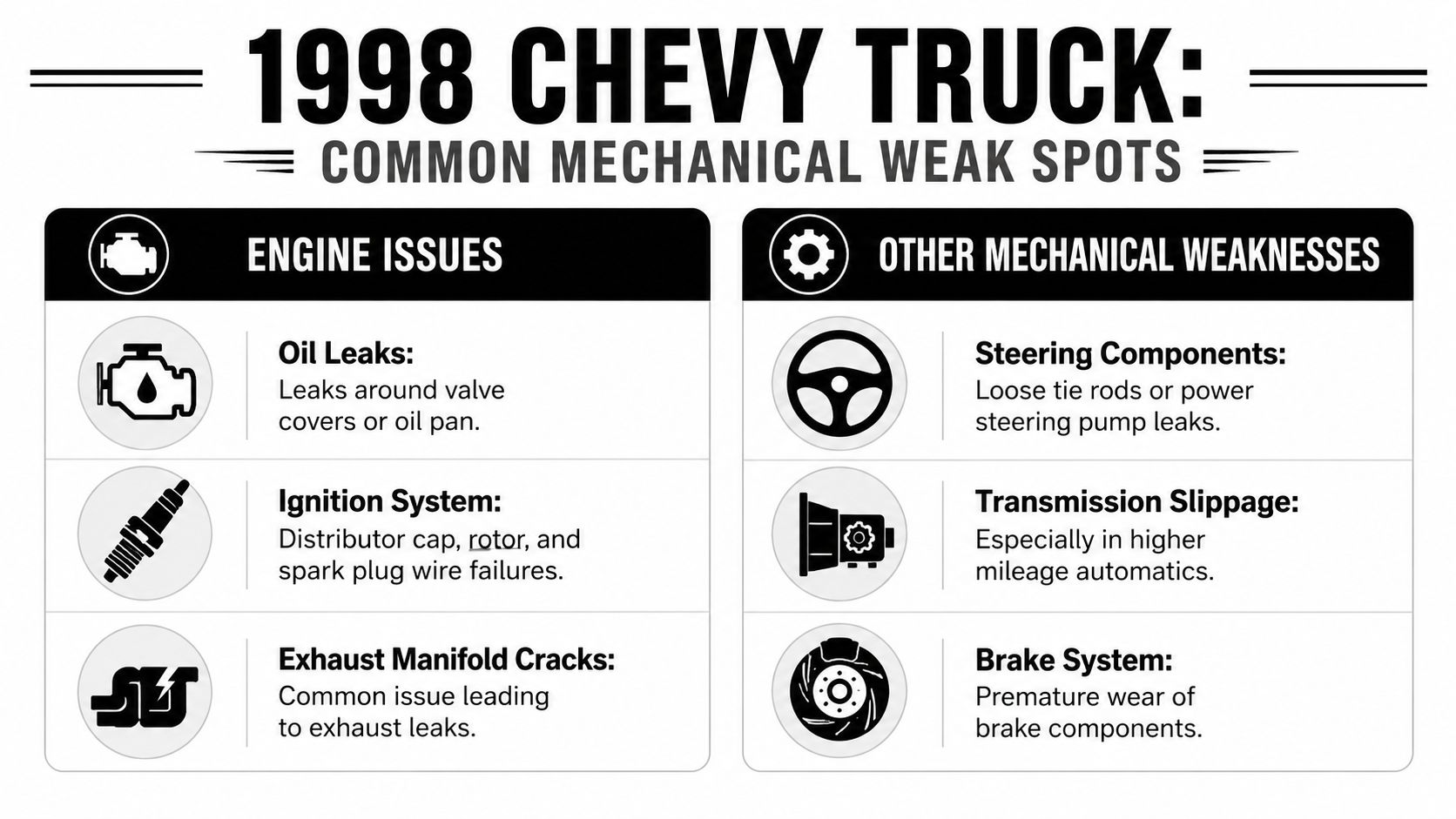
Not every weakness is unique to the 1998 model, but old GMT400-era trucks tend to show wear in the same systems. The image above covers common owner complaints well, and in practice these are the issues that often separate a decent truck from a tiring one to own:
- Oil leaks: Valve cover and oil pan seepage are common on older trucks.
- Ignition wear: Cap, rotor, and wires can create rough running that gets blamed on “bad gas.”
- Exhaust manifold cracks: These usually show up as ticking and exhaust smell.
- Steering slop: Tie rods and steering components can make a truck wander.
- Automatic transmission behavior: Delayed or soft shifts deserve attention.
- Brake wear: Old trucks often need more brake work than the ad admits.
If the seller says the truck “runs great” but it idles rough, has a check-engine light history, or shows obvious ignition chasing, treat that as a pending repair, not as a minor quirk.
A clean-running truck with records is worth more than a rougher truck with a lower asking price. Cheap old trucks get expensive when they stack one deferred repair on top of another.
The Critical Body and Frame Inspection for Rust
Rust is the part buyers most often underestimate, and it's the part that should scare you the most. Mechanical issues can usually be repaired. A badly rusted frame can turn a good-looking truck into a vehicle you should walk away from.
That matters because the 1988-1998 C/K truck's frame rust and torsion bar mount cracking are critical inspection points, and analysis has shown that hidden frame corrosion is a factor in a significant percentage of structural failures during emergency braking on these aging vehicles, as discussed in MotorTrend's GM 1500 trouble spots article.
Rust spots that matter most
Some rust is cosmetic. Some rust changes whether the truck is safe under load or in a panic stop. Learn the difference.
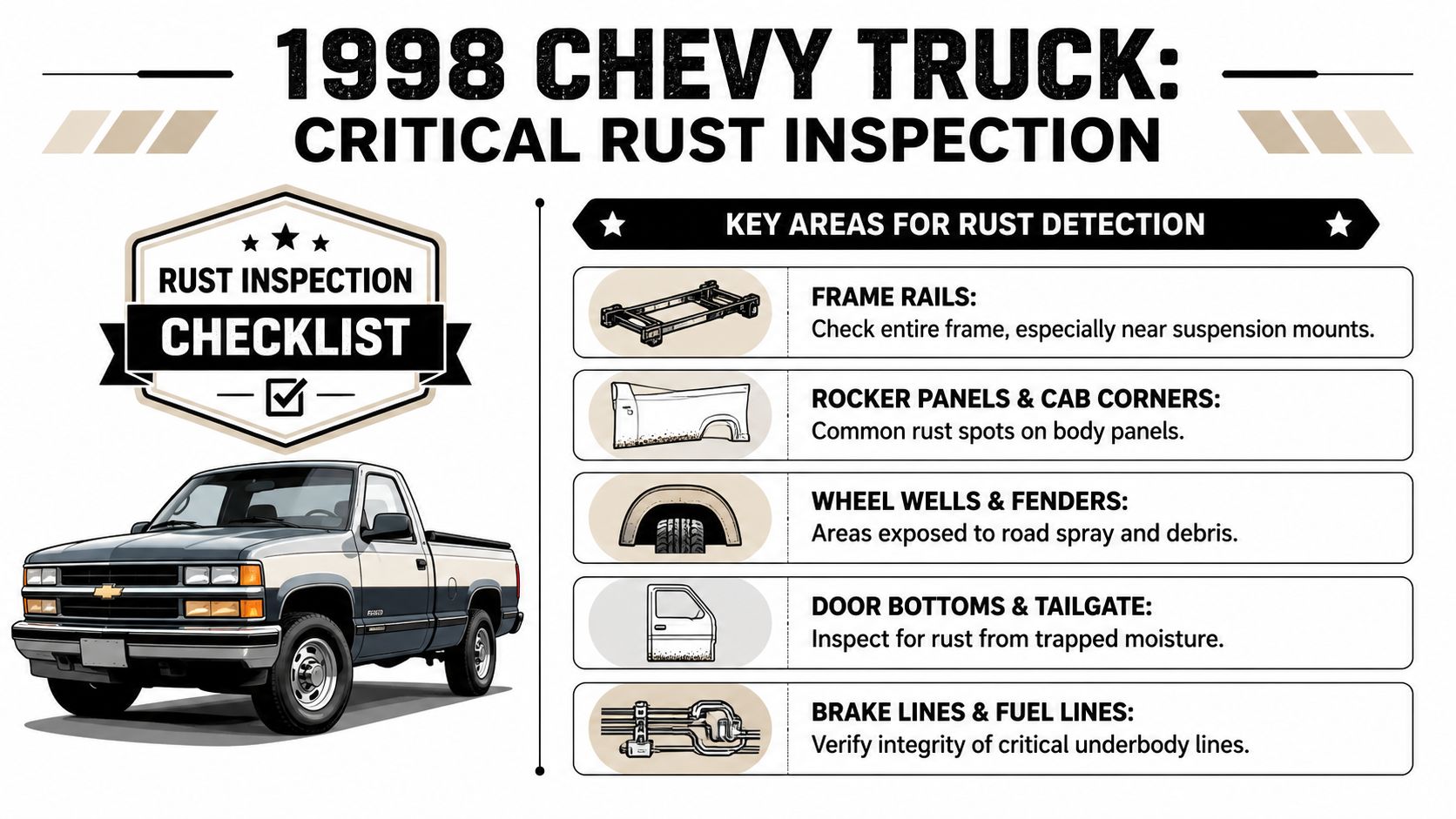
Check these areas closely:
- Frame rails: Look along the full rail, especially around suspension and load-bearing areas.
- Torsion bar mounts and crossmember areas: Cracking or deep corrosion here is not minor.
- Rocker panels and cab corners: These show how the truck has lived and can hint at broader corrosion underneath.
- Wheel wells and fenders: Trapped debris and spray collect here.
- Door bottoms and tailgate seams: Moisture sits in these areas for years.
- Brake and fuel lines: Underbody corrosion here can create safety problems fast.
How to tell surface rust from structural rot
Surface rust is discoloration. You'll usually still see solid metal under it. Structural rust flakes, layers, swells, and leaves edges that crumble when disturbed.
Bring a flashlight. Get underneath. Look for fresh black undercoating sprayed over rough, scaly metal. That's one of the oldest tricks in the book. If the truck is too low to inspect properly and the seller won't allow a lift, treat that as information.
A shiny bedside doesn't matter if the frame is weakened where the truck carries load or handles braking force.
If you're buying in a wet or salted region, prevention matters after purchase too. A practical maintenance guide like this one on Titan Coatings rust protection can help you preserve a solid truck, but rust prevention only works if you start with a structure worth protecting.
How to Verify a 1998 Truck's History and Value
You find a clean-looking 1998 Chevy, the paint shines, the seller says it has never had a hard life, and the price feels fair. Then the VIN report shows a rebuilt title from fifteen years ago, or the mileage trail goes dark for a long stretch. That is how a cheap truck turns into an expensive one.
On these trucks, history is part of the risk profile. The body can look straight and the drivetrain can sound fine, but old collision repair, title problems, and mileage inconsistencies change what the truck is worth and how much trust you can put in it. They also affect safety in ways sellers rarely spell out, especially if past damage involved the frame, cab mounts, or front structure.

What a vehicle history report helps you confirm
A vehicle history report is a filter, not a verdict. I use it to confirm what I see in person and to catch the stories that do not add up before money changes hands.
Focus on four things:
- Title status: Salvage, rebuilt, flood, or other branded titles cut value and raise the odds of hidden repair work.
- Accident history: Useful if the truck has uneven panel gaps, overspray, replacement lamps, or mixed-date glass.
- Mileage pattern: A low odometer means less if the seat, pedals, steering wheel, and service history tell a different story.
- Theft or lien records: Private-party deals can go sideways fast if ownership paperwork is messy.
Reports on a 1998 truck will have gaps. That is normal. What matters is whether the gaps line up with the truck in front of you or create new questions. If you want a clearer idea of what a report can and cannot verify before you negotiate, read this VIN lookup report guide.
How to judge value without fooling yourself
Market value is only the starting point. Real value is sale price plus the repair bill you have not found yet.
A truck with clean title history, consistent mileage, old service records, and no signs of major repair usually deserves stronger money. A truck with missing history, suspiciously fresh paint, title branding, or long registration gaps needs a discount large enough to cover risk, not just current symptoms. That is the part many buyers miss. They price the truck for how it drives today, not for what it is likely to need in the next year.
I also weigh history against use. If you want a weekend cruiser, a minor old claim with solid repair work may be acceptable at the right price. If you want a truck for highway driving, hauling, or family duty, I would be stricter. Unknown structural repairs and mileage questions are not small details on a 1998 Chevy. They are ownership-cost multipliers.
The Definitive Pre-Purchase Inspection Checklist
When I inspect a 1998 Chevy truck, I don't try to decide whether it's “good” in one glance. I move through the truck in phases. That keeps me from missing the expensive stuff because the paint looks nice or the seller talks too much.
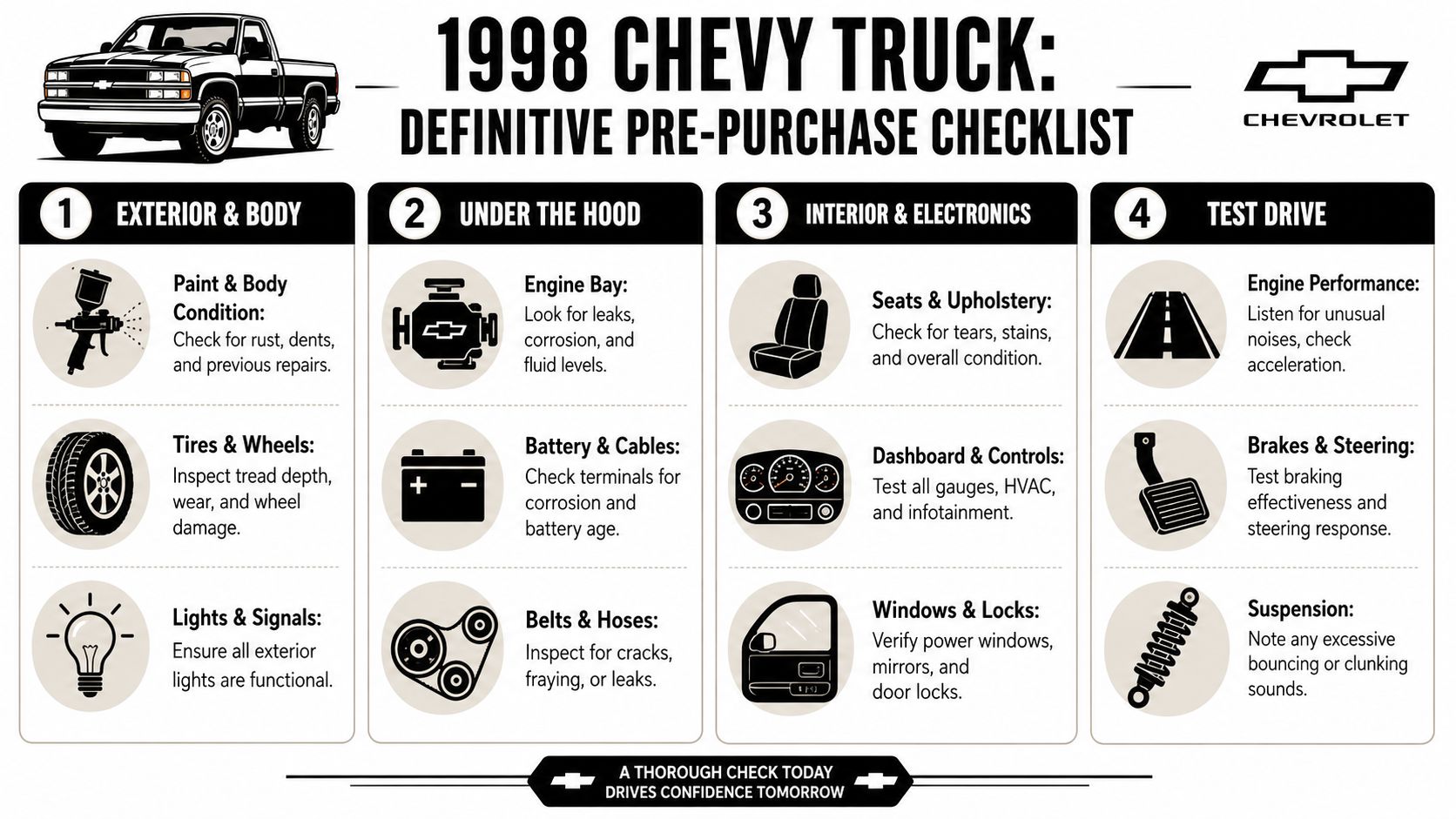
Use this checklist on your phone and slow the process down.
Exterior and frame
Start outside and underneath before you ever discuss price.
- Walk the body lines: Look for mismatched paint, waviness, and uneven panel gaps.
- Inspect rust areas closely: Get under rocker panels, cab corners, frame rails, wheel wells, and body mounts.
- Check the bed and tailgate: Work trucks hide damage here. Look for hard use and poor repairs.
- Look at tires and stance: Uneven wear can point to steering, suspension, or frame issues.
- Verify lights and signals: Old truck electrical neglect often shows up in simple things first.
Interior and underhood
A clean cab helps, but function matters more than cosmetics.
- Test every gauge: Make sure the dash isn't hiding warning-light problems.
- Run HVAC and accessories: Windows, locks, blower speeds, and A/C issues add up.
- Check seat wear against odometer claim: A heavily worn interior with a low-mile story deserves skepticism.
- Open the hood with the engine cold: Look for fluid seepage, sloppy gasket residue, and hacked wiring.
- Scan hoses, belts, and battery area: Corrosion and brittle components tell you about maintenance habits.
Test drive and seller questions
A lot of old trucks reveal themselves at this stage.
- Cold start first: Don't let the seller pre-warm it if you can avoid it.
- Drive at low speed: Listen for clunks, steering looseness, and brake pull.
- Accelerate steadily: Watch for hesitation, misfire, flare, or odd shifting.
- Brake firmly: The truck should stay composed and predictable.
- Ask direct questions: What was replaced recently, what still needs work, and what would they fix if they kept it?
Bring a magnet, a flashlight, and enough patience to walk away.
If you want a broader framework you can reuse on any used vehicle, this pre-purchase car inspection guide is a good companion to the truck-specific checklist above.
Frequently Asked Questions About the 1998 Chevy Truck
What is a 1998 Chevy truck worth in 2026
It depends heavily on condition, structure, and history. For the 1998 Chevrolet 1500 Regular Cab, Kelley Blue Book lists a current resale value of $3,707 and a trade-in value of $2,318 in its valuation data. That's a baseline, not a universal price for every OBS truck. Clean, well-kept examples and desirable configurations can sit above a rough work truck.
Is the 1998 Chevy a reliable daily driver
It can be, if you buy the right one. The platform has a strong reputation, and owner sentiment is still favorable, but daily-driver reliability comes down to rust, deferred maintenance, and whether known engine issues were already handled. A truck with a clean frame and sorted mechanicals can be satisfying. A neglected one can become a rolling repair list.
How is the 1998 C/K different from the 1999 Silverado
The 1998 model is the final year of the OBS Chevrolet C/K generation. The 1999 Silverado moved to the newer body design and marked the shift away from that classic square-body-adjacent look buyers still chase today.
Is the 4.3L V6 enough, or should you hold out for a V8
The 4.3L V6 is enough for lighter use and normal driving. If you want the truck to feel more relaxed under load, or you plan to tow regularly, the V8 is the more satisfying choice.
Should I buy one without a vehicle history report
I wouldn't. On a truck this old, a missing history check leaves too many unanswered questions about accident damage, mileage consistency, and title problems.
If you're narrowing down a 1998 Chevy truck, VekTracer is a practical next step for checking history before you commit. You can compare report options, review vehicle history details, and use the platform to make a cleaner buy-no pressure, just better information before you hand over cash.
Ready to check a vehicle?
Enter any 17-character VIN for a free instant preview — no account needed.