Vehicle History Report for Classic Cars: An Expert Guide
Check a vehicle before you buy
Enter a VIN for a free instant preview — accidents, title brands, mileage, liens & open recalls.
A vehicle history report for a classic car is a compiled record of its past, but for pre-1981 vehicles it often starts with fragmented data because many older cars don't use the modern 17-character VIN format. It's still one of the most useful first checks you can run because it can uncover title brands, theft, and salvage-related records, but it won't replace a physical inspection and paperwork review.
You're probably here because you found a car that looks right. The photos are strong, the seller sounds confident, and the story feels plausible. That's exactly when buyers get into trouble with classics.
A modern used car often lives in digital systems cleanly enough that a report feels close to complete. A classic doesn't. With an older Corvette, Mustang, 911, or pickup, the report is usually the beginning of the investigation, not the verdict. If you treat it that way, it can save you from buying a car with a hidden brand, a theft issue, or a history that doesn't support the seller's asking price.
The Classic Car Dream and the Digital Reality
Checking a specific vehicle?
Run its VIN for a free preview of accidents, title brands, mileage and open recalls.
A serious buyer usually starts the same way. You find the car, compare the photos, listen to the seller's story, and start imagining it in your garage. Maybe it's a ’60s muscle car with fresh paint and an engine bay that looks too clean, or a European coupe the seller describes as a “well-documented survivor.”
That's when you need a vehicle history report for classic cars, but you need to use it correctly. On a classic, the report is not a complete biography. It's a record assembled from whatever title, registration, theft, salvage, and related database traces still exist.
That difference matters. Older cars often passed through decades of paper titles, old registrations, state transfers, restorations, engine swaps, and periods where very little was preserved digitally. A clean-looking online result can mean the digital trail is thin.
Practical rule: If the seller says, “The report is clean, so the car is clean,” slow down. On a classic, a clean report is helpful, but incomplete documentation is still a risk.
What the report does well is point you toward high-value questions. Does the car show branding that affects collectability? Is there a theft or salvage record? Does the title trail support the identity of the car being sold today? Those answers can change whether you're looking at a genuine collectible or a project wearing a better story than it deserves.
The buyers who make the best decisions treat the report as the first chapter of a file. After that come the tags, stampings, title copies, receipts, restoration photos, marque records, and an inspection by someone who knows the model.
Why Standard VIN Reports Fail for Classic Cars
Most buyer frustration with classic history checks comes from one simple fact. The systems built for modern VIN lookups weren't designed around old serial formats.
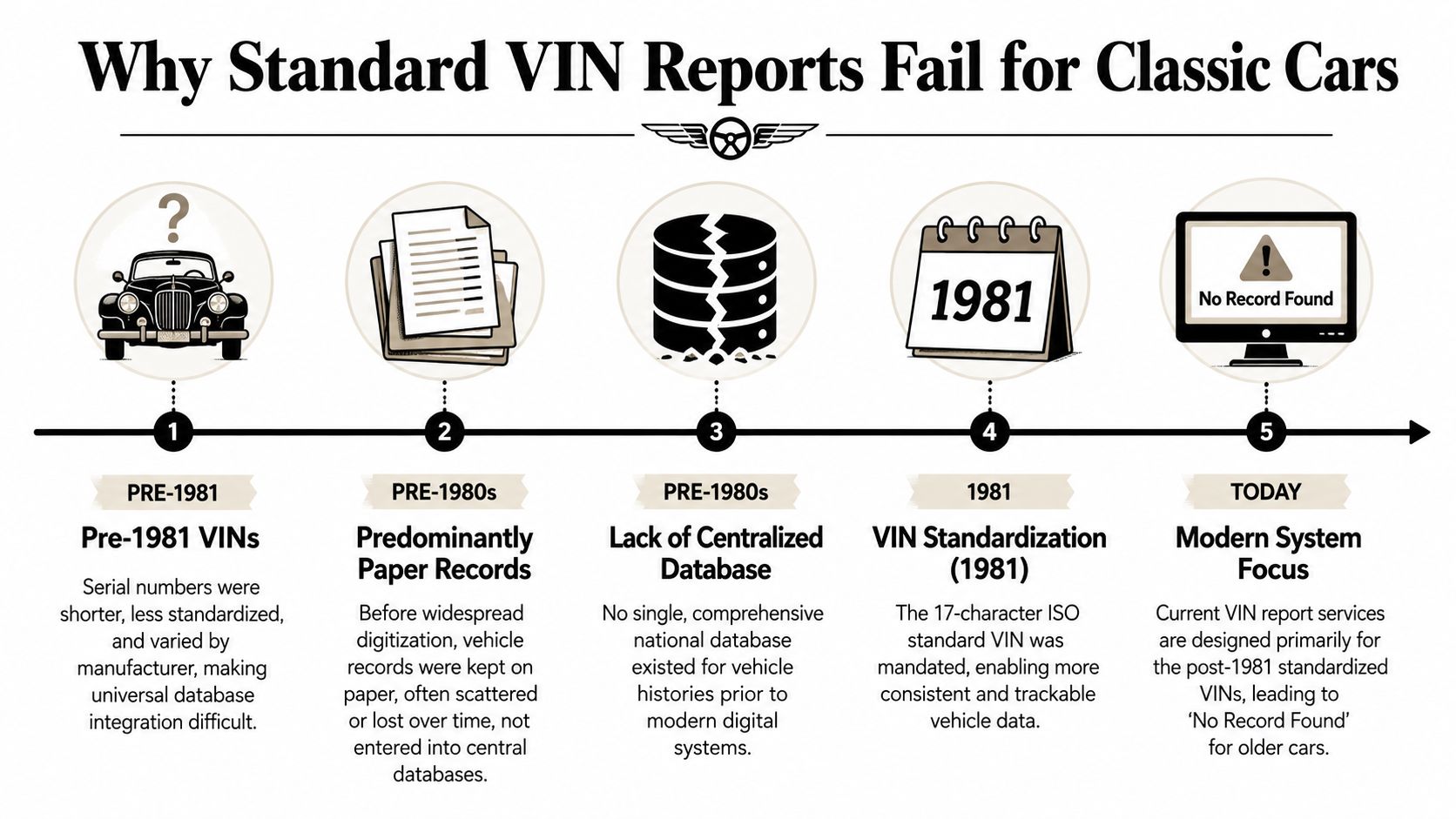
According to Progressive's guidance on classic-car VIN history reports, classic-car history checking is built around the fact that many older vehicles do not use the modern 17-character VIN standard, and the standard format was introduced in the early 1980s. Progressive also notes that classic cars can have VINs or equivalent identifiers in different places on the vehicle and in paperwork.
The pre-standard VIN problem
Before standardization, manufacturers used their own numbering systems. Some were short. Some were structured differently by brand. Some encoded body style or engine information in ways that don't map neatly into current VIN decoders.
That's why a standard report may return little or nothing on a pre-1981 car even when the car itself is legitimate. The problem isn't always the car. Often it's the mismatch between modern databases and older vehicle identity systems.
A quick comparison helps:
| Vehicle type | What usually works | What usually fails |
|---|---|---|
| Modern car | Standard VIN decoder, broad digital history lookup | Very little, if VIN is valid |
| Classic car | Manual identity tracing, paperwork review, targeted record checks | Assuming one VIN search tells the whole story |
Paper records still control the truth
Classic cars also lived through decades when many records stayed on paper. Titles were filed in drawers. Service invoices sat in glove boxes. Ownership changes happened long before centralized digital systems became common.
So when a buyer says, “I ran the VIN and didn't find anything,” that can mean several different things:
- The identifier is shorter: The car may predate the standardized format.
- The records are fragmented: Useful information may exist in paper titles, state archives, or seller-held documents.
- The wrong number was used: Buyers often pull a cowl tag, body tag, or engine number and assume it's the same as the legal vehicle identifier.
- The car's identity needs physical confirmation: Tag placement, stampings, and paperwork all need to line up.
A blank result is not proof of a clean history. On classics, it's often proof that you need to leave the keyboard and inspect the car.
Many buyers lose discipline, either overtrusting a thin report or dismissing reporting entirely. Both are mistakes. The right move is to understand the report's limitation, then use it as one part of a broader identity and provenance check.
What a Specialized Classic Car Report Actually Reveals
A specialized report earns its keep when it finds the kind of records that materially change the car's position in the market. That's the standard I use. If the record changes value, insurability, or whether I'd proceed at all, it matters.
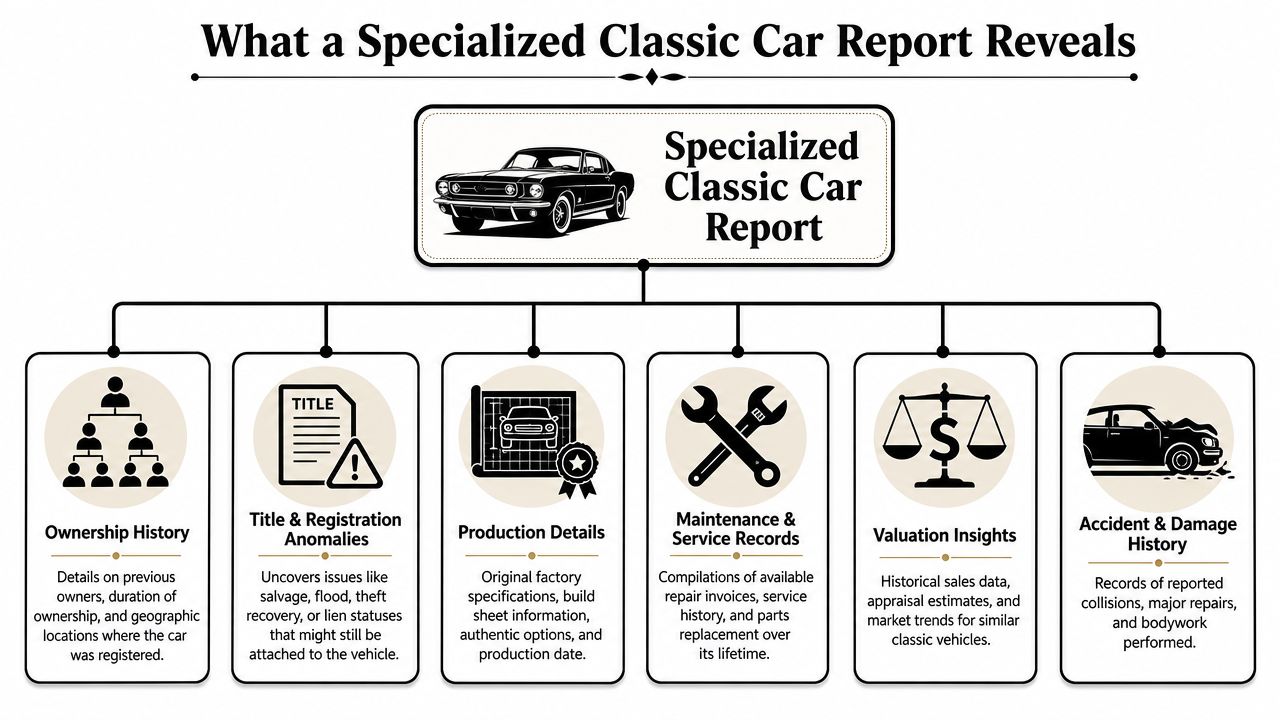
CLASSIC.COM states in its vehicle history overview for collectors that every vehicle on its platform includes a history report covering key events that can affect value. That same source also points buyers toward title-related risk because NMVTIS-accessible reporting can reveal whether a vehicle has been at a salvage yard, stolen, or has a branded title. In the classic market, those flags can separate a collectible asset from a heavily discounted project.
The records worth paying attention to
Here's what a useful classic report may reveal, and why each item matters:
- Branded title history: Salvage, rebuilt, flood, or other brands can affect value, insurance, and long-term resale.
- Theft-related records: A theft entry or recovery history can raise identity questions, parts-swapping concerns, or title complications.
- Salvage yard exposure: If the car appears in salvage-related systems, that changes the conversation immediately.
- Titling geography: Where the car has been titled can help you test the seller's ownership story and timeline.
- Registration chain clues: Even incomplete state history can help identify gaps that need documents to bridge.
What a report can't settle on its own
A good report still won't confirm everything buyers care about most in a classic. It usually won't prove the engine is original to the car. It won't authenticate a factory performance package by itself. It won't tell you whether a tribute car is being represented too aggressively.
That's why I separate history data from identity data.
| Question | Report helps | Report does not settle |
|---|---|---|
| Branded or salvage history | Yes | No, if records are missing |
| Theft-related issues | Yes | Not full provenance |
| Factory-original engine and drivetrain | Rarely | Usually needs physical verification |
| Correct trim and options | Sometimes indirectly | Usually needs marque resources |
| Restoration quality | No | Needs inspection |
If you want a sense of how a modern reporting layout presents risk before you start chasing paper records, reviewing a sample vehicle history report can help you understand the kind of categories a buyer should scan first.
The practical use is simple. Run the report early. If it turns up major adverse history, you may save yourself the cost of travel, inspection, and negotiation. If it comes back clean or thin, that's your signal to move to the physical evidence phase.
Decoding the Red Flags in a Classic's History
A classic history report is not a pass or fail document. It's a list of leads. Some are harmless. Some are deal breakers. Most sit somewhere in the middle and need follow-up.
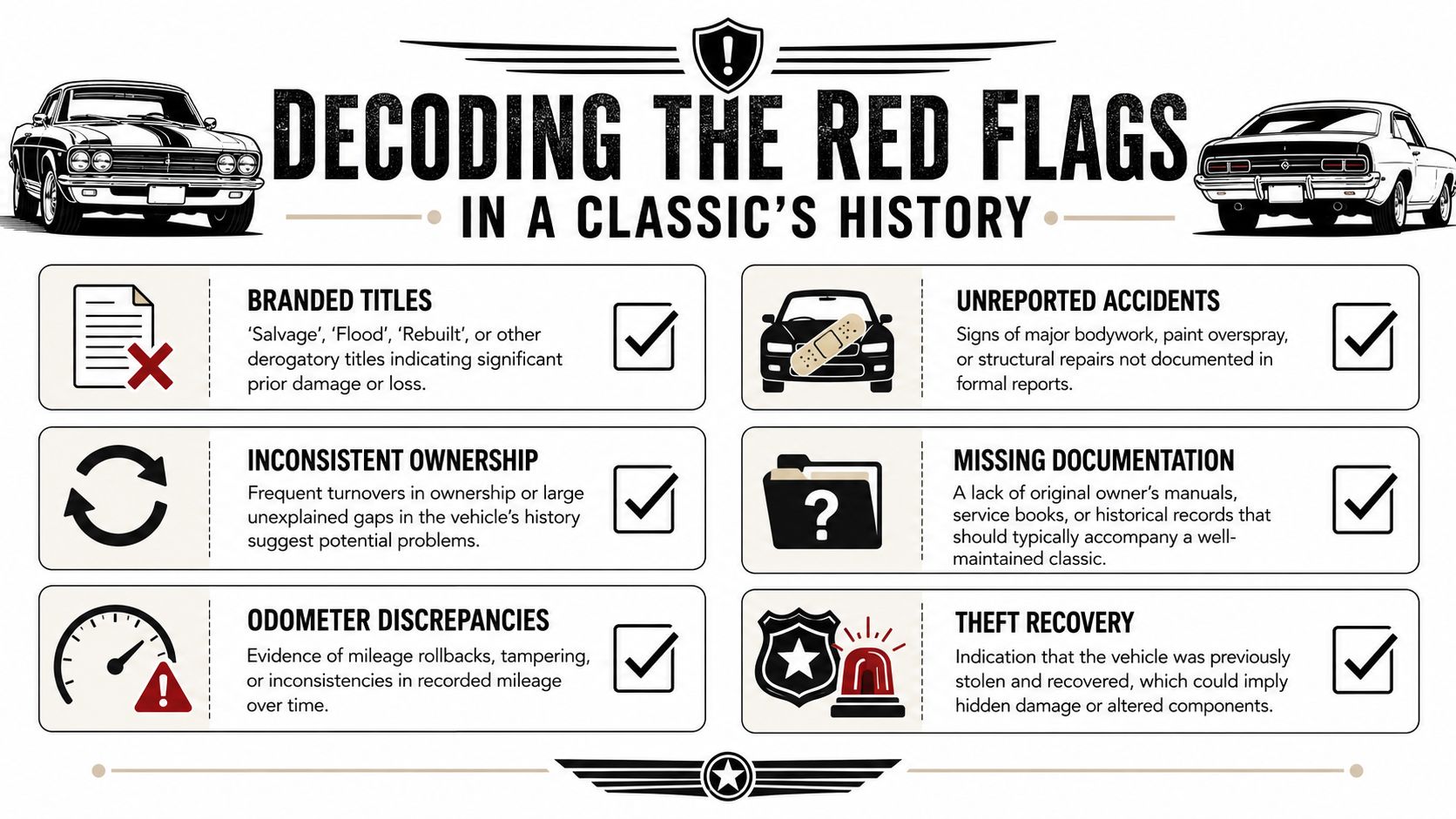
Red flag checklist for buyers
Branded title language
If you see salvage, flood, rebuilt, or similar branding, assume the car's value and insurability are affected until proven otherwise. Don't let a glossy restoration distract you from the legal history. If you need a plain-English primer on how these labels affect a buyer, this explanation of what a salvage title means is a useful baseline.
Ownership gaps that nobody can explain
A gap isn't automatically bad. On old cars, records go missing. The problem starts when the seller fills that gap with certainty but no paperwork. If there's a period no one can document, ask for title copies, registrations, old insurance cards, or bills of sale.
Mileage claims that sound too neat
Low mileage on a classic is possible. It's also one of the most abused selling points in the hobby. On a decades-old car, mileage is only meaningful if service receipts, inspection stickers, registrations, and wear patterns support it.
Damage that the paperwork doesn't mention
History systems don't catch every accident, and classics were often repaired privately. Uneven body gaps, overspray, fresh undercoating in odd places, wrinkled trunk floors, and replacement stampings deserve scrutiny. A model-specific inspection helps a lot here. If you want to see how experienced enthusiasts approach a specialty car, this piece on inspecting a vintage Saleen Mustang is worth your time because it shows how easily appearance can hide significance.
Fraud looks different on classics
Classic fraud often isn't about digital identity theft. It's about value substitution. A less desirable car gets dressed up to resemble a rarer one. A tag gets transplanted. A seller describes a car by what it “started life as” without enough proof.
When the price depends on rarity, every identification mark matters.
Watch for these patterns:
- Tag and stamping mismatch: VIN plate, hidden stampings, engine pad, and title should agree where applicable.
- Too-perfect story, weak paperwork: The rarer the claim, the more documentation you should expect.
- Imported or multi-state history with thin records: This isn't automatically bad, but it raises the bar for proof.
- Recovery or theft notations: A stolen-and-recovered classic can still be legitimate, but it deserves close physical verification.
Questions I'd ask before moving forward
- Can you send photos of every identification tag and stamping?
- Do you have title copies from prior ownership?
- What documents support the mileage claim?
- Who performed the restoration, and are there invoices or photos?
- Has the car ever carried a brand, insurance loss, or theft record?
A strong seller won't be offended by those questions. A weak seller usually gets irritated because the paperwork won't support the asking price.
Building a Complete History Beyond the Digital Report
For pre-1981 vehicles, the primary work is proving identity and provenance in the metal and on paper. American Collectors advises buyers to find stamps on the firewall, door jamb, and frame, then cross-check with model-specific resources such as Marti reports, GM Heritage records, owner clubs, NMVTIS, and NICB in its guide to identifying a classic car without paperwork.
Start with the document stack
Before you crawl under the car, spread out the paperwork. I want to see whether the title, registration history, bills of sale, restoration invoices, and maintenance records tell one coherent story.
Look for consistency in names, dates, locations, and serial references. A title from one state, a bill of sale from another, and receipts that support the transition can make perfect sense. What you don't want is a car with a polished story and almost no paper behind it.
Use this document checklist:
- Title copies: Current title first, then any prior copies the seller has retained.
- Bills of sale: Especially useful where title history is thin.
- Service and restoration invoices: These help support mileage, timeline, and component history.
- Old registrations or inspection paperwork: Excellent for filling ownership gaps.
- Photos from restoration work: Not glamorous, but often more useful than beauty shots.
Match the paperwork to the car itself
Then inspect the physical identifiers. On classics, legal identity and collector value often depend on plate location, stamp style, rivets, body tags, frame numbers, and driveline markings. This is model-specific work. There's no shortcut.
A few rules hold up across marques:
- Check for tampering: Disturbed rivets, altered tag surfaces, or inconsistent fonts need explanation.
- Compare all visible identifiers: The title might be legal, but the car still needs to support it.
- Cross-check claimed options: If the seller says it's a factory special, use marque documentation and club expertise to confirm it.
A report tells you where to ask harder questions. The car answers them, if you know where to look.
Never skip the right inspection
A pre-purchase inspection on a classic should be done by someone who knows that make or model. Not just an old-car mechanic. A real specialist.
If you're buying from out of state, arranging a neutral inspection is often the smartest money you'll spend. This guide to vehicle inspection for remote purchases gives a practical overview of how independent inspections work when you can't see the car yourself.
For buyers who need a broader checklist before committing, this article on pre-purchase car inspection is also a useful companion. Keep the process simple:
- Verify identity.
- Verify paperwork.
- Verify structure and mechanical condition.
- Verify that the seller's story survives all three.
That's how you build a complete history. Not with one search result, but by making every source agree.
A Classic Car Purchase Scenario in 2026
You're comparing two similar late-1960s American coupes. Both look honest in photos. One has fresher paint and a more polished listing. The other looks slightly older, less glossy, and better documented.
You run history checks. The first car shows a troubling note in the title trail and the seller's description suddenly feels selective. Nothing in the ad prepared you for that. The second car doesn't raise the same concern, but the report still leaves questions because the digital record isn't complete enough to prove originality.
That's where disciplined buyers separate themselves from emotional ones.
With Car A, you ask for title copies, restoration records, and close photos of tags and stampings. The seller gives partial answers and keeps returning to how good the paint looks. That's usually a bad sign. Fresh cosmetics are often used to control the conversation.
With Car B, the seller sends a stack of documents. Old registrations. Invoices. Photos from before the repaint. The serial references are consistent. The specialist you hire for a pre-purchase inspection confirms the car's structural condition supports the paperwork, and the identifying marks line up with the model's known conventions.
At that point the decision usually gets easier, not harder.
The shinier car was attractive because it reduced friction. It looked ready to buy. The less flashy car earned confidence because it reduced uncertainty. In the collector market, confidence is worth more than shine.
That's the practical lesson for 2026 as more classic listings move online and more buyers shop at a distance. The best purchase is rarely the car with the strongest ad. It's the car whose report, paperwork, physical identifiers, and inspection all tell the same story.
Frequently Asked Questions About Classic Car Histories
| Question | Answer |
|---|---|
| Can I use a standard VIN check on a pre-1981 classic? | Sometimes, but results are often limited because many older vehicles don't use the modern 17-character VIN format. |
| Does a clean report mean the classic has never been damaged? | No. It may only mean no matching digital record was found. Older repairs were often undocumented or never entered into modern systems. |
| What matters more on a classic, the report or the paperwork? | Neither should stand alone. The strongest buying decision comes from agreement between the report, the paperwork, the physical identifiers, and an inspection. |
| Should I worry if the seller has no old documents? | Yes. Lack of paperwork doesn't automatically make the car bad, but it increases uncertainty and lowers confidence in claims about originality, mileage, and provenance. |
| Can a history report help with value? | Yes. Title brands, theft records, and salvage-related history can materially affect collectability and resale position. |
| What if the VIN tag and title match, but other numbers don't? | Stop and investigate before proceeding. On many classics, collector value depends on more than the legal title alone. |
| Is a branded-title classic always a bad buy? | Not always. It can still be worth buying at the right price for the right purpose. But it should be valued and insured as a compromised-history car, not as a top-tier collectible. |
| What's the safest way to buy a classic remotely? | Get the report first, then insist on document scans, detailed photos of all tags and stampings, and an independent specialist inspection before money changes hands. |
If you want a faster way to start the screening process before you invest time in paper records and inspections, VekTracer can help you review vehicle history data and spot obvious risks early. It's a practical first filter when you're comparing listings and deciding which classic is worth investigating further.
Ready to check a vehicle?
Enter any 17-character VIN for a free instant preview — no account needed.