1997 Pontiac Firebird: The Ultimate Buyer's Guide
Check a vehicle before you buy
Enter a VIN for a free instant preview — accidents, title brands, mileage, liens & open recalls.
You're probably looking at a 1997 Pontiac Firebird for one of two reasons. Either you've wanted a fourth-gen F-body for years, or you found one at a price that makes the dream feel suddenly realistic. The direct answer is this: a 1997 Firebird can be a smart enthusiast buy, but only if you treat it like an inspection project first and a nostalgia purchase second.
I've seen too many buyers fall for the shape, the pop-up headlights, the T-tops, and the badge on the nose, then get blindsided by the stuff that determines whether the car is fun or miserable to own. On this car, the biggest traps aren't just age. They're model-specific. The Optispark issue matters. Trim confusion matters. Service history matters even more than the odometer on a car this old.
That's why the 1997 model still deserves serious attention. It sits in a sweet spot for buyers who want classic late-1990s Pontiac character without paying purely for hype. It can be a solid V6 cruiser, a stealthy Formula, or a Trans Am that still turns heads. But if you buy the wrong one, you won't remember the styling. You'll remember tow bills, hot-stall problems, water leaks, and a stack of deferred maintenance from previous owners.
Introduction Why the 1997 Firebird is a Modern Classic
The 1997 Pontiac Firebird earns its place as a modern classic because it delivers something buyers still chase today. It's a rear-wheel-drive American performance coupe from the end of an era, with long, low styling and enough attitude to make even a parked example feel fast.
That appeal is real. So is the risk.
A car this old can still be rewarding, but only when the buyer understands what they're shopping for. The clean-looking Firebird on marketplace photos may have hidden leak damage from T-tops, electrical issues, a tired transmission, or an ignition problem waiting for the first fully warmed-up test drive. The badge doesn't protect you from neglect.
Practical rule: Don't shop a 1997 Firebird like a toy. Shop it like an aging performance car with collector appeal and used-car problems.
What keeps this car desirable is the mix of analog feel and accessible ownership. You still get a recognizable Pontiac shape, available V8 power, and a strong enthusiast following. What makes it dangerous for careless buyers is the same thing that affects most older sports coupes. Many have been modified, poorly repaired, or cosmetically refreshed just enough to pass a casual inspection.
What this car gets right
The 1997 Firebird still offers the kind of driving experience many newer cars filter out. It feels mechanical, direct, and unapologetically old-school. That's a selling point, not a flaw, for the right buyer.
A good one also has another advantage. It's still understandable. The trims make sense once you decode them, the common problems are known, and the best buys tend to follow a clear pattern.
Where buyers get hurt
The mistakes are predictable:
- Buying on trim badge alone: A Trans Am isn't automatically the best value.
- Ignoring heat-related drivability symptoms: Some problems only show up after the engine reaches operating temperature.
- Trusting appearance too much: Shiny paint and clean seats can hide expensive neglect.
- Skipping paperwork review: On an older specialty car, history matters as much as the test drive.
That's where most generic guides stop short. They tell you what the car is. They don't tell you where the money disappears.
The 1997 Firebird in Context A Snapshot in Time
You find a clean-looking 1997 Firebird online. The nose still works. The stance still works. The seller talks about rarity, T-tops, and how people always stare at it at gas stations. What matters more is where this car sits in the timeline, because 1997 is one of those model years that can look cheaper than the later facelifted cars while carrying many of the same age-related risks.
It was a late-run fourth-generation Firebird, built before Pontiac updated the front end for 1998. That puts it in an interesting spot for buyers. The platform was already established, the styling was still pure early fourth-gen, and the market today tends to split buyers into two camps. Some want the later LS1-era facelift cars. Others prefer the cleaner pre-facelift look and buy 1997 on purpose.
Pontiac built 32,692 Firebirds in 1997, and the base Coupe started at $17,650 while the Trans Am reached $28,900 new, according to Conceptcarz's 1997 Firebird reference. That helps explain why these cars show such a wide spread in condition and pricing now. They were specialty cars when new, but not so rare that every surviving example became collectible by default.
Size is part of the appeal. The 1997 Firebird rode on a 101.00-inch wheelbase and stretched 197.00 inches overall, giving it the long, low profile buyers still respond to. It looks substantial because it is substantial. Park one next to a lot of newer coupes and you see the difference immediately.
That shape still sells cars.
It also creates one of the easiest value traps in the market. Buyers get drawn to appearance first, especially on Trans Am cars with the extra visual drama, and treat the body style as proof of value. On a 1997 Firebird, cosmetics can raise asking price faster than mechanical condition justifies. A shiny pre-facelift car with tired ignition components, deferred cooling-system work, or a worn automatic transmission can still pull strong attention if the panels, wheels, and paint show well.
That matters more on this model year than generic guides usually admit. By 1997, you are buying an old performance coupe that may have passed through several owners, several taste levels, and several budgets. Some were preserved. Some were modified. Some were cleaned up just enough to look like a better car than they are.
Here is the useful context before you start comparing listings:
| What matters | Why it matters on a 1997 Firebird |
|---|---|
| Model-year position | Final pre-facelift year. Buyers either seek that look out or discount it compared with 1998 and newer cars |
| Original price spread | Base cars and V8 trims started life far apart in price, which still affects condition, options, and owner behavior today |
| Production volume | Common enough to shop carefully, but still niche enough that many survivors lived enthusiast lives, for better or worse |
| Physical footprint | The long body and low roofline are part of the appeal, but they also make cosmetic presentation a bigger influence on asking price |
The 1997 Firebird makes sense if you want fourth-gen character without paying purely for the later facelift. The catch is simple. This year rewards buyers who separate visual appeal from mechanical value, because on these cars the expensive problems rarely show up in the first photo.
Decoding Trims and Engines V6 vs Formula vs Trans Am
A lot of buyers get burned at the trim level. They shop the decal, the nose, and the spoiler, then pay V8 money for a car that only wins the parking-lot beauty contest.
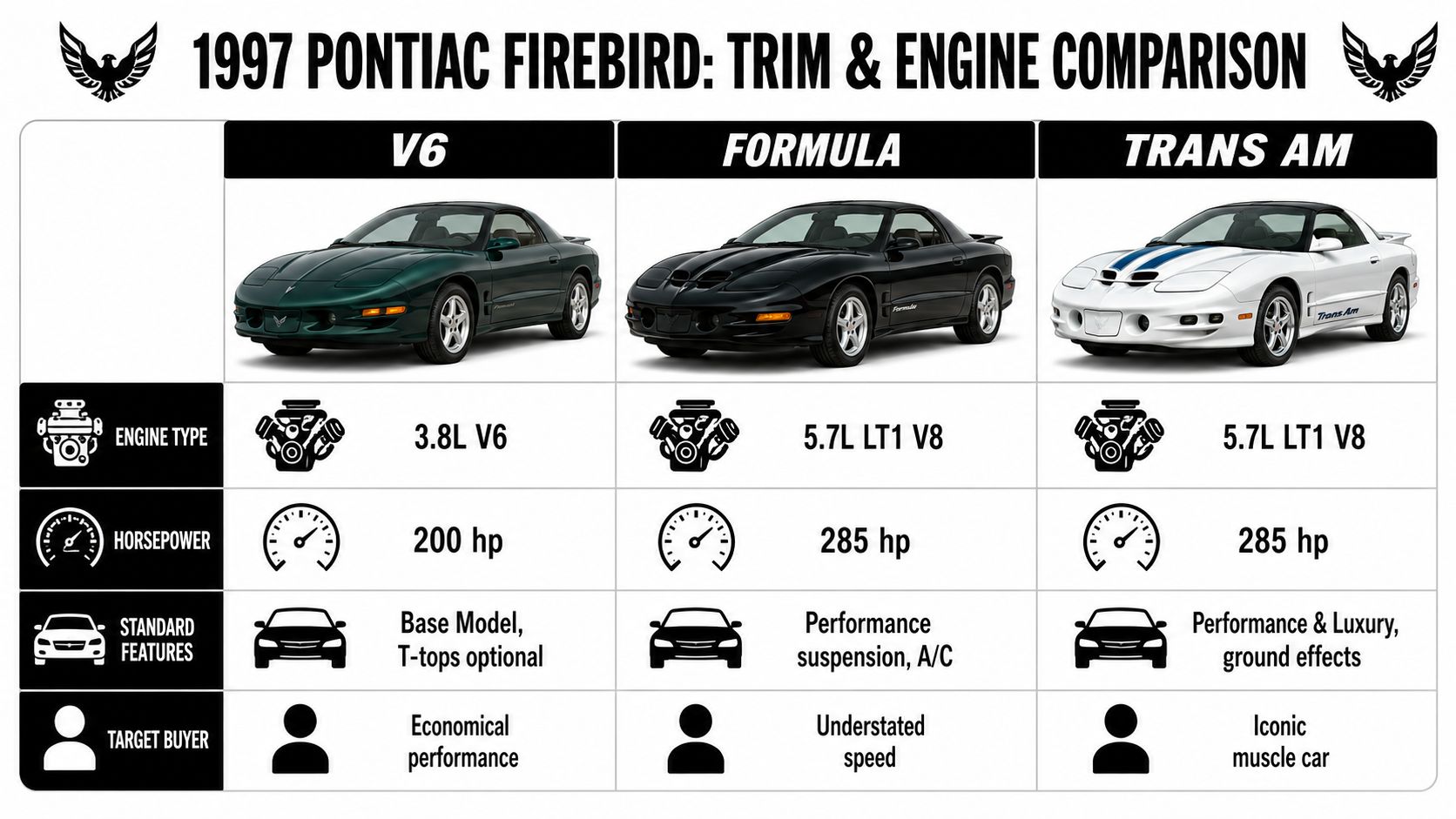
The base V6 is the sensible entry point
The standard Firebird came with the 3.8-liter V6. It is the least risky way into the platform if you want the shape, rear-wheel drive balance, and lower running costs.
That matters more than a lot of listings admit.
A V6 car usually has less image premium baked into the asking price, which gives you more room to buy condition instead of trim status. If the car has been maintained, it can be a satisfying weekend coupe. If it has been neglected, the lower entry price disappears fast through suspension work, cooling-system repairs, interior restoration, and old electrical problems.
The V6 also makes sense for buyers who do not want the added heat, fuel use, and underhood packaging of the V8 cars. You give up bragging rights. You often gain a cheaper, easier ownership experience.
Formula is the insider pick
The Formula is where experienced shoppers start paying attention. It gives you the V8 hardware without asking you to finance every styling cue Pontiac could bolt on.
That is the optimal value play in this lineup.
The common enthusiast view, reflected in this LS1TECH discussion on Firebird buying facts, is that buyers often pay more for a Trans Am's appearance even when a Formula delivers the same basic V8 mission. Practically speaking, that means a cleaner Formula can be the better purchase than a rougher, flashier Trans Am at the same money.
I have seen this mistake plenty of times. A buyer stretches for the Trans Am badge, ignores mediocre paintwork, tired weatherstripping, and a questionable ignition history, then ends up owning the more expensive car on paper and the worse car in the garage.
Trans Am sells the look
The Trans Am earns its reputation on presence. The body cladding, taller rear spoiler, and more aggressive look are a big part of why these cars still draw attention.
There is nothing wrong with paying extra for that. Just call it what it is. You are often paying for appearance first.
That distinction matters on a 1997 Firebird because cosmetic parts and visual drama can distract from expensive mechanical needs. A shiny Trans Am with weak service records is still a risk. A Formula with cleaner fundamentals is often the smarter buy, especially if your budget needs to cover the kind of repairs fourth-gen F-bodies eventually ask for.
If two cars are equally solid underneath, the cheaper Formula usually makes more sense than the pricier Trans Am. If the Trans Am is cleaner, better documented, and less altered, pay for the better car, not just the louder trim.
A simple trim comparison
| Trim | Best for | What to watch |
|---|---|---|
| V6 | Buyers who want the look, rear-wheel drive, and lower buy-in | Neglect disguised by cheap cosmetics, tired interiors, and deferred basic maintenance |
| Formula | Buyers who want V8 performance without paying mainly for appearance | Clones, spotty option records, and cars modified hard then returned to stock |
| Trans Am | Buyers who specifically want the iconic styling and are willing to pay for it | Overpricing driven by looks, not condition, plus hidden mechanical needs behind a clean exterior |
Shop these cars by drivetrain, maintenance history, and overall honesty. Trim matters, but not as much as sellers want you to believe. On a 1997 Firebird, the expensive trap is assuming the Trans Am badge automatically means the best buy.
Unleashing the Beast Performance Specs and Capabilities
The 1997 Firebird's reputation wasn't built on styling alone. Even in base form, it offered enough straight-line performance to feel serious for its time. The question is how much performance you want, and whether the car in front of you still delivers it cleanly.
What the V6 feels like on the road
There's a split in published performance figures for the V6, which is worth acknowledging because old-car specs often vary by test setup and configuration. Cars.com's 1997 Firebird specs list the 3.8L V6 at 200 hp and 225 lb-ft, paired with a 4-speed automatic and rear-wheel drive, with a 0-60 mph time of 7.9 seconds and a 1/4-mile time of 16.0 seconds.
That's enough to make a healthy V6 car enjoyable. It won't deliver the punch of the V8 models, but it still feels like a proper sport coupe rather than a dressed-up commuter.
The WS6 is the benchmark car
If you want the version that defines the upper end of 1997 Firebird performance, look at the WS6. The Automobile-Catalog entry for the 1997 Trans Am WS6 lists the 5.7L V8 with Ram Air induction at 305 hp and 335 lb-ft of torque, along with a 0-60 mph time of 5.6 seconds and a 1/4-mile time of 14.0 seconds.
Those numbers explain why the WS6 still gets serious attention. It wasn't just a decal package. It gave the Firebird a sharper performance identity and a stronger case for buyers who want the most memorable version of the platform.
The WS6 is the car that turns a Firebird from “cool old Pontiac” into “still legitimately quick.”
Performance means more than numbers now
At this age, published specs only matter if the car still runs as intended. A tired V8 with poor ignition behavior, vacuum issues, or weak shifting won't feel like the numbers suggest. A sorted car will.
So use the factory performance figures as a ceiling, not a promise. When you test drive one, judge the health of the car first. Then judge the speed.
Common Issues and Hidden Risks The Optispark Problem
This is the section that saves buyers the most money.
A lot of older Firebird advice gets romantic fast. People talk about styling, exhaust note, and quarter-mile potential. That's all fine. But if you're buying a 1997 car for practical purposes, the first question isn't how cool it is. The first question is what can leave you stranded.
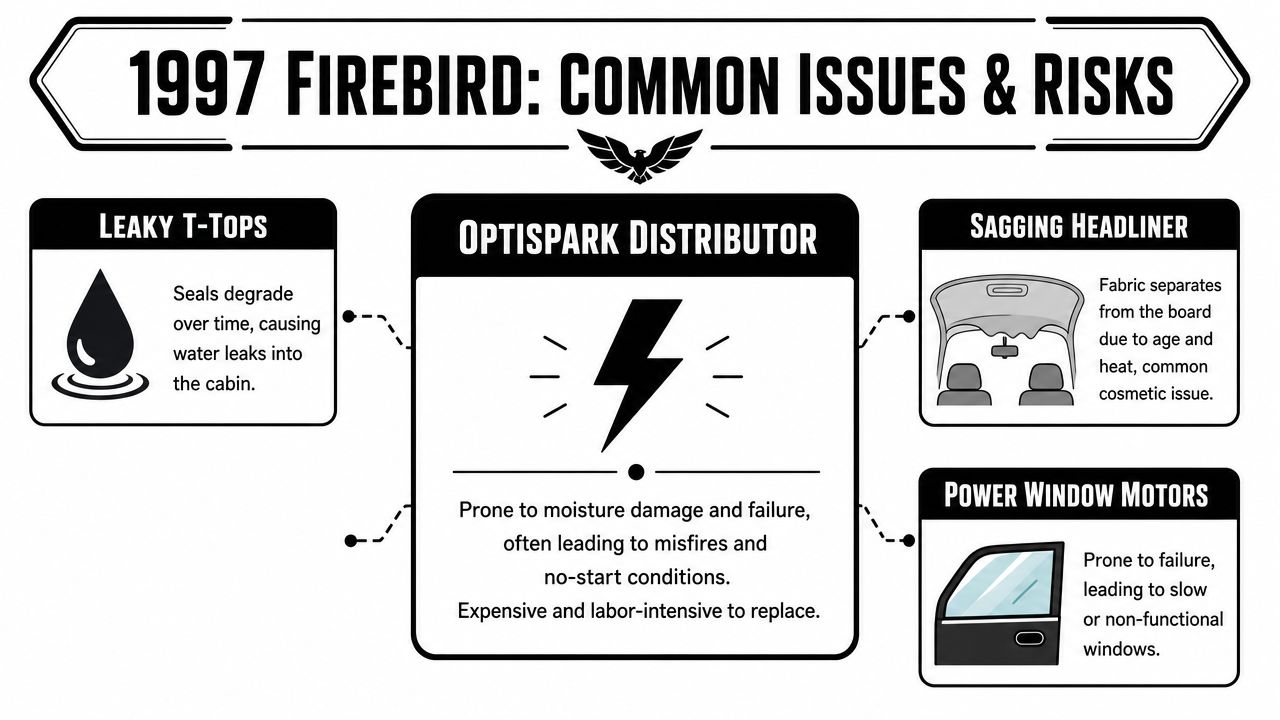
The biggest known risk on the V8 side is the vented Optispark distributor. On 1996-1997 Firebirds, it remains a notorious failure point, often causing the car to stall when reaching operating temperature, and buyers who don't know the issue can end up with a car that suffers a total loss of drivability and a $200 to $400 repair cost, as noted in this owner-community discussion of Optispark failures.
Why Optispark matters so much
This isn't a minor annoyance. The danger is how deceptive it can be. A Firebird can start, idle, and even seem fine for part of a drive before heat exposes the problem. That leads buyers to make the worst possible mistake. They take a short drive, say “feels good,” and hand over the money.
A seller who says the car “just needs a tune-up” deserves extra scrutiny if the engine has hot-start or hot-stall behavior. On these cars, vague ignition complaints are not background noise.
What I'd check before discussing price
If I'm looking at a V8 1997 Firebird, I care less about wax and tire shine and more about evidence. I want repair records. I want signs of cooling system leaks. I want to know how the car behaves fully warmed up, not just during the first few minutes.
Use this quick risk screen:
- Warm idle behavior: Let the engine reach full operating temperature and watch for stumble, roughness, or sudden shutdown.
- Restart test: Shut it off hot, then restart it. Heat-related failures can show up here.
- Cooling area inspection: Look around components tied to moisture exposure and recent repairs.
- Seller language: Be cautious when the explanation is fuzzy, especially if the car dies intermittently.
If transmission health is part of the equation, especially on automatics with questionable shift quality, it also helps to understand hard-part failure points. For buyers sorting drivetrain concerns, this breakdown of 4L60 and 4L65 shell product details gives useful context on a component family often discussed in GM automatic durability conversations.
A short test drive is not enough on this car. You need heat in the system before you trust anything.
Other age-related trouble spots
Not every issue is catastrophic, but the smaller stuff adds up fast. On cars of this age, I often see the same practical annoyances:
- Leaky T-tops: Water gets into the cabin, and interior damage follows.
- Sagging headliners: Common on cars that have lived through heat and sun.
- Power window motor problems: Slow or failed windows are routine on neglected examples.
- Paint and trim aging: Clear coat and plastic trim condition can separate cared-for cars from cosmetic flips.
Mileage claims deserve extra skepticism too. If the odometer story and the wear pattern don't match, read up on the warning signs of odometer rollback in used cars before you negotiate.
The point isn't to be scared off. The point is to stop shopping emotionally. A healthy 1997 Firebird can still be rewarding. A hot-stalling V8 with leak damage and mystery maintenance can empty your patience in a hurry.
The Pre-Purchase Inspection Your Buyer's Checklist
You arrive to see a 1997 Firebird. The paint shines, the seller says it “just needs a small tune-up,” and the Trans Am badges are doing a lot of work. That is exactly how buyers end up overpaying for a car with hidden water damage, weak electronics, or an Optispark-related headache waiting for the first hot restart.
A good inspection on this car has one job. Separate cosmetic excitement from mechanical truth. On a 1997 Firebird, that matters more than the trim name on the fender.
Start with documents before seeing the car
Run the paperwork before you burn half a day meeting the seller. Title status, mileage history, accident records, and registration gaps can change the value of the car before you ever open the door. A clean-looking Trans Am with sketchy history is usually worth less than a straight, honest Formula or V6 with records.
Service paperwork matters too. On LT1 cars, receipts for cooling system work, ignition-related repairs, and regular maintenance carry real weight. If the seller has nothing but verbal promises, price the car like you will be catching up on neglected work.
If you want a broader framework before looking at any used car, keep this pre-purchase car inspection checklist handy.
Hands-on checks that matter on this car
Start outside, then work inward, then go underneath if the setting allows. Rushing this step is how shiny cars win.
Inspect the T-top area and interior carefully
Look for damp carpet, water staining, mildew smell, rusty seat hardware, brittle plastic trim, and a sagging headliner. T-top leaks are common, and the repair bill is rarely limited to weatherstrips.Check the engine cold first
Put a hand on the intake or radiator hose if you need to confirm the seller did not pre-warm it. A cold start tells you more than a polished engine bay ever will. Rough idle, extended cranking, or an obvious miss deserve follow-up.Watch the car again at full operating temperature
Some Firebirds behave well for the first few minutes, then act up hot. That is where LT1 ignition complaints and idle issues tend to show themselves. If the seller resists a full warm-up drive, assume there is a reason.Inspect body fit and paint quality with a skeptic's eye
These cars are old enough to have lived through parking lot hits, cheap resprays, and front-end cosmetic freshening. Uneven panel gaps, overspray on seals, mismatched orange peel, and faded trim next to fresh paint usually mean the appearance got more attention than the mechanicals.Test every basic cabin function
Windows, locks, mirrors, pop-up headlights if applicable on related GM F-body expectations are not the point here, but they tell you how the car was treated. A seller who ignored obvious small failures often ignored bigger maintenance items too.
The test drive should answer expensive questions
A short lap around the block is not enough. I want to know how the car starts cold, shifts warm, brakes straight, tracks on uneven pavement, and restarts after heat soak.
Use this checklist:
- Cold start: Does it fire cleanly and settle into a stable idle?
- Throttle response: Does it pull cleanly, or does it stumble under load?
- Transmission behavior: Do shifts feel consistent, or is there flare, hesitation, or a hard slam into gear?
- Steering and suspension: Does it wander, clunk, or feel loose over bumps?
- Braking: Does it stop straight without pulsing or pulling?
- Hot restart: After a full drive, does it restart immediately, or does it crank, stumble, or act flooded?
A good Firebird feels consistent before and after heat. A bad one comes with a story.
Buy condition over badge
Buyers of 1997 Firebirds face specific pitfalls related to value. A Trans Am can bring more money, but the badge alone does not make it the smarter purchase. If the car looks great in photos and still needs ignition diagnosis, weatherstrip work, interior leak repair, and transmission sorting, the premium disappears fast.
A plain-looking Formula or even a well-kept V6 can be the better buy if the maintenance history is honest and the car behaves properly on the road. Cosmetics attract attention. Mechanical condition determines whether you enjoy the car or resent it.
If paint condition becomes part of the negotiation, especially on dark cars that show every flaw, this walkthrough from Lionheart Detailing's comprehensive guide can help you separate cosmetic correction from repaint-level problems.
The mistakes that cost buyers the most
| Mistake | Why it hurts |
|---|---|
| Letting trim hype lead the deal | A Trans Am premium disappears fast if the car needs ignition, leak, or transmission work |
| Skipping records review | Missing history makes mileage, accident damage, and deferred maintenance harder to judge |
| Accepting a short test drive | Heat-related problems often stay hidden until the car is fully warm |
| Focusing only on appearance | Fresh paint and clean wheels do not tell you whether the car is mechanically sorted |
| Ignoring small electrical faults | Minor cabin issues often point to years of neglect, water intrusion, or cheap repairs |
The right 1997 Firebird is still a satisfying car. The wrong one looks exciting, drives just well enough to hook you, and empties your budget a month later.
2026 Market Value Is a 1997 Firebird a Good Investment
If you're buying a 1997 Firebird as an investment first, be careful. If you're buying it as an enthusiast car with some upside potential, the picture gets more reasonable.
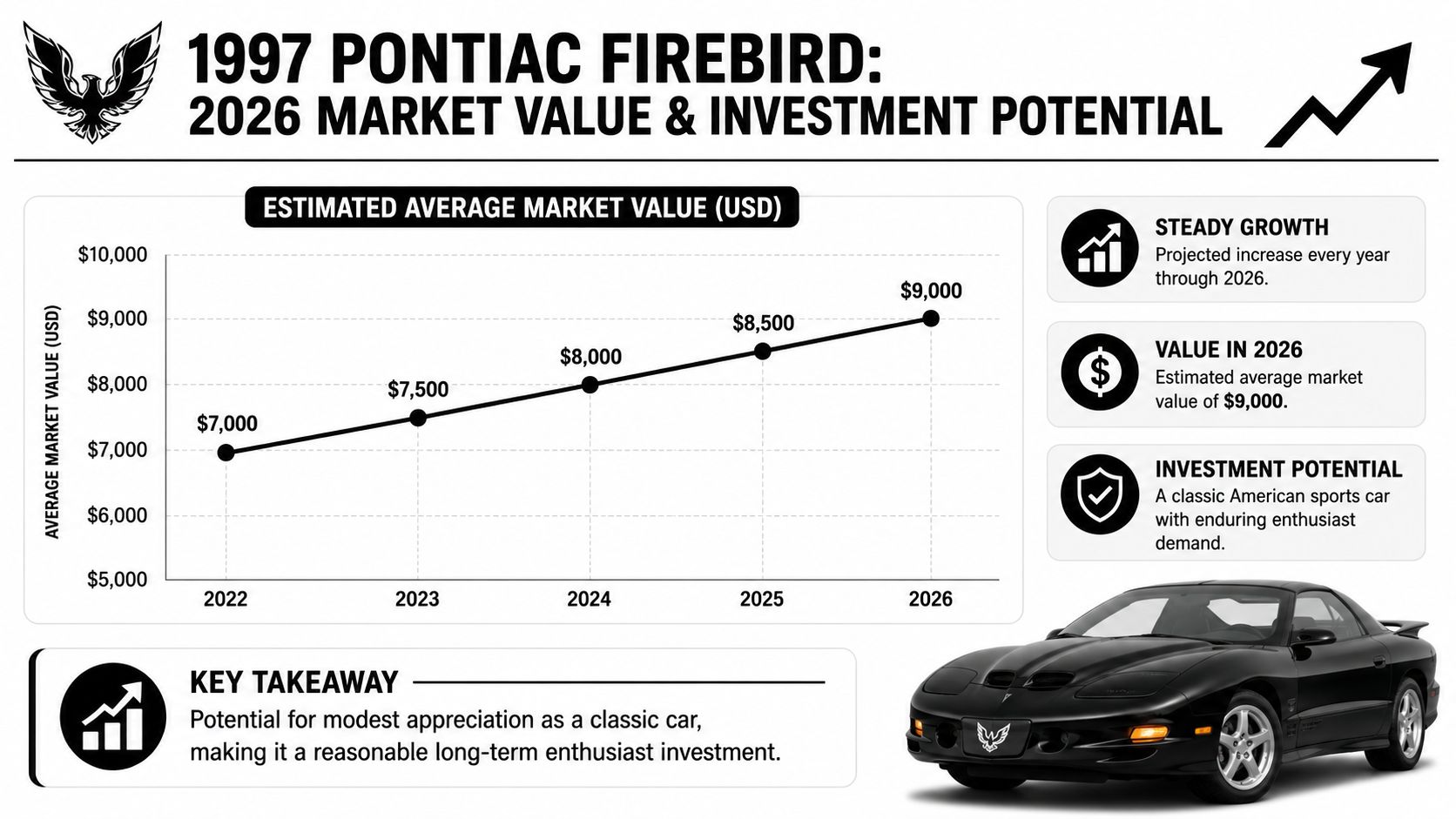
The cleanest hard data in hand points to caution, not fantasy. Current resale values for a 1997 Firebird Formula Coupe have depreciated by 7% over the last 3 years, with a 2026 trade-in value around $4,222, according to The Auto Channel's review data. That tells you two things at once. First, the car still has enthusiast relevance. Second, it remains an aging asset, not a guaranteed money-maker.
When the buy makes sense
A 1997 Firebird is a good buy in 2026 if you fit one of these profiles:
- You want a driver, not a museum piece
- You can inspect carefully and buy condition over badge
- You accept maintenance as part of ownership
- You value character more than modern convenience
That's the honest lane for this car. It can hold enthusiast appeal, but the wrong example will consume any notional value gain with repairs and catch-up maintenance.
The real financial trade-off
The best Firebird purchases are usually the boringly smart ones. Verified history. Strong maintenance file. Honest seller. Fewer surprises. Buyers who chase the cheapest V8 or the flashiest Trans Am often end up paying more after the sale.
Insurance also deserves a quick look before you commit. If you're weighing collector-style ownership, it helps to compare classic vehicle insurance rates and see whether agreed-value coverage makes sense for your situation. For more context on documentation and provenance, this article on a vehicle history report for classic cars is a useful companion.
A 1997 Pontiac Firebird can be worth buying. I wouldn't call it a pure investment car. I'd call it a selective buy. Get the right one, and you'll own something distinctive with lasting appeal. Get the wrong one, and any bargain price disappears fast.
Frequently Asked Questions
Can I daily drive a 1997 Firebird
Yes, but you need realistic expectations. Age is the primary issue, not just the badge. A well-kept car can handle regular use, but an old Firebird usually needs more preventative maintenance than a newer daily driver. If reliability is your top priority, the cleaner and simpler car is usually the better choice.
How much does it cost to insure a 1997 Firebird
Insurance depends on condition, use, driver history, and whether you insure it as a standard older car or a classic. Many owners find standard coverage workable, while cleaner low-use examples may fit better under classic-car policies with restrictions.
Are parts hard to find for a 1997 Firebird
It's mixed. Basic powertrain and service parts are easier to source than model-specific trim, interior plastics, and cosmetic pieces. That means mechanical issues are often less scary than broken or missing trim details.
Is the Formula better than the Trans Am
For value, often yes. For image and styling, many buyers still prefer the Trans Am. The better buy comes down to condition, records, and whether you're paying for real mechanical value or just the look.
If you're serious about buying a 1997 Firebird, run the VIN before you get emotionally attached. VekTracer helps you check accident history, mileage records, title issues, theft data, and recalls so you can spot risk early and compare cars with more confidence.
Ready to check a vehicle?
Enter any 17-character VIN for a free instant preview — no account needed.