1996 Lexus LS400: The Buyer's Guide to a Modern Classic
Check a vehicle before you buy
Enter a VIN for a free instant preview — accidents, title brands, mileage, liens & open recalls.
You're probably staring at a clean-looking 1996 Lexus LS400 listing and asking the only question that matters, is this a smart buy or a polished old luxury sedan with expensive surprises hiding underneath? My answer is direct, the 1996 Lexus LS400 is worth chasing if you want a smooth, torquey, old-school V8 cruiser and you're willing to judge it by history, condition, and maintenance, not by nostalgia. It's the wrong car if you want modern driver assists or a no-thought daily that you can ignore for years.
This is the kind of car that rewards patient buyers and punishes impulse shoppers. The final-year second-generation LS400 still carries real cultural cachet, but age now matters more than badge shine. If you're comparing it against other 90s luxury sedans, or deciding whether a VIN report is worth paying for before you travel to see one, keep reading.
What You're Actually Looking At With a 1996 Lexus LS400
A good 1996 LS400 listing looks innocent because Lexus built it to feel effortless. That's exactly why people get into trouble with it. They see a quiet luxury sedan, assume it's bulletproof, and forget that a 30-year-old car is only as good as its paperwork and upkeep.
This is a car for a buyer who values smoothness over gadgets. It does not belong to someone shopping for modern safety tech, phone integration, or the kind of driver assistance you'd expect in a newer luxury sedan. It belongs to the patient enthusiast who wants a refined V8, accepts age-related maintenance, and knows that a clean example is worth more than a cheap one with a vague story.
Why the final-year detail matters
Being the final year of the second-generation LS400 gives this model a little more appeal than an earlier, rougher survivor. It also matters for the practical ownership conversation, because the cars that remain are the ones that either got maintained properly or got neglected hard enough to disappear. That makes the market narrower and the good cars more desirable.
Practical rule: If the seller can't explain the car's recent maintenance in plain language, assume you're buying someone else's deferred work.
This guide stays focused on the decision that matters, whether the car is worth your money. Expect factory specs, market pricing, weak points, an inspection checklist, and how to read a VIN report before you hand over cash. If your buying style is “I want a clean old Lexus and I'll do the homework,” you're in the right place. If not, walk away now and save yourself the trouble.
Factory Specs and What They Mean on the Road
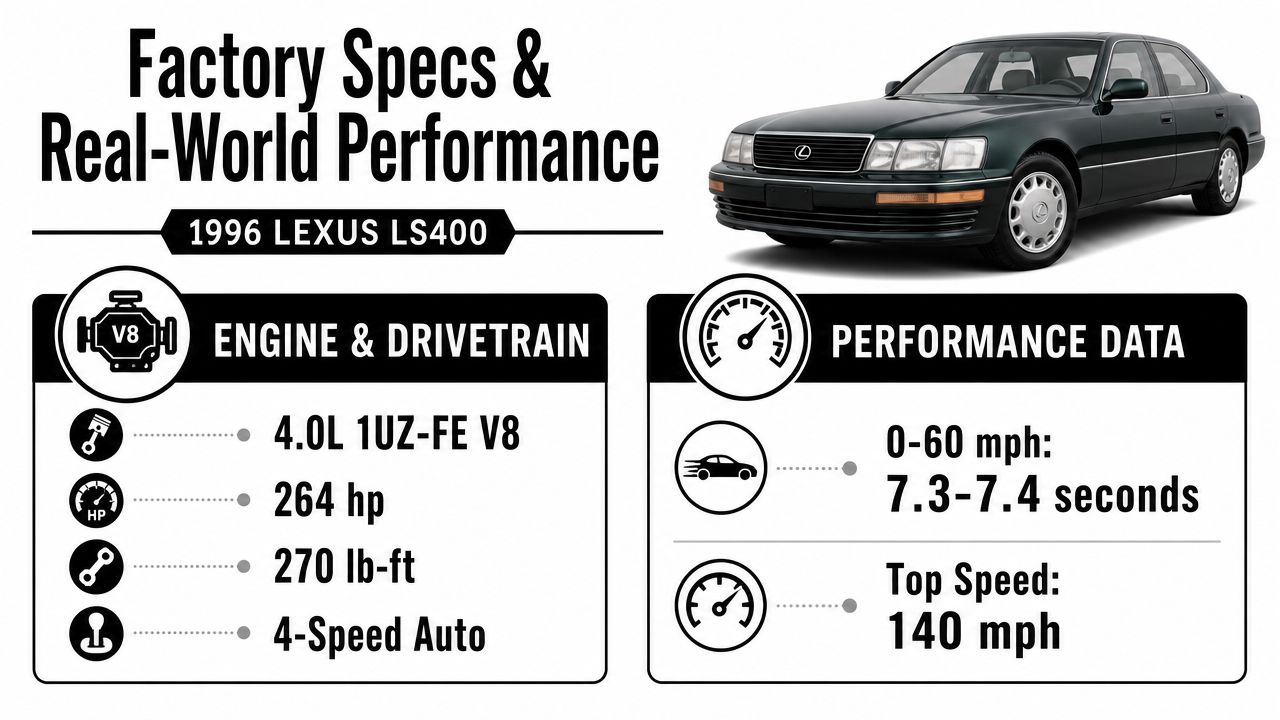
A clean 1996 Lexus LS 400 is a quiet reminder that Lexus built this car to move with authority, not with drama. The 4.0-liter V8 makes 264 hp and 270 lb-ft of torque, and the 4-speed automatic keeps the power delivery smooth rather than busy. Independent specs sources put 0-60 mph at about 7.3 to 7.4 seconds, the top speed at 150 mph, and U.S. fuel economy at 19 mpg city, 26 mpg highway, and 22 mpg combined (Automobile Catalog). Those are solid numbers for a full-size luxury sedan from this era, and they tell you exactly what the car is on the road.
What the numbers feel like in traffic
The LS400 does its best work in normal driving. It pulls away with a deep, effortless surge, then settles into the background once you are up to speed. That is the point of the car. If you want a sedan that feels tense or eager, shop elsewhere. If you want one that glides through traffic without sounding strained, this chassis still makes sense.
It also feels big in the way that matters. The car measures 196.7 inches long, 72 inches wide, and 56.7 inches high, which puts it firmly in full-size luxury-sedan territory (Cars.com). Parking takes more care than in a midsize car, and tight urban spaces will remind you that this is a proper flagship, not a compact dressed up with leather.
Standard gear that matters
Lexus did not treat the basics as optional. Standard equipment includes 225/60 R16 V-rated tires, four-wheel anti-lock disc brakes, and dual airbags (Cars.com). That is the kind of hardware that gives the car real composure on the road and tells you how seriously Lexus approached the platform.
The tire, brake, and airbag setup matters because it shows where the LS400 sat in the market. This was not a soft commuter sedan pretending to be premium. It was a well-engineered luxury car with enough braking, grip, and safety content to match its straight-line strength.
Fuel economy also needs to be viewed in the right light. The LS400 is not a thrift choice, and nobody should buy one expecting cheap operation from a V8 flagship. The right way to judge it is simple, you pay for refinement, not for economy.
Driving reality
A healthy LS400 should feel composed from the first mile. It should idle smoothly, shift cleanly, and build speed without hesitation or harshness. If it feels slow, noisy, or vague, blame condition first, because that is usually what is wrong with an old luxury Lexus, not the original design.
Trim and Equipment, and Why the Lineup Is Simple
KBB keeps the 1996 Lexus LS refreshingly simple, it lists a single U.S. trim, the LS 400 Sedan 4D, with standard items including AM/FM radio, cassette, and child door locks (KBB). That simplicity is a gift for used buyers. You're not decoding a maze of luxury packages, subtrims, and half-rare option combinations.
Why single-trim matters
A one-trim lineup shifts the buying process away from feature-chasing and toward the stuff that changes ownership cost. In practice, that means condition, mileage, service records, and title status matter more than build-sheet bragging rights. You're not trying to find the “right” package, you're trying to find the healthiest example.
That also means the seller's “rare configuration” pitch should carry almost no weight. If the car is clean, documented, and mechanically sound, great. If it isn't, no amount of trim talk fixes bad maintenance.
Focus on the car's history, not the seller's adjectives.
What to ignore
Ignore claims that one LS400 is a special bargain because it has some supposed unusual equipment mix. This isn't that kind of market. The advantage here is that the car is easy to verify and hard to romanticize once you look at the facts.
The practical takeaway is simple. When you shop one of these, stop caring about trim mythology and start asking for service records, cold-start proof, and the VIN history. That's where the value lives.
Reliability, Known Issues, and What Actually Fails
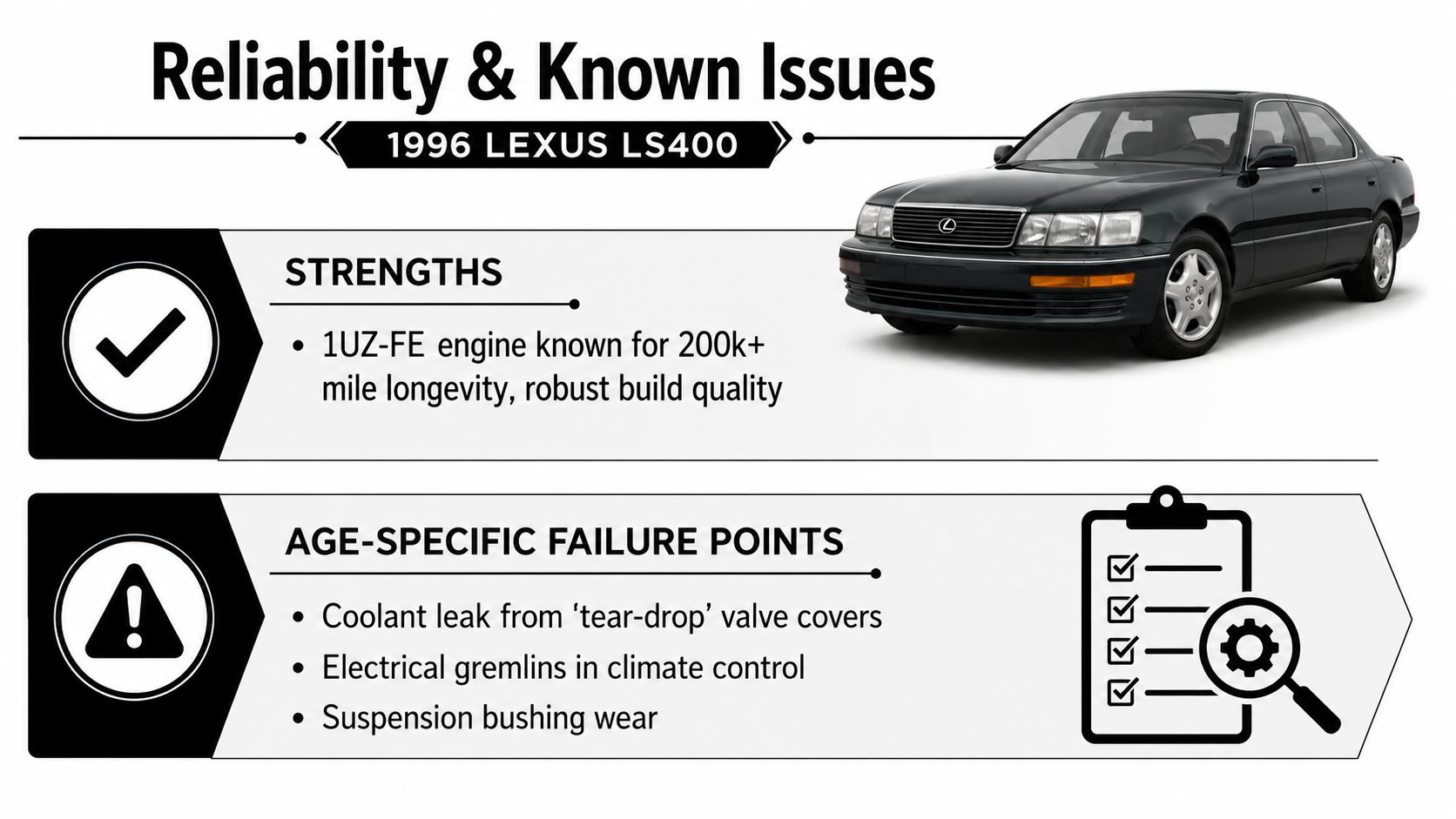
The LS400 earned its reputation the hard way, by surviving long enough for owners to tell the truth about it. The 1UZ-FE V8 is known for lasting a very long time with basic care, but age doesn't care about reputation. Gaskets dry out, hoses harden, mounts sag, and neglected maintenance piles up.
The failures that matter
The biggest rule is simple, timing belt service is essential. If the paperwork doesn't show it, assume it's due and price the job into your offer. Don't debate it, don't hope it was done, and don't let a clean interior distract you from a missing service record.
Valve cover seepage is common on old engines of this type, and coolant hoses can get brittle after decades. Suspension bushings and engine mounts usually show their age in ride quality first, then in drivability. California-spec cars can also bring extra complexity if the secondary air injection system has been tampered with or ignored.
What to treat as normal wear
Not every symptom means the car is dying. Some of the annoying stuff is just age showing up in places that don't strand you immediately. The key is separating cosmetic or comfort issues from the things that become expensive fast.
- Check maintenance first: If the seller can't document timing-belt service, move it to the top of your cost stack.
- Watch for leaks: Oil around the valve covers, pan area, or power steering components is a warning sign, not a dealbreaker by itself.
- Feel the suspension: Clunks and floaty behavior usually point to bushings or mounts, which affect how the car feels more than whether it starts.
- Respect the climate control: Old luxury electronics can get flaky, and that's annoying even when the rest of the car is solid.
If you're also protecting other high-value assets, it's worth thinking the same way you would with jewelers block insurance, you don't assume the asset is safe just because it looks fine on the surface. You verify it.

What a 1996 Lexus LS400 Is Worth in 2026
The market for a 1996 Lexus LS400 is all over the place because condition, mileage, records, and location matter more than the badge. In Australia, one current listing source puts the car's new price at $155,350 and shows an indicative private-buy range of $4,500 to $14,600 today, while another current estimate lands at $7,260 to $10,230. Those numbers do not line up neatly, and that is exactly how this car should be judged, as a real used purchase, not a collectible with a fixed book value.
How to read the spread
The U.S. market price was steep when new, and the point of that number is simple. It shows how far the car has depreciated, not what you should pay for a tired example today.
Treat the price as a condition test. A clean title, solid maintenance history, and a straight body justify paying more. Missing records, vague ownership stories, or obvious cosmetic abuse should drag the number down fast.
Where a premium is justified
Top-of-range money only makes sense when the car earns it. Documented maintenance, no title issues, and evidence that the car was cared for instead of merely cleaned up for photos all support a stronger asking price. If those pieces are missing, the seller is asking for confidence the car has not earned.
For a quick reality check before you make an offer, use VekTracer's used car value estimate alongside your own inspection. Use it to pressure-test the asking price, not to overrule a careful look at the car in front of you.
Pre-Purchase Inspection Checklist You Can Run at the Meet-Up
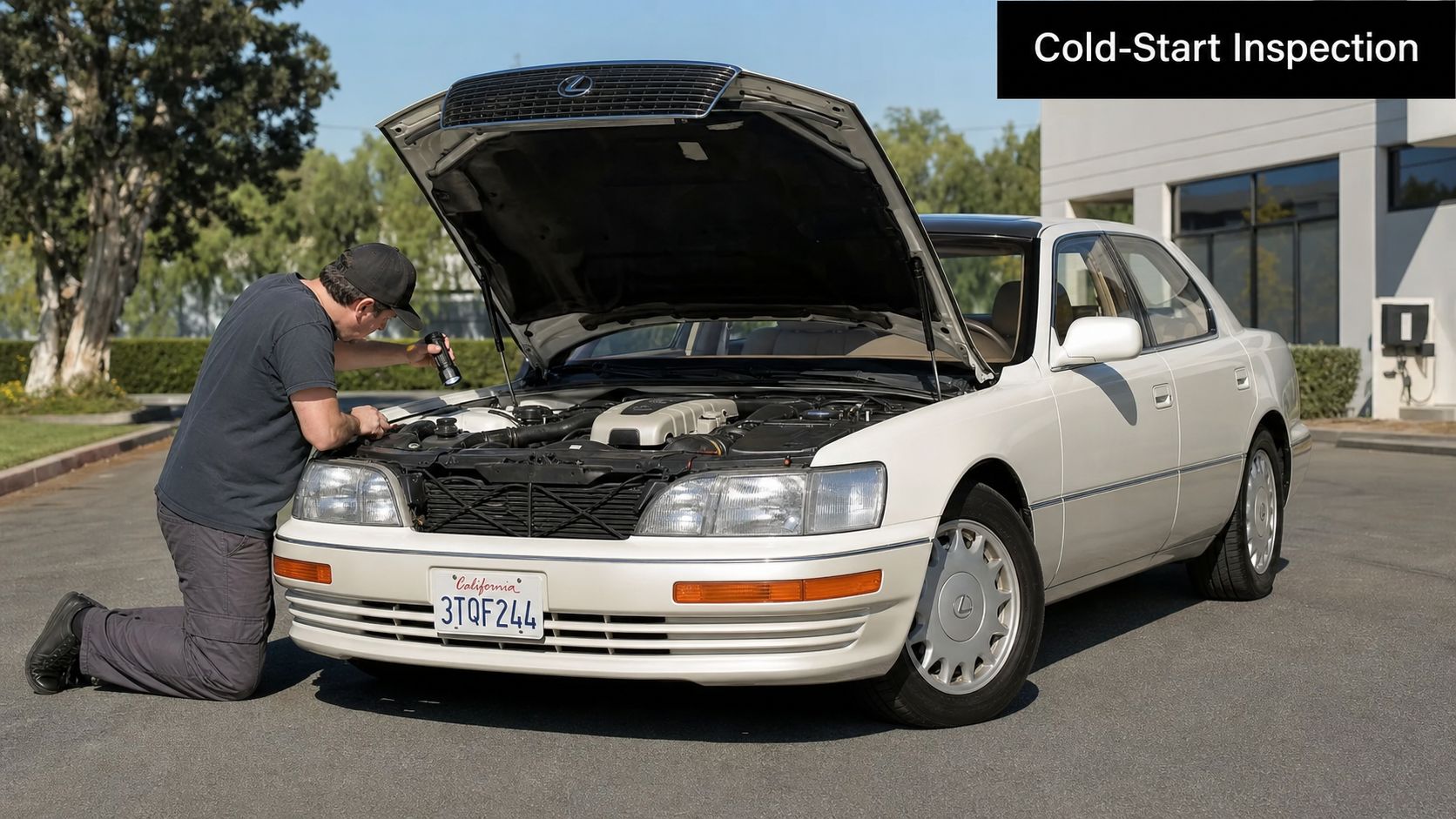
Show up with a cold car if you can. A warm engine can hide rough idle, lazy starting, and a few other sins that matter on a 1996 LS400. The car should fire quickly, settle into a steady idle, and sound composed right away. If it cranks too long or hunts at idle, stop admiring the cabin and start treating the car like a problem to solve.
Walk the car in order
Open the hood and look for evidence, not shine. Check around the valve covers, oil pan, and power steering area for seepage, then scan the rest of the bay for signs of a rushed cleanup. A spotless engine bay on an old luxury sedan often means someone prepared it for sale, not that someone maintained it properly.
Move to the body next. Panel gaps should stay even, paint should match from panel to panel, and the car should not show the kind of small mismatch that comes from cheap repair work. Look at the tires with the same level of suspicion. Matching, reasonably fresh rubber usually says the owner paid attention. Mismatched or visibly aged tires usually mean the car got attention only when something failed.
The best quick-reference checklist is a real inspection flow, not a feature sheet. Use VekTracer's pre-purchase car inspection guide to keep your walk-around disciplined and focused on the stuff that costs money.
Drive it like you mean it
The test drive should confirm that the car still behaves like a luxury sedan, not a tired older sedan wearing leather. The transmission should move cleanly through the gears, with no flare, no hesitation, no clunk over bumps, and no odd throttle response. The car should feel calm and controlled, even when you ask more of it.
Pay extra attention to the parts of the car that usually expose neglect. Suspension noise, wandering steering, brake pulsation, and sloppy gear changes are the kinds of problems that turn a fair price into a bad one fast. If the car feels busy, something is off.
- Cold start: Clean fire-up, stable idle, no long crank.
- Under the hood: Look for seepage, dried residue, or obvious hose cracking.
- Body check: Inspect for mismatched panels and uneven gaps.
- Tires and brakes: Confirm the car still wears a sensible, matching setup and the brakes feel consistent.
- Road test: Listen for suspension noise and feel for sloppy shifts.
Do not let a clean cabin distract you from the basics. A used luxury sedan can look excellent and still need serious work under the skin. If anything on the list turns into a “maybe,” lower your offer or pay for a proper pre-purchase inspection by a Lexus specialist. Do not buy uncertainty.
If the seller has a VIN report, use it as part of the meet-up, not as a substitute for your own eyes. Check the history before you get attached, then compare it against what the car does in front of you.
How to Read a VIN Report for This Specific Car
Run the VIN before you travel, not after you fall in love with the car. A 30-year-old Lexus won't have a modern paper trail, so every recorded event matters more. Treat the report like a filter, not a verdict.
What actually changes your inspection
If the VIN report shows an accident entry, your body inspection gets stricter. Use a flashlight, look deeper at the panel gaps, and check for repair clues instead of trusting the paint. If the mileage progression looks irregular, that's the point where you ask the seller to explain the history in detail.
Title status matters just as much. A clean title keeps the ownership path simple, while salvage or rebuilt branding changes how you think about resale and insurance. Don't assume those cars are automatically bad, but do assume they're harder to move and easier to regret.
A good VIN report doesn't replace a physical inspection. It tells you where to look harder.
Use the report as a map, not a shortcut
A VIN history report should confirm or challenge what your eyes are already telling you. If the car looks straight but the report hints at damage, dig in. If the seller swears the car was babied but the history looks thin, don't hand-wave that away.
A tool like VekTracer's VIN lookup report is useful here because it helps confirm the obvious before you get distracted by interior condition or paint gloss. I'd still inspect the car in person, because the report can only point you in the right direction.
Should You Actually Buy One
Yes, but only if you're buying the right car for the right reason. The 1996 Lexus LS400 makes sense for an enthusiast who wants a smooth V8 sedan, can handle basic maintenance, and is shopping on condition, not cheap asking price. It's a bad fit for anyone who wants modern safety tech, lives in winter salt, or expects the car to behave like a newer daily driver.
My buying line
I'd only pay up for one with a clean VIN report, documented timing-belt service, and a cold-start video that proves something. If the seller can show those three things, the LS400 still deserves respect as one of the better old-school luxury buys. If they can't, walk.
The reason is simple. This car is good when it's been cared for, and annoying when someone's ignored the basics. The maintenance milestones ahead are not theoretical, and the cheapest car on the ad site usually becomes the expensive one in your driveway.
My verdict
Buy the LS400 if you want refinement, old Lexus engineering, and a car that still feels special when sorted. Pass if you want a low-risk commuter or if the seller is asking strong money without strong proof. In this market, the right answer isn't “maybe,” it's either a documented yes or a clean walk-away.
If you're shopping a 1996 LS400 right now, pull the VIN, compare the asking price against the car's history, and don't move forward until the timing-belt story is documented. If you want a faster way to sanity-check the listing before you drive across town, use VekTracer and bring the report with you to the inspection.
Ready to check a vehicle?
Enter any 17-character VIN for a free instant preview — no account needed.