05 Honda Odyssey Buyer’s Guide Trims Specs and Common Issues
Check a vehicle before you buy
Enter a VIN for a free instant preview — accidents, title brands, mileage, liens & open recalls.
You're probably staring at a listing right now, thinking the same thing most buyers think: the 2005 Honda Odyssey looks like a smart family van, but you don't want to inherit someone else's problems. That instinct is right. The 05 Honda Odyssey is still one of the better used minivan buys if you choose the right trim, verify maintenance, and inspect the known trouble spots that too many sellers gloss over.
My advice is simple. Buy the cleanest, best-documented example you can find, and don't let “it's a Honda” talk you into skipping due diligence. This model has real strengths, including space, flexibility, strong safety equipment, and solid owner-rated reliability, but it also has a few red flags that can turn a “great deal” into a money pit. If you want a sharper buying process, this practical guide on how to buy a good used car is worth keeping open while you shop.
Introduction and Quick Overview
The 05 Honda Odyssey remains a strong used minivan choice because Honda got the fundamentals right on this generation. The third-generation Odyssey arrived as a major redesign, with seating for seven in standard trims and up to eight in the EX thanks to a removable center second-row seat, plus useful family-friendly features like the Magic Seat third row that folds into the floor (Autoevolution).
That's the good news. The catch is that a clean example and a neglected one can feel like completely different vehicles. Some buyers fixate on transmission fear and miss more specific risks like paint adhesion problems, ignored timing-belt service, and trim-specific quirks that matter in real ownership.
Broker's view: The right 2005 Odyssey is still worth buying. The wrong one will demand repairs faster than most buyers expect.
If you're shopping seriously, focus on three things first. Trim choice, maintenance records, and body condition. Get those right, and you'll avoid most expensive mistakes before you even show up for the test drive.
Trim Levels and Key Technical Specs
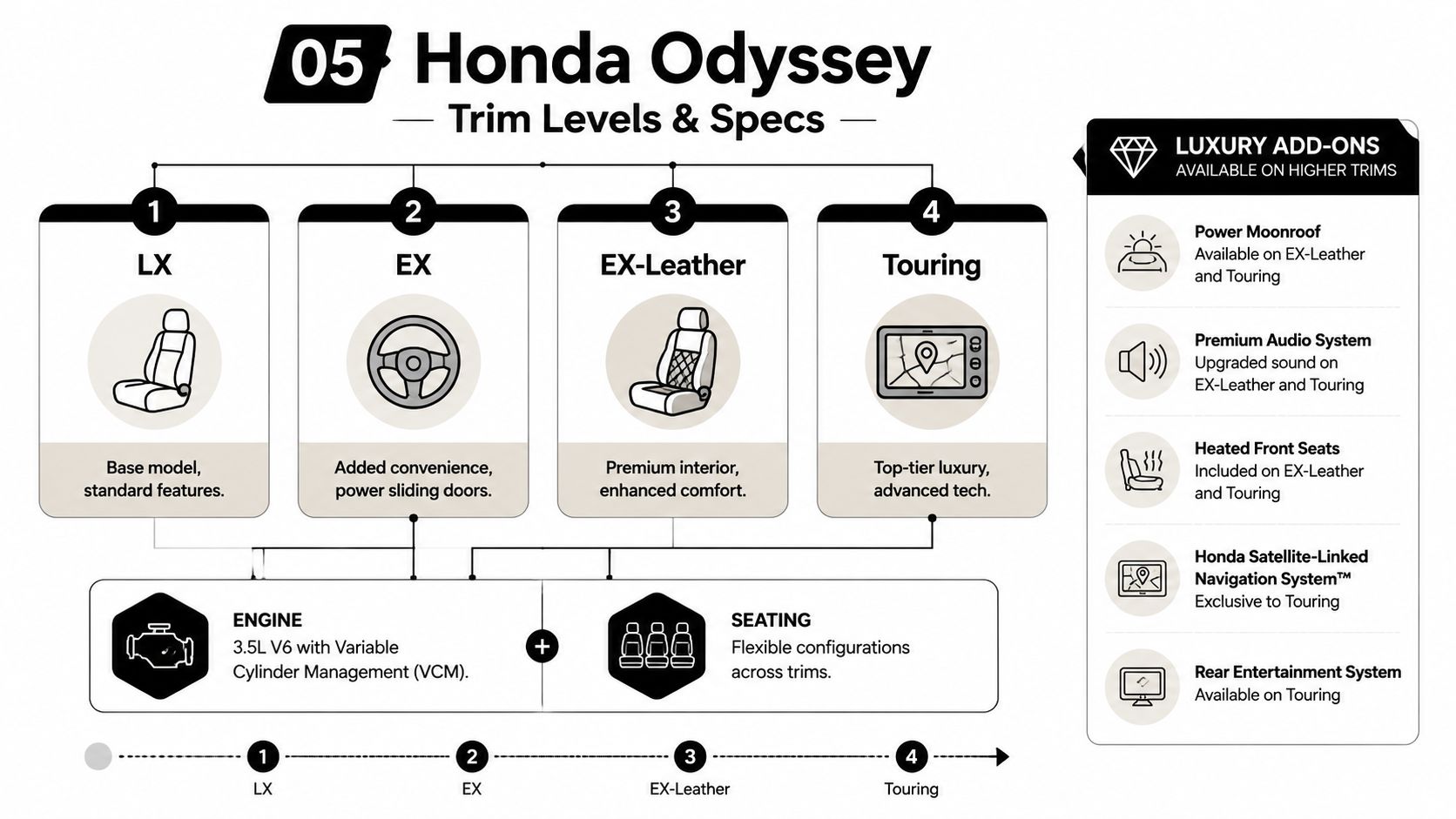
The trim lineup matters more than people think. Honda didn't just stack cosmetic features here. Each version of the 05 Honda Odyssey changes the ownership experience, especially once you factor in seating flexibility, fuel-saving tech, and higher-end equipment.
Which trim makes the most sense
All trim levels came with a 3.5-liter SOHC V-6 making 255 horsepower at 5,600 RPM and 250 lb-ft of torque at 4,500 RPM, paired with a 5-speed automatic transmission (Cars.com). That means the base van doesn't feel weak, and you don't need the top trim just to get acceptable power.
Here's how I'd break it down for buyers:
| Trim | Best for | What stands out |
|---|---|---|
| LX | Budget-minded family buyer | Basic setup, same V6, fewer luxury add-ons |
| EX | Most practical mainstream pick | Better convenience features, plus seating flexibility that can reach eight passengers with the removable center second-row seat |
| EX-L / EX-Leather | Buyers who want comfort without going full top-trim | Adds leather and the first taste of higher-end equipment |
| Touring | Buyers who want the most features and don't mind extra complexity | Luxury-oriented trim with advanced tech and premium touches |
What changed with VCM and pricing
The biggest technical split isn't horsepower. It's Variable Cylinder Management, or VCM, which appeared on the EX-Leather and Touring trims. Honda's system could switch between three and six cylinders during light-load cruising. The 05 Odyssey launched with a 3.5L SOHC 24-valve V6 producing 255 hp and 250 lb-ft of torque, and VCM-equipped trims could improve highway fuel economy by up to 12 percent over base models, with EPA ratings of 20 mpg city and 28 mpg highway (Autoevolution).
Honda also positioned the trim ladder clearly on price. The LX started at $25,510 and the Touring reached $35,010 when new (Autoevolution).
A few Touring-specific details matter if you're comparing listings. The Touring introduced a more upscale direction for the Odyssey lineup, and it uniquely bundled VCM and Active Noise Control to cut cabin noise during light-load operation (Honda News overview).
My trim recommendation
If you want my blunt answer, the EX is the sweet spot for most buyers. It gives you useful family functionality without loading up the van with every expensive feature. The Touring is appealing on paper, but older luxury features often mean more things to sort out later.
If you're shopping for function, buy an EX with records. If you're shopping for comfort, consider EX-Leather. Only buy a Touring if it's exceptionally well kept.
Common Mechanical Issues and Maintenance
Buyers either protect themselves or incur significant costs. The most overlooked mechanical issue on the 05 Honda Odyssey isn't the one commonly discussed initially. It's the timing belt and hydraulic tensioner.
The maintenance item you can't ignore
Owners report that neglecting the $400–$600 timing-belt and hydraulic tensioner service often leads to catastrophic engine damage, and failures on 164k-mile examples are often tied to snapped tensioners destroying the valvetrain (owner discussion on Reddit). If the seller can't prove this job was done, treat that as a pending bill at minimum and a walk-away reason at worst.
That's not optional maintenance. It's survival maintenance.
For buyers who are trying to decode dash reminders or seller excuses, this breakdown of what the maintenance required light means helps separate routine service from the big-ticket items you actually need paperwork for.
What to ask the seller before you drive over
Don't start with “Has it been maintained?” That question gets useless answers. Ask for specifics.
- Timing belt records: Ask for invoice proof, not verbal confirmation.
- Hydraulic tensioner documentation: This is the part too many buyers forget to ask about.
- Transmission behavior: Don't ask if it's “good.” Ask whether it shifts smoothly cold and warm.
- Fluid leaks: Look under the engine and transmission area before the test drive.
- Brake and suspension work: Older family vans often hide wear in bushings, shocks, and brake components.
The realistic ownership mindset
The 2005 Odyssey can still be a dependable van, but only if the previous owner believed in preventive maintenance. Owner reliability scores are strong, and that matters, but owner satisfaction doesn't replace invoices. Some vans survive because people cared for them. Others survive just long enough to reach your driveway.
Practical rule: If maintenance history is vague, price the van as if major service is due right now.
A good test drive should include city speeds, low-speed turns, braking, and a highway merge. Listen for clunks from the suspension, feel for hesitation or rough shifting, and pay attention to whether the van tracks straight. The 05 Odyssey has enough power to feel confident. If it feels tired, sloppy, or noisy, assume deferred maintenance is part of the story.
Safety Features and Recall History
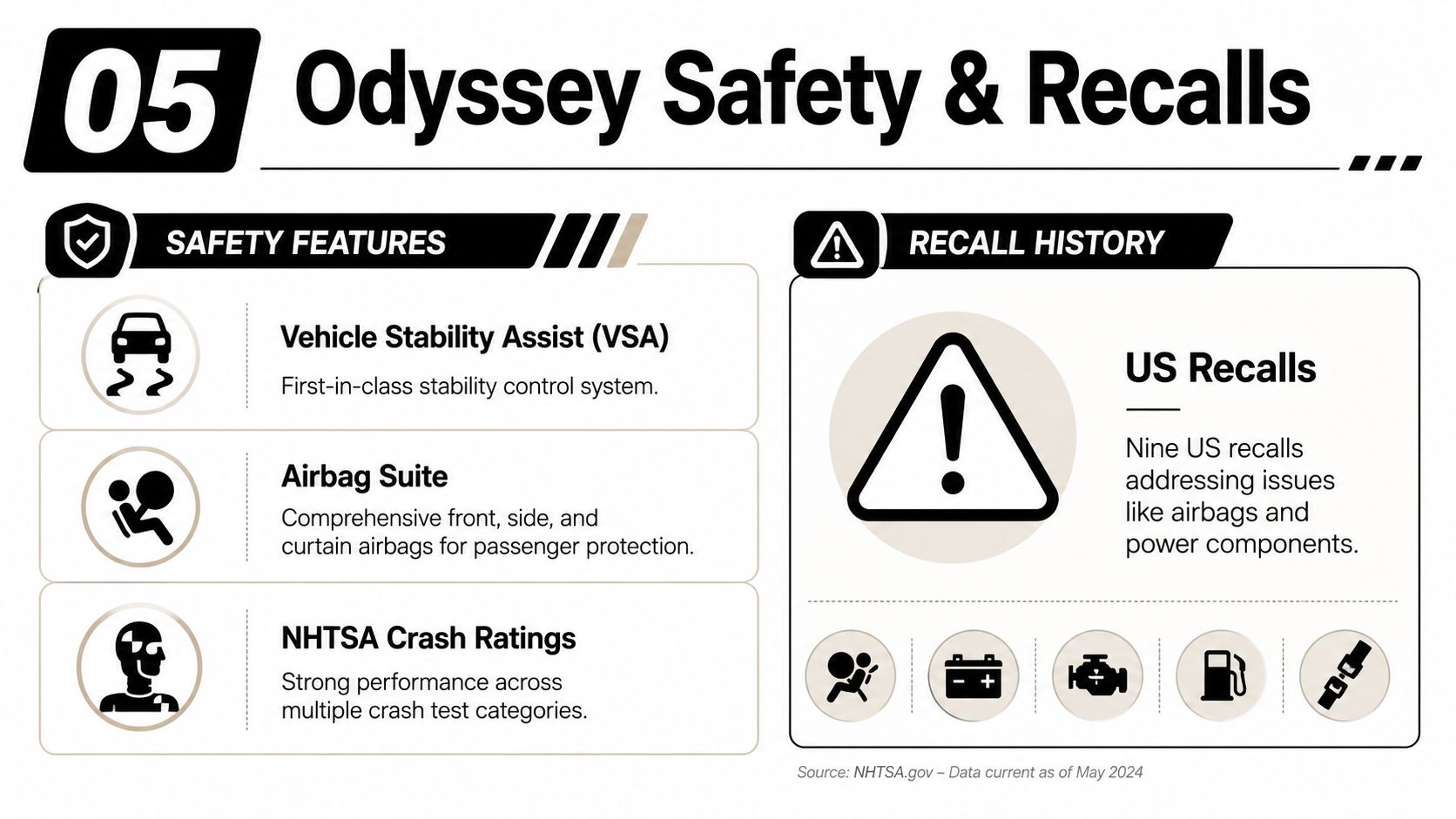
Honda gave the 05 Odyssey unusually strong safety hardware for its class and era. That's a real advantage. It also carried a meaningful recall history, which means you need to check whether the van in front of you received the work.
What the Odyssey got right on safety
The 05 Odyssey offered Vehicle Stability Assist as standard across all four trims, a first-in-class setup according to Conceptcarz's model summary. Honda also included a broad airbag package, and the van earned a 5-out-of-5-star front-side driver crash test rating from NHTSA as noted in Autoevolution's 2005 Odyssey overview.
That combination matters in a minivan. You want stability control, predictable braking, and strong occupant protection in a vehicle that's often carrying kids, luggage, and extra passengers.
Why the recall count matters
The 05 Odyssey has 9 NHTSA recalls on file, yet owners still rate its reliability at 4.6 out of 5, with an overall consumer rating of 4.5 (Consumer Reports reliability page). That tells me two things. First, buyers generally like owning these vans. Second, liking the van doesn't erase open or incomplete recall work.
Use recall history as a file-checking exercise, not an emotional debate. If a seller says, “I'm sure it's all handled,” that's not enough.
- Ask for dealer records showing recall completion if available
- Match the VIN to recall status before purchase
- Inspect safety equipment function such as warning lights and seat belts
- Don't ignore seating accessories if your family setup needs them. If fit is an issue, it can help to find a Honda Odyssey seat belt extender from Seat Belt Extenders before committing to the vehicle
A van with strong factory safety gear is only a good buy if the recall work is current and the restraint systems are intact.
Market Pricing and Value Trends
Pricing a 05 Honda Odyssey isn't about pretending there's a single “correct” number. At this age, condition drives value harder than trim alone. A rough Touring isn't automatically worth more than a clean EX with records. In the marketplace, paperwork and body condition move the needle more than old-window-sticker prestige.
What actually affects value
Three factors shape what you should pay:
| Factor | Why it matters | Buying takeaway |
|---|---|---|
| Trim level | Higher trims add features, but they also add complexity | Don't overpay just because the listing says Touring |
| Service history | Major maintenance separates good vans from future headaches | Records justify stronger money |
| Rust and paint condition | Cosmetic issues can turn structural in humid regions | Body problems should lower your offer fast |
The original spread between trims was wide when new, but that doesn't carry over cleanly into today's used market. Buyers who shop smart treat every listing as an individual case.
Where buyers make pricing mistakes
A lot of people overvalue low asking prices. That's backwards. A cheap Odyssey with poor paint, vague service history, and signs of neglect is usually expensive once you own it. A more expensive one with documented upkeep often costs less in the first year.
The other common mistake is ignoring geography. Humid areas are rougher on paint and corrosion. If you're shopping in the Southeast, near the coast, or across parts of Canada where moisture and road treatment are tougher on older vehicles, inspect harder and negotiate harder.
Don't negotiate from book values alone. Negotiate from visible condition, documented maintenance, and the cost of what you'll need to fix first.
If you want a better decision framework, compare a seller's claims against the van itself. If they say “excellent condition” but the paint is peeling, the seats are tired, and service records are missing, the listing is overpriced no matter what trim badge is on the tailgate.
Inspection Checklist and History Red Flags
This is the section that saves buyers money. The 05 Honda Odyssey has a few underreported issues that don't always show up clearly in generic used-car advice. The biggest one is the paint problem. The 2005 model suffered a factory paint adhesion defect, leading to over 900 complaints of peeling and corrosion, especially in humid markets, and it often won't be obvious from a standard history report alone (MotorAudit).
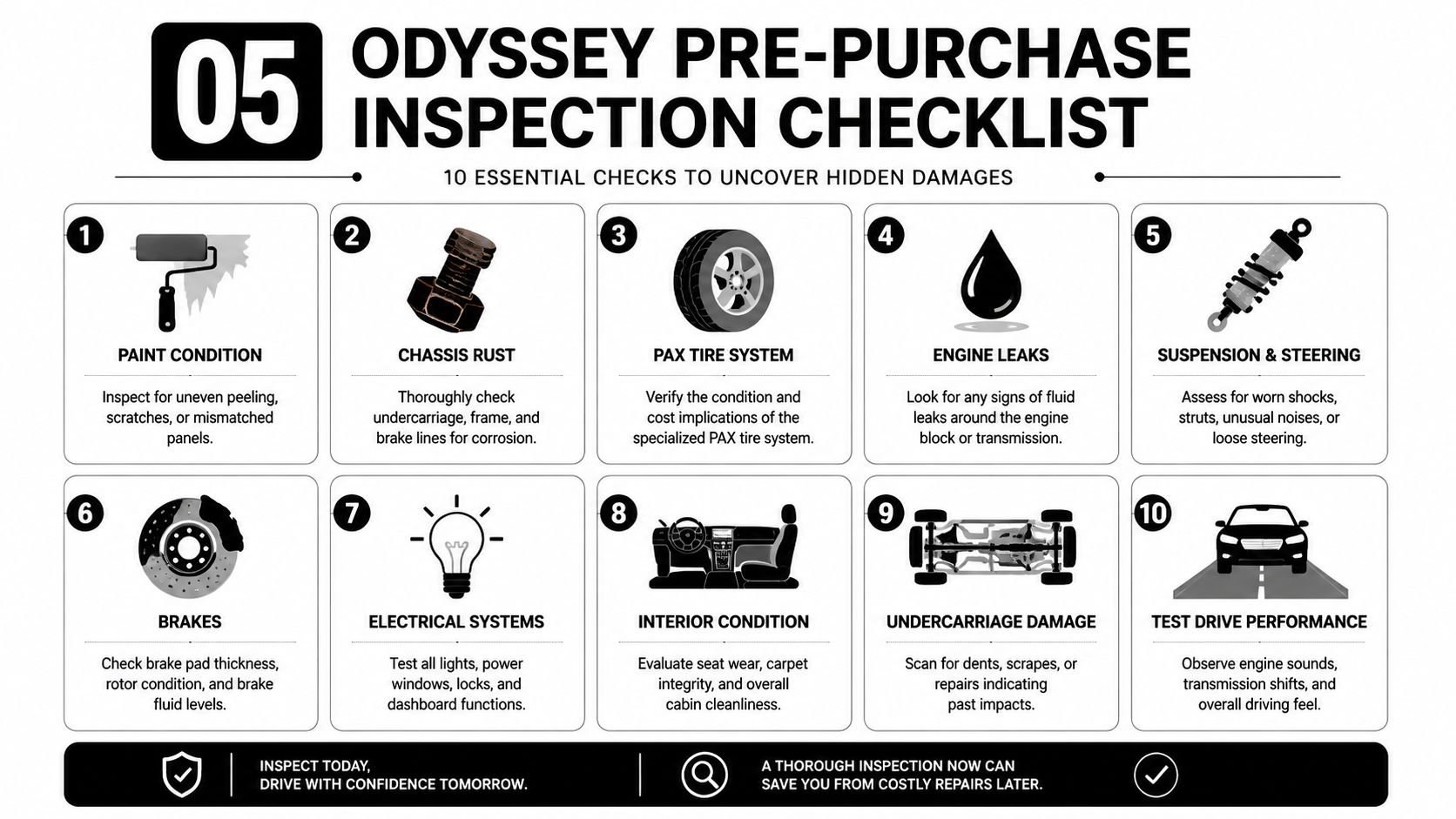
The 10-point pre-purchase checklist
Use this in order. Don't skip around.
Paint condition
Check the roof, hood, and upper body panels first. Uneven peeling, cloudy patches, or mismatched repaint work often tell you more than the seller will.Chassis rust
Get underneath the van. Look at the frame areas, brake lines, and mounting points. Surface rust is one thing. Scaling and corrosion around structural areas are another.PAX tire system on Touring models
If you're looking at a Touring, verify what's on the van now. Buyers often miss the cost and hassle attached to the original PAX setup.Engine leak check
Look around the engine block and underneath after the test drive. A seller who says “all old Hondas seep a little” is usually trying to normalize neglect.Suspension and steering feel
Listen during slow turns and over rough pavement. Family vans hide worn suspension parts because buyers expect them to feel soft.
What to validate against paperwork
The next five checks are less visible, but just as important.
- Brakes: Feel for vibration, weak bite, or a soft pedal.
- Electrical equipment: Test sliding doors, windows, locks, dash lights, and HVAC controls.
- Interior wear: Heavy wear can expose a harder life than the odometer suggests.
- Undercarriage damage: Scrapes, bent areas, or fresh undercoating can point to prior impact or cover-up work.
- Road test behavior: The van should pull cleanly, shift consistently, brake straight, and feel composed.
A real-world buying scenario
Here's the kind of example I see all the time. Buyer A finds a cheap Odyssey with shiny photos and low seller enthusiasm for paperwork. During inspection, the roof paint is peeling, the underbody shows rust, and there's no proof of timing-belt service. Buyer A talks themselves into it because “the engine sounded fine.”
Buyer B looks at a slightly more expensive EX with complete maintenance records, cleaner paint, and a more honest seller. Buyer B pays more upfront and usually wins.
Buy the van with the boring paperwork, not the one with the exciting price.
History report red flags that matter
A vehicle history report is useful, but it won't catch everything. Use it to confirm patterns, not replace your eyes.
- Title brands: Any branding needs an explanation that makes sense
- Mileage consistency: Odometer history should read like a straight story
- Accident entries: Even minor damage should match visible repairs
- Geographic history: Humid-market use raises the importance of rust and paint inspection
- Service records: Not every report includes them, but when they're there, they're extremely useful
If the body, paperwork, and road test don't tell the same story, walk away.
Using VekTracer to Evaluate Odyssey Listings
Most buyers waste time looking at too many listings before they eliminate the obvious losers. That's backwards. Run the VIN first, then decide whether the van deserves an in-person inspection.
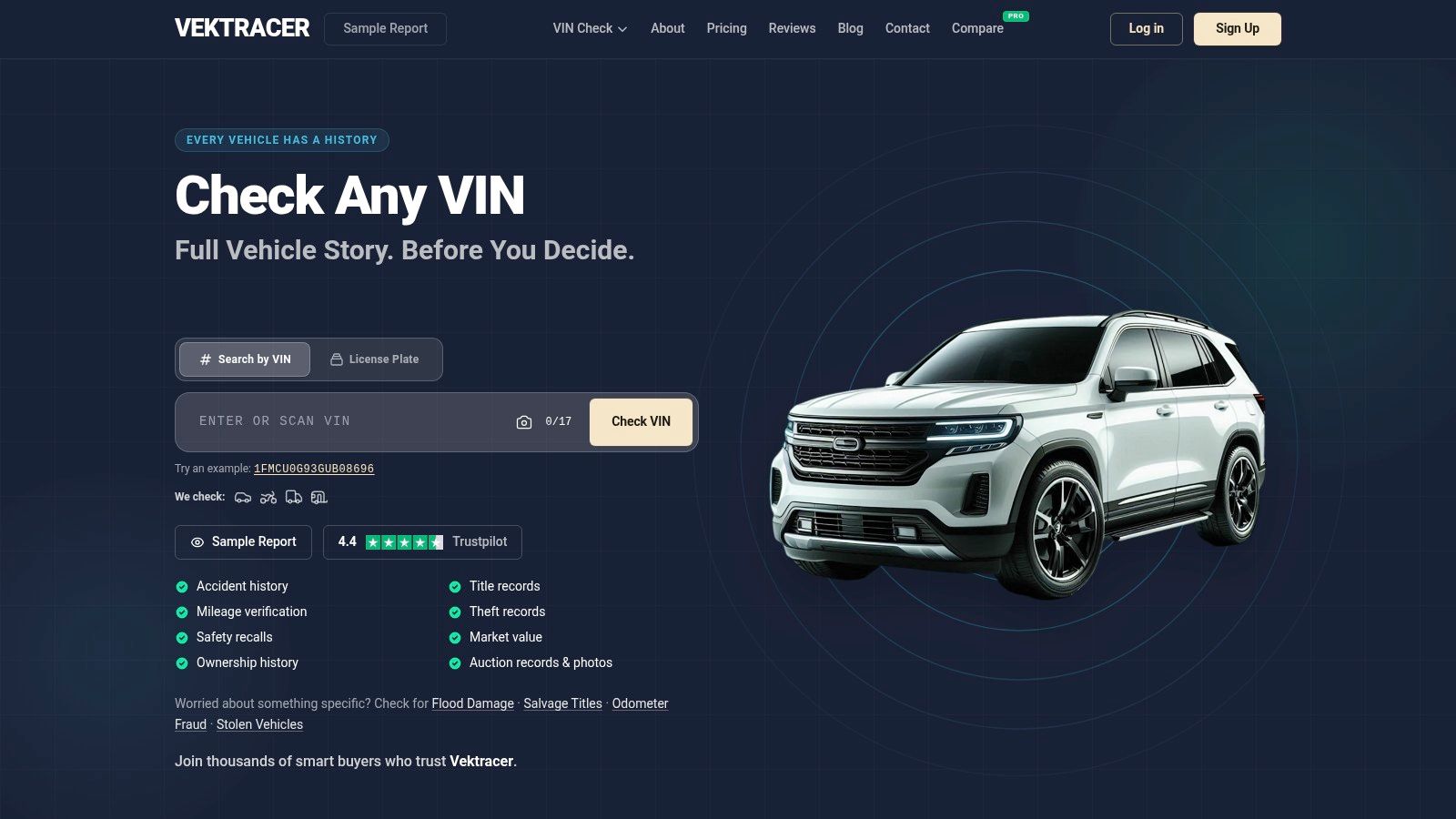
Start with the VIN report
Before you call the seller, pull a Honda Odyssey VIN check. For a vehicle this old, you're looking for consistency. The title history, odometer record, accident entries, theft status, liens, and recall alerts should line up with what the seller says.
If you're shopping across borders, this matters even more. Buyers searching vin check Canada, vin check USA, or a broader vehicle history report aren't just looking for paperwork. They're trying to avoid wasting a Saturday on a van they should've ruled out in five minutes.
What to compare across multiple listings
If you've narrowed the field to two or three vans, side-by-side comparison is where the smart choice usually becomes obvious. This is also where buyers asking whether Carfax is worth it or comparing carfax pricing 2026 alternatives should focus less on the logo and more on which tool gives them the clearest risk picture for the money.
Use a comparison process like this:
| Checkpoint | What to look for | Why it matters |
|---|---|---|
| Title status | Clean vs. branded history | Affects value and future resale |
| Mileage pattern | Consistent odometer trail | Helps spot rollback concerns |
| Accident history | Number and severity of entries | Guides body inspection priorities |
| Recall visibility | Open safety items | Prevents buying unfinished problems |
| Overall risk signal | Which van shows fewer warning signs | Helps you decide where to spend inspection time |
How to use the result in negotiation
The report doesn't buy the van for you. It tells you where to push.
If the history is clean but the paint is failing, negotiate on visible condition. If the history shows accidents, inspect repair quality harder. If title, mileage, and seller story don't match, stop negotiating and move on.
Clean history doesn't mean clean vehicle. It means the van has earned the right to be inspected in person.
That's the best use of a VIN tool. It helps you decide faster, not just collect more data.
Conclusion and Next Steps
The 05 Honda Odyssey is still worth considering if you buy carefully. The best versions offer strong space, practical seating, a capable V6, and safety features that were ahead of many rivals. The worst versions hide expensive neglect behind Honda's reputation.
My buying order is straightforward. Pick the trim that matches how you'll use the van. Prioritize maintenance records, especially for the timing belt and tensioner. Inspect paint and rust like they matter, because they do. Treat recall completion and history consistency as deal-making details, not afterthoughts.
If you're deciding between multiple listings, don't guess. Narrow the field with the VIN, inspect the cleanest candidate, and negotiate from what you can prove. That's how you avoid buying a “good deal” that immediately needs work.
Before you commit to any 2005 Honda Odyssey, run a report with VekTracer. It's a simple way to check title history, mileage consistency, accidents, recalls, and overall risk before you spend money on the wrong van.
Ready to check a vehicle?
Enter any 17-character VIN for a free instant preview — no account needed.