05 Acura TL Guide: Specs, Value, & 2026 Market Insights
Check a vehicle before you buy
Enter a VIN for a free instant preview — accidents, title brands, mileage, liens & open recalls.
You can get burned fast on a 2005 Acura TL if you shop by price alone. The car can look like a clean bargain, then turn into a stack of deferred maintenance, title questions, and financing headaches the moment you ask for records.
That's why the smart move is to treat every 05 Acura TL like a risk decision, not just a test drive. The TL has real appeal, and it also has enough age, mileage, and ownership complexity to punish lazy buyers. If you're shopping one now, use the car's performance pedigree, service history, and VIN-based checks to decide whether it's a deal or a trap, and if you're importing one, it helps to understand the paperwork side too, especially navigating Canada's vehicle import process from J.W. Smith Customs Brokers Ltd.
Introduction to Buying a 05 Acura TL
A silver 05 Acura TL on a used-car lot can look like the perfect compromise, sharp styling, strong V6 power, and a luxury badge without the luxury-car sticker shock. That's exactly why buyers get sloppy. They see the car, love the stance, and forget that a neglected premium sedan can carry expensive surprises that don't show up in the first 10 minutes.
The right way to approach it is simple, assume the lowest-priced car is missing something. Maybe it needs the timing belt work that seasoned owners warn about, maybe it has sketchy title history, or maybe the seller just didn't keep records. Either way, the first job is to separate a clean survivor from a future repair bill.
Practical rule: If the seller can't show you maintenance proof and a clean title trail, walk away unless the price is low enough to justify the risk.
The 2005 TL is worth your attention because it wasn't built as an appliance. Acura positioned it as a premium midsize sedan with serious output and a real enthusiast following, and Cars.com described it as Acura's most popular model at the time. That popularity matters today because there are still good examples out there, but it also means the market is full of cars with mixed ownership quality.
If you're serious, start with a VIN report, then inspect the maintenance story, then drive the car. Don't reverse that order. A quick cosmetic win can hide a lien, prior damage, or service gaps that make the car much more expensive than it looks on the lot.
Understanding 05 Acura TL Trims and Specs
A buyer looking at a 2005 Acura TL should treat the car as a simple package with a clear mechanical identity. Acura built it as a midsize, front-wheel-drive luxury sedan with a 3.2-liter SOHC VTEC V-6 rated at 270 horsepower at 6,200 rpm and 238 lb-ft of torque at 5,000 rpm, and it came with either a five-speed automatic or six-speed manual transmission, according to Acura's specifications from Honda News. That setup defines the car's character before you ever check the paint, the records, or the price.
The trim story is still straightforward, but the used market likes to blur it. You are mostly comparing a base car with one that includes navigation, and sellers often charge extra for equipment that only changes convenience, not the underlying ownership risk. A polished listing can make a common package look special.
2005 Acura TL trim comparison
| Trim | Engine | Transmission | Navigation | MSRP |
|---|---|---|---|---|
| Base | 3.2-liter SOHC VTEC V-6 | Five-speed automatic or six-speed manual | No | Not listed in the verified data |
| Powertrain package | 3.2-liter SOHC VTEC V-6 | Five-speed automatic or six-speed manual | Yes | Not listed in the verified data |
That table keeps the purchase decision honest. The engine does not change across the lineup, so the main questions involve transmission choice, equipment level, and how carefully the car was maintained. Cars.com also noted that the TL was “all new last year” and built on the redesigned Honda Accord platform, which is why this generation feels more modern than older TLs from the same era.
A seller who can explain the package clearly usually knows the car's history. If they stumble on trim details, expect the maintenance story to be weak too.
For a buyer, the recommendation is blunt. Do not pay a premium just because the car has navigation or looks fully loaded in photos. Pay for condition, records, and the transmission you want. That is where VekTracer's Risk Score matters, because it helps surface title, lien, and maintenance problems that are easy to miss if you focus only on trim and options.
Performance and Fuel Economy Breakdown
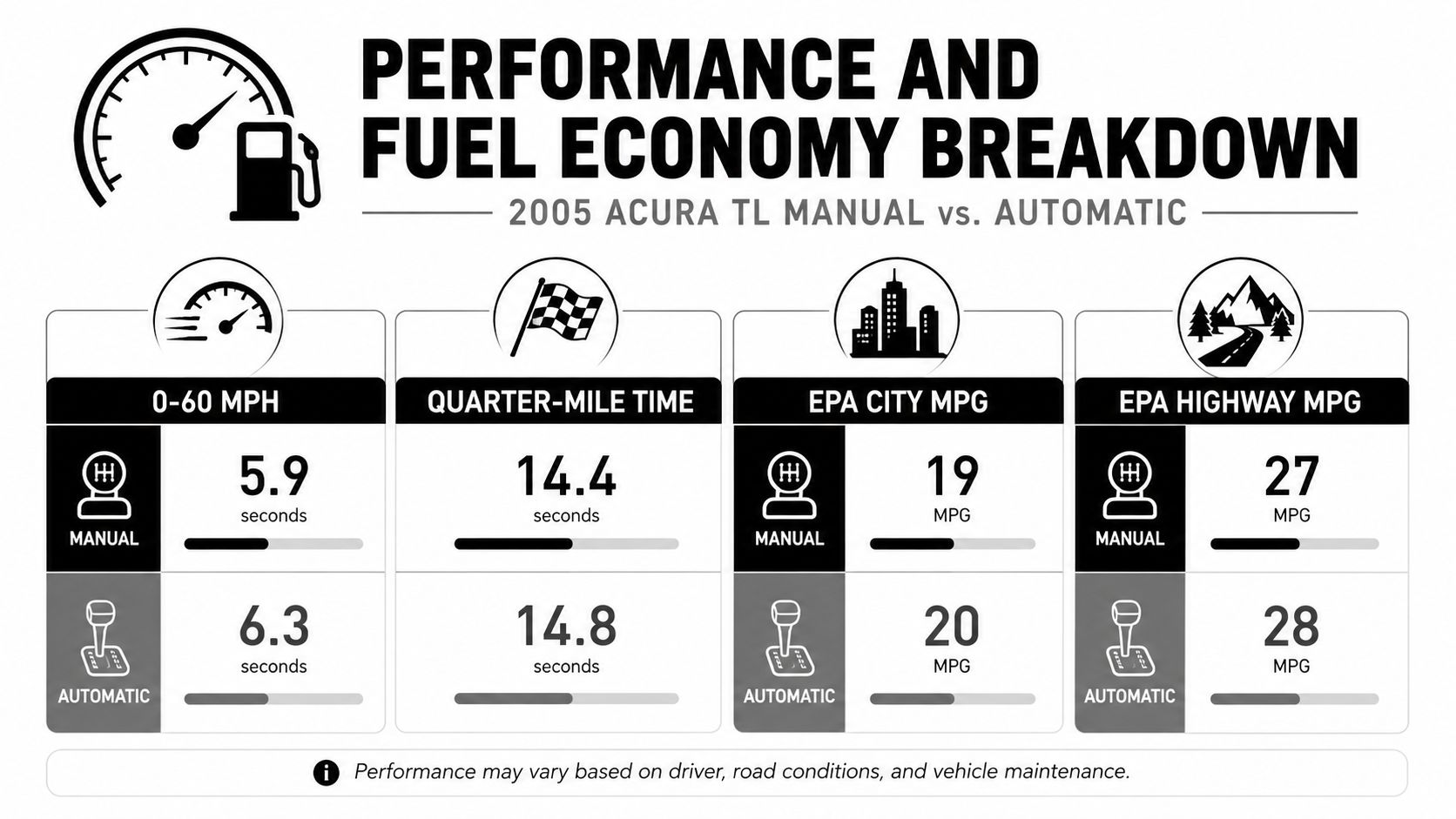
Buy this car for the way it drives, then verify the condition that supports that performance. The six-speed manual is the sharper choice for an engaged driver, while the automatic is the easier one to live with every day. Independent testing puts the six-speed TL at about 0 to 60 mph in 6.1 seconds and the quarter-mile in 14.6 seconds, with EPA mileage around 20/28 mpg for the automatic and 20/30 mpg for the manual Cars.com. That is strong real-world pace and decent efficiency, but it is still old enough that a tired example can feel much worse than the numbers suggest.
What the powertrain tells you
The engine is the part that gives the TL its character. Carfolio lists the naturally aspirated 3.2-liter SOHC 60-degree V6 at 270 hp at 6,200 rpm and 238 lb-ft at 5,000 rpm Carfolio. That torque peak arrives well before peak horsepower, so the car pulls cleanly in the midrange and feels ready for passing and merging without constant downshifts. In daily use, that broad delivery matters more than bragging rights.
Which transmission fits which buyer
- Manual TL: Buy it if you want involvement and you are willing to shop harder for a clean, unmodified example.
- Automatic TL: Buy it if you want easier commuting and fewer excuses for hidden clutch wear or rushed modifications.
- Either one: Let condition decide the deal, not badge talk or transmission loyalty.
The automatic gives up some engagement, but it usually suits the average buyer better. The manual is the better enthusiast pick, but only when the clutch action, shift quality, and service history are clean. VekTracer's Risk Score helps here because a glossy listing can hide title issues, liens, or maintenance gaps that matter more than the transmission badge.
Real Ownership Costs and Maintenance Risks
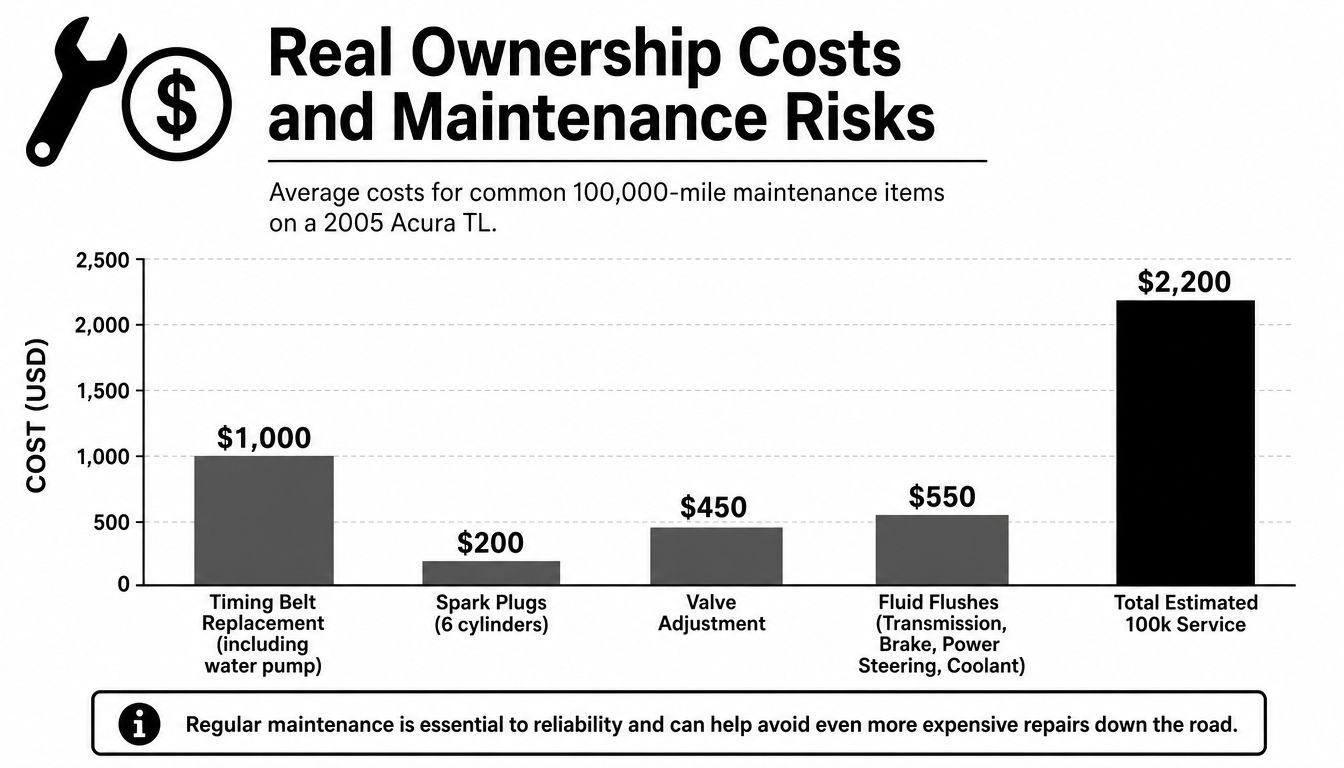
A cheap high-mileage 05 Acura TL can turn expensive fast if the last owner skipped the big-ticket service items. The purchase price is only the opening number. The actual cost comes from overdue maintenance, and these cars punish neglect. On a car this age, you should assume the timing-belt service is due around the mileage range enthusiasts discuss, along with spark plugs, valve adjustment, fluids, brakes, and tires. If the seller cannot prove the work, the car is carrying hidden cost and hidden risk Acurazine.
What to verify before you buy
A seller saying the car “runs great” tells you almost nothing. You need receipts, dates, and a clear maintenance trail.
- Timing belt evidence: Ask for the invoice. If they cannot produce one, treat the service as due or overdue.
- Valve and plug service: Skipped ignition and valvetrain work often shows up as rough idle, misfires, or lazy throttle response.
- Fluid history: Transmission, brake, power steering, and coolant service should be documented or visibly fresh.
- Brake and tire condition: Old rubber and worn pads are warning signs, not minor details. They show a seller who has been deferring costs.
- Accident repair proof: A clean paint job means little if the bodywork underneath was rushed or cheap.
Practical rule: If the maintenance file is thin, price the car as if major service is still ahead of you. If the seller pushes back, move on.
VekTracer's Risk Score matters here because a polished listing can hide title issues, liens, or maintenance gaps that change the deal completely. A car with a good first impression can still be a bad buy if the paperwork and service history do not hold up under review.
The TL's reputation can also mislead shoppers. Enthusiast discussions describe it as having a “$40,000 luxury sedan soul in a $33,000 sport sedan body”, and they also place 2003 and 2005 among the rougher TL model years in complaint-heavy reliability conversations Acurazine. That does not make every example a problem. It means you should assume a bargain car needs work until the records prove otherwise.
If the seller cannot show timing-belt documentation, budget as if a major repair bill is already attached to the car.
Common Faults and Service History Review
A fifteen-year-old luxury sedan has to earn your trust, and the 05 Acura TL doesn't get a free pass just because it wore an Acura badge. The common mistakes here are simple. Buyers inspect the paint, like the leather, and forget that the full story lives in service records, electronics behavior, and underbody condition.
What to inspect first
The cabin tells on lazy ownership faster than the body does. Sticky switches, dead buttons, warning lights that never got fixed, and worn controls all suggest the previous owner postponed repairs instead of staying ahead of them. Under the car, look for signs of sloppy accident work, patchy repairs, and anything that doesn't match the age and mileage story.
The engine bay deserves a slow look, not a quick glance. Fluids should look deliberate, not neglected, and the belts, hoses, and fasteners should look like they've been treated as maintenance items, not afterthoughts.
Service history questions that matter
- Who did the work: Dealer, independent shop, or owner?
- What was replaced: Ask for itemized invoices, not handwritten summaries.
- Were repeat problems fixed permanently: A repeated electrical complaint is more important than a one-time cosmetic repair.
- Does the car pass smog cleanly: If you want a useful primer on why cars fail emissions checks, the breakdown at what causes smog test failures is a practical reference for spotting avoidable red flags before you pay.
A clean service file beats a clean-looking engine bay every time. If the seller has no records, the burden shifts to you, and the asking price should fall hard.
A weak service history doesn't just create future repair costs. It also tells you the last owner didn't care enough to protect resale value.
You're not just checking whether the car runs today. You're checking whether the car was maintained like a premium sedan or abused like a cheap commuter. That difference shows up fast once you start asking direct questions.
Checking Recalls Title and Liens Safely
A clean title is paramount. If the seller can't prove the car is free of title brands, lien problems, and open recall concerns, you're not buying a bargain, you're buying paperwork risk. Start with the VIN and work outward from there.
Use official and third-party checks together
The fastest approach is to run a recall check through official recall resources, then confirm title and lien status through state or provincial records. If the car was ever financed, cross-check for a lingering lien. If it was wrecked badly, you want to know whether the title was branded salvage, rebuilt, or otherwise marked.
VekTracer can streamline that by combining VIN-based history details, title and lien checks, and risk scoring in one report. If you want to see how that specific piece works, their lien check page is the place to start.
Red flags that should make you pause
- Title inconsistencies: Names, dates, or ownership gaps that don't line up.
- Lien uncertainty: A seller who can't clearly show the payoff status.
- Recall confusion: Open safety work should never be shrugged off.
- Mileage mismatch: Any gap between the odometer, records, and listing details.
Practical rule: If the paperwork is messy, don't “sort it out later.” You'll have less leverage after you hand over the money.
This is also where a VIN tool matters more than a quick glance at a listing. A buyer can miss title issues easily, but title issues don't disappear because the car drives well. They become your problem the minute you sign.
Market Values and Pricing Guide
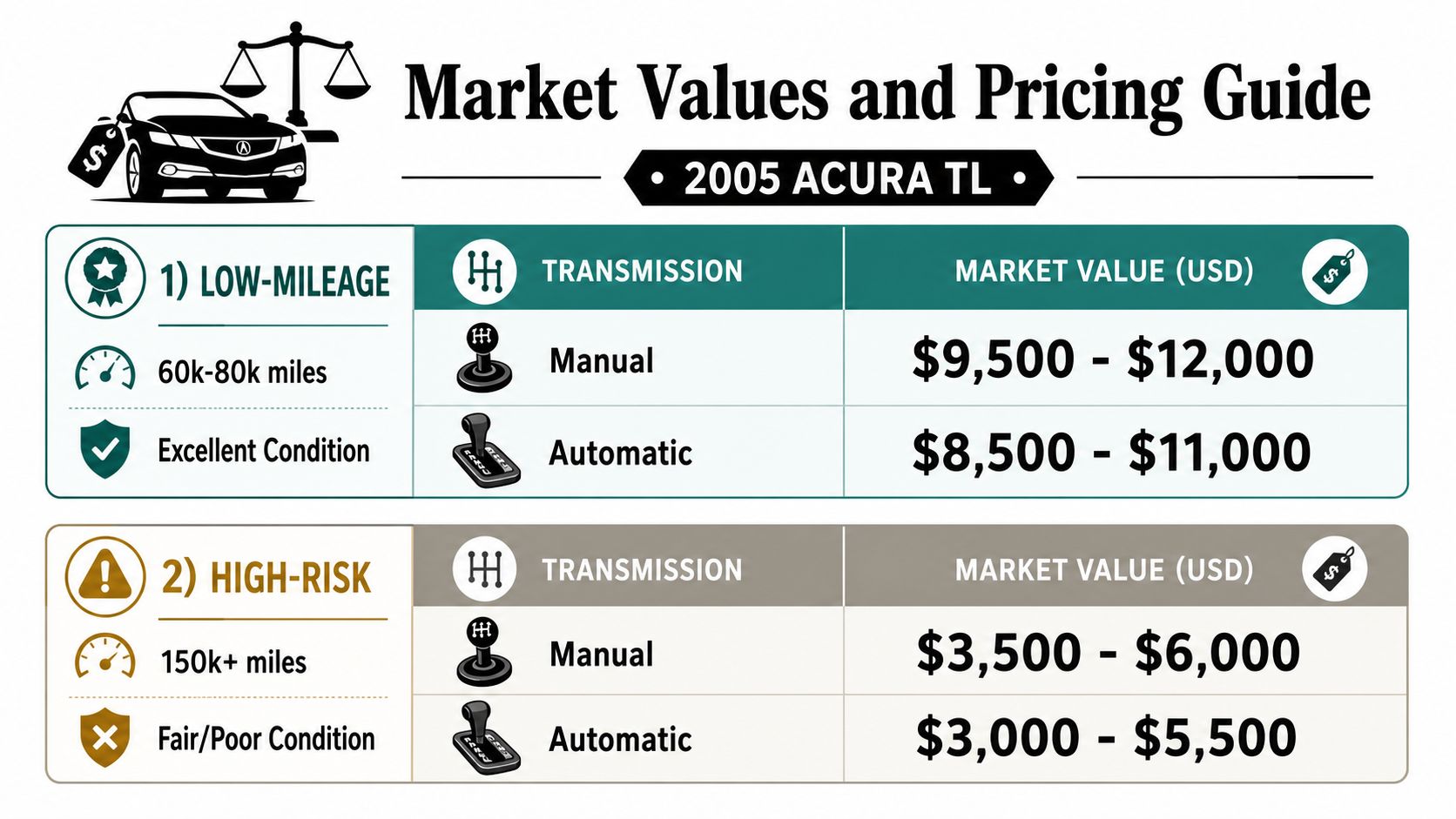
A 2005 Acura TL can look like a bargain until you separate clean cars from problem cars. Mileage, condition, title status, service history, and transmission choice all move the price in different directions, and the cheap examples usually carry the most risk. New-car pricing from the model's era is useful as a reference point, but the used market now is driven by maintenance reality and the chance of hidden problems.
How to think about value
Start with condition, then test the paperwork, then judge the mechanical risk. A well-kept TL with clear records and no title issues deserves a different price than a car with gaps in ownership, warning lights, or signs of deferred service. VekTracer's used-car value estimate guide fits that approach because value should be read alongside risk, not as a separate checklist item.
A seller's asking price means little if the car carries repair debt. A clean title, documented maintenance, and a strong inspection result support the top end of the range. A branded title, missing records, or signs of neglect should pull the number down fast.
If you are buying out of state, transport changes the real cost of the deal. Before you commit, check Car shipping cost and include that figure in your total budget.
Price logic that actually works
- Low-mileage, excellent-condition manual: Pay up only when the clutch, syncros, and service records all check out.
- Low-mileage, excellent-condition automatic: Usually the safer buy for shoppers who want simpler ownership and fewer surprises.
- High-mileage, fair, or poor condition: Price should leave room for overdue maintenance, tires, fluids, and likely reconditioning.
- Any car with title concerns: Cut the number hard or walk away.
A buyer should also separate asking price from risk score. A lower price does not matter if the car has hidden title issues, lien uncertainty, or a service history that points to expensive catch-up work. A higher price can make sense when the car is impeccably clean, but only if the paperwork and inspection support it.
Paying top dollar for a tired TL with weak records is a bad trade. There are enough examples in the market that you do not need to reward neglect.
Inspection Checklist with VekTracer Risk Score
A test drive is not enough. A real inspection of an 05 Acura TL needs a walk-around, a cabin check, a quick under-hood review, and a VIN report before money changes hands. If the car's story is clean, the inspection confirms it. If the story is messy, the inspection usually exposes it.
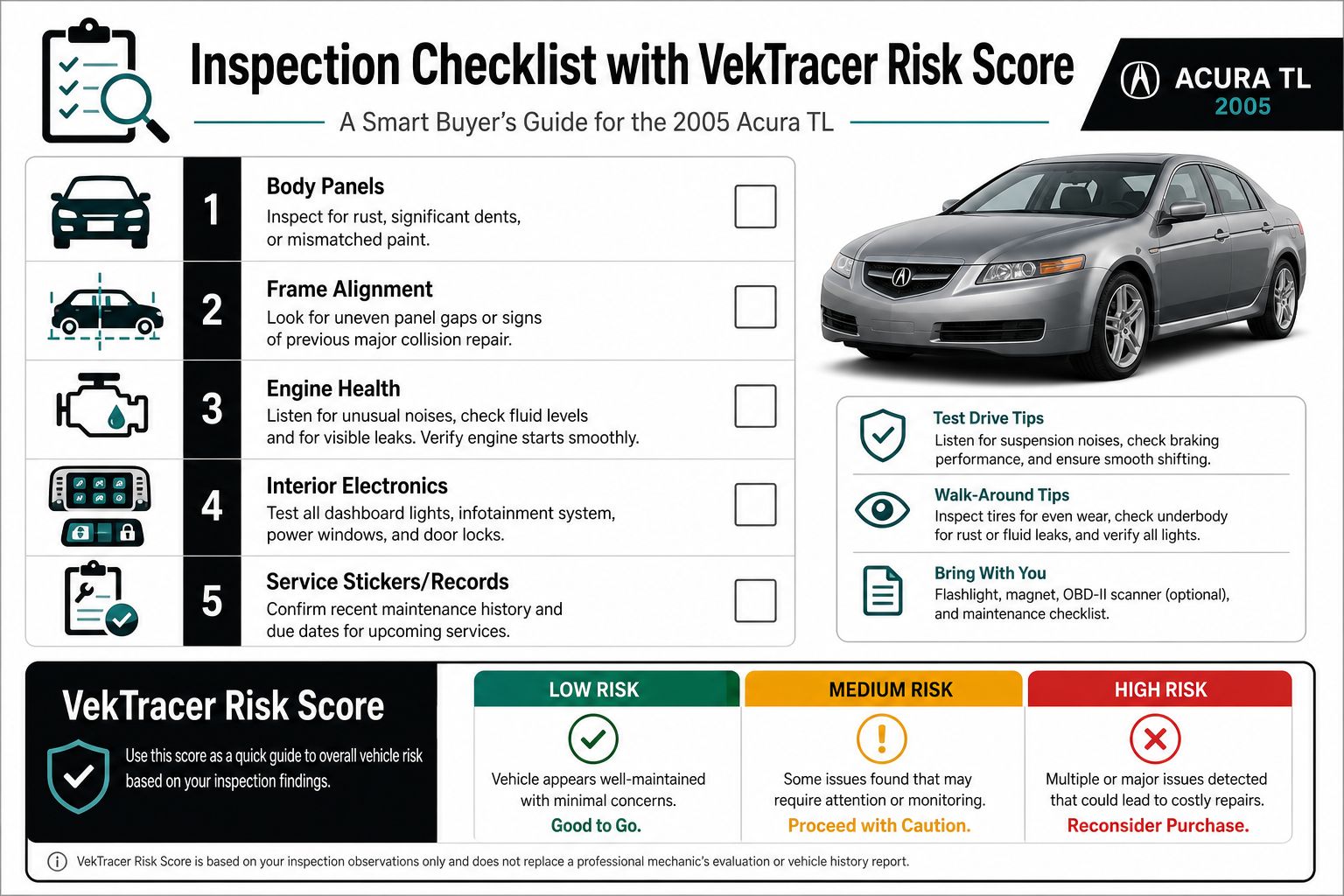
Use this sequence during the walk-around
- Body panels: Look for rust, mismatched paint, overspray, or dents that suggest a past repair.
- Frame alignment: Check panel gaps and the way doors, hood, and trunk close.
- Engine health: Listen for odd sounds, check for leaks, and make sure it starts cleanly.
- Interior electronics: Test the lights, infotainment, windows, and locks.
- Service stickers and records: Match recent work to the mileage and the seller's story.
- VekTracer Risk Score: Treat a low score as a green light, medium as a negotiation warning, and high as a walk-away signal. Their Risk Score explanation gives you the framework for using that number the right way.
A VIN report belongs in the middle of this process, not the end. If the car shows prior accidents, mileage issues, or title complications, you want that information before you spend energy debating cosmetics. VekTracer's VIN check can surface that kind of history fast, and that's exactly what a buyer needs when a seller is rushing the deal.
Practical rule: Never let a clean-looking interior override a bad report. Sellers can detail a cabin in an afternoon. They can't erase bad history.
Use the inspection to decide whether you're negotiating, repairing, or leaving. If the car scores poorly, you're not being picky, you're avoiding a bad used-car bet.
If you're comparing a few 05 Acura TL listings right now, run the VINs, compare the maintenance history, and refuse to rely on appearance alone. Pull a report from VekTracer before you visit the next car, then use the inspection checklist to decide whether the TL in front of you deserves your offer or your exit.
Ready to check a vehicle?
Enter any 17-character VIN for a free instant preview — no account needed.