What Is a Risk Score? a Buyer's Guide to Vehicle Ratings
Check a vehicle before you buy
Enter a VIN for a free instant preview — accidents, title brands, mileage, liens & open recalls.
A risk score is a single, standardized number, often shown on a 1 to 100 scale, that sums up a vehicle's potential problems so you can compare cars faster. It works by turning messy history details into one simple rating, much like a lender uses a credit score to compare borrowers.
If you're shopping for a used car right now, you've probably seen a listing that looks perfect until one detail makes you pause. Maybe the mileage seems low, the price looks fair, but something still feels unclear. That's where a risk score helps. It takes scattered history clues and gives you one number that answers a practical question: How cautious should I be with this car?
For first-time buyers, that matters because raw records can be hard to interpret. One accident might be minor. Another might point to bigger future costs. A title issue can matter more than mileage. A score helps you sort that out quickly, then decide which cars deserve a closer look.
Understanding the Core Concept of a Risk Score
A good way to understand what a risk score is starts with a commonly understood concept: a credit score. A credit score takes many pieces of financial behavior and turns them into one number lenders can compare consistently. A risk score does the same basic job in other settings. It turns several risk factors into one standardized value so people can rank options more easily.
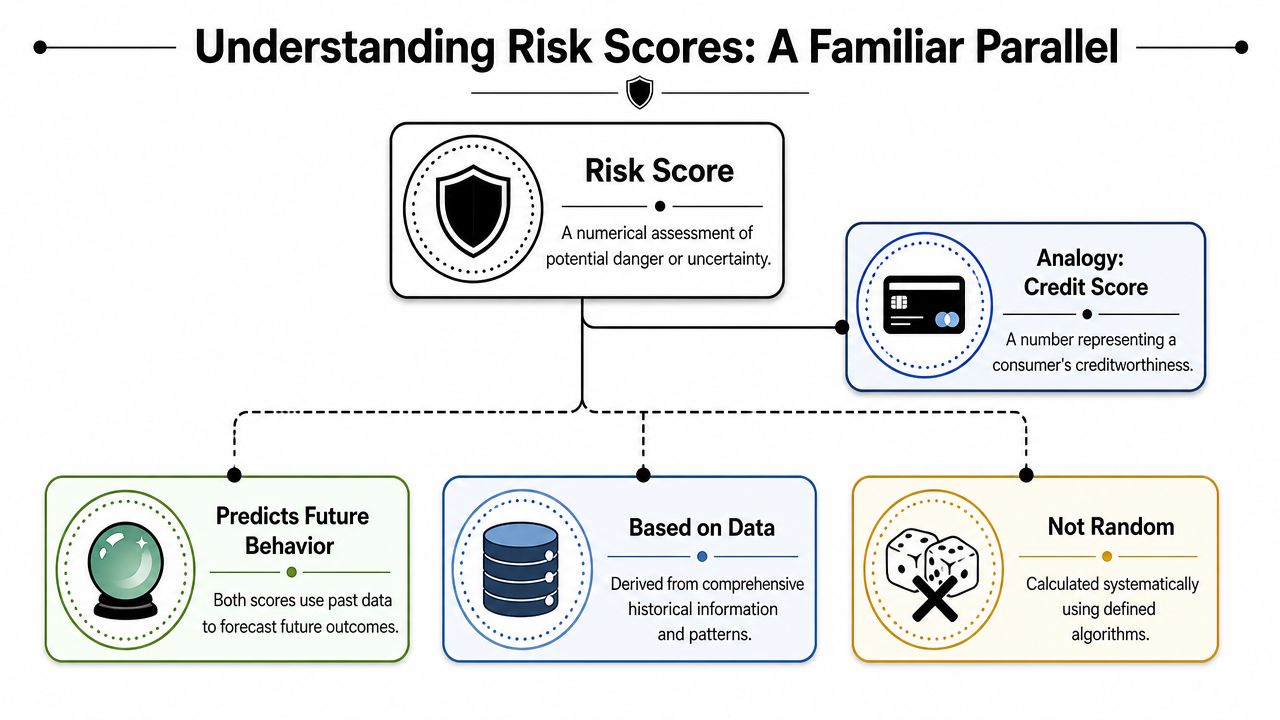
Why one number is useful
When you're buying a car, you aren't judging just one thing. You're thinking about accident history, title status, mileage consistency, recalls, theft records, and possible resale headaches. Looking at all of that at once can feel like trying to judge a student from a pile of test papers instead of a report card.
A risk score simplifies that comparison. It doesn't replace the details. It organizes them.
Practical rule: A risk score is not the risk itself. It's the result of an assessment process that helps you decide what deserves attention first.
That idea is widely used in risk management. One common approach is likelihood × impact. In the example used by MetricStream's explanation of risk scores, a likelihood of 0.8 and an impact of $1 million produces a risk score of $800,000. The same logic can also use simpler scales. On a 1 to 5 scale, likelihood 4 times impact 5 gives a score of 20.
The two parts buyers should remember
You don't need to be a statistician to use the idea. Just remember these two building blocks:
- Likelihood means how likely a problem is to matter. If a car has a suspicious odometer record or a branded title, that raises concern.
- Impact means how serious the downside could be. Some issues are annoying. Others can affect safety, insurability, financing, or resale.
- Combined view means a score helps rank issues together instead of treating every warning as equal.
That's why a single number can be useful in car shopping. It gives you a quick first filter. If you want to see how this kind of system fits into a report workflow, VekTracer's how it works page shows how a buyer can move from VIN input to a report and score.
How a Risk Score Applies to a Used Vehicle
In a used car context, a risk score takes many vehicle records and normalizes them into one consistent scale so you can compare one car against another. For vehicle-risk applications, the key idea is to combine likelihood and impact signals, then normalize them into a fixed scale such as 0 to 100, as described in Splunk's overview of risk scoring.
That sounds technical, but the shopping use is simple. The score helps answer this question: Which car is more likely to bring hidden trouble into my driveway?
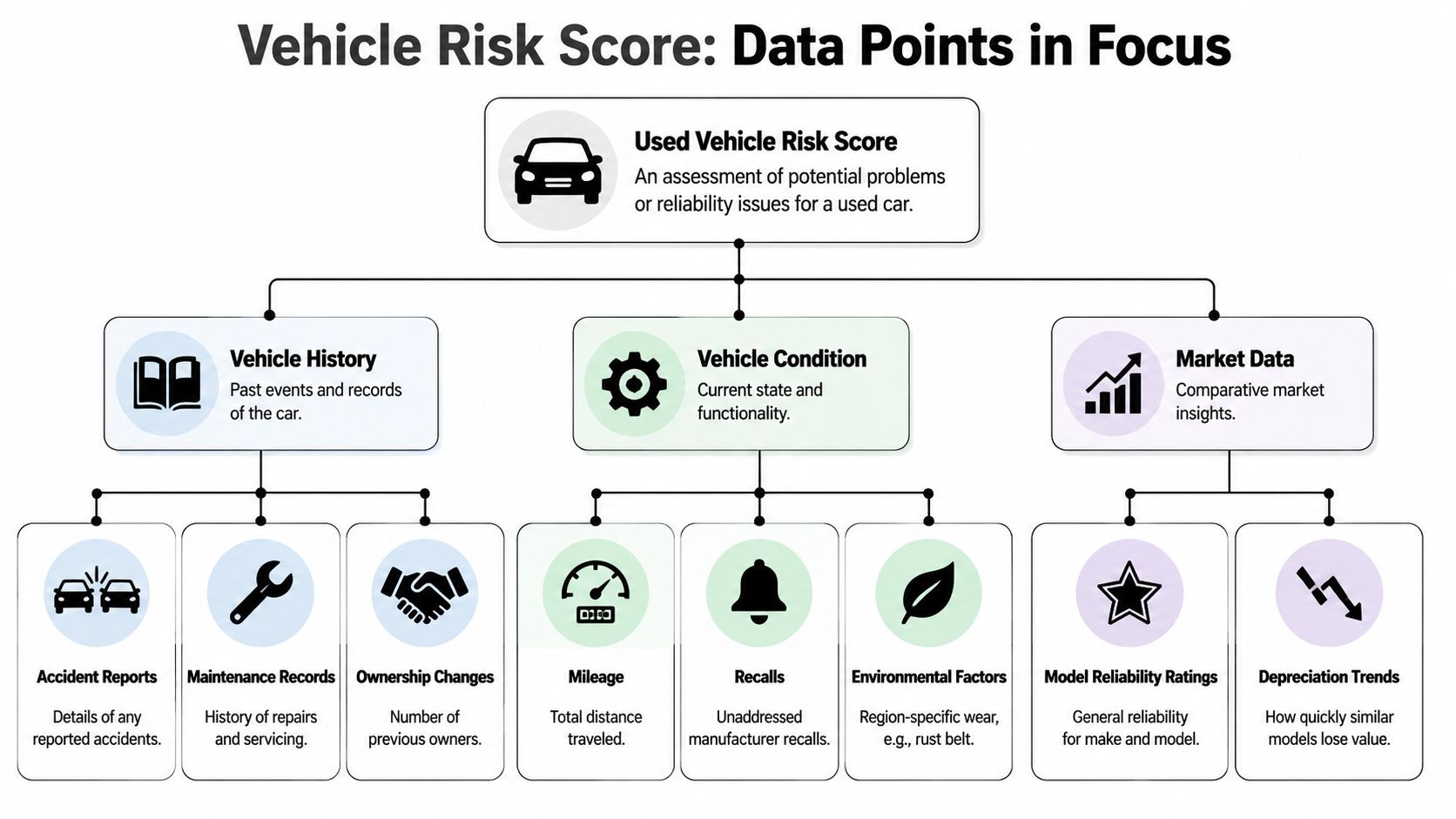
What feeds the score
A vehicle risk score usually reflects several categories of information.
Accident and damage history
A past collision can range from cosmetic damage to something that affects structural integrity, alignment, or airbag performance.Title problems
Salvage, rebuilt, flood, or similar title brands can carry long-term consequences. These issues often matter more than a clean-looking exterior.Mileage consistency
A mileage discrepancy can suggest odometer rollback, record errors, or missing history. Any of those should slow you down.Open recalls
A recall doesn't always mean the car is a bad buy, but it does mean there's an unresolved manufacturer-identified issue to check.Theft and lien records
These can create ownership or legal complications that a casual walkaround won't reveal.
Why some issues matter more than others
A common first-time buyer mistake is treating every flag like it has the same weight. It doesn't.
A car with higher mileage and a clean, consistent history may be a safer purchase than a lower-mileage car with title branding or conflicting records. That's the value of scoring. It brings different warning signs onto one scale, which makes comparisons more realistic.
A risk score helps you compare unlike problems. Title branding, accident history, and mileage anomalies don't look the same on paper, but they can all raise buyer risk.
If you want to go deeper into the records behind a score, a full vehicle history report contains the complete context. Buyers who work across markets may also find regional record systems useful. For example, dealers researching Polish registration data may appreciate this przewodnik po CEPiK dla dealerów, which explains how official vehicle information can support due diligence.
Decoding the VekTracer 1-100 Risk Score
A 1 to 100 vehicle risk score is easiest to understand if you think about the direction of the number first. In the same way a higher credit score means lower lending risk, a higher vehicle risk score means lower vehicle risk. That's the mental shortcut that makes the scale useful.
One of the clearest historical examples of standardized scoring is the FICO score, introduced in 1989. It put borrower risk on a 300 to 850 scale, and a higher score indicated lower perceived risk, as described in IBM's summary of risk score calculation.
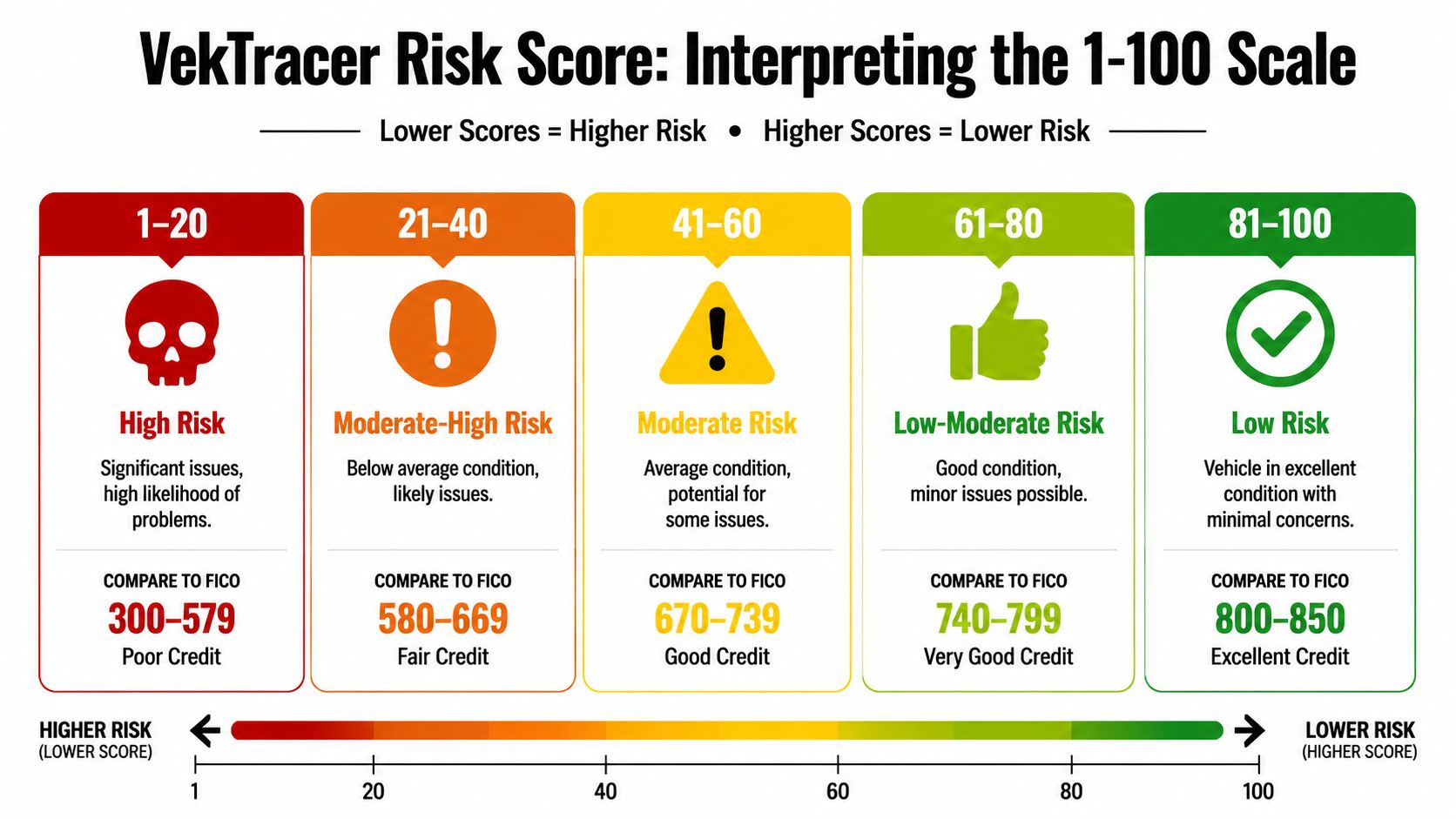
How to read the ranges
For a buyer, the easiest way to use a 1 to 100 scale is as a screening tool.
| Score range | What it usually means for you |
|---|---|
| 81-100 | Low risk. Strong candidate for the shortlist. |
| 61-80 | Low to moderate risk. Worth reviewing carefully, but not automatically a problem. |
| 41-60 | Moderate risk. You need the full story before moving forward. |
| 21-40 | Moderate to high risk. Expect meaningful concerns and inspect closely. |
| 1-20 | High risk. Major caution zone. |
These score bands are how buyers turn a raw number into action. A car in the upper range may still have details worth checking. A car in the lower range might still be buyable at the right price. But the score tells you where to spend your time.
What the number should trigger
A number by itself isn't the whole decision. It's the start of a decision path.
- High score usually means confidence to keep evaluating the car.
- Mid-range score means pause and read the underlying report line by line.
- Low score means ask harder questions, verify documents, and decide whether the deal is worth the extra exposure.
If you want to see how a scored report presents the underlying issues, this sample vehicle history report gives a useful reference point.
Don't ask, “Is this score good?” Ask, “What level of checking does this score tell me to do?”
That shift makes the number practical instead of mysterious.
Real-World Scenarios Comparing Three Sedans
Risk scores make the most sense when you compare similar cars side by side. Say you're looking at three midsize sedans that all seem reasonable from the listing photos and seller descriptions. On the surface, each could make your shortlist. Once you compare the histories, the differences become clearer.
Vehicle comparison of three used sedans
| Metric | Sedan A (Honda Accord) | Sedan B (Toyota Camry) | Sedan C (Nissan Altima) |
|---|---|---|---|
| Model year | Newer used model | Newer used model | Newer used model |
| Mileage | Moderate and consistent | Moderate and consistent | Lower than expected, but questionable |
| Asking price | In line with market | Slightly attractive | Very attractive |
| Risk score | 95 | 75 | 55 |
| History summary | Clean record | Minor past accident | Rebuilt title and mileage discrepancy |
| Buyer takeaway | Strong contender | Needs context | Proceed carefully |
What the scores are really saying
Sedan A is the easy one to understand. Its score of 95 suggests very low overall risk compared with the other two cars. Nothing major in the history stands out, so the buyer can focus on normal checks like service condition, tires, brakes, and a mechanic's inspection. This is the kind of car that lets you spend your energy confirming condition, not untangling record problems.
Sedan B has a 75, which is still workable. The reason it sits lower is a reported minor accident from years ago. That doesn't automatically make it a bad buy. A well-repaired car with a single older damage event may still be a smart purchase, especially if the repair quality is good and the rest of the history is clean. The score is doing exactly what it should do here. It isn't saying “reject this car.” It's saying “verify the repair and don't assume.”
Sedan C comes in at 55, and buyers often fall into a price trap. Maybe the listing looks like a deal. Maybe the lower sticker makes it tempting. But a rebuilt title plus a mileage discrepancy changes the conversation. Those aren't cosmetic concerns. They can affect financing, insurance, resale, and your ability to trust what you're buying.
A lower asking price can compensate for wear. It usually doesn't compensate for uncertainty.
Which one is the smart pick
If all three cars fit your budget, Sedan A is the clearest choice because it combines a strong score with fewer obvious complications. Sedan B may still make sense if the seller can document the repair and your inspection checks out. Sedan C is the one most likely to create downstream friction.
That's why a score matters. It helps you avoid spending equal time on unequal options.
If you're comparing multiple reports and want a familiar benchmark alongside alternatives, our Carfax comparison page can help frame what to look for across report providers.
Using the Risk Score to Make Smarter Decisions
A risk score is most useful when you treat it like a filter, not a verdict. It tells you where to focus, what to question, and when to slow down. Buyers get into trouble when they stop at the number and never ask how that number connects to a real decision.
That matters because a score can look objective while still depending on the variables chosen, the thresholds used, and how fresh the data is. As noted in Thomson Reuters' discussion of risk scores, two scores on the same 1 to 100 scale may not be comparable unless the methodology is disclosed.
A simple buyer checklist
Use the score like this when you're deciding whether to move forward:
- Shortlist first. If you're looking at several cars, use the score to narrow the field before scheduling calls or inspections.
- Read the why. Don't stop at the number. Look for the specific issues behind it, such as title branding, mileage flags, or damage records.
- Match the score to your tolerance. Some buyers will accept moderate risk for a lower price. Others want the cleanest history possible.
- Negotiate with evidence. If the score reflects known issues, use that report detail in the price discussion.
- Walk away when the story doesn't improve. A weak score plus vague seller answers is usually enough reason to move on.
What smart buyers do next
Once you have a score, the next step is to dive into the full report. A VekTracer report lets you click into the factors behind the number so you can see what drove the rating before deciding whether to buy.
If you're new to report reading, this guide on how to read a VIN report and buy smarter helps connect the score to the actual records in plain language.
You should also compare the score against what the seller is telling you. If the seller says the car is “clean” but the report shows title or mileage concerns, trust the documents over the sales pitch. If the score is strong and the paperwork lines up, that's when confidence starts to build.
Buy the car whose story stays consistent when you test it from three angles: the score, the report, and the inspection.
The Strengths and Limitations of a Risk Score
A risk score is powerful because it lets you compare vehicles quickly. If you're deciding between several listings, one standardized number can keep you from wasting time on cars with obvious warning signs. It gives structure to a messy process.
It also has limits. A score depends on available records. If a past problem was never reported, no scoring system can magically detect it from thin air. That's why a score should guide your screening, not replace your mechanic.
Score versus rating
Another point that trips buyers up is the difference between a score and a rating. Industry guidance separates the score as a precise numerical output from the rating as a simpler category such as low, medium, or high risk, as explained in Flagright's overview of risk scoring.
That matters because a small difference between two raw scores may not change your real-world decision, while a move from one rating band to another often does.
- Score means a specific number, like 78
- Rating means the broader category that number falls into
- Decision value comes from tying the number or category to a clear action
A buyer should use both. The score gives detail. The rating gives perspective.
No matter how clean the report looks, always pair the score with a pre-purchase inspection. Records tell you what was documented. A mechanic tells you what's sitting in front of you today.
Frequently Asked Questions About Vehicle Risk Scores
Is a vehicle risk score the same as a vehicle history report
No. A vehicle history report contains the underlying records. The risk score is a summary number built from those kinds of records. Think of the report as the file folder and the score as the quick read on the front.
Is a higher vehicle risk score better or worse
For buyer-friendly scales like the one discussed in this guide, a higher score means lower risk. That's the same basic direction many people already understand from credit scoring.
Should I trust the score or the category label
Use both, but don't overreact to tiny number gaps. The numerical score is more granular. The category label gives you the practical meaning. If two cars are close in score, the underlying issues matter more than the small difference.
Does a risk score matter in a private-party sale
Yes. In a private-party sale, you often have less process, less paperwork, and less recourse than at a dealership. A score can help you spot when a cheap listing deserves more caution.
Can I use a risk score for VIN checks in different markets
Yes, but always make sure the records match the market where the car has been used. If you're researching by region, start with the right lookup path for VIN Check Canada or VIN Check USA.
Would a brand-new car have a risk score
It could, but the score would usually have much less history to draw from. Risk scores are most helpful with used vehicles because there's more prior data to assess.
Is a low score always a deal-breaker
Not always. A low score means you need stronger reasons to continue, better documentation, and a very careful inspection. For many buyers, it's a signal to move on. For others, it may only make sense if the price reflects the added risk.
If you want a faster way to compare vehicles before you commit, VekTracer lets you run a VIN report, review the vehicle's history, and use the risk score as a practical first filter while you shop.
Ready to check a vehicle?
Enter any 17-character VIN for a free instant preview — no account needed.