Find Your Perfect 02 Jeep Liberty Sport: 2026 Buyer's Guide
Check a vehicle before you buy
Enter a VIN for a free instant preview — accidents, title brands, mileage, liens & open recalls.
You're probably looking at listings right now and asking a simple question: is the 02 Jeep Liberty Sport still worth buying, or is it the kind of cheap SUV that becomes expensive the week after you get it home? The short answer is that it can still make sense if you want a compact Jeep with real towing ability, usable cargo space, and a stronger V6 than many small SUVs of its era, but only if you inspect the suspension closely and verify the VIN history before money changes hands.
That's the part most generic used SUV guides miss. They'll tell you the 2002 Liberty Sport is “rugged” or “dated” and leave it there. That's not enough when one history report entry can mean ordinary bushing wear, while another can point to a much bigger suspension repair or hidden mileage that changes the whole value equation. If you're cross-shopping older vehicles with personality, the appeal is similar to what draws buyers to older enthusiast-friendly models like the 2002 Acura TL Type S, except the Liberty Sport trades sport sedan polish for compact SUV utility and Jeep-brand capability.
Introduction to the 02 Jeep Liberty Sport
The 02 Jeep Liberty Sport matters because it landed as a fresh start for Jeep, not just a trim update. It debuted as a completely new model in mid-year 2001 for North America, with a base price of $16,450 for the 2WD Sport and $17,960 for the 4WD Sport, and it was built to be an affordable entry point into the compact SUV market according to Cars.com specs for the 2002 Jeep Liberty.
That background still matters today because it explains the Liberty's split personality. On one hand, it was designed to be easier to live with than older truck-based Jeeps. On the other, it kept enough Jeep character to attract buyers who wanted more than a soft-road commuter. It seats five passengers, offers 29 cubic feet of cargo space behind the rear seat and 69 cubic feet with the seat folded, and was manufactured in the United States according to the same Cars.com Liberty specs page.
Who it fits best
The buyer who gets along with this SUV usually wants three things:
- Useful V6 power: You're not shopping for the absolute cheapest gas bill. You want decent passing power and enough engine for loaded driving.
- Compact dimensions: You want something easier to park than a larger SUV, but not a tiny crossover.
- Real-world utility: Cargo room, available towing strength, and Jeep-style rough-road confidence matter more than a fancy cabin.
Practical rule: If your top priority is low running costs above everything else, the Liberty Sport probably won't be your best match. If your priority is capability in a compact footprint, it deserves a serious look.
Overview and Specifications
A clean-looking 02 Liberty Sport can fool buyers on the first drive. The V6 feels strong enough, the size is easy to live with, and the Jeep badge suggests simple SUV toughness. The expensive part is what hides underneath that first impression. On this model, the specs matter less as bragging points and more as clues to future cost, especially once you match the build details to the VIN history and service record.
The core setup is straightforward. Every 2002 Liberty Sport came with Jeep's 3.7L V6, and that engine gives the truck enough torque to feel usable in daily driving instead of strained. In real terms, that means easier highway merging, less drama on grades, and better tolerance for passengers or cargo than many small SUVs from the same period. It is a better fit for buyers who value usable power over fuel savings.
That strength carries a trade-off. A Liberty that feels healthy on a short test drive can still be an expensive one if the maintenance history is thin. The V6 itself is only part of the ownership equation. The transmission behavior, cooling system condition, differential noise, and front suspension wear usually decide whether this is a decent used SUV or a money pit wearing decent tires.
Chassis layout and why it matters
The Liberty rode on a more modern suspension design than the older Cherokee it replaced, and Automobile Catalog notes that it also introduced Jeep's TracLok rear limited-slip differential on this generation's lineup in a more refined package, as outlined in Automobile Catalog's Liberty Sport profile.
For a buyer, that translates into a clear trade-off. The Liberty is easier to live with on rough pavement and around town than older truck-like SUVs, but that added civility brings more wear points to inspect. A worn front end on one of these can turn a bargain purchase into an immediate suspension bill. If the VIN report shows repeated short-term ownership, inconsistent mileage reporting, or auction movement after years of use, inspect the steering and suspension even harder. Those patterns often line up with deferred chassis work.
Real-world size and use
The Liberty's footprint is one of its best features. It is compact enough to park easily, but it still has enough body height and cargo usefulness to work as a real small SUV instead of just a tall wagon.
Here is what matters most in practice:
| Real-world need | What the 02 Liberty Sport delivers |
|---|---|
| Daily driving | Manageable exterior size with a commanding seating position |
| Cargo use | Useful rear load space for tools, strollers, or weekend gear |
| Rough roads | Better ground clearance and Jeep-style durability than many car-based rivals of the era |
| Used-buying risk check | Specs that look appealing on paper, but can hide cooling, suspension, and drivetrain costs if the VIN history suggests neglect |
Performance context buyers should use
A verified listing for the Sport 4DR 4X4 confirms the familiar factory output of 210 horsepower at 5,200 rpm and 235 ft-lbs of torque at 4,000 rpm, with a 0-60 mph time around 7.9 seconds, on Motor Matchup's 2002 Jeep Liberty Sport 4DR 4X4 page.
That is quick enough to keep the Liberty from feeling lazy by early-2000s compact SUV standards. It also creates a buying trap. Buyers often treat strong acceleration as proof that the vehicle is healthy. I would not. A Liberty can pull well and still have overdue cooling-system work, aging driveline components, or the early signs of transmission trouble. Strong engine output lowers one risk. It does not cancel the expensive ones.
The smart way to read the specifications is this: the 02 Liberty Sport offers useful V6 power, practical size, and better-than-basic SUV capability. The smart way to buy one is different. Use the specs to identify what should be there, then use the VIN history, service records, and inspection results to find out what that capability will cost you after the sale.
Sport Trim Features and Options
A common used-Liberty mistake happens in the first five minutes. A buyer sees “Sport” on the badge, assumes the trims were all close, then pays for a clean-looking truck that lacks the hardware needed for towing, winter traction, or family duty. On an 02 Liberty Sport, the option sheet affects ownership cost more than the trim name does.
The expensive part is not always the missing feature itself. It is what that feature suggests about the vehicle's past use. A Sport with the tow package may be more useful, but the same VIN can also point to harder service life, more strain on the transmission, or rear suspension wear if maintenance was skipped. A plain Sport without those options may be less capable but cheaper to keep on the road if its history is cleaner.
Which factory options change the deal
The Sport trim was the value version, so equipment varied in ways that still matter today. A Liberty Sport equipped with the Trailering Package, 3.7L V6, and automatic transmission carries far more towing usefulness than a manual-transmission example, as noted earlier in MotorWeek's 2002 Jeep Liberty road test. For a used buyer, that difference is not just about trailer weight. It affects how carefully you need to inspect the transmission fluid condition, hitch installation, rear ride height, and signs of past hauling.
A few options deserve real attention:
- Trailering Package: Worth having if you will tow. Also worth extra scrutiny. Check for an aftermarket hitch versus factory equipment, wiring hacks near the rear bumper, and records showing transmission service.
- TracLok rear limited-slip differential: Useful on snow, wet grass, gravel, and boat ramps. It adds traction without turning the Liberty into a serious off-road build. During inspection, listen for chatter or binding in tight low-speed turns if the differential has been neglected or filled with the wrong fluid.
- 4WD configuration: More capability, more parts to inspect. Confirm that 4WD engages properly and that the transfer case does not clunk, bind, or hesitate.
- Child door locks and child seat anchors: Basic family features, but they matter because they show whether the SUV still retains intact, usable safety equipment instead of broken trim and improvised repairs.
How to shop the Sport trim by use case
Buy the option mix that matches the job.
For towing, look for the automatic V6 with the proper trailering setup, then score the VIN history harder than you would on a non-tow Liberty. I put more weight on service intervals, title events, and regional use here because a tow-capable SUV with spotty records can become an immediate transmission and cooling-system budget problem.
For bad weather or light trail use, the limited-slip differential and working 4WD equipment matter more than chrome, audio upgrades, or cosmetic extras. A Liberty with honest paint flaws and a clean driveline history is usually the better buy.
For family backup duty, focus on working safety equipment, clean ownership history, and evidence of routine maintenance. A cheaper example loaded with “useful” options can still cost more if the VIN shows auction movement, salvage history, or repeated registration gaps that line up with neglect.
The trim badge sets the baseline. Actual value comes from matching the hardware to the VIN history and checking whether the mechanical condition supports what the option sheet promises.
Common Mechanical and Electrical Issues
A clean-looking 02 Jeep Liberty Sport can hide a cheap fix, or a four-figure one. That difference usually shows up before you ever turn a wrench. It shows up in how the SUV drives, how the underbody looks, and whether the VIN history lines up with the seller's story.
The Liberty is old enough that broad labels like “needs suspension work” or “has a minor electrical issue” are almost useless. You need the exact failure point because the cost spread is wide. The Weekly Driver's 2002-2007 Jeep Liberty reliability discussion notes a high volume of suspension complaints, but the actual buying decision comes down to which parts are worn and whether that wear also points to neglect, curb impact, or hard use.
Why suspension details matter more than labels
Rear control arm bushing wear and a worn-out front strut assembly do not carry the same risk. One may be a manageable age-related repair. The other can come with alignment problems, uneven tire wear, and a front end that still needs more parts after the first estimate.
Here is how I separate them during a test drive and walkaround:
| Issue type | What it can mean for you |
|---|---|
| Rear control arm bushing wear | Often shows up as rear-end looseness or noise over broken pavement. Usually cheaper if caught before it affects other components. |
| Front strut or alignment-related repair | Can mean bouncing, nose dive, tire feathering, steering pull, or poor braking stability. The bill climbs fast if struts, mounts, tires, and alignment are all involved. |
That matters for pricing, but it also matters for VIN risk scoring. If the history report shows repeated tire replacements, short ownership periods, or auction movement after front-end damage, I put more suspicion on any “normal suspension wear” explanation.
Mechanical risk areas worth extra attention
The 3.7L V6 itself is not the first thing that scares me on these. Deferred maintenance around it is. Cooling system neglect, fluid seepage, and rough idle complaints can turn a decent truck into a budget drain if the seller has no records and the VIN history shows long registration gaps.
The automatic transmission deserves a careful road test. Cold shifts, delayed engagement into Drive or Reverse, flare between gears, and slipping under moderate throttle all deserve attention. On an older Liberty, transmission behavior also needs to be read against the vehicle history. A tow-capable SUV with patchy service records or signs of heavy-use ownership is a different risk from a one-family commuter with documented fluid changes.
Electrical faults are where many buyers get trapped because the symptom looks small. A dead window switch, erratic gauge reading, blower motor issue, or intermittent warning light can be a simple repair, or it can be a sign of water intrusion, poor prior repairs, or a vehicle that sat for long periods. Those patterns matter because electrical neglect rarely stays isolated on a 20-plus-year-old SUV.
What to check before you call it “minor”
Use a short checklist and be strict about it:
- Drive it on rough pavement: Listen for front-end clunks, rear looseness, and extra rebound after bumps.
- Watch tire wear closely: Cupping, inner-edge wear, or mismatched tires often point to suspension or alignment issues the seller is minimizing.
- Test the transmission cold and warm: A Liberty that shifts acceptably after 20 minutes can still show its worst habits in the first few miles.
- Run every electrical item: Windows, locks, gauges, HVAC fan speeds, interior lights, rear glass release, and 4WD indicator lights all need to work consistently.
- Look underneath: Freshly cleaned underbodies, wet transmission areas, or rust around suspension mounting points deserve follow-up.
The best Liberty Sport examples are not the prettiest ones. They are the ones where the mechanical wear makes sense, the repair history is believable, and the VIN trail does not add new questions.
If a seller says the SUV “just needs a little work,” ask which part, which shop diagnosed it, and what invoice supports that answer. If the explanation stays vague, price it like a vehicle with stacked risk, not a simple weekend fix.
Recall History and Safety Alerts
You find an 02 Liberty Sport that drives well, the price looks fair, and the seller says the recalls were "probably handled years ago." That is where buyers get trapped. On this Jeep, unresolved safety campaigns are not just paperwork gaps. They are a fast way to inherit repair delays, insurance questions, and a weaker resale position the next time the VIN gets checked.
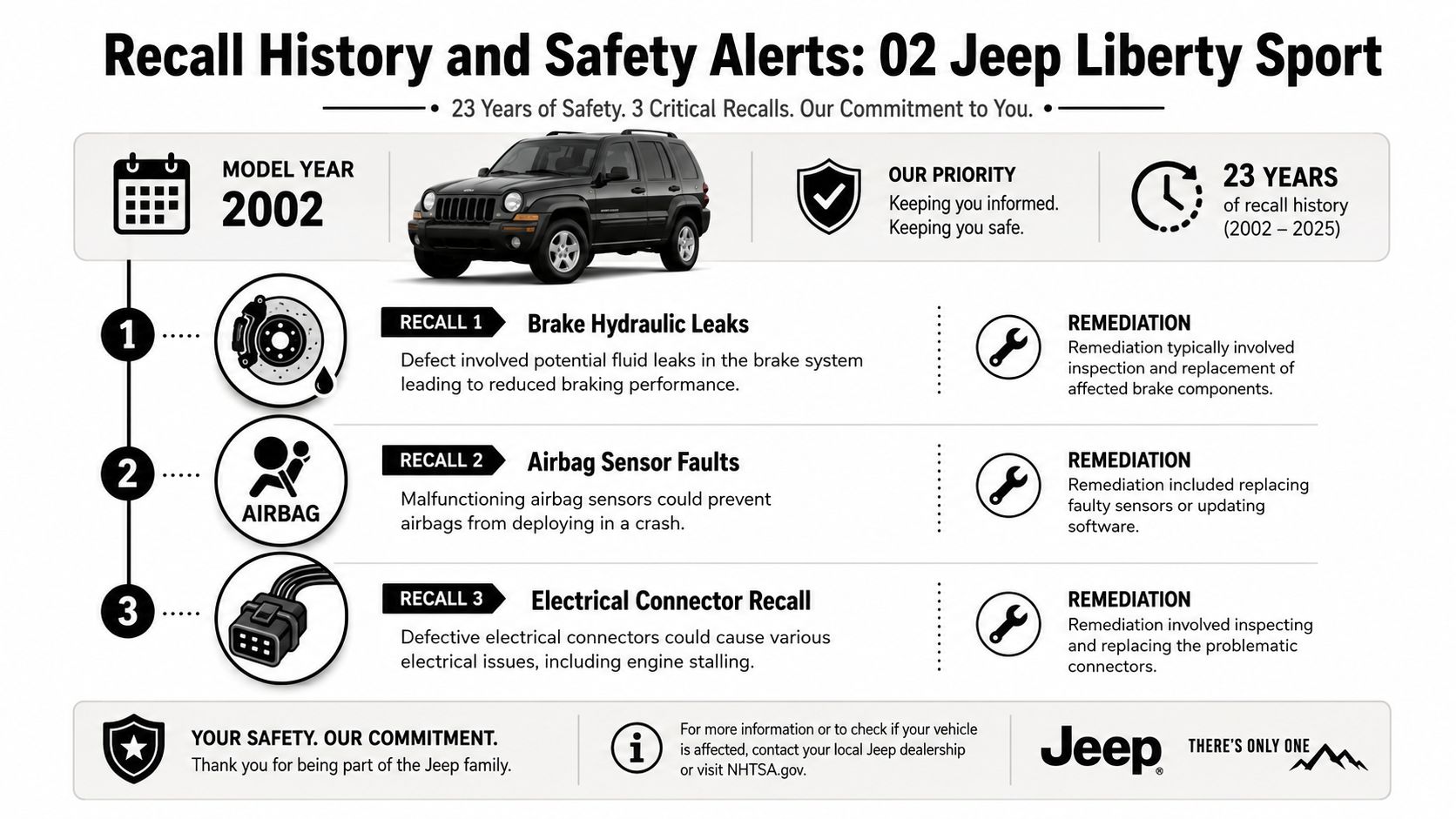
Recall history matters most when it lines up with the problems already seen on the vehicle. If the Liberty has brake complaints, airbag warning issues, or odd electrical behavior, open campaigns change the cost picture immediately. A seller may frame that as "dealer work," but the essential question is whether the Jeep was ever brought in, whether the repair was completed correctly, and whether later neglect created related problems that a recall will not cover.
What the recall categories should tell you
Use recall history as a risk filter, not a trivia list:
- Brake-related campaigns: Treat these seriously because poor maintenance can hide behind recall language. If the VIN shows brake-related recall history and the pedal feel is still weak, inspect the whole system instead of assuming the campaign solved it.
- Airbag-related issues: An airbag light on an older Liberty can mean more than one thing. Open recall status raises the stakes, but a completed campaign does not rule out clockspring faults, wiring issues, or prior collision repairs.
- Electrical system recalls: These matter more on a Liberty that already has intermittent gauges, warning lights, or accessory problems. In practice, hidden labor costs often begin to climb, because diagnosis time can exceed the price of the part.
How this affects VIN risk scoring and buyer leverage
A clean recall record on the VIN helps only if the rest of the history supports it. I put more weight on patterns than on a seller's memory. If a Liberty shows auction history, salvage exposure, repeated registration gaps, or inconsistent service records, "recall completed" does not erase the chance of poor repair work or unresolved safety issues tied to prior damage.
This is the trade-off many buyers miss. Two Liberty Sports can look equal in photos, but the one with verified recall completion and a stable VIN trail usually carries less hidden cost than the cheaper one with vague answers. Before agreeing on price, check whether safety campaigns are open, ask for dealer paperwork if the seller claims they were done, and factor any uncertainty into your risk score for that specific Jeep.
Market Values and Maintenance Costs
The hard truth about pricing an 02 Jeep Liberty Sport is that condition and history matter more than any tidy marketplace average. You can't build an honest “average market values by mileage” table here without making up numbers, and that would mislead you. On this model, a clean-title, well-documented example and a cosmetically similar SUV with hidden suspension work or mileage questions do not belong in the same pricing bucket.
So the better way to price it is to work backward from known mechanical and history risks.
What should shape the price
Start with configuration. A Liberty Sport with the V6, the right towing equipment, and a strong service trail is worth more to the right buyer than a stripped example that can't support the same use case.
Then adjust for the issues that commonly move real transaction value:
- Suspension condition: If inspection points to rear bushing wear, that's one negotiation conversation. If the front end suggests more expensive strut or alignment-related work, that's a different one.
- Recall completion: Open safety campaigns reduce confidence immediately.
- Mileage credibility: If the odometer story feels weak, the transmission risk becomes harder to ignore.
- Presentation: Cleanliness helps sell a used SUV, but it shouldn't hide what matters. If you're selling before upgrading, this guide on how to boost car resale value is useful because presentation does influence buyer confidence, even though it doesn't fix underlying faults.
A practical market value framework
Use this decision table instead of chasing made-up averages:
| Average 02 Liberty Sport Market Values by Mileage | Private-Party Price | Dealer Price |
|---|---|---|
| Lower documented mileage with clean history | Higher end of your local range if suspension, recall, and title checks are strong | Higher still if the dealer can prove history and condition |
| Average mileage with ordinary wear | Mid-range if test drive and underbody inspection are solid | Mid to upper range depending on reconditioning quality |
| Unclear mileage or visible repair needs | Discount heavily or walk away | Often poor value unless the dealer has already fixed the known issues |
That's more useful than a fake spreadsheet because it matches how these SUVs are bought. A rough Liberty with strong history can be a safer buy than a shiny one with missing records.
Maintenance budget thinking that works
Routine ownership on an older compact SUV means planning for fluids, brakes, tires, suspension wear, and electrical troubleshooting. You don't need a fantasy annual budget figure to know what matters. You need a buffer.
A smart buyer assumes three levels of spending:
- Baseline catch-up work after purchase.
- Known age-related wear that appears during the first stretch of ownership.
- One larger surprise if the seller skipped maintenance.
If you need help valuing any older used SUV in a more structured way, the used car value estimate guide is a solid companion to your local listing research.
A cheap purchase price can still be a bad deal if the first repair stack starts immediately.
Mistakes buyers make on value
The most common pricing mistakes are simple:
- They overpay for cosmetics. Fresh paint correction and clean seats don't prove mechanical health.
- They underprice documentation. Service records and a believable ownership story are worth money.
- They ignore configuration. Not every Liberty Sport has the same usefulness, especially if towing matters.
- They compare it to generic compact SUVs only. Some buyers want Jeep capability, not just transportation. That changes value.
Pre Purchase Inspection Checklist
The 02 Liberty Sport rewards hands-on inspection. A quick loop around the block isn't enough. You want to connect what you see, hear, and feel to the known weak spots that can turn a cheap SUV into a project.
On-site checks that matter
Bring a flashlight, a notepad, and enough time to let the SUV show its real condition.
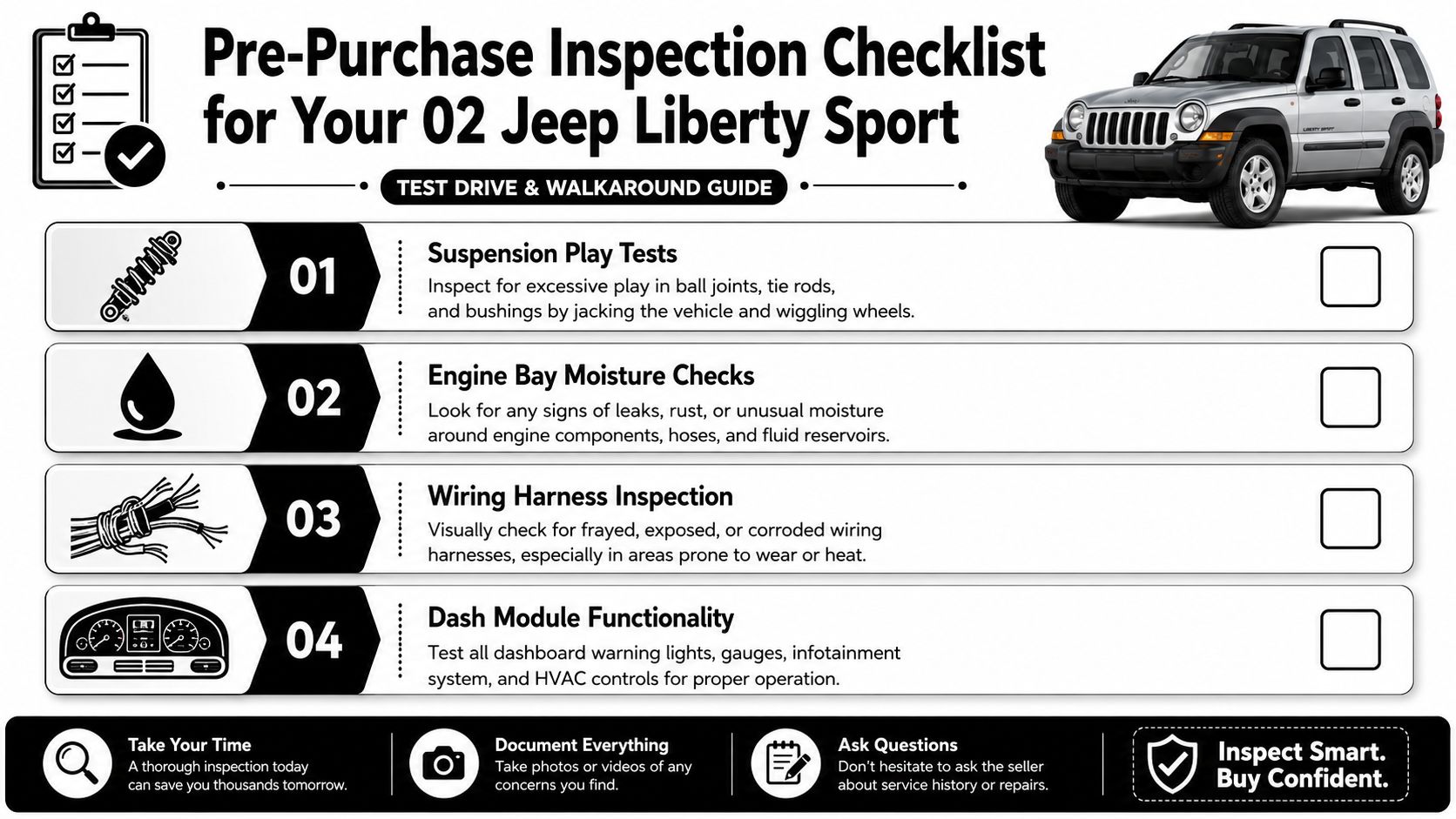
Suspension play test
Check for looseness at the wheels and listen for clunks over uneven pavement. On this model, broad “suspension issues” need to be narrowed down before you can price them correctly.Engine bay moisture check
Look for signs of leaks, residue, or corrosion around hoses, reservoirs, and the surrounding bay. You're not trying to diagnose every stain. You're looking for patterns that suggest neglect.Wiring harness inspection
Scan visible harnesses and connectors for wear, heat exposure, or corrosion. Electrical trouble on older SUVs often leaves visible clues before it leaves a paper trail.Dash startup behavior
Turn the key and watch the warning lights and gauges. A weird startup sequence, dead gauge, or inconsistent warning lamp behavior deserves follow-up.
For a broader process you can use on any used vehicle, this pre-purchase car inspection checklist is worth keeping open on your phone.
Test-drive red flags
Don't let the seller control the route. You want smooth pavement, broken pavement, low-speed turns, and a short highway stretch.
- Shifting hesitation or slip: Pay attention under light throttle and moderate acceleration.
- Steering wander: If it doesn't track cleanly, don't dismiss it as “just an old Jeep.”
- Brake feel: A soft or inconsistent pedal should move recall and maintenance questions to the front of the conversation.
- Interior electronics: Test windows, locks, HVAC controls, gauges, and warning lights while parked and driving.
“A proper test drive isn't about comfort. It's about making the problems show up before you own them.”
What to ask before you leave
Finish with direct questions, not broad ones.
Ask what suspension work has been done. Ask whether the transmission has ever been serviced or repaired. Ask whether recall work was completed. Ask whether the seller can support the mileage with records.
If the answers get vague, your next step isn't negotiation. It's verification.
VIN History Check Workflow
A clean-looking 02 Jeep Liberty Sport can still be the expensive one. I have seen Libertys with decent paint, a quiet test drive, and a low asking price turn into bad buys because the VIN history exposed the underlying issue: the mileage story did not match the wear, or an old damage event lined up a little too well with the suspension and transmission issues buyers often blame on age alone.
That is why I run the VIN before I spend time on the phone with the seller. On this Jeep, history risk and mechanical cost risk belong in the same checklist. A suspicious odometer history changes how you read transmission behavior. An accident entry changes how you price front end noise. An open recall changes how much confidence you can place in a seller who says, “everything works.”
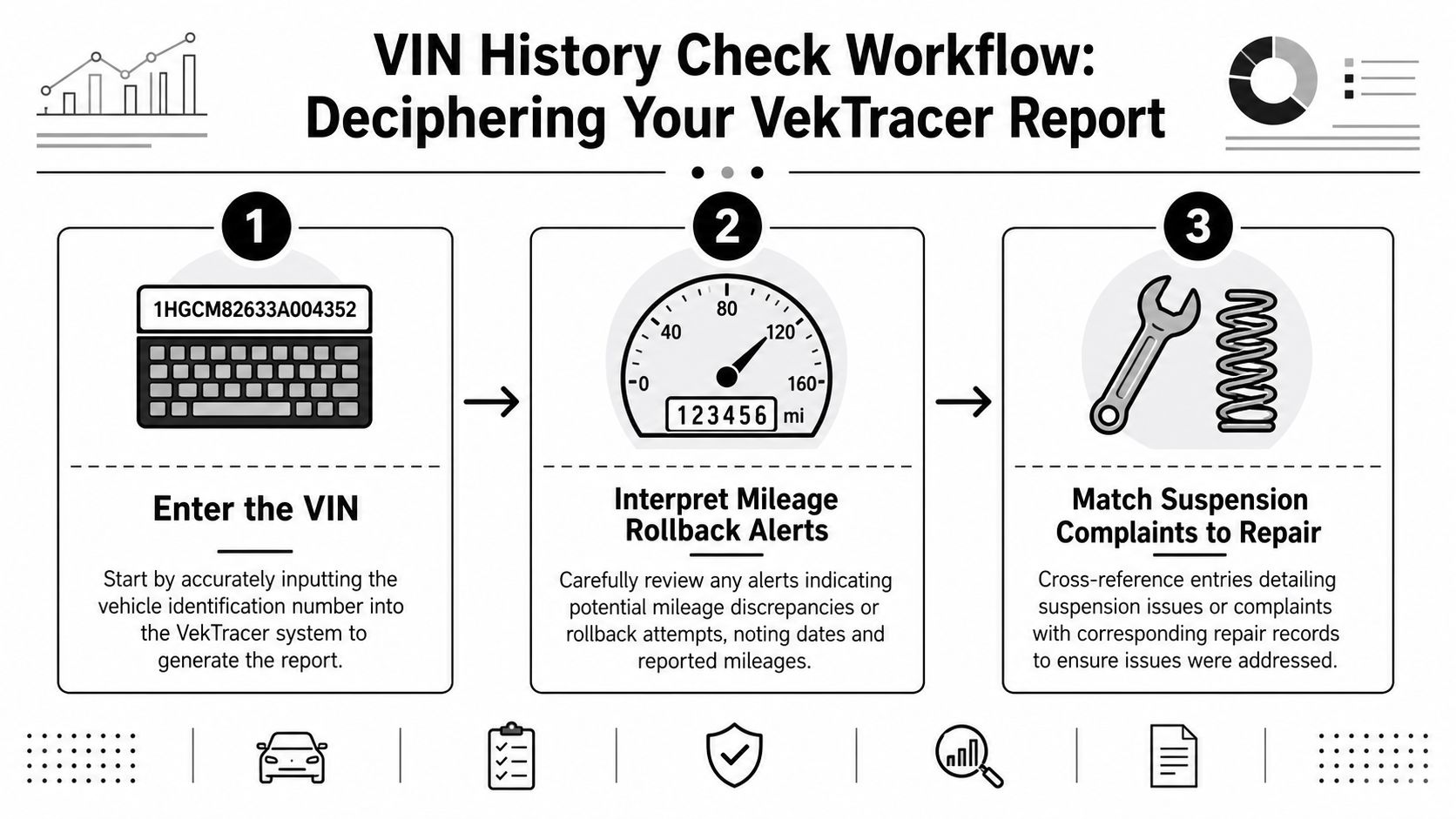
Start with the VIN before you inspect the truck
Get the VIN early. If the seller hesitates, sends a partial number, or keeps redirecting to “come see it first,” treat that as part of the risk score.
The first pass is simple. Check for:
- Mileage consistency across title, registration, inspection, and service entries
- Title branding or damage history that could explain uneven wear or poor panel fit
- Recall status so safety work is not left as your problem after purchase
- Ownership and registration pattern that suggests either normal use or a vehicle that changed hands whenever repairs got expensive
If you want a clearer framework for reading each section of the report, use this VIN lookup report guide.
Match the report to known Liberty cost points
This step is where buyers save money.
If the history shows mileage gaps or rollback warnings, stop treating the transmission as a simple test-drive item. A Liberty that shifts acceptably for fifteen minutes can still be a poor risk if the odometer story is weak. Lower claimed miles often support a stronger asking price, but they also hide wear that should have shown up already in the transmission, suspension, steering, and interior.
If the report shows an accident, do not file that away as old news. On an 02 Liberty Sport, prior front or side damage can connect directly to recurring tire wear, alignment complaints, steering pull, replacement airbag questions, and suspension work that never feels fully sorted. Paperwork and mechanical condition need to agree.
If the report shows repeated registration changes in short periods, ask why. Sometimes it is harmless. Sometimes it means each owner fixed the obvious issue, then passed along the expensive one.
Use a simple risk score
I group these SUVs into three buckets before I negotiate.
| Risk pattern | What to do |
|---|---|
| Clean mileage history, consistent ownership, no major title problems | Continue with inspection and price it on actual condition |
| Some damage or repair history, but records line up with visible repairs | Buy only if the price leaves room for catch-up maintenance |
| Mileage inconsistency, salvage branding, unresolved recalls, or vague ownership pattern | Walk away unless the seller has strong documentation and the numbers still work |
That middle bucket is where buyers get trapped. A Liberty with an explainable accident and decent repairs can still be worth buying. A Liberty with unclear miles and a too-clean sales pitch usually is not.
Cross-check seller claims line by line
Use the report to ask narrow questions.
If the seller says the mileage is original, ask which service records support it. If they say recall work was done, ask for the invoice or dealer confirmation. If they say the suspension was “just replaced,” compare that claim to the history and the parts on the vehicle. Mismatches matter more than the excuse attached to them.
Two examples come up often. A report shows an odometer inconsistency, but the seller insists it was “just a clerical error.” That can be true, but then the burden is on the seller to prove it. Or the report shows prior damage, and the vehicle now has fresh tires on one axle, older tires on the other, and a steering wheel that sits slightly off center. That is not a paperwork detail. That is a cost forecast.
Make the final call based on total exposure
For an 02 Jeep Liberty Sport, the VIN report is not there to replace the inspection. It tells you where the expensive surprises are most likely to be hiding.
A clean report does not guarantee a good SUV. A dirty report can still describe a usable one at the right price. The value comes from combining the history with the known Liberty weak spots and assigning real dollars to the risk before you buy.
FAQ
Is the 02 Jeep Liberty Sport a good used SUV?
It can be a smart buy for someone who wants a small SUV with real utility, decent power, and Jeep-style 4WD capability. It is usually a poor fit for buyers who need low fuel cost, low repair risk, and car-like ride quality.
The main question is whether you are buying a sound Liberty or someone else's deferred maintenance.
What engine does the 2002 Jeep Liberty Sport have?
The common setup is the 3.7-liter V6 discussed earlier in the article. It gives the Liberty enough torque to feel useful around town and on grades, but it also brings higher fuel use and a shorter list of cheap repair outcomes once cooling, ignition, or transmission issues start stacking up.
How much can an 02 Jeep Liberty Sport tow?
A properly equipped Liberty Sport can handle light trailer duty better than many compact SUVs from the same era. Towing ability depends on drivetrain, transmission, axle setup, and whether the vehicle still has its original cooling and hitch equipment in good condition.
On an older Liberty, I would care less about the brochure number and more about whether the transmission shifts cleanly, the cooling system holds pressure, and the rear suspension sits level.
What are the most common problems on the 02 Jeep Liberty Sport?
Front suspension wear is common, but the cost varies a lot. One Liberty may need basic wear items. Another may need a full front-end refresh plus tires and alignment because uneven wear was ignored too long.
Window regulators, electrical faults, and transmission behavior also deserve close attention. If the VIN history shows gaps, mileage questions, salvage branding, or repeated auction movement, assume those issues could be more expensive than they first look.
How many recalls does the 2002 Jeep Liberty Sport have?
This model had a meaningful recall history, including safety-related items covered earlier. Do not accept “it was probably done” from a seller. Verify recall completion with a dealer or with paperwork tied to the VIN, because open recall work affects both safety exposure and the amount of money you may need to spend after purchase.
Is the 02 Jeep Liberty Sport good on gas?
No one buys a Liberty Sport to save at the pump. Fuel economy is average to below average for a compact SUV of its age, especially with 4WD, larger tires, short-trip driving, or neglected maintenance.
If your budget is tight, treat fuel cost as only part of the picture. Older Liberty ownership gets expensive faster through suspension work, cooling repairs, and electrical fixes than through gasoline alone.
Should I get a vehicle history report before buying one?
Yes. On this Jeep, the VIN report helps separate normal age-related wear from hidden risk that can change the deal by thousands.
A clean-looking Liberty with spotty mileage history, title issues, or inconsistent service records can be the expensive one. A less pretty example with straight ownership history, documented recall work, and believable maintenance records is often the safer buy.
If you are serious about buying an 02 Jeep Liberty Sport, run the VIN before you negotiate. VekTracer makes it easier to check mileage history, recall status, title issues, and overall risk so you can tell the difference between a usable older Jeep and an expensive mistake.
Ready to check a vehicle?
Enter any 17-character VIN for a free instant preview — no account needed.