Vehicle History Report Texas: Buy Smart in 2026
Check a vehicle before you buy
Enter a VIN for a free instant preview — accidents, title brands, mileage, liens & open recalls.
You pull into a used-car lot in Houston after the last big rain. The SUV in front of you shines, the interior smells clean, and the price looks fair. What you cannot see is the part that matters most in Texas. Was it flooded, wrecked on I-45, rebuilt after a total loss, or rolled through another state before landing back on this lot?
That is why a Texas vehicle history report comes first. Before the test drive. Before the deposit. Before you let a salesperson talk you into trusting a clean-looking car.
A good report pulls together accident history, title status, odometer records, and other records tied to the VIN from sources such as TxDOT, NMVTIS, and insurers. In Texas, that paper trail matters more than the shine on the paint. This market is full of hard-driven trucks, storm-damaged cars, flood-risk vehicles from the Gulf Coast, and rebuilt vehicles that can look fine to an untrained buyer.
Do not treat a clean title claim like proof. In Texas, a clean title does not mean a clean past. It means you still need to read the record and judge the risk.
A used car in Texas needs a background check before it needs your money.
Why That Shiny Used Car Needs a Background Check
Checking a specific vehicle?
Run its VIN for a free preview of accidents, title brands, mileage and open recalls.
You are standing on a Texas lot looking at a used SUV that shines like new. The paint is glossy, the seats are clean, and the salesperson keeps saying it was “well maintained.” What you need to know is whether that vehicle spent last hurricane season sitting in floodwater, got hit hard on a frontage road, or came back to market after a total-loss payout.
That is the true Texas problem. Cars here live through flood zones, hail, heavy interstate miles, brutal heat, and plenty of serious wrecks. A vehicle can look great and still have hidden structural repairs, electrical issues, or title history that turns your “deal” into a money pit.
Looks are cheap. Repairs that were done badly are expensive.
A walkaround shows you paint, tires, and maybe uneven panel gaps if you know what to look for. It does not show you whether the airbags went off, whether the frame was straightened, or whether the title moved across state lines to bury an ugly past.
A vehicle history report gives you the paper trail. In Texas, that paper trail matters because the risk is not abstract. Flood damage around the Gulf Coast, hard-use trucks in oil and construction markets, and high-speed crash exposure on roads like I-10, I-35, and I-45 all show up later as expensive ownership problems.
Looks don't tell you what happened underneath
Fresh detailing can hide a lot for one afternoon. It cannot erase prior insurance events, title brands, odometer inconsistencies, or salvage history tied to the VIN.
If a seller gets irritated when you ask for the VIN or pushes you to skip the report, take the hint and slow the deal down. Honest sellers do not fight basic verification.
Texas buyers need risk screening, not sales talk
Words like “minor damage” and “just cosmetic” mean nothing without records behind them. What matters is whether the report shows a pattern that raises the odds of future trouble, lower resale value, or insurance headaches.
Check for:
- Title problems such as salvage, rebuilt, flood, or other branding
- Crash history that suggests more than a simple fender bender
- Mileage records that do not line up over time
- Theft, total-loss, or out-of-state history that deserves a closer look
If you are buying for your family, a teen driver, or a long Texas commute, this is basic judgment. A clean-looking vehicle can still be the wrong vehicle. The report helps you decide whether the risk matches the price, or whether you should walk.
What a Texas Vehicle History Report Actually Reveals
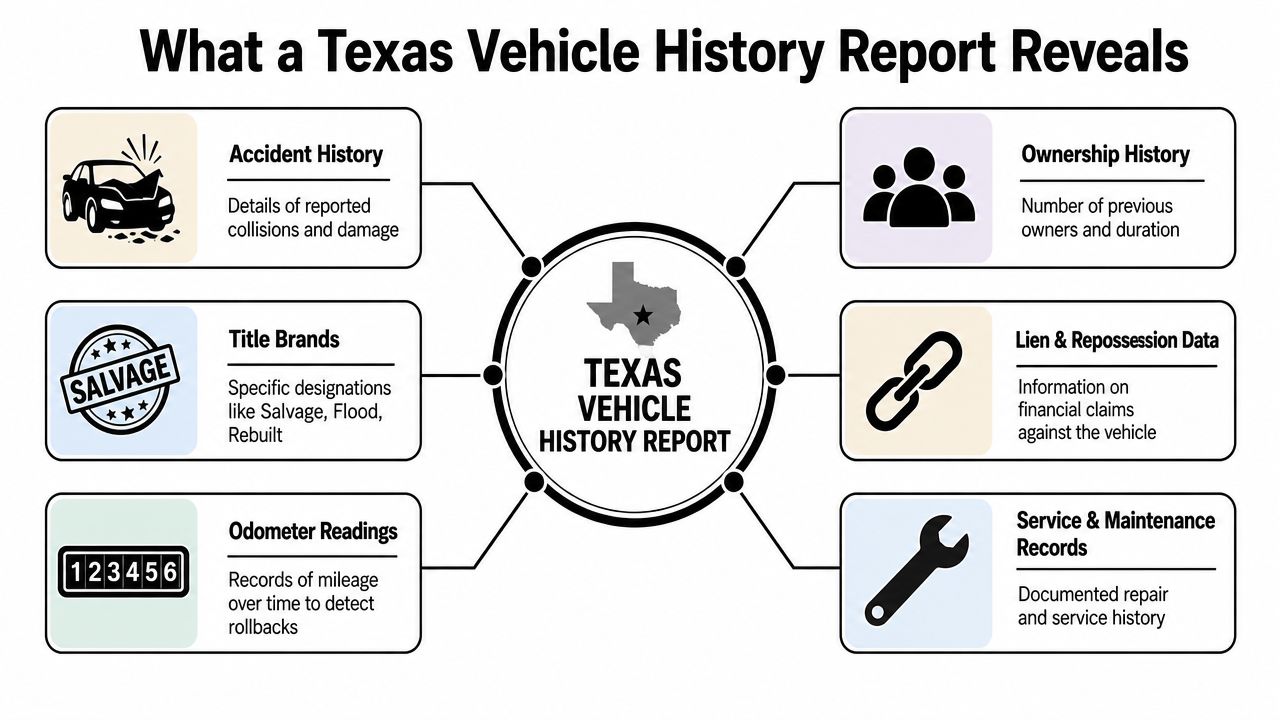
A Texas vehicle history report gives you a risk file, not a simple answer. You are checking whether the VIN supports the seller's story, whether the title history makes sense, and whether the car has been through the kind of damage that turns into expensive trouble six months later.
In Texas, that matters more than buyers admit. A vehicle can look clean on a lot in Dallas or Houston and still carry flood history, prior total-loss records, mileage issues, or repeated ownership changes that should kill the deal.
The starting point is usually NMVTIS, the National Motor Vehicle Title Information System. Texas DMV points buyers to NMVTIS because it can show title events across state lines and flag junk, salvage, or insurer total-loss history that a paper title alone may not reveal. Review the state's Texas DMV guidance on the NMVTIS Title Check and "Look Before You Buy".
The records that matter most
I read a Texas report in layers. Title history comes first. Then I check accident reporting, mileage consistency, and transfer patterns. A single bad entry can matter, but the main danger is a pattern that keeps pointing the same way.
NMVTIS title data
This is your first fraud screen. If the vehicle moved through multiple states, NMVTIS can expose brands or loss history that the current title does not make obvious.
That matters in Texas because out-of-state vehicles pour into the market every day. Some are fine. Some are exactly how flood-damaged or heavily wrecked vehicles get resold to buyers who only looked at the paint and the test drive.
Accident and damage entries
An accident line on a report means very little by itself. You need to judge the severity, the repetition, and the timing.
One reported crash years ago with consistent ownership after that is one thing. Multiple damage entries, towing records, airbag deployment notes, or a sale soon after a loss is a different risk level entirely. Texas roads see plenty of high-speed collisions, so you should assume that a “minor accident” description may still justify a close inspection of frame, suspension, and safety systems.
Odometer and ownership history
Mileage should rise in a clean, boring pattern. If it jumps backward, stalls for long stretches, or suddenly climbs after title transfers, stop and verify everything.
Ownership history matters for the same reason. A car that changed hands over and over may have been flipped after damage, dumped because of a stubborn mechanical problem, or passed around auctions instead of kept by normal drivers.
Brand and loss clues
A common pitfall is for buyers to become complacent and overpay. If the report shows salvage, rebuilt, flood, junk, or insurer total-loss history, treat that as a pricing and risk issue first, and a cosmetic issue last.
If you need a plain-English breakdown of those labels, read this guide to what a branded title means for buyers and resale value.
What each section should make you ask
Do not read the report like a receipt. Read it like a warning file.
| Report area | What it can reveal | What you should ask |
|---|---|---|
| Title history | Cross-state brands, title changes, total-loss records | Does the current title hide an older problem from another state? |
| Accident history | Prior collisions, damage events, possible towing or airbag clues | Was the repair done well enough to trust this car at highway speed? |
| Odometer records | Mileage consistency over time | Do the numbers rise normally, or does the timeline look manipulated? |
| Ownership changes | Fast transfers, dealer moves, auction activity | Why did this vehicle change hands so often? |
| Theft or loss flags | Insurance and legal complications | Can the seller prove they have clear right to sell it? |
The best reports line up cleanly across title, mileage, and ownership records. The risky ones do not. If the seller's explanation sounds simple but the VIN history looks messy, trust the records and slow the deal down.
Decoding Texas-Specific Title Brands and Laws
A seller in Houston says the car has a clean Texas title, drives great, and just needs a quick decision. Then you pull the history and find an older salvage record from another state, a rebuilt title later on, and signs the vehicle spent time in a flood-risk area. That is how Texas buyers get trapped. The current title line is only part of the story.
Salvage, rebuilt, and flood brands mean different levels of pain
Texas buyers need to separate legal status from real-world risk.
A salvage record usually means the vehicle was declared a serious loss. A rebuilt title means it was repaired and returned to the road after major damage. A flood brand, or any strong sign of water intrusion, deserves the hardest line of all. In Texas, that matters more than in many states because coastal storms, flash flooding, and auction movement can push wet vehicles back into the market looking clean enough to fool rushed buyers.
If you want a plain-English explanation of the labels themselves, use this branded title guide for buyers comparing salvage, rebuilt, and resale risk.
Texas title history needs context, not just labels
A clean current title does not erase an ugly past. Texas buyers should read the full sequence. Look for title changes across states, long gaps, insurer loss records, and any shift from salvage to rebuilt before the car lands on a dealer lot or marketplace listing.
That sequence matters because Texas is a high-use, high-stress vehicle market. Cars here spend time in heavy traffic, hail zones, flood-prone counties, and long-distance highway driving. A repaired vehicle that might be tolerable as a short-hop commuter in a dry region can become a bad bet in Texas heat, rain, and daily freeway speeds.
My quick read on branded-title risk
I would sort branded vehicles like this:
- Salvage history: Price it as damaged inventory, not normal used retail.
- Rebuilt history: Consider it only if the discount is real, the repair paperwork is solid, and your mechanic knows how to inspect structural and airbag repairs.
- Flood history or water-damage clues: Walk away unless you are experienced, buying at the right price, and prepared for electrical problems later.
- Title story that conflicts with the seller's story: End the conversation.
One sentence rule. If the report is complicated, the deal should get cheaper and the inspection should get tougher.
The law matters, but your risk matters more
Texas title rules help classify a vehicle. They do not guarantee repair quality, future reliability, or easy insurance. That is why buyers get burned. They focus on whether the car is legally back on the road and ignore whether it is financially worth owning.
Pay special attention to flood-prone origins, coastal ownership history, and any record that suggests the vehicle changed hands quickly after a loss event. Water damage hides in connectors, seat tracks, control modules, carpeting, and under-dash wiring. A good detail job can hide that for a test drive. It will not hide it for the next two years.
My advice: In Texas, a branded title is never a minor footnote. It is a pricing warning, an insurance warning, and often a durability warning all at once.
How to Get a Complete Vehicle History Report in Texas
Don't rely on one lookup. That's the cleanest advice I can give you.
The best Texas workflow is layered. The FTC advises consumers to use NMVTIS-approved providers for title, insurance-loss, and salvage information, then separately check open safety recalls through NHTSA and theft, flood, or salvage indicators through NICB VINCheck. That guidance appears in the FTC's used car buying recommendations. One database catches one kind of problem. Another catches something else.
The fastest workflow for real buyers
If I'm screening a used car in Texas, I'd do it in this order:
- Get the VIN first. No VIN, no serious conversation.
- Run a theft and salvage screen. This is your quick filter.
- Pull a full NMVTIS-based report. That's where title and insurer-linked risk starts getting clearer.
- Check recalls separately. A clean title doesn't mean a safe vehicle.
- Match the report against the seller's claims. At this stage, falsehoods often surface.
A good starting point is a dedicated Texas VIN check tool so you're not piecing together the basics manually.
Free checks versus paid reports
Here's the direct comparison most shoppers need:
| Option | Best use | Strength | Limitation |
|---|---|---|---|
| NICB-style theft or salvage screening | Initial filtering | Fast and useful for quick elimination | Not a full history |
| NMVTIS-based consumer report | Serious shortlist vehicles | Strong title, salvage, insurance-loss view | Won't show everything |
| Texas state record requests | Narrow official verification needs | Helpful for title or registration-specific questions | More effort, not a one-stop solution |
When paying makes sense
A paid report is worth it when the vehicle is a real contender. Don't spend money on every random listing. Spend it when the car has passed your basic screen, the price is close to market, and you might buy it.
Texas-specific guidance also makes clear that not every state record is bundled into one universal check. Some official record requests are separate, and in some cases access requires ID or written authorization. That's why buyers should think in terms of which record solves which problem, not “which one report shows everything.”
If a seller wants a same-day commitment but resists giving you time to run title, recall, and theft checks, the answer is simple. Pass.
Interpreting Red Flags and Hidden Clues
A Texas used car can look spotless in photos and still carry expensive baggage. That matters more here because buyers deal with flood exposure, heavy highway use, hail damage, and a lot of repaired crash vehicles moving through the market. Your report is not just a history sheet. It is a risk filter.
AAMVA explains that NMVTIS-based reports may show title history, the most recent odometer reading, brand history, and sometimes theft data, but they do not promise full service records, full accident reporting, or complete repair documentation. Read AAMVA's NMVTIS consumer guidance with that limitation in mind. The smart move is to judge both what appears on the report and what is missing.
Red flags that deserve a second look
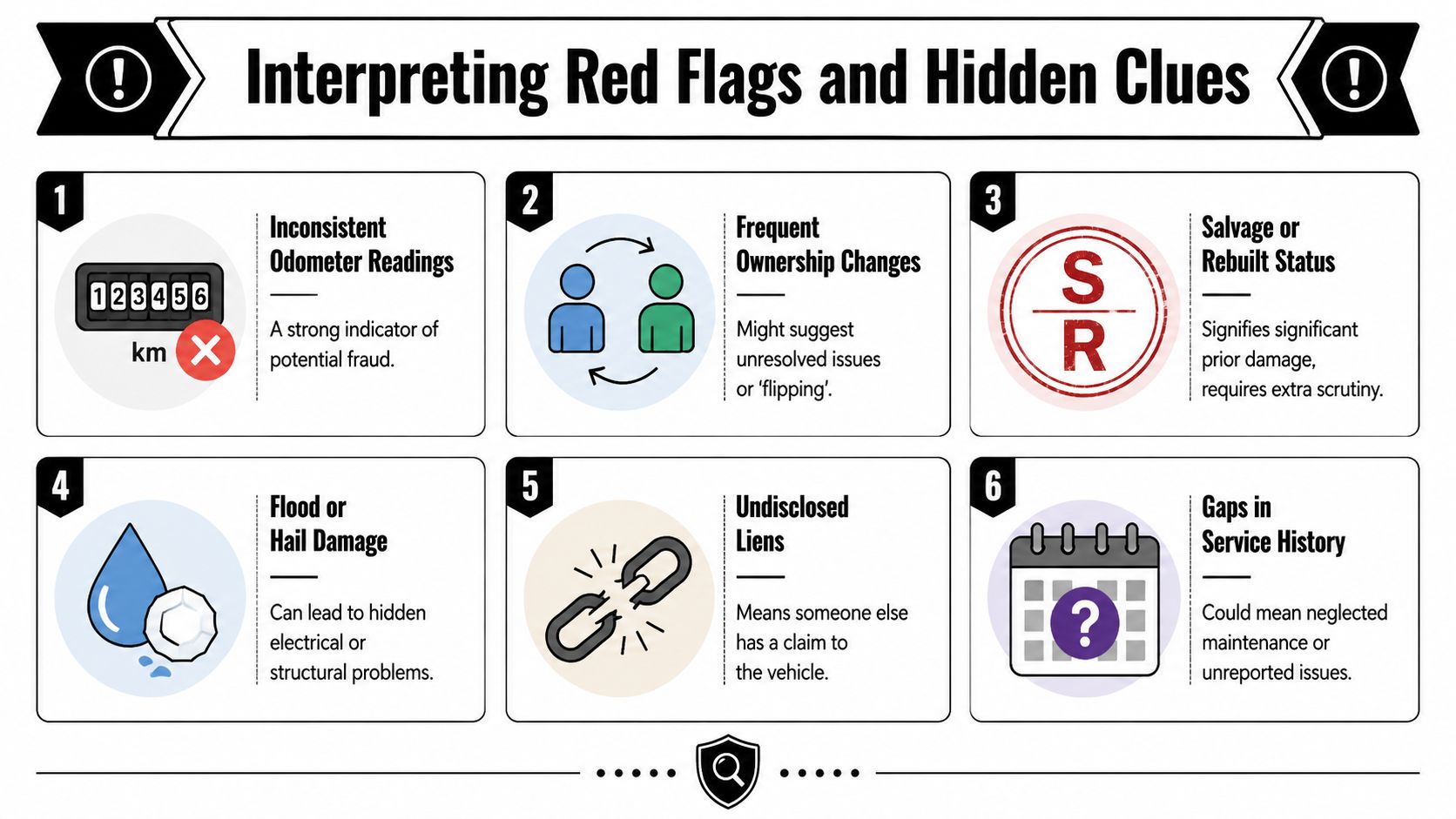
A single warning does not always kill the deal. In Texas, stacked warnings usually should.
- Mileage that jumps, stalls, or backtracks: Odometer records should progress in a believable pattern. Gaps or reversals deserve proof, not excuses.
- Frequent owner turnover: A car that changes hands fast can be a flip, a problem child, or both.
- Brand history without receipts: Salvage, rebuilt, flood, or other serious title events need supporting paperwork. No documents means higher risk and a lower price, if you buy at all.
- Signs of water exposure: A report may mention flood history, but even without that label, look hard at title movement, registration changes, and seller location. Cars displaced after Gulf Coast storms do not always announce themselves clearly.
- Open recalls: A clean title does not make an unsafe car safe.
- Active lien problems: If the lien release is unclear, your purchase can turn into a title mess with the county tax office.
What missing information should tell you
Missing data is not neutral. It means you still have work to do.
A clean report does not prove the vehicle never took a hit, never flooded, or never had major repairs. Body work paid out of pocket, small-shop repairs, and damage that never reached an insurer can leave very little paper trail. That is common in private-party sales and smaller Texas lots.
Use this rule. If the seller makes a big claim, the paperwork should back it up.
| Missing item | What you should assume |
|---|---|
| No service history | Maintenance might have been done. You still need receipts and an inspection. |
| No accident entry | There may have been no reported crash, or no captured record. Check paint, panel gaps, welds, and frame areas anyway. |
| No repair details | You need invoices if the seller says the damage was fixed correctly. |
| No explanation for a title event | Treat it as unresolved risk until the seller proves otherwise. |
Clean report, rough inspection results. Walk away.
Flood clues, title questions, and no paperwork. Walk away faster.
Prior damage, strong repair records, and a strong inspection. Buy only if the price reflects the risk.
How to read the pattern, not just the line items
The biggest mistake buyers make is treating each entry as separate. Texas buyers need to connect the clues.
Here is a pattern that should put you on alert. The vehicle spent time near the coast, then shows a title event in another state. Later, it comes back to Texas with a seller who says it is "just cosmetic" and cannot produce repair invoices. That combination points to hidden water or crash damage far more than any one entry alone.
The same goes for accident history. One minor crash on a late-model truck is not an automatic no. One crash plus inconsistent mileage records, fresh underbody coating, and a vague seller story is a different deal. Price it like a risk vehicle or pass.
If you want a sharper process for connecting report entries to what you see in person, use this used car inspection checklist before you buy.
If you want another benchmark before paying for any full report service, compare providers and pricing on compare VekTracer to Carfax. If you are shopping across state lines, our guide to USA VIN checks helps you use the same screening process from one listing to the next.
Your Actionable Pre-Purchase Checklist
When you're standing on a lot or meeting a private seller in a parking lot, you don't need theory. You need an order of operations.
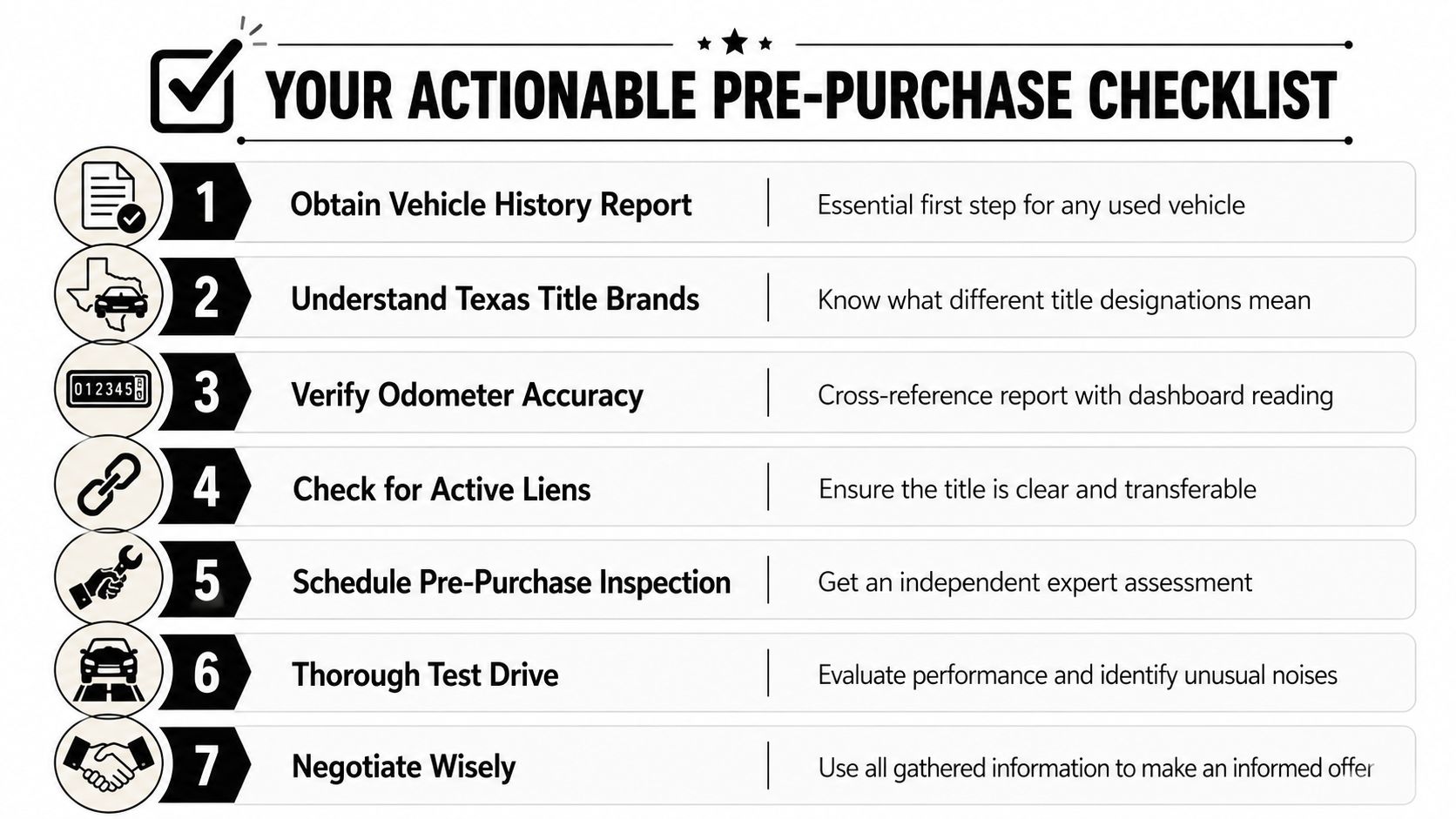
The checklist I'd hand a friend
Get the VIN before anything else.
If the seller won't share it, stop there.Run an initial screen.
Check theft, salvage, and basic title risk before you spend more time.Buy a full report only for serious candidates.
Don't waste money on every listing. Use reports on vehicles you'd realistically purchase.Read for contradictions.
Compare the report to the ad and the seller's story. “No accidents” and “clean title” should line up with the records.Ask targeted questions.
If there's a crash entry, ask who repaired it. If there's a title event, ask for supporting paperwork. If there are ownership jumps, ask why.Get an independent pre-purchase inspection.
Never let the seller's mechanic be the only mechanic.Negotiate from documented facts.
A vehicle with baggage isn't automatically a bad buy. It's a bad buy at the wrong price.
The mistakes that cost buyers the most
A short warning list is worth keeping in your phone:
- Trusting the seller summary: Ads are marketing. Records are evidence.
- Skipping the inspection after a clean report: Reports miss things.
- Buying branded-title vehicles on price alone: Cheap upfront can become expensive fast.
- Forgetting lien and recall checks: Ownership and safety are separate issues.
- Rushing because someone else is “coming to see it”: Urgency is often sales pressure, not your emergency.
For a broader lot-side process, this used car buying checklist is worth saving before you shop.
The simplest buying rule
If the VIN report, the physical inspection, and the seller's explanation all agree, you're in good shape.
If even one of those breaks hard from the others, slow down. Texas has too many used cars on the market to force a questionable deal.
Frequently Asked Questions about Texas VHRs
Can an accident be removed from a vehicle history report?
Usually, you should assume reported events remain part of the record trail if they were captured by the underlying data source. The bigger issue isn't removal. It's incompleteness. Some accidents never make it into every system, which is why a “clean” report still needs an inspection.
Does a clean Texas vehicle history report mean the car is perfect?
No. It means the report didn't show certain problems in the databases it used. That's useful, but it's not a guarantee. Service gaps, poor repairs, and unreported damage can still exist.
How accurate are odometer readings on a VHR?
They're useful for spotting patterns and inconsistencies. They are not magic. If the mileage timeline looks odd, take it seriously and compare it to the dash, maintenance stickers, inspection records, and the seller's explanation.
Should I buy a car with a salvage or rebuilt history?
Only if you understand the risk, the price reflects it, and an independent mechanic confirms the vehicle was repaired properly. For most everyday buyers who want easy resale and fewer surprises, it's smarter to keep shopping.
What's the best way to check a Texas used car before buying?
Use a layered process. Run a VIN check, review title and brand history, check for recalls and theft indicators, then get an independent pre-purchase inspection. One source alone isn't enough.
If you want a faster way to screen a used car before you waste time on a bad listing, VekTracer is worth a look. It gives you instant VIN reports, title and accident history, recall and theft checks, and a simple Risk Score that helps you spot trouble early without overcomplicating the process.
Ready to check a vehicle?
Enter any 17-character VIN for a free instant preview — no account needed.