RV VIN Lookup: Avoid Costly Mistakes in 2026
Check a vehicle before you buy
Enter a VIN for a free instant preview — accidents, title brands, mileage, liens & open recalls.
An RV VIN lookup starts with decoding the 17-character VIN to confirm the vehicle's basic identity, then checking public and commercial databases for recalls, theft, salvage, title, and history issues before you buy. That matters because the modern 17-character VIN standard has been used on most vehicles since 1981, and it lets lookup tools connect one RV to manufacturing, registration, recall, and history records across systems.
You've probably found a used motorhome or trailer that looks right in the photos, sounds right on the phone, and is priced just well enough to make you move fast. That's when buyers skip the dull part and head straight to the walkaround. With an RV, that's backwards.
A used RV isn't just a vehicle. It's a chassis, a coach, a title, a set of appliances, and a long list of things that can be altered, repaired, replaced, or hidden. A proper RV VIN lookup helps you catch problems a visual inspection won't show, and it tells you where to dig deeper before you hand over money.
Your First Step Before Buying Any Used RV
The first job is simple. Verify that the RV is what the seller says it is.
A VIN lookup can decode core attributes such as year, make, model, engine type, trim level, and manufacturing details, and it can also help confirm whether the VIN is structurally valid through the check-digit system. In the U.S., NHTSA's public decoder also supports partial VINs and can return fields like the build plant and country, which is useful when you need to verify provenance before a purchase, as noted in O'Reilly's VIN lookup overview.
What a proper RV VIN lookup actually does
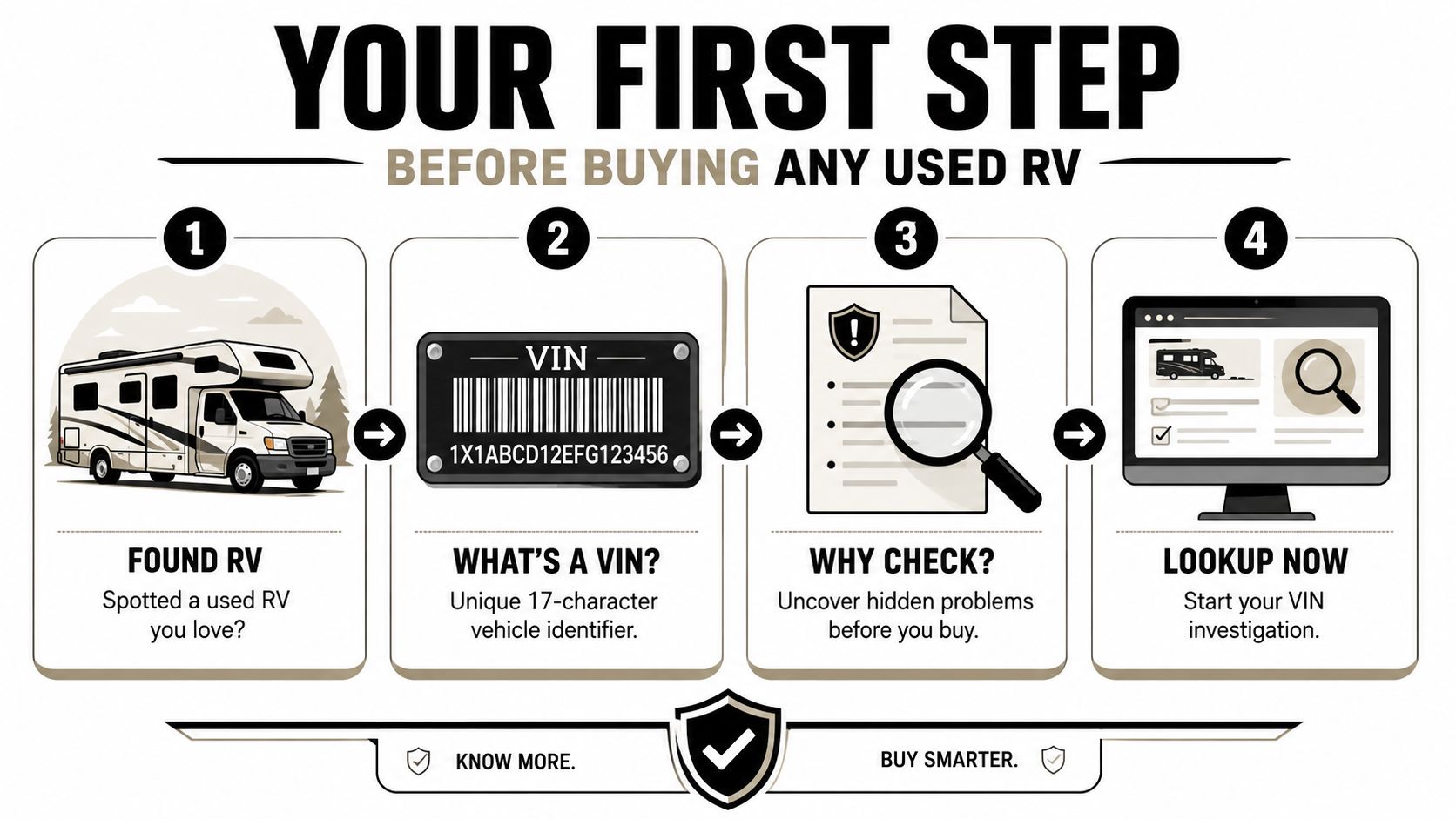
For a first-time buyer, the process should look like this:
- Decode the VIN: Confirm the basics match the listing, title, and seller's story.
- Run public checks: Look for open recalls and insurance-related theft or salvage signals.
- Pull a vehicle history report: Review title events, mileage records, damage entries, and ownership-related warnings.
- Match the paperwork to the RV: Compare the number on the rig, title, registration, and seller documents.
That order matters. If the VIN doesn't decode cleanly, or the decoded details don't match the ad, stop there and resolve that first.
What amateurs miss early
Many buyers think the VIN check is just a formality before the test drive. It isn't. It's your first filter for fraud, title trouble, and identity mismatch.
Practical rule: If the VIN, title, registration, and seller's description don't line up cleanly, assume you have a problem until proven otherwise.
The biggest beginner mistake is treating all RVs like cars. A sedan usually has one identity and one straightforward set of records. An RV often doesn't. A motorhome can carry one identity for the chassis and another set of information for the finished coach. A trailer can be older, altered, repainted, or carrying a damaged VIN plate. That's why a standard car-buying routine misses expensive RV-specific risk.
The goal isn't just a clean report
A clean decode doesn't mean a clean RV. It means you now know what machine you're looking at, and that gives you a baseline for the rest of your due diligence.
Use the VIN lookup to answer practical questions right away:
- Does the stated model year match the decoded year?
- Does the chassis make match what this RV should be built on?
- Is the VIN complete and readable, or are you already dealing with missing characters?
- Does the paperwork show the same identifier everywhere?
If those answers come back clean, move forward. If they don't, you're not shopping yet. You're investigating.
Decoding the VIN and Using Free Public Records
Start with the RV itself, not the seller's screenshot.
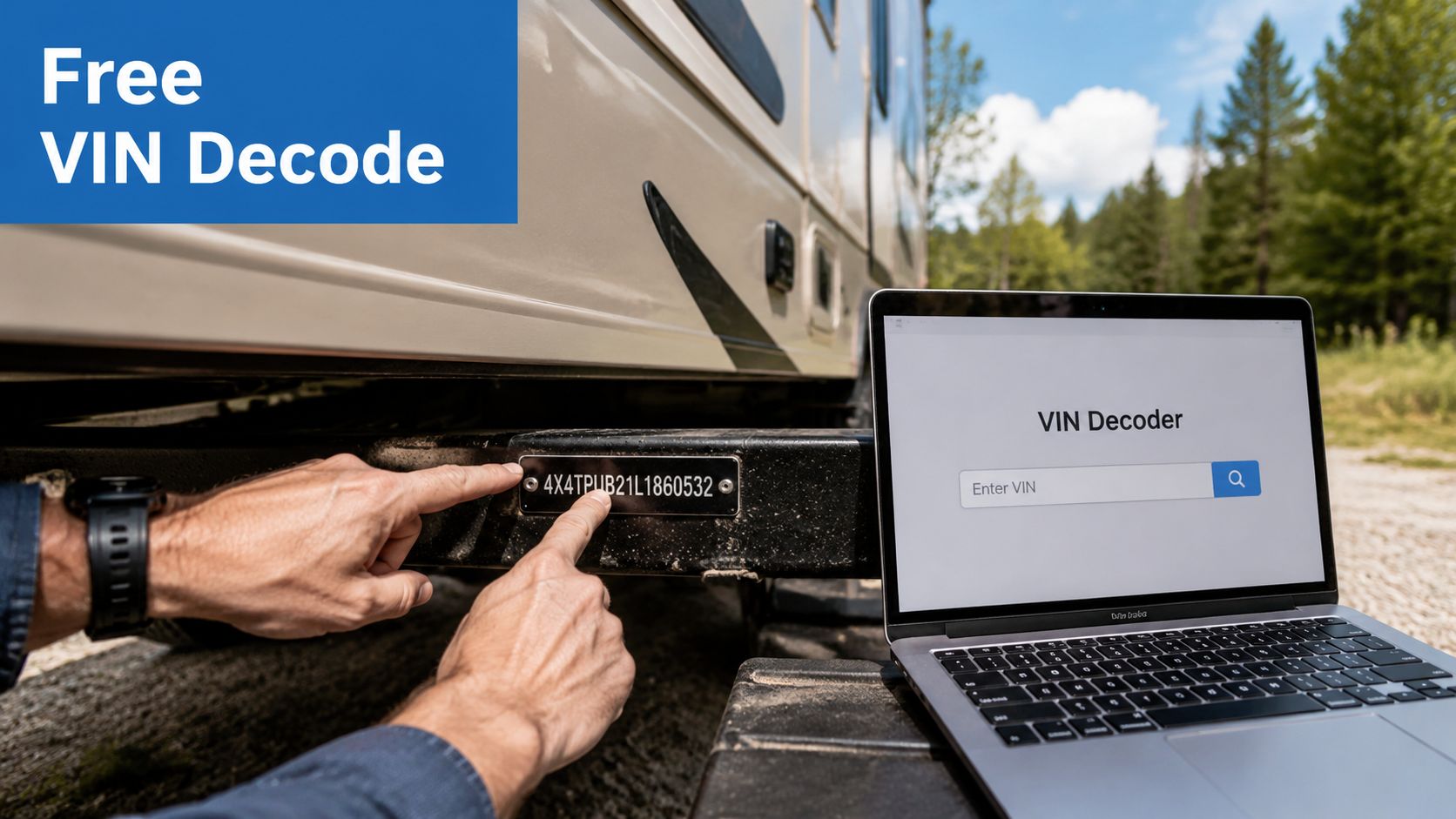
On motorhomes, the VIN may appear in more than one place, including the dashboard area, door jamb, engine compartment, or frame. On trailers and campers, you may need to inspect the tongue, frame rail, manufacturer plate, title, and registration. Dirt, repainting, corrosion, and old repairs can make this harder than buyers expect.
Start with the number on the rig
Write the VIN down exactly as shown on the physical vehicle. Then compare it against the title and registration character by character.
If you're rusty on VIN structure, this guide on how to read a VIN is useful before you start decoding. It helps you separate a simple typo from a real mismatch.
Then use free public tools in this order:
- NHTSA VIN decoder: Confirm basic identity and manufacturing details.
- NHTSA recall lookup: Check whether open safety recalls are attached to that VIN.
- NICB VINCheck: Look for insurance-related theft claim or salvage reporting.
These tools are worth using because they're official starting points, but they have limits. They don't replace a full history report, and they definitely don't replace a physical inspection.
What to do with a partial or unreadable VIN
Here, used RV buying gets messy.
A major challenge on older trailers is a VIN that's partial, missing, or unreadable. NHTSA's decoder can accept partial VINs, but confirming identity often requires you to cross-check the trailer frame, title, and registration because a standard VIN check may not be enough, according to NHTSA's decoder guidance.
That matters more in RVs than in ordinary used cars. A faded plate doesn't automatically mean fraud. It does mean you need more proof.
Use this checklist when the VIN isn't fully clear:
- Inspect the frame stamping: Don't rely only on a sticker or interior label.
- Check every document: Title, registration, bill of sale, and any old service paperwork can help establish continuity.
- Look for tampering: Fresh rivets, scraped adhesive, mismatched plates, or uneven paint near the label area are reasons to slow down.
- Ask your DMV what they require: State procedures vary, and some purchases need an official verification before transfer. These DMV VIN verification details give a practical overview of what that process can involve.
If the seller wants a deposit before you've resolved a partial or questionable VIN, walk away.
What free checks can and can't tell you
Free public records are good at confirming identity and catching obvious safety or insurance flags. They're not good at telling the full ownership story.
Here's the trade-off:
| Tool | What it helps with | What it misses |
|---|---|---|
| NHTSA decoder | Basic vehicle identity, plant, country, partial VIN support | Ownership history, liens, detailed damage timeline |
| Recall lookup | Open safety recalls | Non-recall repairs, prior title problems |
| NICB VINCheck | Insurance theft claim and salvage signals | Full title chain, maintenance, many damage events |
That's why free checks are phase one, not the final answer.
Unlocking the Full Story with a Vehicle History Report
A free VIN decode tells you what the RV is supposed to be. A vehicle history report tells you what's happened to it.
That difference matters because hidden title trouble, theft history, salvage events, and ownership complications don't show up when you stand in a campground looking at shiny fiberglass. Modern VIN lookup systems work by cross-checking a VIN against huge databases. EpicVIN says its decoder checks against 500 million+ records, which shows the scale these systems use to uncover hidden liens, recalls, theft history, and related issues, as explained in EpicVIN's VIN decoder overview.
Why public checks aren't enough
A buyer who stops after NHTSA and NICB is still missing the parts that usually create the biggest financial headaches.
A full vehicle history report is where you look for:
- Title problems: Branded title history, state-to-state title changes, or ownership issues that deserve explanation.
- Lien warnings: You need to know whether someone else still has a financial claim against the RV.
- Mileage consistency: Odometer entries should form a believable timeline.
- Reported damage or accident events: Even limited records can point you toward high-risk areas for inspection.
- Theft and recovery history: A recovered vehicle can still carry lasting issues.
For a broader explanation of what belongs in a report, this article on what a vehicle history report is is a useful reference.
Where a report helps most in RV deals
RVs create a different kind of risk than ordinary passenger cars. A car buyer often worries about collision damage and maintenance neglect. An RV buyer has those concerns plus title complexity, coach modifications, storage damage, and systems that may have been repaired off-record.
That's why I treat the report as a targeting tool. It tells me where to press harder.
A history report doesn't prove the RV is good. It tells you where the story is incomplete.
If the report shows mileage entries that make sense, title events that line up, and no obvious theft or salvage issues, that's useful. If it shows gaps, brand changes, or conflicting registration patterns, that doesn't always kill the deal. It means the seller now owes you documentation.
What works and what doesn't
What works is combining the report with the physical RV and the seller's paperwork. What doesn't work is buying off one clean-looking screenshot.
Here's the practical comparison:
- Useful approach: Decode VIN, run public checks, review the full report, inspect the RV, then compare every finding.
- Bad approach: Read the ad, glance at one report summary, and assume the rest is fine because the interior looks clean.
If you're deciding between several rigs, compare them side by side before emotions take over. Buyers get into trouble when they evaluate one RV in isolation and stop asking whether a cleaner history exists on another unit nearby.
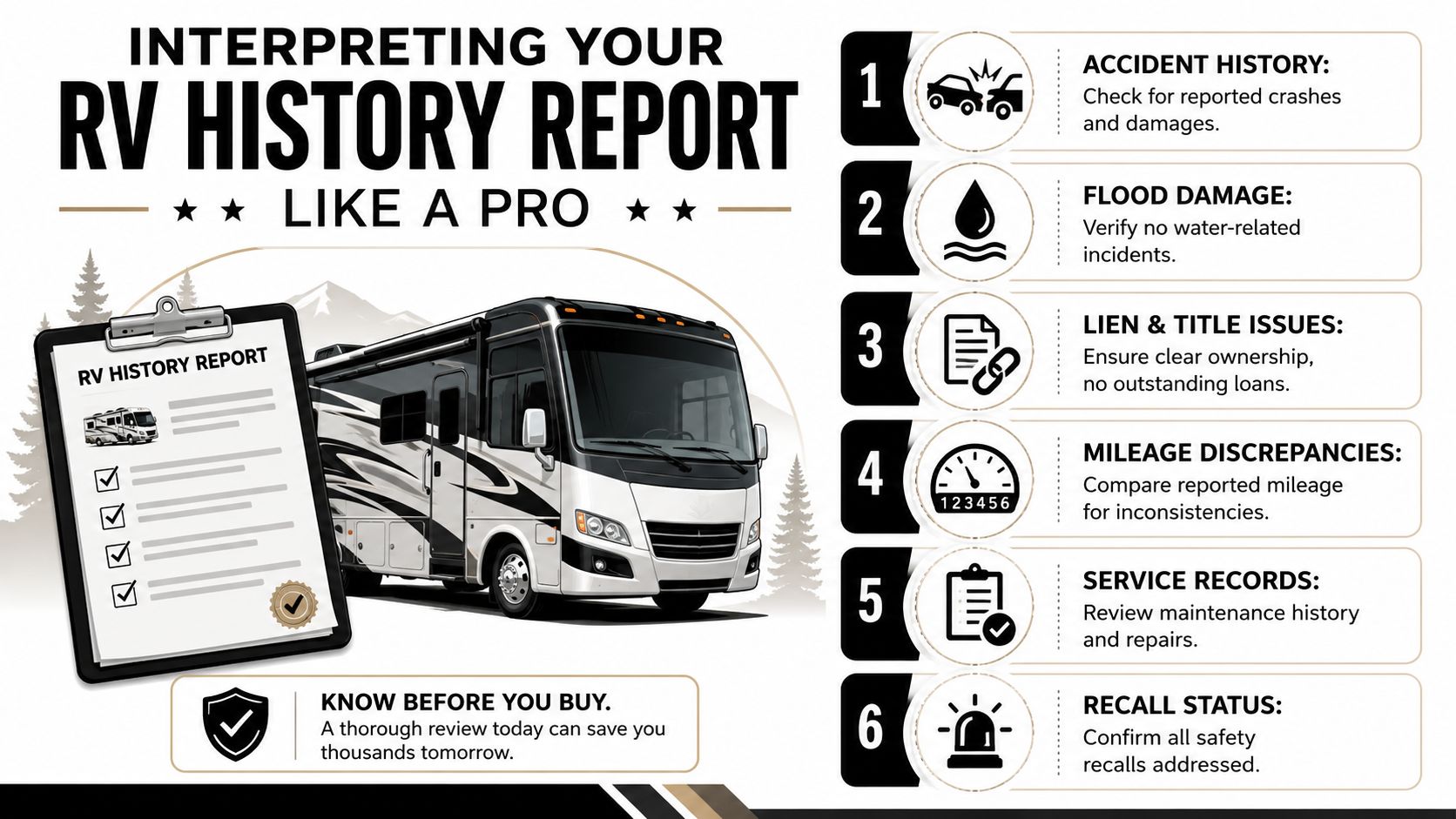
Interpreting Your RV History Report Like a Pro
Getting the report is easy. Reading it without missing the important parts is where buyers slip.
A vehicle history report should answer one question clearly: What would make this RV harder to own, harder to insure, harder to finance, or harder to resell? Don't read it like entertainment. Read it like a risk file.
Read the title history before anything else
If the title section raises questions, deal with that before you care about upholstery or solar panels.
Focus on entries such as:
- Salvage: The RV was declared a total loss by an insurer or authority under applicable rules.
- Rebuilt or reconstructed: It was repaired and put back into service, but you need documentation showing what was fixed and how.
- Flood-related branding: Water damage in an RV can affect structure, wiring, insulation, flooring, and hidden cavities.
- Lien-related concerns: Don't assume the loan was paid off just because the seller says it was.
A branded title doesn't always make an RV unusable. It does make your job harder. You'll need stronger proof, better inspection results, and a lower risk tolerance than the average buyer has.
Check the timeline for consistency
A good report reads like a coherent chain of custody. A risky one feels patchy.
Look for patterns, not one isolated line item:
| Report area | Healthy pattern | Concerning pattern |
|---|---|---|
| Mileage | Gradual, consistent progression | Drops, jumps, or unexplained gaps |
| Title events | Logical ownership and registration flow | Frequent transfers without explanation |
| Damage entries | Clear event followed by repair records or inspection notes | Damage with no supporting explanation |
| Recall status | Seller can show recall work completed | Open recall with no plan to address it |
Use a red-flag checklist
When I review an RV report, these are the first things I circle:
- Mileage that doesn't make sense: One low reading after several higher ones is enough to pause the deal.
- State hopping with no story: Sometimes normal, sometimes not. Ask why it moved and ask for records.
- Insurance-related salvage indicators: You'll need to inspect structure and systems more aggressively.
- Damage tied to one side or corner: That's where I look for repaired framing, slide issues, sealant inconsistency, and body line irregularities.
- Long gaps in the record: A quiet history isn't the same as a clean history.
Inspection mindset: Every suspicious entry on the report should create one specific thing to verify in person.
Don't confuse a sparse report with a clean RV
This is one of the costliest mistakes in the used RV market.
Many coach issues never land in the databases buyers rely on. Roof leaks, delamination, soft floors, amateur electrical work, appliance swaps, and interior rebuilds often live entirely outside the report. So use the history file for what it does well, then hand the RV a much harder physical inspection than you'd give a used SUV.
If the report gives you three concerns, inspect those three areas first. Then inspect the rest of the RV as if no report existed at all.
Spotting Red Flags Specific to Campers and Motorhomes
At this point, a normal car-buying routine breaks down.
An expert RV VIN lookup is a two-stage process. First, decode the 17-character VIN for chassis details. Then cross-check the physical VIN plate, title, and registration, because RVs are multi-stage vehicles and many RV-specific attributes can't be determined from the chassis VIN alone, as explained in DataOne Software's RV VIN decoding guidance.
Chassis VIN versus coach identity
On a motorhome, the VIN may decode the chassis maker and basic vehicle information while telling you far less about the finished living portion the buyer cares about.
That creates a common point of confusion:
- The chassis VIN may describe the platform built by a company such as Ford or Mercedes-Benz.
- The coach or finished RV branding reflects the manufacturer that built out the living quarters.
- The title and registration may emphasize one identity more than the other, depending on the unit and jurisdiction.
So if a VIN lookup returns a chassis manufacturer instead of the brand on the sidewall, that isn't automatically a problem. It is a signal to confirm exactly what's being decoded and what still needs separate verification.
RV problems a standard VIN report won't solve
A history report can warn you where to look. It cannot inspect the RV for you.
These are the issues buyers most often miss:
- Water intrusion: Stained ceiling panels are obvious. Hidden wall moisture, soft subfloors, and delamination aren't.
- Non-OEM modifications: Replaced refrigerators, altered propane systems, generator swaps, and DIY solar installs can be fine or terrible. The VIN won't tell you.
- Frame and underbody repair: Cosmetic bodywork can hide ugly structural history.
- Slide-out problems: The report may say nothing while the slide floor is already failing.
- Appliance age mismatch: A coach can have newer furniture and dead original systems hiding behind it.
A shiny interior can distract you from a wet wall, a patched roof, or a bent frame rail.
What to verify by hand
When the paperwork and report look acceptable, shift to the part many first-time buyers underestimate.
Check these items in person:
- Match all identifiers on the dashboard, frame, title, registration, and manufacturer labels.
- Inspect around every penetration on the roof and sidewalls for old sealant work and water entry clues.
- Look underneath for fresh paint, welding, bent outriggers, or uneven corrosion patterns.
- Open every compartment and smell for moisture, mildew, or recent deodorizing.
- Confirm major equipment is present, functional, and documented if it has been replaced.
A VIN lookup is the start of due diligence. On an RV, it never gets to be the whole process.
Next Steps After Your RV VIN Lookup
Once you've decoded the VIN, checked public records, reviewed the history report, and inspected the RV, you're finally in a position to make a decision from a strong position.
That advantage matters in two ways. First, it helps you avoid the obvious money pits. Second, it gives you a factual basis for negotiation when the RV is still worth pursuing.
Turn findings into decisions
Use a simple decision framework:
- Buy with confidence: The VIN matches everywhere, the history is coherent, and inspection findings are manageable.
- Buy only with conditions: The RV has explainable issues, but the seller provides records and the inspection supports the explanation.
- Walk away: Identity problems, document conflicts, hidden damage, or an evasive seller keep piling up.
If a lien concern remains unresolved, don't close the deal until you've verified it properly. A dedicated lien check belongs in the process whenever ownership claims are unclear.
Negotiation works better when your facts are organized
Don't tell the seller the RV “feels overpriced.” Show the issue list.
Bring:
- The decoded VIN details
- Recall status
- History report concerns
- Inspection photos
- Repair estimates if you obtained them
That changes the conversation. You're no longer bargaining off opinion. You're buying based on documented risk.
A report is not a substitute for an RV inspector
This is the point where many buyers get overconfident.
Even a strong history report won't tell you whether the roof has active moisture, whether the slide seals are failing, or whether a prior repair was done well. A professional pre-purchase RV inspection is still the best final filter before money changes hands.
If you're comparing RV ownership as a lifestyle decision too, this overview of the costs and benefits of RVing is worth a read. It won't verify a VIN, but it does help buyers think more realistically about what ownership involves after the purchase.
FAQ
Can an RV VIN lookup tell me the full coach details
Not always. An RV VIN lookup can decode core vehicle information, but many RV-specific attributes can't be determined from the VIN alone and may require manufacturer records or documentation.
What if the VIN decodes to the chassis maker, not the RV brand
That can happen with motorhomes because the chassis and the coach are not the same thing. Confirm that the VIN on the chassis, the title, and the RV paperwork all make sense together.
Can I use a partial VIN for an older trailer
Sometimes, yes. NHTSA's decoder supports partial VINs, but a partial decode is only a starting point. You still need to cross-check the frame, title, and registration to confirm identity.
Is a clean history report enough to buy an RV
No. It helps, but it won't reveal every RV problem. Water damage, poor repairs, and many coach-system issues still require a physical inspection.
What are the biggest mistakes first-time RV buyers make with VIN checks
The biggest ones are trusting the seller's typed VIN instead of the physical RV, skipping title verification, assuming a chassis decode covers the whole coach, and treating a sparse report as proof the RV is clean.
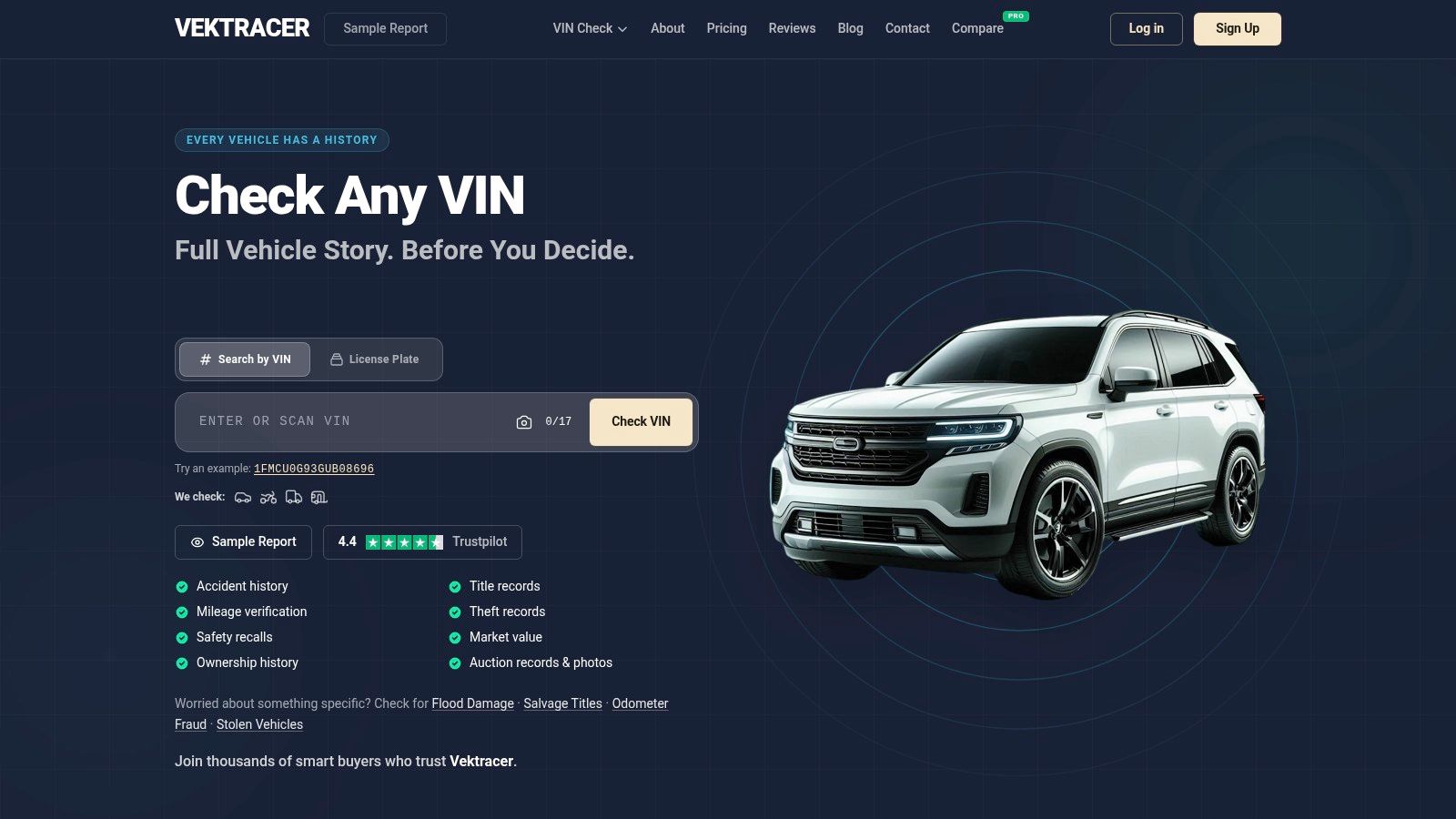
If you want to start with a clear vehicle history review before paying for an inspection, VekTracer is a practical place to pull a report and screen for title, lien, mileage, theft, recall, and damage-related risks before you commit.
Ready to check a vehicle?
Enter any 17-character VIN for a free instant preview — no account needed.