Import to Spain: Vehicle Registration and Customs Guide
Check a vehicle before you buy
Enter a VIN for a free instant preview — accidents, title brands, mileage, liens & open recalls.
You can bring a car into Spain without getting buried in red tape, but only if you know where the paperwork traps are. The problem isn't the drive, it's the split between EU transfers and non-EU imports, where customs, VAT, homologation, and registration can all hit at different moments. If you're planning an import to Spain, the safe path is to sort the vehicle's origin first, then build the file customs will accept.
Spain is a large, diversified buying market, with 2023 imports around $470.33 billion in goods and the World Bank WITS database listing Spain at $469.043 billion CIF for the same year (Statista trade snapshot). That scale matters because Spain doesn't behave like a niche destination, it behaves like a full customs market with enough volume to reward preparation and punish missing documents. I've seen the same pattern over and over, the people who arrive with a clean file move faster, and the people who “figure it out at the port” end up paying for storage, corrections, or another trip to the customs broker.
Understanding the Two Paths: EU Transfer vs. Non-EU Import
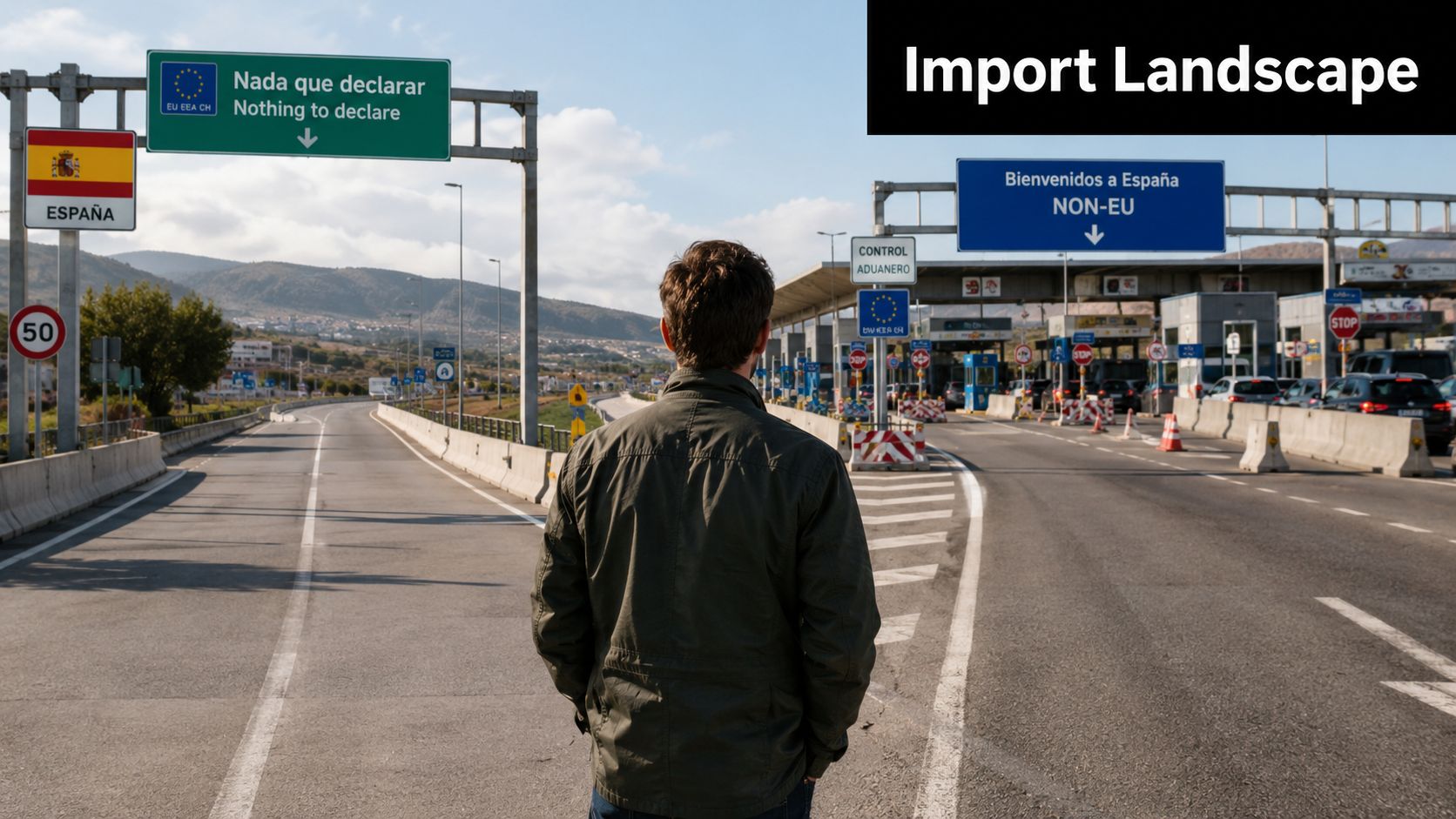
The first check is simple, where the vehicle is coming from. In practice, importing to Spain splits into two very different workflows, an EU transfer that usually stays lighter on customs, or a non-EU import that brings customs, tax, and compliance into the same file. If that origin point is wrong at the start, buyers often budget only for transport and then discover that Spain also wants proof of value, origin, tax treatment, and roadworthiness before registration can move ahead.
EU transfer or non-EU import
A car arriving from inside the EU usually avoids customs duty, while a car arriving from outside the EU normally needs a customs declaration and, in many cases, duty and VAT treatment. That origin decision affects the whole job before transport is booked. If you are settling the purchase in another currency or using a broker, a practical reference like compare international payment options helps keep the payment side under control while transport and customs are still in motion.
The file has to be built before the vehicle lands. Carriers do not assemble missing paperwork, customs agents do not recreate lost invoices, and the registration office will not fill in gaps that should already be in your pack. Spain's customs process expects an importer who has the documents in order, not one who is trying to complete them at the counter.
Why the border cares about preparation
For commercial imports into Spain, the workflow starts with checking whether the vehicle is controlled, then getting an EORI number, then preparing the commercial invoice and packing list, and then filing the customs declaration through Spain's AEAT/SAD process (Lawants guide). Customs may route the entry automatically, but if the file is thin, the orange channel brings document review and delay. That is where weak paperwork gets exposed, and where storage charges, amendments, and broker corrections start to appear.
The practical gap is often not transport, it is the split between logistics papers, customs papers, and registration papers. A buyer may have the bill of sale and shipping booking in hand, yet still be missing the origin evidence or the technical details Spain needs later. I have seen cleaner files move because the value trail was consistent from invoice to declaration to registration, while messy files stall because one document says one thing and another says something slightly different. For buyers who want a broader registration context, review vehicle registration records smarter used car buying before committing to the purchase.
Practical rule: if you cannot explain the vehicle's origin, value, and compliance status on one page, customs may ask you to explain it twice.
Calculating Customs Duties and VAT Obligations
A buyer usually notices the seller's invoice first, then discovers the tax bill later. For a non-EU car import to Spain, customs duty and VAT are calculated from the CIF value, which means the vehicle value plus shipping and insurance. That gap catches many private importers and small dealers off guard, because the sticker price is not the amount customs uses.
Spain applies a standard 21% VAT to imports, and that VAT is generally calculated on the goods' value plus international shipping and insurance, and then in many cases plus customs duties (International Shipping USA). Vehicle import guidance also points to a 10% customs duty on passenger cars for non-EU origin vehicles, although the exact tariff can vary by classification (GetCoc Spain vehicle import tax). In practice, the import cost grows from the CIF base, not just from the seller's price.
Import cost breakdown example
| Cost Component | Amount (EUR) | Notes |
|---|---|---|
| Vehicle purchase price | Varies | Seller invoice price |
| Shipping and insurance | Varies | Added to CIF value |
| Customs duty | Varies | Often 10% on non-EU passenger cars, based on tariff classification |
| VAT | Varies | 21% in Spain, usually charged on CIF plus duty where applicable |
Private moves can be treated more favorably, but only if the exemption is documented cleanly. Spain's mover guidance says personal belongings can enter duty- and tax-free only if the owner proves 12 months of residence outside Spain, the goods were owned and used for at least six months, the move is permanent, and the items will not be sold, transferred, or leased for 12 months (Moving to Spain customs regulations). A separate customs guide also ties the exemption to a written import request, a packing list with approximate values, proof of residence outside the EU customs territory for at least 12 months, and municipal registration in the Spanish municipality where the person will live (Mudinmar import regulations). If those pieces do not line up, customs can treat the shipment as taxable even when the owner believes it qualifies for relief.
Paperwork is where many files break apart. The logistics file may be complete, but the customs file still needs the value trail, ownership history, and residency evidence to match what will later support registration. I have seen cleaner entries move faster because the invoice, packing list, and declaration told the same story, while messy files stalled over one inconsistent line or a missing supporting document. Buyers who want a broader registration context can review vehicle registration records smarter used car buying before they commit.
Practical rule: if you cannot explain the vehicle's origin, value, and compliance status on one page, customs may ask you to explain it twice.
For buyers who have handled overseas imports before, the sequencing will feel familiar, but Spain is less forgiving when the file is incomplete. The workflow looks a lot like importing cars from USA to Australia, where value, compliance, and tax timing all have to line up before release.
Homologation and the ITV Inspection Process
Technical compliance is where a lot of imports stall. Customs can clear a car, but that doesn't mean the car is ready for Spanish roads, because Spain still wants the vehicle to fit the country's registration and safety framework before the plates are issued. The technical sheet, or Ficha Técnica, is the core document here, and it has to line up with the actual vehicle.
Certificate of conformity or individual homologation
A Certificate of Conformity (COC) is the cleanest path when the vehicle already meets EU specifications. In those cases, the paperwork is largely about proving the car matches what Spain expects. If the vehicle doesn't have a usable COC, then individual homologation may be needed, and that turns the process into a technical approval exercise rather than a simple document swap.
That's the difference buyers underestimate. A COC can shorten friction, but it doesn't solve non-compliance. Individual homologation is slower because someone has to confirm the vehicle's technical status in a way Spain will accept for registration.
What happens at ITV
The ITV inspection is the roadworthiness checkpoint. It's not a formality, and it isn't there just to confirm the car starts. The inspector checks whether the vehicle's condition, equipment, and paperwork match the Spanish registration requirements, and imported cars often need small adjustments before they pass. Lighting, warning equipment, emissions-related issues, and data on the technical sheet are common friction points, especially when the car came from a market with different standards.
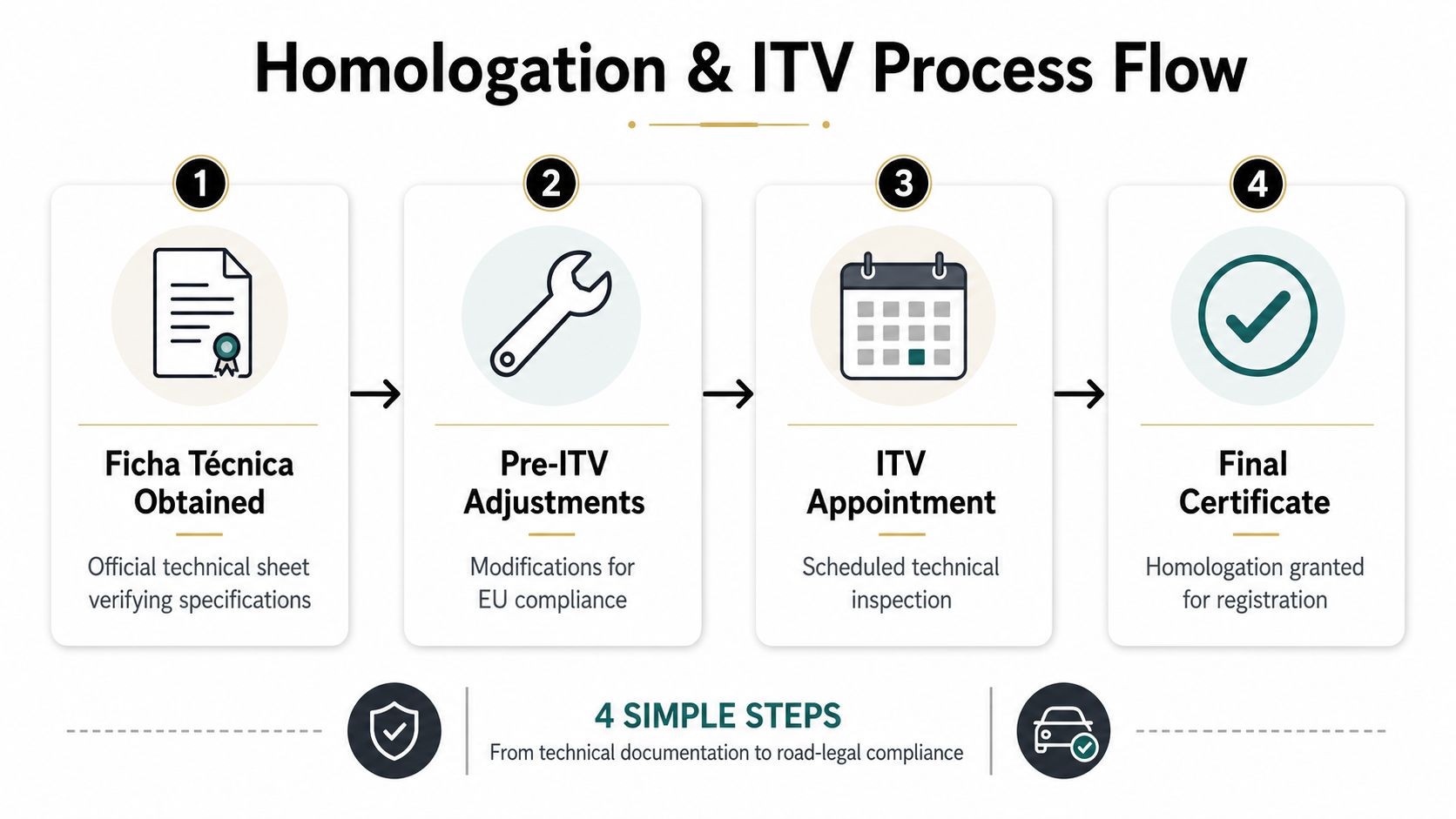
The sequence that usually works is straightforward:
- Obtain the Ficha Técnica or the equivalent technical basis.
- Make any pre-ITV adjustments needed for Spanish compliance.
- Book the ITV appointment and bring the full file.
- Collect the final certificate needed for registration.
If you're deciding whether to check the vehicle before you buy, a structured VIN report platform like VekTracer can sit alongside other due-diligence tools because it gives buyers a vehicle history view before they commit. That matters most when the imported car's paperwork looks clean but the technical history doesn't.
Don't treat ITV as a box to tick after shipping. Treat it as part of the purchase decision, because the wrong car can become expensive long before registration.
Vetting the Vehicle Before You Buy
The cleanest import file in the world won't save a bad car. A vehicle with hidden damage, odometer issues, or title problems can turn an import into a repair and resale headache, and those problems are harder to manage when the car is crossing borders. That's why pre-purchase due diligence matters more for cross-border buys than for local deals.
What a VIN report protects you from
A solid vehicle history report can reveal the kinds of issues sellers rarely advertise clearly, including mileage inconsistencies, damage history, and title concerns. For importers, that's especially important when the seller is outside your home market and you can't inspect the car easily. If you're comparing tools, the practical value of a VIN check USA or VIN check Canada workflow is the same, it gives you the background you need before the car becomes your problem.
VekTracer also offers a Risk Score, which gives buyers a quick risk read before they move ahead. I'd treat that score as a screening tool, not a replacement for inspection, but it's useful when you're narrowing down several cars and want to eliminate the riskiest ones first.
Compare the cost of skipping the check
The comparison is blunt. Without a history report, you may save time up front and lose it later in customs, registration, or resale. With a history report, you spend a little time before purchase and reduce the chance of dragging a bad vehicle through a Spanish compliance process that already has enough friction.
For buyers who want to compare options side by side, it also helps to review vehicle history check before you wire funds. That's particularly useful for used-car traders, because a transparent file can make the difference between a manageable import and a car that sits too long in limbo.
The Essential Documentation Checklist
Spain's customs process rewards clean paperwork. If the file is complete, entry usually moves faster. If it is missing even one piece, the shipment can sit in review, and that is where storage charges, resubmissions, and registration delays start to build. The safest approach is to treat the import as a linked document chain, not a single form handed over at the border.
What customs expects to see
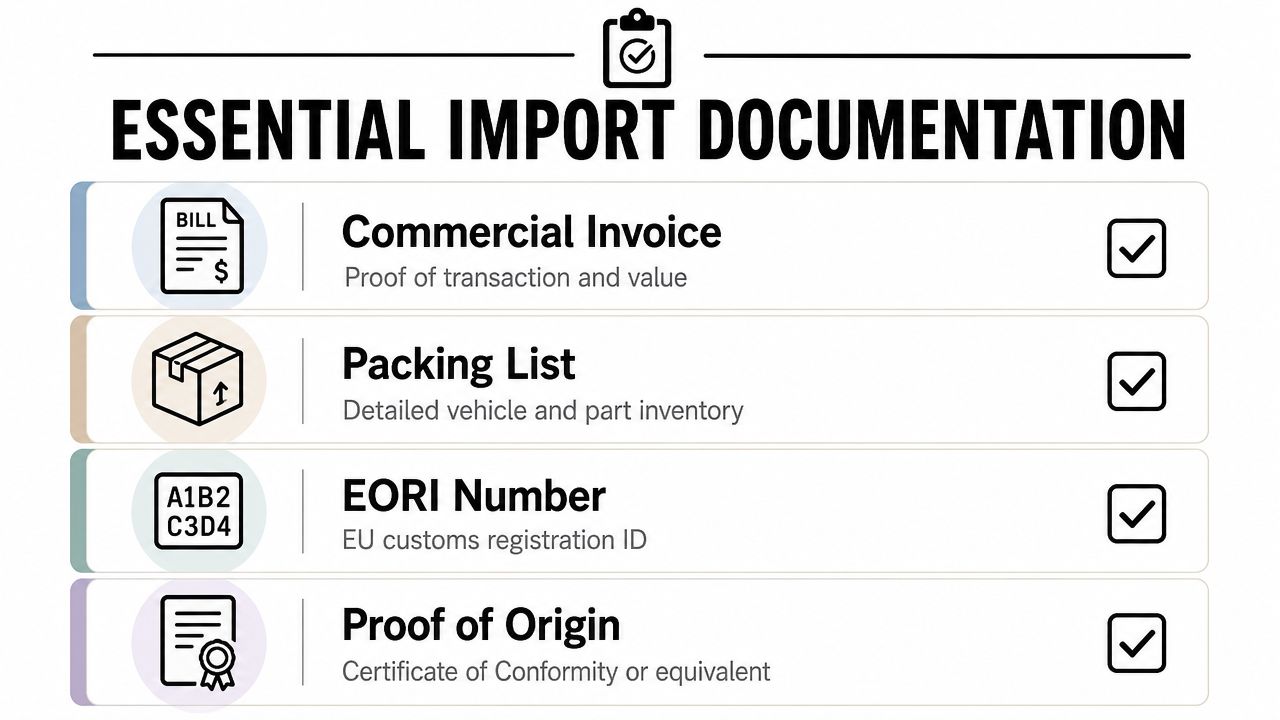
A normal vehicle import file usually needs the commercial invoice, packing list, EORI number, and proof of origin. Freight details, insurance details, and the CIF value also matter where they apply, because customs needs a clear value trail before it accepts the declaration.
For mover exemptions, the paperwork becomes more specific. Spain's customs guidance for personal belongings calls for a certificate of change of residence from the embassy or consulate, a stamped list of imported goods with estimated value and approximate purchase date, and an EORI number in certain cases. A separate import-regulations document also asks for a written import request, a packing list with approximate values, proof of residence outside the EU customs territory for at least 12 months, and municipal registration in the Spanish municipality where the person will live (Moving to Spain customs regulations).
The practical gap I see most often is not the absence of a form. It is the mismatch between the logistics file, the customs declaration, and the documents the local registration office later asks to see. A clean file starts with the import basis, whether that means a commercial purchase, a relocation exemption, or a private move, and then keeps every supporting document aligned to that basis.
Green channel or orange channel
Spain's customs channeling is straightforward in theory and awkward in practice. A green channel can clear automatically when the file is acceptable, while an orange channel triggers documentary review. Once that happens, customs tends to ask for whatever is missing or unclear, so the file needs to answer obvious questions before anyone requests them.
That is why I tell clients to assemble the paperwork as a working file, not a pile of loose PDFs. If the invoice and origin papers do not match the declared value, or if the residence documents do not support the exemption being claimed, the process slows down fast. A VIN check Canada can also help on the pre-buy side when ownership or lien issues could spill into the import file later, which is useful before you commit money to a vehicle that still has a cloud over it.
Use this as the checklist I would want in front of me before shipping:
- Commercial Invoice: proof of transaction and value.
- Packing List: detailed vehicle and part inventory.
- EORI Number: EU customs registration ID.
- Proof of Origin: Certificate of Conformity or equivalent.
- Residence documents: needed when you are claiming a mover exemption.
A file that gives customs a clear path is the one that clears with the fewest questions.
Common Import Pitfalls and How to Avoid Them
The biggest mistake is assuming Spain will treat every import the same way. It won't. A private move, a dealer import, and a one-off cross-border purchase sit under different documentary expectations, and the people who run into trouble are usually the ones who rely on generic logistics advice instead of the customs file the shipment needs.
The errors that cause the most pain
The first problem is missing eligibility proof for tax relief. If you are claiming a personal-effects exemption, the residency window, ownership history, and non-sale commitment need to be documented early, not explained after the shipment is already in the system. Spain's mover guidance sets out the residence and ownership conditions for that exemption, and the file has to support them from the start.
The second problem is underestimating the registration chain. A vehicle can clear the port and still not be ready to drive legally if the technical file, ITV outcome, or registration paperwork is incomplete. That gap is where people lose days, sometimes longer, because one missing document can stop the entire sequence.
The third problem is splitting the paperwork across too many hands. Customs may want one version of the invoice, the logistics agent may hold the packing details, and the homologation file may sit with a different specialist. If those records do not agree on VIN, value, origin, and ownership, the file looks incomplete even when each party thinks it has done its part. I have seen small dealers and private buyers lose time because no one owned the full chain.
What to do instead
Use a simple control list before shipping:
- Confirm origin early. EU or non-EU changes the tax and customs path.
- Prepare the customs file before arrival. Do not wait for the port to ask for it.
- Check technical compliance before purchase. Homologation issues are cheaper to solve on paper than after shipping.
- Keep proof of residence and ownership together. Exemption claims fail when records are scattered.
- Expect review if the file is thin. The orange channel is a delay, not a surprise.
- Keep one person accountable for the full packet. Customs, logistics, and legal teams can all touch the file, but one clean version prevents contradictory submissions.
The practical reality of import to Spain is that the process is manageable, but only if the paperwork matches the vehicle and the vehicle matches the paperwork. When those two line up, the rest is sequencing, not crisis management.
If you are comparing vehicles for a Spain import, use VekTracer to check VIN history, mileage consistency, title and lien status, and the Risk Score before you commit. It is a practical way to screen a used car before customs, ITV, and registration turn a bad purchase into a costly one.
Ready to check a vehicle?
Enter any 17-character VIN for a free instant preview — no account needed.