Honda Civic VIN Decode: A Practical Walkthrough
Check a vehicle before you buy
Enter a VIN for a free instant preview — accidents, title brands, mileage, liens & open recalls.
You're standing at a used Civic with your phone in one hand and a VIN in the other, and the spec sheet looks clean enough to trust. That's exactly where buyers get burned. A Honda Civic VIN decode tells you what the car left the factory as, but it doesn't tell you whether the car has a branded title, a rolled-back odometer, or a hidden repair history.
The smart move is to treat the VIN as a verification tool, not a verdict. Read the code, compare it against the car in front of you, and then decide whether the vehicle deserves a deeper vehicle history report or a hard pass.
The Minute You Stand in Front of a Used Civic
A buyer at a dealership can get a false sense of security fast. The listing says Civic Si, the phone decode says Si, and the dashboard plate looks tidy. That's enough for a lot of people to relax, but the VIN only confirms identity and factory details, not the story that happened after the car left the line.
That's the trap with Honda Civic VIN decode searches. The decode can verify the car's origin, year, engine, and plant, but it can't tell you whether the car was wrecked, rebuilt, or clocked. Free decoders are useful, just not in the way most buyers think.
Practical rule: use the VIN to confirm the car is the same machine described on the sticker, then use history data to judge whether it's worth buying.
The rest of the check is simple enough to do on a lot. Find the VIN in more than one place, split the 17 characters into meaningful chunks, and compare the result against the listing before you get pulled into paint condition or tire tread. If the code and the car don't line up, stop there.
Where to Find the VIN on Any Civic
The easiest place to start is the driver-side dashboard near the windshield. That plate is the one designed to be readable from outside the vehicle, and it's the reference point most decoders expect to see. You can confirm the same number on the driver-side door jamb label or latch area, then compare both against the title or registration document. The NHTSA-recognized windshield-side location is especially useful because you can read it without opening the car as noted in EpicVIN's Civic VIN location guide.
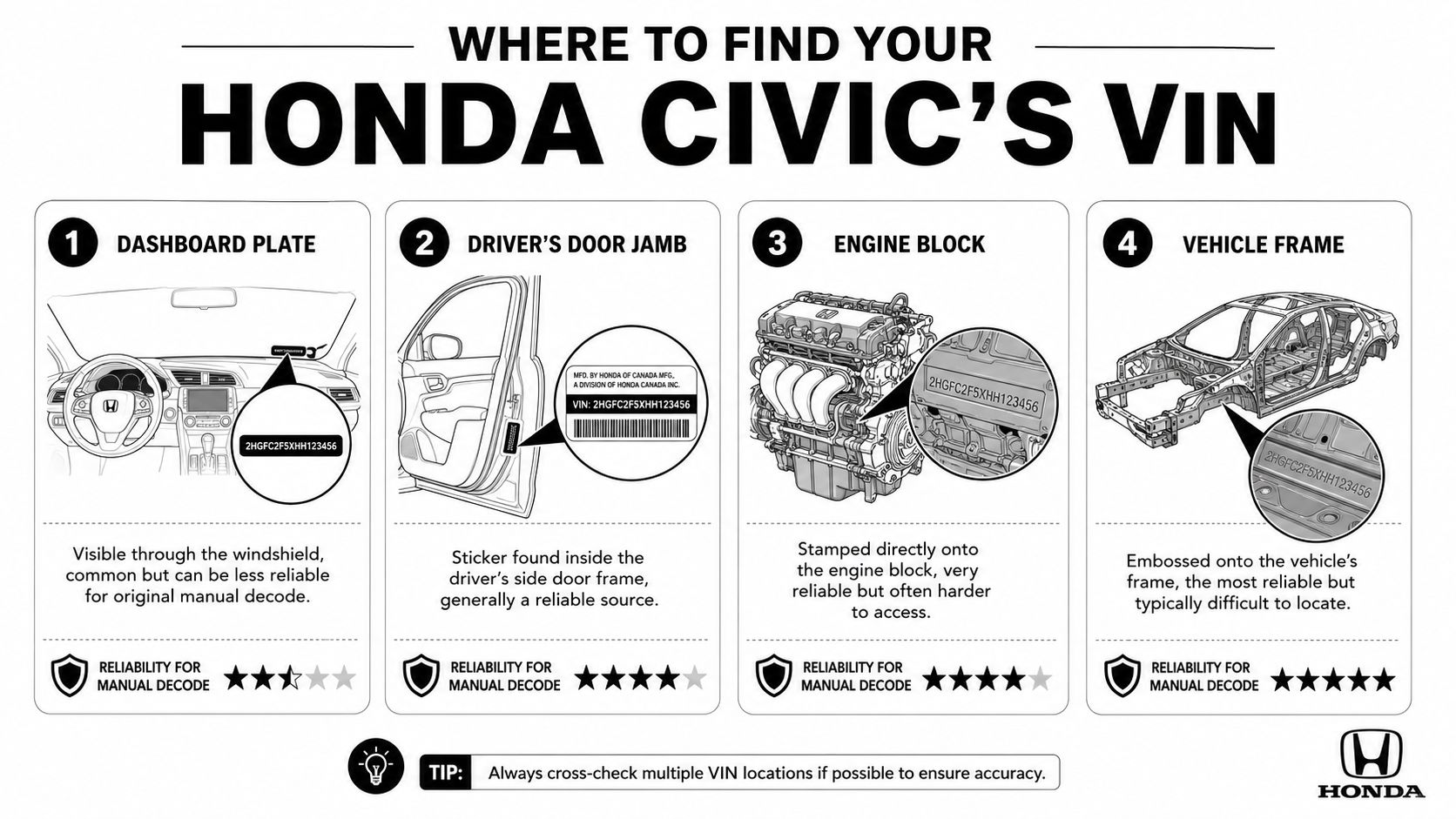
The next place to check is the door jamb sticker. On a Civic, that label is a factory build reference, and it's a strong cross-check because it should match the dashboard VIN exactly. If those two disagree, I don't keep decoding, I start asking why.
A few Civics also carry VIN information on the engine block or related under-hood stamping, especially on older or enthusiast-focused cars. That spot can be harder to reach, but it helps when you're verifying a car that already looks suspicious. The final source is paperwork, including the title, registration, or insurance card, which should match the body plates and each other.
| Civic VIN source | What it's good for | How much I trust it in a walkaround |
|---|---|---|
| Dashboard plate | Quick outside read, first decode check | High, if it matches another source |
| Door jamb label | Factory cross-check | Very high |
| Engine block or under-hood stamping | Older or harder-to-tamper builds | High, but access varies |
| Title and registration | Paper trail verification | Essential |
If two physical sources and the paperwork all agree, keep going. If not, that car just turned from a browsing exercise into a problem.
What Each of the 17 Characters Actually Means
A Civic VIN is built on the 17-character standard, and it breaks into four useful chunks: the World Manufacturer Identifier, the Vehicle Descriptor Section, the model-year character, and the plant plus serial number. Honda's decoding structure also uses character 11 for the assembly plant and characters 12 to 17 for the serial number as described in Meadowvale Honda's VIN guide. That's the part buyers can work with.
Characters 1 through 3 and the build region
The first three characters tell you where the Civic was built. JHM points to Japan, 1HG and 19X point to the United States, 2HG points to Canada, and SHH points to the United Kingdom. That matters because two Civics with the same trim badge can still come from different markets and carry different equipment packages or plant histories as outlined in CarWhere's Civic decoder.
A clean VIN decode can tell you the car's origin, but it doesn't tell you how the car was treated after delivery.
Characters 4 through 9 and the vehicle descriptor
This middle section is where the car's identity gets more specific. On a Civic, it helps identify body style, engine family, transmission, and restraint system, which is why base trims, Si models, and Type R variants don't all decode the same way. If the listing says one thing and the descriptor section points to another, that's a reason to slow down.
Character 10, 11, and the serial tail
Character 10 identifies the model year. Character 11 points to the assembly plant. Characters 12 through 17 form the sequential serial number, which doesn't mean much by itself, but it should fit the rest of the car's identity. If you want a quick way to sanity-check a Civic, this is the part that matters most.
| Civic World Manufacturer Identifier (WMI) Quick Reference | Country of Build | Typical Market |
|---|---|---|
| JHM | Japan | Japanese-built Civic |
| 1HG | United States | U.S.-built Civic |
| 19X | United States | U.S.-built Civic |
| 2HG | Canada | Canada-built Civic |
| SHH | United Kingdom | U.K.-built Civic |
For a quick digital pass, some shoppers use a VIN check USA or VIN check Canada workflow, then compare the result to the physical plates on the car. That's a solid habit, especially when the listing is vague or the photos are too polished.
Decoding Two Real Civic VINs
A manual decode becomes useful when you can compare two examples side by side. A 1HG Civic is a straightforward North American build, while a JHM Civic signals a Japan-built car. That difference alone can save you from mixing up a local market car with an import or a swapped shell.
U.S.-built Civic example
Take a Civic with a 1HG prefix. The first three characters tell you it's a U.S.-built car, the next block describes the body and mechanical setup, character 10 gives the year, and character 11 points to the plant. If the title, dash plate, and door jamb all agree, you've at least confirmed that the car is presenting itself truthfully at the factory level.
Japan-built Civic example
Now compare that to a JHM Civic. Same model name, different origin, different market history, and often different equipment assumptions. That's where a buyer can get tripped up if they only glance at the trim badge and skip the code.
If you want a quick decoding tool while standing beside the car, use the VekTracer free VIN decoder and compare the output against the dashboard plate and door jamb. That's the fastest way to catch a mismatch before you spend time on a full report.
| What to confirm | 1HG Civic | JHM Civic |
|---|---|---|
| Market origin | United States | Japan |
| Factory identity | Matches the WMI | Matches the WMI |
| Plant and serial logic | Should align with the rest of the VIN | Should align with the rest of the VIN |
| Still needs history report | Yes | Yes |
Buyer habit: if the decoded origin doesn't match the paperwork, walk away from the assumption and check the car again.
A correct decode is helpful, but it's still only the starting point. It tells you what the Civic says it is, not whether the seller's story is complete.
What a VIN Decode Cannot Tell You
A Civic VIN decode can confirm the factory identity, but it cannot tell you everything a buyer needs to know. It will not show a salvage, rebuilt, flood, or lemon-law buyback title by itself. It will not prove mileage, ownership count, theft history, liens, or whether the odometer was rolled back.
That is the gap free decoders often leave open. They will show trim, engine, plant, and sometimes open recalls, then stop before the records that actually change the deal. A clean-looking decode can sit on top of a bad car.
For buyers comparing damage-related paperwork, Mattiacci Law's insights on accident reports are a useful reality check on how much post-crash documentation can matter, especially when a car's paper trail is messy. A Civic can decode cleanly and still carry a difficult history on the VIN. The code does not erase that.
Clean decoding is not the same thing as a clean history.
A practical example is simple. If the VIN shows the car is a Type R, that only confirms the factory identity. It does not confirm that the body panels have not been replaced, the odometer has not been manipulated, or the title has not been branded in another state. Those questions live in record databases, not in the VIN itself.
If the odometer story looks thin, a separate history check matters more than another free decoder. How odometer rollback shows up in vehicle records is a better place to start than hoping the VIN string will tell the whole story.
If you have already checked the plates and the paperwork, the next step is a history lookup. The decode has done its job once it confirms what the car says it is.
Four Signs of VIN Tampering to Look For in Person
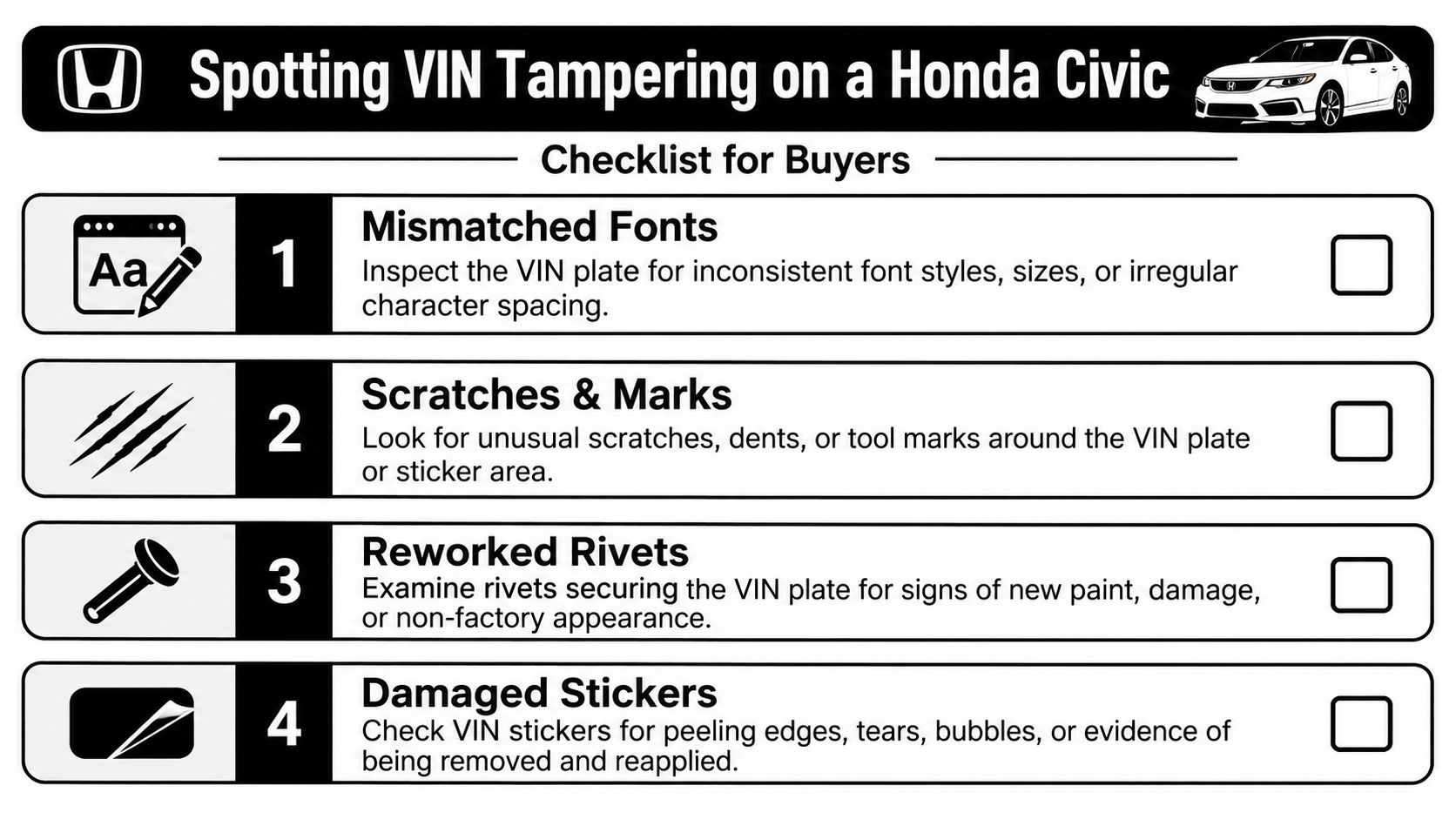
The fastest tamper check is still the old-fashioned one. Look at the dashboard plate, then check the door jamb sticker, then compare both to the paperwork. A mismatch there is the biggest red flag because it suggests someone changed a source that should have stayed fixed.
What to look for around the plate
A dashboard plate with mismatched fonts, odd spacing, or a character style that doesn't look factory is worth a second look. So are scratches, tool marks, or paint overspray around the VIN area. If the surrounding plastic or metal looks worked over, the plate may have been disturbed.
What older Civics can reveal
On some older Civics, you may see aftermarket welds or grinding marks near the dashboard bracket. That kind of work can show that the area was repaired or reworked after a theft recovery or a plate swap. It doesn't prove fraud on its own, but it's enough to stop trusting the easy explanation.
What paperwork tells you
A title that doesn't match the dash or door jamb is a hard stop. So is paperwork that was issued in a different state from the seller's address when the rest of the car's story doesn't make sense. When the physical VIN and the documents disagree, the car should be treated as suspect until the seller proves otherwise.
For a second layer of checking, some buyers keep a VIN check USA or VIN check Canada report handy while they inspect the car, then pair that with a separate odometer rollback review from a history platform such as the VekTracer blog's rollback guide. That combination catches the kinds of problems a plain decode never will.
When a VekTracer History Report Is Worth the Twenty Dollars
Once the Civic's VIN matches across the car and the paperwork, the primary question is whether the history is clean. That's where a report earns its keep, because a VIN decode can't show title brand status, mileage consistency, accident and damage history, or open recall status tied to the exact VIN. Those are the fields that change price, risk, and resale.
A report is easy to justify when the Civic is expensive, unusually clean for the asking price, or coming from a seller with limited records. It also makes sense when the car's origin is a little unusual and you want to confirm the trail before you negotiate. For a buyer comparing tools, the VekTracer Honda Civic VIN check page puts the decode and history workflow in one place.
For dealers or anyone shopping several Civics at once, a partner network for dealers like the one described by Arete Global Shipping Services can sit beside the report process, especially when vehicles cross borders or move through multiple hands. That's not the same thing as history verification, but it's part of a cleaner buying workflow.
Practical threshold: if a report could reveal a branded title, mileage inconsistency, or serious damage on the exact Civic you're about to buy, the report is the cheap part of the deal.
For everyday buyers, the value is plain. A Civic VIN decode tells you what the car was built to be. A history report tells you whether the car still deserves trust. If you want both pieces in one place, visit VekTracer and run the VIN before you sign anything.
Ready to check a vehicle?
Enter any 17-character VIN for a free instant preview — no account needed.