1993 Ford F-350 Value Guide: What It's Worth Today
Check a vehicle before you buy
Enter a VIN for a free instant preview — accidents, title brands, mileage, liens & open recalls.
1993 Ford F-350 Value Guide: What It’s Worth Today
A 1993 Ford F-350 is worth roughly $1,720 to $13,400 depending on condition, configuration, and how you’re selling it. Kelley Blue Book pegs a good-condition example at $3,184 resale and $1,720 trade-in. Edmunds stretches the full range to $1,524–$9,033. Hagerty offers valuations for well-kept 1-ton collector examples, which are higher than typical used-truck market values. Before you negotiate a dollar, run a VIN history check and schedule a targeted inspection.
Quick value snapshot by channel (good condition, typical configuration):
- Trade-in: $1,720 (KBB)
- Private party: $3,184–$5,833 (KBB/Edmunds)
- Dealer retail: $5,833–$9,033 (Edmunds upper range)
- Auction/collector (1-ton): $9,975–$13,400+ (Hagerty sold comps and valuation tiers)
Key Takeaways
A 1993 Ford F-350’s value ranges from $1,524 to $13,400 depending on condition, configuration, and market channel, with the 7.3L diesel 1-ton commanding the highest prices.
| Point | Details |
|---|---|
| Run a VIN check first | A Vektracer report at $19.99 reveals title brands, odometer gaps, and accident history before you negotiate. |
| Match condition to grade | Most trucks land in “Good” — KBB pegs that at $3,184 resale and $1,720 trade-in. |
| Pull three local comps | National guides are starting points; sold listings on Hagerty and eBay Motors show what buyers actually paid. |
| Diesel 1-ton commands a premium | Hagerty values a good-condition 1-ton near $13,400; a real sale closed at $9,975 in October 2024. |
| Negotiate from inspection findings | Rust, missing records, and accident history each justify specific dollar deductions from the private-party price. |
Table of Contents
- 1. What does a 1993 Ford F-350 actually sell for right now?
- 2. Which specs and options move the price the most?
- 3. How do condition grades work, and how do you assess them?
- 4. How have values trended, and is now a good time to buy or sell?
- 5. Where should you check values and find recent sold comps?
- 6. What are the most common problems, and what do repairs cost?
- 7. How does a VIN history report change your negotiation?
- 8. Should you buy this truck, and how do you negotiate the price?
- 9. How do you prepare a 1993 F-350 for sale or get a formal appraisal?
- Vektracer gives you a clear picture before you commit
- Sources
- FAQ
1. What does a 1993 Ford F-350 actually sell for right now?
The market for these trucks splits cleanly into two worlds: the everyday used-truck market and the collector/1-ton diesel segment. Most trucks fall in the first category.

Edmunds reports a clean trade-in around $2,509 and a private-party value near $5,833 for a well-maintained example. The full range, $1,524 to $9,033, reflects how dramatically condition and configuration move the needle. A high-mileage, rusty gas-powered regular cab sits near the floor. A clean, low-mileage 1-ton diesel with documented service history sits near the ceiling.
Hagerty’s collector market tells a different story. A 1993 F-350 1-ton sold for $9,975 in October 2024, and Hagerty’s good-condition valuation for the 1-ton sits near $13,400. These numbers apply to trucks that are original, well-documented, and in strong mechanical shape.
| Condition | Trade-In | Private Party | Dealer Retail | Collector/Auction |
|---|---|---|---|---|
| Concours/Excellent | $3,184–$5,833 | $5,833–$9,033 | $5,833–$9,033 | $13,400+ |
| Good | $1,720–$2,509 | $3,184–$5,833 | $3,184–$5,833 | $9,975 |
| Fair | $1,524–$1,720 | $1,720–$3,184 | $3,184–$5,833 | $3,184–$9,033 |
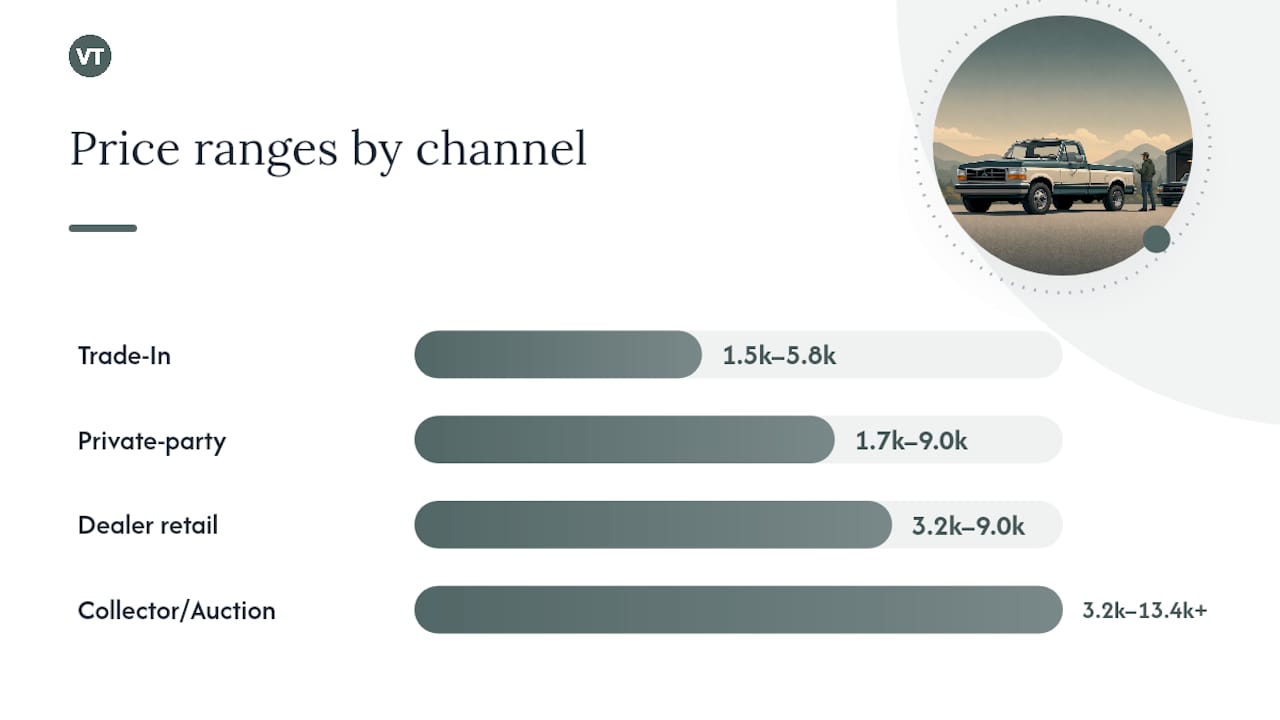
Trade-in values are lowest because dealers need margin to resell. Private-party sales cut out the middleman, which is why they land higher. Auction results vary the most, swinging on buyer competition, the truck’s story, and the auction house’s audience.
2. Which specs and options move the price the most?
Not all 1993 F-350s are equal. The engine choice alone can separate two otherwise identical trucks by several thousand dollars.
Primary value drivers:
- 7.3L IDI diesel: The biggest single value multiplier. Diesel examples attract buyers who want longevity and torque, and they command a clear premium over gas equivalents, especially in the 1-ton segment.
- 1-ton vs. 3/4-ton: The 1-ton (F-350 proper) earns higher collector valuations. Hagerty’s $13,400 good-condition figure applies specifically to the 1-ton designation.
- 4x4 vs. 2WD: Four-wheel drive adds meaningful value in most markets, particularly in northern and mountain states where buyers need it.
- Cab style: SuperCab and crew cab configurations typically command more than a standard regular cab. Long-bed crew cab combos are especially sought after for work and towing use.
Secondary drivers:
- Transmission: A manual transmission on a diesel can be a plus for enthusiasts; an automatic is more broadly appealing.
- Original equipment: Factory air conditioning, power windows, and power locks add value. Aftermarket add-ons can go either way.
- Documented originality: A truck with its original drivetrain, matching VIN tags, and a service folder beats a modified example in most buyer conversations. Modifications can reduce value unless they’re reversible and well-documented.
You can cross-check trim and option combinations against Cars to confirm what was factory-installed versus added later.
3. How do condition grades work, and how do you assess them?
Valuation services use four standard condition grades. Knowing where your truck lands determines which price column applies to you.
- Concours: Essentially showroom quality. No rust, no wear, documented restoration or exceptional preservation. Rare for a 33-year-old work truck.
- Excellent: Minor cosmetic flaws only. Mechanically sound, no rust issues, clean interior. Represents the top tier of daily-driver examples.
- Good: Normal wear for the age. May have minor rust, some cosmetic issues, but mechanically functional. This is where most honest examples land.
- Fair: Visible rust, mechanical issues, or deferred maintenance. Needs work to be reliable or presentable.
Inspection checklist — focus on these areas:
- Frame and cab floors: Structural rust is the single biggest value killer. Probe the frame rails, crossmembers, and cab corners with a screwdriver.
- Drivetrain: Check for transmission leaks, clutch slippage on manuals, and rough shifting on automatics.
- Diesel-specific (7.3L IDI): Look for blue or black smoke at startup and under load. Check for injector drip at idle. Cold-start behavior tells you a lot about injector health.
- Brakes and suspension: Worn ball joints, loose steering, and soft brake pedals are common on high-mileage examples.
- Electrical: Gauge cluster function, lighting, and HVAC blower operation.
- Title and odometer: Look for signs of tampering on the odometer and check that the VIN plate matches the door jamb sticker.
Pro Tip: Pay a diesel-specialist mechanic $100–$150 for a pre-purchase inspection. Ask specifically for a compression or leakdown test on the IDI diesel, an injector drip check, a transmission pressure test, and a smoke test. That investment can save you thousands on a truck with hidden engine wear.
4. How have values trended, and is now a good time to buy or sell?
The everyday used-truck market for 1993 F-350s has remained relatively stable, with values moving modestly over recent years. KBB’s figures, valid through May 2026, show a good-condition resale value of $3,184, consistent with a market that hasn’t seen dramatic swings in the daily-driver segment.
The collector and 1-ton diesel segment tells a different story. Restored or well-preserved 1-ton diesels have seen genuine appreciation, driven by growing interest in pre-emissions diesel trucks. Hagerty’s condition spread from fair to concours for the 1-ton is wide, which signals that quality examples are being recognized and priced accordingly.
What to watch:
- Auction comps on Hagerty and Bring a Trailer show real transaction prices, not asking prices. A truck that sat unsold at $12,000 tells you something different than one that sold at $9,975 in a competitive auction.
- Daily-driver examples in fair-to-good condition haven’t appreciated meaningfully. If you’re holding one hoping for collector prices, the truck needs to be exceptional.
- Owner satisfaction for well-maintained older F-Series trucks remains high, which supports steady demand. A truck with receipts and a clean history report will always find a buyer faster than one without.
For buyers: good-condition gas examples in the $3,000–$5,000 range represent solid value if the frame is clean. For sellers: if you have a 1-ton diesel in excellent or concours shape, now is a reasonable time to list, given collector interest in pre-OBD2 diesels.
5. Where should you check values and find recent sold comps?
No single source gives you the full picture. Use at least two valuation tools plus three recent sold or asking comps in your local market before setting or accepting a price.
- Kelley Blue Book: Best for resale and trade-in baselines. Enter your mileage and condition for a localized estimate. Use it as your negotiation anchor.
- Edmunds: Provides the broadest range ($1,524–$9,033) and separates trade-in from private-party values. Good for understanding the full spread.
- Hagerty: The right tool for 1-ton and collector examples. Condition tiers are detailed, and past-sales data shows actual transaction prices.
- Bring a Trailer: Search completed auctions for 1993 F-350 listings. Sold prices reflect real buyer competition, not wishful asking prices.
- eBay Motors: Filter by “sold listings” to see what buyers actually paid. Useful for both daily-driver and specialty examples.
- Cars: Good for verifying trim specs and checking active local listings to gauge regional asking prices.
National valuation guides give you a defensible starting point. Local sold comps tell you what buyers in your specific market will actually pay. Both matter, and neither alone is enough.
6. What are the most common problems, and what do repairs cost?
Knowing the failure points before you buy protects your budget. These trucks are durable, but 30-plus years of use leaves marks.
- Structural rust: Frame rot and cab floor rust are the most expensive problems to fix properly. Repair costs vary widely by severity, from patch welding to full frame replacement.
- Head gasket and coolant issues: Some gas V8 variants (notably the 5.8L) are known for coolant leaks and head gasket wear at higher mileages.
- 7.3L IDI injector and pump wear: Injector replacement on the IDI diesel runs roughly $800–$1,500 for a full set depending on labor rates. Injection pump rebuilds or replacements add more.
- Transmission and clutch: Manual clutch replacement typically runs $400–$800. Automatic transmission rebuilds can reach $1,500–$2,500 on these platforms.
- Brakes and suspension: Ball joints, tie rod ends, and brake hardware are wear items. Budget $300–$700 for a full front-end refresh.
Fuel economy context: The 7.3L IDI diesel typically returns 15–18 mpg on the highway under light load. Gas V8 variants (5.0L, 5.8L) generally see 10–14 mpg depending on configuration and load. These are approximate figures that vary with axle ratio, tire size, and driving conditions.
Modifications complicate both repair costs and resale. An engine swap or lift kit may appeal to some buyers and put off others. Original, unmodified trucks are easier to price and easier to sell.

7. How does a VIN history report change your negotiation?
The VIN is the truck’s fingerprint. A history report translates hidden risk into dollars you can put on the table during negotiation.
Flags that affect value:
- Salvage or rebuilt title: Reduces value by 20–40% compared to a clean-title equivalent. Some lenders won’t finance salvage-title vehicles at all.
- Frame damage or structural accident history: Walk away unless the price reflects a significant discount and you have an independent structural inspection confirming the repair quality.
- Odometer inconsistency: A mileage rollback on a 33-year-old truck is more common than buyers expect. Any gap in odometer readings is a red flag.
- Flood damage brand: Electrical and mechanical corrosion from flood exposure can be invisible at first and catastrophic later.
- Open liens: A truck with an unpaid loan attached to the title creates legal complications at transfer.
- Theft records: A previously stolen vehicle can carry title complications depending on how it was recovered and retitled.
Pro Tip: A single-vehicle minor accident with no structural damage is a negotiating point, not a dealbreaker. Use it to ask for $300–$500 off. A salvage title or frame damage record is a different situation entirely — either walk away or price the truck as a parts vehicle.
A Vektracer VIN history report pulls NMVTIS-connected data covering accident history, title records, odometer readings, theft checks, and safety recalls. Running one before you make an offer converts guesswork into a documented negotiation position. For a pre-purchase due diligence checklist that walks through every step, Vektracer’s blog covers the full workflow.
8. Should you buy this truck, and how do you negotiate the price?
The right answer depends on what you need the truck to do.
Decision checklist:
- Daily driver: A good-condition gas example at $3,000–$5,000 with a clean frame and clean title is a reasonable buy. Budget $500–$1,000 for deferred maintenance in year one.
- Work truck: The 1-ton diesel is the target. Verify the frame, the injection system, and the transmission before committing.
- Collector/investment: Only excellent or concours examples with documented history justify collector pricing. Anything less is a project.
- Project truck: Fair-condition examples at $1,524–$2,500 can make sense if you have the skills and budget. Know what you’re getting into before the title transfers.
Negotiation guidance:
- Rust on the frame or cab floors: deduct $1,000–$2,500 depending on severity.
- Missing service records or receipts: deduct $300–$500 from private-party value.
- Salvage or rebuilt title: deduct 20–40% from clean-title comparable.
- High-mileage engine (over 200,000 miles) with no recent rebuild: deduct $500–$1,500.
- VIN report showing accident history (minor, no structural): deduct $300–$500.
For sellers: if you have a clean-title, well-documented truck, private party is almost always worth the extra time over a dealer trade-in. The gap between KBB’s $1,720 trade-in and $3,184 resale is real money. Check used car buying tips for the buyer’s perspective, which helps you anticipate the questions serious buyers will ask.
9. How do you prepare a 1993 F-350 for sale or get a formal appraisal?
Preparation directly affects what you net. A truck with a documentation packet sells faster and for more than an identical truck without one.
- Gather your documents. Title (clean and in your name), maintenance records, repair receipts, and any restoration documentation. A service folder adds credibility and reduces buyer hesitation.
- Address the obvious. Fix small items: burned-out lights, cracked mirrors, missing trim pieces. These signal neglect to buyers even when the mechanicals are solid.
- Disclose known issues. Honest listings attract serious buyers and reduce post-sale disputes. Note rust, mechanical issues, and any accident history upfront.
- Take quality photos. Shoot in daylight: all four corners, the frame rails, the engine bay, the interior, and the bed. Photos of the odometer and VIN plate build trust.
- Choose your appraisal route:
- Dealer trade-in appraisal: Fast (same day), but expect the lowest offer. Useful as a floor price reference.
- Classic/concours appraiser: For high-value 1-ton diesel examples, a certified appraiser ($100–$300) provides a written valuation useful for insurance, estate purposes, or high-dollar private sales. Turnaround is typically 3–7 days.
- Auction estimate: Hagerty and similar platforms offer pre-auction estimates. Useful if you’re considering consigning to a specialty auction, though fees apply.
- Set your channel. Private sale takes longer (2–8 weeks typically) but nets the most. Dealer trade-in closes in a day but at the lowest price. Auction sits in the middle on both time and net proceeds, with more variability.
The case for inspection-first buying on a 1993 F-350
The buyers who get burned on these trucks share one habit: they skip the inspection because the truck looks good in photos or the seller seems trustworthy. A 33-year-old work truck has had multiple owners, varied maintenance, and years of exposure to the elements. The frame tells the real story, not the paint. When a 1993 F-350 is a worthwhile buy, it’s because the inspection confirmed what the listing claimed. When it’s not, the frame is compromised, the title has a brand, or the odometer doesn’t add up. Walk away from any truck where the seller resists an independent inspection or a VIN check. That resistance is the answer.
Vektracer gives you a clear picture before you commit
Buying a 1993 F-350 without a VIN history report is a real financial risk. Vektracer’s reports start at $19.99 and pull NMVTIS-connected data covering accident history, title records, odometer verification, theft checks, and safety recalls — the same core data as services charging more than twice the price. For a truck this age, where rolled-back odometers and branded titles are genuine concerns, that $19.99 can save you thousands. See how Vektracer works, or check the report pricing page before your next offer.
Sources
- 1993 Ford F350 Price, Value, Depreciation & Reviews | Kelley Blue Book
- 1993 Ford F-350 Value - $1,524-$9,033 | Edmunds
- 1993 Ford F-350 1 Ton | Hagerty Valuation Tools
- 1993 Ford F-350 - Specs, Prices, MPG, Reviews & Photos
FAQ
How much is a 1993 F-350 worth?
A 1993 Ford F-350 in good condition is worth $1,720 as a trade-in and $3,184 in a private-party sale, per KBB. Collector-grade 1-ton examples can reach $13,400 or more through Hagerty’s valuation tiers.
How much is a 1993 Ford truck worth overall?
Edmunds puts the full used-value range at $1,524 to $9,033 depending on condition, mileage, and configuration. The 7.3L diesel 1-ton sits at the top of that range; high-mileage gas-powered examples sit near the bottom.
What MPG does a 1993 Ford F-350 with the 7.3L diesel get?
The 7.3L IDI diesel typically returns approximately 15–18 mpg on the highway under light load, compared to 10–14 mpg for the gas V8 variants. Actual figures vary with axle ratio, tire size, and load.
What are the most common problems with a 1993 Ford F-350?
Structural rust on the frame and cab floors is the most expensive issue. The 7.3L IDI diesel can develop injector and injection pump wear. Gas V8 variants sometimes show head gasket and coolant problems. Transmission and clutch wear are common across all configurations at higher mileages.
Does a salvage title significantly reduce the value?
Yes. A salvage or rebuilt title typically reduces value by 20–40% compared to a clean-title equivalent, and some lenders won’t finance salvage-title vehicles. Always run a VIN history report to catch title brands before making an offer.
Recommended
Ready to check a vehicle?
Enter any 17-character VIN for a free instant preview — no account needed.