Electronic Lien and Title: A Complete Buyer Guide
Check a vehicle before you buy
Enter a VIN for a free instant preview — accidents, title brands, mileage, liens & open recalls.
You're at a private sale, the seller says the vehicle is paid off, and then you discover there's no paper title to sign over. That can be normal in a state using an electronic lien and title system, but it can also create confusion if you don't verify the state record before paying. ELT replaces paper title custody with a digital record showing the owner, lienholder, and lien status. The record, not the absence of a document, controls whether the seller can legally transfer the vehicle.
Table of Contents
- What Electronic Lien and Title Actually Means
- How ELT Systems Work Compared to Paper Titles
- State-by-State Adoption and Legal Status
- How to Check and Clear an Electronic Lien
- Official Checks vs Commercial Vehicle History Reports
- A Real Buyer Scenario With an ELT Surprise
- What to Do Next Before You Buy or Sell
What Electronic Lien and Title Actually Means
An electronic lien and title, usually shortened to ELT, is a state DMV system that stores a vehicle title electronically instead of relying on a paper certificate. The electronic record identifies the registered owner, the lender with a security interest, and whether that lien remains active. The lienholder is the lender or other secured party listed on the title record.
An e-title is the electronic version of the title record. It may look like a normal title when viewed through a state portal, but the state might not issue a paper certificate unless someone requests one or the transaction requires it. A lienholder of record is the lender officially recorded in the state system, not the bank named on an old loan document.
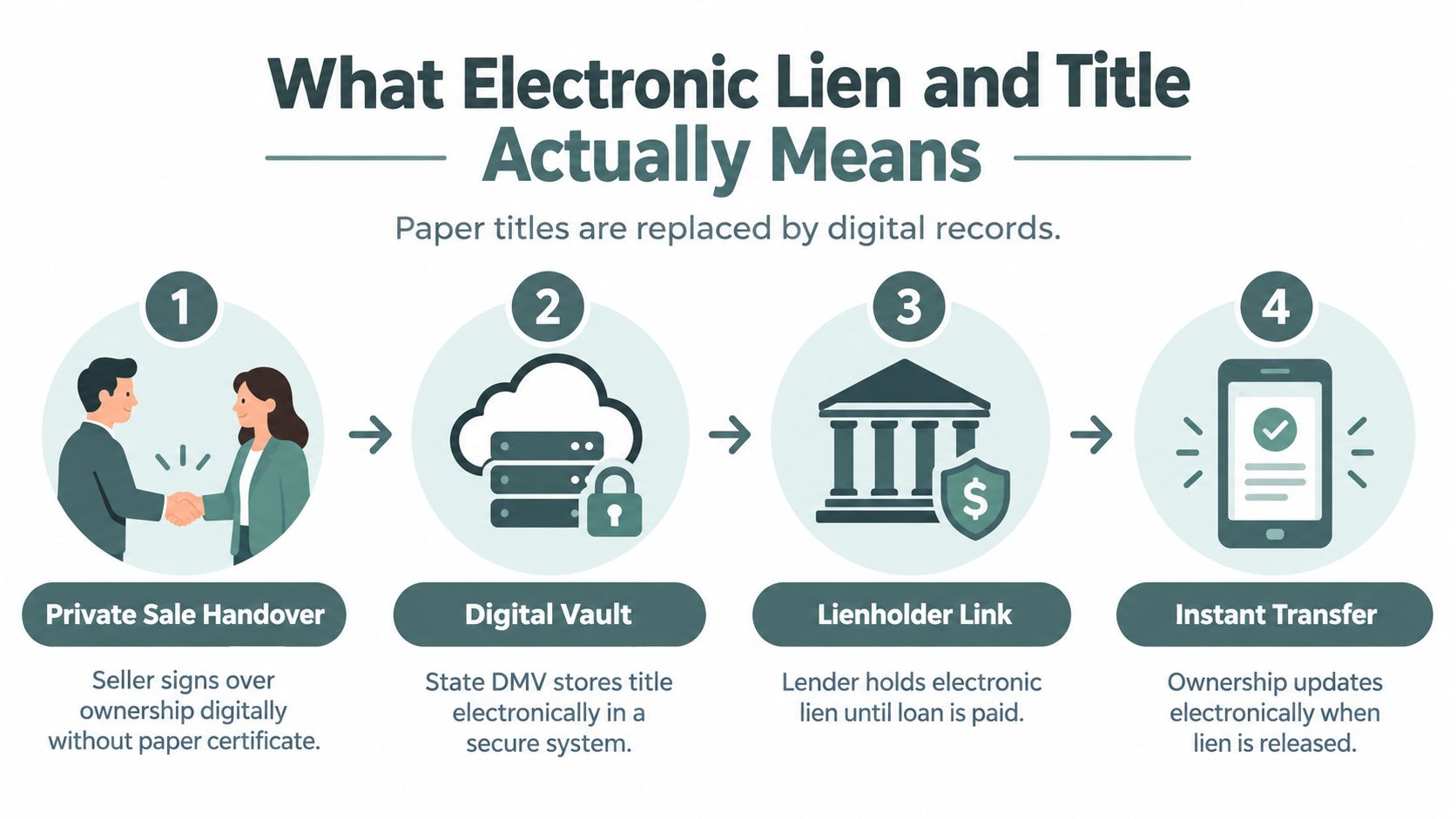
The system changes who holds the title during the loan:
- The state DMV stores the master title record.
- The lender's lien remains attached electronically while the loan is outstanding.
- The lender submits an electronic release after satisfaction.
- The state updates the record and may issue a clean paper title or make the electronic record available for the next transaction.
California describes this model directly. Once a lien is satisfied, a lien-satisfaction notice can trigger automatic title issuance to the registered owner or a new lienholder. The lienholder receives electronic notification, typically the next business day, after titling or registration documents are submitted and processed through the California DMV electronic lien and title program.
Practical rule: A seller's statement that the car is paid off isn't proof that the lien has been released. Confirm the state record and the lender's release.
If you need a broader explanation of the underlying security interest, this guide to what a lien on a car means provides useful background. For a buyer, the central takeaway is simple: ELT tracks ownership and debt in the state's system, and that record governs resale, refinancing, registration, and title transfer.
How ELT Systems Work Compared to Paper Titles
The difference is easiest to understand by following the title through a loan.
With a paper title, the lender commonly keeps the certificate while the borrower makes payments. After payoff, the lender signs or sends a lien release, then the owner or DMV uses that release to obtain a clear title. The physical certificate can be misplaced, damaged, delayed in the mail, or presented without the latest lien information.
With ELT, the state holds the title record electronically. The lender adds its lien through an approved service channel, and the state records that interest. When the borrower pays the loan, the lender transmits a release electronically. The state then changes the record, although a pending exception can still require manual processing.
| Step | Paper Title | Electronic Lien and Title |
|---|---|---|
| Loan begins | Lender's interest is recorded on a paper certificate, often held by the lender. | State stores the title record and lien electronically. |
| During the loan | Physical custody remains important. | Lender and DMV exchange electronic messages through an authorized system. |
| Payoff | Lender sends a paper release or cleared title. | Lender submits an electronic release to the state. |
| Owner needs proof | Owner receives or requests a paper certificate. | Owner may request a printed title if the state or transaction requires it. |
| Buyer verifies status | Buyer reviews the certificate and supporting records. | Buyer must confirm the current electronic record and any required transfer documents. |
| Common friction | Lost certificates, mailing delays, altered paperwork. | Processing exceptions, stale records, interstate conversion issues. |
Virginia describes ELT as a paperless message exchange in which lienholder folders are processed nightly, with an emergency folder handled hourly during business hours. Release occurs only after the lienholder transmits the electronic release. Colorado uses a related model, storing the title record electronically and notifying the participating lienholder through an authorized service provider. After satisfaction, the lender tells the provider to notify the state, which can then print and mail the title.
That timing matters during a private sale. A payoff made today might not appear as a cleared state transition immediately, even if the lender has accepted the money. Buyers should treat ELT as a state-system status change, not merely a lender-side account update. Out-of-state transfers add another layer because the receiving DMV may need its own application, inspection, or VIN verification before it accepts the record.
State-by-State Adoption and Legal Status
ELT adoption has happened in waves rather than through one national switch. California is widely cited as the first state to pioneer ELT processing in 1989, Pennsylvania became the first state to mandate ELT for lenders in 2008, and an industry presentation summarized adoption as six states in the 1990s, ten in the 2000s, and eight in the 2010s. By June 2026, roughly 30 states were reported to operate some form of electronic titling, according to this state-by-state ELT overview.
That growth doesn't mean every state handles the consumer experience the same way. Some states may keep the title electronic by default, while others allow a paper certificate to be requested. Lender participation can also differ. California describes participation as voluntary and continues to accept applications from ELT service providers, while Illinois launched ELT for participating dealers in 2025 and joined 25 other states with active ELT programs, as reported in this Illinois ELT launch coverage.
| State | ELT Model | What the Buyer Sees |
|---|---|---|
| Florida | Electronic title records are used in lienholder workflows. | The state says an electronic title is just as legal as a paper title under section 319.24, Florida Statutes. |
| California | Participation is voluntary for lienholders and the state supports electronic records. | A paper title may still appear in a transaction even when the lender used ELT. |
| Illinois | ELT launched for participating dealers in 2025. | The buyer's paperwork can depend on dealer participation and the receiving transaction process. |
| Oklahoma | The state announced that titles become electronic on July 1, 2025, with limited exceptions. | A buyer may not receive a paper certificate unless an exception or request applies. |
| Indiana | Format preference depends on lien status. | Without a lien, the customer's preference is honored. With a lien, the lienholder's preference controls. |
Cross-state purchases expose the differences. A seller in an electronic-title state might not have a certificate to hand over, while the buyer's home DMV may request a printed title, lien release, VIN verification, or a state-specific title application. Before money changes hands, ask both DMVs what documents they require for an out-of-state transfer.
The legal status of the electronic record is also state-specific. Florida's official guidance confirms that an electronic title can serve as a legal substitute for paper in its system, but that doesn't mean every receiving state will process the transfer identically.
How to Check and Clear an Electronic Lien
The buyer and seller should treat an electronic lien as a transaction condition, not a minor paperwork detail. A clean sale requires agreement between the state record, the lender's payoff information, and the transfer documents.
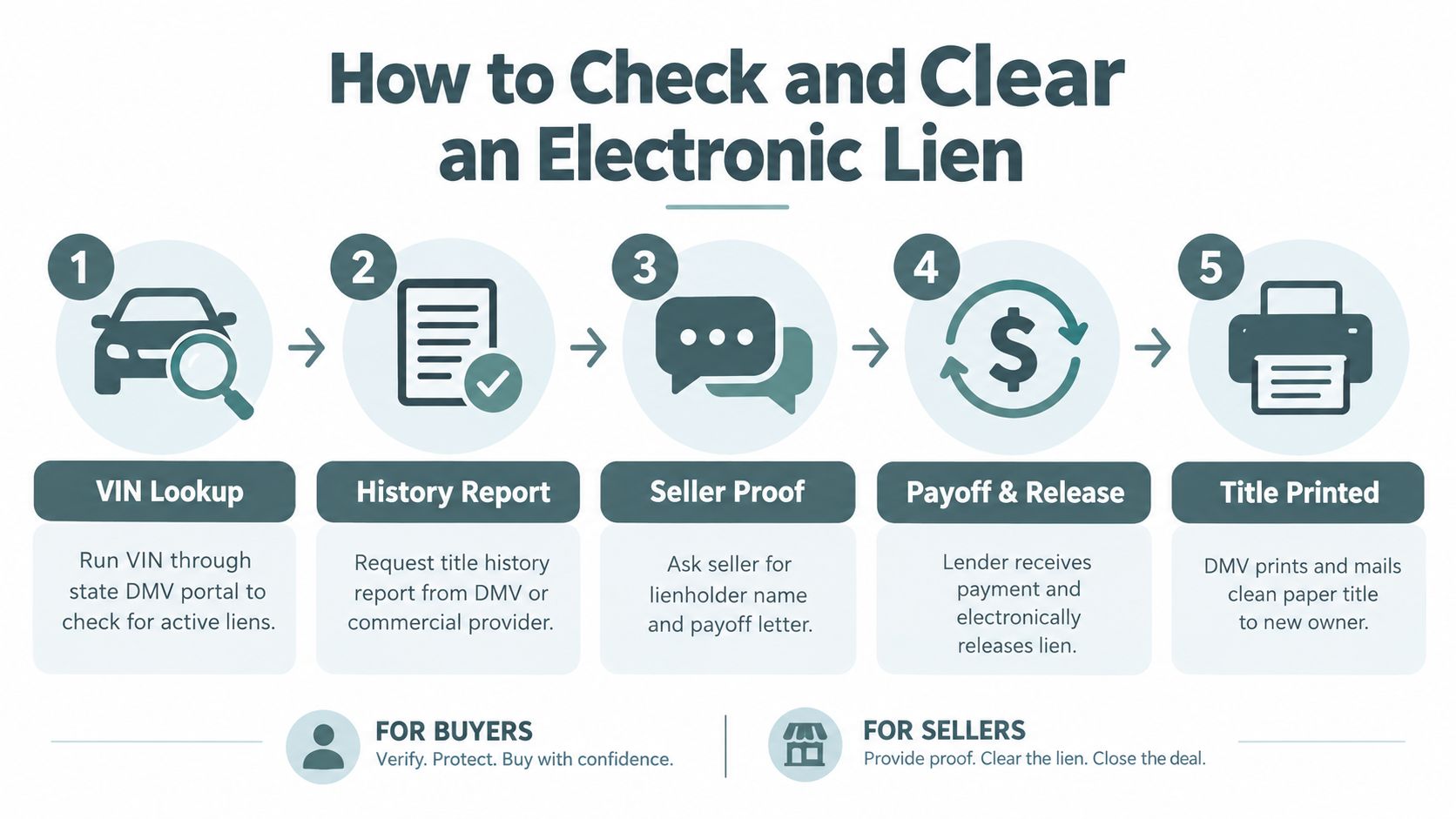
Buyer checks before payment
Start with the vehicle identification number. Use the state DMV's title or lien inquiry service where available, and ask whether the result reflects the current record or a prior snapshot. Then request a title history report and compare the VIN, seller's identity, title state, brand information, and lienholder name.
Ask the seller for the lender's name and a current payoff letter. Don't rely on a screenshot of a loan balance or an informal message from a third party. The payoff letter should identify the vehicle and explain where payment must be sent.
A useful second reference is this guide on how to check for a lien on a car. It can help you organize the search, but you should still confirm the legal title status through the relevant state authority.
Seller clears the record
The seller should contact the lender directly and request the payoff amount, payment instructions, and release procedure. After receiving the required payoff, the lender submits the ELT release through the state's authorized channel. The DMV then updates the title record and issues or enables the appropriate title document under that state's process.
Keep written proof of every step. Save the payoff letter, payment confirmation, lender release confirmation, DMV receipt, and bill of sale. A buyer should avoid taking possession on the assumption that the release is complete if the state still shows an active lien.
Lender and DMV complete the transition
The lender controls the electronic release. The DMV doesn't generally remove a lien merely because the seller says the loan was paid. California's guidance illustrates the general principle: the lien satisfaction notice must trigger the state's title workflow, and pending exceptions can prevent automatic issuance and send the matter to manual processing.
State systems also process events on different schedules. Virginia's nightly processing and Colorado's provider-based workflow show why a lender confirmation and a DMV confirmation may not appear at exactly the same time. Ask the DMV what evidence it will accept if the electronic release is pending.
Before signing: Put the payoff arrangement in writing, identify who pays the lender, state when funds are released to the seller, and specify what happens if the DMV rejects the transfer.
Official Checks vs Commercial Vehicle History Reports
An official DMV check answers a narrow but important question: what does that state currently show about the vehicle's title and lien status? It may also show title brands and odometer information, depending on the state's service. The National Motor Vehicle Title Information System, or NMVTIS, is designed to verify title validity and status, identify where a vehicle is currently titled, and reveal brand history such as salvage status. Its users include consumers, law enforcement, insurers, recyclers, and state titling agencies, as explained in this NMVTIS vehicle title document.
Neither source should be treated as a complete substitute for the other. A state lookup may not show a recent event from another jurisdiction, while NMVTIS is focused on title and brand information rather than every repair, listing, or auction image. A commercial report can combine government records with other feeds, but it can still have gaps, delays, or records that require interpretation.
| Source | What It Confirms | Limitation |
|---|---|---|
| State DMV portal | Current state title, lien, and registration information available through that state. | It may not provide a complete cross-state history or reflect a newly submitted change immediately. |
| NMVTIS | Title validity, current titled state, and brand history, including salvage-related information. | It isn't a complete repair, maintenance, or transaction history. |
| Lienholder | Payoff amount and whether the lender has submitted a release. | The lender's account status may update before the DMV record does. |
| Commercial history report | A consolidated view of available title, accident, odometer, theft, ownership, service, and auction records. | Coverage depends on reporting sources, jurisdictions, and timing. |
For a broader vehicle evaluation, review these used-car title-check steps alongside the official lookup. Vektracer is one commercial option that compiles VIN-based records, including title and lien information, accident and damage records, odometer readings, auction records where available, theft information, ownership context, and recall data sourced from NHTSA databases.
The same layered approach applies to other forms of due diligence. If you're also verifying a seller, intermediary, or business contact, these actionable background check steps can help you separate identity verification from vehicle-title verification. Those are different checks, and neither should replace the other.
A Real Buyer Scenario With an ELT Surprise
A buyer considers a 2019 pickup in a private-party sale. The seller says the loan was paid and describes the title as clean. The buyer runs the VIN through the state DMV service, sees no active lien in that particular check, and pays the seller.
A week later, the new title arrives with a lender's lien from another state. The seller had not satisfied the remaining obligation, and the state's electronic record had not made the problem obvious during the initial check. The buyer now owns a vehicle that can't move cleanly through the title process until the lender's interest is resolved.
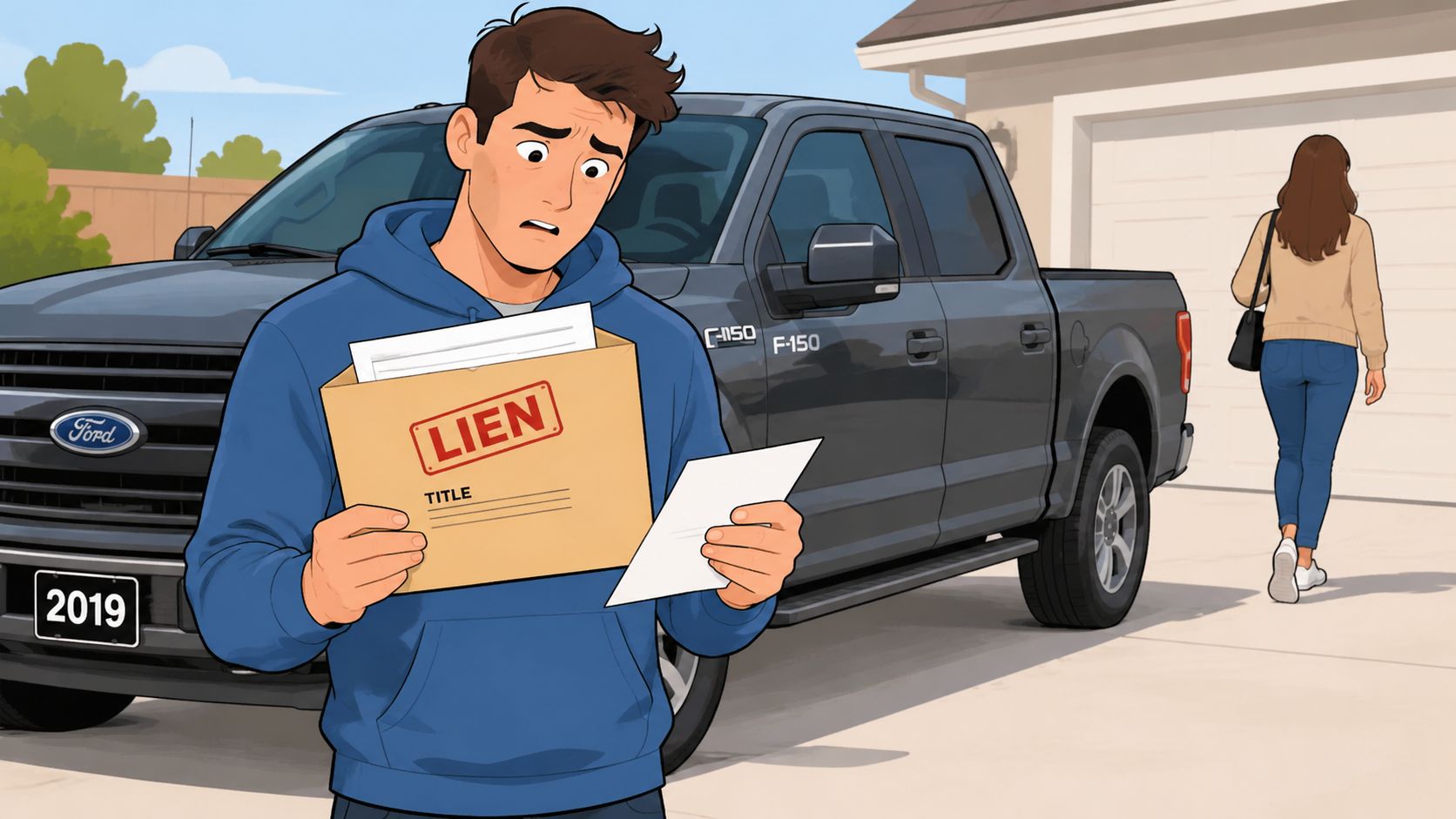
The buyer contacts the lender listed on the incoming title and asks for a payoff statement. Before sending money, the buyer confirms the vehicle identification number, the lender's payment instructions, and the process for submitting proof of payment. After the balance is paid, the lender provides release confirmation and submits the electronic release to the appropriate state system.
The buyer then returns to the DMV with the lender's documentation and asks the agency to update the title record. The DMV may require additional forms or manual review because the original lien was associated with another state. The transaction is eventually resolved, but the buyer has absorbed the delay and the risk of paying a debt that should have been cleared by the seller.
This example demonstrates why a single state lookup can't answer every cross-border question. A multi-jurisdiction history report can provide additional context before payment, but it cannot guarantee that every lien has been reported or released. The safest process combines the seller's direct lender confirmation, official title checks, and a broader VIN history review.
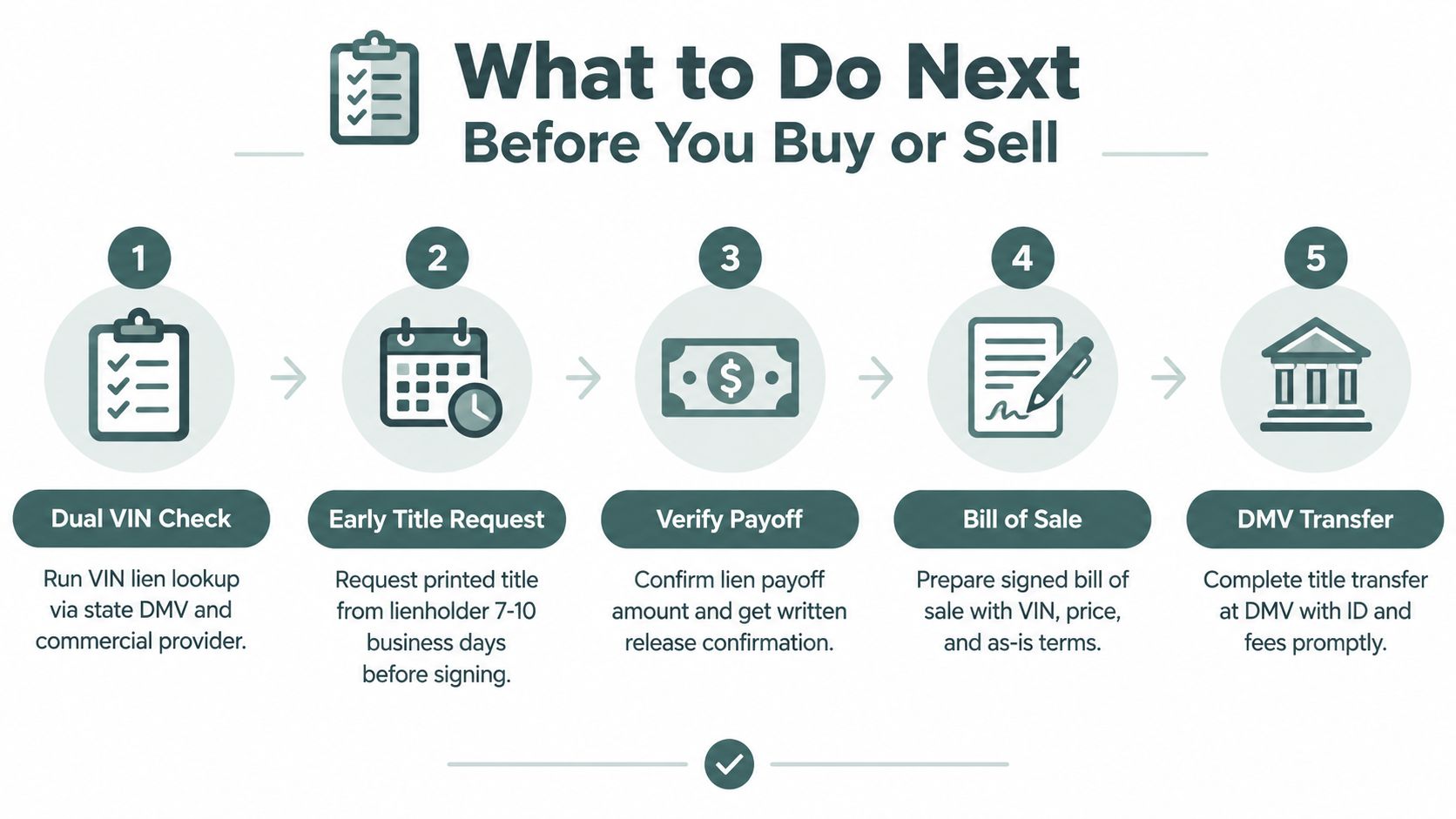
What to Do Next Before You Buy or Sell
Use a layered process rather than trusting one document or one database. ELT reduces paper handling and mailing for lienholders, and official state programs describe those operational savings, but electronic processing doesn't eliminate stale records, processing exceptions, or interstate mismatches. A buyer still needs to prove that the person selling the vehicle can transfer it free of undisclosed claims.
Buyer checklist
- Run two VIN checks. Search the state DMV's available lien and title service, then review a commercial vehicle-history source for records connected to other jurisdictions.
- Request title evidence early. If a lender still controls the record, ask for a printed title or equivalent confirmation well before signing. The requested planning window should be 7 to 10 business days, as specified for this transaction plan, but confirm the actual process with the state and lender.
- Match the NMVTIS record. Check that the VIN, title state, seller information, brands, and ownership context are consistent. NMVTIS is a title-status system, not a promise that every accident or lien will appear.
- Confirm the payoff directly. Call the lender using contact information from its official website or account documents. Don't send money to an unverified payment site or intermediary.
- Write down the chain of custody. Keep the bill of sale, payment records, title application, lender correspondence, DMV receipts, and every release document.
Seller checklist
The seller should obtain the current payoff figure directly from the lender, not from a third-party payment service. Ask the lender how it will submit the ELT release, when the state should reflect the change, and what proof the buyer can receive at closing.
A bill of sale should identify the VIN, sale price, parties, date, and agreed condition. The parties should also state who pays an outstanding lien and whether funds go directly to the lender before any remaining balance goes to the seller.
ELT still leaves several gaps. Payoff and state updates can occur at different times. A vehicle can move from an electronic-title state to a paper-title state and require a new process. Errors can also pass from a lender's system into a DMV database without being noticed until a transfer, refinance, or sale.
Final check: Don't ask only whether the loan is paid. Ask whether the lien has been released in the state record and what document proves the release.
Before you commit funds, use Vektracer as a final VIN-based consistency check across available title, lien, accident, odometer, ownership, and auction records. It won't replace the state DMV or lender, but it can help you spot conflicting history that deserves direct verification.
Use Vektracer to review the vehicle's available VIN history before you buy or sell. Compare its title and lien context with the state DMV record and confirm any open issue directly with the lender or titling agency.
Ready to check a vehicle?
Enter any 17-character VIN for a free instant preview — no account needed.