Bonded Title Cost: What to Expect in 2026
Check a vehicle before you buy
Enter a VIN for a free instant preview — accidents, title brands, mileage, liens & open recalls.
A bonded title usually costs a one-time premium of $100 to $300 for most cars. The final price depends on the vehicle's value, state DMV fees, and the extra expenses that show up around the bond, like appraisal paperwork, notary work, mailing, and the time it takes to chase everything down.
A lot of buyers run into this after they've already agreed on the car. It might be an older pickup from a neighbor, a project car with a lost title, or a cheap daily driver that looks like a bargain until the paperwork falls apart. That's when bonded title cost stops being a small technical detail and starts affecting whether the deal still makes sense.
The short version is simple. The bond premium itself is often manageable. The harder part is the total cost around it, plus the long-term drag a bonded title can put on resale, financing, and insurance while the bond period is still active.
Introduction What Is a Bonded Title and How Much Does It Cost
Checking a specific vehicle?
Run its VIN for a free preview of accidents, title brands, mileage and open recalls.
A bonded title is what many states use when someone appears to have a legitimate claim to a vehicle but can't produce the proper ownership document. Instead of leaving the car stuck in paperwork limbo, the state may allow a title to be issued with a bond attached.
That bond is not just another DMV fee. It's a surety bond tied to the vehicle's value. For many standard vehicles, the premium lands in the $100 to $300 range, but that number only covers the bond itself. Bonded title cost can run higher once the DMV requires valuation documents, application fees, signed statements, certified mail, notary services, or an inspection.
Most buyers only hear the advertised premium and assume that's the whole story. It rarely is. If the vehicle is low-value, the minimum premium may make the bond feel cheap. If the vehicle is worth more, the bond amount rises with the value, and the premium follows it.
If you're new to the process, it helps to understand the bond before you spend money on it. A basic walkthrough of the paperwork side is in this guide on what a vehicle title bond is.
Practical rule: If the seller can't produce a proper title, assume the car's real acquisition cost is purchase price plus paperwork cost plus hassle cost.
That's the decision point. Sometimes a bonded title is the cleanest way to save a good deal. Sometimes it's the warning sign that tells you to walk away.
Understanding the Bonded Title Concept
A bonded title works a lot like a financial guarantee attached to a title problem. The easiest way to think about it is this: the state wants proof that if someone later proves a stronger ownership claim, money is available to cover the loss up to the bond amount.
Who the bond protects
Buyers often get tripped up here. The bond doesn't mainly protect the person applying for the title. It protects the state, any prior owner with a valid claim, and future parties who could be harmed if the title history turns out to be wrong.
That's why the process feels stricter than people expect. The DMV isn't doing you a favor. It's managing risk before letting a paperless vehicle back into legal circulation.
Three parties are involved:
- The principal is the person applying for the bonded title.
- The obligee is the state agency, usually the DMV or equivalent title office.
- The surety is the bond company issuing the bond.
If a claim comes up and the surety pays, the principal can still be responsible for reimbursing the surety. That matters because a bonded title is not the same as buying insurance for yourself.
Why states require it
A bonded title exists because title problems are common in practice. Titles get lost. Owners move. Estates never complete transfers. Old vehicles sit for years. A seller signs the wrong name or skips a transfer.
Without a bonded process, some of these vehicles would be impossible to retitle even when the buyer acted in good faith. The bond gives the state a way to move the vehicle back into the market while still protecting anyone with a valid superior claim.
A bonded title is a path forward, not a magic fix. It gives the DMV a controlled way to issue ownership documents when the paper trail is incomplete.
What the bonded brand really means
A bonded title is still a title, but it carries a brand showing that a bond backs it. That brand matters when you try to sell the vehicle later because informed buyers, lenders, and dealers know there's unresolved title history behind it.
That doesn't automatically make the car a bad buy. It does mean you should treat it differently from a clean-title vehicle with straightforward paperwork. In practice, the right question isn't “Can I get a bonded title?” It's “Does this car still make sense once I factor in the bond, the wait, and the reduced market appeal while the brand remains?”
The Core Components of Your Bonded Title Cost
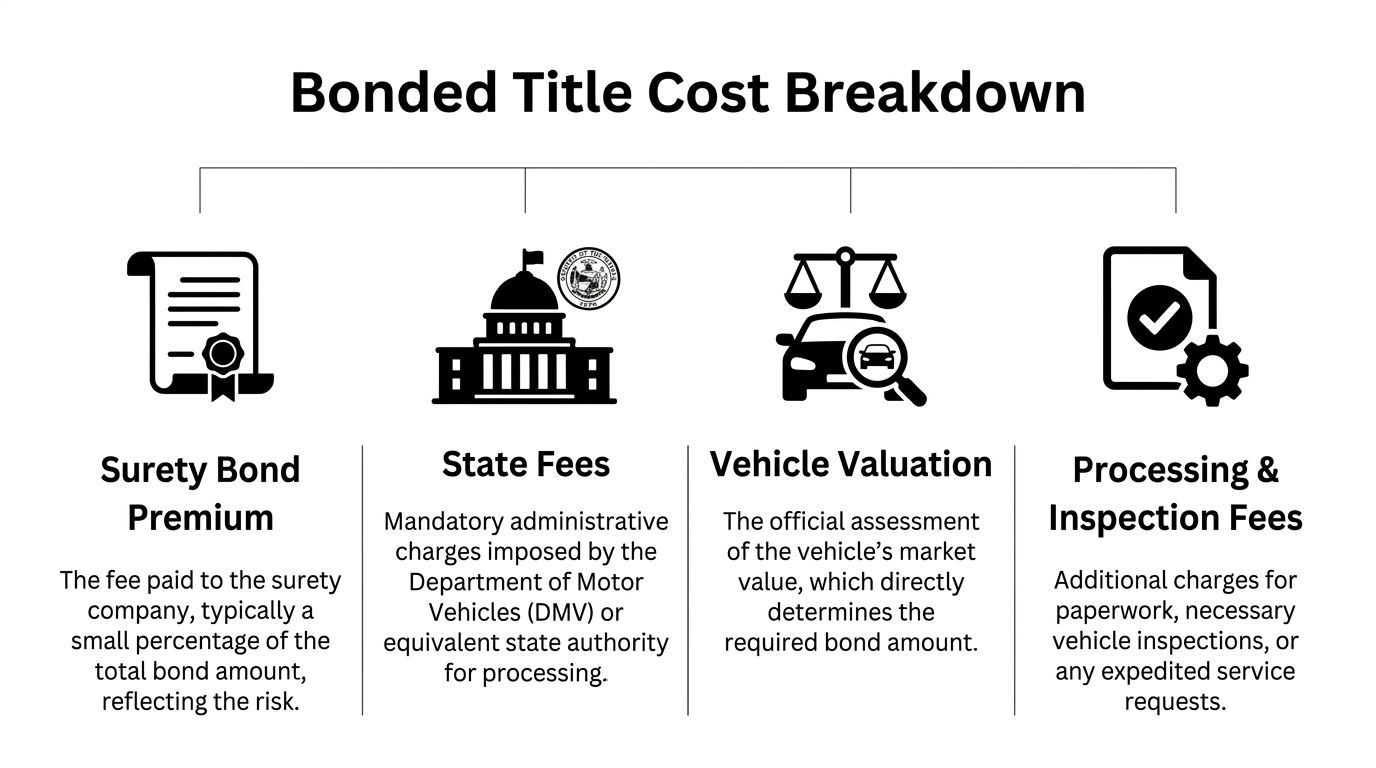
When people search for bonded title cost, they usually want one number. In the field, there isn't just one number. There are several moving parts, and missing any of them leads to bad budgeting.
The surety bond premium
This is the part most websites lead with, and it's the part buyers remember. According to SuretyBonds.com's title bond pricing guide, title bond premiums for motor vehicle bonded titles typically cost $15 per $1,000 of coverage, with a $100 minimum premium. The same source notes that vehicles are often bonded at 1.5 times appraised value, so a vehicle appraised at $4,000 would require a $6,000 bond and cost a flat $100 premium.
That sounds cheap because, in many cases, it is. A bond premium often isn't what kills the deal. It's everything attached to it.
The vehicle valuation
You usually don't get to pick the bond amount out of thin air. The state sets the formula, and the formula starts with fair market value.
In California, the DMV says the value must be based on the average of low and high Kelley Blue Book or NADA values, and the bond amount must match that result in the state's required format. The DMV also states that bonds at or below $6,000 fall into a flat $100 premium benchmark in that market, as described in the California DMV ownership surety bond guidance.
The practical headache is not the math. It's getting a valuation the DMV will accept. If the clerk wants a certain form, dealer appraisal, or value source, your first attempt may not be enough.
State title and filing fees
Budgeting for this can become complicated. State DMV fees vary, and the exact paperwork package varies too. One state may ask for a title application, statement of facts, ownership declaration, and supporting identity documents. Another may add inspection steps or require extra notice to prior owners.
Because fee schedules and procedures change by state, the safe approach is to call the title office before paying for anything nonrefundable.
Here's what usually belongs in your budget even when the bond premium looks modest:
- Title application charges
- Registration-related fees if the vehicle will be plated
- Duplicate paperwork or corrected filing fees if forms are rejected
The miscellaneous costs people forget
These are the expenses that don't look big individually but still matter because they come on top of the bond.
- Notary services if your state requires signatures notarized
- Certified mail if the DMV wants proof that prior owners or lienholders were notified
- Inspection fees if the state requires VIN verification or a physical examination
- Time cost from making multiple DMV visits, correcting forms, and waiting on mailed bond documents
Dealer mindset: The cheaper the car, the more these side costs matter. On a low-dollar vehicle, paperwork friction can wipe out the whole value advantage.
This is why two vehicles with similar bond premiums can have very different total bonded title cost in practice. One seller has a clear bill of sale, a cooperative prior owner, and a clerk who accepts the first packet. The other turns into a stack of corrections, mail receipts, and wasted afternoons.
State-by-State Bonded Title Cost Examples
A $5,000 car with a title problem can be a manageable paperwork job in one state and a money pit in another. I have seen buyers focus on the bond premium, then get blindsided by valuation disputes, inspection requirements, mailing costs, and repeat trips to the tag office. State rules decide how fast that happens.
The two cost questions that matter are simple. What bond amount does the state require, and what extra steps does that state attach to the application? Those two answers usually tell you whether the deal still makes sense.
State-by-State Bond Requirement Comparison
| State | Bond Amount Formula | Bond Period | Example Cost Range for $5k car |
|---|---|---|---|
| California | Bond amount is based on the vehicle's determined value under the state's bonded title process | Commonly 3 years under California bonded title rules | Roughly $100 to $300 for the bond premium and basic filing costs. More if valuation support, duplicate paperwork, or extra DMV handling is needed |
| Texas | Bond amount is commonly set at 1.5 times the vehicle's appraised value under the bonded title process | Commonly 3 years | Roughly $150 to $400 total in a straightforward case, depending on the appraisal charge, bond premium, and county filing costs |
| Florida | Florida does not use the same bonded title process structure as every other state, so costs depend heavily on how ownership proof and state-required documents are handled | Procedure varies by case | Often less about a standard bond formula and more about document correction costs, inspections, notary fees, and agency processing |
These are practical ranges, not universal quotes. Bond rates vary by surety company, low-value bonds often hit minimum premium thresholds, and local offices do not all create the same amount of rework.
What the numbers look like in practice
California example: A $5,000 vehicle usually lands in a relatively low bond premium bracket, so the bond itself may not be the expensive part. The spread is influenced by how the DMV values the car, whether the paperwork is accepted on the first pass, and whether you need notarized forms or supporting records to prove ownership. A clean file can stay near the low end. A file with missing seller information gets expensive fast in time, even if the cash fees stay moderate.
Texas example: Texas is often easier to budget because the appraisal requirement gives you a clearer starting point. If the state accepts a $5,000 appraised value, the bond amount would generally be $7,500. The premium on that bond is usually still fairly modest, but now you add the appraisal fee, title application cost, possible VIN inspection, and the usual incidental charges. That is how a cheap car turns into a $250 to $400 title project before registration.
Florida example: Florida cases can be less predictable because the issue is often not just the bond. It is whether the state accepts your ownership trail, supporting forms, and vehicle history documentation. For Florida-specific process questions, this guide to a bonded title in Florida helps set expectations before you spend money on forms and fees that may not solve the problem.
Why one state stays cheap and another does not
The bond formula matters, but the side costs decide the final number. A state that accepts a simple valuation and a clean bill of sale can keep the job economical. A state that pushes you into an appraisal, inspection, certified mail notices, or corrected affidavits can make the same $5,000 car much less attractive.
That difference also affects the car's real resale math. If you spend a few hundred dollars and several workdays fixing title on a low-dollar vehicle, your margin shrinks before you do any mechanical work. If the vehicle later carries bonded-title stigma with buyers, the upfront savings can disappear on the back end.
Dealer rule: always price the title problem as a full project, not just a bond purchase.
Cross-state deals are where buyers get burned most often. The seller's state may have treated the title issue one way, but your home state decides what it will accept. That can mean a second round of forms, a new valuation, or a process that stalls long enough to kill a quick resale.
The Hidden Risks and Long-Term Financial Impact
A bonded title can look cheap at the counter and still cost you real money later.

The bond is only part of the exposure
Here is the situation buyers miss. You pay for the bond, get the title issued, and assume the problem is over. It is not. The bond stays attached to the file for the state's required period, and during that window a prior owner or lien claimant can still challenge your right to the vehicle.
That matters because the cost is not limited to the bond premium. If a claim comes up, you can lose time gathering paperwork, answering DMV letters, and proving how you acquired the car. If you paid for an appraisal, VIN inspection, certified mail, duplicate forms, or notary services to get the bonded title in the first place, those sunk costs do not come back just because the deal turns messy.
For buyers who plan to keep the vehicle for years, that risk may be acceptable. For buyers who need a quick retail turn, it changes the math fast.
Financing and insurance can tighten up
A bonded-title vehicle is legal to own and sell if the state issued it properly. That does not mean every bank or insurer will treat it like a clean-title car.
Some lenders ask more questions, want extra documentation, or decline the unit during the bonded period. CarInsurance.com notes that insurers can treat bonded-title vehicles differently depending on carrier rules and the vehicle's history, which can affect how easy it is to place coverage and what documentation you need at binding time (CarInsurance.com's overview of bonded titles and insurance).
On the ground, that creates friction in two places. Retail buyers may have fewer financing options, and some insurers will slow the process while they verify title status. If you are selling the car, delays alone can cost you a deal even when the buyer still wants it.
Resale value drops for paperwork reasons, not mechanical ones
Many people misprice bonded-title cars because they look at mileage, condition, and book value, then shave a little off for the title issue. In practice, the discount often needs to be bigger because the next buyer is inheriting the paperwork story along with the vehicle.
A clean, well-running car with a bonded title can still sit longer than a rougher car with a clean title. Buyers ask predictable questions:
- Why was the original title missing?
- Is there any old lien that could reappear?
- Will my lender approve it?
- Will I have trouble insuring it?
- What happens when I sell it later?
Those questions reduce demand. Reduced demand lowers resale flexibility, and that has a cash value.
The hidden cost is often the exit. A bonded-title car can be harder to finance, slower to insure, and tougher to sell for full market money.
Your time has a price too
DMV trips, rejected packets, replacement affidavits, certified mail receipts, and follow-up calls all cost something, even if they do not show up on the bond invoice.
I have seen buyers chase a bonded title on a low-value car, spend modest money out of pocket, then burn hours fixing avoidable paperwork issues. By the time they finish, the project still works on paper, but not by enough to justify the effort. That is common with inexpensive daily drivers where the margin was thin from the start.
If your time is limited, treat every extra step as part of the acquisition cost. A vehicle that saves you $300 up front can easily lose that advantage once you add missed work, admin time, and a weaker resale position.
When the risk can still make sense
A bonded title is not automatically a bad buy. It can be reasonable if the numbers account for the title problem and the ownership trail is believable.
The best cases usually look like this:
- The vehicle is priced well below comparable clean-title units
- You have solid supporting documents, such as a detailed bill of sale, prior registration, lien release, or traceable ownership history
- You plan to keep the vehicle long enough that immediate resale pressure does not matter
- The car is rare or hard to replace, so the title headache is part of getting that specific unit
The bad deals are easy to spot after the fact. Clean-title money goes in, bonded-title risk stays attached, and the buyer finds out later that the cheap bond was the smallest part of the total cost.
How to Save Money and Avoid Common Mistakes
The best way to lower bonded title cost is to avoid needing a bonded title in the first place. The second-best way is to tighten every step before you pay for anything.
Check the paper trail before you buy
Don't start with the bond company. Start with the documents.
Ask for the seller's ID, prior registration, any old title copies, lien release paperwork if applicable, and a signed bill of sale with matching vehicle details. If the names, VIN, or ownership story don't line up, pause the deal.
A weak paper trail usually leads to one of two bad outcomes. The DMV rejects the packet, or the surety underwriter prices the risk less favorably.
Don't ignore the credit variable
This is one of the most overlooked parts of bonded title cost. Many buyers hear the minimum premium and assume that's what they'll pay no matter what. That's not always how it works.
According to Worldwide Insurance Specialists' explanation of lost title bond pricing, applicants with poor credit may face higher premiums, potentially inflating costs by 50-200% compared to advertised rates. That means a “cheap bond” can stop being cheap once underwriting looks deeper.
Mistakes that cost buyers money
Buying first, asking the DMV later
Eligibility comes first. Some title situations have other remedies, and some have bigger problems than a bond can solve.Using the seller's verbal story as proof
If it isn't documented, it won't help much at the counter.Failing to budget the side costs
The bond premium isn't the whole bonded title cost. Mailing, notarizing, appraisals, and repeat visits add up fast.Overpaying for the vehicle
A bonded-title car should be priced with the title defect in mind.
One good habit: Call the DMV before purchase, then call the surety provider. Doing it in that order keeps you from paying for the wrong solution.
What actually works
Practical buyers do three things well. They verify the title issue, they negotiate price based on that defect, and they leave room in the budget for friction. That's the difference between a manageable bonded title file and a money pit.
Your Bonded Title Action Checklist
A checklist keeps this process from turning into guesswork. The right order matters because once you pay for one step, it's harder to undo a mistake upstream.
For private buyers
- Confirm eligibility with the DMV before buying the car or paying for a bond
- Get a written bill of sale with the full VIN, seller information, and purchase details
- Collect every ownership document available, including prior registration, old title copies, and lien release paperwork
- Ask how the state wants the vehicle valued so you don't pay for the wrong appraisal format
- Budget for more than the premium, including filing, mailing, notary, and inspection-related costs
- Negotiate the purchase price downward because the title issue reduces convenience and resale appeal
- Keep copies of everything in one folder from day one
For a broader due diligence process before money changes hands, this title record checklist to avoid used car surprises is worth reviewing.
For dealers
- Treat it like an inventory risk decision, not just a paperwork task
- Check whether the car's margin survives the bonded process
- Estimate holding time realistically because title delays tie up space and cash
- Verify whether your buyer pool can finance bonded-title vehicles
- Document the acquisition file tightly so your downstream retail paperwork is clean
- Price the retail unit with the title brand in mind, not as if it were a standard clean-title car
The key difference is simple. A private buyer might accept hassle to get a specific car. A dealer has to ask whether that hassle still leaves room for profit.
Frequently Asked Questions About Bonded Titles
How long does the bonded title process take
It depends on the state, the DMV backlog, and how complete your paperwork is on the first submission. The process usually slows down when buyers need to redo valuation paperwork, mail notices, or correct seller information. If the documents are clean and the DMV accepts the packet quickly, it moves much faster than a file with missing pieces.
Can I legally sell a car with a bonded title
In many cases, yes. But legal and easy are not the same thing. Buyers, lenders, and dealers may treat a bonded-title vehicle more cautiously than a clean-title vehicle, so disclosure and pricing matter.
What happens if the original owner shows up
If someone proves a superior ownership claim during the bond period, the claim process can involve the surety bond. The bond exists to protect against that risk. A valid claim can create financial consequences for the person who obtained the bonded title, which is why the ownership story and supporting documents matter so much from the start.
Does a bonded title ever become a normal title
Yes, in many states the bonded brand can be removed after the required bond period passes and the DMV's conditions are satisfied. California's example is a 3-year period, as noted earlier. Once the bond period clears and the state removes the brand, the title can move into standard status.
If you're trying to decide whether a title problem is a manageable paperwork issue or a car you should skip, run the VIN first. VekTracer gives buyers and dealers vehicle history reports with title and lien status, theft checks, mileage verification, recalls, and a Risk Score that helps you spot trouble before you commit. If you're comparing report options, you can also review CARFAX alternatives and comparisons, use a VIN check USA tool, or check a VIN check Canada report before taking on a bonded-title deal.
Ready to check a vehicle?
Enter any 17-character VIN for a free instant preview — no account needed.