Get Your Bonded Title Florida: FLHSMV Process 2026 Guide
Check a vehicle before you buy
Enter a VIN for a free instant preview — accidents, title brands, mileage, liens & open recalls.
A bonded title in Florida is a title issued when you can't provide a properly assigned standard title, and the state requires a surety bond to back your ownership claim. That bond is set at twice the vehicle’s appraised value, and the title carries a bonded brand for 3 years before that brand is removed from the record.
If you're looking at a car with missing paperwork, or you already bought one and found out the title trail is broken, this is the process Florida uses to sort it out. It can work, but only if the vehicle fits Florida's narrow eligibility rules and you understand the resale downside before you spend money on the bond.
What Exactly Is a Florida Bonded Title
You buy an older vehicle in a private sale, get a bill of sale, and then find out the title was lost years ago or never signed over correctly. At that point, a Florida bonded title is often the only way to get the vehicle into your name without waiting on a title trail that may never be fixed.
A Florida bonded title is a title the state issues when the ownership paperwork is incomplete, but the applicant is willing to post a surety bond with the title application. The bond acts as financial protection for anyone who later proves a stronger legal claim to the vehicle, such as a prior owner, lienholder, or in some cases a later buyer harmed by a defective title history.
That distinction matters because the bond does not insure the person applying for the title. It protects against loss caused by a bad ownership chain.
What this means in a real deal
For buyers, a bonded title can turn a dead-end paperwork problem into legal ownership. For sellers, it can be the difference between unloading a vehicle and watching the deal collapse once the buyer checks the title record. But there is a trade-off. A bonded title usually narrows the buyer pool, and that reduced demand often shows up in the resale price.
I tell clients to evaluate the car and the paper trail at the same time. A vehicle history report helps confirm whether the VIN, prior branding, and registration pattern make sense. If the title gap looks suspicious, a tool such as VekTracer's Risk Score can help you decide whether the vehicle is merely missing paperwork or carries a bigger fraud or ownership risk. That step matters before anyone pays for an appraisal, bond premium, taxes, tag fees, or repairs.
What the bond amount actually tells you
Florida bases the bond amount on the vehicle's appraised value. The number on the bond is a claim ceiling, not your normal out-of-pocket cost. Applicants pay a premium to the surety company, and that premium is only one part of the total cost to clean up the title.
The bigger financial question is whether the vehicle is worth bonding at all. If the market value is modest and the bonded brand is likely to shave down resale value, the math can get tight fast. A cheap project car with a broken title chain may still make sense for a long-term owner. It makes less sense for someone planning to resell soon.
If you're still sorting out whether you even have enough paperwork to move forward, this guide on how to prove car ownership is useful. It helps you separate a fixable documentation problem from a deal that should've been avoided in the first place.
Why the title gets branded
Florida marks the title as bonded because the state is issuing ownership documents without the standard, fully documented chain of title. That brand is a signal to future buyers, dealers, and lenders that extra risk existed when the title was created.
Some buyers will still proceed. Some lenders will not. Dealers usually look harder at these units too, especially if the vehicle history already shows gaps or inconsistent ownership records. Reviewing what a car title looks like in Florida and where status markings appear helps because buyers often check the VIN and owner name but miss the branding line completely.
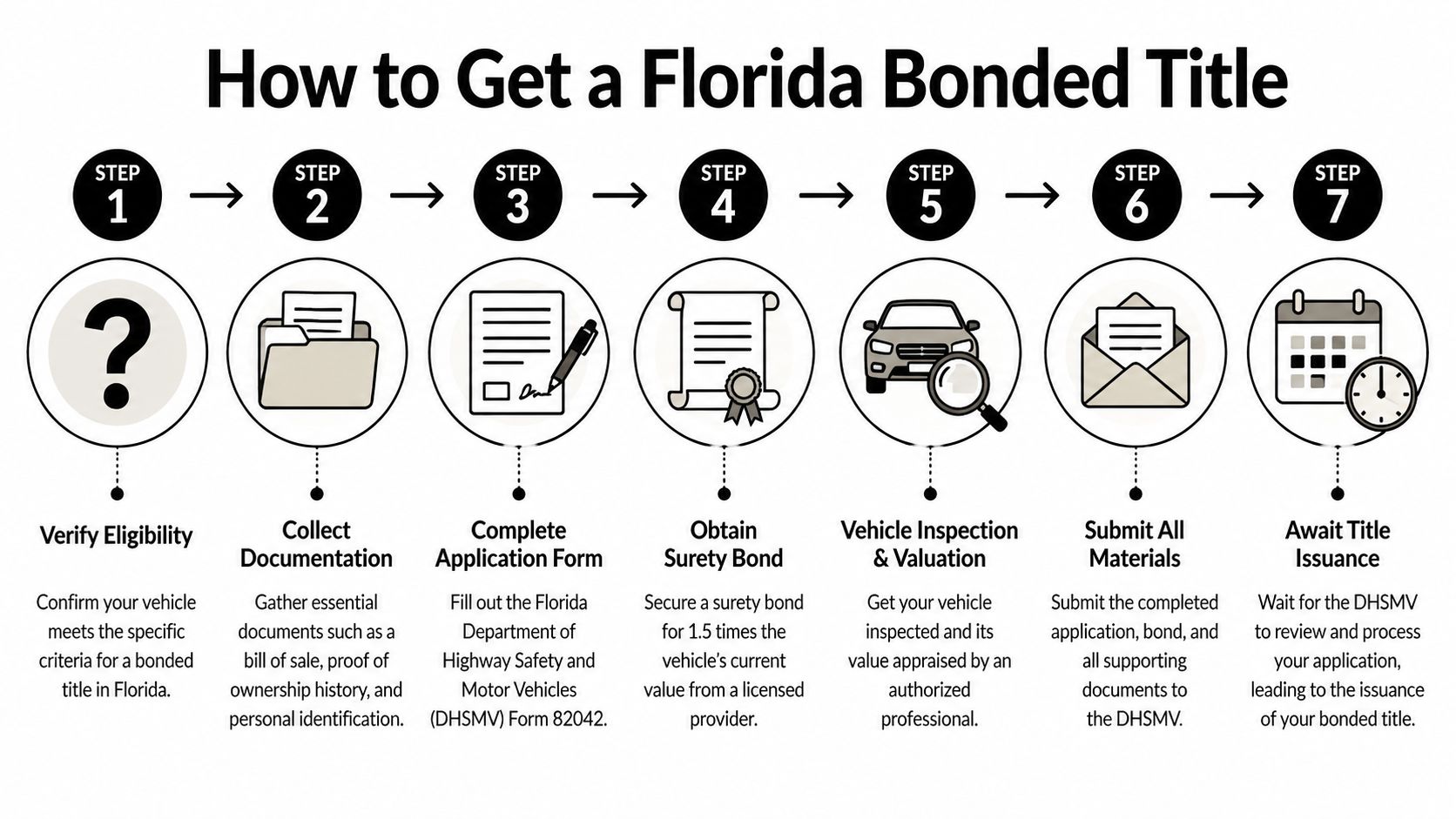
Step-by-Step Guide to Get a Bonded Title in Florida
You bought an older truck from a private seller, got a bill of sale, and then learned the title trail is broken. At that point, the bonded title process is less about filling out forms and more about proving to Florida that your ownership claim holds up under review.
Start with the decision, not the bond
Before you spend a dollar, decide whether the vehicle is worth saving. A bonded title can solve a legal ownership problem, but it does not erase the vehicle's history or make buyers forget the title was branded. If you plan to keep the car, the process can make sense. If you plan to resell in the near term, run the numbers first.
Check the vehicle history before you touch the paperwork. A VIN check USA report helps confirm whether the title status, prior records, and branding line up with the seller's version of events. Pair that with a market-value check and VekTracer's Risk Score. That gives buyers and sellers a better read on whether the vehicle is merely missing paperwork or carrying a larger title problem that will hurt resale, financing, or trade-in value.
Florida is strict on eligibility. The bonded title path generally applies only to certain vehicles that fall within the state's age and title-history rules. A commonly cited example is a 2015 Ford F-150 that would meet the age window in 2026. If that truck has a market value around $18,500, the bond amount would be set at $37,000 under the valuation approach described by Boss Bonds for Florida motor vehicle certificate of title bonds.
A few things stop applications early:
- The vehicle does not fit Florida's bonded-title eligibility rules.
- The title history points to another state instead of a prior Florida paper title.
- An unresolved lien still shows in the record.
- The VIN history raises theft, branding, or ownership inconsistencies.
Build the file in the order a title clerk will review it
Start with your ownership proof. Gather the bill of sale, any old registration, transfer paperwork, repair invoices, seller messages, and any record showing how the vehicle changed hands. One document rarely fixes the problem by itself. Together, they can show a credible chain of possession.
Next, confirm the vehicle's value. Florida uses that figure to set the bond amount, so errors here create problems later. If the trim, mileage, or condition is entered wrong, you can end up buying the wrong bond and resubmitting the whole file.
Then buy the bond from a Florida-licensed surety company. If you want the legal background before you purchase it, this explanation of a vehicle title bond and how it works gives the right context. The short version is simple. The bond protects anyone who later proves a stronger ownership claim than yours.
After that, complete the state forms carefully. Sloppy paperwork gets kicked back fast.
Pay close attention to the forms that cause rejections
The problem forms are usually the VIN verification and the bonded title affidavit. Florida requires Form 82042 for VIN and odometer verification and Form 82026 for the affidavit explaining how you got the vehicle and why a standard title is not available.
I tell clients to compare the VIN character by character across every document before they file. The VIN on the vehicle, bill of sale, bond, and title application must match exactly. One bad digit can turn a workable file into a delay that costs another trip, another fee, and sometimes another bond correction.
Submit a complete packet to the right office
Take the full file to your county tax collector or another office that handles title work. Bring originals when the office requires originals. Phone photos and half-complete printouts do not help at the counter.
A clean packet usually includes:
- Application for title
- VIN and odometer verification
- Bonded title affidavit
- Original surety bond
- Vehicle valuation support
- Government-issued photo ID
- Records showing how you acquired the vehicle
The office will review eligibility, check the system for conflicts, and decide whether the state can issue the bonded title. If a clerk finds a lien problem, a title-history conflict, or mismatched documents, the file stops there until you correct it. That is why the smart move is to vet the car first, especially if you are buying to resell. A bonded title can make a usable vehicle legal to own, but it does not turn a risky unit into a clean one.
Required Documents and Full Cost Breakdown
A bonded title file gets approved or kicked back on paperwork quality. The state is looking for a clean chain of facts: who you are, what vehicle you have, how you got it, and why the regular title path is unavailable. If any one piece conflicts with the others, the delay usually costs more than the bond premium people spend so much time worrying about.
The paperwork checklist
| Document/Item | Form Number | Purpose |
|---|---|---|
| Application for Certificate of Title | HSMV 82040 | Starts the title application and identifies the applicant and vehicle |
| VIN and Odometer Verification | HSMV 82042 | Confirms the VIN and odometer reading through required verification |
| Affidavit for Bonded Title | HSMV 82026 | Explains how the vehicle was acquired and why a standard title isn't available |
| Surety bond | N/A | Provides the financial guarantee required for the bonded title |
| Vehicle valuation printout | N/A | Supports the appraised value used to calculate the bond amount |
| Government-issued identification | N/A | Confirms the applicant's identity |
| Ownership support documents | N/A | Bill of sale, prior registration, or related records that support possession |
If you want the legal background behind the bond itself, this guide explaining what is a vehicle title bond gives the larger context.
What you actually pay
The full cost usually falls into four buckets: the bond premium, title and registration fees, sales tax if tax is still due, and small document costs such as notary, copy, or record-retrieval charges.
The bond premium is a one-time cost. It is not a monthly payment. In many routine files, the premium is relatively modest compared with the value of the vehicle. A major financial mistake is ordering a bond off the wrong valuation or trying to title a vehicle whose paperwork problems make resale harder later.
That trade-off matters for buyers and sellers. If you are buying a vehicle with missing title history, spend a little money upfront on records before you spend more on the bond. A vehicle history report and VekTracer's Risk Score can help you decide whether the unit is merely missing paperwork or whether it carries a bigger problem, such as inconsistent ownership history, theft exposure, or branding that will hurt resale.
Here is how the cost usually breaks down in practice:
- Surety bond premium: Based on the bond amount tied to the vehicle's value.
- Title application and registration fees: Set by the state and county, with totals varying by transaction.
- Sales tax: May apply if the transfer was never properly taxed.
- Supporting document costs: Notary fees, duplicate records, VIN inspection help, and corrected paperwork if something is rejected.
I tell clients to price the whole file, not just the bond. A cheap bond does not make a risky purchase cheap. If a bonded-title vehicle later sells for less because the next buyer sees title friction, the true cost shows up at resale, not at the clerk's counter.
One more practical point. Bring a printed valuation that supports the number used for the bond, and make sure the vehicle description matches every other document exactly. If the valuation is off, the bond amount is off. If the bond amount is off, the application stops until it is corrected.
Risks of Buying or Selling a Bonded Title Vehicle
A bonded title changes the deal before anyone even talks price. I see it happen at the counter all the time. A seller brings in a vehicle they believe is finally "fixed," and the buyer sees the bonded brand and starts discounting for risk.

If you're selling the vehicle
A bonded title gives you a legal path to transfer ownership. It does not restore the vehicle to clean-title market value during the bond period.
That matters because buyers price uncertainty. They worry about prior liens, a break in the ownership chain, and the extra explanation they will need when they resell it. In real transactions, that usually means a lower offer, more inspection demands, and slower time to sale. If you are pricing the vehicle like a standard clean-title unit, expect pushback.
The money issue is usually larger than the bond premium. Earlier cost estimates from Florida certificate of title bond guidance from SuretyBonds.com show how title friction can cut thousands from resale value on a mid-priced vehicle. Sellers need to budget for that discount before listing the car, truck, or motorcycle.
My practical advice is simple. Disclose the bonded status early, show the paperwork that supported the application, and price it with room for the next buyer's risk. Hiding the issue wastes time and usually kills the deal later.
If you're buying the vehicle
Buyers should treat a bonded title as a file that needs extra verification, not as an automatic reject.
The first question is legal. Can you title, register, and insure it without a problem? The second question is financial. Does the asking price leave enough margin for the title history, resale drag, and the chance that a gap in the record points to a larger issue?
Start with the paper trail. Ask for the current title, bill of sale, any lien release, and the seller's explanation of how they acquired the vehicle. Then verify the VIN through a vehicle history report. You are checking for theft records, prior brands, inconsistent odometer readings, and ownership events that do not line up with the seller's story.
That is where a risk-score approach helps. Instead of asking only whether the car can be titled, ask whether the total file looks like a manageable paperwork problem or a vehicle you will fight with later. VekTracer vs. Carfax is a useful starting point if you want to compare reporting tools before you commit. VekTracer's Risk Score is useful for this kind of decision because it forces the buyer to weigh title history against price, not in isolation.
The real trade-off
Some bonded-title vehicles are fair deals. Some are cheap for a reason.
A seller may have a perfectly legitimate ownership claim and still face a lower sale price because the next buyer knows resale will be harder. A buyer may save money upfront and still lose that savings later if lenders hesitate, insurers ask more questions, or the vehicle sits longer when it is time to sell.
That is why I tell both sides to stop arguing about whether a bonded title is "good" or "bad." The better question is whether the discount is large enough to cover the extra risk, paperwork friction, and weaker resale position.
How the Bond Protects Previous Owners and Future Buyers
A bonded title does one job. It puts money behind an ownership claim that Florida is willing to process, but cannot verify through the usual title chain.
That matters when a buyer shows up two years later, tries to trade the vehicle, and a prior lien or ownership dispute surfaces. The bond gives the injured party a route to recover losses if the title was issued on a defective claim. It also gives the state a practical way to issue title without treating weak paperwork as clean paperwork.
Who is actually protected
The applicant buys the bond, but the applicant is not the one the bond is designed to protect.
The protected parties are the people harmed by a bad ownership chain. That can include a prior owner, a lienholder, or a later buyer who suffers a loss because the bonded title should not have been issued in the first place. In plain terms, the bond shifts part of the financial risk away from the public and onto the bonded file.
From a buyer's side, that does not make the vehicle risk-free. It means there is a financial backstop if the title history turns into a legal claim. From a seller's side, it means a bonded title is not just a clerical fix. It is a formal admission that the paper trail had a gap serious enough to require a surety bond.
Why that matters in a real transaction
I tell clients to separate two questions. First, can this vehicle be titled? Second, is it still a good buy or a safe sale after the bonded brand is in the record?
Those are not the same question.
A bond may protect someone who gets hurt by a defective title claim, but it does not solve the market discount that often follows the vehicle. Buyers still hesitate. Dealers still appraise carefully. If the history report shows salvage history, theft recovery, odometer inconsistency, or another red flag layered on top of the bonded title, the resale hit usually gets worse. A quick review of what a rebuilt title means for value and resale helps explain why title brands tend to stack risk instead of canceling it out.
Decision-making matters more than the form itself. A buyer should compare the discount against the likely resale penalty, extra time to verify records, and the chance that a lender or future purchaser will pass. A seller should price the vehicle with that friction in mind instead of insisting the bond "fixes everything."
Why Florida uses the bond system
Florida needs a middle path for vehicles that may belong to the applicant but do not have a clean enough title trail for a standard transfer. The bond lets the state issue title while preserving a remedy for anyone damaged by that decision.
That is the point of the process. It is a legal risk-allocation tool.
When the title can lose the bonded brand
The bonded status does not stay on the record forever. After the required holding period, if no valid claim upends the ownership record, the owner can usually apply to remove the bonded brand and move to a standard title.
For owners who plan to keep the vehicle, that timeline can make the deal workable. For flippers and short-term sellers, it often creates a problem. The bond may satisfy Florida, but the next buyer still sees a branded history during the period when resale matters most.
Alternatives to a Bonded Title in Florida
Sometimes a bonded title is the right answer. Sometimes it's the expensive answer to the wrong problem.

Option one is fixing the original paper trail
If the seller is reachable and the problem is a missing signature, bad assignment, or incomplete transfer, fixing the title chain is usually cleaner than applying for a bonded title. A corrected signature, duplicate title, lien release, or supporting affidavit often creates a better long-term result than branding the title for years.
This route works best when the defect is administrative, not ownership-related.
Option two is a court-ordered title path
When the paperwork is defective and the prior owner won't cooperate, court may be the only path. In practice, this comes up when a title transfer was rejected and the seller disappears, or the signature issue can't be repaired through ordinary DMV channels.
A court-ordered title is more work, but it may be the only route if Florida won't accept the vehicle for bonded-title treatment. That's especially true in defective-title cases that don't fit the bonded title rules.
Option three is walking away from the vehicle
This isn't what buyers want to hear, but it's often the right call. If the VIN history is inconsistent, the seller can't explain prior branding, or the title route depends on assumptions instead of records, the cheapest move is often to leave the deal alone.
That point gets even more important if the vehicle also has branding issues outside the bonded-title question. If you're sorting out title status generally, this explanation of what does rebuilt title mean helps separate one kind of title problem from another.
How to decide
Use this quick comparison:
| Path | Best when | Main drawback |
|---|---|---|
| Correct the existing paperwork | Seller is reachable and defect is fixable | Depends on cooperation from prior parties |
| Bonded title | Vehicle fits Florida eligibility and paper title is missing or defective | Branded title and resale downside |
| Court order | Title defect is serious and administrative fixes failed | More legal complexity |
| Walk away | Story doesn't match records or risks stack up | You lose the deal, but avoid the problem |
Before choosing any path, pull the vehicle history first. Sometimes the report tells you the last titled state, branding status, or title issue that makes the decision much easier.
Conclusion Your Next Steps for Securing Legal Ownership
A Florida bonded title is useful when the vehicle qualifies, the paperwork problem is real, and you understand the trade-off. It gives you a legal route to title a vehicle you can't otherwise title through a normal assignment.
The key is not rushing into the bond purchase. Verify the vehicle is eligible. Build a clean file. Make sure the VIN history supports the story. Then decide whether the bond cost and resale hit still make sense for your situation.
For some owners, especially those planning to keep the vehicle, the bonded route is workable. For others, correcting the original paperwork or pursuing a court order is the better move.
Handle it like a title problem, not a bargain opportunity. That's how you avoid paying for a car twice. Once at purchase, and again when the paperwork catches up with you.
Frequently Asked Questions About Florida Bonded Titles
Can I get a bonded title in Florida for a salvage or rebuilt vehicle
Usually no. A common point of confusion is whether prior accident, salvage, or theft history can still fit the bonded title process. Florida's stricter NMVTIS integration blocks issuance if that kind of record exists for the VIN, and the process is meant for otherwise clean vehicles with missing or defective title proof, not for bypassing salvage or rebuilt branding, according to A1 Surety Bonds' Florida certificate of title bond guidance.
If a seller tells you, "Just get a bonded title and it'll be fine," that's a bad sign when the car has salvage-type history.
How long does a bonded title stay on the Florida record
The bonded brand stays on the title record during the bond period. After that period, the branding is removed from the state's system and the owner can move toward a clean title request if everything else is in order.
If you're buying during that period, price the car as a bonded-title car, not as a future clean-title car.
Can I use a bonded title for any vehicle with missing paperwork
No. Florida doesn't treat bonded titles as a catch-all fix. Eligibility is narrow and depends on the vehicle type, age, title history, lien status, and record status. Vehicles outside that lane usually need a different solution.
If the seller has an out-of-state title issue, unresolved lien issue, or a title branding problem, a bond often won't solve it.
What forms do people most often mess up
The forms that cause the most trouble are the VIN verification and the bonded-title affidavit. Errors happen when the VIN doesn't match across documents, the inspection isn't completed properly, or the affidavit leaves gaps in how the applicant got the vehicle.
A sloppy file tells the clerk that the ownership story may also be sloppy.
Is a bonded title always a bad deal for a buyer
Not always. Some bonded-title vehicles are legitimate transactions involving older vehicles with broken paperwork trails. But the buyer should treat the title brand as a risk factor that affects value, future resale, and confidence in the ownership chain.
The key question isn't "Can I buy it?" It's "Am I being compensated for the risk?"
What's the safest way to evaluate one before buying
Use a layered review:
- Check the title itself for branding and owner details
- Review a vehicle history report for title events, theft records, and lien signals
- Ask for the supporting paperwork used in the title application
- Compare price against title status so you don't pay clean-title money for a bonded-title vehicle
If the seller resists any of those steps, assume the risk is higher than they're admitting.
Before you buy, sell, or bond a vehicle with a broken title trail, pull the history first with VekTracer. A VIN report can help you spot title branding, lien issues, theft records, and other red flags early, so you can decide whether a bonded title Florida case is workable or one to leave alone.
Ready to check a vehicle?
Enter any 17-character VIN for a free instant preview — no account needed.