$19.99 vs $44.99: Best Vehicle History Report for Value Buyers
Check a vehicle before you buy
Enter a VIN for a free instant preview — accidents, title brands, mileage, liens & open recalls.
$19.99 vs $44.99: Best Vehicle History Report for Value Buyers
For most buyers, Vektracer is the best vehicle history report because it pulls from NMVTIS-connected data at a starting price of $19.99, well under Carfax’s $44.99 and AutoCheck’s $24.99. Carfax and AutoCheck remain solid for dealer-standard reporting, and NMVTIS-backed alternatives like iSeeCars fill a similar budget niche. Below, you’ll find a side-by-side comparison, the coverage details that actually matter, and how to use any report to negotiate a better deal.
TL;DR:
- Vektracer provides NMVTIS-backed reports starting at $19.99, offering essential data like accident history, title brands, and theft checks at a lower cost than Carfax.
- Free tools like NICB VINCheck and DMV lookups only reveal limited information such as salvage status and registration, and shouldn’t replace a full report.
- The completeness of service history data is often limited since independent repairs are rarely reported, making a clean service record not always reliable.
- When evaluating a used car, cross-check report findings with official sources like NHTSA recall and NMVTIS databases before making any purchase decisions.
- For volume buyers, subscription plans often save money, but always choose providers that clearly disclose their methodology, recall links, and refund policies.
Table of Contents
Checking a specific vehicle?
Run its VIN for a free preview of accidents, title brands, mileage and open recalls.
- Which Vehicle History Report Providers Are Worth Your Money?
- What NMVTIS Coverage Actually Means for Your Purchase
- How Do You Choose the Right Vehicle History Report?
- Turning a Report Into Leverage at the Negotiating Table
- Why Vektracer’s Reports Hold Up to Scrutiny
- The Real Story Behind “Best” Vehicle History Reports
- Run Your VIN Before You Make an Offer
- Where to Verify Report Findings Yourself
- Sources
- FAQ
Which Vehicle History Report Providers Are Worth Your Money?
Every provider on this list can tell you whether a car has a clean title, but they don’t source their data the same way, and that difference shows up in your final price and in what you actually learn.
Vektracer pulls from NMVTIS-connected sources and covers accident history, title brands, mileage verification, theft checks, safety recalls, and market value in one report starting at $19.99. You can preview the format on a sample report before paying, which is more transparency than most competitors offer upfront.
Carfax is the name most dealers and sellers already recognize, largely thanks to decades of marketing and one of the largest dealer-service-record networks in the industry. That scale is real, but it typically comes at a higher price per report than many NMVTIS-backed alternatives for comparable title data.
AutoCheck, built on Experian data, leans heavily on auction records and its own AutoCheck Score, a summary number auction houses and dealers use to quickly compare vehicles. It is generally priced between Vektracer and Carfax.
An NMVTIS-approved alternative like iSeeCars bundles official title and salvage data with proprietary market-value insights, and its single-report pricing runs even lower than Vektracer’s in some cases, illustrating just how much room exists between the legacy brands and true cost.
| Provider | Price (single report) | NMVTIS access | Coverage | Best for | Report extras |
|---|---|---|---|---|---|
| Vektracer | From $19.99 | Yes | Title brands, accidents, mileage, theft, recalls | Value-conscious buyers wanting NMVTIS-backed data | Market value, vehicle timeline |
| Carfax | Higher price | Partial | Title brands, accidents, extensive service records | Buyers who want dealer-recognized branded reports | Vehicle timeline |
| AutoCheck | Mid-range price | Partial | Title brands, auction records, buyer-facing score | Buyers focused on auction history and scoring | AutoCheck Score summary |
| NMVTIS-approved alternative (e.g., iSeeCars) | Competitive pricing | Yes | Title brands, salvage, market value | Price-sensitive buyers who still want official NMVTIS data | Market value estimate |
Before paying for anything, most buyers try a free lookup first. Here’s what those tools actually give you:
- NICB VINCheck checks participating insurers’ theft and salvage records for free, but caps you at five searches per 24 hours per IP address and doesn’t cover accident or service history.
- State DMV title lookups confirm brand status but rarely include accident details or odometer readings.
- Free VIN decoders tell you the make, model, and factory specs, not anything about the car’s past.
Free tools are a good first filter. They are not a substitute for a full report when real money is on the line.
What NMVTIS Coverage Actually Means for Your Purchase
The National Motor Vehicle Title Information System is the federal database that tracks title brands, salvage designations, and total-loss records across states. Providers connected to NMVTIS can confirm whether a car has been branded salvage, flood, or rebuilt in a way that a state-by-state manual search would take hours to replicate. Not every legacy provider participates fully, which is exactly why NMVTIS status matters when you’re comparing options.
Beyond NMVTIS, reports draw from a handful of other feeds:
- Auction records show whether a vehicle passed through a dealer auction, often with photos and condition notes.
- Dealer service feeds capture maintenance and repair visits, but only from participating shops.
- Insurer total-loss feeds flag vehicles insurers wrote off after major damage.
- DMV title feeds confirm registration and title-transfer history state by state.
Here’s the gap most buyers miss: service history in any report is almost always incomplete, since independent mechanics and cash-pay repairs rarely get reported to any centralized system. A clean-looking service section doesn’t mean nothing ever went wrong. It just means nothing got logged.
Pro Tip: A report with no service entries at all on a 10-year-old car is a red flag by itself. It usually means the owner never used a shop that reports data, not that the car sat untouched.
On pricing, a single report makes sense if you’re buying one car. If you’re a dealer, flipper, or someone who runs several VINs a month, a subscription plan typically saves money fast. Whichever route you choose, look for a provider that publishes its methodology, links directly to NHTSA’s recall database, and states a clear refund policy. Those three details separate a transparent vendor from one hiding behind vague marketing copy.
How Do You Choose the Right Vehicle History Report?
Your priorities should shift depending on who you are. A private-party buyer cares most about title brands and salvage history. A dealer running volume wants subscription convenience. Someone eyeing a 15-year-old classic needs deep service and title records more than accident data.
Whatever your situation, run through this sequence before you commit to a vehicle:
- Pull the VIN and run a full history report.
- Cross-check any recall flags against the NHTSA recall lookup.
- Confirm current title status through your state’s DMV, especially if the report shows an out-of-state title.
- Book a mechanic inspection focused on anything the report flagged.
When you’re talking to a seller, ask directly:
- “Has this car ever been branded salvage, flood, or rebuilt?”
- “Do you have service records, and can I see them?”
- “Why does the mileage on the report not match the odometer?”
Walk away if you get evasive answers, if the title shows multiple salvage entries, or if the mileage discrepancy has no reasonable explanation. No discount is worth inheriting someone else’s flood car.
Turning a Report Into Leverage at the Negotiating Table
A history report’s biggest value isn’t just catching red flags. It’s giving you objective leverage in price negotiations, even when the findings are minor.
Start by verifying every title brand and recall flag directly against primary sources: NMVTIS for title and salvage status, and the NHTSA recall database for open safety issues. If the report shows an odometer discrepancy, ask the seller for maintenance receipts or inspection records that list mileage at different points in time. A legitimate explanation should come with paperwork.
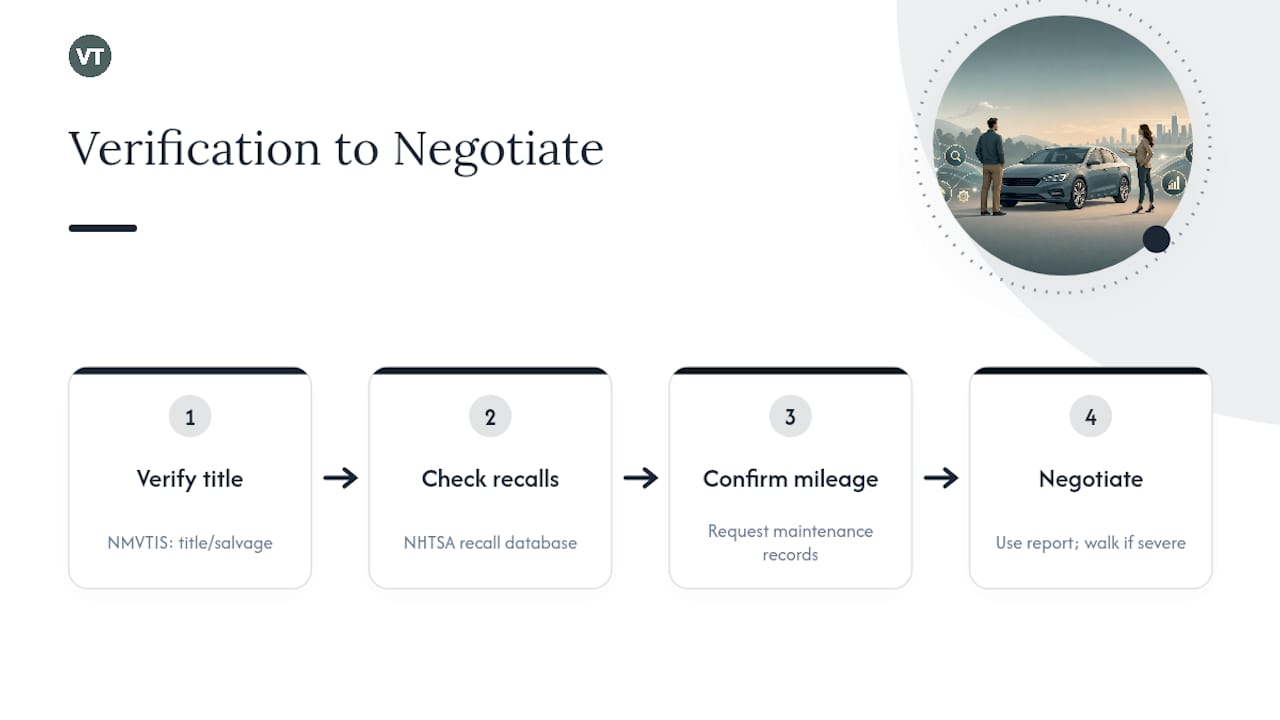
When you sit down to negotiate, put the report on the table. A single moderate accident is worth a real discount, not just an apology. A rebuilt title, several salvage entries, or an odometer rollback you can’t get explained are not negotiation chips. They’re reasons to walk away.
Why Vektracer’s Reports Hold Up to Scrutiny
Vektracer builds every report around VIN-specific data pulled from NMVTIS-connected sources, covering accident history, title brands, mileage verification, theft checks, safety recalls, and market value. You can see exactly what that looks like before paying anything.
- Review the methodology and data sources behind every report.
- Reports start at $19.99, a fraction of Carfax’s $44.99 for comparable core data.
- Educational guides, including a breakdown of title status checks, help you interpret findings without guesswork.
No provider, Vektracer included, captures every repair a car has ever had. Cross-check anything critical against NMVTIS and NHTSA directly, and always pair a report with a mechanic’s eyes on the car.
The Real Story Behind “Best” Vehicle History Reports
Most comparison articles treat Carfax as the default answer and everyone else as a discount knock off. That framing gets the value proposition backward. Carfax’s dealer network and brand recognition are real advantages, but they don’t make its underlying title and salvage data more accurate than an NMVTIS-connected competitor’s. NMVTIS is the federal source of truth for that information, and any provider tapping into it directly gets you the same core answer Carfax does, often for less than half the price.
Where legacy brands still earn their premium is depth of service-record aggregation built over decades of dealer partnerships. If you’re buying a car with an unusually thin service history and you want every possible data point, that network has genuine weight.
For most buyers, though, the decision comes down to what you’re actually paying for: title accuracy, recall linkage, and accident history. On those fronts, Vektracer delivers the same NMVTIS-backed foundation starting at $19.99. Prioritize the data source over the logo, and check the price before you check the brand name.
— Durim
Run Your VIN Before You Make an Offer
NMVTIS-backed data provides the same core answers as legacy brands, often at a lower price. Some providers apply this logic to their reports at more affordable prices than Carfax.
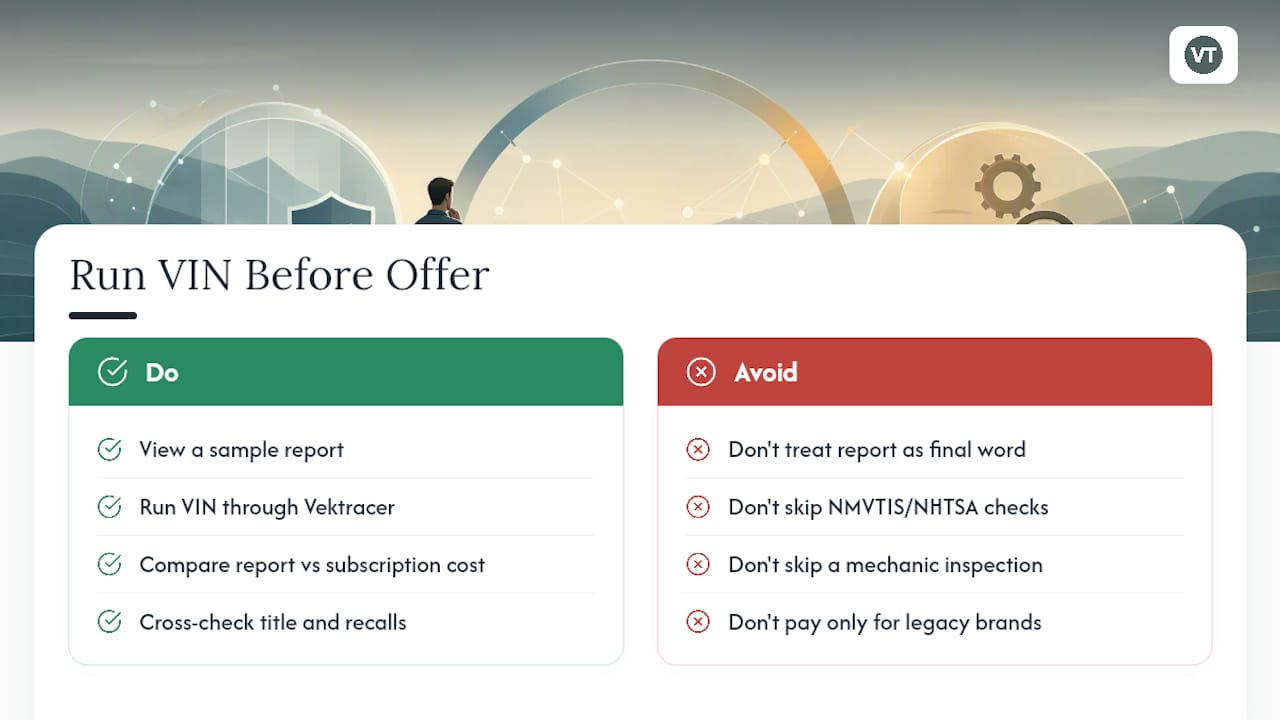
Before you commit to a used car, view a sample report to see exactly what fields you’ll get, then run your own VIN through Vektracer’s checkout to pull accident history, title brands, mileage verification, and recall data in one pass. If you’re checking multiple vehicles, compare the cost of individual reports against a subscription before you buy. And whatever the report says, treat it as your starting point, not your final word. Cross-check title brands against NMVTIS, run recalls through NHTSA, and get a mechanic to look at anything the report flags before you sign.
Where to Verify Report Findings Yourself
- The NMVTIS consumer portal lists approved providers and lets you confirm official title and salvage data directly.
- NICB VINCheck and the NHTSA recall lookup are free first-stop tools for theft, salvage, and open recalls.
- For deeper reading, see Vektracer’s guide on NMVTIS reports and buyer limitations.
Sources
- AutoCheck vs. CarFax: Which Vehicle History Report Do You Need? - CarGurus
- Research Vehicle History | VehicleHistory (NMVTIS consumer page)
- Iseecars
- VINCheck® Lookup | National Insurance Crime Bureau
FAQ
Is there a better vehicle history report than Carfax?
For value, yes. NMVTIS-connected providers like Vektracer deliver comparable title, accident, and recall data starting at $19.99, versus $44.99 for a single Carfax report.
What is the $3,000 rule for cars?
There’s no official industry standard called the “$3,000 rule.” Some buyers informally use it as a rough threshold for deciding whether a repair estimate makes a used car not worth buying, but this varies widely by vehicle value and condition.
What is the best website to check a car history?
The best choice depends on your priority: Vektracer offers NMVTIS-backed data at a lower starting price, Carfax offers the largest dealer-service network, and AutoCheck emphasizes auction-based scoring.
Can I get a Carfax report for free?
No, Carfax does not offer free full reports. Some free vehicle listings include a one-time complimentary Carfax report from the seller or dealer, but you can’t generate one yourself at no cost.
Recommended
Ready to check a vehicle?
Enter any 17-character VIN for a free instant preview — no account needed.