1993 Ford F350 Buyer's Guide: Is It Worth It in 2026?
Check a vehicle before you buy
Enter a VIN for a free instant preview — accidents, title brands, mileage, liens & open recalls.
You're probably looking at a 1993 Ford F-350 because it hits two nerves at once. It's old enough to feel simple and honest, but expensive enough now that a bad buy can sting. In 2026, the main question isn't whether the truck is cool. It is. The question is whether the specific truck in front of you is a durable classic or an overpriced project.
A clean 1993 Ford F-350 can still make sense if you buy with your eyes open. The good ones have real capability, real character, and a market that now treats them as more than worn-out work rigs. The bad ones hide engine wear, wiring decay, and rust that can turn a strong-looking truck into a money pit fast.
The 1993 F350 Legend and Its 2026 Market Value
The 1993 Ford F-350 came from a period when Ford built heavy-duty trucks for work first and comfort second. That matters because buyers sometimes judge these trucks by modern pickup standards and end up misunderstanding what they're paying for. This truck wasn't about trim ladders, giant option packages, or lifestyle branding. It was a straightforward heavy-duty platform built to haul, tow, and survive abuse.
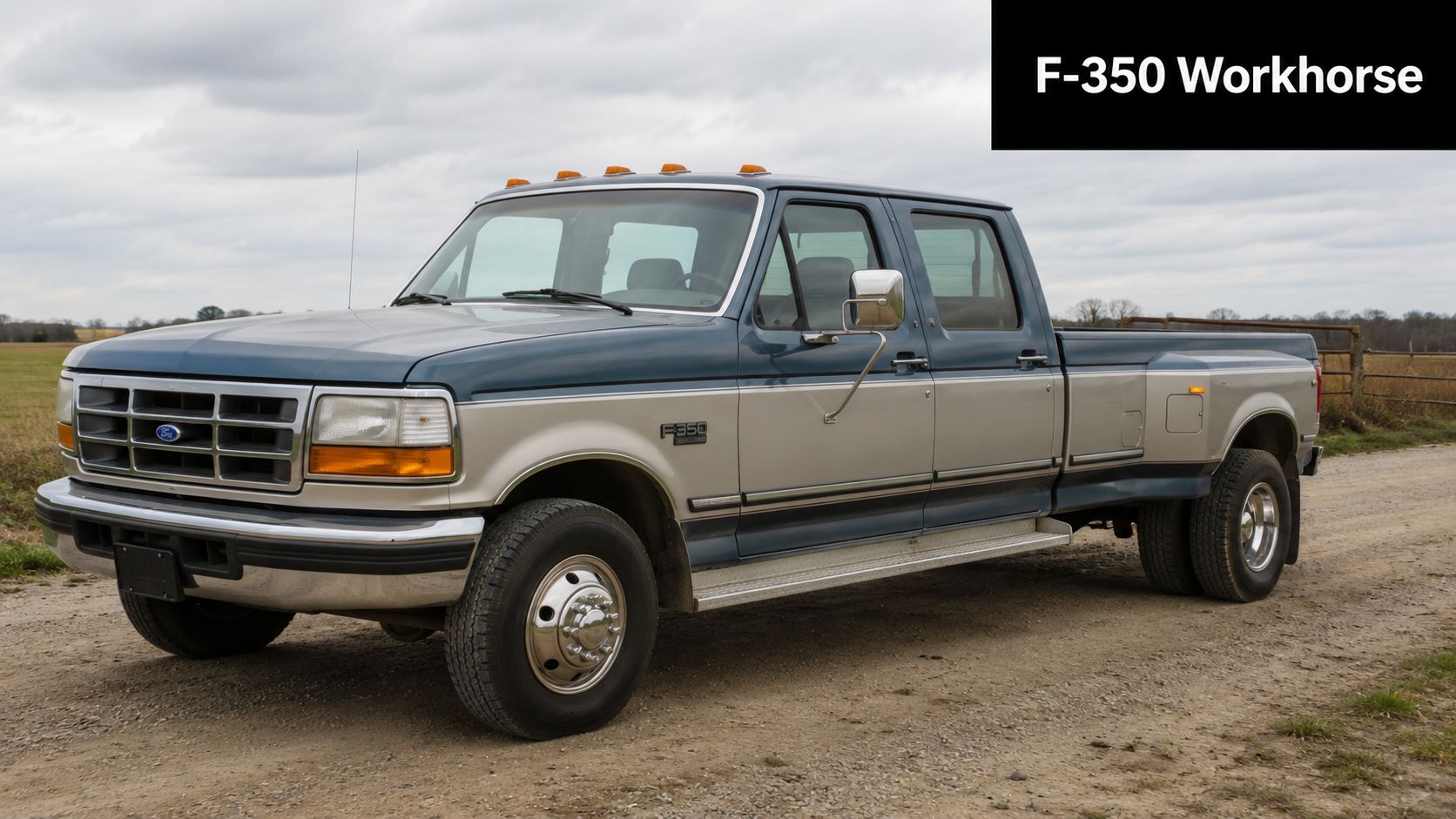
That simplicity is part of why these trucks have aged well in the market. The 1993 Ford F-350 was available in a single trim level (XL) with 6 distinct body styles, and current market data indicates an average listing price of $17,261 for well-maintained units, a significant appreciation from its original trade-in value range of $1,438 to $7,235, according to Cars.com's 1993 Ford F-350 market data. That spread tells you something important. Buyers aren't paying for nostalgia alone. They're paying for scarcity, mechanical honesty, and old-school heavy-duty design.
Why this truck still pulls money
A lot of old trucks are cheap because they're just old. The 1993 F-350 isn't in that category anymore when it's clean and complete. Buyers want them for a few different reasons:
- Work-truck appeal: They still attract people who want a real heavy-duty chassis without newer electronics.
- Collector appeal: Stock examples, diesel trucks, and unmolested body styles draw stronger interest.
- Usability: These aren't fragile classics. They can still earn their keep if maintained properly.
Appraiser's view: Rising asking prices don't make every truck valuable. Condition, maintenance history, and rust exposure still separate a strong buy from an inflated listing.
What the price really means in 2026
An average listing price doesn't mean every seller is realistic. Some owners price these trucks like restored collectibles even when the truck still shows commercial wear, electrical issues, and deferred maintenance. Others list a solid truck at a premium because replacing it with anything equally simple and heavy-duty is hard.
That's why value on a 1993 F-350 is less about model year hype and more about how the truck was used. A farm truck, tow rig, municipal chassis, and lightly used personal truck can all look similar online, but they don't carry the same risk.
If you've been cross-shopping older Ford trucks generally, this kind of market behavior isn't unique to the F-350. It also shows up in older half-ton listings, especially where clean survivors get priced well above what people expect from a three-decade-old pickup, as seen in guides on the 2005 F-150 used market.
Choosing Your Powerplant Gas vs IDI Diesel
Engine choice is where this purchase gets real. The badge says F-350, but the ownership experience changes a lot depending on whether you buy the standard gas V8, the big-block gas truck, or the IDI diesel. I'd treat engine choice as the first hard filter before you even debate paint, wheels, or interior condition.
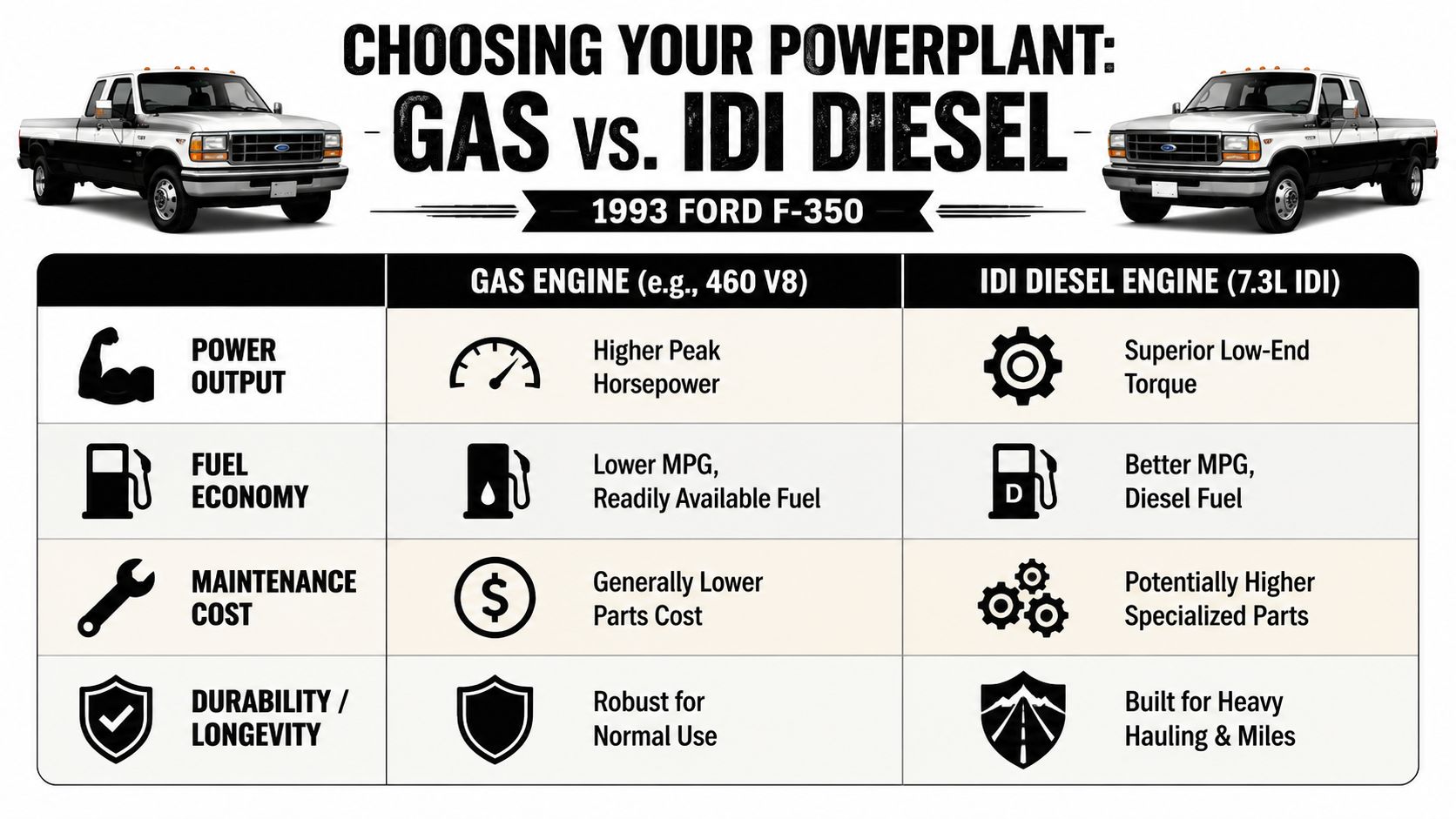
Ford buyers had three main routes here. Buyers could choose between a 7.3-liter IDI diesel V8 (185 hp, 388 lb-ft torque), a 7.5-liter gas V8 (230 hp, 390 lb-ft torque), or the standard 5.8L V-8 (200 hp, 310 ft-lbs torque), as listed in the ninth-generation Ford F-Series powertrain summary).
Quick engine comparison
| Engine | Output | Best fit | Real-world trade-off |
|---|---|---|---|
| 5.8L gas V8 | 200 hp, 310 ft-lbs | Basic use, lighter-duty ownership | Simpler entry point, but not the one most buyers want for serious hauling |
| 7.5L gas V8 | 230 hp, 390 lb-ft | Towing and heavy gas-truck use | Strong output, but you buy it knowing fuel appetite is part of the deal |
| 7.3L IDI diesel V8 | 185 hp, 388 lb-ft | Long-haul durability, diesel character, collector interest | Lower horsepower on paper, stronger heavy-duty personality, but maintenance mistakes get expensive |
What works for different buyers
The 5.8L is the one people overlook. That can be a good thing if you want a lower-drama truck and you don't need diesel identity or big-block pull. It won't excite many collectors, but not every old F-350 has to be a statement piece.
The 7.5L gas V8 makes sense for buyers who want stump-pulling gas power and don't want diesel-specific headaches. On paper it lands right beside the diesel for torque, and in practice it feels more straightforward for some owners because you avoid the special maintenance blind spots that trip up neglected IDI trucks.
The 7.3L IDI diesel is the truck people chase. It has the reputation, the sound, and the long-life appeal that keep values healthy. But reputation can get buyers lazy. A diesel with the wrong maintenance history is not the smart buy just because it's diesel.
The diesel often wins the emotional argument. The gas engine sometimes wins the ownership argument.
Practical decision filter
Use this checklist before you shop too far:
- Choose the 5.8L if you want the least complicated route into ownership and don't need maximum prestige.
- Choose the 7.5L if towing matters and you'd rather stay on the gas side of the parts-and-repair equation.
- Choose the 7.3L IDI only if you're willing to inspect it harder than the others and verify coolant care.
If you're looking at an IDI truck in a cold climate, startup behavior and fuel treatment matter more than many casual buyers realize. A practical primer on best diesel cold weather additives is worth reading before you commit to winter use.
Critical Mechanical Flaws Most Buyers Miss
A 1993 F-350 can sound healthy, idle smoothly, and still have the kind of hidden wear that makes ownership miserable. Most quick inspections miss the expensive stuff because the expensive stuff often doesn't announce itself right away. On this truck, the biggest mistakes usually come from assuming “old but tough” means “safe to buy.”
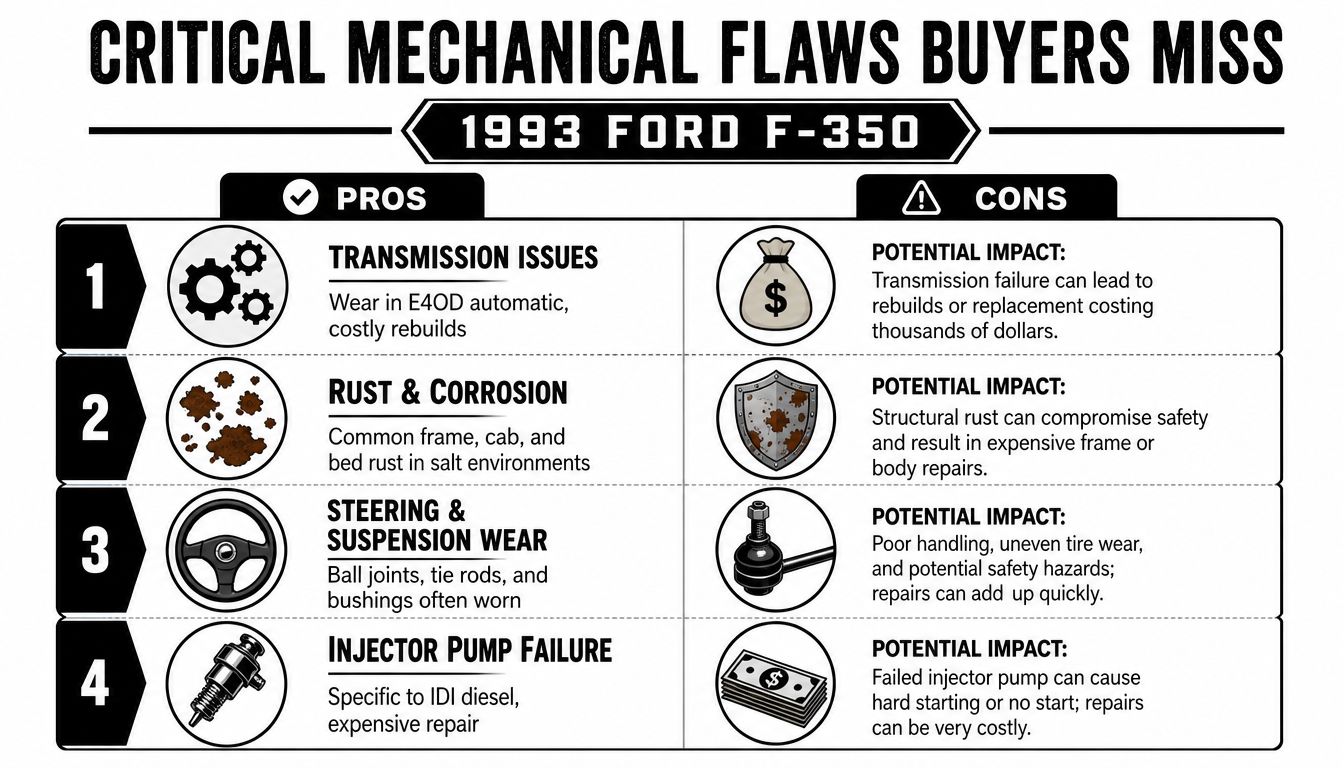
The issue I'd put at the top of the list for an IDI diesel is coolant cavitation. The verified warning is clear: the 7.3L IDI diesel engines were known to have coolant cavitation problems if a silicate additive wasn't used, a failure that causes 'blowby' and expensive engine wear. Furthermore, historical data shows the most commonly reported problem across all 1993 F-350 models is a failing tachometer sensor, as noted in this 1993 F-350 owner discussion and issue summary.
Coolant cavitation is the diesel killer many buyers skip
The idealized perception of many diesel trucks frequently hits a snag. Buyers hear “7.3” and assume they're shopping for an indestructible truck. But the IDI version has a specific maintenance need. If the coolant wasn't managed correctly, internal engine damage can already be underway before the truck gives obvious warning signs.
What I want to hear from a seller is not “it runs great.” I want to hear a confident, informed explanation of coolant service. If the seller doesn't know what cavitation is, that doesn't automatically kill the deal, but it absolutely changes the risk.
Look for these clues during inspection:
- Heavy blowby: Excess crankcase pressure can point to internal wear.
- Vague maintenance answers: If the seller can name oil changes but not coolant care, dig deeper.
- Diesel that starts and runs but feels tired: A truck can remain usable while already carrying major wear.
The tachometer sensor problem sounds small until it isn't
Tach sensor failure doesn't have the drama of engine cavitation, but it matters. On an older truck, a bad tach signal can cloud diagnosis and make it harder to trust what the drivetrain is telling you. It also hints at age-related sensor and wiring decline.
A lot of buyers wave off a dead or erratic tach because it feels minor compared with engine or transmission issues. That's a mistake. With older heavy-duty trucks, small electrical or sensor failures often show you how the truck was maintained overall. One ignored issue usually isn't alone.
Shop rule: On a thirty-plus-year-old truck, don't separate “little issues” from “big issues” too quickly. Small failures often travel in groups.
If you hear lower-end noise or the seller says “they all do that,” slow down and inspect harder. A guide on what engine knocking can mean can help you sort harmless old-truck noise from signs of serious internal trouble.
Spotting Electrical Gremlins and Body Rot
The engine gets all the attention. The wiring and the rust usually decide whether the deal works. On a 1993 F-350, electrical faults and corrosion can waste more time than a worn but still-running engine because they're harder to isolate, easier to underestimate, and often spread across the whole truck.
The known complaints here aren't random. Persistent ABS warning light failures and dimming tail lights are frequently reported electrical issues, often indicating underlying chassis wiring corrosion or relay platform failures that are difficult and expensive to diagnose and repair, based on this discussion of 1993 F-350 electrical trouble symptoms.
What to check before the test drive
Start with the lights before you ever move the truck. Turn on the headlights, step on the brake, work the turn signals, and watch for dimming, delay, or strange interaction between circuits. Tail light dimness under load often points to grounding trouble, aging connectors, or relay issues that won't fix themselves.
Then key on and watch the dash. If the ABS warning light stays on, don't write it off as “just an old truck thing.” That light can be the visible symptom of deeper electrical aging. On these trucks, electrical decay rarely stays in one lane.
Rust inspection checklist that matters
Get under the truck. Don't inspect from standing height and call it good. Bring a light, wear clothes you don't care about, and inspect the structure, not just the paint.
Use this walkaround:
- Frame rails: Look for scaling, flaking, soft spots, and repairs that seem hidden under fresh coating.
- Cab corners and rocker areas: These spots can look acceptable from ten feet away and still be compromised.
- Bed supports and mounting points: A straight-looking bed can hide serious corrosion underneath.
- Door bottoms and seams: Water traps tell you a lot about long-term exposure.
- Brake and fuel line areas: Corrosion here raises safety concerns, not just cosmetic ones.
Surface rust is common. Structural rust changes the value conversation immediately.
A real-world buying mistake
A buyer sees a straight body, hears the diesel start cleanly, notices one ABS light and a slightly weak tail lamp, and assumes those are weekend fixes. Then the truck goes home, the lighting issues multiply, grounds need to be chased, connectors crumble, and rust under the cab mounts changes the repair plan entirely.
That's why I tell buyers to divide rust into two categories. Cosmetic rust affects price. Structural rust affects whether you should buy the truck at all. Electrical issues work the same way. One bad bulb is a repair. Systemwide weirdness is a warning.
Why a VIN Check Is a Non-Negotiable Step
A lot of buyers skip the vehicle history report on old trucks because they think age makes paperwork irrelevant. That's backwards. Age makes history more important because these trucks have had more time to pass through more owners, more states or provinces, more work environments, and more undocumented repairs.

On a 1993 Ford F-350, a modern vehicle history report helps answer the questions the seller either can't answer or doesn't want to answer. That includes title branding, accident history when reported, theft records, lien status, and mileage pattern checks. If you're shopping across borders, this matters even more, because vin check usa and vin check canada results can reveal gaps that don't show up in a handshake sale listing.
Why old-truck buyers still need hard records
A thirty-plus-year-old truck can wear replacement panels, swapped beds, repaint work, and odometer stories that sound believable in person. A report won't catch everything, but it gives you a factual baseline before you start trusting what's on the ad.
This also ties into the broader question many buyers ask now: carfax worth it. For a truck like this, the better question is whether any report is worth it. Yes, because hidden history is expensive. And if you're comparing options, it's smart to review tools side by side, especially if you're already weighing carfax pricing 2026 against alternatives. VekTracer's comparison with Carfax is useful if you want to see how report features stack up before paying for one.
How to use a report the right way
Don't buy a report and glance only at title status. Use it as a pricing tool and a risk filter.
- Match the report to the seller's story: If the truck is presented as a clean long-term local truck, the record should support that.
- Check mileage logic: Old odometers don't excuse mileage inconsistencies.
- Look for region clues: Rust-belt exposure and flood history matter on a truck like this.
- Compare history to condition: A claimed survivor truck with signs of major panel replacement deserves tougher questions.
If you're buying in a salt-heavy province or state, rust prevention after purchase matters too. This guide to Nanak Car Wash truck rust protection is a practical read for owners planning to preserve one of these trucks.
A clean report doesn't prove a truck is clean. It tells you whether the story starts on solid ground.
For classic pickups, that step isn't optional. A focused guide on vehicle history reports for classic cars explains why old vehicles often need more verification, not less.
Final Verdict Is the 1993 F350 a Smart Buy
Yes, a 1993 Ford F-350 can be a smart buy in 2026. But only for the right buyer and only in the right condition. This truck makes sense when you're paying for solidity, not mythology.
If you want a classic heavy-duty truck with genuine capability, strong visual presence, and a market that respects clean examples, it's easy to justify. The platform has real appeal. The diesel versions especially carry long-term interest. The truck also came from the factory with serious work-truck intent, including a maximum GVWR of 11,000 pounds and a maximum payload capacity of 6,410 pounds in DRW chassis-cab form, according to the 1993 Ford commercial truck data book. For buyers who need heavy-duty bones, that still means something.
Who should buy one
This truck fits best if you fall into one of these groups:
- Skilled owner: You can inspect older mechanical systems and you won't panic at age-related repairs.
- Collector-minded buyer: You care about originality, condition, and long-term desirability.
- Purpose-driven user: You want an old-school tow or work rig and understand the maintenance commitment.
Who should walk away
If you need modern daily-driver convenience, predictable repair timing, or zero appetite for old-truck diagnosis, this probably isn't your best move. The wrong 1993 F-350 can eat time faster than money, and that's what wears owners out.
My go or no-go filter is simple. Buy the truck if the condition supports the asking price, the drivetrain matches your use, the electrical system behaves, and the rust is honest. Walk away if the seller leans on reputation instead of records, or if the truck has multiple unresolved issues that “just need little things.”
Frequently Asked Questions
Is a 1993 Ford F-350 hard to get parts for?
Some parts are easy. Some take patience. Routine maintenance items and common wear parts are usually less stressful than model-specific trim pieces, age-specific electrical parts, and certain diesel-related components. The key is to buy the best truck you can, not the cheapest truck you can revive.
Can you daily drive a 1993 Ford F-350?
You can, but you should be realistic. It's a large, old heavy-duty truck with old-truck ride, old-truck noise, and old-truck manners. If you enjoy that and keep up with maintenance, it can work. If you want modern braking feel, modern comfort, and modern convenience, daily use gets old fast.
What should I do first after buying one?
Handle baseline maintenance before you start adding accessories or cosmetic upgrades. Change fluids, inspect brakes, confirm charging and lighting system behavior, check steering and suspension wear, and verify cooling system condition. On an IDI diesel, coolant care moves right to the top of the list.
Buy old trucks in this order: condition first, history second, options third.
Is the diesel always the best choice?
No. The diesel is often the most desirable choice, but not automatically the best ownership choice. A healthy gas truck can be a better buy than a neglected diesel every single time. Buy the engine that fits your use and the truck with the strongest maintenance story.
Does a vehicle history report still matter on a truck this old?
Yes. It matters because age adds unknowns. A report helps you verify title issues, recorded damage, mileage patterns, and ownership trail. That's useful whether you're buying from a private seller, a dealer, or an estate sale.
Is insurance difficult on a classic heavy-duty truck?
It can be, depending on how you plan to use it. Some insurers treat old trucks differently if they're collector vehicles versus regular-use work vehicles. Get quotes before buying, especially if the truck has modifications, commercial history, or nonstandard use plans.
What's the biggest buying mistake people make?
They buy the legend instead of the truck. They assume toughness equals condition. It doesn't. A 1993 F-350 deserves a careful inspection because the expensive problems are often the ones you don't notice in the first fifteen minutes.
If you're narrowing down a few old truck listings and want a cleaner way to judge history before you commit, VekTracer makes that process faster. You can pull a vehicle history report, check title and mileage signals, and compare options side by side so you're not guessing which truck carries the least risk.
Ready to check a vehicle?
Enter any 17-character VIN for a free instant preview — no account needed.